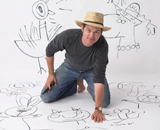
Mo Willems delivers an inquisitive look at opposites.
Is this dark? Is this light? Is this soft? Is this hard? Using colors, shapes, lines and textures, Willems invites readers to explore abstract concepts through artwork.
The New York Times Book Review called Mo “the biggest new talent to emerge thus far in the 00's."
Mo’s work books have been translated into a myriad of languages, spawned animated shorts and theatrical musical productions, and his illustrations, wire sculpture, and carved ceramics have been exhibited in galleries and museums across the nation.
Mo began his career as a writer and animator for television, garnering 6 Emmy awards for his writing on Sesame Street, creating Nickelodeon's The Off-Beats, Cartoon Network’s Sheep in the Big City and head-writing Codename: Kids Next Door.
Reviewing Mo Willems is kind of like poking at a very big, very colorful wall. The wall isn’t really going to care if you poke it or not and unless you continue poking for years at a time, you’re probably not going to make much of a dent in it. Now I just checked and rechecked my notes and as far as I can tell, the last time I reviewed a book by Mo Willems was on January 29, 2007. I believe it was the very first Elephant & Piggie books My Friend Is Sad and Today I Will Fly. In the intervening 14 years I’ve not felt a particular desire to review him again. Mo’s already famous, so highlighting his work won’t cast a light on an unappreciated artist. I already did Elephant & Piggie once, so any subsequent books would just be window dressing. As for Mo’s other forays into children’s literature, he's curious to watch. I was intrigued by his willingness to have other artists illustrate his books (Jon J. Muth, Tony DiTerlizzi, Amber Ren, etc.) but I bided my time. Seems to me, once a picture book creator hits a certain level of fame and fortune, you wait. You wait until they try something new and different. And if that wait means you end up reviewing a book made up of 40” X 40” acrylic paintings, then by gum so be it. I have been very patient and now, for the first time in a long while, I’ve crawled out of my hidey-hole to give the newest Mo Willems book a bit of a sniff. It does not look like his other books. It does not sound like his other books. It is simple. It is colorful. It is interesting. And best of all, it gives kids and their parents something to talk about. And considering how much time we've spent together mid to post-pandemic, that's something.
I think we all know what to expect from an opposite book by now, but concept books are catnip to bored book creators, and Mo Willems is no exception. The first thing you see when you get to the title page is a painting on the left-hand side. A thick brushstroke of green/black/blue and a squared off thinner stroke of black appear on a white square. “This Is Starting” says the text. And we’re off! From here on in you will generally see text on one page and an image on the other. Before you’ve time to process the image before you, you are asked a question. “Is This Dark?” The picture may resemble an eclipse, black on white on black. What do you say? Is it? Why or why not? Turn the page and there’s a white circle on a gray background. “Is This Light?” Again, you need to figure out how you want to interpret the image. Eighteen paintings will ask you questions eighteen times. Some will be easy and some will be difficult but all will be entirely subjective and up to the interpretation of the reader. And when you have gotten to the end, and there are no more questions to be asked, you see a green/black/blue square within a black outline and words that brook no argument. “This Is Finished.”
I’m going to cut to the chase with this review, because you probably saw the word “Abstract” in the title and your warning signals got triggered. Abstract? Ruh-roh. I will now ask the most important question: Is this book kid-friendly? This is where the rubber meets the road, people, because Mo’s trying to have his cake and eat it too. He wants to create a book of abstract art for kids while maintaining a concept book of opposites. What’s interesting with all of this is that I think the book works on a couple of different levels. Let’s just go with the simplest one. You hand this to a small child. They page through it. And because of the format and the colors and the images, there’s a lot to see. So just on a visceral level, it’s enticing to the eye. Then there’s what happens when you read the book with a child. You can discuss just the basic opposites, but since every single page is a question rather than a statement, you’re naturally being led into a discussion with your kid. “Is This Soft?” asks the book? Talk about it for a bit. After all it’s not like you’re going to need an art degree to have a talk with your child. Finally, let’s look at this book as a collection of abstract paintings. Because why the heck limit yourself to the questions on the page? Find out what the kids think about the art. Flip to the back of the book where they show the opposite pairings and talk about that. Ask them what painting they like the most (and ask which one they like the least). You have options.
I should mention that while the original art for this book is 40” X 40”, the actual book itself checks in at a handsome 8” X 8”. It’s a square little number, a shape that I’ve always been intrigued by in picture books. Willems himself broke onto the scene with the square Don’t Let the Pigeon Drive the Bus, which was an uncommon shape at the time. By making this book also square, each painting fits perfectly in the center of its page. Once I'd realized that, I took a couple passes on the book to see what it was up to. I paid attention to the background colors behind the words and behind the paintings, but didn’t get anywhere with that. Though your eye may search for patterns, these particular colors don’t follow anything you recognize.
It wasn’t until I flipped to the back cover of the book that I saw a presentation of the images inside paired together. Interestingly, you get a very different view of the book when it’s laid out in this way, and I spent an inordinate amount of time trying to figure out if I liked the paintings better the way they are in the book or here next to their pairs. Generally speaking, I like that the book dedicates two full pages to a single image. This design choice keeps the reader from splitting their attention. Had Mo put each painting on a page opposite its opposite, your attention would have been cut in half by necessity. You could never have looked at the paintings as individuals but as pairs, which I suspect would undermine the whole dang point of the exercise. Makes sense, right? Except . . . there is one place where he does put two paintings in a single two-page spread. It’s right smack dab in the center of the book and the words read, “Is This Inclusion? Is This Exclusion?” And gentle reader, one cannot help but think that these questions bear more weight than many of the others. Once that question has been answered, the book makes a shift. The paintings that previously appeared on the right-hand pages are now all on the left-hand pages. Not a political statement, but edging that way. Definitely edging that way.
So, brass tacks here, what exactly is Willems trying to do with this book? I mean, obviously it is (as he has said) “a concept book, abstracted”. So has he entered the Chris Raschka/Herve Tullet point in his career where art and picture books mix and meld in a variety of ways, some successful, some not? I mean, I’m curious because Mo’s career is unlike anyone else’s. He has experienced massive fame during his lifetime and during his creative period, and a lot of his energy has been dedicated to the price of what goes with that. But like everyone else, the pandemic stifled Mo. He was supposed to be the Kennedy Center’s inaugural Education Artist in Residence. There were going to be appearances and performances and theater and music and what he calls “live experiments”. Then COVID hit and he got stuck home like the rest of us. He compensated with videos where he might, for example, paint while listening to Yo-Yo Ma (which is to say, the actual Yo-Yo Ma playing right there on a video call). Looking at this kind of art, it really ties into this book so nicely. What’s he trying to do with this production? Impossible to say. Maybe he wants to instill in your children a kind of proto-appreciation for abstract expressionism. Maybe he wanted to take a concept book and turn it on its head. Maybe he wanted to paint great big pictures and then find some use for them. Maybe.
There is no particular reason to compare this book to anything else out there, but my brain is kind of a jerk and sort of gives me readalikes unbidden, whether I want them or not. And by gum the books I kept thinking about as I read this were the very French Hippopposites by Janik Coat and Pomelo’s Opposites by Ramona Badescue. Those books are also concept titles, but what makes them interesting is that they allow the reader to disagree with the opposites they choose. Pomelo in particular stretches the very idea of opposites to the breaking point. So when I read Mo’s book and hit the questions that accompany each page, it occurs to me that every time he asks the kid “Is This Broken?” or some similar question, he’s not requiring the child to agree. He gives them room to think for themselves. Many (most?) kids will simply nod with the book, but for the kid willing to question the world they’ve been handed, these open-ended questions will be key.
Here’s a tip: kids will enjoy Opposites Abstract if you enjoy it. I’m pretty sure if you give it a good reading, they’ll be on board. So no reading this book like it’s a chore, people. Seriously, I see those of you out there who zeroed in on the word “Abstract” at the beginning of this review and got that feeling in the pit of your stomach that your schooling failed you. This book doesn’t care if you know your Helen Frankenthaler from your Beauford Delaney. The work’s been done for you. So if you just want to plunge your eyes and brain into something strange and strong, this foray into the intangible is worth your while. And honestly, if this is the direction Mo’s going to go in for a while, climb on board. THIS is interesting.
When Booklist fails to give it a star recommendation, listen. These are nice paintings and I'd like to see them in person, but it is a total deviation from his other work and should probably be judged as an art book, not children's writing.
I was interested in checking Opposites Abstract out. It's so different from his other books, since there are no cute characters like the pigeon, Piggie or Gerald, but the author's personality still shines through and the art explored is fun.
This is a beautiful book. I love the play on words in the title...rather than opposites attract it is "opposites abstract". The spreads are beautiful and thought provoking. I love abstract art so I clearly recognize the opposites. I wonder how this would work as a read aloud? My favorite spread is inclusion and exclusion. Excellent! Mo Willems worked on this during 2020. It is a testament to the fact that the arts always save us! And art can be created amid chaotic, uncertain times. We NEED it! Thank you Mo Willems!
Not your typical Willems book at all, and I appreciate that. He's branching out and showing us what other types of art he likes to create. I agree with the poster who said they could see this being used in art classes.
I mean, the pictures are nice. Given the style of the images, I wanted it to be more like How Many? or Which One Doesn't Belong? which are genuinely brilliant books about early math, categorizing things, and how we think about images. I mean, this is fine! It's just ok! But if it were any other illustrator would it have gotten published? No.
As someone that has a BA in Art History, I LOVED THIS BOOK. I love how Willems has used non-objective art pieces to illustrate different concepts. The art is beautiful. I would love to see these original artworks in person displayed in an exhibit. Willems, that's your cue to create a traveling exhibition. I can easily imagine a modern art storywalk inside a museum. I was pleasantly surprised to see Willems break away from his usual storytelling to create such a unique book. I'm sure art lovers will appreciate what Willems has created.
Rounded up because more families need to pay more attention to how art and graphic design work, and to value them. Having Willems' name on the book will help to reach them.
If you want more like the first few pages, you might want to look at https://www.wikiart.org/en/rene-magri.... Your librarian can help you find lots of other art appreciation books, too.
I can appreciate what he was trying to do, and this might sit differently in a few years when my 3-year-old is more ready to think about abstract concepts, but for right now it just didn't land. The colors and shapes are fun to look at though.
I have before said "Mo Willems can do no wrong" and I think I might have to take that back. I like the artistic vibe of this book but I didn't like the text format with the questions. It's definitely not Willems's normal type of fun and silly book.
Mo Willems is a genius. He just is. In this simple “picture book” he has taken the complex themes and structures of showing emotion and creating concepts in graphic art and whittled them down to their core. It is such a visual book that my words are not going to be able to do it justice SO go find it and look at it! The beginning end paper has a simple statement – “This is starting” and then shows a white square where we can see that there are some beginning brush strokes in grays, blue and black. Each page from that point forward has another square where another graphic concept is explored. A few pages later light, fluffy, colorful blobs ask, “Is this soft?” Many, many rectangles fill the next page’s square and question, “Is this inclusion?” while a small, dark square within a square, huddles in a corner and asks, “Is this exclusion?”. Curvy contours of blue, gray, white and purple inquire, “Is this calm?” while bursts of color and angles want to know, “Is this excited?” How can a book that is so simple be so complex? Explore it with your favorite artist.
"Opposites Abstract" is a picture book that is written by an American author named Mo Willems.The book uses abstract images to convey the idea of opposites, making it a unique and thought-provoking read. Each page presents a pair of opposite concepts, such as "light" and "dark" or "smooth" and "rough," "empty" and "full," "simple" and "complex," depicted through abstract shapes and colors.
What I liked about this book is that I can use it when I am talking about art in my classroom because the simple text and images encourage my students to think deeply about the relationships between the opposites and to interpret the artwork in their own way. It's a great way to introduce children to abstract art and the idea that concepts can be represented in various forms beyond literal illustrations. I believe that this book will make my students think creatively and interpret the images in their own unique ways.
This isn't a typical book of opposites which show "tall and small" and then pictures of something like a giraffe and a mouse. This is a book of opposites that shows abrstract art and asks the reader "Is it...?".
For "is it soft?" the pictures are three shapes with lots of curves. And for "is it hard?" the picture is lots of shapes with straight lines and angles. For "is it dark?" the center of the picture is a black circle with shading coming off of it so it almost looks like a solar eclipse. For "is it light" the picture is a white circle in the middle of a grey square.
It also has opposites like mechanical and organic, intentional and accidental, broken and fixed. The pictures are beautiful and a great introduction into abstract art.
It is definitely not a storytime book, and that's okay because it was never made with that idea in mind.
Mo Willems' latest title, "Opposites Abstract," is a picture book I recently recommended for the juvenile nonfiction section of our library. Its premise is simple: Present a bold illustration with a corresponding question on one spread, followed by a subsequent spread that abstractly portrays the opposite. Suitable for all elementary listeners/readers, "Opposites Abstract" is a brief read-aloud that could be "ramped up" for older audiences or "scaled back" for younger students, and it beckons rich discussions about vocabulary and visual representations.
So. I loved this book. The artwork was beautiful to look at and it was engaging. It is an art book, so for that, for ME reading it, I give it 5 stars.
Now, I tried to read this book with my 4 year old daughter. She was completely uninterested. While I was captivated by the art, she couldn't pay attention and didn't seem to want to pay attention. For this book as a book to read to a small child to understand the concept of opposites, I give it a 2.
This would probably be better suited as an art book for adults rather than a book to teach children a concept. That said, I loved the art, and will keep my 5 star rating. But parents, caregivers, children's librarians and teachers beware, this will probably not work for reading out loud to children.
I am forever appreciative of Mo Willems. His videos got my then 5-year-old through the initial stages of the pandemic and his Elephant and Piggy books are read weekly in my household. All of this being said, I appreciate this very different book for him - one that brings in original paintings that look like they could be hung in the modern wing of our local art museum. I could see using this in an art class and challenging kids to make their own "awake" or "accidental" paintings. However, the book lacks the sense of humor and engaging qualities of some of his other books, so it won't join the rotation weekly-Willems' books, but I will recommend it to my art teacher friends!
If you expecting typical Mo Willems, with humor and wit, Pigeon or Elephant and Piggie.....this isn't going to be it. If you are expecting a typical storytime text....this isn't it.
However, what I do like about this book is the vividness of the colors. Audrey kept staring at the pages. They are perfect for where she is in her stage of development right now. So I enjoyed this book for that.
Additionally, I am reminded why picture books are excellent ways to expose children to new words. There were some "ten dollar words" (as my mom used to say) in this book. I look forward to sharing them with Audrey when she is older.
This book is really cool, but hard to categorize. It is a concept book that pairs together different abstract pictures to convey opposite concepts, making it rather far flung from the character driven picture book stories Mo Willems is known for. I would say it is foremost an art book that might be useful in conveying art techniques to school children who will be excited that the book is by the author of the beloved Elephant, Piggie, & Pigeon. It is also appealing to those who want to contemplate artworks with a little prompting for exploring differences between pictures.
Opposites Absract is a Mo Willems creation that is very different from his Pigeon, Elephant and Piggie, and Knuffle Bunny books. More than a dozen abstract Willems paintings are presented in pairs along with questions that begin "Is this ...?" For example, pairs include hard and soft, broken and fixed, mechanical and organic. Although Opposites Absract is probably not a read-aloud text, it can be useful for exploring the interplay between our visual and linguistic responses to shapes and color.
Whoa there, what’s with the low overall rating? This book was marvelous! Rothko meets Mo Willems in this interesting concept of the perception of art and opposites. So intriguing! My almost 4 year old easily grasped soft art versus hard. We talked about each artwork as we progressed. He especially enjoyed the mechanical art with its gear and wire type notion. I can’t stress enough how inspiring this book was — by introducing art to young readers and making them think! Great conversation read or just for fun! We loved it so much we are adding it to our at home library.
So, I used this for preschool storytime on opposites and was unsure how the kids would react. It was a small storytime, only 4 kiddos. There was a two year-old there and he was practically sitting on me as I read. He was really into the pictures. His excitement encouraged the other children. The book features few words, but robust ones - mechanical v organic, intentional v accidental. A thought provoking book. The placement of the artwork is interesting. On the back cover, all of the artwork is together and you can see how the works progress.
This book intrigues me but I’m not sure what to think. Abstract art is not my favorite so I admit I go in to this one with some bias. I do like that They are not your traditional opposites. Mechanical:Organic, Broken:Fixed, Excited:Calm. For me this extends the age of the target audience because you could really get in to some deeper conversations with older kids (2nd/3rd) who might typically be a little old for opposite books.
Art is done with colored ink and acrylic paints on paper
Notes: 2021, could be used for deeper reflecting questions.
This is a deviation from Mo Willem's usual picture books.
This is not a story. It is a book of abstract art with questions to help understand and appreciate the artwork. I've never really been into abstract art - partly because I never knew what it meant, but this book helped me understand it a little better.
And, kind of to my surprise, my six-year-old bro who I read all these picture books too really liked this one and spent a long time poring over the artwork in this one.
This book serves as a good introduction to abstract art and is clearly very well-done.
This is a great book to use with my EC students. Even the title, Opposites Abstract, is worth mulling over in your mind before you begin things bout the pictures inside. Instead of a book that claims that the visuals are opposites, it asks if the pictures are representative of abstract concepts like hard, soft, light, dark, etc. As I looked through the book it made me question what I visualized when I thought of concepts like "hard" or "soft" and it would be a great book to use to open a discussion with students about what pictures, words, or examples came to mind. Serious brain puzzler.