Jump to ratings and reviews
Rate this book

The Complete Short Novels

Rate this book
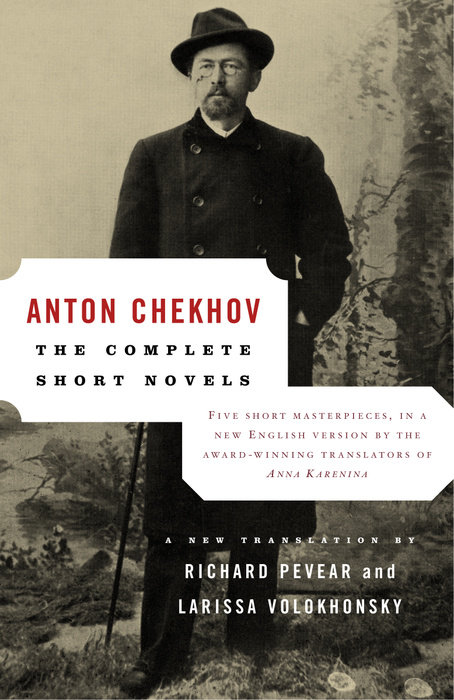
Anton Chekhov, widely hailed as the supreme master of the short story, also wrote five works long enough to be called short novels. Here, brought together in one volume for the first time, in a masterly new translation by the award-winning translators Richard Pevear and Larissa Volokhonsky.

The Steppe
—the most lyrical of the five—is an account of a nine-year-old boy’s frightening journey by wagon train across the steppe of southern Russia. The Duel sets two decadent figures—a fanatical rationalist and a man of literary sensibility—on a collision course that ends in a series of surprising reversals. In The Story of an Unknown Man, a political radical spying on an important official by serving as valet to his son gradually discovers that his own terminal illness has changed his long-held priorities in startling ways. Three Years recounts a complex series of ironies in the personal life of a rich but passive Moscow merchant. In My Life, a man renounces wealth and social position for a life of manual labor.

The resulting conflict between the moral simplicity of his ideals and the complex realities of human nature culminates in a brief apocalyptic vision that is unique in Chekhov’s work.

(Book Jacket Status: Jacketed)


From the Hardcover edition.

548 pages, Paperback

First published January 1, 1896

607 people are currently reading
12551 people want to read

About the author

Anton Chekhov

5,890 books9,760 followers
Dramas, such as The Seagull (1896, revised 1898), and including "A Dreary Story" (1889) of Russian writer Anton Pavlovich Chekhov, also Chekov, concern the inability of humans to communicate.

Born ( Антон Павлович Чехов ) in the small southern seaport of Taganrog, the son of a grocer. His grandfather, a serf, bought his own freedom and that of his three sons in 1841. He also taught to read. A cloth merchant fathered Yevgenia Morozova, his mother.

"When I think back on my childhood," Chekhov recalled, "it all seems quite gloomy to me." Tyranny of his father, religious fanaticism, and long nights in the store, open from five in the morning till midnight, shadowed his early years. He attended a school for Greek boys in Taganrog from 1867 to 1868 and then Taganrog grammar school. Bankruptcy of his father compelled the family to move to Moscow. At the age of 16 years in 1876, independent Chekhov for some time alone in his native town supported through private tutoring.

In 1879, Chekhov left grammar school and entered the university medical school at Moscow. In the school, he began to publish hundreds of short comics to support his mother, sisters and brothers. Nicholas Leikin published him at this period and owned Oskolki (splinters), the journal of Saint Petersburg. His subjected silly social situations, marital problems, and farcical encounters among husbands, wives, mistresses, and lust; even after his marriage, Chekhov, the shy author, knew not much of whims of young women.

Nenunzhaya pobeda , first novel of Chekhov, set in 1882 in Hungary, parodied the novels of the popular Mór Jókai. People also mocked ideological optimism of Jókai as a politician.

Chekhov graduated in 1884 and practiced medicine. He worked from 1885 in Peterburskaia gazeta.

In 1886, Chekhov met H.S. Suvorin, who invited him, a regular contributor, to work for Novoe vremya, the daily paper of Saint Petersburg. He gained a wide fame before 1886. He authored The Shooting Party , his second full-length novel, later translated into English. Agatha Christie used its characters and atmosphere in later her mystery novel The Murder of Roger Ackroyd . First book of Chekhov in 1886 succeeded, and he gradually committed full time. The refusal of the author to join the ranks of social critics arose the wrath of liberal and radical intelligentsia, who criticized him for dealing with serious social and moral questions but avoiding giving answers. Such leaders as Leo Tolstoy and Nikolai Leskov, however, defended him. "I'm not a liberal, or a conservative, or a gradualist, or a monk, or an indifferentist. I should like to be a free artist and that's all..." Chekhov said in 1888.

The failure of The Wood Demon , play in 1889, and problems with novel made Chekhov to withdraw from literature for a period. In 1890, he traveled across Siberia to Sakhalin, remote prison island. He conducted a detailed census of ten thousand convicts and settlers, condemned to live on that harsh island. Chekhov expected to use the results of his research for his doctoral dissertation. Hard conditions on the island probably also weakened his own physical condition. From this journey came his famous travel book.

Chekhov practiced medicine until 1892. During these years, Chechov developed his concept of the dispassionate, non-judgmental author. He outlined his program in a letter to his brother Aleksandr: "1. Absence of lengthy verbiage of political-social-economic nature; 2. total objectivity; 3. truthful descriptions of persons and objects; 4. extreme brevity; 5. audacity and originality; flee the stereotype; 6. compassion." Because he objected that the paper conducted against Alfred Dreyfus, his friendship with Suvorin ended

Ratings & Reviews

What do you think?
Rate this book

Friends & Following

Create a free account to discover what your friends think of this book!

Community Reviews

5 stars
7,260 (61%)
4 stars
3,243 (27%)
3 stars
1,107 (9%)
2 stars
197 (1%)
1 star
73 (<1%)
Displaying 1 - 30 of 224 reviews
Profile Image for Ben Sharafski.
Author 2 books148 followers
January 22, 2022
When Tolstoy was on his deathbed, Chekhov came over to say a final goodbye. When he lowered his face to kiss the dying man, Tolstoy gave him his parting words: "Why do you keep writing those horrible plays? They're even worse than Shakespeare's!"

Well, perhaps 'horrible' is too strong a word. But I do find the plays a bit slow and unengaging, and many of his short stories merely anecdotes written in haste to meet a magazine deadline and put some food on the family table. The novellas, for me, are masterpieces. My Life, Three Years, The Duel - they are my favourite works of fiction bar none.
Profile Image for William2.
859 reviews4,045 followers
July 11, 2021
Second reading. This is a collection of novellas. My Life: A Provincial's Story is a brilliant, deeply impressive, story. Its structure is perfect, its characterizations deft, spot on, its descriptive passages vivid, tactile, redolent. Set in 1890 or so it's narrated by a young man, Misail, a noble, who has this highly romanticized notion of manual labor. (Based in part on Kropotkin's theories of cooperative evolutionary relationships. See Mutual Aid.) His contempt for so-called intellectual work, such as that undertaken by his ungifted architect father, drives that man half mad. He fears Misail will turn his back on his noble advantages and become a worker, which would be a humiliation to him. This is just what Misail does. It's a hideous life he's chosen. His narration is in part a virtual exposé on the corrupt daily practices of just about everyone in town, and it's searing, scandalous. The nobility, the peasants, the workers, the clergy--everyone's taking his off-the-books kickback. He is quite alone for a long time, but because he has acted on what he believes in, he meets those whom he thinks of as his first true friends in the narrow-minded provincial town. Masha is the daughter of the town engineer, a predacious capitalist who's building a railroad near the town. The other is a young man, Vladimir, soon to take his qualification test to become a doctor. Meanwhile, Misail's sister is a virtual slave to the tyrannical father. Not until her life is half over does she, seizing perhaps on Misail's example, break away from him. I have read Chekhov's entire corpus of 400 or so stories. In my humble view My Life is among the 25 or so that are his through-the-roof masterpieces. But be sure to read the Peaver-Volokhonsky translation, not Contance Garnett's. (N.B. I should make clear that I read all of Chekhov’s stories in the 1980’s Ecco reprint edition, translated by Constance Garnett, which I recommend only as a stopgap if a Peaver and Volokhonsky translation is unavailable.)
Author 6 books253 followers
June 17, 2020
Chekhov's plays and short fiction tend to overshadow these, his longer prose works, and unfairly, as it happens. Most of these are concise masterpieces, with only one exception to me (My Life). Most will like be familiar with The Duel which is probably the most well-known of these, but the other works are just as good. The Steppe is a meandering tale of a boy going to the city with a bunch of peasants, nostalgic and almost stream-of-conscious. The Story of an Unknown Man was my favorite, a kind of intellectual terrorist disguises himself as a servant in the failing household of the son of his movement's nemesis.
Chekhov's style is enviable, for he has a good sense of compact, but fertile, language. The stories themselves can be said to focus overall on missed opportunities and their wake, which are, as often as not, second chances.
Profile Image for Ray.
698 reviews152 followers
July 5, 2016
A slice of Russian provincial life from the late 19th century, told in five tales.

In this book Chekhov provides us with a glimpse into family life - love, loss, betrayal, infidelity - together with drunkeness, spite, theft and fury. In some ways these themes make for a modern read, and indeed some of the plots could be TV soaps with just a few modernising tweaks. However other aspects are alien - there is lots written about servants and horses, and we see the thrill of the newfangled railways as they start to carpet the country. In particular the episode in the first story "The Steppe" where a seven year old boy goes skinny dipping with adults he has only just met and is then rubbed down with oil by a priest - innocence that jars in these more jaded and cynical times.

My own favourite story was the Duel, where a philanderer and wastrel is brought to his senses in the face of death, rediscovers love and one assumes lives happy ever after.
Profile Image for Baz.
359 reviews396 followers
November 2, 2020
4.5

Every time I read a classic Russian fiction that’s as philosophical and edifying as it is entertaining, I inevitably wonder why I bother reading anything else. That’s the way it goes. Chekhov is beautifully and casually expressive, and these novellas stimulate both the head and heart. They thrum with ideologies, they’re tense with passionate, searching, pathetic, wonderful characters, and they glow with their compassion and art.
Profile Image for Inderjit Sanghera.
450 reviews143 followers
January 16, 2014
THE HOUSE WITH THE MEZZANINE
The House With The Mezzanine is the story of a somewhat diffident young man, a painter, and his somewhat tenuous romance with two sisters during a vacation; the story is laden with the impressionistic images conjured up by its narrator and is one of Chekhov’s finest short stories.
The narrator, feeling bored during his holidays, decides to go for a walk and during his walk he comes across the grounds of an unfamiliar manor house; “The sun was already thinking and the evening shadows lay across the flower rye. Two rows of closely planted, towering fir trees, stood like solid, unbroken walls, forming a handsome, sombre avenue…It was quiet and dark, only high up in the trees a vivid golden light quivered here and there and transformed spiders webs into shimmering rainbows” Chekhov brilliantly renders the picture from the perspective of a talented impressionist, the narrators keen eye picking out the oscillations of the spiders web via the sinking son, a sombre atmosphere pervades the scene, a kind of ethereal beauty lingers as the ephemeral beauty of the sun lingers in the avenue; “I went past a white house with a terrace and a kind of mezzanine-and suddenly a vista opened: a courtyard, a large pond with a bathing place, a clump of green willows and a village on the far bank, with a slender tall tower whose cross glittered in the setting sun.” You feel as if you are drifting from one painting to another, the narrator comes across two young women, “One of them-the elder, who was slim, pale and very pretty with a mass of auburn hair and a stubborn mouth-wore a stern expression and hardly looked at me. But the other girl-still very young, no more than seventeen or eighteen-similarly slim and pale, with a large mouth and big eyes, looked at me in astonishment as I walked past.” Note the contrast between his description of the two women, he obviously finds the older attractive and is slightly piqued by her perceived indifferent of him, whereas the description of the younger is less sensuous. Notice also, the description of her ‘stubborn mouth’ and the girls ‘astonished’ gaze at the narrator, who is obviously somewhat unreliable as he is using his later relationship with them to colour his first meeting with them.
Not long after this, the older sister, whose name is Lida, pays a visit to the narrator’s friend’s house, where he is staying and, after giving a speech on various social projects she is leading and needs help with, invites him to visit as she and her mother are admirers of his work. (Was she therefore really as indifferent as the narrator makes her out to be when he first sees her?) The narrator is again piqued by her behaviour towards him when they visit; she feels he is misusing his talents by not representing the hardships of the poor and he feels her constant interference in their lives leads to more harm than good. His is treated more favourably, however, by her young sister, Zhenya, he describes her underdeveloped breasts and her child like habit of touching him with her shoulder, he finds her charming and inoffensive, somewhat indolent like him, irrepressibly childish, whereas Lida, whose views he claims he deplores he finds fascinating, “She was a vivacious, sincere young girl, with strong views. And it was fascinating listening to her, although she said a lot-and in a loud voice…”
He becomes a regular visitor to the house and his thoughts invariably turn to Lida, whose mouth now becomes ‘finely modelled’, he watches her distribute aid the poor, yet the two get along no better than before and he feels she holds him in contempt for his supposed indifference to the plight of the poor. The two indeed, stand in stark contrast to one another, her social causes cause him to become subconsciously aware of his own diffidence and lack of purpose, whereas his arguments maker her aware of the hypocrisy of her own attitude; after all by raising the peasants aspirations is she not setting them up to fail in a society in which they cannot progress and “it is easy enough to play the good Samaritan when one had five thousand acres of one’s own” Lida, who has established an autocratic power over family and friends, is not having her ideas questioned and responds badly to the narrator’s caustic criticisms, yet the two are irretrievably drawn to one another. On a conscious level at least, the narrator is more drawn to Missy, who obviously admires him as a person and an artist, no doubt stroking his bruised ego, though there is an obvious romantic element to this; “When I came she would bush slightly on seeing me, put down her book, look into my face with her big eyes and tell me enthusiastically what had been happening…” The narrator is aware of this but gently encourages it, they go for walks, go boating and pick cherries, but it is important to note that he does not reciprocate the feelings; only able to observe Missy through the lenses of adolescence, he sees her as a kindred spirit of sort and if he does encourage her affections it is merely to fan the flames of jealousy that Lida feels when she sees them two going for walks; “Lida had just returned from somewhere and she stood by the front porch, crop in hand, looking graceful and beautiful in the sunlight; she was giving orders to one of the workmen. Talking very loudly, she hurriedly spoke to one or two of the patients, and then, with a preoccupied and busy look, marched through the rooms, opened one cupboard after another, after which she went to the attic storey.”
The narrator’s revels in the reverence in which Missy and her mother hold him, he notes, with some trepidation, that they regard Lida as an enigma, a general of sorts, yet perhaps he is mixing his own feelings in with theirs? His friendship with the family makes him want to paint again, but also makes him question his lack of direction in life, despite the fact that it is this very idleness that attracts him Missy and her mother and divides him from Lida. He muses to his friend, “Lida could only fall in love with a council worker who is as devoted as she is to hospitals and schools. Oh, for a girl like her one would not only do welfare work but wear a pair of iron boots, like the girls in the fairy tale! And there’s Missy! Isn’t she charming, this Missy?” The narrator is extolling the ‘charms’ of Missy, in a language redolent with indifference, yet is perhaps perturbed that Lida would only fall for a council worker and not, perhaps, a landscape painter.
At their next meeting the two again begin a juvenile argument about politics; the narrator is obviously watching her closely as she enters the room as he mentions her removing her gloves (details he rarely gives Missy, who he finds so charming), the narrator argues that her changes to living standards of the poor are shallow and egocentric, she retorts that is better to do something than nothing at all and the most pathetic hospital is worth more than any landscape painting. The narrator leaves for home after the argument and meets Missy at the gates; “It was a sad August night-sad because there was already a breath of autumn of the air.” The narrator is obviously aware that the summer of his holiday and acquaintance with the Volchaninovs will soon be coming to an end. “The moon was rising, veiled by a crimson cloud and casting a dim light on the road and the dark fields of winter corn along its sides. There were many shooting stars. Zhenya walked along the road at my side, trying not to see the shooting stars, which frightened her for some reason.” The narrator realizes that he is in love with Missy-he loves because her because she admires him as an artist and reveres him as a person, he is astonished by the depth of her mind and somewhat fatuously “suspects she is very intelligent”, her beauty moves him, to what I am not too sure, except for an eloquent soliloquy about her appreciation of his art, one suspects why, after spending so much time with Missy he is still unsure about her intelligence, his declaration of love for her is somewhat vague and empty and completely egocentric, his still thinks bitterly about her pretty sister who has no appreciation of his artistic talents, despite the fact that Lida stated she admired his work, and criticised it for its lack of purpose. He kisses her and she, flushed with excitement, departs for home, where he follows her and watches the house. “I walked past the terrace and sat down on a bench on the darkness under the old elm by the tennis court. In the window of the attic storey where she slept, a bright light suddenly shone, turning soft green when the lamp was covered with a shade. I was full of tenderness, calm and contentment- because I had let myself get carried away and fallen in love. And at the same time I was troubled by the thought that a few steps away, Lida lived in one of the rooms of that house, Lida who disliked and possibly hated me.” Given that Lida retires to the attic after seeing the narrator and Missy returning from a walk and that he hears voices in the attic, Lida probably sleeps there with Missy, again although the narrator states he is in love with Missy, his thoughts stray back to and are dominated by Lida and her apparent dislike to him; he feels the attic window where she sleeps staring at him with comprehending eyes, unlike the sad, gentle looks which Missy gives him.
The narrator returns the next day, to be confronted by Lida, who tells her Missy and her mother left that morning, Later he is handed a letter from Missy, telling him that Lida disapproves of their relationship and so has sent her away. The narrator is despondent, on his way back home he notes; “Then came the dark fir avenue, the broken down fence.” The story has come full circles as the narrator departs the estate via the route he first entered, “On that same field where I first saw the flowering rye and hear the quails calling, cows and hobbled horses were grazing. Here and there on the hills were the bright green patches of winter corn. A sombre, humdrum mood came over me and I felt ashamed of all I had said at the Volchaninovs.” Perhaps he is ashamed of leading Missy on or being so acerbic and rude to Lida? He soon leaves for home and never sees them again, though he does learn that Lida has strengthened her political grip on the area, though he had no news on Missy, he sometimes harks back to the time and remembers the green lamp in the attic or his footstep as he walked home. The narrator is still, however, consumed by loneliness and diffidence.
The House With the Mezzanine is amongst Chekhov’s most beautiful short stories; it conjures up and idyllic picture of the youth of the narrator and of his falling in love-that he attributes this love to the wrong person is a symbol of not only by his naiveté but his egocentricity, although he is critical of Lida for the egocentric element of her charity he fails to recognise this element of his own personality and how it blinds him to his true emotions. Perhaps Lida and the narrator are more similar than they care to imagine; both are driven by immense passion, for entirely different causes, both are stubborn, arrogant and intelligent, both are attracted to each other but fail to acknowledge this attraction and the innocent, naïve Missy is dragged in between. Both are wrong in their assertions-firstly the narrator is his somewhat portentous political statements, after all, as Lida state, in nobody acts to redress the inequalities of society then there will never be any progress. As for Lida’s myopic statement that art has no aesthetic value and that it must have a social element, there is no greater irony that this being said in a work of Chekhov, whose work is ‘art-for-arts sake’ and yet did more to increase awareness of the plight of the poor than any social works and immortalized the lives of the Russian of the time more than any history book. After all, the emotional underplay of the novel and the beautiful descriptions of the environment are eternal, as is all great art, and so will resonate so long as humans feel love and appreciate beauty, whereas art concerned with political is ephemeral by its very nature.
Profile Image for NightLights.
65 reviews54 followers
November 8, 2020
Bloody awesome book. Gives you a good perspective how life was back then in the late nineteen century Russia. I've throughly a enjoyed each and every short novels more or less.
Profile Image for Drew Canole.
3,168 reviews43 followers
May 28, 2023
Comprising 5 Chekhov short novels.

The Steppe (Степь, 1888)
The Duel (Дуэль, 1891)
The Story of an Unknown Man (Рассказ неизвестного человека, 1893)
Three Years (Три года, 1895)
My Life (Моя жизнь, 1896)

I did individual reviews on these if anyone is interested in looking those up. I really enjoyed all of them. My personal favourite may be the first one The Steppe about a young boy journeying across the Russian Steppe to relocate and start a new life.

Chekhov only did one "long" novel The Shooting Party 1884, but I think that's an earlier work that I assume isn't as well-regarded as these novels and his better short stories. There's also a short novel called "The Unnecessary Victory" (1882) also not included here.

Apparently he wrote 574 short stories, including unfinished ones. And 12 "novelettes" (I guess 'long short story' is a bad term to use) I've only read a few of the stories, translated by the same team in "Selected Stories of Anton Chekhov" there are 30 in that collection. Maybe I'll try and find some more of his stories.

Honestly, I'd love to read some mediocre/bad stories by Chekhov. It's almost a shame that with modern translated collection of short-stories (and poetry for that matter) we really only ever get "the best of". But I feel like, as with my favourite musical acts, a best-of collection isn't good enough.

He also 7 four-act plays and 10 one-act plays. These days, it's the better of his plays that he's best known for. But I really love his short-stories - and now his novels.
Profile Image for Brian Bess.
421 reviews12 followers
September 2, 2023
The short story master masters a larger canvas


In his short, prolific career (he died at age 44), Anton Chekhov wrote hundreds of short stories, over a dozen plays, and five short novels. This last category is usually considered to be an awkward length—too long to be considered a short story, too short to be considered a novel and usually not published by itself as novels usually are. Personally, I love the short novel; many of my favorite literary works are in this category. Chekhov’s five contributions to the form are all full, expansive experiences, more so than the brevity of the short story can usually contain. In my opinion, Chekhov’s abilities were given free rein in this form. All of his strengths are on ample display in these five novellas.

‘The Steppe’ (1888)
The earliest story in this collection concerns a nine-year old boy, Egorushka, who is being taken by his uncle, Kuzmichov, and family friend the priest, Father Khristofer, to enroll in a school far away. The boy’s mother is a widow. The reason why the boy is being sent away is never explained although Kuzmichov says no one is forcing the boy. In fact, very little is explained as the story continues wherever Egorushka is present. Kuzmichov is combining this trip with business concerns, namely, to sell wool. After wandering through a few nearby villages and encountering some interesting characters at an inn where they stop overnight, they catch up with a wagon train where Kuzmichov drops the boy off. Kuzmichov will sell wool and eventually catch up with the wagon train and deposit Egorushka at the school.

Entrusting a child’s safety with strangers strikes me as well as most modern readers as tremendously irresponsible and neglectful. Presumably this action was considered differently in 19th century Russia. The presence of the priest seems to provide a moral sanction to the decision. Fortunately, the boy comes through the trip relatively unscathed, although he reacts with hostility to some older boys’ rather harsh way of teasing. His uncle finally returns to deposit him in the new school. Once they have left, he realizes with sudden finality that his life has now changed irrevocably and he is on the cusp of a new life. All of this melodramatic thinking is perfectly natural in young children that haven’t built up enough experience, maturity, and objectivity to view the changes in their lives. Chekhov captures this perception of the child’s view of the constantly changing world around him. The rambling, episodic nature of the story is exactly how the child would see the world around him.

‘The Duel’ (1891)
‘The Duel’ has the most cohesive premise and plot of any of these short novels and I am not surprised that it is the only one to be filmed in recent years. Ivan Laevsky is a young man living in a coastal town in the Caucasus with his mistress, Nadezhda Fyodorovna, who is married to another man. He confides to his friend the doctor Samoilenko that he has fallen out of love with her. He’s not comfortable cutting her off without some consolation. He says that Nadia is without resources. He has intercepted a letter that notifies her that her husband has died. He’s decided to withhold the knowledge from her because he feels to show it to her now would amount to an automatic proposal to marry because the way is now clear.

Meanwhile, Laevsky and Nadia have been living on credit that keeps mounting. It is implied that Nadia has resorted to sleeping with the occasional merchant in order to get a debt forgiven. Nadia still loves Laevsky but is becoming frustrated with his listlessness. Among the crowd of men that gather at the local bar is a zoologist named Von Koren that is also a friend of Samoilenko’s, whereas there is a mutual dislike between him and Laevsky. During all of their encounters there is a simmering tension between them as Von Koren likes to provoke Laevsky and Laevsky does not feel comfortable with direct confrontation so he lets these mild insults pass. On one occasion, however, the argument between them escalates to the point where Von Koren challenges Laevsky to a duel. This duel is not being fought over the woman they both love—Von Koren never indicates that he has any interest in Nadia—but because Von Koren is an extreme Darwinist who feels that Laevsky is a superfluous person and “natural selection” dictates that Society would be improved by being rid of him. Dueling at the end of the 19th century is widely considered an archaic, antiquated custom and to seriously contemplate it would be the height of absurdity. This is how Laevsky views it and he fully intends to fire at the sky when the moment arrives. Without divulging any more details, the duel does not go off as expected and both men survive. Laevsky’s close brush with death has enabled him to value his life and to realize that he does indeed love Nadia. He has already given her the letter informing her of her husband’s death in the middle of an argument during which neither of them felt kindly disposed toward the other. But now he admits that he loves her and the way is clear to marry. Relations between Laevsky and Von Koren are cool but civil and Von Koren sees that Laevsky has become a responsible, married man that now cares about his family and his job (he is a civil servant).

Chekhov delves into each character’s minds as well as their hearts in this story, in which ideologies as well as temperaments do battle with each other. There are no real villains, even Von Koren, who is capable of evolving possibly beyond his world view. ‘The Duel’ is one of Chekhov’s best stories in any form.

‘The Story of an Unknown Man’ (1892)
The first-person narrator (referred to as Stepan) of ‘The Story of an Unknown Man’ is some kind of radical extremist (he refers to “my cause”) working as a butler in the home of a man named Orlov, whose father is a prominent statesman and foe of the narrator. He is ostensibly spying on the son and gathering information on the father and the father’s whereabouts. However, he plays his role almost too well. A perfect servant is the fly on the wall for many scenes of a personal nature. Orlov is as indolent as Laevsky, with less of a moral conscience. He too has a live-in mistress, Zinaida, that he neglects after boredom has set in, telling her that he has to go on an extended business trip when in reality he stays at one of his friend’s houses on the other side of town. Stepan at one point even comes in contact with the old man, who has visited when his son is not there. Faced with the perfect opportunity, the narrator does not act. The old man is weak and decrepit and the narrator’s awareness of his own mortality, brought about by the emergence of consumption, brings him to an awareness of kinship rather than enmity with the dying man (“It’s hard to strike a match on a crumbling wall”, he says to himself).

Meanwhile, Stepan is thrown into more frequent contact with Zinaida and becomes her confidant. They decide to leave Orlov and travel to another city. Zinaida gets pregnant and, realizing that her life is hopeless with either Stepan, who is dying himself, or Orlov, poisons herself after giving birth to a baby girl. Stepan raises the infant as best he can over the next couple of years but returns to Orlov and leaves the child with her father. Orlov will make arrangements with someone to take the child into a boarding school.

This story is an engrossing maze of ironies and unexpected turns. Obviously, the best-laid plans of radicals can get diverted by completely unexpected factors. Life has a way of disrupting all expectations. Stepan accomplishes none of the goals he was certain of achieving in the beginning of the story.


‘Three Years’ (1895)
Alexei Laptev is the son of a successful factory owner. He is wealthy but unattractive and socially awkward. His sister, Nina Fyodorovna, is being treated for cancer and is a friend of the daughter, Yulia Sergreevna, of the doctor who is treating her. Laptev sees Yulia frequently during her visits to his sister and has decided he is in love with her. He blurts out a proposal of marriage even before he’s bothered to court her. She refuses at first but then considers his wealth and the fact that she is already 25 and reconsiders. After Nina’s death, Alexei and Yulia take in her two daughters as their father is another of Chekhov’s irresponsible parents. Laptev eventually becomes the default manager of the factory as his brother suffers from mental illness and his father is old and blind. Laptev is now the father of a new daughter as well as his sister’s daughters. He feels like he needs to escape the weight of this overwhelming responsibility and then his wife surprises him with her sincere declaration of love.

This story also has that rambling quality and the feeling that you’re not absolutely certain who is who and what is really happening. Individual scenes are quite dynamic such as Yulia’s encounter with her father-in-law, the self-righteous patriarch of the clan. The character of Laptev’s ex-mistress, Polina Nikolaeavna Rassudina, is particularly well-developed. Polina is described as very thin, with a long nose, looking very exhausted. She supports herself by giving music lessons. Despite the raw deal Life has dealt her she is intelligent and full of caustic remarks. She is obviously jealous of Yulia:
“Whom have you married? Where were your eyes, you crazy man? What did you find in that stupid, worthless girl? I loved you for your intelligence, your soul, but this china doll only needs your money!”

Polina also has a natural ability to be a drama queen:
“The working class, to which I belong, has one privilege: the consciousness of its incorruptibility, the right not to owe anything to little merchants and to despise them. No sir, you won’t buy me! I’m not Yulechka!”

Later in the story, when Laptev becomes more restless and overwhelmed, Polina moves in with another friend of his. We sense that he had still considered her as a viable alternative to his wife.

‘My Life’ (1896)
“My Life” has one of the best opening paragraphs I’ve read:
‘The manager said to me: “I keep you only out of respect for your esteemed father, otherwise I’d have sent you flying long ago.” I answered him: “You flatter me too much, Your Excellency, in supposing I can fly.” And then I heard him say: “Take the gentleman away, he’s bad for my nerves.”

This story concerns an idealistic young man, Missail Poloznev, upper class and born into another successful family business like Laptev in ‘Three Years’. He feels ashamed of his social position and that it’s an injustice to be a parasite of the working class. He tells his father he wants to become a manual laborer. In an inverse of the parable of the prodigal son, his father cuts him off and, in fact, beats his grown son, vowing to disown him. This makes Missail even more determined to live by the sweat of his brow. After disgracing his father by working a job as a house painter, the daughter of the court magistrate suggests that he try the railway office. Missail doesn’t make much of an impression on the railway manager but he does impress his beautiful daughter, Marya Viktorovna. Marya is also idealistic and has dreams of starting a Utopian community. Chekhov wrote this story after meeting Tolstoy and seeing his attempts at building a rural, equitable community. Chekhov is not rejecting Tolstoy; rather, he is putting the ideals into practice in the form of a man who is willing to sacrifice his upbringing on behalf of his ideals.

Missail is reviled by both the members of his own class, who consider him a traitor, as well as many of his fellow workers, who view him as someone that doesn’t belong down in the ditches with them. More so than the male protagonists in the other short novels, he is brave, determined, realistic, and undaunted. He is prepared to live the rough life, to wear himself out as a laborer as a sort of penance in the name of social justice. He inspires his sister, Cleopatra, to seek a life for herself away from being her father’s caretaker. Meanwhile, he and Marya get married. Life with the lower class does not suit Marya, who feels she has talked herself into a trap. She leaves Missail and writes him that she and her father are traveling to America. Cleopatra dies in childbirth and Missail is now raising the daughter.

My summaries have not done justice to Chekhov’s stories because they can’t be summarized as easily as the works of Tolstoy or Dostoevsky. The large ideas that those titans dealt with front and center are simmering under the surface in Chekhov’s stories. He lets the circumstances speak for themselves. With simple narrative language (rendered with effortless clarity in the Richard Pevear/Larissa Volokhonsky translation) he tells you all you need to know; you are eavesdropping on the life of a fully rendered, believable human. With perfectly chosen details he renders people that speak to us across time and geography and radically different cultures with a familiarity that convinces us that they are our human kindred.
Profile Image for Preetam Chatterjee.
6,770 reviews357 followers
December 8, 2025
I read Chekhov’s The Complete Short Novels in my teens, that strange age when I thought I already understood sorrow because I’d written a few overwrought diary entries and listened to too much late-night music.

But Chekhov walked in like a calm doctor entering a chaotic house—unhurried, observant, and somehow already aware of the thing hurting inside me even before I knew how to name it.

I didn’t read the book so much as absorb it, slowly, the way sunlight creeps into a room even when the curtains are half-drawn.

Each novella felt like a lesson in how to feel without being dramatic about it, how to hurt without collapsing, and how to live with a quiet ache tucked inside the folds of ordinary life.

What shook me was how deceptively simple these stories were. As a teen, I was deep in my Russian phase—Goncharov’s lethargic despair, Turgenev’s generational quarrels, Zamyatin’s anti-utopian dread, and Pushkin’s verse strut.

And then Chekhov appeared. No fanfare, no giant philosophical scaffolding. Just people.

Just their flawed, tender, hilarious, stupid, heartbreaking, painfully recognizable selves.

He didn’t build empires; he let you watch someone’s soul flicker behind their eyes for a second. The economy of it stunned me. It still does.

I remember flipping through The Steppe first. I thought it would be a regular “boy-goes-on-a-journey” narrative.

What I didn’t expect was how deeply I’d feel the sky pressing down on the boy’s heart, how the land itself became a kind of weather map of longing.

I’d never been to a steppe—still haven’t—but Chekhov made me feel like I’d lived there all my life.

There were patches in that novella where nothing “happened,” yet everything inside me shifted.

At sixteen or seventeen, that was a revelation: that literature didn’t need plot pyrotechnics; it needed truth.

Then came Ward No. 6, which hit me like a moral sucker punch. I read it in a single sitting, my teenage idealism rustling like dry leaves the whole time.

Here was a story about cruelty disguised as procedure, about institutions that quietly eat people alive, and about how sanity is sometimes just the luxury of those who don't have to think too hard.

I still remember the strange discomfort I felt—the doctor’s passivity, that awful slide from observation to participation, and the fact that Chekhov never once raised his voice.

He didn’t shout; he let the horror sit politely at the edge of the scene, which somehow made it burn more.

What got me was how Chekhov wrote compassion without ever declaring himself compassionate. He didn’t moralize; he watched.

And yet his gaze was so full of understanding that even the most pathetic characters felt dignified. At that age, I didn’t have the vocabulary to articulate what he was doing, but I knew it mattered.

I knew I was reading someone who loved people even when they were disappointing, who saw humanity as a long struggle between tiny kindnesses and massive indifference.

And honestly, that made me look at my own world differently. Teachers, parents, and friends—all suddenly felt like Chekhov characters: flawed but trying, tired but reaching, and ordinary but luminous for a moment if you caught them at the right angle.

I remember The Duel being the one I approached with mild teenage arrogance. “Ah, a duel,” I thought. “Drama, finally.”

But instead it became this messy, swampy, somewhat hilarious, somewhat bleak portrait of moral cowardice.

Nobody was heroic. Nobody was grand. Even the duel itself was more like a badly organized school event where everyone’s pretending they’re professionals.

I laughed, then winced, then laughed again. It made me realize how often literature fakes nobility and how rare it is for a writer to say, “Most people crumble in slow motion, actually.”

But the one that stayed with me longest was My Life.

Probably because I was of the perfect age to take its disillusionment personally.

There was something about its portrait of a young man wrestling with work, identity, moral choices, and the quiet pressure of society that felt uncomfortably recognisable.

I felt like Chekhov had somehow eavesdropped on my inner monologues—not the grand ones but the small ones, the ones that whispered: “What if I’m not made for the life everyone expects me to live?”

At sixteen, that question is basically a full-time job.

The overall experience of reading The Complete Short Novels was like having a slow, steady mentor who didn’t try to tell me what to believe but simply showed me how people behave.

Chekhov taught me that tragedy isn’t always loud, joy isn’t always bright, and life rarely gives you clean endings.

He made me comfortable with ambiguity long before I knew that was a legitimate emotional state.

And he taught me—quietly, gently—that literature is not about solving life; it’s about observing it with enough honesty that you start to see its patterns, however faint.

Looking back, I think Chekhov was the first writer who made me understand that adulthood isn’t one grand transformation but a series of tiny surrenders and small, stubborn resistances.

His novellas didn’t thrill me; they steadied me. They taught me how to sit inside my own feelings without panicking. If anyone else had tried teaching me that at sixteen, I would’ve rolled my eyes into a separate dimension.

But Chekhov? He slipped it in so quietly that years later I realized I had internalized him without meaning to.

Even now, when life feels noisy, I return to him—not for answers, but for the gentle reminder that it’s okay for a story, or a person, to just be.

Chekhov made peace with the ordinary.

And because I read him young, a part of me did too.

Most recommended.
Profile Image for S.L. Jones.
107 reviews23 followers
May 15, 2015
I was sort of upset when I came upon the last page, and had to finish this book - this is the kind of book that could go on, and on, and on, and you wouldn’t get bored. This book is life, the fate of so many seemingly real people, and the perfect escape from your own subsistence.

Some quotes of my preference (very random):

“The Russian man likes to remember, but does not like to live.”

“To constantly go into raptures over nature is to show the paucity of your imagination. All these brooks and cliffs are nothing but trash compared to what my imagination can give me.”

“I’m sorry the man is not in military service. He’d make an excellent, brilliant general. He’d know how to drown his cavalry in the river and make bridges from the corpses, and such boldness is more necessary in war than any fortifications or tactics.”

“Prejudice and hatefulness. When soldiers see a girl of light behavior, they guffaw and whistle, but ask them what they are themselves.”

"It takes all kinds to make a world"
(Det finns fölk till allt.)

“When he lapsed into thought over supper, rolling little balls of bread and drinking a good deal of red wine, then, strangely enough, I was almost certain that there was something sitting in him which he probably sensed vaguely himself, but which, because of bustle and banalities, he never managed to understand and appreciate.”

“I look at love first of all as a need of my organism, low and hostile to my spirit; it should be satisfied reasonably or renounced entirely, otherwise it will introduce elements as impure as itself into your life.”

"The meaning of life is only in one thing—in struggle. To plant your heel on the vile serpent’s head so that it goes ‘crack!’ The meaning is in that. In that alone, or else there’s no meaning at all.”

".. they found the gray Moscow weather most pleasant and healthy. Days when cold rain raps at the windows, and dusk falls early, and the walls of houses and churches take on a brown, mournful color, and you do not know what to put on when you go outside—such days pleasantly excited them."

“I’m quite unable to adjust to life, to master it. Another man talks stupidly, or cheats, and does it so cheerfully, while it happens that I do good consciously and feel nothing but anxiety or total indifference.”

“Progress lies in works of love, in the fulfillment of the moral law. If you don’t enslave anyone, are not a burden to anyone, what more progress do you want?”

“If you don’t make your neighbors feed you, clothe you, drive you around, protect you from enemies, then isn’t that progress in a life that’s all built on slavery? In my opinion, that is the most genuine progress, and perhaps the only kind possible and necessary for man.”
Profile Image for George.
3,258 reviews
April 8, 2023
4.5 stars. A collection of five very engaging, interesting novellas.

The Steppe: A story about a young boy, Yegorushka’s first journey away from home, to a grammar school, where he is being taken by his uncle and a retired clergyman. This novella is more of a collection of short stories including discussion of the merits of education, drivers telling the boy stories and the boy experiencing a storm out in the open.

The Duel: The tale pits a scientist, a government worker, his mistress, a deacon and a physician against one another in a verbal battle of wits and ethics, ending in a duel. The main argument was over individualism versus the common good.

The Story of the unknown man: An anonymous assassin is sent to infiltrate the household of Orlov, the son of a minister, deemed a ‘serious enemy’. The assassin observes the extravagant and frivolous habits of the wealthy family and is repelled by Orlov’s treatment of Orlov’s lover.

Three Years: Alexei Laptev is married to Yulia. Yulia was not in love with Laptev but agreed to marry him as it was her best option, alleviating boredom and getting her away from her self obsessed father. Three years pass and things have changed.

My Life: Misail Poloznev, a young gentleman, renounces the privilege of capital and education in favour of earning his living through manual labour. His father despairs his sons decision.

A very enjoyable reading experience. Highly recommended. I particularly liked ‘Three Years’ and ‘My Life’.

The five novellas were published between 1888 and 1896.
Profile Image for Will.
81 reviews3 followers
May 27, 2024
Anton Chekhov: The Complete Short Novels. English translation by Richard Pevear and Larissa Volokhonsky. Everyman's Library. 2004.

[This review contains spoilers.]

I try to include at least one or two classics every year as part of my reading schedule. For this year's selection, I'm starting off with Chekhov. He is mostly known for his plays and short stories. A while back I picked up an Everyman's Library edition that collects five of his "short novels" (i.e. novellas). Too long to generally be considered short stories, yet too short to be considered novels.

The titles in this volume are:

The Steppe. 1888.
The Duel. 1891.
The Story of an Unknown Man. 1893.
Three Years. 1895.
My Life. 1896.

What follows are my initial impressions that I captured for each respective story after reading it.

The Steppe. 1888.

Chekhov's stories can be deceptively simple, about everyday life in Russia, often set in the 1800's. For example, this story is about a boy who is traveling to the city from a remote town with his uncle (who is a merchant) and an Orthodox Christian priest in a dilapidated horse-drawn carriage. His mother has sent him away from home to attend school so he can get an education and make something of himself. He and his uncle, the priest, and a driver are at first all traveling together. At one point, his uncle passes him off to a group of traveling peasants, where he continues his journey across the wide open steppe. It's written from the boy's perspective. The scenes he sees while traveling, the various people he encounters and what he thinks about them, sitting around a campfire cooking meals, birds and other animals he encounters, swimming in the sea, being caught in a thunderstorm, etc. On the surface, just mundane activities. Yet Chekhov writes in such a way that I could not stop reading, and before I knew it I was caught up in his rapturous prose, contemplating the vastness of the steppe while riding in a wagon train in the dark of night. I had to pause to take in the following passage when I first read this section. It was quite moving and contemplative in nature.

Broad shadows drift across the plain like clouds across the sky, and in the incomprehensible distance, if you look at it for a long time, misty, whimsical images loom and heap upon each other...It is a little eerie. And once you gaze at the pale green sky spangled with stars, with not a cloud, not a spot on it, you understand why the warm air is motionless, why nature is on the alert and afraid to stir: she feels eerie and sorry to lose even one moment of life. The boundless depth and infinity of the sky can be judged only on the sea or on the steppe at night, when the moon is shining. It is frightening, beautiful, and caressing, it looks at you languorously and beckons, and its caress makes your head spin.

You ride for an hour, or two hours...On the way you come upon a silent old barrow or a stone idol set up God knows when or by whom, a night bird noiselessly flies over the ground, and steppe legends gradually come to your mind, stories of passing strangers, tales of some old nanny of the steppe, and all that you yourself have managed to see and grasp with your soul. And then, in the chirring of the insects, in the suspicious figures and barrows, in the blue sky, in the moonlight, in the flight of a night bird, in everything you see and hear, you begin to perceive the triumph of beauty, youth, flourishing strength, and a passionate thirst for life; your soul responds to the beautiful, stern motherland, and you want to fly over the steppe with the night bird. And in the triumph of beauty, in the excess of happiness, you feel a tension and anguish, as if the steppe were aware that it is lonely, that its riches and inspiration go for naught in the world, unsung by anyone, unneeded by anyone, and through the joyful hum you hear its anguished, hopeless call: a singer! a singer!


When the story concludes, we are left with an ambiguous ending, but one that felt appropriate to capturing the uncertain perspective of the young protagonist facing the next stage of his life in a new environment, away from home, and being cared for by an, as yet, unknown to him, distant relative.

The Duel. 1891.

I loved how the personalities of the characters played off of one another in this story. One of the principle conflicts of the story is between Laevsky, an aristocratic libertine, and Von Koren, who is a cold, calculating Social Darwinist, and how these characters can't stand each other, which leads to the titular duel.

The relationship between Laevsky and Nadezhda also had plenty of drama built into it, leading to questions about desire, love, boredom, challenging social structures such as marriage while also capturing the experience of feeling trapped in a relationship where the fire has burnt out yet you are not sure how to properly end it. How desire can turn into repulsion, and how a frustrated escape can lead to mania. How facing your own mortality can change the course of your life, which in turn can change that repulsion back into desire, and perhaps even a matured experience of love. But is it, really? Or is it just guilt? The ambiguity kept me guessing even after the story's conclusion.

I also enjoyed the interactions of several of the side characters, especially Samoylenko and the deacon.

There is a lot of meat to this story, and as with real life, none of the characters are purely good or evil. They all show a mixture of qualities, moral and immoral, likable and unlikeable, to various degrees. Which made this feel quite authentic.

The Story of an Unknown Man. 1893.

The basic premise of this story is that a revolutionary (the specific cause he is dedicated to is never named) goes undercover and gets hired as a servant in the household of a minister's son (named Orlov) with the intention of assassinating him when the time is right. The setting is Saint Petersburg. The time period seems to be after the Edict of Emancipation (which abolished serfdom in the Russian Empire) yet before the First Russian Revolution (obviously, because this was written 12 years prior to the Revolution, which began n 1905). While working undercover in Orlov's household, the "unknown man" (the radical/assassin posing as a servant) begins to develop feelings for Orlov's mistress. This configuration of personalities sets off the main story arc, which explores themes of class, loyalty, meaning/meaninglessness of life, love, abandonment, and the conflict between individual desire and social change.

Three Years. 1895.

For me this story expresses a general malaise, a restless dissatisfaction with life. The main character, Laptev, is part of the merchant class. His family owns a haberdashery business in Moscow. His aging father runs the warehouse like an autocrat (yet fancies himself a great benefactor to his underlings). His brother is actively involved in the business, yet Laptev tries to avoid the place and in fact at the beginning of the story we learn he has moved away from Moscow and is living in a small rural town where he secretly falls in love with a beautiful young woman named Yulia, who has befriended herself to Laptev's terminally ill sister. After Yulia shows a small kindness to Laptev, he overcomes his trepidation and clumsily confesses his love to her and asks for her hand in marriage. At first she rebukes him sharply, then later, feeling embarrassed that she might have harshly offended him, and after some consideration about that lack of prospects she has for her future, decides to accept his proposal, though she feels no love for him. They get married and move to Moscow to be close to the family business after Laptev's sister dies.

The marriage is unsatisfactory for both of them. Yulia feels trapped and regrets her decision and Laptev is frustrated because he knows she has never loved him. It goes on like this for a while, through several events, including the birth and death of their first child, Laptev's father going blind and no longer being able to run the business, and Laptev's brother having a nervous breakdown. Laptev is eventually forced to take over the business out of necessity, yet has no desire to do so. Near the end of the story, it appears the roles have switched between Laptev and Yulia, where she begins to warm to him and wants to be around him, while he seems to be pushing away and reflecting on what life might have been if he had made different choices.

What I'm finding to be typical of Chekhov is that there is ultimately no resolution to the story. It ends ambiguously. Yet this by no means lessens the impact of the narrative. To the contrary, it gives the tale a strong sense of realism. Life rarely (if ever) matches a contrived ending where all the conflicts are resolved and everyone lives happily ever after. This sense of realism is one of the elements I appreciate in Chekhov's writing, and 19th century Russian literature in general.

My Life. 1896.

In My Life I feel Chekhov is pushing strongly against the idea of class, which is not an uncommon theme in many of his writings. Here, the main character, Misail Poloznev, rejects the expectations of his father to be engaged with intellectual work suitable to his class. Rather, Misail extols the virtues of physical labor. This infuriates his father, which leads to their estrangement when Misail leaves home after securing a recommendation from a mutual friend to work for an engineer who is in charge of a railway being built in a provincial town.

Misail meets the engineer and works for him for a time, but after noticing his disdain for the peasant laborers, he stops working for the railway and settles in as a painter. While on a job as a painter he meets Masha, the daughter of the engineer, who at first is enamored by Misail's idealism. They fall in love, get married, and take over managing a country estate. As time goes on, Masha begins to detest the peasants, which leads to complications in the marriage and she ultimately abandons Misail to pursue a career as a singer, first to St. Petersburg and then to America.

Distraught over the abandonment by his wife, and while caring for his sister who has has grown ill, Misail returns to his home town to visit his father. They confront each other and their relationship is left unreconciled. Misail continues his life as a painter, and while some of the townsfolk no longer mock him for living outside of his class, the many sufferings he has faced have left their marks on him.

One of the striking things to me about this story is that, while Chekhov critiques the noble class, showing through various characters tendencies toward hypocrisy, elitism, intellectualism, and even debauchery, the peasant class, while being portrayed as having qualities such as living a simple life and being hard workers, are not romanticized. They are shown at times to be cheats, liars, and brutish. In other words, neither the nobles nor the peasants are beyond reproach.
This entire review has been hidden because of spoilers.
Profile Image for Helen.
214 reviews46 followers
September 29, 2013
I was surprised that David Gilmour chose to talk about Chekhov's personality, a matter so subjective (and where did he find the sources anyway), when there are so many more juicy, fact-backed tidbits to talk about:

1) If we are talking about his virtues, isn't it likely that he contracted that tuberculosis because he was running left and right healing the peasants on his estate?
2) How about the fact that he was not much of a romantic, and preferred professional touch? That he got married reluctantly and never really lived together with this wife? One would think Gilmour would be all over that, considering.

(And I take offense at Gilmour's comment about Chekhov looking older than his years. It's only the beard.)

FLAG AWAY!
Profile Image for Margo Montes de Oca.
69 reviews2 followers
April 6, 2023
i can see why mansfield adored him! master of the form! incisive but kind, subtle psychological realism, huge breadth, deceptively simple, full of humanity
Profile Image for Don Pickworth.
26 reviews
June 23, 2020
The Steppe- 4/5 stars (just straight vibes)

The Duel - 3/5

The Story of an Unknown Man- 5/5

Three Years - 1/5 (either this went way over my head or what is this actually about??? Seems to be basically focused on the fact life is miserable and a lot of that misery can happen in a relatively short space of time, like a span of 3 years)

My Life - 3.5/5
Profile Image for Octavian.
83 reviews4 followers
February 12, 2018
This one took me a little longer than expected because I preferred to invest my time in most of unproductive activities during this period. One of the best books I read so far.
Some stories particularly had a profound impact on me, I would like to mention some of which I loved the most Дуель (the Duel), Шуточка (the joke), Палата но.6 (ward no.6), Душечка (the darling).

Some of the ideas which particularly I found interesting:
1) Marcus Aurelius said “If you are distressed by anything external, the pain is not due to the thing itself, but to your estimate of it; and this you have the power to revoke at any moment.”
The wise, or simply, the thinker hates pain, he is always happy and is not surprised by anything

2)How do you know that genius people never saw ghost? They say nowadays that genius is akin to insanity. My friend, healthy and normal are only ordinary, common people.

3)The higher the person is from a mental and moral development, the freer he is, the more enjoyable life is to him.

4)I was out of my mind, I had the superiority complex, but I was cheerful, often interesting and original. Now I have become more thoughtful and have become like everyone else, I am bored to live. I had hallucinations, but who was hurt by that?

5)She concluded every discussion to a dispute, she had this desire to always catch someone's mistake, always to be there to correct someone's sayings. You start talking to her about something, but she already starts to look into your face and waits a good moment to interrupt you.

6)We were silent and in front of strangers she had this irritation against my nature; It did not matter what I was talking about, she would not agree with me, and if I argued than she always took my opponents' side.

Wonderfully written stories, some of the masterpieces, brought to us more than 100 years ago. I liked the fact that he touched a lot the love theme and the existence/understanding of the human bodies and nature. I can say this is a book I would definitely recommend for reading.
Profile Image for Meeg.
54 reviews5 followers
September 10, 2016
NOTE: Out of the novellas in this collection, I've only read The Duelist

I'm taking a class where we read both the Pevear/Volokhonsky translation (this edition) and the translation by Constance Garnett. Everyone in the class preferred the Garnett translation! She does a better job capturing the poetry and the humor of the original; P&V's translation may stick closer to the literal Russian, but 9 times out of 10 when Garnett renders a phrase more loosely it reads more naturally in English while conveying the same meaning and staying loyal to the spirit of the original. E.g., P&V have Samoilenko refer to his friend Laevsky as "dear heart" while Garnett has him say "my dear boy." No doubt "dear heart" is exactly what it says in Russian, but it sticks out like a broken thumb. No one would say that in English, and "my dear boy" gets the point across just fine.

Garnett was a late Victorian Englishwoman, but on the whole her translation isn't hard to read or distractingly antiquated--and if there's sometimes a phrase that sounds a bit turn-of-the-20th-century, maybe that's OK given that Chekhov wrote the original around the turn of the 20th century. And, if you need further convincing, the Garnett translation of "The Duel and Other Stories" is in the public domain and available free from project Gutenberg.

CONCLUSION: I would not recommend buying this edition when you can find a copy of the (superior) Garnett translation for free.


Profile Image for gwayle.
668 reviews46 followers
February 25, 2010
Finally, I've finished this book. There came a point in each of these short novels when I found them almost unbearably tedious. There are beautiful passages with interesting insights into human psychology and morality, but they are buried under thousands of words of extraneous detail and description.

The Steppe is unforgivably drawn out, though I enjoyed the atmospheric evocation of a brutal landscape. The Duel was probably my least favorite, oscillating as it did between a man who whined about his life and a man who whined about how the first man always whined about his life. Blah. The only redeeming feature was that everyone ran around calling each other "dear heart," which amused me immensely. I liked The Story of an Unknown Man--the suspense and unusual premise were welcome, but the ending fell apart. Three Years is OK, nothing special. I was surprised to like My Life the best of the lot: I was expecting something boringly ideological from the summary, but I found it the most consistently engaging and touching. A man for whom "nothing passes" falls deeply in love with a woman for whom "everything passes." The ending is sad and lovely and perfect.

I guess I should have started with Chekhov's short stories (versus short novels), but now I'm feeling gun shy.
Profile Image for Rodrigo.
121 reviews2 followers
March 1, 2015
It is really great to read an absolute master like Chekov. I used to like his short stories when I was a teenager, but it has been a while since I last had something by him in my hands. After reading an old book by Edmund Wilson where he tells about a trip to the Soviet Union and digresses a bit about Russian literature, I decided to try Chekhov again. And I loved it! Every story is populated with amazing characters, carefully developed, humanistic and tender. The building forces of Russian society in the 19th century are all there -- church, proletariat, aristocracy -- articulating themselves around mundane and at the same time complex situations on an individual level. The translation is careful and delicate, showing a deep respect for the original, without losing sight of the pleasure of the reader. Highly recommended.
Profile Image for Kristie.
121 reviews6 followers
May 25, 2015
I thoroughly enjoyed these five short novels and highly recommend them for anyone interested in Russian literature from the late 1800's. The new translation by Pevear and Volokhonsky is masterful. With the exception of The Steppe - which is a lovely story of a young boy who accompanies his uncle on a thousand mile journey across the steppe, all the other novels involve the exploration of love, relationships and the complexity of navigating through the changes that were taking place in pre-revolutionary Russia. The novels reveal surprisingly modern behavior and give a very interesting insight into how the wealthy and educated were starting to come to terms with the issues that would eventually spark the revolution itself. These novels are immensely readable as well as entertaining and historically fascinating.
90 reviews57 followers
July 28, 2016
As good as it gets. I read the Constance Garnett translations but I would think it would be impossible to tarnish these in translation (they're also available free online, I believe). They're all worth reading, as are all the stories Chekhov wrote from 1888 to 1904 (I just finished a major binge). My favorites: The Steppe (amazing, like a Russian Italian Western), The Duel, Ward No. 6, In the Ravine, Gusev, Misery, Sorrow, Sleepy, The Lady with a Dog, The Student, etc.
Profile Image for Susan Neuwirth.
317 reviews3 followers
September 18, 2015
Read The Steppes and watch The Duel on Amazon Prime. I get a kick out of Chekov, find he has a sense of humor when he writes. Also hard to remember he wrote in the late 1800's/early 1900's. Seems like a modern writer and such a great writer.
Profile Image for Michael Battaglia.
531 reviews64 followers
July 29, 2020
Its very possible that I'm going about this all backwards. Most people who encounter Chekhov generally do so by the medium he's most famous for: his short stories. He's got quite a few that are considered outright classics and it sounds like if you're into classic literature hanging out with a good selection of his shorter works isn't a terrible way to spend your time. If for some reason you're not a short story kind of person then you may have run into his work via one of the many plays he wrote that still get produced by some theatre group near you practically every season ("The Seagull", "Uncle Vanya", "Three Sisters" and "The Cherry Orchard" seem to be the big guns in that regard).

Or, if you're me, you have zero experience with Chekhov and for some reason decide to dive into his work through his least well known format of storytelling . . . novellas.

Why I have this and (as far as I can tell) not a good sized collection of his short work probably comes to the eternally enticing word for me . . . "complete." Billed as "The Complete Short Novels" (turns out he only wrote five) there's something irresistible to me about diving into a fairly comprehensive collection of an author's work, even if its not the best way to introduce yourself to him. That's not as feasible from a short story standpoint since he wrote about five hundred of them, meaning that even if they were all about two pages long it will still be an unwieldly tome and chances are a large chunk of them are only of passing interest unless you have his name tattooed on your body somewhere and have named all of your children "Anton", even the girls. A lot of them are probably also public domain so if you can make friends with a good translator or get your hands on a decent Russian-English dictionary, have at it. For the lazier, there appears to be a collection of fifty-two stories available by the same translator as this volume, which I imagine probably covers most of the highlights.

But the ideal method isn't the way I went about this since it doesn't seem like Chekhov's forte was longish stories (he did write one actual novel, "The Shooting Party", apparently it’s a murder mystery with a fairly innovative twist for its time but it doesn't go down as one of his top-tier efforts). Each of these stories are roughly a hundred pages long and written in the period between 1888-96, which I would say coincides with sone of his more prolific years except that he was for the most part a story generating machine once his career got underway and only the first story "The Steppe" felt somewhat embryonic, while the rest felt like the kind of Chekhov once would expect, for better or for worse.

They're never less than interesting, but there are times when I wondered if the length worked against them slightly. In shorter works, he'd get to the point much quicker and probably be a bit punchier in how it resolved. Here the extra space doesn't seem to give him the opportunity to go dramatically deeper, so they just feel like longer Chekhov stories, which isn't always necessarily a good thing. For most of them the real impact arrived at the end, but that was mostly due to the story becoming just a little bit sharper as things were winding up and not from the cumulative impact of everything that had gone before. Cut out a chunk of the middle, as sacrilegious as that sounds, and I think several of these might have affected me the same way.

Even so, its probably best not to think of these as conventional "beginning-middle-end" stories with pat resolutions and standard conflicts. Chekhov did a lot to steer the short story toward the form as we know it today but the novellas seem to come across as a kind of strange hybrid. The stories themselves come in with what seem these days to be easily understood conflicts (a man pretends to be a servant so he can get back at someone whose politics he disagrees with, two dudes get angrier and angrier until someone calls for a duel, a guy marries a woman who doesn't love him) but then instead of intensely veering toward anything resembling a climax they just kind of ramble on their way with the characters and dialogue all tumbling along in a sort of enlightening conversation with the misery of human existence as nothing seems to improve or resolve but just goes on and on and on until there's finally a small shift that leads the main character to have the melancholy revelation that life just isn't worth living because its so awful and unpleasant even as they kind of shrug with a "But what can you do?" and take another shuffling step along the road to death and merciful oblivion.

Having worked in retail pharmacy, I understand this attitude perhaps more than you might imagine and I actually found the conclusions of the stories quite appealing despite them being almost confrontational in how open-ended they were. Which is the opposite of the problem I normally have with authors, where I like how we're getting to the end and the author just can't bring the ending home properly. Chekhov doesn't grip me in the telling, but I do like how he wraps it up, if that makes any sense.

"The Steppe" is probably the most observational of the stories, depicting a young boy's journey across Russia by probably the slowest method that doesn't involve crawling, a wagon train. Probably due to its nature as the epitome of "Are we there yet?" it feels the most rambly of the set, with the boy and his companions running into various people along the way without it feeling like we're going anywhere other than wherever it is they're going to. But Chekhov has a good eye for how a kid sees the world and he absolutely nails the mixed emotions of the ending, where someone isn't so much growing up against their will but sort of grasping the nearest edge of what growing up is going to feel like and not sure if its something they're going to like. That sense of change he packs in right at the end is remarkable for how condensed it feels but as I said, I'm not sure it justifies the length.

"The Duel" feels the most soap operaish of the set but as I like guilty pleasures as much as the next person it actually goes down as bit easier than "The Steppe". Ivan Laevsky (it’s a Russian story so get used to everyone having two names, neither of which will be obviously connected) is a guy living with a married woman who isn't so into his woman anymore, or working in general. With her the feeling is becoming mutual but when Ivan gets word that her husband has died he hides the note because he doesn't want to be the marrying kind. However, his general attitude is starting to piss off everyone around him until someone finally snaps and the title of the story starts to make sense (hint: they're not challenging each other in a bake-off). Surprisingly, the most optimistic of the stories, which probably tricked me into thinking that the tone of "The Steppe" was a fluke and this was more what Chekhov was like. Nope.

Meanwhile, "The Story of an Unknown Man" has my favorite setup, sort of a "The Remains of the Day" if the butler was only there to spy on his boss and gather dirt to use on someone else. The protagonist of this story assumes he's dying and pretends to be one of the working class so he can find a way to get back at his employer's dad, whose politics he utterly hates. Along the way he turns out to be a not terrible butler and winds up getting involved in the domestic troubles of his boss without hardly trying as the girl he has on the side finally decides to leave her husband and move in with him. Needless to say, this is not viewed as a positive development. Its actually the funniest story for a while as a guy who took on a role for one reason finds himself not only failing at his goal but watching someone's homelife start to unravel around him as the woman arrives and starts to give the place a woman's touch.

That's all well and good but then Chekhov's shifts things in a different direction entirely as the story winds on and it ends not on some farcical note but as something much more thoughtful and reserved, people trying to do what's right in spite of themselves and the trepidation of not knowing if your own plans are going to survive you.

"Three Years" takes on a sort of rom-com scenario, where a young merchant falls desperately in love with a woman taking care of his ailing sister, proposes to her in the heat of passion even though She's Just Not That Into Him and then spends a lot of time discovering what marriage is like when your wife just can't ever get to the stage where she's doodling your names in hearts in the margins of her notebook. It feels mostly all over the place, as we establish the core issue early on and the story keeps insisting on circling their various shades of unhappiness, bringing in his equally unpleasant family to spice things up and in a sense presaging the ending of "Paradise By the Dashboard Light" decades before the song ever existed.

I found it the hardest to get into (probably tied with the next story) and it may be an example of Chekhov's style at its fullest flowering or a good reason that his stories should be a lot shorter than what we get here. Because again, while the story seems determined to drive its central point into the permafrost as it explores every nuance of the scenario, it also feels the most realistic of the tales in this collection . . . something that really makes the conclusion pay off. Its despairing, in a sense ("What have I done with my life") but also thoughtful and hopeful and kind of grim, aware that you can't turn back time but you can enjoy what you have. It makes the story worth it but ask me about the story halfway through reading it and I might have given you a different answer.

Then there's "My Life". A nobleman's son decides to live like the common folk and do all the things the common folk and as you can imagine discovers years before David Lee Roth did that the simple life isn't very simple. But despite all that it never quite becomes a comedy, unless there's a really dark sense of Russian humor at play here. Again, it feels strangely realistic in how Chekhov approaches it, where our first-person protagonist actually gives everything the ol' college try, even attracting his sister to his new ways while causing a rift with his father, who can't understand why his kid wants to go farming and fool around in the countryside. The results are never comical but earnest and if the protagonist is deluded its only because he hasn't quite smashed face-first into the learning curve yet.

It makes for interesting reading, if not totally accessible because the story feels airy and plotless at times, somewhere along the lines of me chronicling my workday and daily routines surrounding it. For most of the story I feel at a distance from these people, not necessarily because of the style (the translator makes everything in here readable) but because there's no easy entry into these people or their lives. Its not that I can't relate, its that the story doesn't seem to care if I do or not.

But once more Chekhov pulls it out with something that sticks to you, with the protagonist leaving us with reflections on his life and life in general that give you the sort of uneasy feel that any change in your life should. You don't know how its going to turn out for these people, and neither do they and its their accepting of the unknown even though they seem to be convinced that unknown doesn't hold any favors for them that makes the stories linger.

With all that said, is this the best place to start with Chekhov? I'd venture "no" if only because its better to get used to his work in concentrated bursts before moving onto the longer stuff. These stories are good but they're slippery in a way that other Russian novels I've read aren't and I think diving into these requires more familiarity with the terrain that I currently possess. I'm willing to try that short story collection someday, but if you've already seen every production of "Uncle Vanya" in a hundred mile radius then this may be the next logical step.
Profile Image for Megan.
163 reviews3 followers
February 19, 2023
Personal Memo: Starting in 2019, I'd become increasingly interested in short stories—how deft, twisting, and exact narrative can be when constrained by form. I started listening to "The New Yorkers: Fiction" podcast and reading the queens of short story like Alice Munro, Lorrie Moore, and others. I got turned on to Chekhov after reading a book review by William2, a Goodreads god I follow faithfully. When I learned Chekhov is considered king of the short novel, I was keen to read him and study what he would do with the slightly extended form. I started The Complete Short Novels on the plane ride home from Ireland in October 2021 and finished it a few weeks later in my girlhood bedroom in Indiana.

I loved Anton Chekhov: The Complete Short Novels, translated by Richard Pevear and Larissa Volokhonsky (a married couple known for their collaborative English translations of classic Russian literature). I loved each of the five works featured—The Steppe, The Duel, The Story of an Unknown Man, Three Years, and My Life—and I even loved the translator's introduction.

Before reading the short novels, Pevear's introduction offered a constructive sense of how to read Chekhov and appreciate his art and sensibility. While Chekhov was "an agnostic and a man of science" (xii) whose dialogue pokes fun at society and modern philosophy, he also writes like a lyric poet—the inner monologues and descriptions of landscape shimmer. And Pevear, necessarily, calls attention to form: "[...] it seems justifiable to call the five works collected here short novels, and to distinguish them from Chekhov's other works, which are at most half their length. The question is metrical, not mechanical. A hundred-page narrative, whatever generic name we give it, moves to a different measure than a narrative of five, or fifteen, or even fifty pages. It includes the effective time and space of a full-bodied novel, but treats them with the short story's economy of means. The interest in bringing Chekhov's five short novels together in one volume is precisely to focus on that distinction of form" (x).

These short novels show off a delicate and honestly delicious economy of means. They prove the principal of "Chekhov's gun"—that every element introduced into a story must be necessary to the narrative—even when the narrative itself ends in irresolution. But they also reveal that a tight and twisting narrative can be as thick and as soft as honey, can teem with a tenderheartedness, for all that is magical and tragic in a life.

The Steppe (1888) — The most lyrical of the five—is an account of a nine-year-old boy who is sent to live away from home and his journey by wagon train across the steppe of southern Russia. LOVE the use of ellipses to propel feeling and meaning. LOVE the steppe and the natural world personified and imposing, especially that sky, wondrous and terrible, and ominous like the seam of linen, wet and heavy and about to break...

"As soon as the sun sets and the earth is enveloped in dusk, the day's anguish is forgotten, all is forgiven, and the steppe breaths easily with is broad chest" (41).

"And once you gaze at the pale green sky spangled with stars, with not a cloud, not a spot on it, you understand why the warm air is motionless, why nature is on the alert and afraid to stir: she feels eerie and sorry to lose even one moment of life. The boundless depth and infinity of the sky can be judged only on the sea or on the steppe at night, when the moon is shining. It is frightening, beautiful, and caressing, it looks at you languorously and beckons, and its caress makes your head spin" (42). - Is this second person?!

"The stars that have gazed down from the sky for thousands of years, the incomprehensible sky itself and the dusk, indifferent to the short life of man, once you remain face-to-face with them and try to perceive their meaning, oppress your soul with their silence; you start thinking about the loneliness that awaits each of us in the grave, and the essence of life seems desperate, terrible..." (66).

"There is something sad, dreamy, and in the highest degree poetic in a lonely grave... You can hear its silence, and in this silence you sense the presence of the soul of the unknown person who lies under the cross. Is it good for this soul in the steppe? Does it languish on a moonlit night? And the steppe near the grave seems sad, dismal, and pensive, the grass is sorrowful, and the grasshoppers seem to call with more restraint... And there is no passerby who would not give thought to the lonely soul and turn to look back at the grave until it was left far behind and covered in dusk..." (68-9).

"The moon rose intensely crimson and morose, as if it was sick; the stars were also morose, the murk was thicker, the distance dimmer. It was as if nature anticipated something and languished" (86).


The Duel (1891) — A series of ethical-philosophical conversations, and conversions, that escalate into a literal duel. Laevsky, a lazy government worker wishes to leave his married mistress. Von Koren, a zoologist, believes Laevsky "a rather uncomplicated organism" (137). In conversation with others about the new idea of evolution and natural selection, Von Koren uses Laevsky as an example of a man unfit to survive and criticizes Laevsky's his whims—his selfishness and passions, especially in relation to women. This dialogue-driven story is a funny, muddled look at what's "right " or "wrong" and how a person can change—or not.

"He [Laevsky] accused himself of having no ideals or guiding idea in his life, though now he vaguely understood what that meant. Two years ago, when he had fallen in love with Nadezhda Fyodorovna, it had seemed to him that he had only to take up with Nadezhda Fyodorovna and leave with her for the Caucasus to be saved from the banality and emptiness of life; so now, too, he was certain that he had only to abandon Nadezhda Fyodorovna and leave for Petersburg to have everything he wanted. 'To escape!' he murmured, sitting up and biting his nails. 'To escape!'" (127).

"'Laevsky is a rather uncomplicated organism[...] Whether he walks, sits, gets angry, writes, rejoices—everything comes down to drink, cards, slippers, and women. Women play a fatal, overwhelming role in his life[...] On finishing his studies, he fell passionately in love with his present... what's her name?... the married one, and had to run away with her here to the Caucasus, supposedly in pursuit of ideals... Any day now he'll fall out of love with her and flee back to Petersburg, also in pursuit of ideals'" (137-8).

"'For each of us, woman is a mother, a sister, a wife, a friend, but for Laevsky, she is all that—and at the same time only a mistress. She—that is, cohabitating with her—is the happiness and goal of his life; he is merry, sad, dull, disappointed—on account of a woman; he's sick of his life—it's the woman's fault; the dawn of a new life breaks, ideals are found—look for a woman here as well'" (138).

"'I'm an empty, worthless, fallen man! The air I breathe, this wine, love, in short, life—I've been buying it all up to now at the price of lies, idleness, and pusillanimity[...] I'm glad I see my shortcomings clearly and am aware of them. That will help me to resurrect and become a different man. My dear heart, if only you knew how passionately, with what anguish, I thirst for my renewal. And I swear to you, I will be a man'" (170).

"He dislodged his own dim star from the sky, it fell, and its traces mingled with the night's darkness; it would never return to the sky, because life is given only once and is not repeated. If it had been possible to bring back the past days and years, he would have replaced the lies in them by truth, the idleness by work, the boredom by joy; he would have given back the purity to those from whom he had taken it, he would have found God and justice, but this was as impossible as putting a fallen star back into the sky. And the fact that it was impossible drove him to despair" (216).

"'So it is in life... In search of the truth, people make two steps forward and one step back. Sufferings, mistakes, and the tedium of life throw them back, but the thirst for truth and a stubborn will drive them on and on. And who knows? Maybe they'll row their way to the real truth...'" (237).


The Story of an Unknown Man (1892, translated also as The Story of a Nobody and An Anonymous Story) — An attentive and urgent first-person narrative from the perspective Stepan—our unknown, nobody, and anonymous man. He is a political activist posing as the servant to a government official, Georgiy Ivanych Orlov, in hopes of learning state secrets against Orlov’s high-profile father. While working undercover in Orlov's home, he witnesses Orlov seduce a beautiful, young married woman, Zinaida Fyodorovna Krasnovsky, who subsequently leaves her husband and shows up on Orlov's doorstep. Stepan is ill with consumption and dreams of an "ordinary, humdrum life" (242), a life that he watches Orlov throw away and attempts to hold himself. This short story is a lament, an emotionally complex elegy for the dreams one has that will never be realized.

I would bet money that passages from The Story of an Unknown Man inspired Elio's father's monologue following heartbreak in Call Me By Your Name: "We rip out so much of ourselves to be cured of things faster that we go bankrupt by the age of 30 and have less to offer each time we start with someone new. But to make yourself feel nothing so as not to feel anything—what a waste![...] Just remember, our hearts and our bodies are given to us only once, and before you know it, your heart’s worn out. And as for your body, there comes a point when no one looks at it, much less wants to come near it. Right now, there’s sorrow, pain; don’t kill it, and with it, the joy you’ve felt.” And here is Chekhov: "Why do we, who start out so passionate, brave, noble, believing, become totally bankrupt by the age or thirty or thirty-five?" (300)... "Life is given only once, and one would like to live it cheerfully, meaningfully, beautifully" (326).

"At that time, I had the beginnings of consumption, and along with it something else perhaps more important than consumption. I don't know whether it was under the influence of illness or of a beginning change in worldview, which I hadn't noticed then, but day after day I was overcome by a passionate, nagging thirst for ordinary, humdrum life. I craved inner peace, health, good air, satiety. I was becoming a dreamer and, like a dreamer, did not know what in fact I wanted" (242).

"I would have liked to fall in love, to have my own family, would have liked my future wife to have exactly such a face, such a voice. I dreamed over dinner, and when I was sent out on some errand, and at night when I didn't sleep, Orlov squeamishly thrust aside female rags, children, cooking, copper pans, and I picked it all up and carefully cherished it in my reveries, loved it, asked fate for it, and dreamed of a wife, a nursery, a garden path, a little house... I knew that, if I fell in love with her, I would not dare to count on such a miracle as requital, but this consideration did not trouble me. In my modest, quiet feeling, which resembled ordinary attachment, there was neither jealousy of Orlov nor even envy, since I realized that, for a crippled man like me, personal happiness was possible only in dreams" (275).

"I prodded myself and clenched by teeth, trying to squeeze from my soul at least a drop of my former hatred; I remembered what a passionate, stubborn, and indefatigable enemy I had been still recently... But it's hard to strike a match on a crumbling wall. The sad old face and the cold gleam of the stars called up only petty, cheap, and useless thoughts about the frailty of all earthly things, about the proximity of death..." (291).

"'To freely follow the yearnings of one's heart does not always bring good people happiness. To feel yourself free and at the same time happy, it seems to me, you mustn't conceal from yourself the fact that life is cruel, crude, and merciless in its conservatism, and you must respond to it according to its worth; that is, be just as crude and merciless in your yearnings for freedom. That's what I think'" (294-5, Gruzin).

"What if, by a miracle, the present should turn out to be a dream, a terrible nightmare, and we should wake up renewed, pure, strong, proud of our truth?... Sweet dreams burn me, and I can hardly breathe from excitement. I want terribly to live, I want our life to be holy, high, and solemn, like the heavenly vault. Let us live! The sun does not rise twice a day, and life is not give us twice—hold fast to the remains of your life and save them" (300-1, Stepan writing).


Three Years (1895) — This story spotlights an unhappy couple over the course of three years of marriage. This spotlight pierces, again and again, the heart of regret, misfortune, commitment, maturity, and the nature of happiness itself. The emotional complexity of these characters is so vivid and absolutely captivating.

"'Yes, everything in this world has an end,' he said quietly, narrowing his dark eyes. 'You'll fall in love, and you'll suffer, fall out of love, be betrayed, because there's no woman who doesn't betray; you'll suffer, become desperate, betray her yourself. But the time will come when it will all turn into a memory, and you'll reason coldly and regard it as completely trifling...'" (340-1, Panaurov).

"'I'm rich, but what has money given me so far, what has this power given me? How am I happier than you? My childhood was like hard labor, and money didn't save me from birching. When Nina was sick and dying, my money didn't help her. If someone doesn't love me, I can't force him to love me, though I spend a hundred million'" (391).

"Yulia imagined herself walking across the little bridge, then down the path further and further, and it is quiet all around, drowsy corncrakes cry, the fire flickers far ahead. And for some reason, it suddenly seemed to her that she had seen those same clouds that stretched across the red part of the sky, and the forest, and the field long ago and many times; she felt lonely, and she wanted to walk, walk, walk down the path; and where the sunset's glow was, there rested the reflection of something unearthly, eternal" (401).

"'Yes, my friend, I'm three years older than you, and it's late for me to think about true love, and essentially a woman like Polina Nikolaevna is a find for me, and I could certainly live my life very well with her into old age, but, devil take it, I keep regretting something, keep wanting something, and imagining that I'm lying in the Vale of Dagestan and dreaming of a ball. In short, a man is never content with what he's got'" (414-3, Yartsev).

"But he went on standing there and asking himself: 'What holds me here?' And he was vexed both with himself and with this black dog, which lay on the stones instead of going off to the field, to the forest, where it would be independent, joyful. Obviously the same thing prevented both him and this dog from leaving the yard: the habit of captivity, of the slavish condition..." (430).


My Life: A Provincial's Story (1896) — Misail renounces his wealth and social position for a life of manual labor. While this story is a heavy political commentary on social class, idealism, and power, it also a story about belonging. And even though Misail is the heart of the story, the women around him are the blood running through it. The women also struggle with balancing their dreams with what's expected of them and their sense of belonging.

"And, as usual, he began his talk about young men nowadays being lost, lost through unbelief, materialism, and superfluous self-confidence, and about how amateur performances out to be forbidden because they distract young people from religion and their duties" (436).

"I loved my native town. It seemed to me so beautiful and warm! I loved this greenery, the quiet, sunny mornings, the ringing of our bells; but the people I lived with in this town bored me, were alien and sometimes even repulsive to me. I didn't love them and didn't understand them" (448).

"By now, when she was not around, Dubechnya, with its decay, unkemptness, banging shutters, thieves by night and by day, seemed to me a chaos in which any work would be useless[...] Oh, what anguish it was at night, in the hours of solitude, when I listened every moment with anxiety, as if waiting for someone to cry out to me that it was time to go. I wasn't sorry for Dubechnya, I was sorry for my love, whose autumn had obviously also come. What enormous happiness it is to love and be loved, and how terrible to feel that you're beginning to fall from that high tower!" (514-5).

"If i had the desire to order myself a ring, I would choose this inscription: 'Nothing passes.' I believe that nothing passes without a trace and that each of our smallest steps has significance for the present and the future" (536).
Profile Image for Old Man JP.
1,183 reviews76 followers
March 23, 2024
A compilation of the five novellas Chekhov wrote.
The Steppe - A young boy named Egorushka is being sent by his mother to a distant village to receive an education. He is being taken by his elderly uncle along with the rector of a church. They set off in a carriage in an attempt to catch up with a wagon train traveling across the Steppe. The story is, primarily, about incidences that they are involved in and their interaction with a variety of characters they meet along the way.

The Duel - The story about a man who has been living with a married woman he ran away with two years before but has since fallen out of love with. He gets into an argument with a man who then challenges him to a duel with pistols. However, they both miss. Afterward the man catches the woman having sex with another man and decides he still loves her and so they marry.

The Story of an Unknown Man - The story is narrated by a man who is working as a servant for a wealthy family. He is actually an undercover agent for a revolutionary group and has been sent to assassinate the wealthy man. He is repelled by how the wealthy man treats his lover buts decides not to complete his mission anyway. After a series of events he ends up with the womans baby after she died in childbirth.

Three Years - A wealthy man falls in love with a young woman. She does not love him back but reluctantly agrees to marry him. In a short time they both realize that it was a big mistake but as the years pass they begin to change their opinion.

My Life - A young man born into the upper class is dissatisfied with working in the intellectual occupation as he is expected to. He wants to work as a common laborer against his father wishes.


Displaying 1 - 30 of 224 reviews

Can't find what you're looking for?

Get help and learn more about the design.