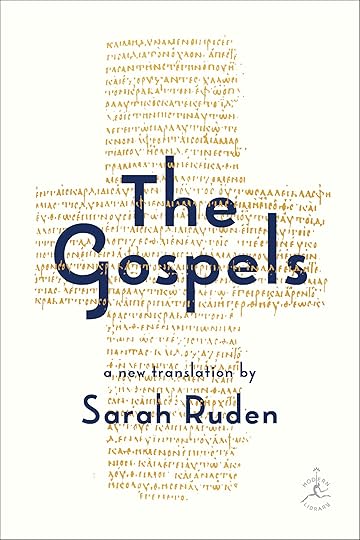
Overview: A refreshing translation of the world’s most historic written Word; one which strives to capture through modern language the authentic impression and accessibility had by the original Greek texts on their contemporary audience.
Review:
“Many words are tainted by history. This makes it difficult to revive or change the concepts that correspond to those words. This seems not really fixable. Maybe a solution is to start from scratch: to create and use completely new languages.”*
I chanced upon this tweet during my reading of Ruden’s Gospels. Discarding the sardonic tone of futility attached to the quixotic recourse to “new languages”, I thought the sentiment touched aptly on that dilemma faced by translators the world and ages over; this dilemma is precisely that which qualifies Ruden's work as a necessary and stand-out edition to the copious list of translations of the world’s most translated, read, critiqued, and revered work; for in this case, the emphasis comes not so much in maintaining definition across languages, as maintaining connotation in language across the years.**
I find it ironic that these, my favorite literary stories of all time, are also among the most difficult for me to fluently read and comprehend at this stage of my life. Having read and encountered the Gospels repeatedly across numerous translations, languages, dialects, and underlying religious currents, it is a struggle to prevent the mind from wandering as it subconsciously finishes every chapter, parable, and verse within the same sequences of words encountered already millions of time. It is like walking through a familiar trail which no longer excites the senses like a novel environment, the likes of which conduce a familiar background letting your thoughts frolic inwardly. This is of course anathema to the intent of the religious Catholic turning to Scripture to renew his fount of passionate Grace.
The issue is made more complex for the cradle Christians who have grown up with copious exposure to a wealth of doctrinal Christian verbiage covering creeds, prayers, figures, proper names, and other nominal terms which denote parochial concepts whose definitions and usage are constrained to the authority of an established Church. These terms, picked up by the juvenile mind in a period of early Catechism, are henceforth stored within an ontological state of pre-consciousness; when invoked, such words and phrases as the Lord’s Prayer, the “Holy Spirit”, the figures of the Trinity, Feudal atavisms of “Lord” and “Servant”, proper English transliterations of Jesus, Mark, Luke, etc., all fail to register as novel, profound theological concepts, emotionally-connotative objects, or anything other than socio-cultural byproducts of a historical Christendom, utterly unrecognizable from the agricultural Judaic settlements inhabited by the Christ himself. In fact, most of us the aforementioned terms generally register no conscious significance whatsoever.
To think then, that the four Gospel book, which I and the Christian faithful value immeasurably as our spiritual fount, our portal to divinity, our authority on matters of faith, daily devotional, bed-side ritual and everlasting Good News; to think and admit that this same text, whose verses and imagery we can quote and invoke on command, are actually some of the most difficult translated texts to fluently comprehend - this is something we tend to oversee. It is unimaginable therefor to reconcile this notion with the fact that the Greek Gospel texts in themselves are of such accessibility that they universally are provided as beginner texts for students of secular Greek language courses.
Under the ineffable weight of the Bible’s vast importance, the Biblical translator, more than any other, heeds an obligation to produce the most “faithful translation.” Failure in this task means the risk of antagonizing ancient institutions and legions of their devout faithful. Ruden’s insight, however, intrepidly marks that this task need not be reduced to producing the most literally conservative transliteration, as is so often the case.
Under the yoke of strict, religious criticism, the dry, uninspired liturgical translations served up to the laiety, with their children of scholarly revisions and updated versions, have led us into the present age with: (1) antiquated and unintelligible texts repeating in rote the same exhausted phrases (stretched in modern tongue to near-meaningless), (2) recourse to conservative and meaningless transliterations of words and phrases (existing only as Sunday school jargon) , and (3) crafty digressions from the original text for doctrinal sake (at worst, choosing to gratuitously omit or make changes to words and verses to ensure adherence to some post-hoc theological position). A better way forward, as Ruden puts it, is to strive to convey the most faithful impression in those who read the Gospels as the simple Greek texts had on their original audience; for it is no small matter that these simple Greek texts were compelling and accessible enough in their content and literary style to ensure the prolific distribution and resulting establishment of the Gospels as the cornerstone of the World’s most historic and impactful institution.
I dare say that Ruden achieves this in my eyes, noting that this is the first version of the Gospels, and even the Bible, which I can sit down and read through as fluently and pleasantly as any ordinary book. At the same time, this is not some avant-garde literary revision of the original text, but an easement of the historic logos in modern tongue. To this end, Ruden displays no insignificant craft in stripping the text of overtly-liturgical post-hoc terms, culturally normative transliterations, proper noun capitalizations, verse segmentations, and pompous red-line augmentations - all anathemic to the content of the original Greek texts.
Likewise, Ruden brings the text to new life with a selection of novel and thought-provoking vocabulary (she provides context and justification for every significant change in word choice), which provide fresh perspective and considerably greater ease of access. These are dressed in a warm Serif font, syntactical outline, and publisher’s artistry which at first glance provides for a written work indistinguishable from that of an ordinary novel.
In spite of all these changes, the religious skeptic may yet hold their peace; for the good news is that one never loses sense of that familiar gravitas which inspires recognition and newfound love for the text in the understanding that this contribution is veritably another part of that most truth Account.
Time will only tell if Ruden’s work will be justified by its fruits; namely if reception of her Gospels will be able to strike a chord in our over-wrought, hyperanalytical, post-modern hearts, just as it did for the lost and weary diaspora on whom the texts of the Greek Logos descended as a life-changing Paraclete. Nonetheless, I can say merrily and with certainty that it had the not insignificant effect of bringing to new life that most treasured Good News that I cannot get enough of. I look forward to adding this English translation of the Gospels to the top of my list of personal Bibles, finding therein the cardinal virtues of faith, hope and love.
*tweet by @yeetgenstein
**the dilemma is thoroughly assayed in the book’s introduction, which is an interesting essay on biblical translation that stands on its own.