
What do you think?
Rate this book


388 pages, Hardcover
First published September 30, 2020


Imagine: if the GDP was replaced with a contentment index. — Graffiti (written by Kelsey)
This is one of those books that when I saw it I knew I had to read it. This was a notable for the Children's Book Council of Australia's Book of the Year in the Young Adult category for 2021, it disappointingly missed out on being shortlisted. But I saw it there and it was an instant must-read. Asphyxia's work is always visually stunning and plays with some worthwhile themes. I'm going to be very honest, Future Girl was going to have to actively work to not be a five-star book. It did not disappoint. The plot is engaging, the writing clever and the characters are something. The art, part of the reason that Asphyxia is so good, shines, both as focal pieces and the journal details.
Future Girl is stylised as an art journal, set in near-future Melbourne, something not quite apocalyptic but certainly in that realm. In this book food as we know it is 'wild food' and the normal food people live on is Organicore's Recon (food supplement, all the nutrition and can taste as you want it to). It is the journal of 16-year-old Piper McBride, starting June 17 to December 21. Piper is Deaf and has been as such since she was 3. As the book starts she communicates through a combination of hearing aids, lip-reading and speaking but finds it difficult. Her mother is Irene McBride a strong woman and a nutritionist, the head nutritionist for Organicore. Irene and Piper but heads on at first Piper's Deafness and her pronunciation later Piper's Deafness, life path and 'wild food'. Piper is introduced to 'wild food', sign language and the Deaf community through Marley. Marley is what is known as a CODA Child of Deaf Adult. Marley rather quickly introduced Piper to his mother Robbie. Robbie is the best character and leave it at that. The less you know about her before you meet her the better. There is variety in the support characters, diversity in ethnicities abilities and sexualities (as I expected), this diversity is shown best in the community that develops around Piper's little garden. While thinking about this book while I was halfway through I realised two things, firstly Piper is an unreliable narrator, secondly, everyone is just a little bit awful and I think that makes them human. The one expectation to this awfulness is the mute pre-school age child, Taggert (I'm pretty sure there is a metaphor there somewhere). It is Piper's unreliability as a narrator that gives me serious concerns about Marley. Not explaining that because it's hard without getting into spoiler territory. This is really good writing.
Some quotes and comments
• "You're not drowning. Just swimming deep. I'm not sure I can do this teenager thing. Perhaps I'm doomed to stay a child forever." — This is one of the first focal statements Piper has in her journal. I just like it as a c piece of context.
• "Why, why, oh why can't I just take it all in like everyone else? Why does it have to be so difficult?" — I'm neurodivergent and struggle with loud grouds I feel this. It's not a lot of fun.
• Full respect for using a Covid reference, death in context. Kinglake too, somewhere that is known by the tragedies that occurred there over a decade ago now.
• I'm just in love with Robbie's house and that entire space. Robbie teasing Marley and Piper being unable to pick up on it is cute.
• "Marley only has to fingerspell half the words, because I know the signs for garden, friends and food, and instead of using the little words, he simply points. Sign language is so economical." — I really like that last line. It's just another example of English being a clumsy and barely adequate language.
• "'When the last free is gone,' she said 'civilisation will die.'" — This was Piper repeating something that Irene said to her frequently.
• There are some brilliant discussions of self, identity and independence when the world perceives you as other.
The style in which Future Girl is written is intelligent. Piper sometimes can't fully understand what is said to her even through hearing aids. As we see the world through her eyes, ears and brain that is shown. Sometimes when someone speaks to her you'll get lines like "Wekana mek a special system jestfa you"; "Yavta avana fishal pass to travel onth tram now.". These are usually from people Piper doesn't know, she struggles to lipread them and the hearing aids are painful. As she starts to learn sign from Marley and Robbie there are different styles used. Capitals for FINGERSPELLING, the first thing Piper learns and the most common sign language; sentence case for Auslan sentences (combinations of fingerspelling and words). Asphyxia Piper has included an Auslan fingerspelling chart and her learnings from Robbie the basics of compost and a Mandala garden. They have a slightly different style, more legible, with more longevity than the sketchy styles of the others. But every piece of art does complement the writing it is with.
I do want to say that I am Australian, specifically from Melbourne. I knew a lot of the place referenced in this book. The sign language used in this book will not be the same in other countries. But the environmental responsibility and activism messages will travel well. Piper is intended to send a message, to educate and to be relatable to different audiences. I think that is done well. For those that are in her position, that of an oral deaf child who can't sign, I think she tells her story well. Tells Asphyxia's story well. Aside from anything else Future Girl is just great representation, written in own voice and with beauty and style.
Yes, the question is no longer what I'm going to do but what you're going to do, Mum. — Piper McBride (this is kinda the whole point, and it's a multi-point statement on ability and environment)
A representative gif: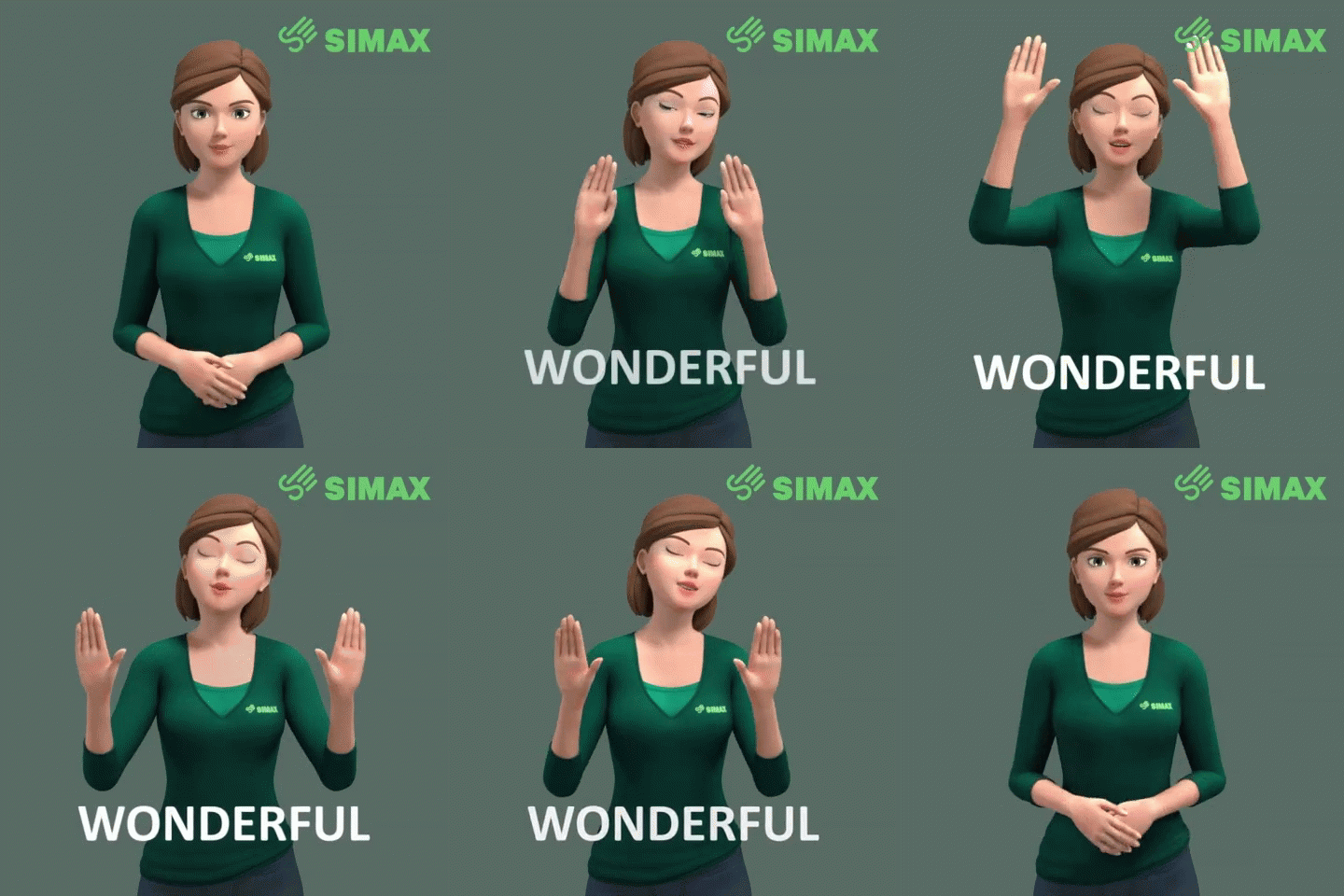
Apologies I know this is ASL


