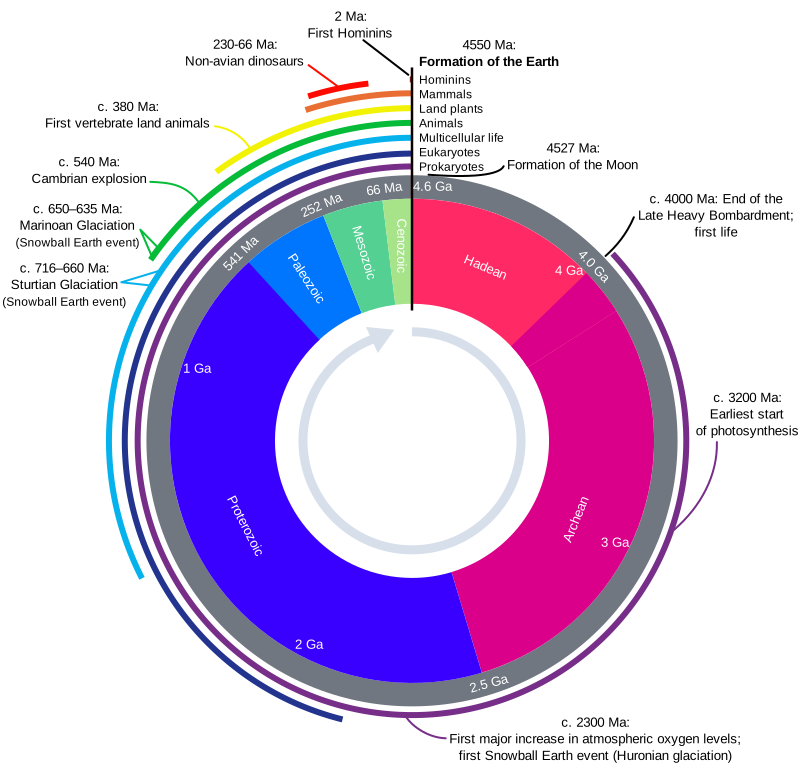
I will accept without much argument that the origin of the universe is still “the big mystery” waiting to be fully solved, but as important and fascinating as that topic is, it is still a backward-looking exercise. Human consciousness, however, and all its related intellectual understanding is possibly an even bigger mystery, and in addition to being just as important and fascinating, there is a forward-looking aspect to it that adds more thrill to its solution.
While each new text on the subject answers some questions and poses new ones, Joseph LeDoux’s enormously engaging book, The Deep History of Ourselves: The Four-Billion-Year Story of How We Got Conscious Brains, inches us ever-so closer to ultimate knowledge. The book is lavishly and generously illustrated with informative grayscale artwork, but the labeling and annotating of the artwork is in an italic font small enough to challenge even young readers’ eyes. The font used for page footnotes—of which there are many—is even smaller, making them almost unreadable! Why? Trust me, there are nerdy readers who want to read all diagram labels and all footnotes.
The first half of this meticulously-researched work is a solid account of evolution starting with unicellular organisms and evolving to multi-cellular life. LeDoux explains that the two functions that dominated primitive life (and arguably still does in a very basic way) were survival and reproduction. Survival, in simplest terms, often meant “moving away” from harmful threats and predators, or “moving towards” life-sustaining ambience. With each short chapter, LeDoux moves along the timeline chronicling the evolution of various species, finally reaching homo sapiens.
It is fair to note that the writing becomes quite dense at times, and the penalty for readers’ attention wandering even for a moment will be some re-reading. As an example, when LeDoux is making a point about goal-directed responses and habits, he says, “…during Pavlovian conditioning, the reinforcing unconditioned stimulus alters the ability of the conditioned stimulus to activate neurons to which it is synaptically connected. In instrumental conditioning, the reinforcing unconditioned stimulus establishes a relation between neurons that process a stimulus and a response, making it more likely that in the presence of the stimulus the response will occur. If the responses depend on the unconditioned stimulus being a valuable outcome at the moment, then the response is goal directed; otherwise, it is a habit.”
Despite such challenging density, LeDoux minimizes the chances of overwhelming readers by adopting Edward O. Wilson’s style in The Meaning of Human Existence of expressing one thought or idea in one concise chapter. This reduces chapter size to between 1500-2000 words, but results in a large number of chapters, albeit helpfully grouped under common headings. I think—or rather, hope—that the structural format will be more widely adopted by other science writers.
There are several critical sections and chapters in LeDoux’s evolving (no pun intended) story. For example, “…And Then Animals Invented Neurons,” “The Beginning of Cognition,” and “Creeping up on Consciousness.” LeDoux is clear with important definitions, especially when they counter mainstream ideas. “Cognition,” he says, “will refer to processes that underlie the acquisition of knowledge by creating internal representations of external events and storing them as memories that can later be used in thinking, reminiscing, and musing, and when behaving. Its dependence on internal representations of things or events, in the absence of the external referent of the representation, is what makes cognition different from noncognitive forms of information processing.”
The Deep History of Ourselves is not for the faint-hearted, but more tenacious readers will be rewarded with a fabulous, sweeping narrative that does indeed successfully address the book’s subtitle of how humans got conscious brains, with ample coverage and analysis of current thinking on the subject.



 of this genre that doesn't highlight Phineas Gage ?); and it's implication. He seems to sidestep the memory issue by using terms like Semantic, and Episodic memory. What other authors refer to as working memory he seems to couch in something called schema.