Jump to ratings and reviews
Rate this book

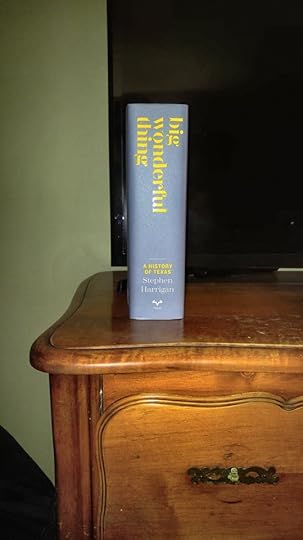
Big Wonderful Thing: A History of Texas

Rate this book

The story of Texas is the story of struggle and triumph in a land of extremes. It is a story of drought and flood, invasion and war, boom and bust, and of the myriad peoples who, over centuries of conflict, gave rise to a place that has helped shape the identity of the United States and the destiny of the world.

“I couldn’t believe Texas was real,” the painter Georgia O’Keeffe remembered of her first encounter with the Lone Star State. It was, for her, “the same big wonderful thing that oceans and the highest mountains are.”

Big Wonderful Thing invites us to walk in the footsteps of ancient as well as modern people along the path of Texas’s evolution. Blending action and atmosphere with impeccable research, New York Times best-selling author Stephen Harrigan brings to life with novelistic immediacy the generations of driven men and women who shaped Texas, including Spanish explorers, American filibusters, Comanche warriors, wildcatters, Tejano activists, and spellbinding artists—all of them taking their part in the creation of a place that became not just a nation, not just a state, but an indelible idea.

Written in fast-paced prose, rich with personal observation and a passionate sense of place, Big Wonderful Thing calls to mind the literary spirit of Robert Hughes writing about Australia or Shelby Foote about the Civil War. Like those volumes it is a big book about a big subject, a book that dares to tell the whole glorious, gruesome, epically sprawling story of Texas.

944 pages, Kindle Edition

First published October 1, 2019

336 people are currently reading
1753 people want to read

About the author

Stephen Harrigan

28 books195 followers
Stephen Harrigan was born in Oklahoma City in 1948 and has lived in Texas since the age of five, growing up in Abilene and Corpus Christi.
He is a longtime writer for Texas Monthly, and his articles and essays have appeared in a wide range of other publications as well, including The Atlantic, Outside, The New York Times Magazine, Conde Nast Traveler, Audubon, Travel Holiday, Life, American History, National Geographic and Slate. His film column for Texas Monthly was a finalist for the 2015 National Magazine Awards.
Harrigan is the author of nine books of fiction and non-fiction, including The Gates of the Alamo, which became a New York Times bestseller and Notable Book, and received a number of awards, including the TCU Texas Book Award, the Western Heritage Award from the National Cowboy and Western Heritage Museum, and the Spur Award for Best Novel of the West.Remember Ben Clayton was published by Knopf in 2011 and praised by Booklist as a "stunning work of art" and by The Wall Street Journal as a "a poignantly human monument to our history." Remember Ben Clayton also won a Spur Award, as well as the Jesse H. Jones Award from the Texas Institute of Letters and the James Fenimore Cooper Prize, given by the Society of American Historians for the best work of historical fiction. In the Spring of 2013, the University of Texas Press published a career-spanning volume of his essays, The Eye of the Mammoth, which reviewers called “masterful” (from a starred review in Publishers Weekly), “enchanting and irresistible” (the Dallas Morning News) and written with “acuity and matchless prose.”(Booklist). His latest novel is A Friend of Mr. Lincoln.
Among the many movies Harrigan has written for television are HBO’s award-winning The Last of His Tribe, starring Jon Voight and Graham Greene, and King of Texas, a western retelling of Shakespeare’s King Lear for TNT, which starred Patrick Stewart, Marcia Gay Harden, and Roy Scheider. His most recent television production was The Colt, an adaptation of a short story by the Nobel-prize winning author Mikhail Sholokhov, which aired on The Hallmark Channel. For his screenplay of The Colt, Harrigan was nominated for a Writers Guild Award and the Humanitas Prize. Young Caesar, a feature adaptation of Conn Iggulden’s Emperor novels, which he co-wrote with William Broyles, Jr., is currently in development with Exclusive Media.
A 1971 graduate of the University of Texas, Harrigan lives in Austin, where he is a faculty fellow at UT’s James A. Michener Center for Writers and a writer-at-large for Texas Monthly. He is also a founding member of CAST (Capital Area Statues, Inc.) an organization in Austin that commissions monumental works of art as gifts to the city. He is the recipient of the Texas Book Festival’s Texas Writers Award, the Lon Tinkle Award for lifetime achievement from the Texas Institute of Letters, and was recently inducted into the Texas Literary Hall of Fame. Stephen Harrigan and his wife Sue Ellen have three daughters and four grandchildren.

Ratings & Reviews

What do you think?
Rate this book

Friends & Following

Create a free account to discover what your friends think of this book!

Community Reviews

5 stars
369 (65%)
4 stars
153 (27%)
3 stars
34 (6%)
2 stars
2 (<1%)
1 star
3 (<1%)
Displaying 1 - 30 of 114 reviews
Profile Image for Richard Derus.
4,194 reviews2,266 followers
Want to read
October 9, 2019
Excited that I won BIG WONDERFUL THING

from University of Texas Press in a Publishers Weekly giveaway!

Plus it's SIGNED!!!
Profile Image for Kerry Pickens.
1,202 reviews32 followers
October 25, 2019
I have read many of Stephen Harrigan's books on nature, and this Texas history book is his tour de force. I wish high schools would use this book as a Texas history book rather than the boring textbooks they use to teach history. Stephen makes the stories and heroes of Texas come alive in all its diversity.
Profile Image for Peter Tillman.
4,039 reviews476 followers
Want to read
October 26, 2019
Fine new review at the WSJ: https://www.wsj.com/articles/big-wond... (Paywalled. As always, I'm happy to email a copy to non-subscribers. And, even if you don't read the book, it's a very entertaining review!)
A Texas-size history makes clear that the Lone Star state, like the United States as a whole, has always absorbed and resisted newcomers; it also has always made claims to an “exceptional” status.
But 944 pp??
Excerpts: Author Harrigan is "as pure a Texan as Larry McMurtry. He has now given us a—no other word for it—Texas-sized book about the place he’s called home for decades. Lavishly illustrated, fully annotated, brimming with sass, intelligence, trenchant analysis, literary acumen and juicy details, it is a page-turner that can be read straight through or at random. It is big. It is popular history at its best."

"Chapter 9 (“The Texas Dream”) begins: “Just when it seemed that Moses Austin’s long run of bad luck was about to turn, a panther leapt out of a tree and grabbed him in its claws.” Today’s Texas is about to be born."
“In Odessa, George Bush learned about the virtues of chicken-fried steak and the inadvisability of wearing his Bermuda shorts among oil-field workers”
And here's Sam Houston: “The Texian standard of the single star, borne by the Anglo-Saxon race, shall display its bright folds in Liberty’s triumph on the isthmus of Darien.”

Not for nothing is Mimus polyglottos the official avian symbol of the state. In 1927, the legislature proclaimed that the mockingbird “is a singer of distinctive type, a fighter for the protection of his home, falling, if need be, in its defense, like any true Texan.”

Since I have a love-hate relationship with the state -- I grew up in Oklahoma, and went to school in Texas -- I'm sure I'll be browsing the thing, at least. But 944 pp.!! In due time . . .
Profile Image for Steven.
574 reviews27 followers
August 20, 2020
Whew! I had to renew this one past it's three-week checkout period at my local public library. At 829 pages (and almost 3.5 lbs) reading this book is quite a workout. But, I think, quite worth it.

Harrigan, a writer for Texas Monthly, tackles the history of Texas in a unique and quite readable way. While he works chronologically from prehistoric times to the present, he has a way of inserting personal recollections that isn't distracting, and is able to re-introduce figures from history in a looping, arcing manner that illustrates how all these names I've heard for years were interconnected. As a person whose family has deep Texas roots, I enjoyed thinking about where my ancestors were and how they related to some of the big events and themes of Texas history, like cattle drives, the Civil War and farming. He writes especially well about the weird world of Texas politics.

Harrigan clearly loves Texas and admires the traits that it and its more famous sons and daughters are known for, but he doesn't gush -- and he definitely doesn't shy away from Texas' more shameful and darker chapters. He makes a real effort to illuminate the experiences of indigenous Texans, Mexican-American and African-American Texans, and women.

To give you a taste of his writing, here's a snippet from the Epilogue, in which he writes about the steady stream of newcomers that continue to flock to Texas:
People viewing Texas from the outside have always recognized that there is something different about it, not just in its expanse but in its attitude also, in its annoying ineradicable mythic presumption. But it's hard to live here and not feel, just a little, that presumption stirring inside of you. So many kinds of people have fought over the geography of Texas for so long, and competed for their places in its ever-changing culture, that there is a kind of harmony of conflict, a hard-earned conviction that the word "Texas" belongs to you as righteously as it does to anyone else.


One criticism I have of this book is the maps. They're pretty crude - they give you a general idea of where things are in relation to each other around the state, but they seem a bit cartoon-ish and lack a preciseness that this book deserves. The copious photographs, however, are very welcome.
Profile Image for Deb (Readerbuzz) Nance.
6,434 reviews335 followers
November 26, 2019
Texas is a big wonderful thing and this is a big wonderful book about this big wonderful thing. Stephen Harrigan attempts to cover it all in a mere 925 pages: the Alamo; Stephen F(uller) Austin; the Battle of San Jacinto; Judge Roy Bean; Bonnie and Clyde; the Branch Dividian compound in Mt. Carmel; Brown & Root; buffalo soldiers; George H. W. and George W. Bush; Cabeza de Vaca; the Caddo Indians; Camino Real; carpetbaggers; cattle drives; Cherokee Indians; Seven Cities of Cibola; the Civil War; Colt revolvers; the Comanches; John Connally; cowboys; Davy Crockett; Crystal City, Texas; Czech and German immigrants; Martin Dies; the Dust Bowl; Dale Evans; Edna Ferber; "Pa" and "Ma" Ferguson; football; Fort Davis; the Galveston hurricane; John Nance Garner; Charles Goodnight; James Hogg; horses; Sam Houston; Humble Oil; Jefferson, Texas; Lyndon Baines Johnson; Janis Joplin; Barbara Jordan; the Karankawas; the assassination of John F. Kennedy; the Kilgore Rangerettes; the King Ranch; the Ku Klux Klan; Jean Lafitte; Tom Landry; lynchings of African-Americans; Mary Kay; mavericks; Larry McMurtry; Mexican-Americans; the moon landing; Nacogdoches, Texas; Jose Antonio Navarro; Madalyn Murray O'Hair; Georgia O'Keeffe; open range; Lee Harvey Oswald; Padre Island; Palo Duro Canyon; Cynthia Ann and Quanah Parker; George Parr; the pecan shelling business; the Piney Woods; the prison system; Prohibition; railroads; Reconstruction; the Republic of Texas; Ann Richards; the Rio Grande; Roe v. Wade; the Runaway Scrape; Antonio Lopez de Santa Anna; the savings and loan crisis of the 1980s; Selena; Allan Shivers; slavery; the Southwest Conference; Spanish land grants; Spanish missions; Spindletop; the State Fair of Texas; Tejanos; tenant farmers; "Texas, Our Texas"; the explosion in Texas City, Texas; the Texas Rangers; the University of Texas; Ralph Yarborough; "The Yellow Rose of Texas"; and Lorenzo de Zavala. Whew. All these stories told as if the author were sitting around the campfire, swapping tales. And, even so, the author concludes the book regretting the things he was unable to include.
Profile Image for Drew.
419 reviews1 follower
November 21, 2019
An epic book about the story of Texas written from the standpoint not only of the victors, white males, but also from the standpoint of Mexicans, Indians, Tejanos, Blacks and the poor. I can’t recall ever reading a history with such a high bar of objectivity. 830 pages—should have been printed in two volumes. My hand is cramped and my arm is sore from holding. Fortunately I did not drop it on my cat in my lap as it would have done her in. Truly a magnificent book and worthy read!
Profile Image for David Rush.
412 reviews39 followers
March 3, 2020
A fascinating book and I am glad I read it.

PROS:
*He covers from pre-Columbian times to George W Bush
*Thousands of interesting and insightful facts and stories.
*He is brutally honest in his telling of an extremely brutal story
*He points out similarities separated by years, decades and even centuries
*The topics are wide ranging, from traditional history to pop culture.
*He has and eye for the quirky
*(Like O’ Rip the horned toad who supposedly survived a 31-year hibernation in a courthouse time capsule )

CONS:
*There is so much information you could almost call it an 800 page Texas trivia book
*It is mostly chronological but it feels like a literary collage that is is hard to hold it all in your head
*The different topics are fun but by the end it is hard to come up with a coherent story of Texas
**(Maybe that is his point, though)

In Summary
While the first half is somewhat traditional storytelling by then end it seems like he is just throwing in those stories he happens to remember from his life. Not a bad thing but still it is a noticeable, but maybe I was hoping for at least as much focus in the last half as the first half.

Review Epilogue
OK, I have padded out the top of this review enough that I think most readers will have stopped by now. I don’t want any crazy Internet Texians attacking me.

THAT was a depressing book!

NOTE: While not born here I have lived in Texas for most of my life and there are many, many, wonderful people and places here...BUT…

I think the moral of this book is that there are an awful lot of assholes in Texas. And so much cruelty in its founding and history it is hard to stomach. Of course the rest of the country (or world, for sure) is no paradise, but we are talking about Texas now.

At its genesis Texas was bound up with slavery and without it this land might still be part of Mexico. Well maybe, but maybe not. Anyway:

(the newly independent Mexico) True to its federalist philosophy, it left the states to decide whether human bondage would be tolerated. This was a crucial question for Texas. Without slavery, Austin was convinced, “we will have nothing but poverty for a long time, perhaps the rest of out lives.” - Pg. 111

Benjamin Lunday, a Quaker activist…had no illusions about the “real objects” of the Texas Revolution - “To wrest the large and valuable territory of Texas from the Mexican Republic, in order to re-establish the system of slavery; open a vast and profitable slavemarket therein; and ultimately, annex it to the Unted States.” Pg. 200

And DAMN the part of this book telling about reconstruction is a horror show. Oh yeah, the relentless demeaning of non-Anglos is, well it is just depressing. Even if you factor out our current cultural norms it seems Texans took a special glee in hurting former slaves, native Americans and the Hispanic population.

But back to the assholery, and I could dwell a long of historical mega A-holes for a while but let’s jump to the 20th century.

(In 1954) The world’s largest Methodist church was in Dallas,so was the world’s largest Presbyterian church. So was the world’s largest Baptist Church. The fifty-year-old pastor of the First Baptists church, shepherding a flock of 18,500 Dallas souls, was an avuncular, craggy-faced premillennialist named W.A. Criswell, who preached hard against integration and racial equality. (“they are not our folks. They are not our kind. The don’t belong to the same world in which we live.”) Pg. 689
Yeah I know it was a different time, but still, an A-hole.

Decades later, Claytie was continuing his father’s work, extracting groundwater to irrigate his twelve thousand acres. When asked on the campaign trail whether the springs might come back if he stopped pumping thirty million gallons of water a day from the aquifer, he was direct. “They might, but I’m not going to do it.” Pg. 793

Again, A-hole

There are more A-holes, plenty of them with many of them being politicians, but what is the point?

Of course there are exceptions. While most were eager to join the confederation many of the German immigrants wanted nothing to do with it and they also viewed slavery for the evil that it was. So it was possible to not be a fan of slavery but most Texans made the choice for it.

In the little hill country town of Comfort, which is about fifty miles northwest of San Antonio, a granite obelisk sits in a patch of parkland on a bluff above Cypress Creek. Three German words are carved on to the southern face of the shaft: Treue Dr Union – True to the Union. Pg 296

And while we learn the Comanches were mean SOBs to the settlers as well as most other tribes in the area, I do love this quote.

I was born under the prairie, where the wind blew free and there was nothing to break the light of the sun. I was born where there were no enclosures and everything drew a free breath… I know every stream and wood between the Rio Grande and the Arkansas. I have hunted and lived over that country. I live like my fathers before me and like them I lived happily…If the Texans had kept out of my country, there might have been peace…But it is too late. The whites have the country which we loved, and we wish only to wander on the prairie til we die. Comanche Chief Ten Bears – pg 336

That���s it, but I want to note some things to see or remember

White shaman mural

Muldoon Catholics

"Waddies" as the term they used for Cowboys

(Gail Borden) He was also a buzzing inventor who would later try to market an amphibious conveyance called a “terraqueous machine” and the repulsive-sounding “meat biscuit,” which also went by the name of “Portable Desiccated Soup Bread.” The meat biscuit was life sustaining but unappetizing, and it never quite found its market. Borden would have much better success with his next product: condensed milk. PG 137

Dubois built an elegant legation on a hill overlooking the new capital - it’s still there, one of the oldest surviving buildings in Austin. Pg 221

the ultimate frontier insult of shaving one of their horses. Pg. 222

The flashier uniforms – sometimes including leopard skin pants – tended to belong to the cavalry, and that was where most volunteers wanted to be. “It was found very difficult to raise infantry in Texas,” wrote a British military observer, “as no Texan walks a yard if he can help it.” Pg. 287
Profile Image for pca.
70 reviews1 follower
April 4, 2024
Reading this should confer a master’s degree, at least
Profile Image for Socraticgadfly.
1,412 reviews455 followers
October 11, 2019
Ideally, I'd give it 3.5 stars. But, given all the hype around it? And in anticipation of yet more?

Three stars it is.

And why?

On the big picture side, this isn't totally a Gertrude Stein book, but ... to some degree, yes, "there's no there there."

Harrington may have laid out a marker of popularizing history that doesn't repeat Texas legends ad nauseum. He's good at that.

But, especially coming from someone who's a novelist? I found it kind of boring. I am not sure what he could have done to rectify it —other than not try to bite this whole enchilada off, as something that's not really novelistically inclined, especially if you're deliberately legend-killing.

I did have a couple of specific nits to pick, which were going to guarantee a four-star rating before I realized it's just not "jazzy."

First, last I checked, I'm still in the United States, not the CSA. Given Southern names to the major Civil War battles just lost me. Related to that, though he did OK on not Reconstruction Republican Gov. Edmund J. Davis totally under the bus, overall, his treatment of Reconstruction was ... bland within the above blandness.

I think it was the Texas Observer that said he did best when focused on "Great Men" (and Women) portions of his history. He probably should have done that even more.

Second? I don't like Texans trying to "possess" Georgia O'Keefe. She wound up in New Mexico, and while her love for the Southwest may have been first sparked by Palo Duro Canyon, when she wanted to settle down, it was at Abiquiu, not the Texas Panhandle.

So, 500 pages of vignettes of, say, the Nacogdoches world — Spanish, French, Angl0 — then Sam Houston, then E.J. Davis, then Quanah, then maybe Pappy O'Daniel, then maybe Cactus Jack, then the basics on LBJ, then maybe the man who made Shrub Bush president: Bob Bullock.

Another way to look at this book just dawned on me. It's probably worth another star as a popularizing history of the state for non-Texans and recent move-ins. Other than that? If you know non-legendary Texas history, you can move on.

One of the few things I learned from this book, really, was that cowboys of the 1800s were sometimes called waddies.

And, no, I don't care if Lawrence Wright is one of the primo blurbers of this book. After all, I three-starred HIS book on Texas history and culture too.
Profile Image for Porter Broyles.
452 reviews59 followers
April 6, 2020
This is a hard book for me to review.

It is one of the best overviews of Texas History that I've read, but I've read so much Texas history that it was hard (for me) to stay interested at times.

I can't think of a major event in Texas history that wasn't covered---sometimes superficially, but still covered.

There were many events that were covered that I was unaware of.

Most chapters started with some obscure trivia/story---many of which I had heard of, but many were unique enough that they were new.

If you are relatively new to Texas History and want a good overview of the subject, then I highly recommend this book. If you are pretty familiar with Texas History, you might want to pass on it.

I feel like I'm being generous giving it 5 stars, but I know that it deserves more than 4 stars! It isn't the books fault.
Profile Image for Rick Wilson.
957 reviews409 followers
May 30, 2021
Fantastic. A bit of a slog to read in one go, it’s very dense, but I can see myself referring back to it regularly in the future.
Profile Image for Gini Rainey.
90 reviews2 followers
October 3, 2019
If you’re looking for a light read, this book would probably not be the best choice for you. However, if you are interested in learning about all the ins and outs that have made Texas the great state that it is, Harrigan’s book will definitely give you all of that information and more.
With 944 pages, Harrigan tells the history of Texas from its earliest days to pretty much current times in his inimitable fashion. Weaving facts together in an easy to read and understand fashion, this book is more like a novel, but pretty much based on the hard, cold facts of how has become a fine blend of all kinds of people doing all sorts of things.
With lots of photos and diagrams, this book is a virtual compendium of all that’s out there about Texas between two covers. Richly referenced and indexed, Big Wonderful Thing will be an historically resource book for many years to come.
Harrigan, a long-time writer for Texas Monthly has scored a direct hit with this book that was published by the University of Texas Press. Researchers, students, history buffs, and folks who love anything Texas need to add this volume to their libraries.
Profile Image for Pete.
759 reviews1 follower
July 22, 2020
just a big honking cornucopia of weird texasicana, or whatever the word is specifically texan americana. that includes the not-as-enunciated bad parts of americana too -- corniness, white supremacy, patriarchy etc. not on harrigan's part -- he's pretty honest about his blind spots and about how silent the j in tejanx has been (please pardon my overwriting). i wasn't entirely into his low key bush 41/43 apologism but he's not writing about them as presidents, but as texans i guess. one of those books that instigates a few dozen wikipedia rabbit-hole-outings. might have been nice to have a bit more about music and art in general, but as harrigan acknowledges, there is no way to cover everything. hits that groove of writing where the author clearly LOVES the subject matter, but in the full and complicated manner of true love - seeing the ugly and the beautiful and the mutability all at once. RIYL The Fatal Shore but want marginally less genocide and more cattle
8 reviews
February 1, 2020
Have you ever wondered who Burnet, Smith, Travis, Hays, Houston, Austin, and many others were? As a native Texan forced to endure many hours of Texas history growing up, this book brings our history alive.

Many of these men were scoundrels. Travis may have died a hero at the Alamo but you wouldn’t want to invest money with him. And it explains why when you see the Alamo today, you think “this is the Alamo?”.

This is the best history book I’ve ever read. And I have learned so much about Texas I never knew.
Profile Image for Kyle Magin.
190 reviews7 followers
July 6, 2020
For 800ish pages this was readable as hell, so don't let the length scare you.

Harrington covers every base in his book and unearths some really interesting revelations about the Lone Star State. You find out why so many Germans ended up here in Central Texas, how OPEC started in a UT classroom, and how all of Roe v. Wade's litigants hailed from here. This is a good canvas of Texas history.

He probably could have done a bit more on minority communities.
Profile Image for J Chad.
349 reviews5 followers
May 14, 2021
While I can’t say this book is perfect (what would that even mean when discussing a subject as broad as the history of Texas?), I can say that it is absolutely, unequivocally, terrifically, fantastically great!
In short, the author does an amazing job of presenting a narrative survey of Texas history through the use of anecdotes, connections, and excellent descriptions of the people and places and things of Texas.
This book was the most entertaining and best book I’ve read in the past several years. I wholeheartedly recommend it to anyone with the slightest interest in Texas and I feel sorry for those without.
Profile Image for Lara.
47 reviews
November 13, 2022
A sweeping examination of Texas history that reads like an epic novel. This book made me think deeply about this state in all of its strengths and faults. I both read and listened to this book, and the narration by George Guidall is superb.
64 reviews1 follower
October 12, 2020
This book will be a centerpiece of my bookshelf and Texas heritage for many years to come.
76 reviews11 followers
July 9, 2020
Many of you will be familiar with author John Steinbeck’s statement, "Texas is a state of mind, something felt rather than articulated," which certainly applies to my feelings about the place I’ve called home for fifty-four years… 1966-2020. Moreover, should you count my years as an adolescent living in San Antonio from 1952-1960 (I was three when my Dad got assigned to Headquarters, 4th U.S. Army, and I attended school at Fort Sam Houston, Texas from kindergarten through the fifth grade) it adds up to sixty-two years that I’ve claimed the Lone Star State as my own.

Because of my inability to adequately explain what it is about Texas that I love, I find myself periodically reading books by authors far more gifted than I at expressing their observations and thoughts on the mystique that separates Texas from all other states. For example, it was almost on this exact same date two years ago that I wrote a review of the book God Save Texas by Lawrence Wright (see my previous blog post dated Jul 5, 2018) which was actually being researched and written at the same time that Stephen Harrigan was compiling his history of Texas, Big Wonderful Thing. The two men happen to be friends and visited some of the same historical sites together.

However, Harrigan’s book is encyclopedic compared to Wright’s; at 925 pages (829 if you exclude the Acknowledgements, Notes, Bibliography, and Index) it is massive in scope, yet surprisingly readable. History is often nothing more than dates, historical figures and events; dry and boring. Harrigan blends these same elements of history with great storytelling, so the only real issue I had with the book was the difficulty I had holding it up to read!

Meticulously researched, Big Wonderful Thing is informative, educational, and entertaining. It spans the years 1528 to the present, but rather than a strict chronological record it uses anecdotal information and individual stories of people and events – not just those that are well known, but obscure men and women and their involvement in moments that shaped the progression and evolution of Texas.

The portrayal goes well beyond the myths about Texas that as a child I learned in school. The reality is far more complex, and Harrigan deftly blends factual material with his abilities as a novelist to engage readers in the small details and stories that give context to the larger picture. Some author bias is inevitable in the telling of these stories, but on the whole it is a notable literary achievement.

The title of the book comes from a quote by the American artist Georgia O’Keeffe: "I couldn’t believe Texas was real… the same big wonderful thing that oceans and the highest mountains are."

Certainly Texas, with all of its faults, complexities, and contradictions has achieved singular elevated status (for better or worse) among the fifty states that comprise our Union, and Stephen Harrigan has given us a worthy rendering of its history that compares favorably and even exceeds that previously attempted by other historians and authors. It is the type of history book that you can literally open to any chapter and find enjoyment in learning something new about Texas or adding to the knowledge that you already had.

I highly recommend Big Wonderful Thing.

Profile Image for J.K. George.
Author 3 books17 followers
February 21, 2020
This is an epic book and a commitment to read through both the soaring parts and passages, along with dips and drabs and cobwebs of minor details. The overall quality and story makes the effort worth it, and I found the early portions about the early Spanish (and French) colonial periods, along with the native American Indian history especially fascinating. The inexorable influx of Anglos seeking, as Harrigan says in the final pages, "fleeing oppression or chasing dreams," included men and women simply unwilling to live under Mexican rule. The wave could not be stopped, especially from the new and muscular country of the United States, as it were. The author describes the Treaty of Hidalgo where the United States, with a gun to the head of Mexico, paid $15 million dollars for Texas as well as all or part of California, Colorado, Utah, Nevada, and New Mexico," as an abiding wound to its (Mexico's) national soul."

Sections of the book that describe the almost indescribably huge land areas of old land-grant and other ranches are fascinating - the stuff of movies. Oh wait, they have been the stuff of many movie plots. The maps and incredible collection of priceless photos alone make reading the print or eBook format essential. But large parts of the central portion of this work seem bogged down in minutia.

A portion describes the "Neutral Zone" between the US and Mexico, then transitions into The Republic of Texas. The move into the US as a slave state, with a dreadful commitment to racism and Anglo superiority over both Spanish/Mexican and black persons, is a damning but accurate part of the makeup of Texas. In fact, overall much of Harrigan's description of Texas is not flattering at all. Yet the courage of the German and Czech areas, where the people refused to go along the supporting slavery at the time of Texas's secession in the Civil War is a refreshing break from the bulk of the population at the time.

For me, the first part of this tome, as well as the latter portions with WW II and more modern characters, were the most interesting. The sections on LBJ, indeed larger than life, measure up to the man, with the JFK assassination particularly riveting.

One section, near the end, captures the essence of this place: "People viewing Texas from the outside have always recognized that there is something different about it, not just in its expanse but in its attitude ....

That sums it up for better or worse.
385 reviews5 followers
August 13, 2023
Stephen Harrigan has written one of the best narrative histories that I have ever read about a subject that is near and dear to my heart.....Texas! I'm a 5th generation Texan, born in Austin, but have spent most of my life in Louisiana. I still love Texas and always will. Most of my relatives were and are residents of Texas and my wife's roots are also in Texas even though we met in New Orleans. I fancy myself as a pretty well informed amateur historian and thought that I knew a lot about Texas until I read Mr. Harrigan's book. I was led to reading Big Wonderful Thing after reading Larry Wright's God Save Texas, having been introduced to Wright's books by my sister-in-law in Dallas. If you have any interest in Texas at all, this is a must read book. I've read a good bit about Texas, Mexico and Native American history, especially of the tribes of the plains. Warning! This is a long book but is by no means boring. It is as comprehensive a history of the state written by a talented writer who knows his subject well and is told only as a native born Texan could tell this story.
Profile Image for Abbey.
475 reviews34 followers
July 23, 2020
POPSUGAR 2020: A book with only words on the cover, no images or graphics

Is it possible that a 944 page book on Texas isn't long enough? I am a native born Texan, the child of a history loving family, and I learned so much that I didn't know about this grand land that I love so. Harrigan celebrates Texas and especially those eccentric characters that populate every town and time here, but he never shies away from getting in and telling the dirty truth of genocide, malignant racism, and corruption.

Honestly, I don't know how many times I called my mother to share a never before known factoid about the county where our family originated, about the company my grandfather worked for, about how much Texas football was discussed and Aggie football wasn't.

It's such a simple topic: the history of Texas. But really, kind of like Texas, this book isn't really something you can explain, but you'll love and understand when you're in it.

Profile Image for Scotty.
140 reviews1 follower
May 9, 2021
I got this book more than a year ago from my father in law, and I’ll be honest it took a fair bit to get into it. Finally I made a promise to myself that I would reas 20 pages a day, and gradually I became hooked. This now stands as one of my favorite popular history book ever. It’s definitely popular history; the author doesn’t try to reexplain old events in a new light, and if he has an overarching theme, it’s that Texas is too big to have a single theme.

I really enjoyed the unvarnished, non-glossy depiction of Texas in this book, warts and all. Another reviewer made the observation that he didn’t think that the author liked Texas very much, but I think Harrigan views Texas like an old friend: he knows the flaws but loves it anyway. There is some truly beautiful imagery in this book, and the epilogue is almost hauntingly literary.

I don’t give many books 5 stars on here. This one deserves it and more.
Profile Image for Mark Bentley.
34 reviews
August 8, 2020
This book may at first be daunting because of its HUGE size, but it is delightfully readable and entertaining while being absolutely packed with facts and trivia about the Lone Star State. To me, a life-long Texan, every chapter resonated with my life and experience or with that of my ancestors. Actually, my ancestors didn't arrive in Texas until the early 1850s, so the history prior to that is vicarious history but that doesn't prevent it from nevertheless being mine, since children in Texas are drilled with tales of Stephen Austin and "Remember the Alamo." Still, I was alternately amused, embarrassed, appalled, and proud as I read it, and that I realized is a lot like the experience of living in Texas. A great book by a fine author.
8 reviews
May 31, 2020
A big, occasionally wonderful, history of Texas and the Texans. Harrigan's aims are admirable but the book reads a bit like the longform version of a handful of Snapple cap trivia. It isn't exhaustive (and isn't meant to be) and the unevenness of attention given to different subjects is frustrating. The only thread here is Texas: there are no big picture ideas, arguments or claims, no profound conclusions about history, identity, or character. Still, it's well-written and worth a read for Texas enthusiasts or people who know nothing about Texan history and wish to know a bit more than nothing.
Profile Image for Andrew Tollemache.
389 reviews26 followers
November 20, 2019
Don't let the 900 pages fool you. This tome is a titanic achievement and the most amazing & entralling book on Texas history ever. I consider myself extremely well versed on this stuff, but I learned new things every couple pages. There are small brush stroke details that I had no frigging clue about on almost every event in Texas history from the full account of Cabeza de Vaca's shipwrecking on Galveston and his odyssey across the American Southwest that had eventually walk all the way to the Pacific coast of Mexico to numerous times in the early 1840s that Mexico recaptured San Antonio to the Pig War instigated the 1st French ambassodor to TX (at the French Legation building just off I-35) to Abraham Lincoln's offer on the eve of the Civil War to make Sam Houston a general in the Union Army if he could keep Texas from seceding.
Early reviews stressed how revisionist Harrigan's book was and how it slays sacred cows of the standard Anglo triumphalist version of Texas history. Harrigan spares no punches in detailing how violent and oppressive the life of this land has been, but unless you get your views on TX history from 1950s Fess Parker Davy Crockett Disney movies there are no shocking revelations. As I said its the cascade of small details that gives this tale of the big events of Texas history so much punch.
To be fair, the last 120 pages do drag a bit as he moves into covering more recent events from the 1960s on, but the closing chapter as he drives out of his driveway in Austin and goes on a epic Texas road trip with nothing but Texas music to accompany him he visits so many of the places discussed in the book to see how they are today. Some places are little changed from how they were 500 or a thousand years ago. In other places the course of history has covered up or grown around and obscured scenes where so much happened. The old San Saba mission ruins now sit next to a golf course as does the fort the US built to instigate the Mexican-American War which is under the fairway of a course along the Rio. The San Jacinto battlefield where Texas won independence from Mexico is now a small preserved field of brush and grass in the shadow of the refinery complexes of Beaumont.
The most poignant part for me was mid way through when in early days of the Civil War Sam Houston had been run out of office for his spot on prediction that seccession and Civil War would be a disaster for Texas, was now, in the twilight of his life feeling like the land he had given 30 plus years of his life had turned against him. One night in retirement in Huntsville he was confronted by a civil guard demanding to know what right he had to walk around without prior approval or papers. Houston thundered "Go to the fields of San Jacinto and you will learn what gives that right!" A few months before he died he actually returned the battlefield along the San Jac and stood under the tree where a quarter centurly earlier he had taken Santana's surrender while Houston grimaced under the huge oak tree, his ankle shattered by a Spanish musket ball. His since freed slave, Jeff, would recount decades later that as Houston stood under that tree that symbolized all that Houston had done for Texas, he wept.
Profile Image for Ricardo.
304 reviews3 followers
July 23, 2021
An appropriately big and beautiful history of a great, complicated state. Stephen Harringan is also a novelist and he brings this sensibility to this general history.
While Lawrence Wright's God Save Texas: A Journey Into the Soul of the Lone Star State attempted to explain the present political turmoil in the state, Harrigan goes into the nooks and crannies of Texas, roping in historical luminaries famous (Stephen Austin, Sam Houston) and the not so famous.
The eternal conflicts within Texas seem to stem from an inability to come to terms with it's own complexity. Conflicts from the endless Indian Wars to the Cortina Wars, a Tejano uprising against Anglo Americans over the border. Other battles feature violence against black Texans, countered by the bravery of the black residents of Millican who defended the town against rampaging white mobs. And the fights continue into culture, no better illustrated by Norma McCorvey, otherwise known as Jane Roe. An actress who played her gave a description which could echo the feeling of many other Texans, “She feels, at the end of the day, that she doesn't have a side that she can belong to.”
Harrigan also does fine work in showcasing the art and music that's come out of Texas, while simultaneously observing how segregated Texas audiences are. On the passing of Tejana singer Selena, Harrigan admits that he and his white colleagues had never heard of her. But she inspired scores of Texans and Mexicans with her style and performance, including a singer from Houston named Beyonce. This fragmentation among Texans is marked not only in culture but in literal borders.
The modern problems on the Texas border with Mexico can be stretched back to the reason why Texas exists: in the 1820's, Mexico attempted to stop the flow of Anglos going over the border to escape what Americans saw as an unstable life in the US. The reverse is now happening and the fears of a Mexican menace has been stoked for generations. If the price of living free from human trafficking, drug wars, and terrorism meant building walls and separating families at the border, then so be it. This callousness echoed the sentiments of Texans who took up arms against Comanches, Apaches, Tejanos, Mexican-Americans and black Americans. There might be fewer carcasses in the grasslands of Texas, but the bloody-mindedness still remains.
The beauty and brutality of Texas remains it's constant features. And as this work explains, the future of Texas will certainly be as twisty, awe-inspiring, yet savage and brutal as it's past.
Displaying 1 - 30 of 114 reviews

Can't find what you're looking for?

Get help and learn more about the design.