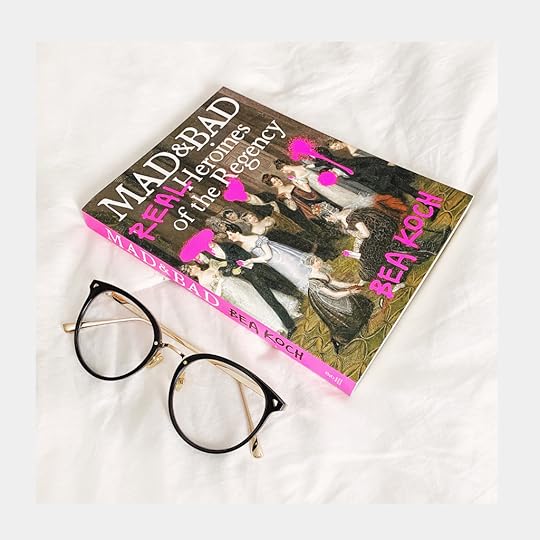
Discover a feminist pop history that looks beyond the Ton and Jane Austen to highlight the Regency women who succeeded on their own terms and were largely lost to history -- until now.Regency England is a world immortalized by Jane Austen and Lord Byron in their beloved novels and poems. The popular image of the Regency continues to be mythologized by the hundreds of romance novels set in the period, which focus almost exclusively on wealthy, white, Christian members of the upper classes.But there are hundreds of fascinating women who don't fit history books limited perception of what was historically accurate for early 19th century England. Women like Dido Elizabeth Belle, whose mother was a slave but was raised by her white father's family in England, Caroline Herschel, who acted as her brother's assistant as he hunted the heavens for comets, and ended up discovering eight on her own, Anne Lister, who lived on her own terms with her common-law wife at Shibden Hall, and Judith Montefiore, a Jewish woman who wrote the first English language Kosher cookbook.As one of the owners of the successful romance-only bookstore The Ripped Bodice, Bea Koch has had a front row seat to controversies surrounding what is accepted as "historically accurate" for the wildly popular Regency period. Following in the popular footsteps of books like Ann Shen's Bad Girls Throughout History, Koch takes the Regency, one of the most loved and idealized historical time periods and a huge inspiration for American pop culture, and reveals the independent-minded, standard-breaking real historical women who lived life on their terms. She also examines broader questions of culture in chapters that focus on the LGBTQ and Jewish communities, the lives of women of color in the Regency, and women who broke barriers in fields like astronomy and paleontology. In Mad and Bad, we look beyond popular perception of the Regency into the even more vibrant, diverse, and fascinating historical truth.
How about this blurb: “Discover a feminist pop history that looks beyond the Ton and Jane Austen to highlight the Regency women who succeeded on their own terms and were largely lost to history -- until now.”
Yeah, I loved this. I've not read a wealth of regency romance, but I’m always fascinated with regency England from a historical perspective. Jane Austen and Lord Byron? I’m in.
The women mentioned? Of course I had not heard of them before. There are many untold stories of brave and bold women, and I’m so grateful Bea Koch, one of the owners of The Ripped Bodice bookstore, took on this fascinating project. It turns out the true women of the Regency were even more vibrant and diverse than we ever expected. So much fun and well-written, I highly recommend this one.
I received a gifted copy. All opinions are my own.
The author of this runs a romance novels only bookstore and is well connected in the book trade, and I assume that is the explanation of how such a mediocre book got into print.
It is being described as "feminist" and "pop history," and neither genre deserves to get stuck claiming this book as an example of that sort of work.
What you have here is a series of decently researched high school term papers on women in Regency England. You get mini bio after mini bio, reciting the facts of that person's life, with little to make you really get to know them as more than the literary equivalent of baseball cards.
The language is readable, but the tone is cutesy. The bibliographies at the end of each chapter include movies, and several chapters use film references to support whatever argument she is trying to make-- without allowing for the fact that the films in question don't always stick to written history.
I'll sum up by saying that this reads like a work researched by Mary Bennett and written up by her sister Lydia. And that is not a compliment.
P.S. Speaking as someone who is the mother of 2 daughters, if the author can explain how she has given birth to a dog, I'd really like to know how she did it. "Dog mother!" SNORT!!!
I received this book for free from the publisher (Grand Central Publishing) in exchange for an honest review.
I love learning about awesome historical reading so I had high hopes for this book. Unfortunately, this book didn’t hit all the marks.
It was hard for me to get into this book at first because the book didn’t grip me. The book pretty much consists of short biographies of different women from the Regency period. For the first couple of chapters, none of the women grasped my attention. As the book progressed, I became more interested.
The main reason why the book didn’t fully capture my interest until later on was the writing style. The entries on the women are very basic. They don’t do a deep dive into their lives or offer much of an analysis aside from the obvious. If it was written in a more engaging way then that would have helped solve the issue. Also, I think the book would have worked better if it were a collection of essays. It would have been more powerful.
There were some things I did like. I liked that every chapter had a conclusion section. Doing that helped tie together the biographies of the particular chapter. I also liked that the recommend reading was included at the end of each chapter, making them easier to refer to. Lastly, I found the chapters on women in STEM and queer women to be the strongest.
Overall, the book had fascinating content but the execution left much to be desired.
“The real heroines of the Regency aren’t empty-headed heiresses or scheming mamas—they’re intelligent, talented artists, thinkers, scientists, and so much more” says the author of this new book about women of the Regency period in England. (Jane Austen wrote during this time, and the historical novels of Georgette Heyer are set during this period.) One of the more interesting topics covered are women of color during the Regency period. Recommended reading lists are presented at the end of each section instead of at the end of this book, which seems intended to provide readers of Regency romances with some background of the women mentioned in these novels. Readers looking for more in-depth information might be better served elsewhere. Thanks to the publisher and Netgalley for this ARC.
3.5 Stars - This is a very readable series of biographies of well and lesser known women around the Regency period of English history who defy commonly held wisdom of "the WAY things WERE" in that time period. While I'm not sure this will satisfy those who are looking for an extremely detailed history of women in the time period, I think it meets its stated aims admirably: to provide a primer on women who were do not adhere to the very specific perception many readers of historical regency romances have about what was or was not "historically accurate." Indeed, this is a great place to start in deconstructing the notion of historical accuracy, not because we can't know ANYTHING about history, but because history is complicated and the historical accuracy police do not have room for outliers in their constructed view of the period. This is a book that celebrates those outliers & invites readers to challenge their own assumptions about the period... and hopefully to dive into even more historiography exploring this fascinating period of history!
Sadly this is just not very good. The writing is awkward and the paragraph breaks make no sense. Although the content could be very interesting, it's presented in a generic flat way, like a first year university course essay, right down to the excessive use of direct quotations. Too bad, I was excited about this one 🙁
I'm pretty sure that this author got this book deal because she owns a bookstore. That's the only possible reason why anyone would publish this unsophisticated book about a time that is so well-documented and richly nuanced.
The Regency is such an important time in history, especially for women's issues -- it's a time that really marks the movement from womanhood as domestic to women in the world. We see the rise of scientists, mathematicians, political movers and shakers and many others, and Koch seems to have had trouble finding many of these powerful, influential women. Instead, a book that purports to be feminist and about women begins (literally -- first sentence/page) with Lord Byron? What an odd choice.
Every woman is given 3-5 pages and the entries honestly read as wikipedia entries -- there's nothing new or thoughtful about the characters, and no sense of how they fit into the context either of the time or now, in hindsight. Koch is a romance lover, but doesn't ever do any significant thinking about the relevance or power of the Regency in the genre.
But what is truly devastating about the project is this -- it has no interest in being historical. Koch appears to have spent most of her time researching on Wikipedia and by watching....movies? Dido Belle has an entry, and an entire page of it quotes and pontificates on a fictionalized adaptation of her life? It's so weird, it reads like a middle school history paper.
There is one shocking entry, however, that really spoke to how poorly researched this book is: In a later chapter of the book, Koch separates out three women as women of color in the Regency. Leaving aside the fact that these women are 1) separated out and 2) there are only three, while there are more in the chapter about mistresses (how?!), the worst bit is this: she uses Princess Caraboo as one of the examples of women of color in the Regency. Princess Caraboo was a white Englishwoman who pretended to be a foreign princess and duped an entire English village.
It's a fabulous story, and Koch makes the argument that Caraboo pretending to be a woman of color means that history is not as white as we often make it out to be. It's an important point, and one that the other two women in the chapter make without question (film adaptations as primary source material aside). Except...here's the thing...Caraboo didn't pretend to be of color. Indeed, in all the research on Caraboo, including portraits and reams and reams of interviews and coverage of her pulling the wool over the eyes of a whole village, there is no discussion of her dying her skin or wearing any kind of makeup at all to darken her skin. She spoke a "foreign" language, and wore a turban, and that was that. Anyone who had done real research would have discovered that -- it's one of the most discussed issues about Caraboo's story among experts from the time. Historical fact aside, why Koch chose to highlight a white charlatan instead of any number of remarkable women of color of the time is truly bizarre.
The writing is uninteresting, the research is atrocious, and the book, which so many romance readers would surely love if it were well executed, is the exact opposite.
The co-owner of the Ripped Bodice bookstore goes in-depth on the real figures that inspired the whole romance sub-genre of Regency romance. There are chapters on the royal women of the time, what the ton actually was and the various features of the ton used in so many romance novels. There are also chapters on how mistresses worked, how women found employment in the time, including female artists of the time, and those that found work in the sciences. There's also plenty on the feminists of the time as well as historical LGBTQ representation and other diversity including non-white women in Regency England as well as Jewish women.
Fascinating by itself, and a must-read if you're a fan of the genre that this is a background for.
If Regency bodice-rippers are your gateway drug to women’s history, let this be a beginner’s guide to the topic. Koch introduces a number of Regency era women to the uninitiated. If you’re expecting something deep and absorbing and you have more than a passing familiarity with the history of the era, this book is not for you. If, you’re new to the subject and want a guidebook to learning kore, Koch more than gets the job done. Here’s hoping more novices take this book and run with it!
Received from Edelweiss and the publisher in exchange for an honest review.
This one started a little rocky for me, the writing was a bit disjointed and there was a ton of info. But, as we went along I really started enjoying it. The chapters on women in STEM and queer women were my favorites, but each chapter is important and informative.
I truly appreciate how Bea Koch looks at women as multidimensional people. She is correct in pointing out that often women in history are reduced to their status as "mistress" or "lady" and looked at as individuals, while they often are so much more than just their titles and often have their own circles that are not looked at. I was surprised at all the connections between the women featured.
I also loved all the the connections to romance novels!
Overall, I really enjoyed this one. It can be quite dense in parts, but if you are interested in history I recommend it.
*Thanks to the publisher for a finished copy in exchange for an honest review*
This book examines the Regency through the lens of Regency Romances - and then goes a step farther and lets us know that, while they are still largely escapist fiction, their research tends to be good and that women like the romance heroines did exist...before history tried its best to erase them.
Probably my favorite part of Koch's book is that she emphatically does not take a straight, white, Christian view of the time period. There are chapters for queer women, Black women, and Jewish women, all of whom are systematically removed from most history books. As a Jewish woman, it's important to me, and affirming, to see what I've always known to be true (that we exist and have existed) put down on the page and published. Even if you couldn't care less about the Regency period, I highly recommend this book as a work of inclusive history.
Mad and Bad is a mash up of Regency history and the media that popularizes it. So often we view Regency women through the lens of how they're portrayed through historical romance books or movies like Pride and Prejudice or Emma. Women can seem one note... virginal, quiet, frivolous, stifled. This book sheds a light on the various types of women who broke the mold through art and science, espionage, or who they dared to love.
Each chapter is broken up into a category and it then dives into sharing stories of women who fit that category. There's one on royalty (Queen Charlotte, Princess Caroline, Princess Charlotte); one on mistresses (where it seeks vengeance for the often ridiculed Caroline Lamb); one on Black women who lived in and impacted the Regency, featuring Dido Elizabeth Belle (the illegitimate daughter of a British officer who was raised by her father's uncle in England) and Mary Seacole (a nurse from Jamaica who traveled and worked all over the world, whose accomplishments are often overshadowed by Florence Nightingale's).
I enjoyed the commentary Bea Koch provided of how often women from history are reduced to one thing: a lady, a sister, a caretaker, a mother, a helper, a mistress. Women are complex, and yet they are a footnote in stories of history that include them. While the author does not deep dive into any one woman, she lights a spark of interest for applicable readers.
—
I've seen several other reviewers remark that the short biographies we get in each chapter are not researched enough, or read like Wikipedia articles. I think this is noting that the biographies we get for each woman are rather short, like Wikipedia entries. We don't get an in-depth history of each woman, but that's the point - this book acts as a jumping off point, a way to honor and spotlight women who aren't as well known as their male (or, in some cases, white) counterparts.
This book probably won't suit for people who have no interest in history, or in this period of history. Or, alternately, people who know a lot about this period of history may find it underwhelming - or if they're more interested in historical events rather than people. Same for people who enjoy history but don't like historical romance because it's "inaccurate".
For those interested in the Regency era or those who read historical romance, this a great non-fiction read. It allows readers to read about women who were likely the inspiration for some author's characters (there is a geologist reminiscent of Minerva Highwood from A Week to be Wicked!).
I liked the "recommended reading" at the end of each section, and that she included historical romances. I could go on a tangent on how historical romances impact history and are important to history but... I'll save that for another time and place. (But I will say those who think historical romances or movies/TV set in history are completely inaccurate don't look at books written in those time periods. Pride and Prejudice was written in the Regency and features an out of class marriage while ignoring other ugly realities of the era - like chamber pots and infrequent bathing. Art always romanticizes history but that doesn't mean it's worthless to it.)
—
I do want to list what I feel are valid criticisms for this book.
I wish women of color would have been more heavily featured, and not just one chapter. So often history and historical romance is white washed, and we as readers need to question that and ask for more from historians, writers, media producers… There was one chapter that featured women of color (Black women), and three entries in that chapter, compared to other chapters that got more women featured. Out of these three women, two were Black - the other was a white woman pretending to be a foreign born ("ethnic" or exotic) princess. Perhaps hers could have been written into a chapter on criminals or infamous women of the Regency, rather than Black women.
I think the editing on this book could have been a bit tighter. In the chapter on Jewish women, there was a note about a woman, Rachel Lazarus, who wrote to a writer about the anti-semitism in her work. It says the author responded, the pair struck up a friendship, and the author attempted to 'write' her wrongs in a later book - Harrington (1817). However later, this is rehashed twice. (Two pages later: "Both Maria and her father responded to Rachel's letter. ... Maria goes a step further. She tells Rachel she is writing a new book to make up for her past mistakes and asks if she might send a copy to her for perusal when it's done." And two pages after that they again talk about the book Harrington.)
—
Overall, this is a fun, fascinating, light read about women from the Regency era. This is not a be-all, end-all history book but provides insight to female friendships and accomplishments and is both a great introduction to the time period or something for those who want to dive deeper into learning about the Regency.
Mad & Bad: Real Heroines of the Regency is an informative, intriguing look into the importance and influence of a bold, noteworthy set of women from the regency period on the literature we indulge in and enjoy every day.
The writing is educative and descriptive. The characters are intelligent, independent, and driven. And the novel is a fascinating, enlightening tale about the intricacies of the higher echelons of Regency society and the women who were plucky enough to pave the way for the feminist ideals of today.
Overall, I found Mad & Bad: Real Heroines of the Regency to be a quick, easy, fascinating treat full of facts and illustrations of a group of women who were certainly ahead of their time and without a doubt an inspiration for us all.
Thank you to Grand Central Publishing for providing me with a copy in exchange for an honest review.
This is history light,very light but readable. I see many reviews which claim this reads like a Wikipedia article but I do not agree at all. This is comparable in content, tone and accuracy to other books like this, which cover a variety of people in a time period. This isn't delightful to read but its far from a chore. This isn't a feminist view of history and in fact ends up supporting white supremacy and white washing history. Dido Elizabeth Belle was born enslaved. Her uncle who is considered a moderate abolitionist held her in slavery until his death, though it was kept quiet. She absolutely was NOT treated like her cousin, as is evidenced in her portrayal as a caricature in the famous painting. She was not dressed in the latest styles nit by a long shot, she was dressed in what was considered an exotic costume and her pose is also exotic. I hate that when this has been proven repeatedly historically ad nasuem white women stubbornly refuse to acknowledge reality. Dido was not allowed to eat at the table when guests visited as she was never fully accepted by her family as a human being if equal worth to white human beings. She was exoticized, fetishisized and othered. It's all right there in a historically accurate reading of the painting which multiple Black Historians have provided. Feel free to watch A Stitch in Time season or series 1 episode 4 in which the presenter gets told to her face that she's wrong. It's on YouTube. The painting in the movie Belle is altered because the origin is racist. Why did she include a white lady who lied about being a WOC in a section about WOC?
It's great to see the many types of women, though either unconsciously or deliberately omitted from historical records, were vital to so much of political, scientific, artistic, economic and cultural life during the Regency period. Whether part of the gentry, conventional or otherwise, non-white, middle or lower class, queer or Jewish, these women were important and made many contributions to their society.
I had a bit of trouble keeping all the different names and titles straight, but this book gives me a sense of just how rich and/or active the lives were of the women named in these pages, and a place to start when I want to delve deeper into them.
This review is based on an ARC ebook received for free from NetGalley. I am not being paid to review this book and what I write here is my own opinion. My rating scale is below.
review Bea Koch, one of the owners of the Ripped Bodice, a bookshop specializing in the romance genre, researches and reports on the women of the English Regency Era in this highly readable volume. Her research takes a broader view of the Regency Era, rather than limiting it to the 10 year period between 1810 and 1820 when George IV served as George III’s regent. It covers portions of the Georgian and Victorian Eras as well.
As one would expect, this book begins with a discussion of the Ton, specifically Almack’s and its patronesses and then moves onto the royal women of the period who, Koch writes, tended not to rely on each other, but rather on small circles of peers and advisors. It makes sense to begin here, because it is this crowd that is the main topic of discussion in Regency romance novels.
From the legitimate members of the nobility, Koch moves onto mistresses. There’s a good deal of overlap between the groups. Koch takes pains to bring her selected mistresses’ other accomplishments to light, rather than solely highlighting the salacious bedroom gossip surrounding them. This is a deliberate authorial decision aimed at combating the tendency to limit mistresses to their romantic affairs and thereby overlook or ignore other aspects of their lives.
There are several chapters devoted to the accomplishments and struggles of female entrepreneurs, artists, and scientists. These are all remarkable in spite of the stifling age into which they were born. It was interesting in particular to learn about the first woman in England to receive an official government position (Caroline Herschel). The final chapters examine queer women and the difficulties of labeling women such, conceptions of historical accuracy and race in the Regency, and finally Judaism in the Regency.
There are figures at the end of every chapter, often contemporary cartoons or artwork depicting the women under discussion. There are also several works of recommended reading for those who wish to learn more, and it would be a surprise if most readers didn’t come away with at least one name to look up. Koch’s research was thorough, but in distilling it for brevity and readability she left a lot to pique readers’ interest.
This was an intriguing look at an era in history which has come to be defined by fiction, and would make a great read for feminists, historians, and readers of Regency romances (which is not to say that one person cannot be all of those things or a combination of those things, people do contain multitudes, after all). Additionally, I imagine it would get a lot of reading in a library collection, or make for an edifying textbook in a survey course.
rating scale 1 star - I was barely able to finish it. I didn't like it. 2 stars - It was okay. I didn't dislike it. 3 stars - It was interesting. I liked it. 4 stars - It was excellent. I really liked it. 5 stars - It was extraordinary. I really hope the author wrote more things.
The Regency period of British History has long fascinated pop culture -- most notably in the form of Regency Romances a sub-genre of Historical Romance that can and does dominate the marketplace. Perhaps it's for that reason that Bea Koch, the owner of the Ripped Bodice bookstore (a store that only sells romance novels), wrote this book.
Mad and Bad is a quick trip through a few luminaries from a broad spectrum of "types of women" like Mistresses or Artists or the Patronesses of Almack's. And I do mean quick trip. Essentially this book features a bunch of snapshots of some of the more prominent historical women of the time period. The biographies of these women are brief... about the size of a Wikipedia article... and don't go into a lot of depth. What you get is a taste, an amuse bouche, of these women's lives.
But it's not really a filling meal...
As a lover of both history and Historical Romance, I was really looking forward to reading this book. There are so many fascinating women in the regency featured in this book including two of my personal favorites: Mary Anning and Emma Hamilton.
I was happy with their inclusion along with the inclusion of other awesome women who I've only a passing familiarity with, but I found the execution wanting. As in I wanted more. For example, I was excited to read about the patronesses of Almack's -- these monoliths have appeared or have been mentioned in many a Regency Romance and I have long wanted to learn the truth. And while I enjoyed this section, some of the Patronesses were left out and some of those who were featured didn't get much more than a quick summary of their life. It made me hungry for more.
I appreciated that the author acknowledged that the Regency was less white, less straight, and less Christian than most people think. But again, I wanted more. Her section on Jewish Women in the Regency was one of her best, and I'm definitely going to be looking into more of these awesome Jewish Women. But it wasn't the meaty morsel I want out of my non-fiction.
But that's not the only problem I had with this book, in her section on Women of Color in the Regency, the author, I feel, made a large misstep. The section only focused on three women: Dido Elizabeth Belle, Mary Seapole, and Princess Caraboo. The last one isn't even a woman of color, but a con-artist who pretended to be an "exotic foreign princess" to make money and mooch off of people. It didn't leave a good taste in my mouth. I'd have liked to have seen more women of color, including those from the Indian Subcontinent, featured rather than the Rachel Dolezal of the Regency.
On top of that misstep, the book wasn't laid out in a logical fashion. In many instances, the book would interrupt it's quick dive into its featured woman to talk about someone else... most of the time another woman, but in one instance a man. I found it confusing... more suited to a footnote than a large interruption. I don't know if the final book will feature a Bibliography, the ARC I was provided was clearly unfinished and didn't have one. There is at the end of each section a list of Recommended Reading/Watching at the back, but it's not a bibliography. Not really. It features Movies, TV shows, and Romance Novels in addition to non-fiction sources.
So did I learn anything? Yes, I absolutely did. But was it more than I would have gotten from a Wikipedia Article on the subject, I'm not sure.
So because of that, and because of the other problems I did have with this text. I'm going to give this:
There are so many amazing women in history, and what you learned in school only scratches the surface. • Bea Koch’s Mad and Bad: Real Heroines of the Regency explores women’s contributions to the Regency period. Koch, a co-owner of The Ripped Bodice romance bookstote in Los Angeles, sells and reads a ton of Regency romances a year, so it’s only fitting that she explores the real-life heroines who inspired the fiction. • I absolutely loved the bite-size biographies. Koch ends each chapter with a recommended reading list, which means the reader gets just enough to be fully interested in each woman and has easy access to more in-depth factual information and similar fiction romance titles. The organization of the chapters is well done and easy to follow, especially for a Regency period newbie like me. These women are all awesome and absolutely fascinating! • I love that Koch dedicated chapters to highlight women of color, Jewish women, and queer women of the period. I wish there were more than two women of color featured, however as Koch explains, the historical record from the time is still extremely whitewashed and their stories are still in the process of being uncovered. Overall, I learned a ton about the Regency period, and I really appreciate Koch’s approach to exploring history that encourages contextualizing that decade with the periods before and after. This book has got me on a quest to learn more about fantastic women from all eras of history! ⭐️⭐️⭐️⭐️⭐️ • Mad and Bad: Real Heroines of the Regency was released on September 1st and is available now! Thank you to @grandcentralpub for sending me a finished copy in exchange for my honest review. • Follow me on Instagram & Twitter @whatalexreads for book reviews, recommendations, and more!
Mad and Bad: Real Heroine of the Regency is an introduction to the ladies who lived in that period. I loved the prologue because yes, we know and are taught (in school mostly) (or well, that's me personally studying Literature in college) about all the great writers and leaders from the Regency-- all of them men. But never really go too deep or mention at all the women who were also leaders, game changers, poets and artists. "The wife of..." is always the sentence where they are mentioned and that's not it. So what Bea Koch shows us in this lovely book is the real heroines that had and still have an impact today.
I say it's an introduction because the book gives us descriptions and biographies of each of these ladies. If you didn't know about them, like me, this new information will be amazing. But I'm sure many have researched and probably know more about the topic, so I don't know if this book will give them new stuff to know, you know? But for me, it was a really great book! Royalty, sculptors, poets, famous mistresses, and so many ladies that stood at the top of their game.
The mention of romance novels throughout the book was a lovely touch and made me go all "woaaah I know that novel, and that one" and so on.
To me, 𝐌𝐚𝐝 & 𝐁𝐚𝐝 read like a college research paper which is why my book review is being presented like I’m grading it.
𝐓𝐡𝐞 𝐜𝐨𝐯𝐞𝐫: A+
𝐓𝐡𝐞 𝐏𝐫𝐞𝐦𝐢𝐬𝐞: A+
𝐓𝐡𝐞 𝐄𝐱𝐞𝐜𝐮𝐭𝐢𝐨𝐧: D
The method in which the information was being presented did not make for an easy read. I felt that it did not flow, the tone was too cold and textbook like, and I could not understand why a painting would be referenced on one page but you may not see it until the next chapter. I also did not care for the major emphasis that was still being placed on who these women were connected to romantically.
I applaud the author’s dedication to researching the topics and providing her sources and suggestions for further reading or viewing.
I did enjoy learning fun tidbits about accomplishments of these women and how there were deep dives into more well known topics. As a research paper I would give it a B+. As a nonfiction novel that I read in my free time, I give it 1 ⭐️.
I want to thank the publisher for my gifted copy in exchange for my honest review.
I am completely enamored of this book. Mad and Bad presents a broad overview of the many women who are often forgotten in our conception of the Regency and the years that surrounded it. Some of the women here are familiar to me - Lady Caroline Lamb (from whom the book takes its title) makes an appearance, as does Caroline Herschel. But others I'd never heard of before, and it is those that makes this book a fascinating read. The book is not comprehensive, but it is a useful and well-written entry point for anyone interested in learning more about the women of the Regency.
Brief, entertaining biographies of real-life Regency-era women who have not gotten their due. I knew about Mary Seacole and a few others, but most of these women were new to me. I especially liked the last section, which is on Jewish women in Regency Britain and their decisions to engage with Christian and secular cultures or keep separate from them.
An introduction to some of the real women who lived during the Regency period. Regency romances focus on happy marriages. This book show some of the reality: marriages arranged by families, usually for family benefit, sometimes thinking of the benefit of the girl involved, but usually only financial or societal, not personal. Lots of unhappy marriages. Some women were able to live life on their own terms, but often at a price: social isolation and sometimes ostracism. Chapters are: Introduction to the Regency world and why we're here; The Ton: either you're in or your out; Game of thrones (royal women); Mistresses; The family business: artistic families; Our STEM foremothers; The fairer sex (lesbians and other non-traditional relationships with women); Historical accuracy and Regency England (women of color); Educators and ambassadors: Jewish women in the Regency; Our Regency. Most chapters have one or two black-and-white illustrations at the end that are referred to in the text. There's also a bibliography pertaining to the chapter, which includes romance novels, often series, that touch on the topic. This book reminds us that Regency England wasn't just Christian white women marrying Christian white men. There were Jewish and mixed-race people in England. Some women had ambitions: literary, artistic, scientific and were able to follow up on these desires. Women weren't isolated one-offs. They had friends and relatives that they corresponded with or met with to share their abilities and learning. I'm a little doubtful of some of the accuracy. In the chapter on mistresses, Emma Hamilton plays a large role. The text refers to an illustration that supposedly depicts her, but the caption calls her Emma Hart. Also in the same narrative, one of her lovers is Horatio Nelson, who was referred to as a famous general. Anybody who knows anything about the period should know that Nelson was a famous admiral. General and admiral are similar ranks, but in very different fields. What else did she get wrong that her editor didn't catch and fix? A good reminder of women we don't hear much about and perhaps a start to further research.
Do you love Jane Austen? Do you love Regency romance? If so, then you have to read this book.
So much of what we know about the Regency has been filtered through a very specific white, male lens. Mad and Bad peels back that veil to reveal the period in all of its multicultural and complex glory. The stories of trailblazing women like Mary Anning, Anne Lister, and Caroline Lamb are framed through the greater context of how women really lived during the Regency and it is an absolute wonder to behold.
As the owner of a bookshop dedicated to romance, author Bea Koch offers a unique perspective on the material. and often discusses how literature written about the Regency period has shaped our understanding of it for better or for worse. Best of all, she offers recommendations that cover a diverse scope of badass heroines at the end of every chapter.
This book is an absolute must-have for historians, romance readers, and strong women everywhere.
Thank you so much to NetGalley and Grand Central Publishing for an ARC of this book in exchange for a fair and honest review!
Thank you to Morgan at Grand Central Publishing and the author for the review copy. All opinions in this review are my own.
Before I write about anything else, I want to take a second to appreciate how awesome this cover is! The good news is Mad & Bad: Real Heroines of the Regency is just as amazing as its cover!
Each chapter of Mad & Bad focuses on a group of women from the Regency, which history has either ignored or turned into footnotes in the stories of men. Koch also discusses how the group is represented in Regency romance novels. I love that each chapter has resources at the end for further reading. These lists offer both history books as well as romance novels.
Also, Koch owns her own bookstore devoted entirely to romance novels called The Ripped Bodice. I will definitely be adding it to my bookstores to visit list!
A solid primer for anyone looking to know more about the Regency and the women who existed in all manner of society circles throughout that time period! I'm not very well-versed in it, personally, so it proved to be a very educational and entertaining read that didn't necessarily go too in-depth on its subjects. A lot of figures I either wasn't familiar with or had never heard of at all, so I appreciated the accessibility of the writing and the clear passion the author has for her subject (as well as all the books she lists as recommended reads!).
I voluntarily read and reviewed an advanced copy of this book from the publisher via NetGalley. All thoughts and opinions are my own.
This book really intrigued me but I couldn't get into it. It read like a long list of biographies of people I'd (mostly) never heard of, and lacked a real sense of story-telling or intrigue. I assumed that it was well researched but other reviewers have really eviscerated it so I'm no longer sure. As someone who loves history and loves learning about lesser known people from history, I expected to love it but it missed the mark for me.
I read a temporary digital ARC of this book for review.