Jump to ratings and reviews
Rate this book

娜塔莎之舞:俄罗斯文化史

Rate this book
在托尔斯泰的名著《战争与和平》里,娜塔莎,这位自小接受法国教育的贵族小姐,爱唱歌、跳舞,不论苏格兰舞、英吉利茲舞,还是俄罗斯民间舞,她都能翩翩起舞,展现婀娜多姿、优雅动人的俄罗斯风情。奥兰多·费吉斯通过“娜塔莎之舞”,重新诠释《战争与和平》这部巨作,介绍托尔斯泰、普希金、陀思妥耶夫斯基、柴可夫斯基、契诃夫、斯特拉文斯基、肖斯塔科维奇等伟大的作家和艺术家,以散文般的优美笔触再现广袤质朴、包容一切的俄罗斯。

《娜塔莎之舞》通过对18世纪兴起的俄罗斯芭蕾、绘画、诗歌、戏剧和音乐等讨论,探索俄罗斯文化中欧洲文明与民间元素之间的分歧,“文明”和“本土”两个俄罗斯之间的对抗,以及贵族上流社会和底层农村民众间的分裂。书中更进一步讨论“俄罗斯灵魂”和“俄罗斯性”的建构与表现,揭示政治、国族认同、社会观念、风俗習惯、民间艺术、宗教等对俄罗斯文化的形成和发展所产生的影响,呈现出一幅充满戏剧性的细节、辉煌炫丽的文化长卷。

819 pages, Hardcover

First published January 1, 2002

743 people are currently reading
13432 people want to read

About the author

Orlando Figes

14 books897 followers
Orlando Figes is an English historian of Russia, and a professor of history at Birkbeck, University of London.

Ratings & Reviews

What do you think?
Rate this book

Friends & Following

Create a free account to discover what your friends think of this book!

Community Reviews

5 stars
1,984 (45%)
4 stars
1,651 (37%)
3 stars
583 (13%)
2 stars
108 (2%)
1 star
42 (<1%)
Displaying 1 - 30 of 408 reviews
Profile Image for Katya.
3 reviews
December 20, 2007
Figes has gathered a lot of cultural information and organized it into one book, which is very helpful if you want to get a general review of Russia's culture without referring to multiple sources. Some threads that go through the entire book and tie the narrative together, such as the history of the Fountain House in St. Petersburg, almost give you an impression that you are reading fiction. However, some of the information that Figes offers is incorrect. For example, when talking about Dostoevsky's "Crime and Punishment," he calls Sonia Marmeladova Raskol'nikov's lover, which is incorrect and misleading. He ascribes to Dobroliubov the authorship of the term "Oblomovism," when it was Goncharov who coined the term and used it in his novel "Oblomov" first, and Dobroliubov's article "What is 'Oblomovism'?" came out later. He states that in Bulgakov's novel "The Heart of a Dog" a dog's organs were transplanted into a human being, when it was the other way around, hence the sense of disappointment implied in the title of the novel. The origins of the word "bistro" in French are also given incorrectly. I wonder what else I missed. In other words, this is an interesting book, reads easily despite its volume, but it left me disappointed, because in the end I felt I couldn't trust the author.
Profile Image for Kalliope.
738 reviews22 followers
February 13, 2020

This is the third time I have read this and have enjoyed it, again, tremendously.

Expectedly, with each read I come out with a greater familiarity with the very complex formation of the Russian cultural body. Both in details and in the overall thesis - that of a duality in its conception and development.

This last time I scribbled more notes in the margins signalling sections to which I may come back as I visit the various writers, musicians and painters singly, later on.


Profile Image for Susan.
397 reviews114 followers
April 21, 2009
I'm tempted to say that this is a great book because like Russian art it has a soul, but that sounds presumptuous since I've not an expert on any Russian art and I've never been to Russia. But I've been a fan of Russian literature--especially the great novels of the 19th century, and of Russian music and particularly of the Russian ballet and its offshoots in the West.

The book starts with an episode from War and Peace in which Natasha and her brother visit an retired army officer (their uncle) who lives in a cabin on the edge of the estate. During the visit Natasha unconsciously begins dancing to a peasant melody. The point is that she has the "soul of the Russian people" in her heart and even though she's the daughter of an aristocratic count she "understands" the culture of the Russian peasants. The book ends with an equally emotional scene: the return of Stravinsky to Russia in 1962 during the Khrushchev thaw. I remember that scene from US television coverage: Stravinsky arriving at the airport and also at a performance of The Rite of Spring at the Marisky Theatre in what was then Leningrad. Both episodes represent a deep-seated emotional attachment to the land--something that seems to pervade every Russian art and which some of us (like me) find both fantastic and strangely appealing.

The intervening review of Russian literature, painting and other visual arts, architecture, music, opera, ballet, film, even science fiction in the period from the 18th century to the present is discussed, more or less chronologically, but more significantly set in the context of Russian history (including the war with Napoleon, the cultural conflict between Moscow and Petersburg, the influence of the church and of the peasants, the affect of the Mongol invasion as well as Russian's colonization of Asian lands, and finally of the Soviet period and the influence of Russian émigrés in the west).

The organization was sort of like music: a theme and elaboration, with repetitions so the reader doesn't get lost. I found it confusing at first, but then found I enjoyed it.

Profile Image for Anthony.
375 reviews153 followers
December 21, 2025
A Waltz through Russia’s Past

If you’re interested in Russia then you must read Natasha’s Dance by Orlando Figes. It is a deep dive into Russian history, based on themes, which loosely are in chronological order. From the building of St Petersburg and the European looking court of Peter the Great and the 18th Century aristocracy, to the aftermath of the Napoleonic invasion of 1812. The cultural home of Russia: Moscow, to the influence of eastern cultures. How culture grew in the Soviet Union (fun fact it was repressed and then pre 1917 culture was brought back) to the culture of Russians who fled the terrors of the Bolsheviks. It is a history of folklore, art, music, poetry and famous figures and how they crossed paths to great the Russian identity. In order to understand this fascinating country this is a must read and I was extremely impressed.

The 19th Century high culture of Count Leo Tolstoy and Fyodor Dostoyevsky have captured worldwide imagination ever since, with their colourful characters of aristocrats, soldiers, prostitutes, drunks and down and outs, this combined with grand ideas of war, society and the individual make timeless classics. Combined with the great music of the age, Glinka and Tchaikovsky or the politically charged painting of Repin bring this era to life under the grand Tsars. Through these tales Figes shows how the intelligentsia fostered into the nihilist, then anarchist, then People’s Will and finally into the Bolsheviks. He also shows not all we’re anti-monarchist, even if most were anti-autocratic. All of this underwritten through constant wrestling of the censorship, which plagued culture. This was ramped up after 1917. Josef Stalin’s favourite novel was The White Guard by Mikhail Bulgakov, an author who’s published works mostly weren’t published until after his death!

So what about after 1917? Well this is where Figes slows down and begins to focus less and less on the individual work of genius. As I have said above, the Soviets eventually harked back to the golden age of culture from the mid-late 19th Century. We still learn about some of the greats such as painter Marc Chagall and poet Anna Akhmatova, however Figes looses interest. For me this isn’t a problem, as they are not as famous of as great as some of the titans from the century before. But, as I have ventured down my Russian rabbit hole I have learned to appreciate their talents and now feel it is a shame that Figes doesn’t spent a little more time on them.

One of the main themes of Natasha’s Dance, which is also prevalent in Figes’ most recent work, The Story of Russia; is the question of nation. What is Russia? How do we define it? What is completely fascinating is the rich Russian’s obsession with the peasant, from how they are described in novels such as War and Peace, to how the upper classes, tried to live like them and even toil the land like them, bare foot and all. This fascination lived through until the late 20th century. Students in the 1870s onwards went out to speak with the ‘people’ to turn them to ideas of socialism, something Lenin famously did (himself a hereditary noble), but finding they were religious and simple folk who cherished their ‘father Tsar’. Figes point however is that both peasants and aristocrats are connected to Russia and are ‘Russian’, more than they would like to admit.

There is a lot of information in Natasha’s Dance and I had to re read chapters to take it all in. However this is not a problem as Orlando Figes is an excellent writer, his style is simply captivating. In spite of this, I have read in other reviews that Figes has basic facts wrong, especially around the Russian language itself, which is a shame and takes away from the overall achievement of the book. There is more than one reference to this and as I result I cannot give this book five starts as it leaves a question over Figes’ validity.
Profile Image for Anya Nielsen.
Author 4 books3 followers
February 2, 2015
Orlando Figes is a Professor of History at Birkbeck College, University of London and has written 8 books about Russia. Natasha's Dance is a seminal work of over 700 pages with maps and notes and further reading.
History is a statement of facts, that is those that have not been suppressed in the archives. Writing history is uncomplicated but writing about the culture of Russia without being Russian is infinitely more difficult. Figes facts are impressive but I felt a certain underlying antipathy for Russia.
I don't believe Figes understood the significance of Orthodoxy on the lives of ordinary Russian Christians throughout the ages including during Soviet times when so many were martyred for their faith. Russian tradition, food, music, entertainment, literature and the elusive Russian Soul all follow the church calendar, its many feasts and fasts.
Figes website shows extensive first hand research through his interviews with Russian people from minority groups and Russians who lived through the communist era who support the Soviet ideology, but nothing from the Diaspora and pro Tsarist Russians living in exile in Europe, America, Australia, Sth America or Britain.
The Russian language is very rich and has many foreign words especially French words because French was the language of the nobility of the elite. Tsar Peter the Great opened the window to the West flooding Russia with European ideas, architecture, music, art and European languages. Figes says the Russian language was lacking which is why it became peppered with French, German, English words. He says Russia was backward and lacking in most respects. If that is true then how can there be a legacy of world acclaimed literature, art, music, dance, and architecture? The roots of this can be seen in the ancient Golden Ring towns where the most beautiful churches and monasteries with amazing frescos and iconography date back to 10th and 11th century.
In the last section of Natasha's Dance - 'Russians Abroad' on p538 he says the émigrés in Berlin, Paris and New York 'created their own mythical versions of the good Russian life before 1917'. Figes says they began to go to Easter midnight Masses and 'now as exiles clung to native customs and beliefs'. Catholics have Mass Orthodox have Liturgy. Ask why did the Tsars build beautiful cathedrals in the 1800s in Jerusalem (and hostel for pilgrims), Paris, Cannes, Nice, Florence, Baden-Baden, Dresden, and other cities in Europe if church going Russians were not already travelling and living for long periods in these cities?
Russians living in exile expected this to be a temporary condition believing communism would soon fall and they would return home again to Matushka Rossiya. Most of them reviled the new regime. Even so some were drawn back to the concept of 'Rodina' the place where ones roots lay where they belonged, where they could hear the music of their native language and see familiar streets and feel the climate and smell the birch forest only then was their Russian Soul at peace. This cultural concept was not explored.
I prefer the writings of Suzanne and Robert Massie they seem to have understood the idea of Russianness. Rodina and the Russian Soul together with the painful and often maligned history that is Russia.
Profile Image for Chiara Pagliochini.
Author 5 books449 followers
July 1, 2015
« L’odore della terra russa è diverso, e queste sono cose che non si possono dimenticare… Un uomo ha un solo luogo di nascita, una sola patria, un solo paese – può avere un solo paese – e il luogo di nascita è il fattore più importante della sua vita. […] Non ho lasciato la Russia di mia volontà, anche se c’era molto che non mi piaceva nella mia Russia e nella Russia in genere. Ma il diritto di criticare la Russia è mio, perché la Russia è mia e perché io l’amo, e non concedo questo diritto a nessuno straniero. » (Igor’ Fëdorovič Stravinskij)

Nella sua trattazione della cultura russa, Figes parte dall’idea secondo cui « una cultura è più di una tradizione. Non può certo essere contenuta in una biblioteca, come gli “otto volumi sottili” che gli esuli mettevano nel loro bagaglio. È qualcosa di viscerale, di emotivo, di istintivo, è una sensibilità che foggia una persona e la lega a un popolo e a un luogo ». Sulla base di questa premessa, egli intende dimostrare l’esistenza di “un temperamento russo, un insieme di costumi e di credenze innate” che sarebbero il filo rosso della storia e della mentalità di questo popolo.
Una premessa che è stata variamente messa in discussione e che gli ha persino attirato la definizione di libro “kitsch”.
Tuttavia per chi, come me, si avvicina alla cultura russa per la prima volta, “La Danza di Nataša” rappresenta uno straordinario viaggio alla scoperta di costumi, storie e vicende umane di un popolo che non possiamo esimerci dal vedere come altro, irrimediabilmente fisso in un mito, in una sua esoticità.
Intrigante, divertente, scritto magnificamente, ricco di aneddoti interessanti e commoventi, questo saggio, che si legge come un romanzo, �� stato un compagno di viaggio impagabile. Il coinvolgimento che suscita per la materia trattata a tale da spingere a un sempre maggiore approfondimento delle proprie conoscenze.
Per questo motivo e per il genuino piacere della sua lettura, mi sento di attribuirgli il massimo dei voti.
Profile Image for Bettie.
9,978 reviews5 followers
June 5, 2015


Opening: On a misty spring morning in 1703 a dozen Russian horsemen rode across the bleak and barren marshlands where the Neva river runs into the Baltic Sea. They were looking for a site to build a fort against the Swedes, then at war with Russia, and the owners of these long abandoned swamps.

Even though the author is a sock puppet*, I still need to read this book.

*http://www.telegraph.co.uk/culture/bo...

2015 Reboot as I didn't bookmark where I was up to the last time this was picked up.

Fantastic, and my TBR pile has swollen with the literary references.

The Bronze Horseman by Pushkin is here

Full film: October: Ten Days That Shook the World - Sergei M. Eisenstein

Stravinsky Ballet Petrushka
Profile Image for Mike.
273 reviews17 followers
November 29, 2012
As a schoolboy I wrote to Orlando Figes as part of the project to write my graduation paper. It was 1998 and the questions I asked did not make much sense, but ask I did before getting on with writing my piece. I had read the recently published 'A People's Tragedy' and Figes could do no wrong in my eyes.

Orlando Figes is an interesting writer, and one who should take a lot of credit for his part in steering mass-published Russian history away from the cover-all texts of a decade ago (including the aforementioned 'Tragedy'). Natasha's Dance, which has been followed by his more recent work, The Whisperers, veers away from the 1861-1953 period on which so much has been written and opens up new lines of investigation to the amateur reader.

Natasha's Dance is a richly interwoven and interestingly ordered work that charts the cultural development of Russia down the ages. Russian literature, theatre and art in general are well known outside Eastern Europe, but the underlying foundation from which this creativity has sprung is not. Figes does a good job of pushing less conspicuous cultural trends to the fore, examining their more recent development in a clearly written and engaging way.

My only real criticism of Natasha's Dance is that the scope of the book is too ambitious. Figes has done a great job of writing about Russian culture since Russia became Russia in the post-Mongol world, but that leaves the reader wondering where the origins of these cultural, artistic and attitudinal movements lie. There certainly has been be a boundary for a study as broad as this to make sense and stay focused, and the boundary from which Figes works is a sensible one, but it leaves important questions unanswered and the reader (or, more precisely, me) wanting a prequel to Natasha's Dance. How did what is now Russia look culturally before the Mongol invasions? How did Mongol occupation affect local culture, and did that local culture affect Mongol traditions and art?

The subject that Figes addresses cannot fully be appreciated in isolation, which is where I was left by Natasha's Dance. Perhaps I am being a little hard on Figes given that within his defined scope ND is extremely good, but then perhaps I have felt isolated since I waited all those weeks and months for some guidance on my graduation paper all those moons ago.
Profile Image for Janet.
Author 25 books88.9k followers
January 24, 2013
I found this a great, wide net for Russian culture--I read it before a trip to Russia, and despite Figes continuing to be controversial figure in Russian scholarship, no one ever questioned his thoroughness. A great great introduction to Russian history and culture.

The book was assigned reading for an alumni trip to Russia I took in 2006, and I was SO glad I'd tackled it--though it's a monster, to be sure. Easy reading, and divided thematically rather than chronologically, which prevents it from feeling like a slog. He mixes it up nicely into chapters like "The Peasant Marriage," "In Search of the Russian Soul" and so forth.
By the time I left for Russia, thirty years after having been a student there, I understood all kinds of things about Russian cultural history which enriched my trip 100%--for instance, I knew who the Sheremetevs were (all I'd known was that the poet Akhmatova lived in a wing of their palace in Petersburg/Petrograd/Leningrad). I understood what was behind the circle of incredible Russian composers and artists who all came up under the encouragement of Russophile critic Vladimir Stasov--Borodin, Mussorgsky, Rimsky-Korsakov, Repin, Kramskoi, Vasnetsov, etc. I knew what the cultural significance of the Decemberists was, and how the victory against Napoleon colored everything that followed. Worth its weight. Though it would be cool if it were published into its component 7 smaller books, slipcased,
Profile Image for Christopher Saunders.
1,048 reviews958 followers
March 19, 2021
Orlando Figes’ Natasha’s Dance offers an immersive, panoramic overview of Russian history and culture. Figes (A People’s Tragedy, etc.) focuses primarily on the two centuries between Peter the Great’s reign and the Russian Revolution, showing how Russia tried to forge its own, distinct identity amidst competing pressures. Peter, and subsequent generations of nobility, idolized Western Europe to an almost embarrassing degree (Russian aristocrats of this era not only spoke French among themselves, but punished their children for learning Russian), as reflected in the construction and culture of “the Window on the West,” St. Petersburg. Certainly the expansive architecture and epicurean excess of Russian elites put anything in Paris or London to shame. At the same time, however, Russia nourished its own culture, a unique mixture of European, Asian and Central European influences; blending state-sanctioned Orthodox Christianity and minority religions like Islam, Judaism and Siberian shamanism; the political gulf between tsarist autocracy, a liberal intelligentsia and an increasingly radicalized proletariat; the stratification between educated and illiterate, privileged and peasantry. Following Napoleon’s invasion, wartime nationalism and resentment towards Western Europe only quickened this impulse without lessening its contradictions. Indeed, Figes demonstrates how much of Russian art and culture was a conscious effort to forge this identity: the great novels of Dostoyevsky, Gogol and Tolstoy, the music of Stravinsky and Tchaikovsky, artists Serov and Rubilev all forged a distinctive Russian style that indelibly captures these preoccupations. He’s scathing in his discussion of the intelligentsia of late Tsarist Russia, whose patronizing view of their countrymen tended to alienate rather than help them; particularly, their condescension idolization of peasants as “pure Russians,” without acknowledging their squalid, often violent living conditions (or, worse, valorizing poverty to assuage their guilt). And of the antisemitism which undergirded much of Russian society, exploding periodically into pogroms and repression. Of course, when the Revolution came the diktats of propaganda and “socialist realism” did much to suppress or distort Russian culture - though the efforts of Eisenstein, Pasternak and Shostakovich kept it alive, despite censorship and threats from Stalin. It’s a heavy, potentially dense subject that Figes, as in so much of his work, makes extremely readable. Between Figes’ sketches of historical and artistic figures, his delightful prose and wry humor, it’s a marvelous exploration of a complex country, culture and people.
Profile Image for Elentarri.
2,065 reviews65 followers
November 13, 2022
While the subject of Russian cultural history is interesting, and Figes writes an accessible and easily digested narrative, this book is erratically organized, and has a number of errors (most obvious being the incorrect plots of novels, the origin of Russian nesting dolls, and the origin of specific words and concepts), making the whole work somewhat suspect in terms of accuracy.  The book begins in the 18th century and extends through the Soviet regime (20th century AD), completely ignoring anything involving Russian culture before 1700 AD.  I felt this omission was detrimental to a book purporting to be on Russian culture.  This book also focused more on famous Russian aristocrats, novelists, poets and composes, while ignoring the lives of the "little people".  In addition, Figes gives short shrift to the role the Orthodox Church and the church calendar played in the lives of Russians.   

So, if you want a broad, general, introductory (if biased) overview of Russian culture and aren't too particular on how it all fits into the wider world, aren't too picky about accuracy, nor have read any of the novels quoted/discussed extensively in the text, then you might be interested in this book.  Otherwise, look somewhere else - perhaps a book on Russian culture, written by a Russian?

Addendum:
https://www.mhpbooks.com/orlando-fige...
https://www.theguardian.com/books/201...
https://www.theguardian.com/commentis...
https://www.dailymail.co.uk/news/arti...
Profile Image for Czarny Pies.
2,828 reviews1 follower
September 4, 2016
This book is much better than the sum of its parts. For the period from roughly 1760 to 1960 it contains histories of Russian literature, painting, ballet and classical music. There are weaknesses in all four areas but together they make a compelling narrative. According to Figes Russia indeed has a soul at least from the perspective of high art . The great tragedy of the communist political experiment was that it destroyed the cultural traditions in these areas drove the artists into ignominious graves. Tales of the gulags provoke rage. This elegiac work invokes delightful melancholy.

Just beware: this work was written for me. It might not work as well as for you. I attended my first symphonic performance in 1964. The main item on the program was Mussorgsky's "Pictures at an Exhibition" which Figes analyzes at some depth in this book. Since then my serendipitous voyage as a cultural dilettante has featured many encounters with Russian works. I was a subscriber to the local opera company for a 20 year period during which they staged at least one Russian work per year. Similarly the local ballet company is highly committed to the Russian repertory. Finally, I have own a copy of Sergei Bondarchuk's epic movie version of "War and Peace" which features the stunning dance by Natasha. Like most Goodreads members of my age, I have sampled Tolstoy, Dostoevsky, and Gorky. Paintings by Chagall and Kandinsky can be found in most major North American art galleries. If over the years, chance has not brought you into touch with Russian works in literature, painting, ballet and opera, "Natasha's Dance" will be extremely tedious in places.
Profile Image for rosshalde.
105 reviews3 followers
April 11, 2013
Nataşa’nın dansı ismini Tolstoy’un "Savaş ve Barış" isimli eserindeki Nataşa karakterinin bir soylu olmasına rağmen bir köy müziği eşliğindeki dansından alıyor. Yazar burada karakterin farklı öğretilerle büyütülmüş olmasına rağmen içindeki Rus ruhunu her daim korumasından etkilenerek bu tarih kitabına bu ismi vermiş.

Kitap 8 ana bölümden oluşan bir kültürel tarih incelemesi. Salt bilgi içerikli olduğu için bir kurgu romandan beklenilen akıcılık bu eserden beklenmemeli ancak muadillerine göre kolay okunuşunun bu kitabı popüler yaptığını düşünüyorum. Dediğim gibi salt bilgi içerikli olmasından dolayı kitap hakkındaki düşüncelerimi bölümler halinde spoiler korkusu olmadan vermek istiyorum, bütününe yorum yapmak zor çünkü bölümden bölüme yazarın tutumunun değiştiğini fark ettim. Bu dengesizlik ve yer yer taraflı anlatım yüzünden de 5 yerine 4 yıldız verdim.

1.Bölüm: Avrupalı Rusya

Bölüm esas olarak Petro’nun Petersburg şehrini inşa edişi ile başlıyor denilebilir. Petro’nun Avrupa takıntısına oldukça ayrıntılı olarak yer veren yazar okuyuculara bu takıntının derecesini daha iyi anlayabileceği şekilde tarif ediyor;

"Yeni başkentteki her şey Rusları daha Avrupalı bir yaşam tarzı benimsemeye zorlamıştı. Petro soylularına nerede yaşayacaklarını, evlerini nasıl inşa edeceklerini, şehir içinde nasıl dolaşacaklarını,kilisede nerede duracaklarını, ne kadar hizmetçilerinin olacağını, balolarda nasıl yemek yiyeceklerini, nasıl giyinip saçlarını nasıl kestireceklerini, sarayda kendilerini nasıl taşıyacaklarını ve kibar bir toplumda nasıl sohbet edeceklerini söyledi. Baskı altındaki şehirde hiçbir şey şansa bırakılmamıştı. Bu saplantılı düzenleme St. Petersburg'a düşmanca ve bunaltıcı bir şehir imajını vermişti"

Petro’nun başlattığı bu akım Petersburg’daki aristokrat kesimin özümsemesiyle birlikte bence oldukça ilginç boyutlara varmış. Şeremetevo gibi yüzyıllarca varlığını devam ettirmiş Rus klanları üzerinden somut örneklerle konuyu daha açıklayıcı bir şekilde aktarmış yazar.

Avrupa’ya hayran olma durumu şeklen ve manen kendini değiştirerek Avrupalı olma ve bunu Avrupalılara kabul ettirme seviyesine gelmiş bu dönemde. Ancak Avrupa’nın Rusları benimsememesi de aynı şekilde hayal kırıklığına uğratmış Rusları. Yazar bu durumu kısaca;
“Ruslar Avrupa içerisinde bir aşağılık kompleksi yaşıyorlar” diyerek özetlemiş. Kendini kabul ettiremeyen Rusların saldırgan ve milliyetçi bir tutuma geçmesinde kırılma noktası bu sanırım.
“Rusya eğer Avrupa’nın bir parçası olamayacaksa o zaman farklı olmaktan daha fazla gurur duymalıydı” düstüruyla içinde Karamzin ve Puşkin gibi önemli isimlerin de olduğu bir yeni bir akım oluşmuş.

2.Bölüm: 1812 Çocukları

Bu bölüm aslında çok daha ilgi çekici bir akımla alakalı oldukça bilgilendirici olduğu için kitap içerisindeki en sevdiğim bölüm oldu diyebilirim. Dekabristler olarak bilinen ve Avrupa etkisine karşı Rus halkının özünün köylü erdemlerinden oluştuğunu savunan ve anayasayı değiştirmek için çaba veren aydın ve subayların girişimleri ayrıntılı bir şekilde anlatılıyor. Dekabrist önderlerden en ilgi çekicisi Volkonski olabilir. Tolstoy’un akrabası olan Volkonski Tolstoy’un "Savaş ve Barış" eserindeki Bolkonski karakteri için ilham kaynağı olmuştur. Hatta Savaş ve Barış eseri aslında Volkonski’yi anlatan bir eser olacak Tolstoy sonradan fikrini değiştirmiştir.

Napolyon’un Rus seferi ile Fransız hayranlığının hat safhada olduğu Rusya’da doğal olarak işlerin değişmesine rağmen hala Fransız hayranlarını barındırması Rusya’yı Moskova –ulusalcılar- Petersburg- batıcılar- gibi bir ikilemde bırakmıştır. Ancak bu masum bir ulusalcılıktan çok ırkçılık seviyesine varmıştır maalesef. Dekabristlerden en ılımlılarından biri olarak bilinen Volkonski bile “Gürcüler, Finlandiyalılar ve Ukraynalılar Ruslaştırılmalı yalnızca “aşağılık” olarak tabir edilen Yahudiler ülkeden sürülmeli ve yok edilmeli" gibi bir anlayışa sahipti. Dekabristlerin girişimi başarısız olmasına rağmen kültürel açıdan etkisi dalga dalga yayıldı diye düşünüyorum. Gogol gibi halka inen, Fransızca yerine günlük Rusça kullanılan eserlerin yazılmaya başlanması, Puşkin’in Yevgeni Onegin’de yaptığı gibi Fransız hayranı Rus soylularının eleştirilmeye başlanması ile 18. yy’da Fransız etkisinde kalan ve neredeyse hiç Rusça eser verilmeyen bir dönemi kapatmıştır diyebiliriz. Yazar bu bölümleri eserlerden parçalar ile inceleyerek daha ayrıntılı bir şekilde yansıtmış.

3.Bölüm: Moskova! Moskova!

Bu bölüm Rusların Altın Orda Devleti hakimiyeti altından kurtulup bunu mitleştirdikleri şehir olan Moskova’ya övgüler şeklinde daha çok. Petersburg’a kıyasla daha dindar, daha tutucu ancak daha Rus olan bir şehir Moskova. Gogol bunu şu şekilde yansıtmış;

"Petersburg titiz, dakik bir insan, mükemmel bir Alman, her şeye hesaplı şekilde bakan biridir. Bir parti vermeden önce hesaplarına bakacaktır. Moskova bir rus soylusudur, eğer iyi vakit geçirecekse, sonunda yere yığılana kadar gider ve cebinde ne kadar olduğu konusunda endişe etmez. Moskova yarı ölçüleri sevmez... Petersburg, Moskova'nın acayipliği ve zevksizliği ile dalga geçer. Moskova rusça konuşmayı bilmediği için Petersburg'u kınar... Rusya'nın Moskova'ya ihtiyacı vardır, Petersburg'un ise Rusya'ya."

Bizans’ın yıkılışıyla kendilerini 3. Roma olarak tanımlayıp Hristiyanlık dünyasının kurtarıcısı ilan eden Rusların daha çok dini yönü ile ilgili kısımlar mevcut bu bölümde. Bununla birlikte aydın kesimin köylülere, sade halka yönelmesi ve eserlerinde bunları konu edilmesi üzerinde durulmuş. Klasik müzik severler için ilginç ayrıntılar mevcut ancak ben daha çok diğer alandaki etkileriyle ilgilendim. Resimde, edebiyatta gerçekçiliğe dönüşün başladığı 1850- 1890 arasının yoğun olarak anlatıldığı bölümde en çok dikkatimi çeken şeylerden birisi: Moskova sanat tiyatrosunda öğrenci ve fakirler için ayrılan ucuz koltukların zenginlerin koltuklarıyla ön sıralarda bir arada olmasıydı. Darısı 2000li yılların medeniyetlerinin başına diyorum.

4.Bölüm: Köylü Evliliği

Serfliğin kaldırılması ve halka inilmesi gerekliliğinin öğrenciler tarafından benimsendiği bir dönemi anlatıyor bu bölüm. Haklarını anlatmak, onlarla birlikte yaşamak için bir çok aydın ve öğrenci halka gitmiş ama girişimleri hüsranla sonuçlanmış. Çernişevski’nin "nasıl yapmalı"sının henüz yazıldığı yıllarda bundan etkilenen aydın ve öğrenciler köylüler tarafından “ biz çar olmadan nasıl yaşarız” sözleriyle karşılanıp imparatorluk görevlilerine ispiyonlanmaya başlanması biraz traji-komik. Aynı şekilde Köylüleri mitleştiren aydınlar aslında onların hiç de düşündükleri gibi olmadığını, bir yüce erdem kaynağı değil sıradan insan olduklarını keşfetmesi de bu döneme denk düşer ve gerçek Rus köylüsü hakkında somut fikirler edinmeye başlarlar. Bu bölümde Rusların kadınlarla ilgili birkaç atasözü gözüme takıldı ve belirtmek istedim;

"yaşlı kadını ne kadar döversen çorba o kadar lezzetli olur."

"karına baltanın sapıyla vur, eğil ve nefes alıyor mu bak. eğer alıyorsa, o zaman hasta taklidi yapıyor ve daha fazlasını istiyordur"

"karını kürk mantoymuş gibi döv, o zaman daha az ses çıkar"

"bir eş iki kere güzel olur: eve getirildiği zaman (gelin olarak) ve mezara taşındığı zaman"


Böyle bir anlayışın yaygın olduğu dönemde Gorki, 1891 yılında zinadan suçlu bulunduktan sonra çırılçıplak soyulup kocası ve diğer köylüler tarafından kırbaçlanan bir kadın lehine araya girmek isteyince bir grup köylü tarafından kendinden geçene kadar dövülmüştür.

Sadece köylüler için değil asiller içinde karısını dövmek kanunen tanınmış bir hak olduğu için bu dönemle ilgili bu tarz şeylere rastlamak pek ilginç değilmiş ama ben şaşırmıştım.

5.Bölüm: Rus Ruhunu Arayış

Bu bölüm Ruslar’ın Ortodoksluğa geçiş hikayesinin ayrıntılı bir şekilde anlatıldığı bir bölüm olmuş. Ortodoksluğun eserlere ve günlük hayata işleyişi Tolstoy ve Dostoyevski’nin eserlerinden verilen parçalarla, ve Tarkovski’nin Andrey Rublev filminden sahnelerle incelenmiş. Gereksiz uzatılmış bir bölüm. Rusların Ortodokslukla bağının oluşması ile ilgili şu anekdot zaten bölümün geri kalanının değerini gözümde düşürdü diyebilirim.

“Kievan Rus’un 10. yydaki pagan prensi Vladimir, Gerçek İnanç’ı bulmaları için temsilcilerini çeşitli ülkelere göndermişti. İlk önce Volga’daki Müslüman Bulgarlara gitmişler, ama onların dininde neşe ve erdem bulamamışlardı. Roma ve Almanya’ya gitmiş ama kiliselerinin çok basit olduğunu düşünmüşlerdi. Ama Bizans’a geldiklerinde temsilciler şöyle bir rapor vermişlerdi: “ Cennettemiydik, dünyada mı bilemedik., çünkü dünyanın hiçbir yerinde böyle bir ihtişam ve güzellik yoktur.””

Ben hiçbir toplumun bir dine geçişinin bu kadar sakin ve planlı olduğunu düşünmediğim için bu noktada yazarın güvenilirliğine dair inancım kırıldı. Özellikle Rusların Ortodoksluk hikayelerine dair okuma yapmayı planlıyorum. Ancak şu an içim dışım Rus olduğu için bunu daha ileri bir tarihe attım.

6.Bölüm: Cengiz Han’ın Varisleri

Gerçekten çok fantastik bir bölüm. Burada Rusların kafasının ne kadar karışık olduğunu görebilirsiniz. İşin tuhaf tarafı bu bölümde anlatılanların izlerini bir süredir tanıdığınız Rusların zihinlerinde de görebilirsiniz. Doğu’ya karşı inanılmaz bir nefret, batılı olma çabası ancak batı tarafından kabul edilmeyince biz doğulu muhteşem vahşi barbar kabile İskitlerin soyundan geliyoruz gibi demeçler verip, Kafkas kültür öğelerini kendilerininmiş gibi Avrupa'ya tanıtıp, Sibirya’yı “Bizim Hindistan” diye yüksek sesle söyleyebilecek derecede kendilerini kaybetmeleri nasıl tanımlanır bilemiyorum. Tatar kelimesini farklı formlara sokup “ iğrenç, korkunç” gibi bir manada kullanmaları ve Avrupa’dan tokat yiyince çoğu Rus aydınının( Anna Ahmatova ve Lermontov’da dahil) “ ben aslında tatarım, benim köklerim tatar korkun bizden triplerine girmeleri mi dersiniz” Yani bu bölümün okunması lazım ya başka bir şey demiyorum. Avrasya bozkırındaki Müslüman kavimlerle sırf Ruslaştırmak ve buraları sahiplenmek için evlilik politikası gütmeleri de ayrı bir fantezi ürünü bence. Dostoyevski bile Doğu’ya bakış açısını şu şekilde dile getirmiş;

“Avrupa’da asalak ve köleydik ama Asya’da efendi olacağız” Blok’un şiirlerinde ise kendilerini kabul etmeyen Avrupa'ya karşı Asyalı kartını nasıl oynadıklarını çok net bir şekilde görebilirsiniz;

"Sizler milyonlarsınız, bizler halk yığını
Ve halk yığını ve halk yığını
Gelin savaşın! Evet biz İskitleriz,
Evet, Asyalı, çekik gözlü, hırslı kavim."


Bunun gibi bir sürü örnek var bu bölümde. Artık okurken güler misiniz ağlar mısınız bu karakter bölünmesine bilemiyorum.

7.Bölüm: Sovyet Merceğinden Rusya

İnanılmaz derecede taraflı bir şekilde yazılmış bir bölüm. Eğer bir tarihçi, kültürel tarih kitabında Sovyet Rusya dönemindeki edebi eserleri ve akımları incelerken Ahmatova gibi sembolist, rejim karşıtı yazarların hayatlarına en ince ayrıntısına kadar yer verirken Ehrenburg gibi yazarları sadece “ Stalin döneminde ölmemeyi becerebilmiş birkaç Yahudi aydından biri” şeklinde geçiştiriyorsa ben bunda art niyet ararım. Bütün bunların yanında Rus şiirine katkısı açışından göz ardı edilemeyecek kadar değerli olan Mayakovski’nin yaşamını müthiş bir inançla çarpıtıp, Stalin karşıtı görüşlerini bütün rejime karşıymış gibi gösterme çabası ise Mayakovski ile ilgili ayrıntılı bilgi sahibi olmayan okuyucuları yanlış yönlendirecek seviyede diye düşünüyorum. Diğer bütün bölümlerde siyasi olayları sadece dönemin sanatsal akımlarını daha anlaşılabilir bir biçimde göstermeye yetecek şekilde anlatırken 100 sayfalık bu bölümde neredeyse her iki cümlesinden birisi Stalin rejimi olan bir tarihçinin güvenilirliği ve tarafsızlığı tartışmaya açıktır bence. Sovyet dönemi edebiyatı ve sanatsal akımları ile ilgili bilgi edinmek isteyenler başka bir kitap bulmalı ama Ahmatova’nın biyografisini veya Stalin karşıtı bir eser okumak istiyorsanız bu bölüm işinizi görebilir.

8.Bölüm: Yurtdışındaki Rusya

Özellikle Sovyet döneminde yurtdışına gitmiş Rus sanatçıları anlatmış yazar bu bölümde. Rejim karşıtı bu yazarları savunayım derken Thomas Mann gibi yazarlara rejime destek verdiği için inceden dokundurmayım anlayışı ise oldukça sırıtıyor. Bölümde Nabokov ve Şair Tsvetaeva’nın hayatı üzerinde aşırı derecede fazla durulmuş. Çok fazla kayda değer bir bölüm olduğunu düşünmüyorum. Gorki ile ilgili bölümleri ilgi çekiciydi ancak ilk bölümlerdeki tarafsız ve bilgilendirici anlayış bu bölümlerde kendisini göstermedi maalesef.


Profile Image for Lukáš Cabala.
Author 7 books145 followers
January 13, 2021
Kniha začína stavbou Petrohradu, ruských Benátok, a cez pasáže o náboženstve, etnografii sa dostáva k Dostojevskému, Čechovovi a Tolstému. Nasleduje revolúcia a vrcholí to stalinistickým obdobím a emigrantskou vlnou ruských umelcov. Celé je to potiahnuté krutosťou, smútkom, najmä časti o Achmatovovej v Dome fontán a Cvetajevovej, dvoch veľkých ruských poetiek zomletých v mlyne Sovietskeho zväzu. O ruských vysťahovalcoch, ktorí celý život ako slnečnice k slnku, nech boli kdekoľvek, hľadeli k rodnej zemi a možnosť, že sa budú jedného dňa môcť vrátiť, ich držala pri živote. Nabokov, Stravinskij, Bunin, ale i tí, čo zostali doma a snažili sa to ustáť, už spomínaná Achmatovová, Pasternak, Gorkij, ktorý sa po krátkej zahraničnej anabáze vrátil, lebo ako mnohí iní nevydržal vonku. Je hanbou krajiny, že najväčšie piliere svojej kultúry pravidelne vystavuje enormnému tlaku bezohľadne valiacich sa dejín...
Profile Image for Rebecka.
1,233 reviews102 followers
December 4, 2012
I've been reading this book on and off for years, often re-reading the same passages since if you study just about anything related to Russia, you can use this book in a paper. It's an awesome book, and it should be obligatory reading in any Russian class. I love the way in which it is written, which shows immense skill and planning on behalf of Figes. Authors or composers are not just presented in the manner birth-life-death, but interwoven in a specific time frame. Each chapter jumps back and forth between a number of highly important characters, placing them in their cultural and historical setting with great insight.

This is the kind of book you can read just for fun. It's very easy to read, the language is not particularly academic or heavy, and there are no boring parts. It is, however, quite long ;)
Profile Image for Cams.
344 reviews92 followers
July 5, 2024
With Natasha's Dance, Figes has written a cultural history that has not only enlightened me, but has inspired me to think about what I might create myself. Maybe a historical novel? Hmmm.

I've always been fascinated by Russia, a fascination which led me to learn the language, read its literature, listen to its music, watch its ballets and live in Russian-speaking countries, including Russia itself.

My knowledge of Russian history is reasonable, at least of Russian *political* history. Of its cultural history, I'm less knowledgeable. That's what made this book such an absolute joy for me to read. We follow the big political events through a cultural lens, starting with Peter the Great's choosing a swamp as the location of Petersburg through to Shostakovich’s meeting with Stravinsky in 1962, when the latter returned to Russia for the first time after fifty years in self-exile. It's a moving scene when Stravinsky sets foot on Russian soil again and bows to Russia:
Stravinsky emerged and, standing at the top of the landing stairs, bowed down low in the Russian tradition. It was a gesture from another age, just as Stravinsky's sunglasses, which now protected him from the television lights, symbolized another kind of life in Hollywood.

The book reads like a who’s who of the Russia's cultural greats: Dostoevsky, Chekhov, Mussorgsky, Tolstoy, Rimsky-Korsakov, Tchaikovsky, Kandinsky, Tarkovsky, Eisenstein et al.

Of particular interest to me was learning of the serfs and how some were ‘employed’ by their owners to create art and theatre for their owners. Nikolai Sheremetev and Praskovya's relationship was super interesting - lord and serf. Praskovya was a soprano singer in Sheremetev's opera and, according to Figes, she was Russia's first superstar. She went on to marry Sheremetev in a secret ceremony and it caused his ostracism from society.

I knew that French was the language of the upper classes in Russia, but I didn’t fully understand that not only was French their first language, but that many of them didn’t speak Russian well at all. Not only that, but Russian didn’t have the vocabulary to express literary concepts.
Such was the challenge that confronted Russia’s poets at the beginning of the nineteenth century: to create a literary language that was rooted in the spoken language of society. The essential problem was that there were no terms in Russian for the sort of thoughts and feelings that constitute the writer’s lexicon. Basic literary concepts, most of them to do with the private world of the individual, had never been developed in the Russian tongue: ‘gesture’, ‘sympathy’, ‘privacy’, ‘impulsion’ and ‘imagination’ - none could be expressed without the use of French. Moreover, since virtually the whole material culture of society had been imported from the West, there were, as Pushkin commented, no Russian words for basic things:

But pantaloons, gilet, and frock —
These words are hardly Russian stock.

Pushkin was one of the first of the nobility to take up the arts as a vocation. There were no Russian novelists or poets in print at that time; nor were there theatres in the towns and cities - they were built by serfs in country estates for the enjoyment and entertainment of the nobility.

I've loved the work of the filmmaker Andrei Tarkovsky since my landlady came through to my room in Odesa to tell me that Stalker was on TV. If you haven't seen it, you should! I was delighted to read about Tarkovsky's work in Natasha's Dance and have it placed in the context of the political landscape of the time.
‘Modern mass culture’, Tarkovsky wrote, ‘is crippling people's souls, it is erecting barriers between man and the crucial questions of his existence, his consciousness of himself as a spiritual being.’ This spiritual consciousness, he believed, was the contribution Russia might give to the West - an idea embodied in the last iconic image of his film Nostalgia (1983), in which a Russian peasant house is portrayed inside a ruined Italian cathedral.
Modern mass culture in the Brezhnev era. Imagine what he would have made of the mobile phone era!

And then there's the Soviet poet, Anna Akhmatova. I studied her poetry during my undergraduate degree in 1995 and I had a gorgeous book of her poems in Russian. I must have known at least some of her story from when I was writing my essay back then, but we are talking almost 30 years ago. I felt particularly moved by her story in Natasha's Dance, so much so that I went up into my attic to go through all my boxes of books to try and find that poetry book. I didn't find it. I might even have donated it or just binned it during a house move or something, thinking that I'd never look at it again. I hope not! I'll look elsewhere for some of her poetry in the meantime. And the poetry of Marina Tsvetaeva, too. The scene that describes her suicide is brutally moving. As is the scene of Akhmatova's standing outside the prison in Petersburg.
In the terrible years of the Yezhov terror, I spent seventeen months in the prison lines of Leningrad. Once, someone 'recognized' me. Then a woman with bluish lips standing behind me, who, of course, had never heard me called by name before, woke up from the stupor to which everyone had succumbed and whispered in my ear (everyone spoke in whispers there):

'Can you describe this?'
And I answered, 'Yes I can.'

Then, something that looked like a smile passed over what had once been her face.
She did go on to describe it in her poem Requiem.

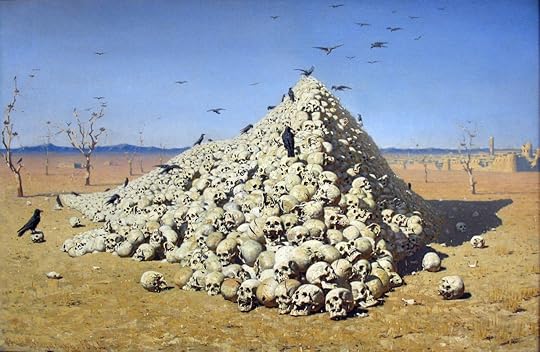
And yes, I did listen to Mussorgsky, Stravinsky and Shostakovich while reading this book. I also looked up a lot of paintings. I recommend that you read the book with the Internet close at hand. Vasily Vereshchagin’s ‘The Apotheosis of War’ is particularly chilling.
Apotheosis of War

I could quite easily go back to the start of this book right now and read it again. But I won't. Instead I'm following it with another book by the same author, A People's Tragedy: The Russian Revolution, 1891 - 1924.
Profile Image for Jacob Aitken.
1,687 reviews418 followers
July 25, 2020
About half this book is quite good, and even where it is bad it fails gloriously. Granted, I was more interested in Figes' take on Holy Russia. He did a fantastic job showing the religious depth of Holy Russia. He explored the fine nuances of the Old Believer schism. He showed remarkable skill in dealing with Dostoevsky.

He tried to make the argument that the Asiatic culture is more due to the non-European strain of Russia. This is a harder argument to evaluate. At its best moment, he is right. Russia is different from France or Britain.
Profile Image for Katia N.
710 reviews1,110 followers
August 11, 2012
Well written journey into the Russian cultural and social history. I liked the most the first part of the book. Of course it is a bit sketchy as the subject is huge, but there are a lot of interesting facts and you can see that the research has been done for the book.
Profile Image for Derek.
1,843 reviews140 followers
September 14, 2022
A sweeping cultural history of Russia. Lots of fun. Figes’ learning and writing talents everywhere on display. A great starter kit for Russophilia.
Profile Image for Mihkel.
90 reviews9 followers
January 21, 2021
Figes kirjutab oma teoses, mille pealkirjaks võinuks vabalt olla ka näiteks rowlinglikult "Vene hing ja kust teda leida", kyllalt põnevalt Vene identiteedi olemusest ja ajaloolisest kujunemisest; millisena on teda erinevatel aegadel nähtud, kust ja kes on teda proovitud leida, ning milliseks on pyytud teda väänata, kui selgub, et reaalsus ei klapigi idealistlike kujutelmadega.

Märkimisväärselt silmaringi laiendav ja temaatikalt mitmekesine lugemine, mis lubab naabrit ning idapool toimunud ja toimuvat ytsjagu paremini mõista. Oh, et suudaks mälu vaid kõike seda meeles hoida!
Profile Image for Mircea Poeana.
134 reviews23 followers
May 12, 2020
Dupa ce am intors ultima pagina am avut senzatia parcurgerii unui maraton.
Dar cartea aceasta nu poate fi parcursa decat "la pas".
Pentru ca fiecare "borna" marcheaza, de fapt, o introspectie fascinanta in spiritul rus.
Dupa ce vei fi parcurs ultima pagina te vei intreba, coplesit:
Ce este Rusia?
Autorul ofera cu o netarmurita generozitate si eruditie o infinitate de raspunsuri.
La fel de necuprinse precum stepa inghitita cu nesat de catre caii inaripati ai unei troici fantastice.
Profile Image for Daniel Bijl.
7 reviews
July 1, 2020
This book is very comprehensive and gives you profound insights into Russian culture throughout the last centuries.
Profile Image for haniurka.
45 reviews2 followers
July 4, 2024
Jestem absolutnie zachwycona, chłonęłam każde zdanie, każde słowo. Ogrom nazwisk i pojęć w ogóle nie przytłacza. Oczywiście nie jestem w stanie spamiętać olbrzymiej ilości informacji, ale sposób w jaki zostały one przekazane - majstersztyk. Figes tak obszerny temat przedstawił właściwie jak świetną powieść. Odrobinę więcej przeczytałabym o czasach sowieckich oraz o Syberii, ale to pewnie moje osobiste skrzywienie (te zagadnienia najbardziej mnie interesują w Rosji). Polecam z całego serca, pozycja naprawdę wybitna!
Profile Image for Katelyn Smith.
31 reviews2 followers
April 8, 2024
"Russia was too complex, too soically divided, too politically diverse, too ill-defined geographically, and perhaps too big, for a single culture to be passed off as a national heritage." Too True.

Figes' awesome epic of a book has brought me the same joy as my undergrad arts degree. Reading it felt like a beautifully curated set of lectures by Figes in conversation with artists from the past. I can't wait to read the rest of his books!
Profile Image for Gintarė Lialienė.
238 reviews24 followers
February 16, 2025
Tai neabejotinai storiausia metų knyga pretenduojantis tapti skaitinys. Nors ėmiau tiek dėl temos, tiek dėl gerų atsiliepimų, vis dėlto kirbėjo abejonė, kurią išsakė ir vienas pažįstamas, su kuriuo aptarinėjau savo istorinės tematikos literatūrą, - ar tai nebus rusų kultūros unikalumą ir mesianistinę misiją propaguojantis tekstas. Laimei, tikrai ne. Anglų istorikas, pasitelkdamas neįtikėtiną šaltinių, kurių nemaža dalis yra kultūros reiškiniai (knygos, paveikslai, muzikos kūriniai, statiniai, kultūriniai judėjimai ir t.t.), pasakoja tautinės rusų idėjos formavimąsi ir naratyvo apie rusų tautos ir kultūros misiją kilimą. Šio proceso kelyje - ir bandymas vaduotis iš atsilikimo, ir kontrvakarietiškos tendencijos, ir žavėjimasis valstiečiais bei jų kultūra, ir bjaurėjimasis jų žiaurumu ir pažiūrų ribotumu. Mano manymu, Figes tiesiog meistriškai pateikia įvairių šaltinių analizės apibendrinimus, plačias apžvalgas ir gana tikslų fokusą į atskiras įdomias, bet savaip simptomatiškas asmenybes.
207 reviews12 followers
July 1, 2012
Debating between a three and four star rating for this. It wasn't necessarily 'bad' in most regards but it didn't stand out as being exceptional either. There were a couple factual errors but others have pointed those out so I will concede to them. Mostly, I was aggravated with its structure. There were many interesting avenues it mentioned but never really explored. I understand this is just supposed to be an overview of Russian culture and I did learn quite a bit from it but I think I would have been more satisfied with a more general overview at the beginning and then more in depth analysis of the specific topics. I was shocked by how little of Lenin and Stalin actually made it into the book. They certainly weren't left out but neither were they biographied.
One thing that did stand out as a rather skilled part of the book was the title and ongoing theme. I've read War and Peace a bit more than I'd like and am very familiar with the Natasha dance scene. Picking that scene as an example of the true 'Russian soul' was very apt. I wasn't necessarily thinking about it when I read W&P but it is a perfect example of how within every Russian, even the upper class, there is a native Russian soul that is a part of all. While this theme wasn't necessarily steady throughout, it was emergent in several areas; especially when reflecting how the Russian expatriates in the 20th century sorely missed their homeland.
Profile Image for Titus Hjelm.
Author 18 books98 followers
January 14, 2022
Figes' Revolutionary Russia was so biased that it was almost humorous (see my review here: https://www.goodreads.com/review/show...), so I approached this with some trepidation. He is at this best, of course, talking about the 18th and 19th centuries, which duly take up 2/3 of the book. Figes spends as much time on post-revolutionary emigre culture as he does on the whole Soviet period. That should already give you a sense of his blinkered view. But the actual section on the Soviet Union is basically one big lament about the fate of the bourgeois artist's fate in the new Russia. This makes sense from the author's perspective, according to which Soviet history is not even Russian history, but rather 'a lens' through which Russia looks distorted. Paradoxically, right-winger Figes ends up taking the Bolsheviks' word for the civilisational break instead of interrogating the claim, like, erm, historians are supposed to do (I think). Otherwise much of the text is big man (much less woman) history, which is sort of disappointing, as the book begins well enough with a broader view. The contextual chapters are the most interesting ones. But it's a great book if you want to know what it feels like to miss the 19th century on the 21st.
Profile Image for K.M. Weiland.
Author 29 books2,528 followers
October 29, 2013
I've always been nominally interested in Russian history (the Romanovs mostly), but I've never really studied anything beyond the 1917 Revolution. This mammoth approach to Russia's cultural history provides a fascinating glimpse into the heart of a foreign nation - and, in so doing, an interesting, if perhaps unintended, perspective on my own national ideology.

I can't comment on Figes's historicity or accuracy, since much of what's here is new material to me. But I will say that I found it fascinating, from beginning to end, and particularly the first three-quarters that address the periods prior to the Revolution and the Soviet Union.

Figes offers not so much a history as a commentary. His comments on the Russian arts, which take up at least half of the book, are riveting. He has a knack for the anecdote, and despite the massiveness of the book, his presentation of the material never grows tedious.
Profile Image for John Carter McKnight.
470 reviews86 followers
March 2, 2014
A cultural history of Russia that's immensely readable and absolutely exhaustively referenced: it's a goldmine of primary sources. The structure is thematic, ratcheting forward and back across topics in a way that actually reinforces nicely the broad structure of Russian history by returning to key places and times from different perspectives.

Natasha's Dance is hefty, at some 580 pages, but some of the most fluid and engaging nonfiction I've read. Figes' style is conversational but never shallow, incisive but never pedantic. I'm definitely looking forward to reading more of his work, especially as several people have told me his history of the Russian Revolution is a new classic and one of the very best on the subject.

The only bone I'd pick is that Figes stops around 1962: I'd have been very interested in his account continuing into the great age of satire and rise of pop music in the late Soviet years.
Displaying 1 - 30 of 408 reviews

Can't find what you're looking for?

Get help and learn more about the design.