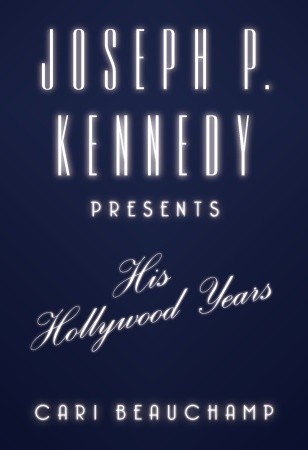
This is the extraordinary story, told for the first time, of Joseph P. Kennedy’s remarkable reign in Hollywood, in which he ran three movie studios simultaneously, led the revolution in sound pictures—and made the fortune that became the foundation of his empire.
Kennedy saw filmmaking as “a gold mine” when movies were an idea one week, in front of the camera the next, and in theaters within the month.
It was 1919; Kennedy was thirty-one years old.
Between 1926 and 1930, Kennedy used his talents to position himself as a Hollywood leader. He ran Film Booking Offices (FBO), was brought in to run Pathé and the Keith-Albee-Orpheum theaters, and became the chairman of their boards. Within months, he was asked to head First National film company. By 1928, Kennedy—merciless, electrifying, a visionary—was running three studios at once.
In Joseph P. Kennedy Presents, Cari Beauchamp writes about the genius behind Kennedy’s profiteering and his importance in changing the way Hollywood conducted business. As one of the first nonfamily members to be given access to Kennedy’s personal papers, Beauchamp, through years of meticulous research and countless interviews with those close to Kennedy, has dug through the maze of deals and the files of memos and notes, only recently made available, to tell in full how he made it all how he charmed, cajoled, and bullied; how he juggles various backers—and managed to line his pockets with millions.
Beauchamp writes about the movies Kennedy produced and the stars he made, about the studios he razed and those he reorganized, about the jobs that were lost and the careers that were ruined (among them, that of silent film cowboy star Fred Thomson—one of America’s top box-office draws).
Beauchamp tells for the first time the full story of Kennedy’s affair with the feisty Gloria Swanson, the “reigning Queen of Hollywood”—an extravagant escapade that became legend and that triggered one of Hollywood’s biggest financial fiascos. It began with Kennedy taking over Swanson’s personal and professional life (“Together we could make millions,” he promised), and ended with his first failure (personal and public) and her career on the brink of ruin, a million dollars in debt.
Beauchamp writes as well about the Hollywood titans surrounding William Randolph Hearst (Kennedy was a welcome guest at “the ranch”) . . . Cecil B. De Mille . . . David Sarnoff, who, with Kennedy, masterminded the unprecedented deal that resulted in the founding of RKO, and that made Kennedy millions.
A fascinating tale of business genius and personal greed that brings to light not only the way Joseph P. Kennedy made his fortune, but how he forever changed the business of movie-making.
Cari Beauchamp is the award winning author of Without Lying Down: Frances Marion and The Powerful Women of Early Hollywood. She also edited and annotated Anita Loos Rediscovered: Film Treatments and Fiction by the Creator of Gentlemen Prefer Blondes and co-wrote Hollywood on the Riviera: The Inside Story of the Cannes Film Festival. Her book, Adventures of a Hollywood Secretary: Her Private Letters from Inside the Studios of the 1920s, was published in 2006 and her current project, Joseph P. Kennedy Presents: His Hollywood Years, has just been published by Knopf.
Cari wrote the Emmy nominated documentary film The Day my God Died which played on PBS and she was nominated for a Writers Guild Award for Without Lying Down: The Power of Women in Early Hollywood which she wrote and coproduced for Turner Classic Movies. She has also appeared in over a dozen documentaries.
She has written for Vanity Fair, Architectural Digest, Variety, The Hollywood Reporter, The New York Times, the Los Angeles Times and various other magazines and newspapers. She is an Academy of Motion Picture Arts and Sciences Film Scholar and her books have been selected for "Best of the Year" lists by the New York Times, the Los Angeles Times and Amazon.
She has appeared as a featured speaker at venues throughout the United States and Europe including The Academy of Motion Picture Arts and Sciences, The British Film Institute, the Museum of Modern Art, The Edinburgh Film Festival, the Cannes Film Festival, the Los Angeles Times Festival of Books, The Women's Museum of Art in Washington D.C. and the Los Angeles County Museum of Art.
Before turning to writing on a full time basis in 1990, she worked as a private investigator, a campaign manager and served as Press Secretary to California Governor Jerry Brown. She lives in Los Angeles.
"A few years back, author Cari Beauchamp wrote an absorbing book called Without Lying Down: Frances Marion and the Powerful Women of Early Hollywood. This was a great narrative about female empowerment in the growing industry of motion pictures, but it did have an intriguing minor player in Joseph P. Kennedy, better known as the patriarch of the Kennedy dynasty but here portrayed as an early mover and shaker and one of the few non-Jewish movie moguls. With this later book, Beauchamp focuses entirely on Kennedy and his thorny Hollywood career. Kennedy put another feather in his “self made man” cap as head of FBO, a company that made a tidy profit with cheapie Westerns in the 1920s. His most notorious effort of that era, however, was the doomed Queen Kelly, a costly Erich von Stroheim epic starring Kennedy’s mistress, Gloria Swanson. The tangled production of that film made for some of the more interesting chapters in this book, along with the areas that dealt with Kennedy’s complex home life (I didn’t know he had an institutionalized daughter, for one). The bulk of the book deals with Kennedy’s wheelings and dealings, which is where it falters. Unlike screenwriter Francis Marion, who was a genuinely appealing and interesting person, Kennedy comes across as, well, a big douchebag. His ambition was admirable, but the man seems like the ultimate glad-handler whose all consuming desire for success left a lot of ruined lives in his path (including that of Marion’s husband, cowboy actor Fred Thomson, who met a tragic fate when Kennedy froze him out of work). It is to Beauchamp’s credit that she can write about such a reprehensible person and make it work, but I was relieved to find him dead in the end." - Scrubbles.net review, September 19, 2010.
Well written and fast-moving . . . but has the irritating "notes without citations" cost-saving format. Ugh! And there's lots of info in the notes, too, so I made a practice of reading each chapter's notes when I completed the chapter.
Joseph P. Kennedy has my nomination as biggest A-hole of the 20th Century USA. Screwed everyone he met (figuratively and, if it was a female, literally, or at least tried). Nice insight on the business of Hollywood c. 1920s, too. Very nicely written . . . makes me interested in reading the author's biography of screenwriter Frances Marion.
Have two other books on Joe Kennedy and/or the family and at first I decided to read Doris Kearns Goodwin's book but then decided I'd had enough of Old Joe at the moment . . . perhaps a bit later. So now on to another book about Hollywood in the Old Days, Douglas Fairbanks, Junior's, autobiography.
The Kennedy family patriarch clearly laid the blueprint for future money makers and takers, such as Donald Trump and Bernie Madoff. Ruthless, greedy, willing to lay out elaborate schemes and patiently wait for the prime opportunity to strike, Joe Kennedy worked the system to his advantage. Starting out in business as "America's youngest Bank President", Kennedy tries his luck at the burgeoning film industry. Unscrupulous, always keeping his eye on the prize (in this case, making money), Kennedy built relationships, and then when they ceased to be of value to him (on any level), he cut them out of his life, not caring about the emotional ruin he left in his wake. joe Kennedy clearly never lost a night's sleep over ruining anyone's life.
The book reveals an untarnished look at Joe Kennedy's life. His famous family is a side story here (although enough is mentioned to cause the reader to wonder just how sane Rose Kennedy was - for accepting her husband's lifestyles (absences, infidelities, business practices) - and for her own seeming peculiar expectations of parental/family life)
A little weighed down at times with names and dates, the book nevertheless reveals how someone who came from outside the entertainment industry, was able to enter - wreak havoc - and depart, having made millions.
If you're interested in this era of Hollywood history or Joseph Kennedy then this would be a good book. But the more I learn about Joseph Kennedy the less I like him and because of that I couldn't like the book. Basically Kennedy was a greedy narcissist. As JFK once said: "He was driven by his own vanity." Or as he would tell his children: "It doesn't matter who you are, it only matters who people think you are."
Joseph Kennedy was very good at accumulating wealth. But he often cheated even friends in order to increase his wealth. For example, he got his movie company where it looked like it was worth a lot and sold it to friends knowing that it was not worth anything like what they paid for it..
And his adulterizing put JFK to shame. He in fact counseled his sons to get all the sex they could. He sometimes brought his girl friends home with all the family there. He bragged to the whole family about his conquests. He got in bed with female guests and tried to get them to cooperate. He had a 8 year "affair" with Gloria Swanson. As one of his friends said: "He viewed women as a commodity to be enjoyed."
One interesting point of trivia: Kennedy began making movies when they were silent and when sound became available Thomas Edison was convinced that no one would ever want sound and wouldn't invest in it.
Probably the most overlooked big name in Hollywood history is Kennedy. Likewise probably the most overlooked aspect of the Kennedy's is the old Hollywood connection.
This book is a nearly perfect answer to that. The only reason I can't give it five stars is it feels like it went out of its way to bury any accomplishment that Kennedy had because he was a douchebag. You can show what a douchebag he was and still admit he accomplished things. Don't get me wrong this book tells us he did this or that but surrounds it in three times as much unrelated info on an affair or on how he didn't go home for this or that. Douchedouchedouchedidsomethingbutrememberdouchedouchedouche. It worked for most of the book but was a little much by the end.
A captivating look at the Kennedy patriarch, Joseph P. Kennedy's foray into the motion picture business in the late 20s.
With a reputation as a savvy businessman, at 25 he became "America's Youngest Banker", Kennedy Sr. recognized the opportunities that the movies brought - money and power! In two short years he was running three studios simultaneously before in a bold move merging his studios with David Sarnoff to form RKO Studios that became the blueprint for contemporary Hollywood; as author Cari Beauchamp writes: "Louella Parsons hailed Joe Kennedy as 'the coming Napoleon' of movies, the white knight with the wherewithal to save film studios by bringing bankers and corporate representatives onto their boards of directors. He was the architect of the mergers that laid the groundwork for today's Hollywood."
The book also looks into Joe's influence on Gloria Swanson. He believed they could make millions together! He wanted to handle every aspect of her career; He managed her finances, produced her films for her production company 'Gloria Productions' which he set up, and eventually became her lover. But when the partnership ended abruptly, Gloria was left in even more debt then before she met Kennedy, which left Gloria feeling betrayed by the man she put her complete trust in. Their partnership was only profitable in the end for Joe.
This book portrays Joe as a ruthless, calculating and ambitious businessman who doesn't mind using his friends and associates for his own personal gain. But though he comes across as a very unlikeable man, his impact on the film industry can't be denied, as wrote Sam Dembow in a letter to Kennedy that said that: "for the short time you have been in this industry you had done more to place it on a higher plane than any one individual."
Cari Beauchamp has written a well researched, insightful look into this part of Joseph P. Kennedy's life and the movie business at the time.
Astonishingly meticulous research forms the basis for the story of the business career of Joseph Kennedy, focusing on his time in the film business and how he contributed to the evolution of film-making into a business rather than purely an art form. Lots about his personal life, too, including his philandering and his unique relationship with his wife and his many children.
Kennedy took Hollywood by storm in the mid to late 20s. He recognized the opportunity to make a lot of money fast and ended up owning and running three studios and changing the way Hollywood made contract and organized their entire business. The palce was never the same after he left, abruptly, after making over 15 million dollars. It discussed his long affair with Gloria Swanso and his abrupt leaving of her as well. He was one ruthless guy. Most biographies on Kennedy, barely mention this time of his life. It is most crutial to understanding of his further career and business style.
Consistently informative and filled with anecdotes that helped this reader appreciate the Kennedy dynasty more beyond its public image of politicking. The only downside was a myopic focus on one particular Silver Age Hollywood studio without drawing clear enough connections to other studios and other contemporary film personalities. Well worth the read though, the sort of almost British approach to an overlooked era in America that needs to be read, even if it is too focused and antiquated to be appreciated today.
That Joseph and Rose Kennedy give new meaning to 'disfunctional family'. In addition to Kennedy's duplicitous dealings with family, frends, lovers and co-partners, this book presents a detailed and knowledgable social history of the early Hollywood years. (Disclamer, author Cari Beauchamp is a long-time friend of mine).
This book sheds further light on how all the money was made, the man behind it, and the fallout he left behind. Interesting book about this particular era in both Kennedy's life and the film industry in it's infancy.
You do not often read about the father of John, Robert, and Ted Kennedy. This book gives a good description of a man who knew how to delegate, handle money, and make a fortune. Good book about the time in his life that made his real fortune to start.
Joseph P. Kennedy was not a nice man--money-grubbing, star-struck, power-hungry. But the book was well-written, and I enjoyed the Hollywood history parts.
Well researched, but the writing is a little clunky in places. Beauchamp clearly doesn't like Kennedy, Swanson or Rose, and after awhile, it becomes a little tedious to read about their escapades.