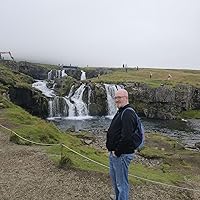
I grew up in Oregon but have lived all over—D.C., Virginia, Maryland, London, Wyoming. My father was an FBI agent and I was a bureau kid, which is similar to being an army brat. You tend to spend your time with other bureau kids and get transferred around a lot, though, I fared better on that front than many others.
One positive aspect of this lifestyle is that you can’t help but absorb an enormous amount about the FBI, CIA, Special Forces, etc. Like most young boys, I was endlessly fascinated with talk of chasing criminals and, of course, pictured it in the most romantic terms possible. Who would have thought that all this esoteric knowledge would end up being so useful?
I came into writing from kind of a strange angle. When I graduated from college in the late eighties, I had the same dream as everyone else at the time—a corporate job, a nice car, and a house with lots of square footage.
It turns out that none of that really suited me. While I did go for the corporate job, I drove a beat-up Jeep and lived in a tiny house in a so-so Baltimore neighborhood. Most of the money I made just kind of accumulated in my checking account and I found myself increasingly drawn to the unconventional, artistic people who lived around me. I was completely enamored with anyone who could create something from nothing because I felt like it was beyond me.
Enter rock climbing. I’d read an article on climbing when I was in college and thought it looked like an incredible thing to do. Someday, I told myself, I would give it a try. So one weekend in the early ’90s, I packed up my car, drove to West Virginia, and spent a weekend taking lessons. Unknown to me at the time, this would be the start of an obsession that still hangs with me today. I began dating a girl who liked to climb and we decided we wanted to live somewhere with taller rocks and more open space.
Moving to Wyoming was the best decision we ever made. The place is full of the most amazing people. You might meet someone on a bike ride and find out they were in the Olympics, or climbed Everest, or just got back from two months trekking in Nepal. In a roundabout way, it was these people who made it possible for me to write a novel. They seemed to have no limitations. Everything was possible for them and I wanted to be that type of person, too.
I was working for a little bank in Jackson Hole, spending my days making business loans and my afternoons and weekends climbing. For some reason, it finally occurred to me that I’d never actually tried to be creative. Maybe I could make something from nothing. Why not give it a shot?
My first bright idea was to learn to build furniture. That plan had some drawbacks, the most obvious of which being that I’m not very handy. It was my wife who suggested I write a novel. It seemed like a dumb idea, though, since I majored in finance and had spent my entire college career avoiding English courses like the plague. Having said that, I couldn’t completely shake the idea. Eventually, it nagged at me long enough that I felt compelled to put pen to paper. Eight months later, I finished Rising Phoenix and about a year after that I managed to get it published.
The success of Rising Phoenix and my subsequent books has allowed me to make my living as a writer, which isn’t bad work if you can get it. Other than that, my life hasn’t changed all that much. Aging elbows have forced me to replace climbing with backcountry skiing and mountain bike racing. I got the not-so-smart idea of restoring an old pickup to replace the dying Jeep. And, I still live in Wyoming...
“Climb Mount Niitaka”.- Code phrase initiating the Imperial Japanese Navy’s attack on Pearl Harbour.
“Once a man’s will is set, he need no longer rely on others or expect anything from the world”.- Yoshida Shonin.
Recently, I went to a country I had not previously visited in Asia. Japan. Land of the rising sun, first country in Asia to develop to the point where it could flip off the 19th Century Colonial Imperialists with confidence, party to a war which led to the death of millions across Asia and the pioneer of todays advanced technologies around the world. While it’s global domination days are very far behind it, Japan, despite a crippling societal lethargy it suffers, Japan is a nation that still has the money and brains to lay the hurt down on anyone who threatens it. Currently, Japan is engaged in a geopolitical game of chicken with China and South Korea over sovereignty over various islands in the East China sea which according to highly questionable UN report are said to contain natural gas deposits. Masking this blatant self – interest is an unhealthy level of nationalism. Currently Japan’s political system is dominated by ultra – nationalists who seek to eliminate the lethargy Japan is suffering by being more proactive on the world stage.
This has concerned its neighbours, the PRC and ROK who despise Japan for its atrocities in WW2 and are paranoid that history would repeat itself if given the chance. While Japan’s ultra – nationalists are wealthy and powerful, they have as of now merely limited themselves to denying Imperial Japan’s war crimes. But what if the more proactive among them wished to strike a blow for their cause? This is the backdrop of “The Patriot Attack”, a conspiracy/spy thriller by Kyle Mills. The son of a FBI Legal Attaché to London who later became a security consultant, Mills made his name writing edgy crime thrillers and later signed on as one of the continuation writers for Robert Ludlum’s Covert One franchise.
Recently, Mills has exploded into the big league by landing the hotly contested position of continuation writer for the Mitch Rapp franchise. Having read “The Survivor”, I decided last year when travelling on holiday in Japan to bring along “The Patriot Attack”, and experience Mills work before he succeeded Vince Flynn. What did I find? A big surprise. Now to the review. What happens when three countries dig themselves holes that they cannot get out of?
We start the novel during the 2011 Fukashima incident. Two scientists are working underneath the power plant when the earthquake happens. Their experiment is immediately damaged and both are infected. One of them, Dr Hideki Ito manages to get away, but is forced to leave his assistant behind and watch her succumb to radiation poisoning. He himself has also been contaminated and mulls over how long he has to live. We then cut to 2016. Colonel John Smith, the main protagonist is in Northwest Japan attempting to conduct an asset link – up in a warehouse. Unfortunately, the asset has been hit by crossbow bolts and only manages to hand over a briefcase before bleeding out. Smith then is attacked by the hitters pursuing the asset and is forced to dive into the sea before being hit by at least one bolt.
Across the world in Egypt, CIA officer Randi Russel is hunting a terrorist. Expertly poisoning him in the middle of a crowded street, she vanishes, only to have Fred Klein, the director of Cover One contact her upon her return to the USA. He tells her Smith has gone missing and assigns her to find him. And in Tokyo, in front of the Yasakuni Shrine, General Masao Takashashi is nearly assassinated by a bomb but miraculously survives despite the bomb being designed to destroy most armour plated automobiles. This kicks off a series of events that centre around one of the most ingenious WMD’s ever conceptualized, one that could end the world as we know it. As the JSDF General begins to carve a blood splattered path into the history books, only one question remains. Is it right or wrong for a Patriot to attack first?
In term of plot, The Patriot Attack is a surprisingly deep look at the future of modern warfare. While the book on the surface, is a traditional conspiracy thriller, it’s actually a bit more complex under the surface. Taking a conventional warfare scenario and adding in technology that will appear on the next battlefield within 20 years, the story lightly bends science fiction and technothrillers together to create a classic, old school speculative thriller, something that hasn’t been seen in the genre in a long time. Unlike most speculative thrillers however, like the disastrous Ghost War by Peter Singer, Kyle Mills infuses far more heart and soul into the narrative by respecting the fundamentals of a good narrative, not forgetting about them, while at the same time, examining the tools that shall be used the wage advanced warfare.
Action and setting? Very satisfactory. Mills is very solid in this department. However, let me be frank, his small-scale stuff is average. His true strength lies when he goes all out and writes large scale set pieces, many which would be fit for a large scale multi – million-dollar action movie. From a race through a Beijing department, to a gun battle through a hidden mountainside JSDF facility, to a grand, teeth chattering climax on the Japanese Prime Minister’s Gulfstream IV jet as it is pursued by USAF F35 JSFs, The Patriot Attack only gets better and better as you keep turning the pages.
Research? Phenomenal. The Patriot Attack gives a truly in depth look at the weapons of advanced warfare that we shall see on the battlefield in about two decades time. Whether it be artificial intelligence, electromagnetic pulse weapons and even nano – technology, Mills explains things for the reader, while demonstrating these fancy weapon’s possible applications. One of the highlights I found was a truly horrifying anti – personnel weapon that acted like a giant shotgun shell slug. The results when several bit characters were subjected to it would rival even the worst slasher movie. Mills also gives an accurate look at Sino – Japanese relations in the 21st century, and the messed up cocktail of bad blood, historical rivalry and plain racism stoked by both countries against each other, that make said relations far worse than they should be.
Characters? Surprisingly good. I admit I wasn’t impressed with the main protagonist (and I’ll get to him later). The rest of the cast on the other hand, were outstanding. I’ll focus on three standouts who stole the show collectively.
First, Dr Hideki Ito. Ito is a fascinating, surprisingly sympathetic character. A well-intentioned bloke who has had his creations perverted by a psychotic tyrant, Ito represents the side of Japanese culture that is most appealing, the creative, pacifistic side which has given the world a lot over the years. Initially in awe of his boss, Ito has gradually gotten concerned about the direction of the undertaking he was selected to take part in, and ultimately being a man who has nothing left to lose, makes a very brave decision to help save the world from annihilation.
Second, Randi Russell. Whenever Randi appears, the author’s narrative sprung to life like a M67 fragmentation grenade crashing through the window of a public library. A tough woman who is married to the job, Randi is a funny, somewhat paranoid figure due to the nature of her profession. It’s this darkly comedic paranoia combined with her skill in combat that makes her a compelling combination, even more so when the mask of mistrust breaks and her humanity begins to shine through, in two of the most tragic scenes of the story. If the author were ever to return to writing Covert One books, I’d pay top dollar for a book focusing solely on Ms. Russell, who joins the recent influx of very deadly female protagonists in contemporary thriller fiction.
Thirdly, Masao Takahashi. The antagonist of the story. Chief Of Staff of the JSDF, Takahashi is a fully paid up, card carrying member of the Ultra – nationalist political establishment. Son of one of Japan’s leading Zaibatsu executives, Takahashi is motivated primarily by the painful demise of his mother in post WW2 who deliberately gave him and his brother her rations, starving to death as a result. Not wishing to have this happen again, he set about building a war machine that could annihilate China and America at the same time. This desire however has become twisted and warped over the years, and combined with the eugenics inherent in the Japanese ultra – nationalist ideology has resulted in an otherwise well-meaning man becoming a closeted genocidal maniac. The General isn’t a moustache twirling chap however. Mills expertly makes everything he says come across with a cool, dispassionate logic. Even when advocating the slaughter of a billion people, Masaso pulls off the rare bad guy feat of making the reader pause and stop, realizing that he might have a point, albeit only for a moment before remembering the substance and end game of his truly monstrous scheme.
Now to the constructive criticism. Firstly, some of the writing could have been tightened up a bit more. Mills has already honed his style in the later Mitch Rapp books and as such and clearly had developed as a writer shortly after this novel. Secondly, John Smith. I found the main protagonist boring, a blank slate with little personality or color. Granted, the other cast members picked up the slack, but being a blank slate, Smith, could have used a whole lot more fleshing out. I previously read one of Jamie Frelevetti’s Covert One books and I found her John Smith far more dynamic and compelling than the one I met in The Patriot Attack. However, that being said, the issues I had with the protagonist did not unduly ruin the story or my reading experience.
Overall, The Patriot Attack is an impressive, classic speculative fiction thriller done right. Unlike the soulless, non – fiction research manual “Ghost Fleet”, written by two academics who should have consulted with an experienced thriller novelist before even writing the first draft, Kyle Mills, surpasses them with solid writing, excellent plot structure and a cast of characters who constantly surprise and hold the readers interest. At the end of the day, it’s not the guns, weapons or high tech toys that make a good novel. It’s the story that is to be told and The Patriot Attack tells a complex tale wrapped up in history, geopolitics and the fate of the most important place on earth. If you really want to find out what will be used on tomorrow’s battlefield, check out The Patriot Attack which might play out in the near future.
I kind of didn't like the fact that Japan was the villain and people were working with China at one point. But hey... it's not all that bad as the fight did reach US soil and the aerial battle between US and Chinese jets was awesome.
First and foremost, a large thank you to NetGalley, Kyle Mills, and Grand Central Publishing for providing me with a copy of this book, which allows me to provide you with this review.
In March 2011, everything ran effectively at the Fukushima Daiichi Nuclear Power Plant until an earthquake and subsequent tsunami severely damaged the facility. Years later, Dr. Jon Smith is in the region to meet with a former plant employee who possesses a sample he wishes to share from one of the Fukushima reactors. During the meeting, both are attacked and Smith is left severely injured and coalescing in a covert facility within Japan. Hearing of Smith's plan and noting that he has not returned on time, CIA Agent Randi Russell takes it upon herself to rescue the head of the ultra-secret Covert-One team. While she is able to extricate Smith from his captors, she also learns that the sample may be the key in Japan's new nuclear arsenal, with China as the country's first target. Back in the United States, President Sam Adams Castilla cannot help but notice that military aggression between China and Japan seems to be heating up and quickly calls a summit that he will mediate. He brings the leaders together in hopes of quelling tensions that have been strong since well before WWII, when the latest set of atrocities are mentioned in history texts. As Smith and Russell are able to acquire some of the aforementioned sample, they present it to an engineer who is baffled to learn of its content. With Masao Takahashi as the military Chief of Staff, Japan is creating the next-generation of weapons, seemingly harmless but whose use could cripple any opponent. This form of nanotechnology could wipe out anything military in a short span of time, no matter its size. Will Smith and his team be able to stop Japan's burgeoning nanotechnology warfare while Castilla attempts to keep the Asian powder-keg from exploding? Mills effectively continues the legacy that Ludlum started in this high-impact series as he seeks to answer these questions for the enthralled reader.
It is highly impressive to see how Mills has successfully picked up the torch on Ludlum's Covert-One series. I have witnessed other authors ruin a series' momentum or character development when taking over for an author who has passed away, taking control as though they now own the collection. Mills has tapped into the Dr. Jon Smith character and the nuances of the Covert-One team, as well as the intricacies of biological and nanotechnologies found within the entire series. Additionally, Mills is able to present strong political and social themes throughout to further explore the importance of the novel's plot, allowing the reader to see things on a macro scale. While some readers might be interested only in the thrills and action within the pages of this novel, extrapolating to both the series level and current political situations, it is highly interesting to realise how plausible these things might be, given the geopolitical situations at hand. While he alternates writing Covert-One novels, Mills does not miss a beat and is able to build on previous Ludlum novels, as well as those of his colleague, which allows those fans of the series not to feel jilted or left to skip books to gain the proper momentum. Mills is a wonderful storyteller and has the essence of the Covert-One theme embedded in his writing style, which proves refreshing and is highly refreshing for Ludlum fans who have suffered through the destruction of another series Ludlum left incomplete.
Kudos, Mr. Mills for this wonderful addition to the series. I hope you are kept on as one of the key writers to keep making Robert Ludlum proud for years to come.
A guest left this book in the hotel I work in, so I gave it a go.... The praise for this book are about the dead author (Ludlum) not about the actual writer (mills).... a great sign.
I basically liked nothing about this book but didn't hated to the point of not finishing it. thankfully the pace is quite high with lot of small chapters so I could read just a pages at a time.
The story had nothing going on for me. The probability of it happening seams so low in my opinion that it never got me hooked. you never really imagine that the villain's plan is going to succeed.
and I don't like when authors twist real events like this, it is just adding fuel on conspiracy theories and people believing the moon landing never happened.
I gave Kyle Mills one more chance and it was the last time. For whatever reason, he fills the need to make all of the characters talk with a lot of profanity. This is not consistent with the many other books on Covert-One. The other authors, such as Jaime Freveletti, are much better writers. Sorry Kyle, I'm done with your books.
as always, these authors never cease to amaze and hold anyone's attention. These novels are unbelievably exciting with always the right bit of mystery and action. The main characters are true of heart and become part of you as they achieve their missions. These novels continually leave me anxious for the next one. This is the second time I've read this one and love it.
A simple clandestine meeting turns into something more sinister...perhaps the start of World War 3 and the ultimate subjugation of the entire world to a world power previously thought under control. This may be one of the toughest assignments ever to come to Covert One. Victory is far from certain as LTCOL Jon Smith tries to prevent the war and the potential end days that follow.
While Mills is a decent enough ghost writer, with a Ludlumesque sense of complex plots, his lead characters remain too bland and generic. Jon Smith has unrealized potential, and more scars and injuries than a 17th century pirate, which makes you want to see more interesting characters and dialogue to go along with the fast=moving adventure. Too much B Movie; too little engaging writing.
After re-listening to FADE (Awesome) and prior to that, SURVIVOR, I found PATRIOT ATTACK better than Survivor and a good write overall. I find the premise interesting and creative, but I wish the ending was better. 6 of 10 stars
An interesting take on Japan and how the military culture may have evolved secretly since WWII, but overall not a great read. Characters are pretty two dimensional with few compelling reasons to turn to the next page (unless you're an idiot like me who can't NOT finish a book).
This is a Covert-One novel, started by Robert Ludlum. Once again, Jon Smith and Randi Russell save the world. This time they saved it from nationalistic Japanese who wanted to unleash nanotechnology.
Every moment is so darn urgent that this book becomes numbingly easy to set down for a break; I was always confident that I could focus on real life for a moment without thinking that I'd lose the momentum of a character's subtle growth.
That said, the steady drumbeat of "near misses" is entertaining, and right down the predictable middle of the confines of the genre. If you want an action novel, it's here.
I'm not a Ludlum fan. I read this because the post-Ludlum author has written some serviceable post-Tom Clancy novels. This novel is a rare work in which China is the good guy and Japan the bad guy. Interesting techno-fantasy.
This book is the 12th in a series COVERT-ONE created by Robert Ludlum. I am impressed; this action story is very different than the usual genre. The Patriot Attack is the story of a deepening rift between Japan and China. The United States has an agreement to defend Japan as the constitution crafted by Gen Douglas MacArthur at the end of World War II. Unbeknown to any of the world governments the head of the Japanese Defense Force has been quietly building weapons of war Covert-One operations Colonel Joh Smith and Agent Randi Russell we’re in Japan; Smith to receive secret papers to be smuggled to the US, and Randi Russell comes to Japan to find the wounded colonel being held as his captors try to locate the papers he possessed. Not much introspection in book number 12. I look forward to finding the first eleven.
I do love me a good story of intrigue and suspense. As with all novels of this genre there are a lot of characters to think about, to keep them straight, and to remember names, motives, relationships. It's a tricky read for the first hundred pages. And then the story kicks in and everything makes sense. Now all you need to do is live with the questions while you keep reading:
> Will Jon live long enough to rescue Randi, returning the favour she paid him in the first few chapters? > Is Klein trustworthy? > Did Kaito really die? > Is Sanetomi as stupid as Takahashi thinks he is?
But beyond that, once the book's over the questions that remain are more like: > Is that kind of technology seriously even possible? > How many maniacs actually are alive and in power on our planet, really? > Is WWIII inevitable, actually? > Does good always win?
Kyle Mills continues to show his grasp for stepping into the shoes of authors who have left us and continuing their stories! The Patriot Attack is another page turner that keeps your attention until the end.
The scary thing about the subjects of these books is the real possibility of the threat occurring. We might have thought it an impossibility or something in the future, but technology is advancing so fast, that impossibles are now possibles. Nanotech, drones, remote bombs, miniature gadgets that destroy big things are no longer outside the realms of possibility.
Mills does a great job of combining that tech with warped power hungry people to give us a great read that makes you want to go by some MRE's! Thanks for writing a thriller.
Starts well but finishes quickly and without style. Look its a tech / spy thriller so you expect a little fantasy and extremes of sience etc but there has to be a line in the sand and this one crosses that line into silly and with great big plot holes, not too mention 'who would do that?!!' moments. The whole Covert One series is a bit too far out there for me with just two 'agents' who would undoubtely been knocked off very early in the piece.
So if you leave your brains at home and just go for full fantasy its an ok read if you like some realism and some less than predictable outcomes and a plausible plot, it isn't for you.
A satisfactory, if not excellent, end to the series (that we know of). I wonder if Kyle Mills intended this series to end with a bruised and battered Jon Smith, a nowhere to be seen Randi Russell, and basically every other recurring character (save for the top brass) to be out of sight mostly. Anyway, nanotech again - interesting, though a bit sad they barely mention the other Covert One story that also focused on nanotech. And the flip between the usual protagonist and antagonist country is also interesting. Still, I wonder if a lot more could have been told here - Utopia Experiment was definitely more philosophical for example.
This entire review has been hidden because of spoilers.
Kyle Mills is keeping the franchise alive quite skillfully. Fast paced, with Jon and Randi performing their usual stunts with blessings from the elusive Klien and the president. One major drawback here is that the stories are getting quite repetitive. Every story revolves around mad men in possession of apocalyptic technologies who are hell bent on wreaking havoc across the world. Of course they are not successful thanks to the Jon and the C-One team. Still, its a nice read!
Very drama! Such wow! What luck of the major characters! They never seemed to die, but everybody else did. While I found myself listening to this book with a lot of interest, the writing is cliche and repetitive, too much swearing, and a rather unbelievable plot. World War III basically lies in the hands of 2 people who keep getting very, very lucky in their predicaments. It might make a good movie, but as a book it falls short of anything I would ever call "great fiction."
Kyle Mills takes the characters of Jon Smith and Randi Russell and brings them into an interesting doomsday scenario. His writing is quick and keeps the reader wondering what will happen next. Also as Smith is getting a bit older he doesn't bounce back miraculously from his injuries the way Bourne seems to in his stories. This story had me turning pages and staying up late to finish.
Whether writing under his own name or Clancy or Ludlum, Kyle does a masterful job. Good character development, believable plots and edge of the seat action combine to create a great book.
The ways to kill each other seems unlimited. Let's hope that America will continue to be focused on saving others from themselves. The bravery of our Armed Services is never ending.
I enjoyed this one quite a bit (although the premise was a bit over-the-top, but that's O.K.). Kyle Mills has an effortless writing style and is going on my list of favorite authors! I thought the ending of this one was a little flat but to be honest I couldn't put the book down.