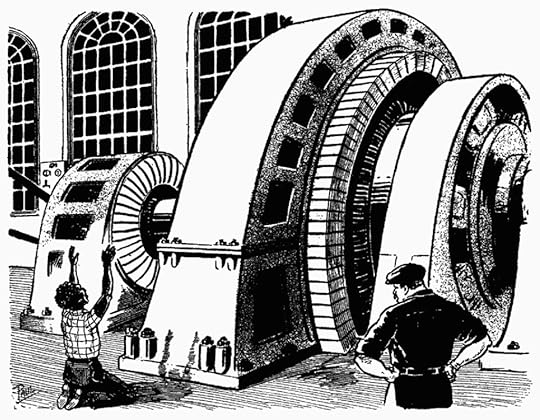
قَرويٌّ هاربٌ من عُبوديةِ المُستعمَراتِ في ثيابٍ بيضاءَ مُهلهَلة، حطَّ رِحالَه في لندنَ ليَتعبَّدَ في ضريحِ الحضارةِ والتمدُّن. كانَ أبوهُ يَعبدُ حَجرًا نَيزكيًّا؛ فما الذي يَستحِقُّ أن يُعبدَ وتُقدَّمَ له القرابينُ في نظرِ ذلكَ القرويِّ الأَبْلهِ وهوَ في مِحرابِه الجديدِ داخلَ إحدى مَحطاتِ الكهرباءِ بمدينةِ «كمبَروِل»؟
يَفزَعُ العاملُ المسكينُ إلى أكبرِ المُولِّدات — ذلكَ الذي يَملأُ نفسَه مَهابَة، وربما أصابَهُ بلَوْثةٍ في عَقلِه — مُلتمِسًا حمايتَه من رئيسِه الذي يُعامِلُه بكلِّ قَسْوة، ومتَّخذًا منه إلهًا يتعبَّدُه ويتضرَّعُ إليهِ ويُشهِدُه على ما يتعرَّضُ له مِن آلام. فهل سيصبحُ العاملُ أفضلَ حالًا في كَنفِ سيدِ المولِّدات؟ وهل سيَكفُّ رئيسُه القاسِي عن إيذائِه؟ هذا ما سنتعرَّفُ عليهِ في هذهِ القصَّة المشوِّقة.
Herbert George Wells was born to a working class family in Kent, England. Young Wells received a spotty education, interrupted by several illnesses and family difficulties, and became a draper's apprentice as a teenager. The headmaster of Midhurst Grammar School, where he had spent a year, arranged for him to return as an "usher," or student teacher. Wells earned a government scholarship in 1884, to study biology under Thomas Henry Huxley at the Normal School of Science. Wells earned his bachelor of science and doctor of science degrees at the University of London. After marrying his cousin, Isabel, Wells began to supplement his teaching salary with short stories and freelance articles, then books, including The Time Machine (1895), The Island of Dr. Moreau (1896), The Invisible Man (1897), and The War of the Worlds (1898).
Wells created a mild scandal when he divorced his cousin to marry one of his best students, Amy Catherine Robbins. Although his second marriage was lasting and produced two sons, Wells was an unabashed advocate of free (as opposed to "indiscriminate") love. He continued to openly have extra-marital liaisons, most famously with Margaret Sanger, and a ten-year relationship with the author Rebecca West, who had one of his two out-of-wedlock children. A one-time member of the Fabian Society, Wells sought active change. His 100 books included many novels, as well as nonfiction, such as A Modern Utopia (1905), The Outline of History (1920), A Short History of the World (1922), The Shape of Things to Come (1933), and The Work, Wealth and Happiness of Mankind (1932). One of his booklets was Crux Ansata, An Indictment of the Roman Catholic Church. Although Wells toyed briefly with the idea of a "divine will" in his book, God the Invisible King (1917), it was a temporary aberration. Wells used his international fame to promote his favorite causes, including the prevention of war, and was received by government officials around the world. He is best-remembered as an early writer of science fiction and futurism.
He was also an outspoken socialist. Wells and Jules Verne are each sometimes referred to as "The Fathers of Science Fiction". D. 1946.
اسم الكتاب📚 : سيد المولدات المهربائية اسم الكاتب ✒: هربرت جورج ويلز عدد صفحات الكتاب📄 : 18 صفحة نوع الكتاب : خيال علمي تقييم الكتاب 🌟: 3/5
نوع القراءة : إلكتروني 💻
📌 ملخص الكتاب : هل فكرت يوما أن تعبد آلة ؟! هل ستجرؤ على تقدير قرابين بشرية لها ؟ الزنجي ازوما زي فكر و تجرأ على عبادة مولد كهربائي بلندن و سماه سيد المولدات ؛ و بدأ يتضرع إليه و يشكو له عذاباته و جور رئيسه هولرويد له ؛ فبدأ يتخيل إشارات المولد له و ومضاته كرسائل إلاهية ؛ فقرر أن يقدم رئيسه له كقربان ؛ لكنه لم يكتفي بذلك إذ ظن ان المولد لا زال متعطشا للدماء فقرر التضحبة بالمدير العلمي للمركز لكن هذا الأخير عاركه و نجا ؛ ليقدم أزوما زي نفسه للمولد كقربان كما قدم ابوه نفسه للإله جوجرنوت من قبله.
للبحث 🔎: نظرية دورة كارنو الفيزيائية ثماثيل بوذا في رنجون الاجلاف اله جوجرنوت
ENGLISH: In this short story, first published in 1894, Wells tells about the most short-lived of all religions. This story contains an interesting paragraph, which Wells could have applied to himself years later, when he became an atheist. The paragraph says: He doubted the existence of the Deity, but accepted Carnot’s cycle, and he had read Shakespeare and found him weak in chemistry.
Another quote I found interesting: Of course a crowd collected outside the gates of the yard — a crowd, for no known reason, always hovers for a day or two near the scene of a sudden death in London.
ESPAÑOL: En este cuento, publicado por primera vez en 1894, Wells habla de la más efímera de todas las religiones. Este cuento contiene un párrafo interesante, que Wells podría haberse aplicado a sí mismo años más tarde, cuando se hizo ateo. El párrafo dice: Dudaba de la existencia de la Divinidad, pero aceptaba el ciclo de Carnot; había leído a Shakespeare y lo encontró flojo en química.
Esta otra cita también me pareció interesante: Naturalmente, se reunió una multitud fuera de las puertas del patio; en Londres, sin razón conocida, siempre se reúne durante un par de días una multitud, cerca de la escena de una muerte súbita.
Another Wells story knocked off. A simple story of an abusive boss at an electrical power plant who treats his immigrant underling like a slave, until the immigrant - who has come to view the dynamo as a God - decides that Gods need sacrifices.
Those sensitive to the realities of of older worldviews (even when the author is attempting to portray his progressiveness for the time) should probably avoid as this was written in 1894 as Wells wrote The Time Machine - but did not invent one himself (no matter what TIME AFTER TIME may tell you) and the story turns on Azuma-zi's "savage" understanding of his new god. As these things go, not bad but not top flight Wells - some nice interesting pre-Futurist touches with the poetic extolling of the dynamo and the wonders of electrical creation.
قروى يهرب من العبودية الى لندن ليعمل هناك وحينما يرى الحضارة والعلم والالات رأى ان افضل من يعبده هو المولد الكهربائى الكبير فى المحطة التى يعمل بها ووجه كل ايمانه الى ذلك المولد
Normally, you can mark politically incorrect writings from this time period as products of the times, but this particular one is just straight up racist. Wells can't decide if his character is from Asia or Africa, but the fact he's not white is all that matters to his story, as the character begins to worship a dynamo as a god and to present human sacrifices to it.
Penguin books, 2007. A short story with a very interesting metapolitical subtext. The language is simple, but vivid and it does have a high level of actualization (in the theoretical sense of Viktor Šklovski), at least for a non-native English speaker like me. It's very hard for a non-native speaker to dig a level of language actualization or language automatization. The story lays out many dichotomies: the industrial age (spirit of the machine) - the agricultural age (spirit of the gods), whites- nonwhites, the West- the nonWestern world, "culture"- "savagery".... It's a perfect example for an orientalist academic approach. This short story truly demonstrates the racist nature of the protestant and anglo-saxon world. They really turned the wrong way with Martin Luther. Thanks God I'm not an anglo-saxon! H.G. Wells in that sense perfectly falls in line with the modern radical left; a racist hipocrite. Hasta luego mis murcielagos!
I'm in the "other stories" part of my "The Time Machine and other stories by H. G. Wells" book, and oh boy are the other stories not great.
A dark-skinned "savage" comes to London and ends up worshipping a big machine, then kills his mean boss with it and then himself. The last paragraph sums it up well: "So ended prematurely the worship of the Dynamo Deity, perhaps the most short-lived of all religions. Yet withal it could at least boast a Martyrdom and a Human Sacrifice."
Also, in the first page and a half there are 3 variations of the n-word, including one ending in "oid".
This entire review has been hidden because of spoilers.
Published in 1894, H.G Wells' 'The Lord of the Dynamos' offers a short yet interesting story considering the anxieties of an increasingly industrialised city-scape. In studying these anxieties, Wells also interrogates contemporary ideas regarding eugenics and the position of racial minorities in society at this time. In this way, casting Azuma-Zi as "a dumb animal", his brain "twisted round in the reverse way to a European's", while Holdroyd is ironically titled the "Lord of the Dynamos".
A quick, little, lesser known short story about a giant electric generator powering the train network and the aboriginal workman who stokes the engine and worships it as a god. Odd to find it as a standalone audio"book" (at only 25 minutes long). Clearly doesn't belong in any Best Of Wells collection, explaining why I hadn't come across it before. But not bad - definitely worth reading.
Super racist, but interesting short story, nonetheless, about the worship of a machine/technology as a god.
The whole premise, unfortunately , depends upon the racism as a foundation: 1) Wells literally writes of a non-white immigrant’s “savagery,” aka the worshiping of inanimate objects or natural phenomena by non-white societies, and the “shape of his face/brain,” essentially screaming phrenology. 2) It’s…explained? Implied? that this immigrant has such a small brain that he determines the largest of the machines he monitors is a god, eventually leading him to believe that said god requires sacrifices. 3) The machine does “save” him from his bullying, racist boss after he sacrifies him to it, but it still essentially comes down to a non-white immigrant being considered too slow/stupid/ignorant to understand the world he finds himself in. 4) This (in the on-point words of one of my fellow reviewers) “murderous, idolatrous” immigrant then wonders if the machine is still hungry, and attempts more murder before sacrificing himself when others come to the victim’s aid.
Per glancing at some essays and other criticism online, it seems Wells was actually intending to critique imperialism and racist attitudes here as well as technological dominance? And though he is sympathetic to his MC, perhaps also to critique religious fervor as well?
This entire review has been hidden because of spoilers.
Read for ENL 173 - Published in 1894, reflects themes of that age about race and dependence on technology - Racist language by modern standards, call Azuma-zi the n-word, negroid, describe him as savage, animalistic, uncivilized, describe his appearance in a very racist way, he doesn't like to work, his father worshipped a meteorite, etc. - question of do we judge a person from history by modern standards or by the standards of the time? - Is Azuma-zi even African? Described as Asiatic and likely Islaamic (saalamed the dynamo) - maybe Southeast Asian? Perhaps reflection of English attitudes towards people from the British Raj in India? - Humanization and personification of the Dynamo - extensive imagery describing its hum and its movement - Religious hysteria - Overarching theme - opinion that non-whites are unequipped to handle or interact with civilization and advanced technology, superiority of civilization over "uncivilized" peoples
This entire review has been hidden because of spoilers.
Opening illustrations by Frank Rudolph Paul from H.G. Wells' short story The Lord Of The Dynamos
It deals with what Wells describes as "certain odd possibilities of the negro mind brought into abrupt contact with the crown of our civilization" and the narration displays racist attitudes common among British society of the time, in addition to the overt thuggish bullying racism of the character Holroyd.
عودة بعد فترة طويلة لكتابات ه.ب.ويلز والحقيقة رغم ان هذا العمل قصه قصيره لكنها من أفضل ما قرأت له رغم عدم شهرتها محاولة الربط بين مدي تأثير الخرافات الدينية على ضعاف على العقل والنفوس الى تصل بها لعباده الآلات بل والبحث عن رضائها والفداء اليها ككافة رموز الطوائف الدينية منذ انسان الكهف كانت في منتهي الابداع عمل مميز يستحق النجوم الأربعة.
Short but yet a violent story, Worshiping a big generator (Lord of dynamos) may not makes sense, however the dynamo was the only lord that can save the servant from his racist master. I guess this story was somehow involved in the famous AC/DC war current Tesla/Edison...
Def problematic by today's standards but something with it clicked for me and it's part of the genre of "I wish I could adapt this as a movie/short" alongside Cain by Saramago. Reminded me a bit of The Lighthouse (Eggers) which is always a good thing.
very short but quite a good read. the language used betrays its age, even more so than with the other works of Wells I've read recently.
a story on slavery, on racism and on how one can suddenly turn to religion in their darkest hour. superstition and worship can lead men to do disturbing things.
buen cuento sobre la extrañeza de las nuevas maquinas y su facilidad para matar y el final es muy bueno de como esta nueva religion de dioses tuvo un martir y un sacrificio
Interessant skrevet og fortalt, men plaget af sin udstilling af race og civilization som grundlag for hele fortællingen, omend den også nuancere og ikke ligefrem udstiller de hvide som gode heller.
I understand that HG Wells' views were a reflection of the times, but some of the racist language and imagery was too distracting. It was difficult to appreciate the rest of the story as I normally do when reading stories by him.