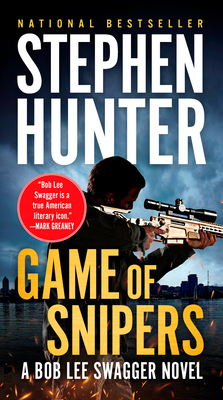
NATIONAL BESTSELLER "Bob Lee Swagger is a true American literary icon." --Mark Greaney, author of Mission Critical
In this blazing new thriller from Pulitzer Prize winner Stephen Hunter, master sniper Bob Lee Swagger takes on his biggest job to date...and confronts an assassin with skills that match his own.
When Bob Lee Swagger is approached by a woman who lost a son to war and has spent the years since risking all that she has to find the sniper who pulled the trigger, he knows right away he'll do everything in his power to help her. But what begins as a favor becomes an obsession, and soon Swagger is back in the action, teaming up with the Mossad, the FBI, and local American law enforcement as he tracks a sniper who is his own equal...and attempts to decipher that assassin's ultimate target before it's too late.
With all-too-real threats and twisty, masterly storytelling, Game of Snipers is another gripping addition to a bestselling Bob Lee Swagger series.
Librarian Note: There is more than one author in the GoodReads database with this name. See this thread for more information. Stephen Hunter is the author of fourteen novels, and a chief film critic at The Washington Post, where he won the 2003 Pulitzer Prize. He lives in Baltimore, Maryland.
I have been reading the Bobby Lee Swagger novels so long, I feel almost as old as Bob. This book does not make him to be young or superhuman. He is 72 and it shows. But his mind is sharp as ever. A great cast of characters. Loved the ending. At 73 can we expect any more of Bob Lee?
Game of Snipers is the latest in Stephen Hunter's Bob Lee Swagger series and is as good as they come. Highly recommended for fans of thrillers that are written well and full of quotable lines.
This is a great piece of work, how a book about a sniper who doesn't use a sniper rifle can be good is all up to a great author. I just love Bob Lee Swagger stories. Any Swagger book is a good book. I must thank the G.P. Putnam's sons and Edelweiss for giving me the opportunity to read this one. I strongly recommend all my followers to try Stephen Hunter.
Bob “the Nailer” Swagger returns in another rip-roaring thriller from New York Times bestseller Stephen Hunter (G-Man, 2017, etc.), who serves up another thrilling adventure featuring the world’s more feared sniper.
Until now, when it comes to the long gun, Bob Lee Swagger’s unique set of skills has gone unmatched on the battlefield. That changes, though, when a man his equal in every way sets his sights on Swagger—who is determined to help a woman in desperate pursuit of exacting justice for her fallen son.
It all started when Janet McDowell arrived unannounced at Swagger’s Cascade, Idaho ranch, and asked him to help her track down the man who killed her son. More than a decade prior, Lance Corporal Thomas McDowell was shot in killed while in Baghdad, and Janet has spent the years since furiously trying to track down the man who pulled the trigger. Risking everything, including her life, Janet has visited the Mid East—where she was beaten and raped, talked to soldiers who served with her son, and followed every clue she could uncover.
Quitting her job and spending every waking moment pouring over the details she’s compiled has left her lonely and broke. Sustained by loans from family and friends, Janet’s obsessions lead to her being shunned by the CIA and Pentagon, who dismiss her as a crazed, heart-broken mother with an ax to grind, but no actionable intel. What they don’t know, however, is that Janet has indeed found the man who killed Tommy—a legendary gunman known only as “Juba the Sniper,” and she wants Swagger to travel to a small town in southern Syria and repay the favor by putting a bullet in him from a mile away.
Though he feels for Janet and wants to help, Swagger . . .
Another good one. Bob Lee is getting old, makes mistakes, doesn't always pay attention...he's showing his age at 73. But he's still the best at the sniper mission. He is no longer on the front line but a consultant helping to find "Juba the Sniper" who is on a mission to kill someone in the US. Of course, Bob Lee does find a way to get into the action but doesn't always come out on top. But put a rifle in his hands with time for just one shot and see if he still has it....4 Stars
Reading the new Bob Lee Swagger novel, Game of Snipers is like putting on a favorite pair of pants. You know the characters and what Swagger stands for - it's so comfortable to ease into the story. "Swagger gets a visit from a mom who's deployed son was killed by sniper fire. She wants someone to find the sniper. Swagger gets his old friend, FBI Agent Nick Memphis, involved when he realizes that the sniper has something big planned. And now they must figure out what and where and when. And hope that Swagger still has some of his sniper magic."
Swagger is now 72 and running lay barns for horses. He shows some mortality in this book. And the reader is never sure if Swagger is going to make it all the way through. Hunter gets technical in the descriptions of what is needed for a long range shot (more than a mile) and sometimes it feels like that slows the story down a bit. But it still comes down to Bob and team looking at the evidence and shooting setups to find a sniper.
Bob's wife is conspicuously absent a couple of times, but you have to assume that Hunter felt like her part would not matter to the story.
Bob Lee Swagger has been around since 1993 (Point of Impact) It's nice to see him age and grow and become less of a super hero and a little more human. If you haven't read Stephen Hunter before, you can still read this as a stand-alone. Game of Snipers is a great addition to the Swagger story. If you like some action, you'll definitely want to add to your summer reading list.
This book is an exciting, but thoughtful thrill ride into the world of seventy-two year old Bob Lee Swagger. Bob is getting into his twilight years and likes to sit in his porch at his home in Idaho and contemplate life. When unexpectedly a woman walks into his life.
Her son was killed by a sniper while serving in the military overseas. She has spent years, a great deal of money and at a terrific personal sacrifice to track down the man who killed her son. She has him in her sights, knows where he is and would like Swagger's help in bringing him down.
He wants to help, but not by tracking the sniper himself; he feels he is too old – and perhaps too slow – to take on that kind of mission any longer. He enlists the assistance of friends in Mossad. The operation takes on a life of its own as the agents involved learn that the man is wanted – and badly – for several killings around the world. In come the FBI and some local police officers to assist in capturing the man. (They believe that they can capture him! Hmmm...)
The book contains some detailed information about sniper rifles and ammunition (like all Swagger novels), and I found this interesting. My husband is a gunsmith (and nut), and I kept asking him, “Is that right?” There are twists and turns in the plot that kept this reader interested and very much engaged in the story.
Stephen Hunter is a superb writer and I could find no flaws in the book regarding typos and grammatical errors. The plot moves along smoothly and the book reads quickly. The transitions are flawless. In addition to Swagger's heroism, this reader takes her hat off to the woman in the story. She was a picture of determination (obsession?), and strength. I like the way the story illustrated this as well. I've always enjoyed Mr. Hunters's writing and this book is no exception.
I want to thank NetGalley and Penguin Group Putnam/G.P. Putnam's Sons for forwarding to me a copy of this absolutely great book for me to read, enjoy and review.
Reading the new Bob Lee Swagger novel, Game of Snipers is like putting on a favorite pair of pants. You know the characters and what Swagger stands for - it's so comfortable to ease into the story. "Swagger gets a visit from a mom who's deployed son was killed by sniper fire. She wants someone to find the sniper. Swagger gets his old friend, FBI Agent Nick Memphis, involved when he realizes that the sniper has something big planned. And now they must figure out what and where and when. And hope that Swagger still has some of his sniper magic."
Swagger is now 72 and running lay barns for horses. He shows some mortality in this book. And the reader is never sure if Swagger is going to make it all the way through. Hunter gets technical in the descriptions of what is needed for a long range shot (more than a mile) and sometimes it feels like that slows the story down a bit. But it still comes down to Bob and team looking at the evidence and shooting setups to find a sniper.
Bob's wife is conspicuously absent a couple of times, but you have to assume that Hunter felt like her part would not matter to the story.
Bob Lee Swagger has been around since 1993 (Point of Impact) It's nice to see him age and grow and become less of a super hero and a little more human. If you haven't read Stephen Hunter before, you can still read this as a stand-alone. Game of Snipers is a great addition to the Swagger story. If you like some action, you'll definitely want to add to your summer reading list.
I have been a fan of author Stephen Hunter since POINT OF IMPACT. That particular book changed my mind about reading. I would have never thought I would appreciate a book about a sniper. But that book is one of my top ten of all time.
I've read most of Hunter's books since that time and loved the beginning ones. But, to me, there was a huge slump over the last few books. Hunter is back in fine form.
I missed the actual detail-oriented shooting books and I missed Bob Lee Swagger as a shooter. He is back in this book, 72 years old, and living in Idaho, rocking on his front porch. One day a woman, a mother, shows up to request his help. For years she has singlehandedly been trying to find the sniper who killed her son in 2003 in Baghdad. She now requests Swagger's help in making the sniper pay for that death.
I'm not going to give any more details other than there's a lot of sniper info on weapons, ammo, and all the minutiae that go into making a long distance shot.
I loved the book and I highly recommend it to those fans, especially the ones who loved the early Swagger books.
I received this book from Putnam Books in the hopes that I would read/review it and leave an unbiased review.
The book opens with a woman Janet McDowell wanting help from Swagger. Telling him of the story of her son being killed by a sniper years ago, she goes through her trials and tribulations that have now led her to him. She also has somewhat of a picture of the man that she has been searching for. Not only has she been searching but so has Israel. Now taking her information with him he travels to Israel and goes through everything she explained to him. He then travels back to the U.S. Where they believe the sniper will be making his next attacked. I found this to be another good book in the series and at times shows Swagger at 72 a little off his game when in the field, which is understandable. The story still was in line with the other ones and kept me going until the end. I do believe anyone who has read the other books would be pleased with this one as well. I received this book from Netgalley.com I gave it 5 stars.
Another great one and I have read all of the Bob Lee Swagger Series. This one blew me away (no pun intended) . I am not a great lover of guns or what they imply these days, but Stephen Hunter provides an up to date realistic graphic of the NRA, Jihadi insurgents, Mexican Cartel Leaders, Israeli interventions, FBI, CIA and new characters that are spellbinding. Twists and plots galore and a major twister ending that culminates in thought provoking insights to history today. A great and disturbing read into the analytical research of firing a bullet one mile to take down an enemy. If you like G-Man, Snipers Honor, The Third Bullet, Dead Zero, I, Sniper, Night of Thunder, the 47th Samurai, Time to Hunt, Black, Light and Point of Impact, you will love Game of Snipers (All Bob Lee Swagger Series Novels). I’ve read them all plus Earl Swagger Series as well. Keep it up Mr. Hunter..
Stephen Hunter has joined the likes of Daniel Silva and the late Vince Flynn in chasing down radical Islamists. During the scene set in Mossad headquarters I expected Gabriel Allon to walk into the meeting room.
As chasing a sniper stories go, this one was better than average. Probably because of Hunter's attention to detail and my familiarity of the "Bob The Nailer" character. On the other hand, Swagger is in his 70's and one wonders just how much longer he's going to be running around taking part in such adventures.
Swagger is approached by a woman who lost her son. She has spent years trying to track down the killer of her son. Now Swagger finds himself tracking one of the deadliest snipers. Local law, FBI and the Mossad are all pulled in.
This wasn’t my favorite Swaggert novel. There was way too much detail about the weapons which I found boring, I skipped over it. I liked it well enuf to want to see how it ended. Thank you to net galley for an advanced readers copy.
Of all the authors I follow, Stephen Hunter is the one I wait for most. Bob Lee Swagger is an incredible and indelible character and Hunters stories are always meticulously plotted with this new book being no exception. I thought his last, G-Man, was about as good as writing could get but this is as good as if not better. Having finished it and written this review, I’m going back and reading it again.
Look: there are times when I am reading books from this series and I think, “What a tight, careful technothriller in the tradition of Day of the Jackal.” And there are times when I think, “These are books for men who masturbate to gun catalog copy.”
I should add that if you masturbate to gun catalog copy, do I have a book for you!
PS Second thriller I’ve read where Trumpy shows up in the distance, less as character than as landscape. I preferred the LeCarré.
Gunnery Sergeant Bob Lee Swagger is a true fictional American hero—a Medal of Honor winning U. S. Marine sniper in Viet Nam, the son of a Medal of Honor winning U. S. Marine sniper in WWII, grandson of a USMC sniper in WWI, and father of a USMC sniper in Iraq. Bob Lee knows the deepest secrets of guns and sniping, and he's willing to pass them on.
Bob Lee is also a persuasive man. He has talked author Stephen Hunter into writing sixteen books about the Swagger family: eleven about Bob Lee, three about father Earl, and two about son Ray Cruz. In addition, Hunter's bookshelf includes three non-fiction books. I've read all of the Swagger books and enjoyed each one—they are filled with acts of derring-do and with information about the sniper's tradecraft and weapons. They are also each very different—some are tongue-in-cheek, some display an odd lunacy, and some are dead serious. Hunter must have great fun writing about the Swaggers, but the books sagged a bit in the middle of the sequence.
Hunter's latest Bob Lee book, Game of Snipers (2019), brings the early Hunter roaring back. It begins with 72-year old Bob Lee sitting on the front porch of his house watching a glowing sunset and awaiting a dinner cooked by his loving wife Julie. He's enjoying a mint julep and pondering on his past when an unwelcome visitor arrives. Now, Bob Lee is always polite, but any visitor is always unwelcomed; the long unmarked driveway to his house is his way of saying "Stay Away." Yep! Bob Lee is as close to the Marlboro Man as you can get.
The visitor is a Janet McDowell, the fiftyish single mother of Lance Corporal Thomas McDowell, a Marine killed in Baghdad by one very long-distance head shot from a Dragunov sniper rifle, the .31 caliber Russian rifle using the 7.62 x 54R cartridge developed in 1895 by the Tsar's armorers. The shooter was clearly a master sniper, several cuts above the normal Jihadi shooter, and Mrs. McDowell has devoted her life to bringing that particular sniper to justice—which for her means getting him killed.
She has worn out the CIA and DOD on the subject, has traveled to the Middle East several times to get information—and to be repeatedly raped and beaten—and has bribed to get access to sensitive government files. She has also immersed herself in learning the sniper's methods and his weapons, and she's even taken to using firearms and studying ballistics. Finally, she's converted to Islam to better understand her enemy. She has discovered the street name of her target—Juba the Sniper, but no more. This is a very committed woman.
As Janet McDowell lays out her bona fides on his porch, Bob Lee decides that she has "true grit." She's done her homework, she's built a list of helpful but informal contacts within the intelligence community, and she needs to take the next step—contacting people who can put boots on the ground to locate and kill Juba. Bob Lee refuses to bring McDowell-justice to the sniper—that would be outright murder, not an act of war—but he takes on a role as her advisor and go-to man.
His first step is to contact the Israelis. The Mossad is very interested: Juba is at the top of their Jihadi target list, and they are impressed with Bob Lee's knowledge and tradecraft. They know where Juba is and they launch a mission to Syria with Bob Lee aboard to capture him. Unfortunately, he's not home at the time but as his henchmen try to burn the house and all the information, Bob Lee glances into Juba's workshop and gets valuable insights: Juba is testing Lapua .338, an ammunition designed for very long shots, far beyond the 1,000-yard effective range of the Dragunov, his normal weapon. He is also testing various loads—quantities and composition of powder—for a mission with very specific atmospheric parameters.
Bob Lee surmises that the probable target is an American and the location is probably on American soil. Bob Lee concludes that Juba's target is a high-level government official who, at the time of assassination, will be in a particular area of humidity, atmospheric pressure, and other ballistic-relevant characteristics. He doesn't know who it is or what the special atmospheric conditions are, but it's a start. He could have learned more, but his fleeting glance at the lab was all he had before the Mossad team had to depart.
With this information the Mossad's priority level jumps and it contacts the FBI to determine if Juba is now in the U. S. The FBI forms "Task Force Marjorie Daw" to pursue Juba; Bob Lee joins it as a "consultant" and Janet McDowell plays an important role. The attention shifts to America where the FBI, with Mossad and Bob Lee's help, is hot on Juba's trail. (Wonk note: Marjorie Daw was a character in an 1869 short story in which a man becomes attracted to a fictional woman: the story's last line is For, oh, dear Jack, there isn't any piazza, there isn't any hammock—there isn't any Marjorie Daw. The name was taken as a stage name by an American silent movie actress).
Juba is traced to the sanctuary city of Dearborn, Michigan. He quickly learns that he an active FBI target and goes on the run with the FBI and, more importantly, Bob Lee Swagger—the master sniper—anticipating his moves. The Juba chase ends when he disappears at the Wyoming ranch of Mexican drug lord named Raúl Menendez. Menendez is a genteel, polite, likable stone-cold killer who employs a variety of interesting henchmen, chief among them being La Culebra, a man to remember and avoid.
Menendez, a hater of Norte-americanos, is under contract with unknown high-level Jihadis, to provide a safe place for Juba to prepare for the big event to come. Juba gathers his equipment together: an Accuracy International AWM Arctic rifle chambered for .338 Lapua and capable of matching the longest distance recorded kill (Afghanistan, 3,770 yards, over two miles), a stash of custom loaded and specially processed .338 Lapua cartridges, tons of ballistics software packed into an iPhone for calculating elevation and windage based on temperature, humidity, air density, wind direction and velocity, and quality of pizza eaten the previous evening. He also is given a selection of kidnapped homeless people to tie to posts and use as targets at the specified distance of 1,847½ yards.
The FBI team keys in on Menendez's ranch as Juba's probable training site but when they raid the ranch they encounter only a bunch of dead bodies, including Menendez but not Juba. Juba is gone, but, in addition to the dead bodies, he leaves behind some telltale indications of his methods and equipment. With this, Swagger and the FBI team work hard to figure out who is the target and where and when the assassination is supposed to happen. Swagger's encyclopedic knowledge is essential, as he helps the FBI team scan through date books for government leaders who might be at open venues with atmospheric conditions close to those on Menendez's ranch.
There will be many characters killed in the completion of this book, none deserving lamentation. Yes, the FBI—well, really Bob Lee— will correctly determine Juba's target, prevent the assassination, and dispatch Juba. But none of that really matters—a Bob Lee Swagger story is all about the chase!
This book is now at the top of my Stephen Hunter list as a great read for any thriller-fan except, perhaps, those who are viscerally anti-gun and/or are turned off by detail in the fine art of riflery. My general rule is that in the fiction category, five stars is reserved for books with a strong literary foundation: great writing, unusual style, a unique story to tell, sensitivity to characters and places, and so on. But I happily abandon that rule for Game of Snipers, as I do for much of Stephen Hunter's work. It's good to see him back in form.
Bob “the Nailer” Swagger returns in another great thriller...Definitely older and feeling it, he now uses his intelligence based in experience, to carry much of the story, but his physical abilities return to save at the end...Interesting, that I just finished Mason Cross' "The Killing Season" in which the antagonist in this "Bob the Nailer" plays such a great role...Juba, the legendary sniper of the Iraq insurgency, is in the US and Bob and his FBI connections are in a race to stop his next kill...Good stuff!!!
I've been trying to figure out what I have in common with Bob Lee. He was a soldier fighting battles, I was an army cadet specializing in playing bass drum in our marching band. He was a skilled marksman, I was chastised for shooting the wire that held the targets during marksman training. I was aiming at the target. He has over 391 kills. I once shot a Richardson ground squirrel. And I still feel bad about it. He has a bad hip. Hah! Bingo! A supersniper jihadist, the Mossad, revenge, an unknown target... all the elements of a good thriller. The attention to detail Hunter pays to rifles and snipers is quite astounding. I don't know how long Swagger can go on, but I will follow along. Hunter is a very good writer. I learned a lot of new words.
Lots of action, lots of information on guns, bullets and all the elements affecting the shot. A grieving mother wants revenge for the death of her son!
Shooting for accuracy requires Zen-like devotion and concentration but it can have a deeply technical, uber-nerdy side as well. As someone who spent a bit of my younger life trying to be better at biathlon (skiing and shooting), I can relate to the challenges of fine-tuning sight picture, building the perfect position, breath control, or, bench testing and curating a variety of ammo brands, bullets and loads to gain the slightest accuracy advantage. Author Hunter's deep dives down the rabbit hole of sniper arcana should be inherently interesting to a wide array of readers because of the daunting tasks that haunt such a pursuit of perfection. At the very least, Sgt. Swagger’s words of weapon wisdom read authentic. I’m of the opinion that it’s worth the effort of wading thru all the sniper-yarn tropes and gun porn for the occasional frisson triggered by this briskly-paced pursuit thriller. Even for those averse to all the technical detail there’s a decent mystery to explore and engaging characters (not to mention some old friends for fans of the series). Having said that, these Bob the Nailer yarns are getting a bit long in the tooth like their protagonist. Maybe it’s just that the wisdom of the good ole boy has been tainted by recent regressive political choices, but I found it hard to buy into the inference that country common sense offers some special insight. Still Swagger is a compelling character and there is still something genuine in the straight ahead, no BS, apolitical insights, awkwardly laced with double negatives, that pepper the book. Stephen Hunter's still got it, but it may be time for Swagger to ride off into the sunset.
I’ve read all the Bob Lee Swagger books and they are all good. The author hit the bullseye on this one. The storyline was good and the ending as well. Bob Lee is 72 in this book and he acts his age even suffering through some events he never would have had to when he was 25. The storyline is contemporary with current events even though some issues are left unsaid and not in the end ever fully resolved. A good way to conclude this book. The techie discussion about firearms is detailed but not so deep as to loose those of us not fully immersed in these things. The right amount of detail to retain this reader’s interest. It was fascinating to follow the details involved in order to be successful as a sniper. A great book for those who read this genre.
Stephen Hunter's Game of Snipers was incredibly enjoyable. The real thrill was seeing Bob Lee Swagger duke it out with another sniper who was as talented or more talented then he. Ellery Queen had a term for this-he would have called this big bad "the player on the other side." Swagger has faced tough opponents in the past but never someone he cannot (eventually) outshoot or outsmart. This novel is almost entirely a "pursuit" novel-an extended series of chases and machinations. This is something Hunter excels at writing. Good reading.
Always exciting, Bob Lee's adventures help to get this septagenarian's ticker going. I have read each novel as well as Earl's tales. If these are made into other films like the Whalberg one my hope is that there is someone more credible playing Bob Lee than what happened with Reacher. That little Cruise chap made a very poor substitute for the protagonist of those novels.
Another in the series of Bob Lee Swagger novels from Stephen Hunter. In this one, Swagger is nearing 70 years of age, with some of the physical difficulties of such. He, along with the FBI, and supported by experts from the Mossad, are trying to find, and stop, a world-class sniper from completing his assignment. He already has left behind a series of extremely cruel, yet effective, murders. They don't what the man's assignment is, only that he most assuredly has one, that it's bound to be someone of very high profile, and supposed to occur within the United States. The story takes the reader on a myriad of twists and turns, and along the way provides more information about the world of sniping - rifles, ammunition, powder, reloading, computerized adjustments for windage, humidity, and every other factor that might impact a bullet in flight for over 1,800 yards. (It's almost unbelievable what a small number of dedicated snipers around the world have been able to achieve as a result of technology - but this story takes you to that place). Swagger, as an exceptional sniper himself, has been called in to advise the FBI's Counterterrorism Division, who is attempting to stop the killer. The target, as it turns out, is a surprise to everyone - except the killer.
The book opens with a woman Janet McDowell wanting help from Swagger. Telling him of the story of her son being killed by a sniper years ago, she goes through her trials and tribulations that have now led her to him. She also has somewhat of a picture of the man that she has been searching for. Not only has she been searching but so has Israel. Now taking her information with him he travels to Israel and goes through everything she explained to him. He then travels back to the U.S. Where they believe the sniper will be making his next attacked. I found this to be another good book in the series and at times shows Swagger at 72 a little off his game when in the field, which is understandable. The story still was in line with the other ones and kept me going until the end. I do believe anyone who has read the other books would be pleased with this one as well. I received this book from Netgalley.com I gave it 5 stars.
I love reading Stephen Hunter books about Earl or Bob Lee Swagger. This is about an Arab sniper that Bob Lee learns has gone to the U.S. in order to kill a significant person, identity unknown. It took me a while to get into the book, primarily because of Hunter’s detailed descriptions of guns. I’m as interested in guns as I am in plumbing or trash collection, i.e. not at all. The detailed descriptions continued at various times throughout the book, but skimming over them kept me from missing the pace of excitement that developed in the story. I had considered giving the book four stars instead of five, four stars meaning to me that it was really good but not great; however, I realized that my judgment was based on my lack of firepower knowledge and interest and not on the storyteller’s writing ability. By the time I was two thirds of the way through the book, I could hardly put it down and missed precious sleep to finish it. Only a well-written book can hold my undivided attention like that. Hence, five stars.
I have enjoyed most of the Bob Lee Swagger novels. This one is pretty good. I love the details about long distance shooting and reloading. Bob Lee is, was, and always will be a great character. Bob's age has become a logically written barrier to his performance in dangerous situations, but he is still tough.
On the other hand, the plot was just okay, describing a trigger pull by way of a simile comparing it to female sex organs was really inappropriate if not misogynistic, and a sniper banking a 300 yard shot off one guy's skull into his target's face was just ridiculous.
Still there were things to like in the details and character of Bob Lee.
This thriller was a super fun read. intelligent and well developed characters. According to the author notes, he tried to lead out complex details on sniper rifles, ammo, etc but he really should have cut back more on that area.