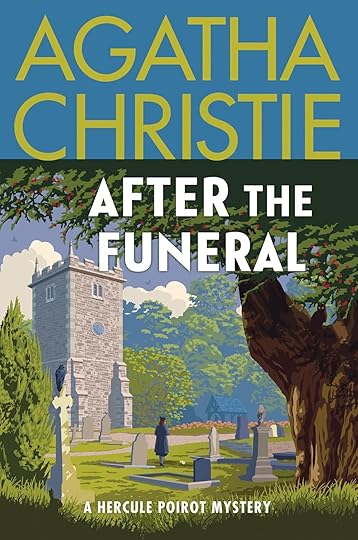
Agatha Christie’s #31 Hercule Poirot mystery is the work of a writer that at this point knows her craft so well that she can do it almost in her sleep. And this story has a lot of sleep in it, and dreams. And a couple of funerals. I prefer this original title, After the Funeral, because it speaks to the more serious literary tone of this book (compared to the more comic tone she often seems to be going for, as in the current title, Funerals are Fatal, which isn’t exactly accurate, as you are led to believe that a murder happens at a funeral, which it does not). The tone here in this book is not actually comic but serious, with a touch of madness.
In almost all Christie books there are bystanders who suppose that the crime must have been done by a “madman,” and it almost never is true. Poirot is a psychological detective. He operates by getting to know the possible murderers and thinking—using his little grey cells—and proceeding, not through the available evidence, that’s police work, only technical—but through ratiocination, through step-by-step logic as it applies to the study of human nature. So both Poirot and I think Christie also don't feel that "madness" is a central rationale for murder. Or interesting, really. Madmen are random, and thus boringly illogical, not worth the trouble to Christie and Poirot. Oh, we do have our daffy characters here, one possibly quite mad, Timothy, and one pretending to be mad, Greg, but finally those types are always comic relief, distractions. Which is not say madness is irrelevant to this tale, but . . . you won’t get me to tell, I won’t!

But back to the point: Poirot operates through logic, and talking to people, through what he calls “the dangers of conversation.” As he says, “if you can induce a person to talk to you for long enough, on any subject whatever, sooner or later they will give themselves away. [Name redacted] did.”
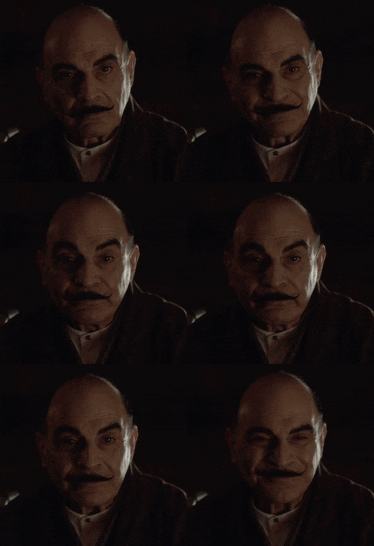
One of the features of this tale that finally makes Christie impressive in this particular book and not just ploddingly proficient is that Christie increasingly reveals her love/hate relationship with her little round Belgian, whom she likes to make fun of for his arrogance. No one in this tale, he is disappointed to discover, even has heard of him. She—wickedly—skewers him, as they many refer to him as “Mr. Pontarlier.” His name is his brand, his cache, and they get it wrong! Sacre bleu!
And she makes fun of his way of speaking:
Poirot: “The time has come to tell you all.”
Inspector Morton: “You sound like a young lady in a Victorian melodrama.”
And he kind of does, in this tale of all things Victorian! And at this point, dozens of books done, Christie feels forced to write him in this way! Augh! But she both does what she has to do, she makes Poirot come alive, and then she simultaneously satirizes him. Can he actually be to the masses both adorable and annoying? Looks like it.
And then Morton can’t resist saying what we as readers are thinking, something Christie perhaps might admit herself about her now close to fiftieth book, which she really does want to finish:
“Yes, yes, tell me all! And for the Lord’s sake hurry up and do it!”
Which he does, of course, finally. But here again she is making fun of Poirot for his necessarily meticulous (and sometimes admittedly boring, and long) method, which she is compelled to recreate, book after book, so tongue-in-cheek makes fun of herself for being trapped to write him in this way!
But then the resolution, the ingenuity of which makes you realize that it is all necessary, and moreover (such a Victorian word!) worth it! So in the end, all is forgiven, we love Poirot after all, and so does Agatha! Which is why she is Dame Christie, and not Detective Nobody!
(Spoilers in here, but not THE spoiler, I wouldn’t do that). The facts of the case: Richard Abernethie dies. After the funeral Cora Lasquenet says she thinks it was murder, and for which she is herself murdered. After which Miss Gilchrist, Cora’s companion, who may know the truth about Cora, is taken ill eating a piece of wedding cake laced with arsenic. And after that Mrs. Abernethie, who may know the truth about Cora, is conked on the head, concussed, hospitalized. Will she recover, to reveal the truth?! Oh, have it either way, because we have M. Poirot!
But seriously, what do we get for speaking the truth at odd moments? Or are they lies? What do we really know about Cora? Or about anyone?
You think as you read that details are just details, but Christie will make you pay attention, again and again, because some mundane details that are shared with us actually do figure in to make this a sort of dazzling resolution, among them:
“The visit of an art critic, a smell of oil paint, a picture postcard of Polflexan harbor and finally a bouquet of wax flowers standing on that malachite table. . .”
And a telegram with these four words: "Definitely a Vermeer, Guthrie."
And the imperfect reflection of people in mirrors. Poirot: “To see ourselves as others see us!”
And Victorian stolidity and aesthetics and values and “ladylike” manners being replaced by something rather modern.
And a consideration of the nature of madness.
And, just randomly, I like this line, from Timothy: “I’ve a soul above corn plasters, Entwhistle.” I didn't know what this meant, no, but it made me smile. But one would hope we all would have souls above corn plasters, oui?
Reading along in this book, do you have the temerity to be bored?! You must have patience, mon ami! A bit of advice about method, to which both the Inspector and Poirot ascribe:
"You don't want to fluster your bird too soon. But when you do fluster it, you want to fluster it well." And Poirot does, finally. He patiently builds his case, and then flusters the bird well in a final explosion of flustering!
I had never heard of Funerals are Fatal, and thought for 200 or so of the 224 pages that this was just another 3 starred book, oh, come on, get it over with, but the ending—gathering together all the relevant motifs—brought it to 4 stars. What did I know? What do I ever know? It’s maybe even better than that, really, compared to any other mysteries being written, but alas, I am getting a little tired of Christie in spite of myself. 30 books! Sacre bleu! Only 9 to go!