Jump to ratings and reviews
Rate this book
Rate this book
'Who’s going to save us this time?'

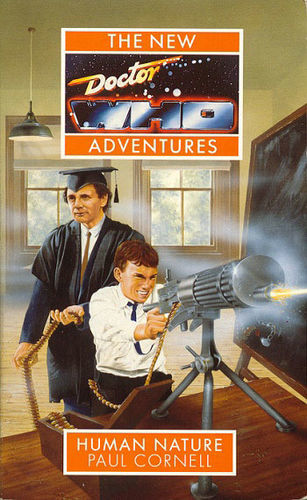
April, 1914. The inhabitants of the little Norfolk town of Farringham are enjoying an early summer, unaware that war is on the way. Amongst them is Dr John Smith, a short, middle-aged history teacher from Aberdeen. He’s having a hard time with his new post as house master at Hulton Academy for Boys, a school dedicated to producing military officers.

Bernice Summerfield is enjoying her holiday in the town, getting over the terrible events that befell her in France. But then she meets a future Doctor, and things start to get dangerous very quickly. With the Doctor she knows gone, and only a suffragette and an elderly rake for company, can Benny fight off a vicious alien attack? And will Dr Smith be able to save the day?

This is the novel that inspired the recent Tenth Doctor TV episode of the same name.

255 pages, Paperback

First published July 18, 1995

241 people are currently reading
993 people want to read

About the author

Paul Cornell

616 books1,501 followers
Paul Cornell is a British writer of science fiction and fantasy prose, comics and television. He's been Hugo Award-nominated for all three media, and has won the BSFA Award for his short fiction, and the Eagle Award for his comics. He's the writer of Saucer Country for Vertigo, Demon Knights for DC, and has written for the Doctor Who TV series. His new urban fantasy novel is London Falling, out from Tor on December 6th.

via Wikipedia @ http://en.wikipedia.org/wiki/Paul_Cor...

Ratings & Reviews

What do you think?
Rate this book

Friends & Following

Create a free account to discover what your friends think of this book!

Community Reviews

5 stars
391 (41%)
4 stars
352 (37%)
3 stars
165 (17%)
2 stars
27 (2%)
1 star
7 (<1%)
Displaying 1 - 30 of 119 reviews
Profile Image for Lady Nerd.
160 reviews76 followers
December 7, 2020
This was an enjoyable read with a much better Human!Doctor than the TV show episode. I loved that the minor characters were fleshed out as much as possible and Bennie in particular was a very interesting companion. All in all, this was a good story with a lot more useful details implemented in the right places.
Profile Image for Ms_prue.
470 reviews9 followers
October 17, 2011
Flipping amazing. And now I understand what the fuss is about Bernice Summerfield, and I want to read every book in which she appears. She may be my new favourite companion.
Profile Image for Farnoush Mellark.
155 reviews34 followers
December 6, 2020
I always loved Human Nature/The Family of Blood, and the idea of Doctor, being a human, although I didn't like his human character, he was someone who Doctor wouldn't be proud of. But still I loved that story and the speeches they gave about how The Doctor is and all that the fury of the timelord thing and the way he defeated his enemies and hello...David Tennant! EPIC!
But this book is waaaay better. I mean, no surprise. Books are always better than the adaptation. Almost always.
I loved this version of John Smith and how he knew Doctor would be against war and killing people and how he came to this decision to let the Doctor back. I loved Tim's character arc and I loved Bennie. She was awesome. Alexander and Richard? LOVED THEM!
Also, can we talk about how cat friendly is TARDIS? More cats in TARDIS, please.
Profile Image for Daniel Kukwa.
4,740 reviews122 followers
January 29, 2011
One of the most magnificently written Doctor Who novels ever written...AND...you can enjoy it without conflicting with the equally powerful TV version. Paul Cornell has a knack (or should that read...gift) for probing the most emotional corners of the Doctor Who universe, and this may well be his finest example on the printed page. Never has the Doctor come into sharper relief as a character, and never has his companion been more resourceful...and more needed in his life. An utter triumph on every level.
131 reviews1 follower
June 16, 2010
One of the best pieces of original Doctor Who fiction yet published. A magnificent story full of humanity and wit.
Profile Image for Alice Dillon.
46 reviews
December 17, 2015
Human Nature has just overtaken Prisoner of the Daleks as my favourite Doctor Who book. It was really spectacular in every possible way and somehow it was even more beautiful and moving than the TV episodes.

For one thing, there was much more time to explore the characters in-depth and, in fact, one of my favourite scenes was the humanisation of the thus-far awful headmaster. There are also many more characters than we meet in the TV series, including Alexander, Hadleman and Constance. Not only the humans, but the family itself was a lot more fleshed out in both character and motive. The vague ‘they want to live forever’ is much more complex in this novel, coming from a race whose lives are empty and meaningless so they just conquer. The futility and idiocy of war is nicely paralleled with this truth about their species.

A lot more happens in the book as well. There’s 8 hours of material, as opposed to the hour and a half we get on screen. I still love the condensed form of the story, as it is a lot pithier, and there were certainly some unnecessary parts of the book, especially at the start, as it was being tied over from the previous story in the series. However, there was a much better sense of scale with all the extra scenes. The book gives more of a picture of how John Smith and Bernice have built up lives in this community and the romance between John and Joan is given the appropriate time to blossom, though that scene with the cat at their dinner date was highly strange and unnecessary…

One of the things I loved about this book in comparison to its TV counterpart was that Timothy was not just a little psychic, but quite manic, affected by the pod (the fob watch of the book) so that he became otherworldly and almost Gallifreyan himself.

This was my first encounter with Bernice and I have to say that I loved her. She was intelligent, sarcastic and very capable. I listened to this as an audiobook and Lisa Bowerman’s performance brought her very much to life for me and I wish she were a companion for the TV series. Lisa Bowerman was also brilliant with all the other characters. Often with audiobooks, especially Doctor Who ones, the narrator can be a bit hit and miss, but she perfectly acted every single character and not once was I confused about who was talking. I often forgot it was a cast of one, as Lisa Bowerman’s voices for each of the characters were so individual.

I also liked the hints to Benny being queer. I looked it up and apparently ‘ambisexuality’ (or omnisexuality) was the norm in her culture. It was fairly subtly referenced and could easily go over the heads of some readers, but she seemed to be quite enjoying a woman’s advances on her and immediately jumped to the conclusion that she was gay (assuming that by ‘coming out’ she meant it in our current sense of the phrase and then being surprised when the answer was yes to her asking whether the character had a boyfriend), though she said that the advances had come at the wrong time, as she was mourning the death of her lover, and rejected them. Not only this, but later on in the story it became evident that another couple of characters were gay/bisexual, which was still subtle for most of it, but became explicit by the end.

This was all part of a larger theme of romantic love in the book, which forms a large part of the Doctor’s motive for becoming human, rather than him already being on the run as on TV. Other themes it explored were race (in reference to one of the school boys), feminism (including the suffragette movement and other restrictions on women), politics (the story had a strong socialist leaning), the stiff upper lip mentality of the time and the masculinity expected of all the men, war and, subtly, queer stuff as well!

The story was also a lot darker than the TV episodes, with much more death and a lot more focus on some of the moral issues involved in a war, including examining the choice not to fight and the idea of being a conscientious objector.

A really excellent book and I would especially recommend it in its audiobook format.

P.S. Also, no scarecrows! They were an easy shortcut for the TV episodes, but it was a surprise that one of the most iconic elements of that story wasn’t even in the original book.
P.P.S. Oh, and the ‘I hate pears’ line that we all love so much was actually on the original list of things for Bennie to not let the Doctor do!
Profile Image for Harry.
58 reviews3 followers
February 7, 2019
This was my second time reading Paul Cornell’s Human Nature and I wanted to see if my opinions will change. Well, have they? Let’s find out!

I can see why Human Nature is so highly regarded as an all time classic Who novel and one of the best Who books ever written. While there are probably some who consider this to be overrated, I honestly do not care because I absolutely love this book.

Despite this story being pretty much a “Doctor-Lite” tale, it’s still brilliant and that’s mainly due to its engaging plot as well as a handful of really well written and interesting supporting characters. I won’t be comparing this to it’s television adaption starring David Tennant as I’ll only be talking about the book itself. The story itself is brilliantly written and while there maybe a couple of chapters that are a little boring, most of the book it’s really, really enjoyable. There are lot of times where the book can be really atmospheric and that helps to give the story a bit of drive.

One of the best parts about the novel are the villains who are basically a family wanting to gain timelord abilities by using a Pod which has turned The Doctor into a human called John Smith. My favourite member of the family is probably Greeneye, not sure why but I just found the character to be an interesting part of the book. Another aspect of the book I really liked is the character of Timothy Dean who is pretty relatable to readers and I did find myself caring about him quite a lot. Bernice Summerfield is also really well written here and does get a lot to do. After all, Cornell did create her character in the book Love and War.

I don’t what to say too much on the book as I really want other Who fans to go into this not knowing too much about it as there are some parts of the story that are best left for the new reader to experience. Overall it’s a fantastic book, one of my favourites and definitely one of the best Doctor Who books of all time. If you liked the television adaption then you’ll love this book as I’ll say I personally think they’re as good as each other!
Profile Image for Beth.
368 reviews20 followers
August 8, 2015
This is the book upon which the 10th Doctor episodes "Human Nature" and "Family of Blood" are based. The basic plot is somewhat similar, but the details are all quite different. This makes a certain amount of sense, because Benny and the Seventh Doctor are quite different from Martha and the Tenth Doctor. But some don't make sense: in the book, Joan Redford is a science teacher, in the TV show, she is demoted to a nurse. It would of course be much harder to pass Martha off as the Tenth Doctor's niece being put up on a break from University as Benny was, but did they have to make her, of all things, a maid in the school? The plot has similar themes, but these changes necessitate quite a few changes of detail (and the Doctor's romance with Joan Redfern is much more advanced from the book.)

If you're not at all familiar with the New Adventures series from the nineties, there are a few things that might make sense (I know a little by osmosis, although the only NA I read cover to cover was "Ship of Fools"; knowing that little bit helped a little bit), but I quite enjoyed the book, even if there were a few bits that would have made sense had I read previous volumes in the New Adventures Series.

I recommend this book to Dr. Who fans of classic and new series alike.

Also, there are some inside jokes with the names that fans of Classic Who and New Who will both enjoy.
Profile Image for Trin.
2,303 reviews677 followers
June 11, 2007
The Doctor Who novel that was recently adapted as 'Human Nature/Family of Blood.' It's available free online [http://www.bbc.co.uk/doctorwho/classi... convenient. I was unfamiliar with both the Doctor (Seven) and the Companion (Bernice Summerfield) the novel is about, and to be honest I'm really mostly invested in Ten (although now also in Martha. Martha is amazingly awesome. *beams*) so this was really mostly intriguing in terms of what had/had not been changed between book and screen. The only other thing that really struck me was that the Doctor stated unequivocally that he's not capable of "small" love—"big" love for humanity, yes, but not romantic love. That's certainly something to ponder (especially since I don't think it's true).

Anyway, I suspect this is only interesting if you are really into Doctor Who right now. Which I am.
Profile Image for John Kenneth Fisher.
3 reviews1 follower
November 13, 2011
First read this in High School, oh, 15 years ago or so, and remembered quite enjoying it. After seeing it a bit back turned into a (fantastic) episode of the show, decided to revisit it, expecting it to not have aged well. On the contrary, it still holds up, especially if you are familiar with the Seventh Doc and Benny. While not flawless - the framing story is far better in the teleplay version, the villains are weak (but the story isn't about them, now is it), etc, it's a solid read that should be enjoyed by both old school fans looking for a great seventh doc story, and new fans who want to see where one of the best eps of modern Who came from.
Profile Image for Ken.
2,562 reviews1,375 followers
May 29, 2018
Reprinted as part of the ‘History Collection’, fans will know this from the TV adaptation with the Tenth Doctor.

Originally part of the Virgin Nee Adventures with the Seventh incarnation.

It’s a fascinating read, there’s numerous differences between the two versions - so makes for essential reading.

One of the best Doctor Who book ever written.
Profile Image for Elizabeth Newton.
Author 4 books20 followers
September 25, 2016
Human Nature was an entertaining, exciting read. I was very interested just in the cover because it has Sylvester McCoy’s face on it, and it’s called Human Nature which was the name of the David Tennant two-parter and I wondered straight away whether there was a connection between the two. I saw on the back cover that those episodes were based on this book and became even more excited. Knowing it was Sylvester McCoy’s Doctor represented in this story, I was expecting Ace to be his companion, but instead, it is a girl called Bernice Summerfield. Not having heard any of the audio book adventures that this character had been in, I was initially disappointed, and the closest we get to Ace, is when Bernice says she wishes Ace was there. But you quickly get to know Benny and she has bags of character. Even though she at first appears to be some alcohol-obsessed junkie, always ordering and pining after alcoholic beverages, she proves to be a worthy companion in my book. She’s moral, smart and positive and knows the Doctor well.

At first, the story is similar to the David Tennant adaptation, but it soon takes such unexpected turns and it’s exciting to be reading a story where perhaps I can’t assume what’s going to happen anymore. The content in this book is a lot more adult than any other Doctor Who book I’ve read. There is a little light swearing and blasphemy, and quite vivid, violent and gory descriptions, not to mention all the alcohol that Benny does or wishes to consume.

There is a very cleverly written dream sequence and some beautifully sweet moments between the Doctor’s alter ego John Smith and the characters around him. The villains have so much character, they’re almost likable – but of course, at the same time, classically villainous. They have faults and arguments with each other just like any family and I found myself smiling widely during a few of their scenes.

Some scenes are a little hard to follow. The weird timey-wimey phenomenons that occur would be a challenge for any writer and although Cornell does a good job, I still tended to get lost in places. I also felt like a couple of the ‘tie-offs’ at the end were unnecessary, I found myself wishing Cornell had left that for me to imagine and assume. I wanted the epilogue to be a bit shorter. After such a great ending, feeling like I’d come to the end, I still had so much reading to do. The epilogue, however, does give a vivid and intense snippet of what it was like on the battlefields of the Great War, which adds a really nice historical flavour and context to the rest of the story.

A really good, sophisticated read. A brilliant and unique Doctor Who adventure for grown-ups.
Profile Image for Matthew Kresal.
Author 36 books49 followers
July 25, 2011
This is Human Nature: The basis for the revived TV's series two part story Human Nature / The Family of Blood. Written by Paul Cornell and published back in May 1995, this novel has earned a reputation as one of the best Doctor Who novels ever. Having read quite a few of them I'm willing to go one step further: Human Nature is the best Doctor Who novel ever written.

Human Nature is (to paraphrase a famous quote from the series) far more then just another Doctor Who story. It is a strong story about love, war, and what makes us human. One of the reasons for this is because it's a novel full of real characters, not just one or two dimensional cut outs. This is especially true of the malevolent seventh Doctor, who becomes a human being and leaves his companion Professor Summerfield having to save him.

While the novel features a fair amount of action and typical science fiction material, the story has a love story running through it. That is the love between the humanized seventh Doctor (Dr. John Smith) and Joan Redfern that while it might initially seem out of place, Cornell makes it fit. Cornell creates a realistic relationship between the two and whenever they're together the pages really do light up. In fact, Smith and Joan are the literal heart and soul of Human Nature. It is there relationship, and its climax that really make this novel standout.

The novel's only real flaw is it's villains who are a bit of a joke for the most part. The Aubertide shape shifters are clumsy to say the least and very rarely (if at all) to they have menace. That said they have a great moment in chapter six, but for the most part Cornell drops the ball in terms of the villains and in turn creates the novel's only real problem.

Don't let that flaw deter you though. This novel is what science fiction is at its best: a morality tale in a very different dressing. To put it another way: If you read only one Doctor Who novel let this be the one you read.
Profile Image for Nadia.
288 reviews16 followers
July 20, 2016
This is really good even for Paul Cornell and one of my favourite things to come out of Doctor Who period.

I had heard that the anti-war stance had been gutted from the tv version but I wasn't expecting it to be this explicit. That was my reason for checking it out but it wasn't the only difference that was a pleasant surprise. I really loved how dark and violent it was, as much as Martha is my favourite character Bernice was fascinating in her own right that I really want to know more about her and...there were other reasons as well. Overall I think it gave a lot of the ideas a lot more depth than the 90 minutes could do. At this point I'm really used to being disappointed by and lowering the bar of my expectations for popular sci fi when it tries to tackle the big "important" issues and I'm just happy that this is not one of those times.

It's really a shame that the other books prolly aren't as easy to acquire as this one.

I really wish that this version of the Doctor's take on war could have made it on the show but I guess it wouldn't have been consistent with the four years of him wandering the universe with that "one chance to avoid genocide" thing he was doing.

Somewhere between four and a five.
Profile Image for Mark.
10 reviews
September 15, 2015
Really enjoyable. Lisa Bowerman was great as the reader (I have the audiobook version). I was already familiar with the adaptation for the TV version, but this has a lot more in terms of detail, the family are much more fleshed out, and there's more humour than I remember from the TV version. Highly recommended.
Profile Image for Jason Wilson.
765 reviews4 followers
December 24, 2017
I don’t normally review these but this was the novel that inspired the Tennant two parter . Similar plot but different emphasis - the doctor becomes human to empathise with a companion who suffered a bereavement . When he changes back the doctor has failed . The aliens are similar but not quite the same , Tim isa bit darker .
Profile Image for Sarah.
192 reviews3 followers
January 25, 2025
Waar ik vroeger niks met scifi had, vind ik het de laatste jaren steeds leuker worden. Daarom besloot ik eind oktober de afleveringen van de nieuwe Doctor Who (vanaf de 9e Doctor) eens te proberen en ik denk dat het nog licht uitgedrukt is als ik zeg dat ik inmiddels best geobsedeerd ben.

Gelukkig is het een handige serie voor een obsessie, want naast een behoorlijke lading aan afleveringen en spin-offs, zijn er ook een heleboel boeken (waar ik als fan van lezen natuurlijk erg blij van word). Informatieve boeken, stripboeken, boeken gebaseerd op de afleveringen en boeken met nieuwe avonturen. Human Nature valt onder onder die laatste categorie, al ken ik het verhaal al wel dankzij de afleveringen Human Nature/Family of Blood met 10 en Martha. Die zijn op dit boek gebaseerd, al is het boek zelf met 7 en Benny/Bernice. Ik ken de oude Doctors (nog) niet, maar wil die nu ook zeker gaan kijken. En liefde voor Benny, wat is zij een leuke compagnon!

Naast het verschil in Doctor en compagnon, is het boek op verschillende vlakken best anders dan de aflevering. De "menselijke" Doctor als John Smith is in het boek niet zo'n eikel als in de serie. Benny heeft een heel andere rol dan Martha (had het in de aflevering echt te doen met Martha... Al werd ik er bij al haar afleveringen, en dus ook deze, een beetje gek van dat ze werkelijk de hele tijd zat te klagen over de onbeantwoorde liefde van 10. Ik snap het, wie is er nou niet een beetje verliefd op David Tennant? Maar als je allemaal aliens ontmoet, kun je toch wel even over iets anders praten?). Qua verhaallijn zijn deze versies hetzelfde, maar ze voelen toch anders. En allebei zijn ze top! Heb genoten!
Profile Image for Ivo.
230 reviews19 followers
March 25, 2018
Dieser Roman wurde 1995 im Rahmen der „Virgin New Adventures“ geschrieben, Protagonisten sind der Siebte Doktor (Sylvester McCoy) sowie seine Companion Bernice Summerfield. Bernice wurde als Companion speziell für diese Buchreihe entwickelt, kam später aber zu weiteren Ehren in den Big-Finish-Hörspielen.

Wesentlich bekannter dürfte die Handlung den meisten aber mit dem Zehnten Doktor (David Tennant) sein, da das Buch für die TV-Serie als Zweiteiler verfilmt wurde und dort zu einer der populärsten Folgen avancierte (Hugo Nominierung).

Der Doktor befindet sich als gewöhnlicher Mensch mit dem passenden Namen „John Smith“ im England kurz vor dem Ausbruch des Ersten Weltkrieges - und zwar ohne jegliche Erinnerung an sein Leben als Time Lord. Er ist Lehrer an einer Eliteschule und verliebt sich eine Kollegin. Dieser Plot führt zu sehr anrührenden Szenen, insbesondere als klar wird, dass die unvermeidliche ausserirdische Bedrohung eine Rückverwandlung zum Doctor notwendig machen.

Ich habe ja mehrere Anläufe mit den Doctor-Who-Novelisations gemacht, so richtig warm bin ich nie geworden, und so hält sich auch hier die Begeisterung in Grenzen. Ich würde trotzdem der Aussage eines Goodreads-Kritikers zustimmen, dass man, sollte man nur ein Who-Buch lesen wollen, zu diesem greifen sollte. Deshalb von mir 3,5 Punkte, die ich auf 4 aufrunde, nicht zuletzt auch weil ich großer Fan des TV-Zweiteilers bin, der basierend auf dieser Vorlage geschaffen wurde.
Profile Image for Philip.
627 reviews5 followers
June 14, 2024
After rewatching the TV episode, I thought I'd give this a go and I was not disappointed! I couldn't help but spend the whole book mentally comparing it with the episode that I remember watching live 17 years ago. The episode does benefit from being expertly honed and edited by Russell T Davies, with the storyline streamlined, the villains turning into the terrifying Family of Blood, and small changes for the better, like Smith's dream journal and stopwatch. However it's source material is brilliantly original, shockingly violent and with an assortment of well written side characters. The battle scenes feel fast-paced and with genuinely high stakes, while the sci-fi elements blend in perfectly with the historical setting. This stands as one of the best Doctor Who novels, perfectly complimented by it's TV counterpart. 5 stars.
154 reviews
July 8, 2022
My first Doctor Who read as an audio book, which is always biased depending on the narrator Who was fantastic in this. Even with jumps between diary extracts and narrative, I could follow a neat plot which was enticing even if I knew the ending
Profile Image for Elisabeth.
813 reviews21 followers
August 27, 2014
The televised episodes Human Nature and Family of Blood, two of my favorites, are based on this novel. I can't help but compare the two. Briefly, however, it's an excellent novel on its own. The story is tense and exciting; companion Benny, whom I met here for the first time, is intelligent, self-possessed, solid; the Doctor, Seventh in this case, is very much himself, even when he isn't. Being a full-length novel, it has a bit more depth than the televised version, and a bit more darkness too.


Possible spoilers below.


I like the Seventh Doctor in this role; as much as I adore Ten, it's wonderful to have a love story between older, less beautiful people for a change. The novel length also allows their love a bit more depth, a stronger foundation than it gets on TV. I like Bernice a lot; she's a bit less 'badass' than Martha - she doesn't cleverly figure out what happened to her friend, and she doesn't face down an alien with a gun - but she is brave and smart as a companion must be, and much more down to earth than any other companion I can think of. She doesn't have her own heart set on the Doctor, but she doesn't have any patience for his romance either; she believes people should be themselves, and anyway she doesn't want to be stuck in 1914. Joan is somewhat different, older, a science teacher rather than nurse, though she still manages to do more nursing than teaching. I'm torn over her; I like and dislike the TV and novel versions of her in more or less equal measure. Tim is very different, and I think I like the TV version better. The aliens' story is almost entirely different and I definitely like the novel version better, though as a result the Doctor doesn't get his lesson in consequences. (Not that Seven needs it - he's much more self-aware I think than Ten.) Verity makes her appearance, as does a certain Mr. Moffat - I'm dying to know whether in fact the character is based on the now-much-more-famous Moffat, as it is likely that he and Cornell knew each other at the time.

Overall, a great television story, a great novel, a great writer. I recommend all three.
Profile Image for Molly!.
6 reviews
May 31, 2025
★★★★⯪ – A would-be masterpiece with an unfortunate aftertaste.
This review contains spoilers for the ending of the book.

Read Human Nature. Do it! It’s a resounding success of a novel that, contrary to the associations of the phrase “tie-in media”, is in the same weight class as some of the best stand-alone sci-fi novels you’ve read. It’s riveting, it’s brave, its characters are written with incredible feeling, and it contains a stupefying example of how to write a satisfying romance in appallingly few scenes. The book is, in this case, a hundred times better than the movie. That said, what I’m interested in exploring in this review is something I haven’t seen discussed elsewhere: how the ending of Human Nature falls on its face.

A recurring theme in Doctor Who, and especially the New Adventures, and especially especially Paul Cornell’s work, is the tension between the epic and the everyday; between grand, unfathomable science fiction and the little things in life. When an effort is made to emphasize this contrast, the author du jour typically comes down on the side of the latter – sometimes unsuccessfully (the Fifth Doctor’s “well-prepared meal” speech in Earthshock [1982], an episode in which the evil robots with big guns arguably win, comes to mind), and sometimes, as is generally the case in Paul Cornell’s oeuvre, powerfully. Take his earlier novel for this line, Love and War , in which the winning hands include calling somebody by their chosen name and telling a story about a road trip passionately enough. Cornell seems to me an eminently media-literate man – he writes, I get the impression, with a watchful eye fixed on his message: Choosing to conspicuously yields no positive results whatsoever, and despite making an appearance rather early, they’re never . It is jarring, then, when the novel not only shoots itself in the foot, but does so shortly after explicitly proclaiming that “I shall not shoot myself in the foot”.

Hanging over the plot – in which the Doctor has turned into John Smith, a human, losing his memories and superhuman powers – is the possibility for the true Doctor to make a return in order to, as the deus he is, save the day ex machina. This would, of course, beyond being deeply unsatisfying (plenty of Doctor Who plots follow the structure “the Doctor is tied up somewhere, so everyone else’s agency is limited to waiting for him to show up and fix things”), run counter to the larger message of the book: If true triumph is to be found in the everyday, why should the solution be “we need the inscrutable Time Lord from faraway Gallifrey to work his sci-fi magic”? Indeed, the novel recognizes this, and – as if to reassure the reader – contains this line:

He sat down beside her. ‘John Smith is the real me. And it’s because of all this, not despite it. You don’t know what you really want in life until it’s taken from you.’
‘You mean Joan?’
‘Yes. […] I have to save her. And I have to do it as me.

Unfortunately, in a move I can only describe as inexplicable, the novel then promptly turns around and has becoming the Doctor be the solution. Hey, is that the machina? Well, the deus has just come ex it, and he saves the day by way of technobabble. How Cornell managed to lay out a plan for the reader so concretely and yet summarily fail to execute on it, I do not know – but there is a possible explanation, though I described it as “inexplicable”. Quote the endnotes of the 2002 e-book version:

[N]obody had ever really done mythologist Joseph Campbell’s ‘Hero’s Journey’ for the Doctor, the plot that’s most commonly recognised in popular culture as that of Superman II, where the hero gives everything up to discover what normal humanity is like. Fertile ground, I thought.

The particular stage of the Hero’s Journey Cornell refers to here is the apotheosis, in which the hero gains enlightenment. And, sure, the apotheosis can be applied to the novel as a whole; that enlightenment being found in humanity (that is to say, human nature). Apply the whole Hero’s Journey to the story, however, and the apotheotic moment within the book is… when John Smith and becomes the Doctor. Here, “enlightenment” is becoming an inscrutable Time Lord from faraway Gallifrey. If Cornell did indeed choose this development as part of the Hero’s Journey, it’s a shame, and if not, it is inexplicable – either way, a tone-deaf moment in an otherwise pitch-perfect book. (As an aside – and this is hardly a critique, as it isn’t fair to ask that an author should’ve come up with the exact same idea – I can’t help but feel Cornell missed the opportunity to , something that would have been possible thanks to the unique setup of the Doctor as a character.)

In fact, at no point after returning to Doctorhood does the Doctor ever make a decision differently in light of his experiences as a human – he gets a chance, in the form of deciding whether to be empathetic enough to say goodbye to his paramour (as opposed to pulling an Irish goodbye for the ages)… but comes down on the side of “no”, and has to be convinced by his companion. (In the first draft of the book, he actually does disappear without a trace, a choice Cornell rightly recognized as a mistake.) Ultimately, there’s never any sign of the Doctor having learned anything from his ordeal, save for a scene at the very end, in which  – a lovely moment, given that it isn’t something the Doctor is given to doing, but underwhelming as the sole result of becoming human for a time.

Human Nature does succeed in its messaging in other areas – for one, it makes a stand for pacifism and conscientious objectors (something Cornell walks back in the TV adaptation, apparently having lost his pacifist streak along the way). As a work of character writing, it’s flawless – I didn’t even mention Bernice Summerfield’s role in the book, but it’s one of her most essential novels; her thoughtscape laid out beautifully before the reader. Take this review as one long – and, admittedly, significant – asterisk next to my central sentiment: “It’s amazing.*”
1 review
July 10, 2016
By far one of the best doctor who stories ever told. Adapted into a 10th doctor episode by the same name Human Nature asks one simple question. What would happen if the Doctor was truly human?

Human Nature follows the 7th Doctor and his companion Bernice Summerfield (Benny) to a small English town in 1914. To understand his companions grief over a previous incident The Doctor has used a device to turn himself human for 3 months while Benny takes a mini vacation in the same quiet town. Unknownst to both of them a group of shape-shifting aliens followed them in search for time lord DNA.

John Smith/The 7th Doctor are excellent in this book. Unlike the 10th doctor, the 7th doctor seems a lot more emotionally cold and calculated so it was kind of weird (in a good way) to see him as the flawed human named John Smith. However, all the doctors core beliefs are still there so they almost feel like the same person with the only noticeable difference being John Smith's inability to solve sticky situations.

Intelligent, attentive, quick thinking and strong willed Bernice Summerfield is by far one of the best companions ever and it really shows in this one. This is one of the few stories that really shows the Doctor's reliance on his companions and Benny doesn't back down from the challenge. A must read if you are a Summerfield fan.

All in all Human Nature is a suspenseful and interesting story, but what really stands out is the characterization of the Doctor, his relationship with his companion, and Benny's amazing performance. If you are a Doctor who fan you can not pass up this one up!


Profile Image for Joe Kessler.
2,371 reviews70 followers
April 10, 2019
This Doctor Who novel was first published in 1995, back during the wilderness years when the television show had been canceled and the franchise was only continuing through such works on paper. These days it's more famous for having been adapted into a pair of David Tennant episodes for the revived series in 2007, and like most modern fans, I'm discovering the original book after having already watched the story play out on screen. From that vantage point there are few surprises in the plot beats, but it's still an enjoyable tale of the sci-fi hero losing his memories and falling in love.

There's a lot that I like in both renditions of this adventure, and some things I prefer in one over the other. I feel that the villains are better-drawn and more threatening on TV (despite producing less gore and a lower body count), and that Tennant's Tenth Doctor makes for a more convincing romantic figure. On the other hand, the Seventh incarnation of this character is a better fit for the manipulation at the heart of the narrative, which makes the eventual distinction between his human and Time Lord selves considerably more striking. I also appreciate that paperback companion Bernice Summerfield can disguise herself as the amnesiac Doctor's niece, whereas the episodes somewhat problematically force her replacement Martha Jones to take up work as a maid.

Still, I wouldn't say that either version of events is the superior, definitive take, even though it sort of strains credulity to accept both as having happened in the Doctor's personal chronology. But hey -- it wouldn't be Doctor Who if there was some simple way of determining what's canonical.
Profile Image for Adam Graham.
Author 63 books69 followers
September 25, 2016
Paul Cornell's novel is read superbly by Lisa Bowerman who manages to perfectly capture each character. The story is also very well-scored with emotionally evocative but not overstated.

The core of the book is superb. Smith is a compelling characters whose struggle with self-identity and struggle fitting in drives much of the story. The romance between him and Joan is very sweet and effecting, while still being mature and appropriate to the age of the characters. Tim is also incredibly interesting as a character, particularly as he becomes the Doctor and you really identify with his plight.

The story suffers from extraneous elements and characters that were introduced, didn't add much to the core story, and weren't properly developed enough for readers to care about. The villains are not bad, but aren't interesting either.

Overall, though, the themes of love, loss, war, identity and the question of what it means to be the Doctor give the story a strong emotional edge and makes it a worthwhile read or listen.
Profile Image for Jim Mann.
833 reviews5 followers
August 14, 2017
Human Nature/Family of Blood was one of the great episodes of the new Doctor Who. It had the Tenth Doctor turn human to hide from an alien family that wants to consume the power of a Time Lord. He became Mr. Smith, a teacher at a school/military academy just prior to World War I. As a human, without memories of his being a Time Lord, he falls in love and faces much of the chaos around him as that human.

The two-part episode was based on the novel Human Nature, a story of the Seventh Doctor, written in 1995 by Paul Cornell, who later went on to write the TV episode. It has a lot in common with the TV episodes: the Doctor has turned into human Mr. Smith, an alien family is looking to consume Time Lord energy (though the Doctor hadn't been fleeing from them), and he does fall in love. The aliens are bit more complex (and even nastier), and there are more plot complications than the TV show. But it makes for a fun read.

Which is better? I'd pick the TV show, in large part due to David Tennant's great performance. But the novel is also worth a read.
Profile Image for Thomas.
Author 1 book59 followers
December 28, 2015
I have to admit it: I'm a HUGE Doctor Who fan. That said, I have not thought too much of the handful of books I've read that accompanied the series. Human Nature, on the other hand, was just brilliant. I admit it still had it's pulpy bits in the story, but in general it was as well written as many of my favorite novels (well, maybe not Gibson or Stephenson quality, if we're talking modern scifi, but quite solid nonetheless).

I'll be seeking out other books by Cornell. It should also be mentioned that this book was loosely used as the basis for the episodes Human Nature and The Family of Blood in the 3rd seasons of the new Doctor Who series. These were easily among the very best Doctor Who episodes ever, so getting this book (it was a present from my darling wife) was a real score.
This entire review has been hidden because of spoilers.
Profile Image for Kris.
1,359 reviews
February 21, 2020
This is one I have read quite a few times before so I know well what happens in it. What surprised me this reading was how much of the book is devoted to the Aubertides hunting Benny and The Doctor.
The reason being, I feel, is that is the least interesting part. If it was just a story where the TARDIS team play a game of hide and seek in early 20th century with The Aubertides it would be a forgettable runaround. The aliens are uninteresting, their plan feels vague and the whole thing is very small.
The reason it is a 5 star book is that we are allowed to genuinely care about the romance between Smith and Joan, the stakes are his life and the conclusion is the good he inspires. That is what makes it wonderful.
Displaying 1 - 30 of 119 reviews

Can't find what you're looking for?

Get help and learn more about the design.