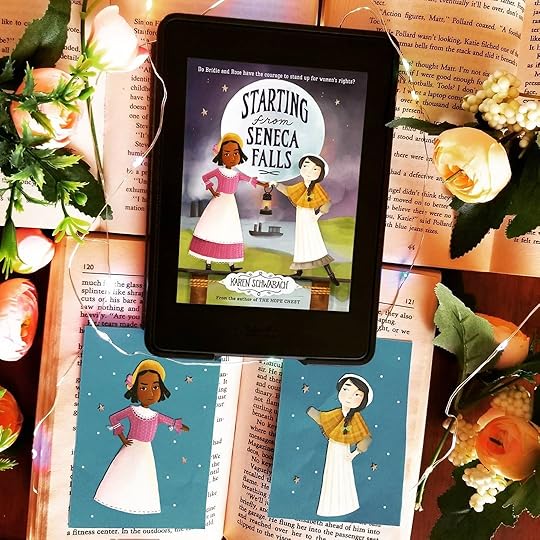
Celebrate the centennial of the Nineteenth Amendment with another historical novel about women's suffrage from the author of The Hope Chest!
Bridie's life has been a series of wrongs. The potato famine in Ireland. Being sent to the poorhouse when her mother's new job in America didn't turn out the way they'd hoped. Becoming an orphan.
And then there's the latest wrong--having to work for a family so abusive that Bridie is afraid she won't survive. So she runs away to Seneca Falls, New York, which in 1848 is a bustling town full of possibility. There, she makes friends with Rose, a girl with her own list of wrongs, but with big dreams, too.
Rose helps Bridie get a job with the strangest lady she's ever met, Mrs. Elizabeth Cady Stanton. Mrs. Stanton is planning a convention to talk about the rights of women. For Bridie and Rose, it's a new idea, that women and girls could have a voice. But they sure are sick of all the wrongs. Maybe it's time to fight for their rights!
Karen Schwabach grew up in upstate New York and lived for many years in Alaska, where she taught ESL in the Yup'ik village of Chefornak. She later taught in the education department at Salem College in North Carolina. She's the author of A Pickpocket's Tale, The Hope Chest, The Storm Before Atlanta, and Starting from Seneca Falls.
This middle grade book is the perfect mixture of story, adventure and history. This would be an awesome way to teach this portion of American history to children in a classroom or homeschool setting. Bridie the main character is an Irish immigrant to the US and through her story readers are introduced to the concepts of poorhouses, the Potato Famine, the Underground Railroad, slavery, women’s rights, human rights, abolition, suffrage, educational inequality, the gold rush, westward expansion and more. The story of a young girl alone and trying to figure out a new place is perfect for readers to learn alongside her. The format of the book also does a good job explaining the concepts in a way that doesn’t feel like a history lesson, but surely is one. The end of the book also has historical notes which would be great jumping off points for further research. There is one aspect of the book that could be hard for sensitive children as the main character does fear for her life at the hands of a cruel person, as well as there is some physical violence and domestic abuse. While these are not easy topics, they are central to what women’s rights were about as husbands and fathers were owners of their wives and children. Because this occurs in the historical context of the book, it would be a good time to explain how today we each have rights to safety and what to do if somebody is violating those rights. There are also memories of deaths of family members in the book, but nothing graphic or too specific. Please don’t let this keep you from reading this book with a class or your children because the value far outweighs any tough questions.
I've loved every book that I've read from this author~ STARTING FROM SENECA FALLS is no exception. There's an ease to the narrative and dialogue that makes it so easy to slip into. Writing like this is NOT a simple task. Historical details had me eager to learn more about the "characters" (MANY are actual historical figures) after finishing the story. Sure, this book works great in a classroom, but it's equally at home with me, my Irish wolfhound, and a bowl of soup on a rainy evening (which is exactly how I finished it).
3.5 stars- a half star off for not using period language and speech patterns
1848 is a year of promise for the United States as anti-slavery activists campaign hard against the expansion of slavery into the new U.S. territories ceded from Mexico. 11-year-old Bridie Gallagher knows her knew hometown, a little village in the finger lakes region of New York called Seneca Falls, is the center of the country. From there you can go anywhere- for all the good that does Bridie who never sees the outside of the poorhouse and rarely anywhere except the inside of her solitary confinement cell where she's put for asking too many questions or sassing back. When the poorhouse directors loan Bridie out to the Kigley family, Bridie has a bad feeling about her future. When the Kigleys turn out worse than she expected, Bridie fears for her life. If she runs and gets caught, it's back to the Kigleys where she'll surely die. Bridie takes a chance and heads across the lake to Seneca Falls where she meets Rose, a Black girl with troubles of her own. Rose takes Bridie under her wing and helps Bridie get a job with the eccentric Mrs. Stanton. Bridie is pleased to earn a wage but unsure if she wants to be stuck caring for someone else's house and children until she marries. When Mrs. Stanton's friends come to tea to plan a little (!) women's rights convention it opens Bridie and Rose's eyes to the possibilities of the future if they're brave enough to reach out and grab them.
I really liked the history in this story. It was real and honest as well as interesting. I've known about Elizabeth Cady Stanton and the Seneca Falls Convention since I was Bridie's age or younger and the subject of women's rights has always fascinated me. Karen Schwabach is a skilled enough writer to present the history the way it was without sugarcoating or overcorrecting to make it palatable for young readers of today. While voices of the Indians and the Mexicans in the new territories are not present, the reader hears about them through the eyes of the White characters and gets an idea of what Seneca Falls was like at the time. The focus of the story is mainly on women's rights with a side of race issues. The one thing she does that I didn't like is the author writes her story in a very modern voice. Bridie and Rose's speech patterns don't sound period correct and they often use modern phrases. Elizabeth Cady Stanton, being educated and elite sounds more old-fashioned and of course the Quakers use plain speech. In 1848 the country was sharply divided over the issues of women's rights and slavery. Kids will be able to draw connections to today's social justice movements and see what has changed/not changed since then.
I liked the plot well enough. It was a little bit adventurous like an American Girl Saves the Day story but not too out there. It didn't keep me turning the pages to see what happened to Bridie and Rose. The story might be a little too slow for young readers of today. It picks up a lot in the last few chapters but before then it's mainly daily life, which I happen to enjoy but I know my nieces would find BOOOOORRRRING. *sigh*
Bridie's story is heartbreaking. It introduces kids to the Irish potato famine and the extreme poverty immigrants faced in their new home. Her story also illuminates WHY women's rights is so important. Bridie states over and over again her mother should still be alive. If the law was more fair or enforced, her mother would still be alive. It was pretty shocking and eye-opening to me even as an adult historian. I knew Elizabeth Cady Stanton was instrumental in passing a married women's property act but none of my teachers or professors ever explained what happened to Bridie's mother quite like that. The story does not take a turn towards the temperance movement but that should be the subject of the author's NEXT book as a companion to this one because the plot also underscores why temperance was a women's rights issue.
Bridie and Rose are both appealing characters. Bridie will appeal to young readers because she's spunky and questions everything. She's not very historically accurate in that sense but of course there were girls who asked WHY and WHY NOT or else there wouldn't be a Maria Mitchell, Elizabeth Blackwell, Rebecca Lee Davis Crumpler or Eunice Newton Foote. Bridie's questions make a lot of sense in the context of the time period. They're not too modern or adult shoved into a historical fiction novel for kids. Bridie has already lived a HARD life at only 11. She has the right to question the things that happened to her. She isn't sassy for the sake of being sassy. She genuinely wants to change her life and get answers to her questions. I empathized with her struggles but her decision about her future comes very late in the novel for me. I was left wondering where her story was going for a long time.
Rose's story illustrates both racism and sexism. She's a free girl of color, second generation born free, but still faces challenges. There are certain schools she isn't allowed to go to because the teachers won't allow "colored" or girls! When she does go to school, she's smarter than her teacher and he tries to hold her back lest the parents complain. She faces discrimination from other children and the fear her teacher will be fired and the next one won't allow her in school. Rose has big dreams and isn't going to let anyone stand in her way. I just loved reading her textbooks. I haven't ever seen those before! Rose is kind and compassionate because she knows how it feels to be alone in the world and running towards a goal. I love her friendship with Bridie. It's very sweet.
Elizabeth Cady Stanton is eccentric by 19th-century standards. She was self-educated in subjects typically taught to boys and attended a young ladies' academy (Emma Willard) to learn more than just how to run a household. She's a thinker and a do-er but at odds with her husband and the rest of her community for she alone thinks women should have the right to vote. That notion was shocking at the time and even her own husband thought that was a ridiculous notion. He also didn't believe much in women's rights and thought in black and white in terms of the law-laws that are not in favor of women. I appreciate the honest portrayal of Lizzie, as her friends call her. She's cranky and fiercely defends her position on women's rights. She's single-minded in pursuit of her goal and this makes her seem thoughtless and uncaring when it comes to race relations. While she's friends with Frederick Douglass at this point and doesn't believe in slavery, she's not actively campaigning to end slavery or arguing for rights for enslaved women too. She does her part in not wearing cotton and not buying sugar grown by slave labor but she ignores a runaway family of enslaved people when she encounters one. I think she was a woman of her time, narrowly single-minded in pursuit of one goal believing if women had the right to vote everything would be different and women would vote to end slavery. She's pleasant enough to Rose and Bridie.
The Kigley family is interesting. There's a LOT going on beneath the surface there that young people might not pick up on right away. Mr. Kigley is abusive, that much is clear, and then later it becomes evident he's an alcoholic. He's truly evil. There's something not right in his brain and when he beats a woman or a girl, he beats to kill. He may be too scary for young, sensitive readers. Mrs. Kigley is an abused wife who takes her own pain out on Bridie. She says she had 5 children and only Lavinia survived. Of course the children could have died for a variety of reasons including malaria but my interpretation is either her husband beat her while she was pregnant and she lost the babies or her husband beat the children to death. Mrs. Kigley thrives on punishing Bridie because it's the only way she can survive. Lavinia has picked up on her mother's behavior and is just awful to Bridie. Even later when she has no good reason to be so rude and snooty, she's awful and like Bridie, I was tempted NOT to feel sorry for her.
There's a myriad of secondary characters, some real, some not. Famous figures such as Frederick Douglass and Lucretia Coffin Mott make cameos. It was fun seeing the famous convention unfold and watching history in the making. How I wish I could have been there! The national park is on my bucket list.
This is a fun book for kids (girls) ages 7-12 who love the American Girl and My America books. This book skews younger than Dear America but it is perfect to bridge the gap between younger middle grades and older. I can also see this being used in the classroom as I know her earlier book The Hope Chest is.
A wonderful way to introduce middle grade readers to 19th century abolitionist and women’s rights movements. Readers knowledgeable of the history will smile at the frequent historical nods.
Starting from Seneca Falls you can go anywhere in the world.
We have come a long way in the short history of our nation and we as a nation have led the way in human rights. Based in the time of 1849 and with actual men and women that paved the way like Elizabeth Cady Stanton and Frederick Douglas. our two young protagonist Birdie and Rose learn what it means fight for human rights and freedom.
Birdie has come in from Ireland. Her story is well known. Her family leaving Ireland for America for a better life after her family suffered in the Irish Potato Famine. Orphaned, Birdie is now in the poor house in Seneca Falls. Birdie is outspoken, thoughtful, loyal. You like her right a way. She has spunk with everything that she has gone thru. Birdie is taken out of the poor house by the Kigley family on loan. Birdie has a bad feeling with this family and her bad feelings are realized and she runs away. On the run she meets Rose. Their meeting is remarkable. It is at night and with Rose's kindness and wit she is surprised by that Rose is colored. Rose leads Birdy to Mrs. Stanton's where she begins to understand the fight for human rights.
The narration is both between Rose and Birdie. Rose in her dream to be a scientist. She seeks education and finds it with a local teacher. Birdie realizes her rights and no longer fears the family of Kigley of taking her back. With a twist of fate, she and Rose help the Kigley women in their rights as well.
The book is geared for 5th graders to middle schoolers and has much to offer in what is human rights and those that fought for them and why. Our world has a long way to go but those like Birdie and Rose there is hope. Highly recommend.
A special thank you to Childrens Random House and Netgalley for the ARC and the opportunity to post an honest review
Both Elizabeth Cady Stanton and Frederick Douglas are brought to life in this fast-paced historical fiction story about two unlikely friends during the 1800s who participate in the women’s suffrage movement. Readers will hear more about the Irish Potato Famine, realities of the Poor Houses, the plight of orphans, and even the Erie canal. It was suspenseful and quite informative, so don’t be deceived by the cover and length, which might indicate it’s solely intended for young children. No, this book will be very enjoyable for older readers, as well. Don’t miss the historical note at the end!
For more children's literature, middle grade literature, and YA literature reviews, feel free to visit my personal blog at The Miller Memo!
A BIG thank you to Netgalley and Random House Books for providing an advanced copy of this book for my review. This book might seem like a cute friendship tale from the cover, but it is so much more than that. It beautifully blends fiction with the historical events at Seneca Falls for Women’s rights.
Bridie and Rose are adorable as the main characters. They face a lot of challenges but stick together and remain positive for a better future. One of my favorite scenes was when Bridie speaks about her mother’s situation with everyone in the meeting. I also loved her fascination of the printing press, and made me curious to visit one myself. Rose is a character that inspires you do better, as she knows the value and importance of education from an early age. She doesn’t let the color of her skin stop her from achieving her dreams.
The author has done a wonderful job in telling Bridie’s tale while providing historical events of the Seneca Falls in an accurate manner. I always love reading stories that get me interested in historical events. Reading this story encouraged me to research more about Elizabeth Stanton and Frederick Douglass. Furthermore, the story also covered many other topics, like the printing press, phrenology (which I had never heard of) and the Irish Potato Famine.
I feel this is one of those books that everyone should read. It provides awareness as to how far we have come in the last 200 years, but still have so much further to go. Overall, Starting from Seneca Falls was very entertaining and informative.
I don't know how much kid appeal historical novels actually have these days, but I enjoy them!
STARTING FROM SENECA FALLS examines some important issues—slavery, women's rights, escape from domestic abuse, etc. The story has an interesting setting that comes alive with vivid period details. It highlights historical figures that modern kids definitely need to know about. The girls at the novel's center are fictional, but they're sympathetic and easy to root for. Plotwise, STARTING FROM SENECA FALLS had enough going on to keep me interested, but it still felt unfocused, like it was trying to cover too much ground. Bridie had no real story goal to keep her and the action moving forward, so the story felt a bit loosey-goosey. Still, I enjoyed it overall. I wouldn't say I loved this novel, but I liked it and appreciated the issues it brought to light. If I could, I'd give it 3 1/2 stars. Since I can't, I'm rounding up.
Starting From Seneca Falls By: Karen Schwabach Random House Children's Random House Books for Young Readers Children's Fiction/Historical Fiction Publish Date 23 June 2020 #StartingfromSenecaFalls #NetGalley
This was a great book and I gave it 5 stars. I read this book in one day, it is only 240 pages. It is quick, enjoyable and knowledgeable. When I started reading this I thought it was a second book in a series and I found myself checking God Reads to make sure it wasn't. Once I realized it wasn't a sequel I was able to breeze through it. This book is about the first meeting for Women's suffrage and how it came about in the view of a young girl. Bridie/Phoebe is an orphan who is sent to help a family for two weeks but ends up running away because the father is mean. She befriends a another girl, Rose, who is colored. Rose helps her find a job with Mrs. Stanton who has unique ideas. Mrs. Stanton is well off and doesn't care who you are or how important. She works with Mrs. Cady and others to put together a convention for the women in the town in Seneca Falls, New York. These ladies were important for the start of the rights we have now. I enjoyed the way the author wrote this story so that the younger reader can get to know how thing about for women. At the end of the book there is a historical section that tells you more about what was true and what was made up. Most of the events were true and only a few of the people were fake. I highly recommend that you read this book and have the younger children this even if they are male.
This middle grade book is the perfect mixture of story, adventure and history. This would be an awesome way to teach this portion of American history to children in a classroom or homeschool setting. Bridie the main character is an Irish immigrant to the US and through her story readers are introduced to the concepts of poorhouses, the Potato Famine, the Underground Railroad, slavery, women’s rights, human rights, abolition, suffrage, educational inequality, the gold rush, westward expansion and more. The story of a young girl alone and trying to figure out a new place is perfect for readers to learn alongside her. The format of the book also does a good job explaining the concepts in a way that doesn’t feel like a history lesson, but surely is one. The end of the book also has historical notes which would be great jumping off points for further research. There is one aspect of the book that could be hard for sensitive children as the main character does fear for her life at the hands of a cruel person, as well as there is some physical violence and domestic abuse. While these are not easy topics, they are central to what women’s rights were about as husbands and fathers were owners of their wives and children. Because this occurs in the historical context of the book, it would be a good time to explain how today we each have rights to safety and what to do if somebody is violating those rights. There are also memories of deaths of family members in the book, but nothing graphic or too specific. Please don’t let this keep you from reading this book with a class or your children because the value far outweighs any tough questions.
I skimmed through this while cataloging it and was impressed. The School Library Journal review speaks for me:
"Gr 4–8. The setting is Seneca Falls, NY, 1848. Famine and war ravage Europe, cholera and malaria kill indiscriminately all over the world, and gold is found in California. There are many rules. One rule states children are never to speak unless spoken to. Another rule prohibits girls from learning math. There are many rules for white women, formal (women cannot vote or hold office) and informal (they should not defy their husbands or speak unless spoken to). Meanwhile, enslaved Black people are routinely and violently dehumanized. The novel opens with Bridie locked in a cell, again. Bridie is trouble; she asks too many questions and has opinions but she doesn't have the privilege of speaking her truth. Rose is stubborn. She is a young Black girl who wants to be a scientist and helps free people from slavery. These are things girls just don't do in America in 1848. When Bridie is sent to live on a farm as an indentured servant, she learns some rules are beyond unfair—they are inhumane. When she flees, she meets Rose, and together they encounter a cast of historical figures including Elizabeth Cady Stanton, Frederick Douglass, and Lucretia Mott, who navigate the organization of the human rights movement and, ultimately, the right to vote. With so many historical references, this novel is a strong example of historical fiction that could be utilized in U.S. history lessons on this important time period."
Random House Children's Random House Books for Young Readers Children's Fiction | Historical Fiction Pub Date 23 Jun 2020
I am reviewing a copy of Starting from Seneca Falls through Random Houde Books for Young Readers and Netgalley:
Birdie has experienced a series of wrongs in her life. First their was the potato famine in Ireland, later she was sent to the poorhouse In America when her Mothers new job didn’t turn out as expected, and then she becomes an orphan.
The latest wrong is probably the worst though. Birdie finds herself having to work for a family that is so abusive, she’s afraid she won’t survive if she doesn’t escape. She decides she is going to run away to Seneca Falls New York, in 1848, Seneca Falls is a town full of possibilities. It is in Seneca Falls she makes friends with Rose, a girl with her own list or wrongs, but she had big dreams too.
It is Rose who helps Birdie get a job with the strangest lady, Birdie ever met. A lady named Mrs. Elizabeth Cady Stanton. Mrs. Stanton is planning a convention to talk about the rights of women. Rights for women is a new idea for both Birdie and Rose. The idea that women and girls could have rights is an idea that is hard to grasp, but they are sick of all the wrongs. Now maybe it’s a time for rights instead of wrongs.
I give Starting From Seneca Falls five out of five stars!
I should preface this review by saying I'm not a teacher or parent, and only read this to see if it would be a good fit for my ten-year-old niece, so this review is extremely subjective.
While well-written with a lot of history packed into its pages, I wasn't comfortable with giving her a book in which an adult physically abuses a child, which happens early on. It's not graphic, and is historically accurate, but I'd rather protect her innocence for a bit longer when it comes to the evils of the world. She'll discover them in time, but I don't feel the need to actively accelerate that time.
Beyond that, this felt like a novel that may be better suited to a classroom reading than individual reading. The history is woven in organically, and while there is an appendix giving context, I think young readers not familiar with the period may find the novel hard to follow unless they are simultaneously learning the relevant history of the period in class. Just by way of example, there's a scene involving phrenology, and while I was familiar with it, I doubt a child would be--even a well-educated adult I mentioned this to wasn't familiar with phrenology. While a goal of reading is to learn new things, it seems that a book that is too difficult to understand could deter rather than encourage a reluctant reader.
Again, it is very well-written, but would perhaps be better suited to a slightly older and more experienced reader.
This book was a pleasant surprise as I was afraid this children's fiction book was a quickly published book to exploit the the 100th anniversary of the ratification of the 19th admendment giving women the right to vote. It is a thoughful exploration of the beginning of the women's suffarage movement, which began in 1848 in Seneca Falls, NY. Bridie is a orphaned girl living in a poorhouse after her mother dies and she is taken with by a farm family that needs an extra pair of hands, but she comes to find out she is the scapegoat for an adused mother and daughter who use her to avoid the wrath of drunken husband/father. Bridie runs away and meets Rose who sets her up with Elizabeth Cady Stanton, who with her husband are abolishionists, but Mrs. Stanton helps organize the first Women's Conference which explored the issues that women had to deal with at that time: if married - their husbands controlled property, money, and they had to returned to their hushand if they left even if they were in an abusive situation. There is more to Bridie's and Rose's story but they reflect what injustices they experience because they happen to be females. A nice reader's advisory choice for children (ages 10-12) who are learning about the women's suffrage movement and where some of these ideas came from at the dawn of the movement.
This is a splendid book! It’s written for young readers, but it held my interest with its story of two girls making their way largely on their own in 19th-century New York.
Packed into this story is a lot of information about life in that time, with an eye-opening view of how life was without a lot of rights and laws that we now take for granted. We learn about many things, including the troubles of the Irish, the use of indentured servants, the rights of women in that era, and the Underground Railroad assisting people of color fleeing from slavery.
I was also fascinated by the depiction of life on the Erie Canal.
Of course, there are real historical figures woven into this story, most notably Elizabeth Cady Stanton and her spirited battle to earn voting rights for women. We also get glimpses of others including Frederick Douglass.
I enjoyed this story, learned a lot, and would highly recommend it for older children. It may be more appealing for girls, since the two main characters are girls and the main issues are centered on women’s rights.
My thanks to author, publisher, and NetGalley for providing a preview copy to read and provide an honest review.
In this centenary year of the vote for women, lots of stories are being told. This one about Bridie and Rose brings events vividly to life. While the story is geared towards readers aged 8-to-12, I would take that as a guideline. As an adult, I also found that I enjoyed reading this book. It begins to engage readers immediately as they meet Bridie who is locked up in the poorhouse and literally climbing up a wall. Readers just know that she will have the wits, pluck and sense to better her life. They will quickly see that this was not easy though and that Bridie faced some harsh treatment. They will be glad when she finds a friend in Rose.
Readers will witness the struggles that the two girls face. They will watch as Bridie gets a job with someone named Elizabeth Cady Stanton. Yes, we all know how this ended but how we got there is so interesting.
This book is engaging and involving. At the end of the novel are many helpful historical notes. These add greatly to the book.
Many thanks to NetGalley and the publisher for this read in exchange for an honest review. It should find its place in home and elementary school libraries.
This book was a surprise to me -- I think because it felt very modern and accessible and relatable while being firmly and believably set in 1848 New York state. I loved how the friendship between Bridie and Rose plays out, the strength and eccentricities of the suffragettes, the kind presence of Frederick Douglass and his ever expanding household, and the tie-in to printing, too, of course. I very much liked that the author's note takes on the challenges of Elizabeth Cady Stanton (her later racist behavior) as well as celebrating her scientific mind. There's a ton of history in this book, and the author does a good job of balancing that with a respectful and modern critical eye. Topics include domestic violence, rights of women, slavery, Irish immigration and the potato famine, Black education, women scientists (both black and white) and early upstate New York history.
11 year old Bridie is placed out from the poorhouse when her mother dies. Her employers are abusive and she flees for her life, ending up with a new friend, Rose, who helps her find employment with Elizabeth Cady Stanton right before the first meeting to discuss women's rights.
Bridie lives in the poorhouse. Her father and brothers died from the potato famine in Ireland, and her mother died after immigrating to America. As an orphan, Bridie has to work to earn her keep so she is given to the Kigleys, a farming family, on a trial basis to see if they would like to buy her contract as an indentured servant. This would mean that she would have to work for nothing but a little bit of food and a place to stay until she turned 21 years old. Mr Kigley is a mean, vicious man who beats his wife, daughter, and most of all Bridie. She definitely does not want to work for him for free until she is an adult, so she runs away. On the road she meets Rose who suggests that she try working for Mrs Stanton, who is none other than the famous Elizabeth Cady Stanton, known for fighting for women’s rights, especially the right to vote. Bridie has never had any rights, but maybe, just maybe things are about to change. (for 4th grade and up)
The story itself is okay. Without a glossary, readers might struggle with some of the period language. The entire end notes leave a lot to be desired, actually.
The Quakers were mentioned several times in the story, but no further context is given in the historical notes. Similarly, the story mentions "Mad Janet" and how the poorhouse was used to contain "peculiar" people, but none of this was further addressed in the back matter. Based on the back matter, a reader would also walk away from this book assuming that the fight for women and African American rights is won.
I was further disappointed that the author also did not address this sentence from page 13:
"No, not Black, Bridie corrected herself; it was more polite to say colored or a girl of color."
Maybe this was true in 1848 when this story takes place? Regardless, Black is not a bad word.
I have wanted to incorporate more historical novels into my daughters’ read aloud bedtime stories. This book does a great job explaining the beginnings of the women’s suffrage movement, and has led to some great discussions with my daughters.
The story is about an orphan, Bridie, who runs away from her job with an abusive family and meets Rose at Seneca Falls, New York. The two become friends and help each other while learning from Mrs. Stanton and helping with a women’s convention.
This book was a little too advanced for my children. My oldest is 7 and my only critique was that I wish there were some illustrations to go along with the chapters. I’d recommend this to children 9 and older.
Thank you Netgalley and Random House Children’s for the ARC of this book. I will be checking out more of Karen Schwabach’s books!
Realistically, this book just didn't do it for me. I have read a lot more historical fiction that engaged me than this did. I do appreciate that it was about the Seneca Falls Conference, as that is something that isn't covered in children's historical fiction nearly as much as it should be. That being said, the book wasn't REALLY about the conference. It was about two girls trying to have the life they wanted during a time when that wasn't accessible to women. But the girls were so young, and in general, I think that a lot of things that happened to forward the plot were too convenient. Like why didn't the Kigley women leave earlier (before Bridie even got there). What made them leave when they did? Did well to do women really take random women off of the street to work for them? I don't think so. In general, just an OK book.
This book that looks at the beginnings of the women's suffrage movement through the eyes of two girls will probably take some adult "selling" (as well as some background information from adults) to get the targeted age group to read it but it is worth the effort. I like that Schwabach shows the relationship between Elizabeth Cady Stanton and Frederick Douglas but doesn't shy away from pointing out in a historical note at the end Stanton's rocky relationship between women's suffrage and black suffrage. This is a book that I'm sure will sell very well for years to come at the gift shop of places like the Women's Rights National Historical Park and the 4th-6th grade kids who are made to read it by their parents will luckily find out that they actually like it.
Fans of historical fiction will love this book! I loved how the author focused on female characters who are minorities and immigrants. The author's notes are very important in this book and readers may want to START with these in order to understand the story and give context to the characaters and setting. I appreciate that Schwabach does not shy away from history when discussing Elizabeth Cady Stanton and how she spoke about African Americans in her later life. Yes, she was a supporter of Women's Rights, but she had her flaws too. I hope that we can purchase this book for the classroom.
Little did I know that when I finished this book it would be on the anniversary of the Seneca Falls Convention that is talked about in this book. What a happy coincidence! I really enjoyed this book and believe middle grade readers would as well. It is a well researched historical fiction which does an excellent job of illustrating the struggles of women during the 1800s especially prior to the Civil War. The relationship between the two girls is relatable as well as the interwoven of actual figures from the past. Highly recommend for grades 5th and above.
Thank you Netgalley and publisher for an e-ARC in exchange for an honest review
Historical fiction is one of my favorite genres, and this book definitely did not disappoint. This was such a good mix of fictional characters and real history from a different side of the women's suffragette movement. The story was engaging as it went through Rose and Bridie's struggles to solve different problems in their own lives. I loved this book and the message from start to finish! Definitely one to add to our historical fiction section of our classroom library!
Historical fiction Quick, early chapter book about women's rights, Fredrick Douglas, and Elizabeth Stanton. Bridie ends up in the poor house thanks to her father taking her and her mother's wages and drinking them away. She is chosen to be indentured to a family that blames her for everything and beats her. She escapes, with the help of Ruth, an African American who is free and is working for Mrs. Stanton. Together they travel the Erie canal to save Lizzie from her father and end up staying in Rochester NY for better lives.
This historical novel, set in the 19th century, will give readers an introduction to the women's right movement and the historical figures who played a role. The story follows Bridie, an orphan, who runs away to Seneca Falls to escape an abusive family, and gets a job working for Mrs. Elizabeth Cady Stanton. She learns about the importance of Mrs. Stanton's work and begins to realize the implications that fighting for women's rights could have on her life and the lives of others.
A round-about story about a young Irish immigrant girl who, after her mother's death, becomes an indentured servant to a mean family. She sneaks away in the night only to be rescued by an African-American child who knows Elizabeth Cady Stanton will help the helpless Irish lass.
Mix into this mess politics, feminism, abolitionism and suffragettes and you get one huge mess that does not make a good story. Pass on this one.