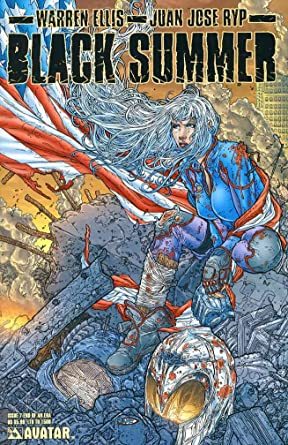
When America's premiere hero kills everyone in the White House in pursuit of his own brand of justice, his innocent former teammates become the targets of a massive military crackdown.
What happens when a crimefighting hero's pursuit of justice leads him to the horrifying conclusion that he must kill his President to save his country? When John Horus decides that no one is above his personal law, he kicks down the door to the White House and throw the entire country into chaos. Now, his former teammates in the Seven Guns -- some crippled, some crazy, and all considered guilty by association -- become live targets for a military determined to wipe them all from the face of the earth. BLACK SUMMER is Warren Ellis' graphic novel about where you draw the line, and where justice is nothing but death from above.
Warren Ellis is the award-winning writer of graphic novels like TRANSMETROPOLITAN, FELL, MINISTRY OF SPACE and PLANETARY, and the author of the NYT-bestselling GUN MACHINE and the “underground classic” novel CROOKED LITTLE VEIN, as well as the digital short-story single DEAD PIG COLLECTOR. His newest book is the novella NORMAL, from FSG Originals, listed as one of Amazon’s Best 100 Books Of 2016.
The movie RED is based on his graphic novel of the same name, its sequel having been released in summer 2013. IRON MAN 3 is based on his Marvel Comics graphic novel IRON MAN: EXTREMIS. He is currently developing his graphic novel sequence with Jason Howard, TREES, for television, in concert with HardySonBaker and NBCU, and continues to work as a screenwriter and producer in film and television, represented by Angela Cheng Caplan and Cheng Caplan Company. He is the creator, writer and co-producer of the Netflix series CASTLEVANIA, recently renewed for its third season, and of the recently-announced Netflix series HEAVEN’S FOREST.
He’s written extensively for VICE, WIRED UK and Reuters on technological and cultural matters, and given keynote speeches and lectures at events like dConstruct, ThingsCon, Improving Reality, SxSW, How The Light Gets In, Haunted Machines and Cognitive Cities.
Warren Ellis has recently developed and curated the revival of the Wildstorm creative library for DC Entertainment with the series THE WILD STORM, and is currently working on the serialising of new graphic novel works TREES: THREE FATES and INJECTION at Image Comics, and the serialised graphic novel THE BATMAN’S GRAVE for DC Comics, while working as a Consulting Producer on another television series.
A documentary about his work, CAPTURED GHOSTS, was released in 2012.
Recognitions include the NUIG Literary and Debating Society’s President’s Medal for service to freedom of speech, the EAGLE AWARDS Roll Of Honour for lifetime achievement in the field of comics & graphic novels, the Grand Prix de l’Imaginaire 2010, the Sidewise Award for Alternate History and the International Horror Guild Award for illustrated narrative. He is a Patron of Humanists UK. He holds an honorary doctorate from the University of Essex.
Warren Ellis lives outside London, on the south-east coast of England, in case he needs to make a quick getaway.
Ellis look at the empowered vigilante's role in modern society… a US President starts an 'illegal war' on Iraq (familiar?), and as a result a super powered vigilante takes him and his Vice President out and declares them as War Crime criminals... Black Summer tells the story of what happens next. On paper a captivating idea, but only executed averagely by Ellis. 6 out of 12, Three Star read 2011 read
sturm und drang! John Horus, once the leader of the now-defunct superteam the Seven Guns, has taken a hard look at the U.S. of A. and does not like what he's seen. so he takes matters into his own hands by bloodily dispatching the president (and the vice president. and several of their advisors) and issuing an ultimatum: hold new elections, create change... or else! only his former teammates can stop him. but do they even want to?
in Black Summer, Ellis riffs on the theme of Who Watches the Watchmen. he doesn't breathe new life into this familiar scenario, and his usual black humor is somewhat absent, but this is still an effective and often exciting story. Ellis' imagination delivers, as usual; particularly enjoyable are the Seven Guns' fascinating abilities and their intriguing backstory - I would love to read a story all about the Seven Guns' wresting control away from their home city's corrupt ruling powers and defiantly standing up to the U.S. government - and not only winning, but being embraced by the public. as an arch-progressive, I also enjoyed the fantasy of the American government finally paying for its misdeeds in the two Gulf Wars. although I suppose my private fantasies stop short at imagining the assassination of Bush and his cronies. or do they? Black Summer itself is fully cognizant of how any violent response to the government - whether leftist or coming from the right - is a first step into some exceedingly murky waters.
overall the flaws are minor and rather typical for Ellis: an occasional clumsiness with dialogue and a sense that the narrative is being rushed towards its climax. his story is really aided by Juan Jose Ryp's art; the back cover describes it as "insanely detailed" and I think that about sums it up, along with the words hyperreal and pyrotechnic (for the latter, quite literally at times - there's so much fire!).
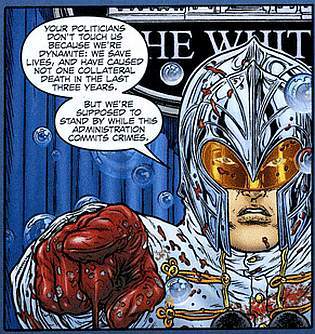
best of all is the conception and design of John Horus. and his floating eyes! he pretty much blows all other characters away when he appears.
The lesser of the two Warren Ellises fails unimpressively here at his attempt to reimagine Watchmen for the post-Sept. 11 age. A plot involving one of an elite team of superheroes who goes bananas and butchers most of the executive branch serves as a platform for Ellis to make undercooked grumblings about the Bush administration, justice, vigilantism, and I dunno, I guess violence. Add some nonsense about superpowers being derived from highly advanced guns, a pack of bland sociopaths for heroes, careless cram sessions of uninteresting backstory and a fuckton of explosions, and you have the half-baked dump cake that is Black Summer. One star for an eye-catching cover, and another for artist Juan José Ryp, who at least seemed to be having fun.
A grim, brutal and post 11th September Super-Hero deconstruction Warren Ellis style. It really needed a few issues more of character fleshing/world building to be another Watchmen, but Juan Josè Rip ultra detailed artworks are really amazing ones.
This was a tough one to judge because there's things I LOVE and some that just kept nagging me.
So the story is about a superhero who decides he has had ENOUGH! He's ready to take control of the united states by...killing the president. I mean that's how the story starts it's not a spoiler. Once he does the deed he goes on national television and claims he will not let the corrupt government hurt the citizens anymore. That change MUST come. IN doing so the people of the united states government and army go after the remaining superheroes of the country. So thanks to John's actions of killing the president his old crew who worked with him to save people are now under fire.
Good: I really enjoyed the setting and idea in here. The idea of the president getting murdered and a new law of independence and revolution beginning is interesting. Tom and the crew are all entertaining. I mean NO one is really likeable but glimpses of the past that combine with the current actions it all makes more sense. I also really enjoyed the ending and while it might be bleak to some I thought it elevated the message.
Bad: The art wasn't something I particularly enjoyed. I didn't mind the bleak or doomed atmosphere but more than so many lines and such happening that the action was really hard to tell what was happening. Also everyone had that resting bitch face going on that just wasn't working for me. I also thought the middle dragged a bit and having one less chapter probably would have made it flow better.
Overall I enjoyed the story a lot and the characters despite them all being pieces of shit. I'd rate the story alone a 4 out of 5. BUT this is a graphic novel, and the art wasn't very good, or didn't gel with me. So for that art I'd give it around a 2. So together it's going to make a 3 out of 5. I think for the story alone this is worth checking out. Warren Ellis does a very good job there!
I have rarely been as pleasantly surprised as I was with this one. I picked it up entirely based upon the cover, and the fact that I generally like Warren Ellis's work. (But mostly the cover.)
The "heroes" in the book are technologically- or medically- modified super-people. Specifically, they all chose to get their powers, as opposed to the usual comic-book-accident kind of setup. It deals with why they were willing to go through with this and its repercussions. Of course, the quick description of the book tells you that it opens with one of them killing the president, and the book really seems to want to address that topic--can you go too far, even with good motivations?
The plot is too busy to delve too deeply into the characters, but they all get enough time to be fleshed out at least a little. It specifically takes time to flash back to the moments when they decide to go through the process and address their respective motivations, and you get a good sense of the strain between them from their interactions. Of course, during these flashbacks, Ellis takes the opportunity to give use the pseudo-scientific explanation for what, exactly, is going on. (And that's a lot of the fun from reading Ellis--I like a little science with my coffee.)
The storyline itself is a bit crowded. I rarely think graphic novels, particularly collected editions, are too short--the monthly comic format seems to lend itself to some level of padding. But this story really could have breathed a little more. I would definitely read more stories about the same characters. The characters themselves, as well as the science, are both interesting on their own, and aren't showcased very well because of the time constraints.
The art itself is pretty incredibly detailed. It leaves me claustrophobic, or spending way too much time examining a panel because of all the detail. Having said that, it's a little TOO detailed, at times, because I spent way too much time examining a panel. You know, because of all the detail. So it's pretty impressive and awesome, but can be a little distracting at times.
Overall, I would compare it favorably with Watchmen, in that it seems to be addressing some of the same issues. But it's definitely more sci-fi, crowded, violent, and much less talk-y. The denouement itself uses a Chekhov gun plot device, so paying attention will pay off, but because of this it ends up being *very* slightly unfulfilling. (The suddenness of the ending probably also influenced that. Again, a little more room would be nice.)
But overall, excellent. I wish there was more like it.
This was shockingly good. I'm a fan of Warren Ellis, but he really outdid himself here.
This may be a little too political for some, as it comes across at times as a thinly veiled critique of the Bush Administration, but that's only part of the story. This is one of the "realistic" super hero stories that show just how things could be if super heroes were real.
When the top superhero in the world assassinates the most powerful world leaders, it's up to his team to stop him..or should they? The story is great with shades of grey as everyone questions their own beliefs as to what they should do next. While they don't agree with his methods, some of them think he has the right idea in mind. Then the government panics and decides the superheroes are probably all in it together and the only thing to do is kill them all as quickly as possible.
This review is really only scratching the surface of this story, but it's a very complex story involving politics and superpowers. Also, the art from Juan Jose Ryp is literally some of the most detailed art ever seen in comics. I've always thought he was an underrated artist in the vein of Geoff Darrow. The art just seems almost too complex to process, but in this case that's a good thing.
Overall just a very solid superhero story that really deserves more acclaim. If you like your superhero stories with a dash of realism you should read this.
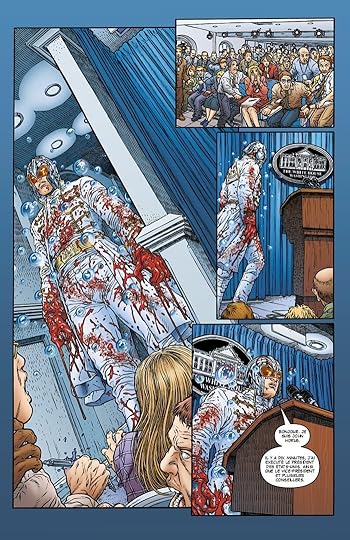
Riveting setup: a renowned superhero walks into a press conference covered in blood and announces that he has just executed the president, vice-president, and a number of advisers and secret service agents, for "war crimes and stealing elections". (Bush is never mentioned by name but this was published in '04 and the Iraq War kicked off in March '03.)
The rest of the book fails to deliver, as bitchy, unlikable heroes fight their way to a dull, predictable finish devoid of tension. In the absence of an engaging plot, it'd be nice to at least have someone to root for. Black Summer provides neither.
Not too long after Watchmen was released to panoramic commercial/critical success, all sorts of people within and (far more importantly) without the comic community realized something (not so) profound: comics did not have to be the stupid, puerile, (Comic Code Approved) ethically-black-and-white fantasies that they always were (for the most part) from the Golden Age onward. With this insurmountable benchmark heavily radiating across all future publications, graphic novels have had the bifurcated choice to either continue chugging immutably along or to continue to push the bounds of sequential narration, breaching the limits of the medium that Moore/Gibbons so well utilized, then deconstructed to revolutionary effect. Warren Ellis’ Black Summer tries to stand in the same line with this giant of yore but, without a firm structure, finds its automaton of straw crashing and burning all the way to the end, falling far short of its ostensible influence(s) and most profound predecessor.
Where Watchmen begins with a murder – so to does Black Summer. Where Watchmen employs capes riddled with flaws and internal disagreements – so to does Black Summer. Both utilize then amplify well known tropes (i.e, anti-authoritarianism) which singe and tear across their respective stories. However, while Watchmen masterfully blended the old and established with it’s own hefty dashes of the avant-garde and morally ambiguous to create a tale that was as coherent as it was brilliant in its conceptual analysis of Human Nature – Black Summer (no matter how well it tries to riff off of …) devoid of any profundity, doesn’t even deserve to be in the same orbit as such.
Appropriating the work of others is nothing new and is a phenomenon that has stretched across all cultures, religions, and societies throughout human history. Straddling the lines between homage/respect and “straight jackin’”/outright theft – incorporating the works of others into one’s own can be a daunting minefield of sorts. While indubitably influenced by such: Ellis has done a crap job with his referential insertions that range from simple (the intro assassination) toward the maudlin and poorly-executed (dialogue between the protagonists does little to develop them let alone texture the story further). With little to care about, I felt just as dehumanized as the (faux) heroes within – fully covered facades obfuscating essentially non-existent characters and the paltry story they have been damned to be part of.
So that’s really that. Jimmy Page might have ripped off the intro for Stairway from another band (Spirit) but was able to take the work of others and masterfully reshape it to fit his vision. Page might have created the most memorable song of all time yet, it’s the stochastic process underlying it that musicians, authors, and artists have been employing for centuries. Most notably, the most recent and important development in the sonic arts, Hip-Hop, is propelled by the possession, repossession, cycling, and recycling of established works (no matter their quality). DJ’s and MC’s have a duty not just to, ‘move the crowd” but, a far deeper responsibility to mine, interpret, reinterpret, then breathe fire into the works they have lifted. Ellis by contrast, has performed a weak cut-and-paste operation that is far to sparing in its application of external sources, and wallows way too much in it’s own original constructions that could have gained immeasurably far more from without than within.
In a world where superheroes police the world, one superhero goes ultra-pious and decides that the US President isn't good enough to lead the country and murders him along with his staff and key members of his administration. This leads the Army to take out the rogue superhero while his former colleagues wonder how it came to this - weren't they supposed to be doing good?
I wanted to like this book more than I did mostly because Warren Ellis is a wonderful writer and partly because I'd heard so many good things about the book but I came away from it thinking "Is that it?". The story seems very similar to Ellis' other famous superhero series "The Authority" where a group of superheroes police the globe and take things into their own hands and away from the governments of the world as they are too corrupt while the Authority are "more evolved". The fallout from that is similar to the chaos that ensues in "Black Summer" but the characters aren't as interesting as Hawksmoor, Swift, Jenny Sparks, the Engineer, Midnighter, Apollo and the Doctor.
The superhero's "powers" are kind of stupid too - super-guns give them the ability to take out tanks and helicopters but they can also say a password that turns them into a different shape (eg. Regular man says password and becomes masked muscle man) and have other powers. It's a bit too Manga for Ellis' gritty storylines and wasn't very compelling.
Juan Jose Ryp's artwork is amazingly detailed. His double pages of fighting and gore is eye-catching and have you staring at it for ages before turning the page. It reminds me of Geof Darrow's work but Ryp's style is more dynamic.
Not a bad book as superhero stories go and filled with more ideas and is far more interesting than your average DC/Marvel comic is but a disappointingly weak effort from the usual brilliance I've come to expect from Warren Ellis.
Warren Ellis... sometimes you have to remember that one cool scene or nifty idea isn't enough for an entire story. I was hooked by the opening scene of a superhero killing the president, justifying it in his own twisted way. However, from there it goes down the standard path of, "Team of special soldiers were created, they've gone off the rails, now they need to be taken out." We've seen this plot played out in hundreds of different ways and this isn't that much different.
The majority of the book is spent not so much on plot but on allowing Juan José Ryp to meticulously illustrate huge panels of massive carnage. Gore has never been so eloquently depicted! Despite this attention to detail, it is not an excuse to shortchange plot and character development.
I will spare you from diving into spoiler territory since this isn't an altogether bad read if you're an Ellis fan, but the final plot "twist" is telegraphed so strongly early in the story that you are completely aware that everything you'll read will simply be getting you to that point. And once you reach the climax... if you're like me, you'll feel slightly let down. Yes, it's the only logical conclusion to the story, but it lacks the grand scale that Ellis I felt was trying for throughout the book.
Black Summer could have easily been improved by taking a few of the giant splash pages of violence and using them to develop the characters a bit further, dig into their psychological state, and explore some of the moral topic touched upon briefly throughout. That, and don't telegraph the ending so much!
A book which dives head first into the basic paradoxical tension between the individual and the possibility of a greater good in American society. Grotesque, witty and just a tiny bit moronic. Loved it.
The "Guns" are enemies number 1 till 7 after Gun John kills the prez... Storywise I thought this was definitely something new, but too far fetched and definitely towards the end I found myself losing interest.. The ending then also let me down a bit, but all in all I had fun reading it. The artwork had me in doubt: at times I thought it was magnificent with all the details worked out, but then again it was tóó busy, giving me headaches ..
Still, definitely worth a gander if you happen to stumble across this one.
Black Summer is the first of a superhero trilogy that Warren Ellis wrote for Avatar Press, where more mature content is the norm and creators seemingly have free reign, continuing through No Hero and finishing with SuperGod. It's been favorably compared to The Watchmen but it doesn't come very close to what that landmark series achieved. Ellis starts with an intriguing concept - - a superhero executing the President of the United States, Vice President and advisors after finding them guilty of fabricating a rationale to go to war with Iraq (a not-so-subtle jab at the second Bush administration). It might have gone in more interesting directions from there, but Ellis sticks to the oft-used formula of government against the super-heroes allegedly turned criminal. To be fair, there are some interesting flashback scenes that shed light on the characters, but this is essentially a multi-issue free-for-all bloodbath that ends as you might expect despite the twisty reveal. What saves it is the outstanding art from Ryp, as Black Summer serves a a brilliant spotlight on his work with double-page spreads of carnage. The art is hyper-realistic and sometimes so detailed that you've got to study it closely to understand everything that is going on. It's bloody and violent as hell, and very explosive and fiery - - also a showcase for the colorist. For those who haven't experienced the creativity of Warren Ellis before and want to see what he can do with capes and tights - - I would recommend the Planetary series over this. It remains my favorite of his superhero work.
This started with the bang, but it lost me in the middle and brought me back at the end. Strange, but I thought there was too much action, maybe because the fighting scenes were incomprehensible, you could not tell what was going on. I did like the general idea of the story, but the plot twist was really predictable.
I admire the ballsy gutsiness of this story more than anything else. A fed up superhero may be the only thing that could save us from King Trump! But my eyes are smarting from the art. There's insanely detailed and there's baroque and then there's this. It's too much. And I wasn't a fan of the colors either. But what an idea!
I'd actually give this book 3 1/2 stars if this website could handle such a fine rating system.
Black Summer starts with an electrifying premise: there exists an American kind of Justice League, The Seven Guns, science-superheroes, and one of them, the Egpyt-themed blonde-hair blue-eyed leader John Horus, in the year 2006, after 9/11, after years of war in Afghanistan, has murdered President George W. Bush and other cabinet leaders in the White House, for making up about weapons of mass destruction, for imposing torture policy, and for starting an imperialist war based on those lies; there are further implications about election theft. Covered in blood in the White House press room John Horus gives an ultimatum to the American people: the United States will have free and fair elections based in truth, or John Horus will just have to murder a president again, won't he?
The premise, taking the sort fascist justice fantasy that in many ways underlies every superhero story to such a political extreme, a sort of Superman imposing Truth and Justice, could make for a pretty fascinating graphic novel, especially since these heroes are so explicitly American--gun owners, scientists, entrepreneurs--unfortunately the premise is somewhat squandered, the plot instead being more in Ellis's wheelhouse of military espionage and intrigue. Though some ideas are touched on in TV segments à la Dark Knight Returns, the plot isn't what happens to the United States or the world in the wake of this, but what is happening to the Seven Guns, who are systematically hunted down and murdered by the government, until our protagonist manages to kill both John Horus and the military leader while speechifying about superheroes having to leave the government to their own business. One could read the final few pages as satirical given the talk of him being a liberal, but he ends up feeling like many of Ellis's characters, a mouthpiece for Ellis to talk about an idea, which unfortunately is boring and sucks. There is a funny scene where the conservative among the Seven Guns naively suggests turning themselves in, after learning the CIA has made it their mission to assassinate them all.
Still, the military vs superhero stuff, hyperviolence rendered in overwhelming detail by Juan Jose Ryp, is all pretty fun to read, and as usual for Ellis's science-hero stories the technology is interesting and believable. The book is mostly told in Ellis's trademark six-panel grid style, though there are a few 9 panel pages here and there. There's a lot of joy in the character designs, which seem to pull from The Authority, Metal Gear Solid, and Power Rangers all at once; as well there's a lot of fun with the superhero tropes: more than anything this feels like a take on Captain Marvel or Miracleman, where the heroes are given their powers by a mysterious benefactor (who has sold out to the CIA by the time our story begins) and they each have to say a magic word to activate their powers, which all have their focus. They each seem to have invulnerability, but one has magic floating orbs which fire lasers, one is very fast and good at science/hacking etc., one can fly, one has superspeed, one has superstrength, and then there is someone on a motorcycle. It doesn't have the density or theme or character depth of a Watchmen or even a Dark Knight Returns; it has a good premise and a lot of incredibly well-drawn superheroes shooting American soldiers and F14s. There's a lot of talk about it being a Watchmen riff, but it does feel like more of a Dark Knight Returns thing, or an even more hyperviolent The Authority than an attempt at doing a Watchmen-style story.
(Zero spoiler review) 4.5/5 Now this is what I'm talking about. This is what I want my superhero comics to be. As someone who is yet to read pretty much all of the great superhero arcs from across the decades, I already know my favourite recipe when it comes to making my favourite superhero story. And Ellis has managed to get pretty much all the ingredients right here, even if the cooking time is a little bit off in places. First and foremost. The art of Juan Jose Ryp is nothing short of staggering. This guy puts more detail into his most basic of panels than most artists do in their covers. And when he really gets cooking and goes for a super detailed page or double page spread, god help us. This guy is operating on basically an entirely different plane to pretty much everyone else in the industry. He deserves to be far more of a household name than he is, and Mark Sweeney's colours more than compliment Ryp's supernatural talent. In fact, the guy deserves additional credit for having to colour some of the most minute and intricate detail he has likely ever had to work with. With all that, it would be easy to say Ellis is the weakest link here, although that would be doing the man a great disservice. The guy is either hot and on it, or ice cold and nowhere near the mark. I've unfortunately had to read some absolute ass from him, although Black Summer is one of his finer performances. Delving into the minutia of superhero antics and ethics, and creating an exciting and interesting ethical dilemma. It does a great job of walking a political tightrope without being pandering or too preachy. You see modern comic books. You can make a point without insulting, belittling, or downright lecturing people. In fact, the only real stumbling block in the story was the scale of the story. It all transpires in what seems like a day (with numerous flashbacks to years prior). This was a world that is hinted at, although leaves a lot on the table, unspoken or ignored for brevity. Obviously, there is a lot going on here for a single arc trade. But damn me if I didn't want a much longer run, where more of this world couldn't be unravelled and explored. That said, the pacing is great, with Ellis taking his time to build to the climax, rather than rushing it as he easily could have done. Large sections of the book are reasonably dialogue heavy, which is how I like it. If a superhero story is all punching and no build up, well it can go and piss off as far as I'm concerned. Despite only being seven issues, this is an absolute must read as far as I'm concerned. If you're weary of what modern superhero's have become, or you just want to look at some ball bustingly good art, then you could do a hell of a lot worse than Black Summer. 4.5/5
Black Summer is another Warren Ellis graphic novel, illustrated by Juan Jose Ryp. The Seven Guns are a group of government sanctioned and supplied superheroes who went to war for us, tackled crime for us and overall were there for the people. When one of them died a few years ago, it disheartened some of the group and the others went on ahead and did their jobs. John Horus, most powerful of them all decided one day that his idyllic vision of the country we should have was being run by a crooked man. He assassinated the president. John Horus went on television and confessed to it, gore soaked and blank, as he is emotionally. This caused the government to respond and of course the rest of the group were considered to be in league with John Horus, but this simply wasn't true. They had to defend themselves against the army due to one of their remaining number attempting to surrender to the government and they destroyed him with a tank round. This act caused the remaining four, five if you include John Horus, but he wasn't "with" the group. He was acting as the god he believes he is and therefore was attacked by the government on a different battlefield. The government panicked, having not killed any of the Seven Guns and therefore released their "defense protocol", new versions of the Guns. This did not work, though the heavy hitter of the Guns was killed. John Horus responded to this after having not been killed by the government's feeble attempts to get rid of him and had to see the remnants of Tom Noir. When the battle came again for the last time an agent who gave the Guns their powers showed up and muddied the waters. To add insult to injury Tom Noir showed up, not dead and confronted John Horus and his actions. This ended up in Tom revealing that he had a weapon made just to rid the world of something like John Horus and he destroys himself and his once friend. He realized that John would never know that he had become a criminal and he would never stop doing his particular brand of "good" which would endanger millions of innocent live. He had to be put down and was in the last act of promoting the pursuit of true justice. The other three Guns were far away, actually saving lives. Tom made sure he, John Horus and the agent were removed. No fringe element of Guns left and no man with the power to make more. Job done. This was a good book, fun to read. Gory, violent and adrenaline packed, the words match the art. Very good in form and function. As a huge Warren Ellis fan I liked this a lot but there are books I liked more and reviewed higher, but that takes nothing away from this book. It's a great story and something we will never, ever see Marvel of DC make in book form and for sure never in movie form. I am totally fine with that.
John Horus, a member of the former superhero team called the Seven Guns, kills the president and demands that free elections. The team was disbanded and its tech-enhanced members went their own way. Tom Noir, Frank Blacksmith who created their enhancements, Zoe Jump, Angel One, Dominic Atlas Hyde and Kathryn Artemis are the other members left alive after Tom's girlfriend, Laura Torch, was killed by a bomb that also took Tom's leg. Frank, thought dead, orders a newer generation enhanced individual to kill Tom because of what he knows. Tom defeats his attacker and contacts Zoe to bring the rest of the team together. After escaping the authorities they regroup in a secret location with armed government forces on their tracks.
Essentially, “Black Summer” is grappling with distrust of authority through the lens of superheroes. It’s asking who should wield the power, and it’s wondering if those that have the power currently are the ones that truly should.
The story begins with the death of a president, and ends in bloodshed by the hands of a team of superpowered individuals. As a whole, the story acts less like a talking piece (kind of like how “Supergod” was in my opinion) and more an examination of motivations. The President and their administration in this story were corrupt and had committed several crimes against various countries and their homeland. John Horus, Tom Noir, and others all want to help their city and country because they see that those in power are corrupt. And yet, when they have superhuman abilities, they, too, are also corrupted. In just a few chapters and a bit under 200 pages, you see why everyone, down to the military generals, did what they did. By the end of the story, there is no positive outcome for anyone. It’s bleak, but it’s really impressive to balance all of these perspectives and factors.
I did find myself getting confused by the art, especially during action scenes. The paneling made sense, but also the art was just a bit confusing with all the flames and blood and people dressed in black. I was regularly getting confused by what I was supposed to be looking at, but usually a piece of dialogue on the next page would boil it down. So far, out of this trilogy, I like “Black Summer” more than “Supergod.”
This came out in 2008, so it's hard to say where it fits in the timeline of superhero-commentary stories that Alan Moore brought to the mainstream with Watchmen. It does feel like it's been done before, several times, and better executed (even by Ellis himself, in the excellent series Planetary). I enjoyed reading it, though, and there did seem to be an underlying moral, the sort which doesn't typically stand out to me when I read Ellis's stuff. The moral is that it's better to help people than save the world. The primary conflict is between two super-beings who seem to be trying to save the world from the likes of the other and end up destroying the world in the process (or come very close to it). The superbeings who escape the paradigm the two antagonists (there aren't really any protagonists in this story) have created do so by assisting survivors from the mess the superbeings have created. I appreciated this sentiment and was a little surprised to see it put forth so clearly, for Ellis in particular. But between Ellis and Morrison and Moore and Millar and Waid and even Gail Simone (see her well-written Tranquility series), the superheroes-as-threats-more-than-benefits subgenre needs to say something new and unique to really impress me anymore. I'll still be entertained thoroughly, because the subgenre is a favorite of mine, but I'll need a new angle to be impressed.
Cogí esta obra de la biblioteca sin tener muchas referencias sobre ella, pero tras un buen sabor de boca en mis primeras lecturas de Warren Ellis. No me ha sorprendido demasiado, pero no es algo malo del cómic, porque ha ofrecido justo lo que quería. La narrativa de "¿qué hacer cuando un superhéroe se va de madre?" y "¿hasta dónde deben llegar los superhéroes?", directamente heredada de Watchmen, resulta bastante atrayente, y Ellis sabe manejarla de tal forma que no pierdas el interés en ningún momento.
Siendo buena se queda, eso sí, a las puertas de ser sobresaliente, porque algún punto flaco tiene. El arte de Juan José Ryp, por ejemplo, es impresionante, pero también un tanto confuso a veces, y en cada combate vemos páginas que no son más que mares de fuego y sangre en los que resulta difícil distinguir nada. Un poco lo mismo le pasa a veces a Ellis con el pasado de los personajes o sus poderes y acciones: la norma del "show, don't tell" funciona si el lector entiende lo que le estás mostrando, y eso no siempre se cumple aquí.
Con todo, son aspectos que si bien debilitan un poco el nivel general de la obra, tampoco lo mutilan. Y aunque para ser un cómic con una carga política tan fuerte termine siendo poco comprometido, recomiendo leerlo a quien le interesn este tipo de historias del género.
If it has the Avatar Press logo on it, you can rest assured that the comic book will meet the following criteria: Adult-oriented topics with excessively high levels of violence and high quality writing, artwork and coloring. Black Summer follows suit and is a fun read for those looking for a 'real world' take on superheroes a la Watchmen. I myself would totally sell out and cash in if I had super powers. The artwork by Juan Rose Ryp is just fantastic, and the coloring by Mark Sweeney and Greg Waller is equally stunning. There is so much going on in each and every panel, a real eye candy feast here.
Warren Ellis always has characters smoking cigarettes and dropping F-bombs in his stories. I have no idea why. This story was obviously very topical during the George W. Bush administration but holds up well. Recommended reading for those that like their comics with "Mature Readers Only" labels on them.
Back when I was going to the LCBS weekly, I used to spy the Ellis work that he was doing with Avatar Press.
Having fallen in love with his work, I wondered why he would stoop so low to penning these garishly-drawn, blood-spattered books...
...and then I got one and realized that the covers are in no way indicative of the content.
The story is vibrant and alive in the way that Eliis always managed to make them. It has something to say about the state of warcraft in America and how our leaders fail us just a little more often every year.
And while this sounds heady fir a book with so violent a cover, Ellis also opens some of the most deliriously incredible action.
This book is a genuine triumph, made all the better because I long believed that it couldn't be. Try it and be impressed too.
Un cómic al que me acerque con muchas espectativas. Lastimosamente cumplió algunas y otras no. Su principal virtud es no extenderse demasiado e ir al grano en la.mayoe parte de su desarrollo. La historia entretiene y no se siente pesada a pesar de los flashback recurrentes que usa. Pero se.queda corto en el diseño de personajes u sobre todo en sus motivaciones. Siento que el cómic podía dar.mcuho más de si. Pero el autor fue a la segura y aunque me gustó y es entretenido deja una sensación de oportunidad perdida.