“It was the egret, flying out of the lemon-grove, that started it. I won’t pretend I saw it straight away as the conventional herald of adventure, the white stag of the fairy-tale, which, bounding from the enchanted thicket, entices the prince away from his followers, and loses him in the forest where danger threatens with the dusk. But, when the big white bird flew suddenly up among the glossy leaves and the lemon-flowers, and wheeled into the mountain, I followed it.”
This is the opening of Mary Stewart’s The Moon-spinners, an adventure suspense story from 1962. It is an enticing opening for those who want to immerse themselves in a fantasy world; one full of mystery and romance. Egrets and lemon-groves … and someone promising us a tale of danger and adventure. Where can this be, this exotic location, and who is confiding their enchanting flight of fantasy to us? We are hooked. We read on …
“What else is there to do when such a thing happens on a brilliant April noonday at the foot of the White Mountains of Crete; when the road is hot and dusty, but the gorge is green, and full of the sound of water, and the white wings, flying ahead, flicker in and out of deep shadow, and the air is full of the scent of lemon-blossom?”
Mary Stewart’s powers of description are mesmerising; gradually enfolding us in a world of sensation. The book is redolent with scenes of great beauty; shimmering colours, heady aromas, the bewitching magic of the exotic and strange.
“I could smell verbena, and lavender, and a kind of sage. Over the hot white rock and the deep green of the maquis, the judas trees lifted their clouds of scented flowers the colour of purple daphne, …
Silence. No sound of bird; no bell of sheep. Only the drone of a bee over the blue sage at the roadside. No sign of man’s hand anywhere in the world, except the road where I stood, the track before me, and a white vapour trail, high in the brilliant sky.”
It might read like a travelogue, except that the scenes it describes are picture postcard perfect. This is her skill. Mary Stewart dazzles and draws you in with her glorious descriptions; impressions that are so sublime that they seem unreal. In this Mary Stewart novel, it is not the handsome young stranger who is so ravishing; it is the island itself which captivates and seduces.
“The trees were spindly, thin-stemmed and light-leaved; aspens, and white poplars, and something unknown to me, with round, thin leaves like wafers, that let the sun through in a dazzle of flickering green. Between the stems was a riot of bushes, but mostly these were of light varieties like honeysuckle and wild clematis …
A little stir of the breeze lifted the tree-tops above me, so that the sun-motes spilled dazzlingly through on to the water, and shadows slid over the stones. A couple of butterflies, which had been drinking at the water’s edge, floated off like blown leaves, and a goldfinch, with a flash of brilliant wings, flirted its way past me into some high bushes in an overhanging piece of cliff.”
There is romance, and there is also mystery. Mary Stewart was one of the most prominent writers of romantic suspense novels: a blend of romantic fiction and mystery novels. However her noticeable writing skills, and her references to classical mythology in this novel, put her above the mainstream. Critics consider her work to be superior to those of other acclaimed romantic suspense novelists such as Victoria Holt and Phyllis Whitney. I cannot comment on this, never having read those authors, but I am seduced by her writing. Her powers of description are impressive—within their narrow parameters. Do not expect to find anything undesirable, grubby or ugly within these novels. Mary Stewart somehow manages her breathtaking thrills, scaring her readers with nail-biting suspense, without cracking the surface of her perfectly divine vistas.
“The water was smooth and gentle, but with an early morning sting to it, and a small breeze below the salt foam splashing against my lips. The headland glowed in the early sunlight, golden above the dark-blue sea that creamed over the storm-beach at its feet.
Here, where I swam, the water was emerald over a shallow bar, the sunlight striking down right through it to illumine the rock below. It threw the shadow of the boat fully two fathoms down through the clear green water.”
We have the sparkling heroine Nicola, who at 22 years of age, bright, competent and attractive, is destined to find true love in this most romantic of destinations. Combining the two genres, developing a full mystery story while also gradually increasingly the strength of the attraction between two people, enables the author to provide a focus. Mary Stewart herself said that the process of solving the mystery “helps to illuminate” the hero’s personality, thereby also helping the heroine to fall in love with him. It is a neat trick, and once you have read one Mary Stewart novel, you can see how adept she is at manipulating her readers with it. She does it exceptionally well—and they love her for it. Many a Mary Stewart fan will cry, “I didn’t want this to end!” And what greater accolade can there really be, for a teller of tales?
“It was already hot. On this stretch of the hill there were no trees, other than an occasional thin poplar with bone-white boughs. Thistles grew in the cracks of the rock, and everywhere over the dry dust danced tiny yellow flowers, on thread-like stalks that let them flicker in the breeze two inches above the ground. They were lovely little things, a million motes of gold dancing in a dusty beam, but I trudged over them almost without seeing them. The joy had gone; there was nothing in my world now but the stony track, and the job it was me to do. I plodded on in the heat, weary already. There is no-one so leaden-footed as the reluctant bringer of bad news.”
Mary Stewart’s heroine, Nicola Ferris, is portrayed as a typically independent young woman for the time. She is a junior secretary at the British Embassy in Athens, Greece. She knows the country, its language and culture very well, but yearns for tranquillity and solitude when she is on holiday, and knows exactly where to find it: in a small village called Agios Georgios, on the beautiful island of Crete. By a series of unforeseen circumstances, she ends up in a remote area, with nobody knowing exactly where she is, or expecting to see her for another day or so.
This does not faze her at all. Rather, she makes the most of this opportunity for immersing herself in the isolation, greedily absorbing the stunning natural environment. Exulting as she finds another idyllic spot, she scrambles to another unique viewpoint, and achieves another ambitious climb. Nicola feels it is simply perfect, and looks forward to the next day, when she will be able to share it all with her older cousin Frances, who is a keen photographer and botanist. The two get on well well together, and Frances has been tempted to join Nicola, because of her descriptions—from earlier holidays—of the wonderful landscape, and proliferation of indigenous wild flowers. Nicola and Frances, coming from different destinations, are each then due to arrive at a small village hotel in Agios Georgios. It is run by a friend of a friend, and although very modest, said to promise excellent and authentic Greek cuisine.
It is, of course, all too perfect. Nicola’s impulses to be entirely alone quicken our pulse rates, as we realise the very real danger she is in. All of a sudden, having ventured up a little-used path into the White Mountains, she finds herself, a tourist, in the tight grip of one of the country’s inhabitants, with a knife at her throat.
The story which follows is a tale of greed, family feuds, blood vengeance, passion, murder and crime. It is full of suspense, and the reader switches between suspecting one character, and then another. In addition to Nicola and Frances we have Lambis and Mark, Stratos Alexiakis and Tony, Sophia and Josef, and the youngsters, Georgi, Ariadni and Colin. There are Greeks, Cretans and English, here, and it is not clear until the end who are the culprits and who the victims. Is it either of the two hiking companions? Is it one of the hotel proprietors? Is it one of the villagers? We root for some characters of course, willing the villain not to be the young man Mark, whom Nicola (despite her protestations of independence) is well on the way to falling in love with, nor can we bring ourselves to believe that the eminently sensible and likeable cousin Frances has anything to do with it.
So why is someone in hiding? Why is it so necessary that she not become involved? What are the secrets which, at all costs, Nicola must not discover? As the plot dramatically unfolds, both Nicola and the reader begin to gradually piece together the clues. The net is closing in, with Nicola and her loved ones caught in the middle. In mortal danger, Nicola must find solutions which not only demand all her ingenuity, but also necessitate more and more daring feats of physical skill.
The story cranks up to a very exciting ending, with thrills and spills a-plenty. For all her claims to independence, and the many episodes in the novel where it is Nicola herself who works out the mystery, and saves one of the others from certain death, in the end we have a knockabout scene where her hero shows that he is a manly man at heat, with the temper and strength any wimpish heroine could desire.
We are reminded that this in 1962. Females are on their way to becoming accepted as strongly authoritative figures, but are not yet empowered; they still have a tendency to go weak at the knees on occasion. On the other hand, a distinction is drawn between the more emancipated English females, and their Cretan counterparts, which is probably quite authentic.
Another jarring note is the description of a clearly gay character, Tony. It feels very much here as if Mary Stewart is investing Frances with her own attitudes. Frances calls Tony “Ceddie”, or “Little Lord Fauntleroy” behind his back. For one character to relate to another in this way would be acceptable as part of her personality, but when the author herself writes Tony’s speech as such a camp caricature, it becomes rather distasteful.
It is also a bit of a cheat for the characters to keep referring to later events as “Boy’s Own stuff” when actually that is exactly how the reader feels they are coming across! Having three children in the book, one of whom is an impressionable young teenager, is quite enough for us to have scenes of derring-do seen from their point of view, without drawing attention to the unrealistic and far-fetched nature of the adventures.
Incidentally, there is a 1964 film based on this novel, starring Hayley Mills, Eli Wallach and Peter McEnery. It is a Walt Disney production, and apparently the plot diverges widely from Mary Stewart’s book. The visuals are good, with no expense spared in the production. It was filmed on location in Crete, where Disney rebuilt a war-damaged village and hired local people as the background players. But it is only very loosely based on Mary Stewart’s novel.
If we take The Moonspinners at face value, as one of the better popular novels from 1962—rather than an all-time classic, with concerns and insights above and beyond its time—then it’s a ripping yarn, and most enjoyable. Mary Stewart draws from the classics in every chapter, always beginning with a quotation from one of the Romantic poets, or a particularly lyrical poetic quotation from an earlier or later poet. Many of these are poems which relate to Greek mythology. Setting the scene in this way, as well as the accuracy of her references to the indigenous flora and fauna, ensures that Mary Stewart’s novels are always just that little bit above the ordinary. To go back to the very beginning, preceding her opening are these words from Keats’s “Endymion”:
“Lightly this little herald flew aloft …
Onward it flies …
until it reach’d a splashing fountain’s side
That, near a cavern’s mouth, for ever pour’d
Unto the temperate air …”
which set the mood and atmosphere perfectly for what is to follow. And that title, so romantic in itself? It is from an old Greek legend, as Nicola explains:
“They’re naiads – water nymphs. Sometimes, when you’re deep in the countryside, you meet three girls, walking along the hill tracks in the dusk, spinning. They each have a spindle, and onto these they are spinning their wool, milk-white, like the moonlight. In fact, it is the moonlight, the moon itself, which is why they don’t carry a distaff. They’re not Fates, or anything terrible; they don’t affect the lives of men; all they have to do is to see that the world gets its hours of darkness, and they do this by spinning the moon down out of the sky. Night after night, you can see the moon getting less and less, the ball of light waning, while it grows on the spindles of the maidens. Then, at length, the moon is gone, and the world has darkness, and rest, and the creatures of the hillsides are safe from the hunter, and the tides are still …
Then, on the darkest night, the maidens take their spindles down to the sea, to wash their wool. And the wool slips from the spindles into the water, and unravels in long ripples of light from the shore to the horizon, and there is the moon again, rising above the sea, just a thin curved thread, re-appearing in the sky. Only when all the wool is washed, and wound again into a white ball in the sky, can the moon-spinners start their work once more, to make the night safe for hunted things …”
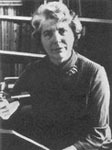
Mary, was in truth “Lady Stewart”, although she never used the title. She also had the beautiful maiden name of “Rainbow”, and her writing feels not only English, but also very restrained in its passion. If you are an unashamed romantic, and like plenty of literary allusions; and if, in keeping with the author, you prefer your romance to be a variety of high-quality lyricism, rather than erotica, then this novel may well make you swoon.