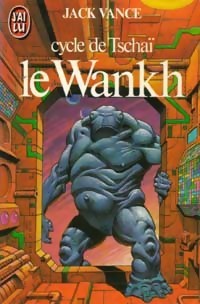
An orange haired girl, a purple moon, a fairytale cog on a remote ocean: would he trade it all to be back on Earth?
In the first book of the series, space ranger Adam Reith gets stranded on the planet Tschai, home to no less than four alien species and their accompanying humanoid servants/slaves. ( Reith looked through the scanscope and saw the shadow to be a Phung indeed. From where it had come he could not guess. It was over eight feet in height, in its soft black hat and black cloak, like a giant grasshopper in magisterial vestments. ) Reith manages to gain a couple of trusted companions and to save a beautiful damsel from being sacrificed to local gods. His stay on Tschai proves equally dangerous and marvelous and in this second volume he continues on his quest to find a means to capture a spaceship capable of returning him to Earth. But he's not in a hurry, which is a good thing, since there are all kind of troubles and delays to his journey.
There are a lot of similarities between Tschai and the Dying Earth, between Reith and the scoundrel Cugel, starting with the palid, tired amber sun shining over the planet and ending with the lack of scruples, opportunism and casual violence of the so called heroes. But I must say there's never a dull moment on this place so aptly named Planet of Adventure.
The survival kit which Reith had salvaged from the wrecked scout boat included a pellet gun, an energy cell, an electronic telescope, a knife, antiseptics, a mirror, a thousand feet of strong cord.
With these tools and with Anacho the Dirdirman and Traz the steppe raider, Reith sets out to return the alluring Ylin-Ylan to her father, ruler of distant Cath. Why would Reith hope to receive a huge reward for returning 'spoiled' goods is one of the unexplained mysteries in the novel:
The fact that you and the girl have formed an erotic accommodation is of course a complication advises the phlegmatic Anacho.
Beside the dry humor, the cavalier attitude to women is another characteristic of Vance and of so many other writers of classic pulp adventures. Poor Ylin-Ylan of many sensual and secret names soon becomes an anchor dragging our adventuring hero down and she must be somehow disposed of...
I could go on describing the journey, but why spoil the fun? Expect trouble about every other page (fliers crashing, barbarian attacks, insurance scammers, cult assassins, courtiers plotting, storms, sea-monsters, jealous women, duelists, alien soldiers, etc). Expect colorful, exotic places and weird, grotesque, hostile tribes of bizarre religious customs (eaten alive by giant scorpion larvae!!!).
Coad was a busy town. Along the crooked streets, in and out of the ale-colored sunlight, moved men and women of many casts and colors: Yellow Islanders and Black Islanders, Horasin bark-merchants muffled in gray robes; Caucasoids such as Traz from the Aman Steppe; Dirdirmen and Dirdirmen hybrids; Dwarfish Sieps from the eastern slopes of the Ozanalai who played music in the streets, a few flat-faced white men from the far south of Kislovan. The natives, or Tans, were an affable fox faced people, with wide polished cheekbones, pointed chins, russet or dark brown hair cut in a ledge across the ears and foreheads. Their usual garments were knee-length breeches, embroidered vest, a round black pie-plate hat. Palanquins were numerous, carried by short gnarled men with oddly long noses and stringy black hair: apparently a race to themselves; Reith saw them in no other occupation. Later he learned them to be natives of Grenie at the head of the Dwan Zher.
Given the fast-paced and dangerous ride across Tschai, it is admirable that Vance manages to include a few passages of philosophical and religious debate, such as this dialogue between a Yao courtier and Reith:
Yao doctrine, of course, is to some extent a syncresis; or better to say, in the course of the 'round' all aspects of the Ineffable are given opportunity to manifest themselves, so that, as we move with the cycle, we experience all theopathy. a rather pretentious way to say 'what goes around comes around')
- - - -
It occurs to me that the man and his religion are one and the same thing. The unknown exists. Each man projects on the blankness the shape of his own particular world-view. He endows his creation with his personal volitions and attitudes. The religious man stating his case is in essence explaining himself. When a fanatic is contradicted he feels a threat to his own existence; he reacts violently. [Reith's reply]
—«»—«»—«»—
One of the reasons this review is thin on actual plot details is not only the density of events, but also my delay in writing it down (finished the book more than a month ago, but then I moved into a new apartment and put my reading tasks on hold). Nevertheless, I can't wait to dive right back in and find out how Adam Reith and his companions will escape from their latest mishap.
\