
What do you think?
Rate this book


186 pages, Pocket Book
First published January 1, 1976


Il primo approccio dell'autore danese Jørn Riel alla scrittura è avvenuto quasi per caso. Ho appreso su di lui da Maria Valeria D'Avino nell'illuminante postfazione a Uno Strano Duello che:
«Nel primo anno di soggiorno in Groenlandia, trascorso sull'isola di Elle in compagnia di un coetaneo eschimese, gli era venuta l'idea di organizzare delle "serate letterarie" per ammazzare il tempo. Purtroppo però, gli unici libri che i due giovani avevano a disposizione erano alcuni manuali tecnici. Così, dopo un'estenuante declamazione di norme telegrafiche, Riel iniziò a scrivere racconti per poi leggerli all'amico. Da allora, non ha più smesso di dar vita a storie, che produce di getto e consegna per la pubblicazione quasi senza rileggerle»Semplice. Un pò come dire che se hai bisogno di un tocco di colore per la tua sala da pranzo prendi tela, colori e pennelli e ti dipingi un bel quadro da appendere. Poi volti la testa e ti rendi conto che forse sul quel ripiano nell'angolo un bel busto di marmo ci starebbe mica male. Semplice. Prendi un blocco di marmo e scalpello e voilà. E un bel faretto per illuminare il busto appena creato non ce lo vogliamo mettere? Prendi cavi elettrici, martello, intonaco, mattoni, vernice etc, e monta un bell'impianto di illuminazione. Facile. Semplice. Al di là dell'ironia, davvero sembra tutto semplice per Riel, quando scrive. La sua prosa ha il dono dell'immediatezza e della genuinità tipiche delle cose semplici. Caro Jørn, dove sei stato tutto questo tempo?
Il secondo libro che leggo della serie Skrøner ha tutto quello che avevo già apprezzato in Safari artico. Stavolta leggiamo di una prova di virilità che mette di fronte il giovane Lasselille alla sua più grande ambizione. Assistiamo all'insolito duello tra il maggiore Hansen e Lause. Scopriamo la passione segreta di Fjordur. Osserviamo le gesta del cane Labano. Veniamo a sapere delle conseguenze dell'eredità del conte. Partecipiamo assieme ai protagonisti all'installazione di un telegrafo alimentato da una bicicletta. Sullo sfondo, le bianche distese della Groenlandia nord-orientale, sterminate e silenziose. In un'intervista Riel confessa che, quando è costretto a soggiornare per qualche tempo in una metropoli piuttosto affollata, osserva perplesso il delirio della frenesia quotidiana. E conclude: «ci vuole coraggio a vivere così».
Voto: 8
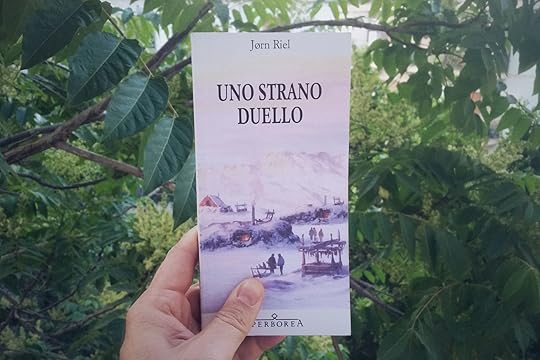
The first approach of the danish author Jørn Riel to the writing was almost by chance. I learned about him by Maria Valeria D'Avino, in the enlightening after-word of Uno Strano Duello ("A Strange Duel", translated in english), that:
«In the first year of his stay in Greenland, spent on Elle Island in the company of an Eskimo peer, he had come to the idea of organizing "literary evenings" to kill time. Unfortunately, the available books were some technical manuals. Thus, after an exhausting declamation of telegraphic standards, Riel began to write tales and to read them to his friend. Since then, he didn't stop producing stories»Simple. Like saying that if you need a touch of color for your dining room and take canvas, colors, and brushes and paint a beautiful picture to hang. Then, turning your head you realize that maybe on that shelf in the corner a beautiful marble bust would not be bad. Simple. Get a chisel and a block of marble and voila. And what do you think about a beautiful spotlight to illuminate the bust just created? Get electrical wiring, hammer, plaster, brick, paint etc, and mount a beautiful lighting system. Easy. Simple. Beyond irony, it really seems all easy and simple to Riel, when he writes. His prose has the gift of immediacy and genuineness typical of simple things. Dear Jørn, where have you been all this time?
The second book of the Skrøner series I read possesses everything I enjoyed in Safari artico ("Arctic Safari", translated in english). This time we read about a virility test that puts young Lasselille in front of his greatest ambition. We observe the unusual duel between Major Hansen and Lause, and the heroic deeds of Labano the dog. We discover the secret passion of Fjordur, and the consequences of the count's legacy. We are involved, together with the protagonists, in teh installation of a telegraph powered by a bike. On background, the white expanses of northeastern Greenland, boundless and silent. In an interview, Riel confesses that, when he is forced to stay some time in a crowded metropolis, he observes the busyness of everyday life. And he concludes: «It takes courage to live this way».
Vote: 8


