Jump to ratings and reviews
Rate this book

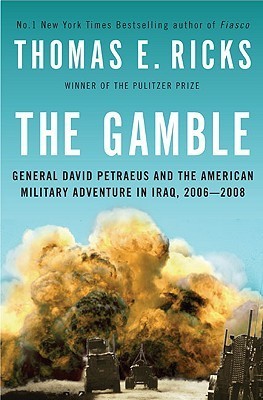
The Gamble: General David Petraeus and the American Military Adventure in Iraq, 2006-2008

Rate this book
The Gamble tells the gripping story of how, in the Iraq War's darkest hour, an unlikely collection of dissident generals, scholars and foreign experts pulled the country back from the edge of the abyss and saved countless lives. This was 'the surge', and at its helm was General David Petraeus, now acknowledged as one of the greatest military tacticians in US history. Based on unprecedented access to the entire chain of army command - at the top and fighting on the ground - this is the definitive account of one of America's biggest ever military gambles, and what it means for the future of Iraq.

394 pages, Hardcover

First published February 10, 2009

96 people are currently reading
2182 people want to read

About the author

Thomas E. Ricks

18 books440 followers
Thomas Edwin "Tom" Ricks (born September 25, 1955) is an American journalist who writes on defense topics. He is a Pulitzer Prize-winning former reporter for the Wall Street Journal and Washington Post. He writes a blog at ForeignPolicy.com and is a member of the Center for a New American Security, a defense policy think tank.

He lectures widely to the military and is a member of Harvard University's Senior Advisory Council on the Project on U.S. Civil-Military Relations. He has reported on military activities in Somalia, Haiti, Korea, Bosnia, Kosovo, Macedonia, Kuwait, Turkey, Afghanistan, and Iraq. Ricks is author of five books: the bestselling Fiasco: The American Military Adventure In Iraq (2006), its follow-up The Gamble: General David Petraeus and the American Military Adventure in Iraq, 2006-2008 (2009), The Generals: American Military Command from World War II to Today (2012), the novel A Soldier's Duty (2001), and Making the Corps (1997) (from wikipedia)

Ratings & Reviews

What do you think?
Rate this book

Friends & Following

Create a free account to discover what your friends think of this book!

Community Reviews

5 stars
697 (30%)
4 stars
1,000 (43%)
3 stars
486 (21%)
2 stars
83 (3%)
1 star
36 (1%)
Displaying 1 - 30 of 163 reviews
Profile Image for Brian.
327 reviews
March 23, 2022
Thomas Ricks is no fan of President Bush's invasion of Iraq, and has called it the greatest foreign policy disaster in U.S. history. He detailed the run-up to war and the first few years in Fiasco and has now written about the huge change in strategy and tactics that occurred with the surge.

He details how classic counterinsurgency theory holds that people are the objective, so the task is to figure out how to "win" them. And he quotes Col. H.R. McMaster as saying, "Every time you treat an Iraqi disrespectfully, you are working for the enemy." And according to Ricks, this was rampant.

And the levels of violence were high. By mid-2006, insurgents were detonating about 1,000 roadside bombs per week, and Iranian made explosively formed projectiles caused an estimated 73% of U.S. casualties in 2007. But the U.S. was holding to the same course of action, and Ricks believes the bottleneck was at the top of the Pentagon with Rumsfeld. He continued to support passing responsibility to Iraqi forces against the evidence of sectarian militia members in those forces.

In September of 2006, retired General Jack Keane told Rumsfeld, "Despite capturing Saddam Hussein, killing his two sons, holding three elections, writing a constitution, installing a permanent government, beginning to develop a capable ISF, killing Zarqawi - the level of violence has increased every year in the contested areas. Security and stability is worse today than it has been since the insurgency started. It threatens the survival of the government and the success of our mission."

A few months later, military historian Eliot Cohen pointed out to Bush that not a single general had been removed for ineffectiveness. In short, under Rumsfeld's watch, we were too respectful to our generals. In World War II, George Marshall fired several dozen senior generals, and during the war, 17 division commanders were relieved.

So the story of how many men, led by Generals Petraeus, Keane, and Odierno, came to change the face of war in Iraq is told. They looked at how to match your policies with your resources and in a memo to Petraus Maj. Gen. Fastabend wrote, "If this is the decisive struggle of our time, be decisive." Something that the military structure had lacked since the war planning stage.

The goal in Iraq became sustainable security, and as strategic analyst Steven Metz said, "We can't have stability and democratization because democratization is often destabilizing and chaotic." This is the story of how adapting to new strategies and tactics on the battlefield changed the course of this war. According to Ricks, the "best case is Iraq will calm down, be mildly authoritarian, and probably become an ally of Iran." But he cautions we won't know the true outcome for decades.

One of the problems with books by Ricks is there is such a huge cast of characters that it is challenging to keep the players straight and how much importance to put on them individually because they might just be a day-player in this drama. But it is worth the effort to be this well informed.
Profile Image for Michael Gerald.
398 reviews56 followers
March 24, 2021
The invasion of Iraq was just a pretext for exerting US hegemony in the world, with devastating consequences for the region.
Profile Image for Ted.
186 reviews3 followers
August 20, 2025
Bit dry, but quite enlightening. The degree of corruption and wasted resources on low-IQ democracy aspirers was stunning.
Profile Image for Ken.
373 reviews86 followers
January 7, 2021
The Gamble: General David Petraeus and the American Military Adventure in Iraq, 2006-2008
Insight from a General's perspective, interesting and comprehensive, what stood out for was one of his change in tactics seems fairly basic (but treat all civilians like human beings & crowd out the space given to extremists), and then negotiating a certain level of peace with the factions that can be changed, as not all can, but overall there really are no winners in war everybody looses, but what is worse is good people standing by and letting evil continue. Courage of General Peraeus and his means of achieving peaceful objectives, not all peaceful. Got an inkling of how a top level warrior thinks.
Profile Image for Bart.
Author 1 book127 followers
May 25, 2009
This book is a well-reported effort with multiple citations and sources and a somewhat coherent, if ultimately un-hopeful (as opposed to hopeless), conclusion in its epilogue.

For those who read the book as a weather forecast, the epilogue will provide all that you seek. For those that read this book for a tapestry of the way the United States military operates, the entire book is recommended. For those that seek insights on the formulation, and revision, of strategy and tactics, really, you'll get the most out of the opening 150 pages.

Those are the ones I enjoyed most. The complete revision of U.S. strategy as it pertained to counterinsurgency. Counterinsurgency has interested me ever since reading Ernesto "Che" Guevara's Guerra de Guerrillas. It is a fine conundrum: If a state fails to protect the utilities from the guerrillas - fails to keep the lights on and the water running - the state appears incompetent, and so why not go with the guerrillas? If the state wages full war against the guerrillas, hidden within the population, it converts bystanders to guerrillas and loses by numbers alone.

The solution, as the US apparently learned in Vietnam and then refused to teach a generation of our officers, is to protect the populace at all cost - once the insurgency is underway (always to be considered an initial failure). That is, kill and capture is a surefire way to lose an insurgency.

The US spent most of the years 2004-2006 killing and capturing insurgents, while "commuting to war" from its forward operating bases: Drive 90 minutes, patrol 90 minutes, drive back 90 minutes. All the time, the focus was on finding and killing insurgents - and when civilians popped up and asked for basic services, they were provided bread or money or told to shut up. Always, the populace was an obstacle standing between the US military and the enemy.

The fundamental change brought by General David Petraeus was to focus always on the populace - and when insurgents popped up, they were to be killed or captured as a means of removing them as obstacles, not as the ends in themselves. Petraeus's job was to regain the strategic initiative, a task that appeared impossible when it was first undertaken. Petraeus succeeded, though, in the unlikely and proud American tradition of generals like Washington, Sherman, Grant and MacArthur.

How the occupation of Iraq ends, though, is an entirely different, and less-hopeful, matter. Thomas Ricks seems to conclude that a force of between 25,000-50,000 US soldiers will need to remain till at least 2015 for there to be any chance of stability. And Petraeus has already taken the notion of a flourishing democracy off the table. A disloyal (to Iran) Shiite government in Baghdad that looks suspiciously like an Iranian puppet but isn't completely, Ricks concludes, might be the best hope we have. Un-hopeful as that reads, it beats every realistic alternative.
Profile Image for Steve.
899 reviews274 followers
February 9, 2010
The best book I've read so far on the conflict(s) in Iraq. I thought about giving this 5 stars, but the last 30 pages or so has Ricks trying to guess where this is all going. Nothing wrong with that, since the situation in Iraq is ongoing (and is now our longest war), but at that point it moves from history toward crystal ball gazing. (But in this case, it's very informed crystal ball gazing.) General Petraeus, the focus of much of book, comes across as one of the rare, transformative figures that come along every once in a while in history. He understands the conflict, and how to fight it. But at some point politics will take over, and what is now considered a tactical success (the Surge), could collapse due to the politics surrounding the U.S., Iraq, Iran, etc. I was somewhat surprised that Petraeus was trying so hard to get the Army to move in the direction of Counterinsurgency. I kept asking myself whether we had learned anything from Vietnam? Ricks points out, about midway through the book, that the Iraq invasion, with its emphasis on Blitzkrieg, may have been a swan song for that particular style of fighting. I'm not sure I buy that, but he makes a good case for it. As far as the invasion itself, Ricks thinks that in itself may damn the Surge. It was a bad decision, not thought through, and fought stupidly for several years. Ricks also doesn't think too much of Rumsfield, who comes across as the Wrong Man in the Wrong Place at the Wrong Time. His replacement, Gates, is a vast improvement. So much so, that one can see why Obama decided to retain him. A great book that I highly recommend.
Profile Image for Trish.
1,422 reviews2,710 followers
March 17, 2009
Ricks has a thesis--you can guess it from the title--and he makes his point forcefully. It had always been my contention that the people of Iraq must be better served and the concept of sending troops out into small outposts in cities and towns to establish peaceful areas is intuitively convergent. The intent was to have peace for long enough that a political solution could arise.

In practice we have been arming former insurgents to keep them from fighting with us and Iraqi citizens. We have established an uneasy calm for a period, but the political process has not moved in the direction we had hoped. Instead, with more peaceful living conditions in the cities and towns, political positions appear to have regressed and entrenched rather than broadened and become more inclusive.

How it plays out is anybody's guess. What I liked about Ricks' work was obtaining a sense of the difficult choices facing commanders at the time Petraeus was writing the new counter-insurgency manual, the disconnect between Washington and Baghdad, a peek at what life must have been like for thinking beings, our soldiers, executing orders and living in Iraq. I think the editing on this work was magisterial, because the amount of information must have been overwhelming, yet the material is cut so that a clear narrative with a fresh perspective emerges. I appreciate the timeliness--I can't believe we are reading in such depth about events that occured so recently. Kudos to Ricks.

Profile Image for Brett C.
947 reviews233 followers
May 16, 2021
This was a detailed account on General David Petraeus and his execution of military campaign and wartime doctrine in the first Iraq war. Recommended for anyone interested in modern warfare. Thanks!
Profile Image for Richt.
3 reviews
March 11, 2009
Sad and frighting how we got in this mess in the first place.

This book describes how a group of active duty and retired generals, and colonels and civilian experts (Petraeus,et.al) who were against the war in the first place were able to redirect the Iraq war, because the Republicans got whipped in the 2006 elections. After their losses in the election, the old regime had to finally admit that we were about to lose the war, fire Rumsfeld, and hand over the keys to Petraeus and company.

After a recounting of the stupidity and horrors surrounding the run up and conduct of the war from 2003 to 2007, we get an inside look on how we averted total disaster by changing commanders and strategy.

The new commanders changed to focus to protecting, communicating with, and making allies of the Iraqi people (including many insurgents). Our troops started staying in the Iraqi cities 24x7, instead of hiding out in isolated bases. This change in strategy (well there was really no strategy before this) and tactics, had more to do with the change in status than the surge in troop numbers. Though the surge certainly made it easier. It is the classic counter-insurgency strategy that was ignored by Rumsfeld and his yes-man generals. Petraeus literally wrote the counter-insurgency book for the US military.

A great irony can be found here. Had the election not forced the old regime to change things, the war would have been over for the USA by now, with us leaving in disgrace and Iraq in an full-fledged civil war, and Iran controlling a big part of Iraq. So by voting anti-war, we are getting a longer war, which may have an outcome that is better than the total disaster that the old regime was leading us to.

The sad part is that all this has accomplished was a relatively stable, safer Iraq that now has the opportunity to move towards a self-governing society. It is more likely we will get another Saddam than democracy. Obama's plans for Iraq match up with the advise of Petreaus. We will have 35 to 50 thousand troops in Iraq for decades. They just won't be doing so much dying and killing. They are more of a peacekeeping force than an invading army now. So it is not a victory, it is an incomplete with hope. At least it beats having 130,000 troops there killing and dying for little or no reason.

The best thing would have been to not invade in the first place. DUH!
Profile Image for Kashayar.
Author 1 book1 follower
July 27, 2011
This book is a great work on the surge and the magnificent job done by the US military in Iraq from late 2006 to late 2008 as this book came out. I admit I am not a fan of Rick's way of thinking on matters of foreign policy and especially I dont like his liberal bias. Why would one ruin a good book by showing his liberal bias? Mocking the president or vice president? why? Can't you just report what has happened without commentary of your own? There are dozens of this bias through out the book but I just want to point to two of them as examples and how he is wrong: 1- on pg 76, he claims the fall of Saigon in south Vietnam did not make the domino effect happen. Only to contradict himself a paragraph down the page saying "except for those in re-education camps in Laos and Cambodia and Vietnam. So he admits to domino effect being taken place. 2- On page 102, he mocks Pres Bush in "hit a new low" statement he makes. Hit a new low in whose eyes? a liberal like Ricks or me and other Bush supporters? Of course, Bush was never high in the eyes of people like Mr. Ricks. Again, I am saying this is a good book and worth reading but the liberal bias in it is overbearing and makes the book appear as a work of a partisan hack. All those praise for Sen. Webb for what? How is he related to the surge and Iraq reporting? When he praises Bob Gates and scold Bush and Cheney for their disdain of the government, he is misguided. Bush and Cheney are not disdainful of the outstanding careerists like Secretary of Defense Gates but I assume they are disdainful of the reach of a big government. I think the author has his own priorities wrong in this book. It is one thing to hate Bush and another to insert bias in a work of journalistic nature.
Profile Image for Christopher.
768 reviews59 followers
May 10, 2015
A great follow up to his previous book on the Iraq war, Fiasco, Ricks shows how American troops, led by Gens. David Petraeus and Ray Odierno, did a complete 180º turn in terms of strategy and brought a relative amount of security to the country. Ricks also added something that I thought was lacking from his previous book: short, biographical info on key figures like Petraeus, Odierno and Keane. And, just like before, Ricks has a knack for illustrating the facts both on the ground and in the hallways of power. Strangely though, I found this book to be far more lacking in in-depth details and reflections than Fiasco, especially in part 3. Although he makes up for it in the epilogue, I felt that Ricks could have said more than he did on the surge's consequences before the epilogue. He probably was hampered by the fact that he had little time to finish the book before publishing it (1-3 months by my guess) and because we still aren't sure what the lasting consequences of the surge are. Having said that, Ricks once again shows that he is the authority on what has been going on, both good and bad, in Iraq.
Profile Image for Lee.
1,125 reviews35 followers
August 2, 2022
This is an interesting book on how General Petraeus and the American Military turned their failure in Iraq into a qualified success. General Petraeus and General Odierno are the heroes of this book, with Ricks detailing how they took a war that was being fought the wrong way and made it right. Ricks does a good job of highlighting how much this was a change in mentality as much as it was a change in strategy.
I would have given this book 4-stars, but for me it got too much into the weeds and became hard to follow sometimes. Ricks drew off lots of interviews from soldiers on the ground, giving the narrative a sense that he really dug a lot, but also sometimes slowing down the narrative. Some readers, particularly those more familiar with military narratives, may want this. If so, consider this a 4 star rating. But for me, I was hoping for something that was more broad strokes.
Still, a great book for any one interested in the Iraq war. I listened to the audiobook, which did a good job of re-presenting the book.
Profile Image for Bookmarks Magazine.
2,042 reviews809 followers
April 15, 2009

By and large, critics were less eager to assess Ricks's work as an author and more interested in his opinions about the success of the "surge" and the future of Iraq. But this is perhaps the book's greatest endorsement; whether they were liberal or conservative, American or British, critics viewed Ricks's facts as unassailable and his analysis as strong. They were impressed not just with his unparalleled access to the main actors in Iraq but also with his ability to integrate two commonly held but seemingly irreconcilable views -- that the war was a mistake and a catastrophe (as expressed in Fiasco) and that Petraeus and the surge represented an amazing turnaround. Thus, many critics found that although Ricks seems to express a consensus view, The Gamble is counterintuitive and challenging, refreshing yet sobering.

This is an excerpt from a review published in Bookmarks magazine.

126 reviews15 followers
February 9, 2010
A great read in the best journalistic tradition. The book is in three parts

1. Things begin to fly apart in 2006
2. A new strategy is conceived, which includes the surge, but it definitely not limited to it
3. Does the new strategy work? His answer is, 'Yes, no, and we'll have to wait and see.'

Normally I shy away from accounts of so recent events, but I make an exception here. He puts us in the middle of the story and does not promise us ultimate answers.

I should also add the book, aside from some stinging criticism of Rumsfeld, Wolfiwitz, and a few others, is mostly apolitical, just as active duty officers are supposed to be. Ricks avoids commenting too much himself, but when he does do he criticizes Republicans, Democrats, the military, the Iraqis, etc.

As a great bonus, there are unclassified copies of various orders, graphs, etc. used by the military during this time.

Very well written and easy to follow along. . . well worth your time.
Profile Image for Kathleen.
1,956 reviews39 followers
September 24, 2009
Much like its subject, this book demands a commitment; it is not an easy read. It is well written and worth the time, though. Focusing on Petraeus as something of a system-bucking intellectual, this book avoids the first three-four years of the war in Iraq that enrage me most of all. Successfully explaining what people mean when they say things like "the surge was tactically successful, but a strategic failure" and giving a thorough view of the strategic situation from 2006-2008, this is a far more informative source than I remember the nightly news being at the time. Not being a huge C-Span fan, all I really remembered about Petraeus' April 2008 Congressional testimony was the Daily Show's "Iraq me Dave Petraeus" theme song.

So: smart, well written, and will tell you why we're stuck in Iraq for twice the time we spent in Berlin post WWII. Read it.
13 reviews1 follower
February 28, 2009
This book follows up on Ricks' work in Fiasco with the story of the way forward in the Iraq War. While this is probably a war that didn't need to be fought, it is one that we need to finish.

In spending a lot of time with those responsible for the new way we fight in Iraq, General Petraeus and Odierno, Ricks determines that what we are doing is working, though we may be in Iraq much longer then many people think. If you read Fiasco, I would recommend this book to you.
Profile Image for Brendan.
12 reviews
February 28, 2009
Straight forward, even handed account that crystallizes the last two years of the Iraq War. If your ignorant of where America is in Iraq or how we got there, I strongly recommend reading Ricks' previous book on Iraq 'Fiasco' followed by 'The Gamble'.
Profile Image for Jimmy.
1,226 reviews49 followers
December 16, 2014
Thomas Ricks has written another wonderful book on the military and the importance of having the right generals during war. In this book he looks at the Surge of the Iraq war and the military leadership involved with the great “gamble” of achieving some kind of nominal success in winding down the war. Most Americans have little understanding about the Surge and those who are better informed often know about the Surge in the context of the heated partisan debate in 2006-07 between Republicans and Democrats sitting on Capitol Hill. Indeed few understood the strategy and operational perspective of the leaders “on the ground” and I think that include many politicians. It does not help that very little has been written about the military leadership that led the actual Surge since few journalists in my opinion are capable of understanding or appreciating the operational side of the military. I think Ricks is an exception to the rule and his writing as a journalist over the years has matured and display a great understanding and appreciation of military strategy and the importance of the right personnel at the level of General officers. For some he is a must read as a great introduction for military intellectuals.
In order to appreciate the surge one must first understand the military’s involvement in Iraq prior to the surge. Ricks in the book is blunt in his discussion of the early years of the Iraq war with its bad leadership, blunders and shortsightedness among those in the officer corps. He argues that bad leadership will result in ugly outcomes like that of Haditha and similar episodes. I know the incident in Haditha is rather contentious but he does make a point that how the Battalion commander and upper echelon commanders handled the incident show a lack of understanding of the basic premise of counter-insurgency is to win the people rather than further alienate them from the military’s objective. Ricks sees Haditha as a sort of turning point. The early years of Iraq was a difficult time as many Battalion, Regimental, Brigade and even Division Commanders didn’t understand just what kind of war they were waging. Ricks pointed out that the ones that did understood were actually the outsiders such as General Petraeus. General Petraeus was different than most of his peers in many ways: unlike most of the Army’s leadership in the early years of Iraq his career was spent mostly among light infantry rather than the heavy infantry (think Mechanized infantry). There is an unspoken code that officers are to separate themselves from political connection but Petraeus was comfortable with courting political support and in fact desired that. Petraeus was also highly educated and open to discussion among civilians for their expertise. This play a crucial role in his formulation of his doctrines on Counter-insurgency as General Petraeus is the one who led the re-writing of the modern Army’s Counter-insurgency manual. I have heard in the past that Petraeus wrote the manual with the legendary Marine Corps General Mattis but what I didn’t know before and learned in the book is how many people and how diverse was the make up of the group that help consulted and wrote the Counter-Insurgency manual. Petraeus had all kinds of experts ranging from the expected military officers to human rights lawyers and civilian historians of the military. What I appreciated in the book is how the author pointed out that for General Petraeus, the metric for measuring success in his strategy is not merely winning territory but winning the people instead. He saw the people not as “collaterals” in the way of a military objective but instead the people was the objective and the prize.
The war being conducted badly was what eventually drove politicians to re-evaulate how the war was being conducted—and it was also what led George Bush to finally be open for new and fresh military leadership. I appreciate the author describing the relationship of the old leadership versus the new leadership that was going to lead the surge. In particular I was delighted to read about the relationship between General Petraeus and Odierno who were both very different in temperament and approach but both worked together well. Previously I had thought of Odierno as the General who merely was famous for helping the US pack up after major military operations in Iraq and Afghanistan and I had no idea how much of a role Odierno played in the surge. I’m glad I read this book! Odierno was the one who was the “hammer” while Petraeus was the soft spoken leader so to speak. Together they worked out a balance in approaching the insurgency.
There are far too many things I learned from the book and one should get a copy for oneself! At the time that I read this book towards the end of 2014, I realize that this book was published in 2009 and the book was limited in its coverage of Iraq between 2006-2008. Obviously one can’t help but to think of the future of Iraq. The author was realistic in my opinion and was no mere cheerleader for the Surge—he also caution that the objective of the Surge might fail if politicians don’t allow troops’ presence to continue longer and the author also saw that Iraqi politicians has the ball in their court to build partnership that stretches beyond partisanship in particular with the Sunni-Shiite-Kurds divide. How true that is in hindsight as 2014 has turned out to be the year of ISIS’ expansion. I think we must not forget that Iraq has now been more or less divided into three powers, the very thing that America wanted to avoid with Iraq’s future. I read this book with much nostalgia thinking about my own time in the military and deployment in Iraq. Like the author, I have many mix feelings, saw the Surge as a success but one with many limitation as to how far it will go if its not followed up on the political end both in Iraq and the United States. One thing that the author didn’t see coming that I can’t help thinking about as I read the book was how much of a role the current conflict in Iraq with ISIS owe its ability and strength from the “Sons of the Awakening” that the US military employed back in 2006 and onwards. Many of these were Sunni militants who switched sides who sought employment with the US as militias against Al Qaeda. Since the Iraqi government with its Shiite majority would have never supported this make shift army and didn’t want to incorporate them into the regular Army, what would have happened to these military aged men who were trained, armed and unemployed? It doesn’t require rocket science to connect the thought that these men would obviously be a source for ISIS to tap into once the Americans’ departure left a vacuum. I have come to a stronger opinion that the United States should really think long and hard before we train any militant groups as we can never predict what it will mean for us and the region five, ten and twenty years down the line. If history tells us anything, we often train and equipped our future enemies.
Profile Image for Hotavio.
192 reviews8 followers
April 9, 2011
The Iraq War has kind of faded from the forefront of the American conscience, but is far over. At least this is one of the assertions that Thomas E. Ricks makes in Gamble: General Petraeus and the American Military Adventure in Iraq as he advocates the continuance of the militarily supporting the “democracy” of Iraq. “Even as security improved in Iraq in 2008, I found myself consistently saddened by the war, not just by its obvious costs to Iraqis and Americans, but also by the incompetence and profligacy with which the Bush administration conducted it. Yet I also came to believe that we can’t leave.” With this statement, Ricks echoes much of the sentiment that Americans have towards this woe begotten intervention. Still, in The Gamble, Rick’s unearths some aspects of the military affair that he has enthusiasm over, particularly in General David Petraeus and the 2007 military surge of Iraq. Amidst the complications of supporting change in Iraq, Ricks elevates Petraeus to a mythic level, a relatively comfortable task when juxtaposing the effects of the Surge with the directionless military policies of former Secretary of Defense Donald Rumsfeld and former top U.S. commander in Iraq, General George Casey.
Being from Penguin Books, The Gamble is written to appeal to wider audiences (as indicated by the book’s pronouncement of making the New York Times Best Sellers List. To appeal to a broader audience’s taste for the controversial and grisly details and to frame the success of the Surge, Ricks makes liberal use of atrocities committed by the US forces under the directionless pre-surge policies. This is evident from Rick’s mention of the military’s “door busting” approach to locating insurgents that ended up in 24 dead civilians in the town of Hadith in 2005. The first chapters of The Gamble relay familiar aspects of a misguided war quickly coming unraveled, but also hint at the hope of realignment back home with a cabal of officers aimed at reversing the policy of Iraq in favor of one based on counter insurgency. This group was to identify a figure head in Rick’s hero, General Petraeus.
Ricks is hard pressed to find fault with Petraeus. While providing some of the common criticisms of Petraeus, he is quick to detract from them by adding his own rebuttals. One area of particular concern to Ricks was the September 2007 and April 2008 congressional hearings on the effectiveness of Petraeus and his methods in Iraq. The author relays the concerns of congress in supporting the troop levels in Iraq, particularly at a time when both political parties were feeling especially accountable to voters. Petraeus, who had to stand by for the effectiveness of the Surge, was grilled by several presidential hopefuls. Two areas where Ricks was particularly disgusted were MoveOn.org’s defamation of Petraeus and then Senator Hillary Rodham Clintons’ claim, “I think the reports that you provide us really require the willing suspension of disbelief.” Ricks identifies Petreaus’ victories over Clinton by masterfully evading her questions and claims, upholding Congress’ confidence in his direction in Iraq. Rick’s support of the Surge is capped by the quote from Al-Qaeda’s second in command Ayman al Zawahiri, “Today, the wind-by the grace of Allah-is blowing against Washington,” as the reader is reminded who this political squabbling benefits.
When identifying Petraeus as a hero, Ricks does not neglect us of the general’s contributions to Iraq. Among the many is a complete reversal of mission, from the military eliminating insurgents and handing power over to a democratically elected Iraqi government in a timely manner to the commitment to understand and provide the Iraqi citizens protection from Shiite militants, al Qaeda, and even the religious inspired cleansing of the Iraqi National forces. Refraining from the timetable approach to withdrawal, the author believes in the necessity of prolonged occupation, comparative to America’s role in Western Europe after World War II.
Regardless of the Surge’s successes, Ricks does not paint a rosy post-Surge picture of Iraq. He reminds us of the tribal nature of Iraq, its division based on religion and ethnicity, and warns heavily of the Iranian influences in a now Shia run country. Contradicting American hopes that intervention in Iraq has not been in vain, Ricks provides a poignant quote from the police chief in Fallujah, “No democracy in Iraq. Ever.”
The Gamble is a reader friendly book, with plenty of opportunities for advanced study. Appreciable is the addition of generous appendices, allowing for easy comparison of the Casey and Petraeus missions in Iraq. There are several illustrations, some attributing to counter-insurgency techniques, like Captain Travis Patriquin’s cartoonish diagrams on building rapport with the sheiks of Anbar, some more amusing like the comparison of Generals Petraeus and Ambassador in Iraq Ryan Crocker to Tony Curtis and Sidney Poitier in “The Defiant Ones”. Also helpful is the list of military abbreviations in the begging of the book, though the author often provides explanation of the abbreviations in the text. One unusual, but beneficial, addendum is that of the “Cast of Characters,” which identifies the wars participants, along with their positions and the year that they were important. With all of these generous features, author notes and sources are slight. This could be attributed to Rick’s reliance on interviews for most of his information, not necessarily a bad thing given the timeliness of the subject matter.
The Gamble outlines an ever important change in American policy in Iraq, identifying the Surge as the turning point, with Petraeus as its hero. While “the gamble” is a won battle, Ricks is careful to remind the reader that the war is far from over and will never be a victory in the way that former president George W. Bush had envisioned. In recognizing this, Ricks raises some legitimate concerns for the future of Iraq making The Gamble a useful source for information on the war, while posing questions about the feasibility of American withdrawal.
Profile Image for Jake.
4 reviews
February 5, 2024
Ricks’ works (this, and Fiasco) are indispensable for anyone interested in developing an understanding of the U.S. invasion and occupation of Iraq, 2003-present.

Toby Dodge, an English political scientist specializing in the Middle East, in reference to the U.S. invasion of Iraq, stated, “America will have bequeathed a highly unstable state to the Middle East and a great deal of suffering to the Iraqi people, for nothing.” Ricks’ works essentially prove Dodge’s thesis.

Ricks crafted this book through several interviews with key decision makers within the U.S. military during the buildup and aftermath of “the surge”. These testimonies are woven into the narrative, which gives due credit to Gen. David Petraeus and others that steered the U.S. towards a more effective counter insurgency strategy.

This book has a long list of characters and can be hard to follow at points. However, Ricks’ journalistic style lends well to overall readability.
130 reviews1 follower
November 20, 2019
A good, quick ready about an interesting and complex topic. While Ricks does the Surge justice - describing in detail the situation in Iraq before, during, and after the 2007 troop increase - the theme of the book is adjustment writ large. It’s a study in how large organizations, which are typically beset with inertia and their own politics, shift their thinking and eventually their strategy. The players in the book are fascinating to read about 11 years later. HR McMaster plays a leading role, as does a dynamic George W Bush, and an ascent Obama. Like many books of this era, The Gamble sometimes devolves into a hagiography of David Patreus, so it’s fascinating to consider his subsequent fall from grace. Overall, a fascinating look at how change occurs, though I wish I had read Rick’s first effort Fiasco, about 2003 to 2006 first.
214 reviews2 followers
August 19, 2023
Same style as Fiasco. Great blend of interviews, anecdotal observations, and data to tell the story of the Surge. It really makes you appreciate how close the US was to absolute disaster in Iraq and how the talent, extreme intelligence, and will of military leadership was able to turn it around. I liked how the book didn't paint an overly positive or pessimistic image. It made me think how many decisions from the tactical to strategic come with their own series of incalculable intended and unintended consequences. The surge stopped the violence and pending civil war - but what new challenges (or opportunities) did that create?
Profile Image for Shaun.
678 reviews9 followers
November 25, 2017
I found this book informative and fascinating. I served in Iraq in the Wild West days during the beginning of the war 2003-04. It was interesting to learn about how the Surge affected the war effort and helped us come to a conclusion in Iraq for now. Things in the Middle East are a mess. The culture is so much different that here in the US. I have many Iraqis that I worked with and love and miss so much. I pray they will stay safe. Enjoyed this book immensely and learned a lot too. Check it out, it's well written and worth the time.
Profile Image for Jimmy.
Author 6 books280 followers
August 7, 2016
This book is a must read for anyone interested in discussing the second Iraq War and the so-called "surge." A lot of people blame the surge for the turnaround in the war, but it was more than that. Just sending in more troops was not enough. It took the Sunnis to change their minds about fighting the US. That was known as the "Sunni Awakening." Without it, the surge may have failed. It also took a new strategy. The original strategy, if it can even be called that, was a total disaster that destroyed Iraq and its people for three years. There is no forgiving the Bush Administration for such a miserable performance. Yet Bush deserves credit for at least recognizing the blunders, probably the biggest American military blunders in history. They include disbanding the Iraqi army and de-Baathification. Absolutely horrible decisions.

Petraeus used foreigners to advise him. The Australian Kilcullen said, "In '03 we confused entry with victory. What we have to do now is not confuse departure with defeat." He hated the Green Zone where people were just sitting ducks for mortars and separated from the war. Among the rules Kilcullen created: 1. Secure the people where they sleep. 2. Never leave home without an Iraqi. 3. Look beyond the IED. Get the network that placed it. 4. Give the people justice and honor. We talk about democracy and human rights. Iraqis talk about justice and honor. 5. Get out and walk. Patrol on foot.

Petraeus also listened to Sadi Othman (a pacifist New York Palestinian Arab) and Emma Sky (an anti-war British expert on the Middle East). Sky became astonished at how much she loved the American military: "America doesn't deserve its military."

Ethnic cleansing of the Sunni areas by Shiites also had "soft" cleansing: 1. Bankers would not operate in Sunni areas. That means Sunnis had to keep a lot of cash on hand which could be robbed. Or they had to drive through Shiite checkpoints with the cash to reach a bank. 2. The government would not supply much electricity to Sunni areas. Then they would have to go to markets in Shiite areas. Purpose of both ideas is to get rid of the Sunnis.

The single biggest change in 2007 was the sobriety of the new mind set of the military. It was finally ready to try something new. General Tommy Franks, whom I despise, and Defense Secretary Donald Rumsfeld used "rapid decisive operations." But once they reached Baghdad, they stopped moving. They lost both mass and velocity and control of the situation.

Under Petraeus things changed. Lt. General James Dubik: "You can't kill your way out of this kind of war." Now the leaders wanted slow ambiguous operations built not around technology but around human interactions. Now commanders spoke to their frustrated soldiers in Arabic: "Shwia, shwia"--"Slowly, slowly." It was these changes and not the surge that turned the war around.

In April 2007, Major General Fastabend, Petraeus's strategic adviser, composed a 20 page essay "How All This Ends." His 6 major recommendations are as follows. 1. Get rid of extremists by working with them. It was a bit easier here because it meant getting Sunnis back into governing. 2. Risk alienating our own allies, the Shiite-dominated government. Petraeus went even further signing up Sunnis to what became the Sons of Iraq. 3. Reach out to Moqtada al-Sadr. He wanted a date for Americans to leave. We said we couldn't do that. But then we asked what date they had in mind. They said December 2012. The Americans almost laughed because no one wanted to stay that long. So easy to do. 4. Begin reconciling Sunnis and Shiites in local towns and provinces rather than in the government. 5. Slow down transition to Iraq control, called "rushing to failure." 6. Talk the Iraqis into a small US presence.

As security succeeded, Al Qaeda used new methods for suicide bombers: bicycles, women, preteen boys. Eventually it used mentally handicapped or disabled girls.

The surge succeeded militarily but failed politically. The Americans were looking for reconciliation, but it wasn't happening. The Maliki government didn't want the Sunni militias to become a part of the army or police force, so the Sons of Iraq were patiently hanging on.

A turning point for the Maliki government came when they decided to move into Basra where Shiite gangs under the control of Iran were wreaking havoc. It was not planned well but it became a political victory for Maliki. However, Maliki did not understand just how much American help he actually had. He became overconfident.

Iran continued to interfere. They had at least four sites where they trained Iraqi Shiites to assassinate Iraqi judges and officials.

White House aides and others in the Bush administration took credit for the surge when it really had nothing to do with them. And as I have already pointed out, followed a failed policy and came along with other breakthroughs. Credit should go to Generals Odierno and Keane. I tip my hat to Odierno for his unselfish service to country.

One cost of the war is the fraying of the military. Drug abuse, suicide, divorce, PTSD plague the services. The quality of the recruits has been steadily dropping. Soldiers are dropping out at an alarming rate. Excessive overseas duties has caused great stress.

The book offers little hope for a secular, liberal Iraq. Hell, we can't even get that over here. The final line of the book: "The events for which the Iraq will be remembered probably have not yet happened."

Profile Image for Matt.
99 reviews
April 12, 2019
This was a very informative account of the strategic change that occurred during the Iraqi Surge lead by Gen. Petraeus. It was interesting to understand the challenge of each organization (White House, Pentagon, Joint Chief's etc) having varying views of the plan. At the end, it detailed the change in Commander in Chief which placed another interesting spin on the situation. It was an impressive operation considering all elements that the book explained.
Profile Image for Dennis Osborne.
364 reviews1 follower
February 13, 2020
A detailed account of the Iraq war, with all the dirty laundry aired and the many poor decisions that surrounded it. An insightful look at the counterinsurgency put forth by General Patraeus and how his views were so counter toy that of those prevailing in both the military & the political leaders at that time. You just shake your head when you read about Donald Rumsfields disastrous handling of just about everything
Profile Image for Philip.
419 reviews21 followers
August 9, 2021
This fascinating look at how a group of patriotic Americans both in the military and out worked together to try and reverse their countries fortunes in a war that the US was losing. They borrowed successful strategies and tactics from a dozen armies around the world that had fought successful counter insurgency campaigns. But sadly, even the best tactics, the bravest soldiers and the best allies can't make up for a fatally flawed strategic viewpoint. A sombre lesson in this book for us all.
Profile Image for Martin Koenigsberg.
985 reviews1 follower
March 23, 2017
I really enjoyed this book. Ricks has become one of my favourite American journalist-authors. In this book he follows "The Surge" of 2007-8 in the Iraq occupation, from the clear losing the war period before it, through the idea and its diffusion in the Pentagon, to its execution and issues. He ends with a pithy analysis of possible futures- and is remarkably prescient. While the book sometimes oversimplifies issues in counterinsurgency, and does make some characters somewhat one-dimensional, any reader will come away much better informed on the topic. Policy and Politics wonks will loves this book, but any history and/or military enthusiast should enjoy it too.
Profile Image for Jude Glashow.
9 reviews
June 21, 2025
Informative and interesting to hear the perspectives of those who reshaped the course of the Iraq war. Author kinda beats a dead horse on many of his points. Found it a bit slow and boring. Additionally, with all that has happened in Iraq since this book was written, some of the content no longer applies, but I guess that’s the nature of historical literature.
Profile Image for Philip.
70 reviews1 follower
October 30, 2017
Engaging account of the planning, execution, and outcomes of "the surge" in Iraq, told entirely from the perspective of the Americans. There are hardly any Iraqi voices in this book.
Displaying 1 - 30 of 163 reviews

Can't find what you're looking for?

Get help and learn more about the design.