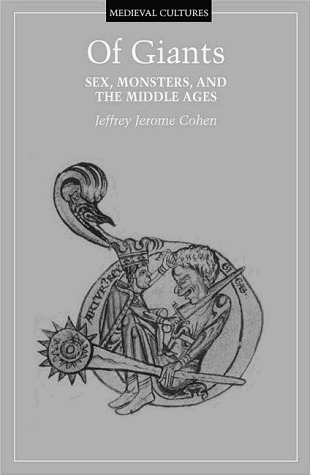
A psychoanalytic look at the representation of monsters, giants and masculinity in medieval texts. The phenomenon of giants and giant-slaying appear in various texts from the Anglo-Saxon to late Middle English period, including Beowulf, The Knight and the Lion, History of the Kings of Britain and several of Chaucer's books.
Mycket rolig och tankeväckande. En del bitar gällande sex-delen känns, om inte krystade, så åtminstone väl ensidiga på bekostnad av andra och möjligen mer rimliga (både historiskt och symboliskt är min intuition) ingångar, inte minst teologiska. Detta blir tydligt framför allt mot andra hälften av boken imo.
The 20 pages of introduction were already a bit too philosophical for my taste. I hoped that this would get better but it sadly did not. I quit early. The introduction and the following paragraphs with words I barely understand were bad enough. But then the claims of eroticism in a picture where a naked lionman eats a human, then claiming the Bible corraborates celtic giant myths about giants coming first, claiming the germanics were unfamiliar with roman architecture and thenclaims of homoeroticism are just dumb. I had no time for this.
Informative, well-written, and argumentatively sound, this book would be a pleasure to read for anyone interested in the Middle Ages, the giants and monsters about which they wrote, and psychoanalytic theory. (I'm sure there are dozens of you)
Interesting, and pretty readable. He goes a little Lacan-happy in places, but overall it's a good intro to the why and how of monsters, and why society needs to perpetuate them.
Great little book on what for years was my main fascination in life: teratology, the science of monsters, as seen in medieval texts. I'm eager to follow up with this author's range of other work.
read for my thesis work but very much enjoyed. I will probably reread at a later date when I am not so crunched for time and focused on 3 particular texts.
Well, first of all, this book finishes by talking about Galehaut and Lancelot, so now all I can think about is how much I want to cry because I have a LOT of feelings about Galehaut. A lot. Too many, probably.
This was actually really interesting in places -- and where it wasn't, it was more because I was unfamiliar with the texts being explored and therefore couldn't meaningfully connect with the ideas, rather than because it was badly written.
I did feel that there were places where a comparative glance at Irish literature would've really added to the discussion, especially at the beginning of the book when Cohen discussed giants as remnants and records of a historical past -- exactly the role that Caílte and Oisín play in Acallam na Senorach, where they're depicted as giants. But I'm sort of used to Irish lit being ignored by everyone who isn't explicitly a Celticist, and hey, it gives me something to say.
I was periodically struck by the fact that literary criticism seems determined to use three incomprehensible words where one ordinary word would probably do; I found I couldn't focus too much on each sentence or I had no idea what it said, so I just had to skim slightly and let the overall meaning sink in without worrying about the specific words. I don't know what it is about literary criticism, but it does delight in being as obscure as possible. Then again, Cohen quotes Judith Butler a few times, so if he's taking stylistic tips from her, well... That explains a lot.
My one other criticism is that he uses the term "transgendered", but since it was published in 1999 and both terminology and awareness have shifted drastically since then, I'll let it slide.