Jump to ratings and reviews
Rate this book

Islands of Blood and Storm #1

Queen of the Conquered

Rate this book
An ambitious young woman with the power to control minds seeks vengeance against the royals who murdered her family, in a Caribbean-inspired fantasy world embattled by colonial oppression.

Sigourney Rose is the only surviving daughter of a noble lineage on the islands of Hans Lollik. When she was a child, her family was murdered by the islands’ colonizers, who have massacred and enslaved generations of her people—and now, Sigourney is ready to exact her revenge.

When the childless king of the islands declares that he will choose his successor from amongst eligible noble families, Sigourney uses her ability to read and control minds to manipulate her way onto the royal island and into the ranks of the ruling colonizers. But when she arrives, prepared to fight for control of all the islands, Sigourney finds herself the target of a dangerous, unknown magic.

Someone is killing off the ruling families to clear a path to the throne. As the bodies pile up and all eyes regard her with suspicion, Sigourney must find allies among her prey and the murderer among her peers... lest she become the next victim.

Queen of the Conquered reckons with the many layers of power and privilege in a lush fantasy world—perfect for readers of V. E. Schwab, Kiersten White, and Marlon James.

400 pages, Paperback

First published November 12, 2019

424 people are currently reading
18732 people want to read

About the author

Kacen Callender

15 books2,583 followers
Kacen Callender is a Saint Thomian author of children's fiction and fantasy, best known for their Stonewall Book Award and Lambda Literary Award-winning middle grade debut Hurricane Child. Their fantasy novel, Queen of the Conquered, is the 2020 winner of the World Fantasy Award and King and the Dragonflies won the 2020 National Book Award for Young People's Literature.

Callender is Black, queer, trans, and uses they/them and he/him pronouns. Callender debuted their new name when announcing their next young adult novel Felix Ever After in May 2019.

Ratings & Reviews

What do you think?
Rate this book

Friends & Following

Create a free account to discover what your friends think of this book!

Community Reviews

5 stars
376 (16%)
4 stars
781 (33%)
3 stars
780 (33%)
2 stars
303 (12%)
1 star
109 (4%)
Displaying 1 - 30 of 575 reviews
Profile Image for Samantha.
455 reviews16.4k followers
April 28, 2020
4.5 stars

TW: slavery; suicidal imagery and ideation; mentions of rape; lynching

This book is a brutal exploration of slavery, privilege, and revenge. Although slow to start (which is what bumped it down a half star), this turned into political intrigue, mixed with the rage against colonialism, and a Clue-like murder mystery set in Caribbean inspired island setting. If you want your characters to be likable or have strict morals, you aren’t going to find that here. This wasn’t like anything I’ve read before and I’m looking forward to the sequel.
Profile Image for ☘Misericordia☘ ⚡ϟ⚡⛈⚡☁ ❇️❤❣.
2,526 reviews19.2k followers
July 4, 2020
◇─◇──◇────◇────◇────◇────◇────◇─────◇──◇─◇
TLDR? Here's the short version of this increadibly stupid dialogue:

Me: I don't like racism. I think people who are racists are stupid idiots. I think the book has the following weak points, though. Nevertheless, I will rate the book higher than I should for making a go at addressing the problem of racism.
POC1: No! How come you're saying that? You insensitive tone-deaf shit!
Me: Whoa? Well, I just have no idea how people can think racist stuff: it's so obviously dimwitted. They should go and do something else instead of being dumb racists.
POC2: You fucking racist bitch!
Me: Now, wait a sec, how did you come up with that? I don't give a fuck about racist stuff, I said as much and I'm even from the bunch of countries where this shit isn't practiced!
POC3: There are no such countries in the world.
Me: *eyeroll* Slavic countries: Russia, Poland, Ukraine....
POC4: Russia's racist! And had slavery! And first slaves were Slavs!
Me: That's not historically accurate ...
POC5: Stop being defensive! You, filthy racist!
... and it goes on.

What the fuck is wrong with these commenters? And why do I have a feeling that it was a bunch of bots posting all that trash below? What the hell? Thought police gone glitching?
◇─◇──◇────◇────◇────◇────◇────◇─────◇──◇─◇
2020 July upd:
While this initially was a 5-star review, on further concideration I decided to lower the overall grade.

ON topic:
Reason: I decided to dock this novel 1 star, so far, after
> getting lots of drastically uneducated people telling me that Russia is racist (spoiler: it isn't, has never been and has nothing to do with this fantasy world altogether) and...

> them proceeding to keep informing me about how they failed to see that my points were about how racism was portrayed in this fantasy novel (spoler: dull, very dull, I almost fell asleep!) and not about actual real life racism that was perpertrated historically.

These reminded me that I gave this novel a higher grade than it was worth and that I should reconsider. After all, this wasn't the stellar experience I usually want from a fantasy novel and initially I gave this novel 5 stars only due to this book taking on the very important problem of racist practices. As this book failed at incorporating the problem of racism in it in a sensible way, I think now I will reflect this fantasy's failure to be a 5-star fantasy novel (as well as one adressing an important problem properly).

> I dock further stars for stupidity (see below) and

> I dock another star off this book for showing slaves becoming the new slavers (I don't think that was a sensible approach to plotting and showing the horrors of racism).

OFF topic:
What makes me most disappointed in that people insisting that 'Russia's a long standing racist country', even fucking fail to appreciate that one of its Golden Age most loved poets had Ethiopian roots and nobody has ever cared about that!
Also, pray tell me, just how many Africans could have had this sort of career in any other country in 17th century: https://en.wikipedia.org/wiki/Abram_P....

BTW, both of them had Caucasian indentured servants (aka almost slaves) and, guess what? Nobody cared about that.

So, maybe, in Russia, it wasn't the race that was important? Maybe it was talent, education, nobility and connections? This wasn't precisely a fair arrangement. Still I wouldn't call that racism.


I really dislike how some people can fail to appreciate the absense of racism. Ignoramuses or ungrateful snots or both, some people are.
Even more I dislike Nationalists, since people who hate Russia/any other country on spot are basically that. I'm pretty sure that had I mentioned 'Lithuania' instead of Russia, nobody would have started calling it racist.


Further considerations:
This novel has realized its potential to progressing towards a 2-star review due to nasty commenters who were way too agressive and, frankly, who have no understanding of what racism actually is. I think, for them, reading such fantasy should be a no-no.

Hope the next one in the series addresses these issues better. I still think that racists are 'Sad people with pathetic little minds' as I wrote in the initial part of my review but, BUT that's no thanks to the book or to, frankly, subpar commenters.

I also hope that other commenters will actually read the fucking book before addressing me. Maybe they would just see for themselves that I was actually 'rating the book forward' in the hope that the author writes another one, a better one, in this series.
◇─◇──◇────◇────◇────◇────◇────◇─────◇──◇─◇
PS I really love how people after reading my review start implying I'm a racist. Proves my idea that our contemporaries, sadly, can't really read. Or maybe they can make words from letters but they have lost the ability to understand the gist of what they're reading. *eyeroll* Too bad.

Racism as the most salient topic
Racism is insanely boring, at least as it was represented in here. I almost didn't think I'd have it in me to follow through all the skin-colour-themed debacles. In real life, I imagine, it's even worse. Does one wake up and start thinking racing things or do they have some business to do?

I've got some questions to the people of the countries that practiced (or maybe still do) racism: how the fuck can people, sane and seemingly adequate, find time and will and effort and energy to go about all the racist bullshit? Were they bored? Had they nothing better to do? No other endeavours to apply themselves to? Sad people with pathetic little minds.

People should really consider doing all kinds better things with their brains other than going through their lives thinking petty, stupid, pathetic and harmful thoughts such as racist thoughts. There are so many other, more wholesome and healthy and useful things that one could expend their mental energy on: the beauty of this world, literature, history, human development, the secrets of the universe, etc. etc. etc. And instead racists lock themselves behind the mental bars of hatred and subject everyone else to a horrible treatment. Sounds like a 'lose-lose' for everyone: the society, the people who are subjected to racism and... ta-da! even to racists themselves...

So, while the book's dealing with the topic a lot worse than a 5 star book should, I'm not docking any stars for that since the topic's worth it and it hasn't been mangled altogether like so many other books on this same topic.

Stupidity
The book - everyone in it behaved in the most moronic way imaginable. I'm not even going to count all the instances: I'll just relax and consider this to be a fun book about really stupid people.

In all seriousness, there isn't a single character who did not behave in the most stupid ways. I don't think I've ever seen such a set of dolts (both islanders and masters) in a good book.

In all seriousness, most of the Fejrn don't really want to be on the islands and most of the islanders don't want them to be there, none of the island actors communicate (even though they actually could act as a unique front or something), it's pathetic how everyone wallows in the mess of their own creation. But that's me and the plot being a bit at odds with each other.

Everyone is plotting against everyone else and perceives others only as tools and is ready to stab the next person in the back at the nearest opportunity. The deceived are the deceivers at all times. The whole is plenty disgusting to behold. I think the idea must have been that whenever one inflicts something upon the world, the world responds in kind, with a taste of one's own medicine (i.e. Marieke vs Sigourney vs rebels vs Fejd vs everyone else). Communication is crucial and it's incredibly backwards throughout the whole mess.

Angst
One could eat all the angst with a spoon: all the guilt trips, righteousness, constant mess that the characters insist on creating just to wallow in it all even more...

As I'm a sucker for angst, I think #2 will be a fair read. If it comes forward.

Q:
The ocean has always terrified me. It isn’t meant for the living. The water, burning my eyes and nose and throat, can so easily fill my lungs; the power of the tide can pull me beneath its waves. Most frightening of all are the spirits. (c)
Q:
I feel that there’s regret in his gut, regret he hopes I won’t see, though he knows any emotion he has, any thought of his, belongs to me. If I will it, I can hear his thoughts the way I might think to myself; his emotions become my own. It requires effort, yes—energy, to make my mind become one with another’s—but after holding this kraft for so many years, it’s a skill that comes with the ease of racing across the fields of Lund Helle, or holding my breath beneath the sea. (c)
Q:
He prayed to the gods of the masters, asking for forgiveness, even though the masters don’t believe that taking the life of an islander is a sin, and so there would be nothing to forgive. (c)
Q:
For a moment, I feel death—know what it is to die, just as I have felt a thousand times. (c)
Q:
Most would rather pray to the Fjern gods, hoping for freedom, than fight for their freedom in life. In a way, I admire the dead rebels at my feet. (c)
Q:
Working. This is easier than saying his parents are slaves. (c)
Q:
“Focus only on yourself and your ambitions... and soon you’ll find that you care not what a single person thinks. Not even your gods.” (с)
Q:
I miss my mother, and the years that I never got to have with her. (c)
Q:
“If you aren’t careful, the Jannik family might inherit your enemies.”
“The Lund family is strong enough that it doesn’t matter which enemies you inherit. You should be grateful.” (с)
Q:
If I’d been told as a child that I deserve to own all I see, maybe I would believe it, too. But it’s because I haven’t been told this, and they have, that I’ll succeed over them; this I know, because while they sit and wait to be handed this world, I’ll work and I’ll fight for my position. I’ll succeed, while they wait for me to fail. (c)
Q:
His life holds the strength of the generations of spirits who came before him. All the islanders who line up behind him like an army, giving him the power to continue the fight that they could not.(c)
Q:
It’s easy, when surrounded by people who question you, to begin questioning yourself. (c)
Q:
He exuded the confidence only a person who knows the world belongs to them can exude: There’s no need for self-consciousness, or to second-guess your actions, or the words that fall from your mouth, when you know there will be no consequence—when you know that the world will still be yours. (c)
Q:
She has always wanted to learn as much as she could, reading her texts and studying her sciences, doing her experiments on herbs and blood; but for Erik, his curiosity appeared in other ways. His was a curiosity for life. Curiosity for others: for their bodies, for their lives. He longed to know the stories of the people around him. Longed to know their motivations, their desires. (c)
Q:
Gods, what he could do with this kraft of mine: learn the secrets of all those around him, learn of their desires so that he can fulfill them. Erik doesn’t believe in forcing the loyalty of others. He believes in inspiring such a love in followers that they would die for him. (c)
Q:
It’s interesting to me that he can feel confident that he’ll live, but is also resigned to die. (c)
Q:
Yes, of course Marieke was my slave, when I wouldn’t grant her the coin my family owed her for her years of service, along with the coin owed her dead daughter and the girl’s father. How could she be anything but a slave, when she had nowhere to live, no food to eat, no opportunity? She’d had no choice but to stay with me, Løren believes, and this perhaps was the worst sort of slavery: one that’s mocking as it declares its freedom, punishing Marieke for making her imagine it’s her own choice in staying. (c)
Profile Image for karen.
4,012 reviews172k followers
November 21, 2019
NOW AVAILABLE!!!

i showed up early to a book reading/signing last week, and once i had settled comfortably into my seat, i took this book out of my bag and started reading. the woman next to me noticed the cover and exclaimed that she had just finished it herself and loved it, enthusiastically praising its merits.

this is that kind of book. the people who love it are going to gush about it; chatting up strangers, recommending it to friends, gift-wrapping it for family members. me, i’m the jerk who can’t keep my mouth shut and just nod along when a very sweet lady—a fellow book-nerd—is so passionate about a book that she assumes everyone loves it as much as she did, and i gotta go and deflate her squee-bubble with my honest-but-mood-killing, “yeah, i’m halfway through and i’m still trying to get into it…”

so, yeah. it’s that kind of book, but i’m not that kind of reader.

before i dig in, i will say that the ‘turn’ in this caught me completely off-guard in the best possible way; a perfectly ‘fair play’ resolution to the mystery that i did not see coming, but was so satisfying a solution that i thought it was going to be one of those books with such a strong ending that it would redeem the so-so feelings i’d had up until that point. but no; the ending is more like a baton-pass or a hot potato, which wouldn’t ordinarily bother me, if i’d been enjoying the book, but in this case it made me feel like shouting “WHY IS THIS MY RESPONSIBILITY??”

still, for a third-act chunk of it, i was so hooked.

there’s so much “almost” here—so much i almost like, and now that i’ve finished it, i wish i could sit down with that nice lady from the reading and hash it all out with her. instead, i’ll just type words here by myself. sniff.

first things first—i read an ARC of this, and it’s an ARC that—one hopes—was going to have another editorial go-round before publication; it’s got all sorts of distracting typos and misused words, and that’s fine—that’s pretty much expected in an ARC, and my brain will overwrite the errors as it reads, but there’re* also some less-cosmetic issues that bugged me—inconsistencies and repetitions and stylistic awkwardness, and it’s hard to know if this is ‘fix it in post’ ARC-roughness that’ll be smoothed and tightened in the final book, or if i’m just not keen on the author’s storytelling choices.

the nutshell-plot:

this is a fantasy-slant on scandinavian colonialism in the caribbean, in a world where certain individuals are born with magical abilities known as ‘kraft.’ here, the collectively—named ‘islanders’ have been enslaved by the fjern, subjected to all the brutality and indignities of historical slavery, as well as the authorized execution of any islander found to have kraft, which is considered too dangerous a weapon for the oppressed to have. only one of the many islands making up the nation of hans lollik is held by an islander—one sigourney lund, who was born sigourney rose, daughter of a noble family who were all massacred when she was a little girl. she escaped, but was presumed dead, and has been in hiding ever since, plotting to avenge her family, take the throne for her people, and then free her slaves along with all of the others. she is also the only islander (reluctantly) permitted to have kraft, which in her manifests as the ability to read minds. using her power to manipulate those around her, not above a little light murder, she manages to arrange her marriage to a fjerd whose family is one of the kongelig—noble families and advisors to the king, who has summoned the kongelig to his island for the storm season, at the end of which he will choose his successor from their number.

this number of contenders gets smaller and smaller as the kongelig begin to die mysteriously during their time on the island, and, although she does not mind that her competition is being eliminated—these pale-skinned monsters responsible for her family’s death—sigourney begins to suspect all is not as it seems with the king, the kongelig, the whole situation.

the premise is excellent; the outline of the story is great, if you were to bullet-point it all out, but the difficulty for me as a reader is in the delivery; the mode of storytelling.

i wholeheartedly applaud callender’s decision to make sigourney an unsympathetic protagonist, which was entirely successful. she is not well-liked—certainly not by the fjerd, who despise her on racial grounds, but also by her own people, who see her as a race-traitor for not freeing her own slaves. for both of these reasons, she also hates herself, which readers are told again and again throughout the novel. her big plan is to take the throne, free her people, and be seen as some savior, but she’s unwilling to free her own slaves until she achieves this goal because—she reasons—she needs them in order to get the throne in the first place; to be seen as an equal to the fjern, whose respect she craves even as she despises them, thinking that playing the game by their rules is the only way to win. she consoles herself with the fact that she doesn’t beat or execute her slaves (much), and she’s really doing all of this for her people and they’ll thank her for it later. all of which is wildly self-delusional, which her people recognize even if she can’t—the fjern will never consider her an equal because that’s how racism works, her people will never forgive her for owning them, and she’s really only out for her own power and status. she’s selfish and entitled and so fortunate to be free, she’s no different than the kongelig—believing that she knows what’s best for the islanders and making decisions for them accordingly.

What have I done for this boy—for any of the slaves of Hans Lollik—to hate me the way that they do? Shouldn’t they be glad, to see one of their own free and among the kongelig, to potentially gain the power to release us all from the Fjern? I’ve sacrificed myself for this—my freedom, my peace, potentially my life—and rather than meeting me with thanks and love, I’m met with such hatred.


it’s a bold move on the author’s part, making the protagonist so very much part of the problem, so complicit in the power structures keeping her own people down, so superficially conflicted, morally, about bedding her slaves when she feels the need for physical attentions. i prefer a complex, ethically-challenged character to one who’s squeaky-clean and flat (like beata larsen, the true-love of sigourney's new husband), and i could have put up with sigourney’s constant stream of shame and self-loathing if she’d demonstrated some of the ambition and ferocity that got her to this part of her journey, but once she gets to the island, once her goal is in sight, she just…stalls. she obeys the king's orders and submits to the other kongelig's demands, even when she doesn't agree with them, but when it comes to furthering her own agenda, she slows her roll, earning her an admonishment from her ally and confidante marieke, the only slave she's ever freed:

"You should have patience, yes—but not to the point that you miss your opportunity."

for someone who wants to rule the world, she sure isn’t enterprising. she discovers things and then just sorta waits around to see what will happen next, like there aren’t bodies dropping all around her and everyone hates her and she could be next. she’s inflexible; sticking to her plan, unable or unwilling to act on new information/adapt to new circumstances even when it becomes clear that she needs to adjust her approach.

for someone who can read minds, she sure can’t read a room. or understand people. or—most unforgivably—tell a story.

and here’s where i finally address my biggest complaint with the book (“it's about time!” exclaims the one person still reading this review)

this book is written as one info-dump after another, as sigourney reads people’s minds and turns it into pages of exposition, which makes for such a dull and uninflected reading experience. when there’s dialogue, yay! when there’s action, bigger yay! but pages of first person present tense regurgitation of what people are thinking and feeling, recounting their memories and motivations, is just so limiting. it’s a slog to get through. least, it was for me.

anyway, there it is. there’s a lot in this book that i appreciated, and there were scenes that i liked, and a moment where i thought it could be love, but the writing style was difficult for me to get into, so as excellent as the excellent parts truly were, the first 3/4 of it was stylistically exhausting, and i could not recover, even though i so badly wanted to.


* i’m also curious whether the author’s insistence that “there’re” is a word will pass the gate. where are we on this? it’s not something i’ve seen before outside of phonetic dialogue, and they used it a lot and it stabbed me in the eye every time. i am blaming the overuse of the word “there’re” for this bloodblob that appeared in my eye last week—when i was reading this book—and i only just now, when complaining about this word, made the causal connection.


j'accuse!


******************************

resumed!

******************************


pause for now. fifty pages in and it's not grabbing me yet, or i'm not *getting* it yet, but the writing style is uneven and the too-many typos in the ARC are distracting and i have too much to read right now to handle a slow-pacer, so imma zoom through some less-demanding books and circle back, maybe continuing with a finished copy.

I WILL RETURN!!!

come to my blog!
Profile Image for chan ☆.
1,329 reviews60.4k followers
Read
July 17, 2020
on pause for now, definitely interested in the story and will revisit. just not a fan of the audiobook and don't have a physical copy of this rn.
Profile Image for K.J. Charles.
Author 65 books12.1k followers
Read
November 25, 2019
The premise of this book is incredible. It's set in an alt-Euro-colonised Caribbean island archipelago, where the white colonisers have enslaved the black islanders and the worst vilenesses of slavery go on. The various islands are ruled by white families. Our POV character is Sigourney, the mixed race inheritor of a white family who were murdered by the other top families and who is now scheming her way to becoming the next regent of the islands, in order to wreak revenge for her bereavement and gain power.

Not, you note, in order to free her people. This is not YA, and Sigourney is a magnificent depiction of the oppressed becoming the oppressor. She talks about wanting to free the islanders, wanting their love--but she's still a slave owner, she sexually exploits slaves and has them whipped or killed when it suits her, and there is a superbly chilling moment when, asked if she will free her people when she's regent, she reflects that, after all, will the islands be economically viable without slave labour? This is one of the best depictions of the corruption of colonialism I've ever seen--she's outraged at racist wrongs to herself but the sorry sordid truth is she doesn't want to change the system so much as she wants to be on top of it. It reminds me powerfully of Wizard of the Crow in the way it shows the cascade of evils that flow from colonialism.

This aspect of the book is just so good. Sigourney isn't evil or sociopathic: she's not even abnormally selfish, and that's the most monstrous thing of all. The author's note comments that everyone now assumes they'd have been part of the resistance or the revolution or the Underground Railway, whereas, in fact, an awful lot of people and especially those who aren't being oppressed will stay complicit in oppression rather than risking their own privilege. And when it's a choice between Sigourney's own wellbeing or that of a slave...well, she debates it internally, but she always makes the same choice. The awful thing is, we're fairly sure she would have been a perfectly adequate human if she hadn't been born into a society of grotesque inequality and racial cruelty and violence, but she was, and we see how warped it makes her. (Let me state here that anyone going 'oh but the heroine was so unlikeable!' about this book has missed the point so hard they're going backwards.)

There's a sort of mystery element to the book where the top families come together to be considered for the regency in a wild Game of Thrones thing as they set about murdering each other. The revelation of the killer at the end is spectacular

The book is let down by some editing issues, mostly repetition. The narrative tells us the same things repeatedly, giving us the motives or attributes of characters over and over again, sometimes within just a couple of pages. This slows the book badly and really should have been dealt with by a line editor, especially with a book this long--I think you could lose 10% by cutting the repetition. I'm cross it wasn't, because the book is original, powerful, engaging, and necessary.
Profile Image for Chelsea Humphrey.
1,487 reviews83k followers
dnf-lost-interest
September 13, 2019
I feel like this particular snake is making an appearance on all my highly anticipated SFF novels of 2019, and I'm not mad about it.

description

*Many thanks to the publisher for providing my review copy.
Profile Image for Charlotte Kersten.
Author 4 books566 followers
Read
February 6, 2022
"They would rather burn the throne to the ground than let you sit on it.”
“Then I’ll sit on its ashes.”


Spoilers follow, as well as trigger warnings for sexual violence. The entirely of this review will be on the subject of slavery and colonialism as well.

So What's It About? (From Goodreads)

Sigourney Rose is the only surviving daughter of a noble lineage on the islands of Hans Lollik. When she was a child, her family was murdered by the islands' colonizers, who have massacred and enslaved generations of her people -- and now, Sigourney is ready to exact her revenge.

When the childless king of the islands declares that he will choose his successor from amongst eligible noble families, Sigourney uses her ability to read and control minds to manipulate her way onto the royal island and into the ranks of the ruling colonizers. But when she arrives, prepared to fight for control of all the islands, Sigourney finds herself the target of a dangerous, unknown magic.

Someone is killing off the ruling families to clear a path to the throne. As the bodies pile up and all eyes regard her with suspicion, Sigourney must find allies among her prey and the murderer among her peers... lest she become the next victim.

What I Thought

Queen of the Conquered is unabashedly hideous. Perhaps it seems redundant to say this about a book entirely about racism, slavery and colonialism. But I think this book's power lies specifically in the fact that time and again it delves unflinchingly and remorselessly into the worst that human beings are capable of, and time and again it comes back with troubling, thought provoking questions about complicity, privilege and the lies we tell ourselves about the harm we do in the world.

On one level, this book is concerned with the psyche of white supremacy - how it relates to greed and material gain, the way that it reifies itself through processes of dehumanization and brutality over centuries. We see the human cost of these oppressive systems in their agonizing reality, and we see the way that colonialism justifies its abuses by insisting that it's actually all for the good of the colonized. Some of the violence in this book is explicit and impossible to ignore, but Callender is just as interested in the subtleties of the racist ideology, showing that even the most enlightened and liberal people of  a privileged group cannot entirely escape that ugly way that that privilege was earned or the insidious way that white supremacy weeds its way into the mind.

On another level, this book is equally interested in the psyche of a very specific class of people: those with some modicum of privilege and societal power who are nevertheless oppressed in other aspects of their identity. This is where Callender explores something that I've rarely seen explored in fiction: the way that a person of a marginalized identity may become complicit in a system of oppression because they are privileged in other ways and stand to profit from the system of oppression because of that aspect of privilege. Sigourney is black, yes, but she is a free woman who controls her own island - and therefore reports to the kongelig and upholds the massive mechanism of slavery that keeps the colony running.

She is an incredibly complicated character - there are moments of clarity where she is full of self-loathing for her complicity in her own people's oppression, but for every one of those there are ever more where she justifies her actions to herself, telling herself that she is using her privilege for a noble cause, telling herself that she could not achieve her goals of overthrowing the kongelig without playing by their rules. But I don't think it's actually justice for her people that she is after, merely selfish vengeance at the cost of the people she currently enslaves. She tells herself that the ends justify the means, but how can this be true if the means are slavery, murder and rape?

The twist at the end of this book is absolutely fantastic, and I'd rather not spoil it for anyone. Rather, all I'll say is that with the story moving in its current direction I couldn't be more excited to see what happens next- oppression may divide the oppressed, and the ultimate revelation of how this may be weaponized was excellent.

My main concerns about Queen of the Conquered involve the pacing issues created by the inclusion of Sigourney's kraft, which is psychic magic. This ends up taking the form of infodumps about people's lives, and while the majority of the psychological profiles were interesting I have to admit that it could be frustrating for the plot to slow to a crawl every few pages while Sigourney explained every character's secrets and thoughts. The reveal at the end was explained solely by Sigourney reading people's minds, which felt like an odd way to convey the most important part of the story.  In addition, I ended up getting a little impatient with the way that Callender repeated the same world-building and exposition points more than once. I sometimes appreciate this if the world is especially complex, but in this case I didn't think it was necessary.

I also read a lot of reviews that complained about Sigourney as a protagonist, which I think boils down to how comfortable you are subjectively with morally-grey and deluded protagonists. She repeatedly makes terrible decisions and engages in despicable practices such as forcing her slaves to sleep with her, and she could be extremely hard to stomach at times. I'm able to sit with a protagonist I despise as long as the hatefulness is in service of an interesting point, which I think it is in this case. But if you don't like reading about shitty people...well, stay away from this one.
Profile Image for Holly Hearts Books.
401 reviews3,272 followers
November 12, 2019
"Focus on yourself and your ambitions and soon you'll find that you care not what a single person thinks."
Profile Image for Yanique Gillana.
493 reviews39 followers
November 1, 2019
So disappointing...

1.2 stars

Characters: 1
Setting: 1
World Building: 0
Plot: 2
Language: 2

I am grateful to Orbit for sending me an advanced copy of this book, because I specifically requested it with high hopes and confidence in their publishing selections. With that said, I was thoroughly shocked and disappointed. This is another one of those instances where I have to say that I believe a book is objectively bad. Even when I dislike a book, I can usually find the good aspects of it in order to highlight them along with my dislikes; however, not a single aspect of this book was handled well and I actually forced myself to finish it in order to write a clear and honest review.

The language was awkward, I found problems down to the basic mechanics of sentence structure and was shocked because this is not the author's first book AND it's being traditionally published. There was no flow to the writing and the sentences were bogged down with (Scandinavian) names of places, titles, and people that were constantly being repeated with a total disregard for pronouns. The author also felt the need to do 90% exposition through pages of information dumping rather than showing us the events within the actual time-line of the story. The main character Sigourney is given this means to glean information form people (no specifics for spoiler reasons) and so all of the motivations of characters and events are simply told to us through her thinking of them.... that's just boring to read!

Let's talk about the world building... non-existant. Yes the world has some sort of magic, there is some religion of sorts, there are gods maybe... and that's it. That's all we know and that is not me exaggerating, nothing was explored so we know nothing about how anything works.

The setting... this is supposed to be Caribbean inspired, which is one of the things that drew me in as a person who is from the Caribbean. Basically, there are islands, where dark people are slaves and light people rule, some of the islands have sugar plantations and eveyone drinks sugar cane wine, and they grow mango, guava, and sugar apple trees (yes I named these three trees specifically, because the existence of these three trees was mentioned every chance the author got). That's it. To add to the ambiance the author sprinkled scenes of pure brutality everywhere. Scenes that had nothing to do with the plot, or character development, and weren't even part of the timeline of the story were described in detail seemingly for shock value. This even extended to random casual thoughts from our MC

Characters. This was probably the worst offense of this book. There was only one character that was even remotely developed and that was Sigourney, and even that was not done well. She was inconsistent throughout the entire story; her motivations didn't match up to her actions, her existence was at odds with the world, and there was nothing interesting or intriguing about her. I think there was an attempt to make her morally gray, but she just seemed nonsensical. The other characters were all reduced to whatever singular opinion they had of Sigourney (they hate her and imagine horrible things whenever they look at her) and that's it. We were treated to the long list of names of characters, only to have them all be completely interchangeable.

Lastly the plot. This was just so sad. The main character experiences something at the beginning of the book and says she wants revenge. She proceeds to seek power to that end, but along the way does nothing that leans towards seeking that revenge. Then there's what is supposed to be a plot-twist/big reveal within the last 50 pages, and the book ends. Lot's of things happened in this story, but they were all poorly introduced and disjointed and none of them were actually a part of any progressive plot. This plot idea was not enough for a whole book.

Final thoughts? I think the diversity and uncommon setting in this book and the background of the author may have been a driving force for this one. I hate to say it, but the quality of the writing here definitely suggests that. I don't recommend it.
Profile Image for Tomoe Hotaru.
259 reviews879 followers
April 11, 2021
09 Jan. '20
Read my review for King of the Rising

“Your own people hate you. You’ve betrayed them. Abandoned them, for coin and comfort, while they’re enslaved and raped and tortured and murdered around you. No one has any love for you, even if you pretend they do. Even if you force them to. You have no true allies or friends. Those closest to you want you dead.”

︵‿︵‿୨♡୧‿︵‿︵︵‿︵‿୨♡୧‿︵‿︵︵‿︵‿୨♡୧‿︵‿︵


And at the end of the day, that is exactly what Sigourney Rose is. You may be spending half, if not the entire novel, feeling sorry for her--that her grand scheme of liberating her people is such a well-kept secret that no body around her can see that she's only trying her best and sacrificing herself for her people, her slaves.

She may have deluded herself into thinking she's a liberator, but truly the fuel that drives her climb to the top is a tumultuous balance between the power for vengeance, and power for power's sake. Liberating her people is at best a potential side-effect, and at worst a lie she tells herself to help her sleep better at night.


︵‿︵‿୨♡୧‿︵‿︵︵‿︵‿୨♡୧‿︵‿︵︵‿︵‿୨♡୧‿︵‿︵
“You’re lying to yourself, Elskerinde Jannik. Tell me, how do you envision these islands under your rule?”
I think of the land, lush and green with fruit, my people walking free. This is what my mother would’ve wanted. But even as the image crosses my mind, questions fill me: How will our islands continue to compete in the world’s economy if there are no slaves to work the land? We will make ourselves vulnerable for another attack if I release all the guards of the islands as well. The Fjern would send their armies to quell my rebellion, and we would be massacred.
︵‿︵‿୨♡୧‿︵‿︵︵‿︵‿୨♡୧‿︵‿︵︵‿︵‿୨♡୧‿︵‿︵


But because we're so deep in the present-first narrative that is Sigourney Rose, it's easy for us to buy into her self-justifications, unless we take a step back and start to see her for her actions, not her plans. She is a slave-owner. She takes her slaves to bed. She kills slaves as punishment for breaking certain oppressor rules. She otherwise enforces the kongelig's laws; and whether it's to blend in with the oppressors she plans to overthrow and play them at their own game, it already says a lot that this was the path to liberation that she chose.

So even though you might not like Sigourney, and that may taint your feelings towards the rest of the book, it at least works in creating an unsympathetic but believable character . It's also successful in its goal to show how easy it is for us to assume we would fall on the right side of history, but the world isn't as simple as that.

I did enjoy this book. To strip it off its parts, it all boils down to a murder-mystery (which is my thing) on top of a deep, thought-provoking character study (also my thing!), set in a carribean-esque part of the fantasy world. So yes, triple-shot of my cuppa tea, but that's not to say it isn't without flaws.


For one, if you're not into bouts of navel-gazing, or for slow build-ups with little action, this might not be the book for you. A lot of Queen of the Conquered relies on drama and tension. The mystery aspect isn't resolved until the very end, and in a manner which I personally found a bit of a let-down. Sigourney has the ability of mind-control, which also means she can read minds. This is how the mystery is resolved. She reads it off the mind of a character, which was previously inaccessible to her.

This inaccessibility is sometimes due to external factors--characters having the ability to close off their own minds from her, either by strict practice or by their own form of Kraft--but more often than not, it's by her own doing. She avoids reading the minds of slaves, for example, because feeling the brunt of their hatred, their pain and suffering, makes her feel like shit pretty much.

But towards the end of the novel, we suddenly learn that people are also able, if they wanted, to show Sigourney untruthful thoughts. This felt as a bit of a contrivance for me, as all along it seemed--by way of the narrative--that Signourney has been able to simply dive into the thoughts of other people. Even become someone else, as she puts it. She is able to see their childhood, their fears, desires, motivations. . . how is it possible that someone can project a misleading thought to her, if she has this uncanny ability to see even what you ate for breakfast?

That aside, the voice itself may be a bit dry and monotonous for some . I personally didn't mind it, but I surely noticed it. There are moments where Sigourney's mind-reading abilities become a source of confusion, shifting the narrative from first-person close to third-person omniscient at the snap of a finger. It was kind of pushing it for me. Sometimes we would be looking into the thoughts of a certain Character A, but the narrative somehow flows into a biographical history of the completely different Character B, which Character A should not have known about.

A lot of readers will probably already be thrown off by the narrative voice and the difficult terms and titles thrown at us as of Page One [and no, there isn't a glossary of terms included]. It's petty and disgustingly anglo-centric of me to say, but every time I read Kraft, I automatically think of the cheese. Anyway. Took me out of the sombre atmosphere quite a bit.

Finally, the conclusion of Queen of the Conquered. I mentioned the resolution to the mystery before, how I found its execution a bit of an anti-climax. Although it was served upon the silver platter of infodump, the twist itself was great. Not one I saw coming, to be honest. But it was a double-edged sword.

It made all the perfect sense in the world, and it drove the message[s] of the book even further home. So in that regard, the answers and resolution thereafter was a perfect fit for the novel.
On the other hand, it also introduced a third element: an untold story, filled with characters and plots that were completely unbeknownst to us. One filled with more scheming and plotting, and perhaps a story, the story, that some type of readers would have found infinitely more interesting.
Profile Image for Angelica.
871 reviews1,222 followers
Want to read
June 4, 2019
At this point, I'm just gonna add every book with this snake on the cover. It's the exact same snake and all the books sound oh so good!
Profile Image for Maëlys.
436 reviews281 followers
December 16, 2020
☆ 4 / 5 ☆

Sigourney is the last surviving member of the Rose family of Hans Lollik and is seeking revenge for the murder of her family. Her goal is to make it on the throne of the country and beat the colonisers to it through careful planning and the use of her craft, an ability to read and control minds. However, contenders for the throne seem to be dying one by one and suspicion is cast on Sigourney as an outsider. She has to carefully make her way through the colonial politics of the island, trying to stay out of reach of the fatal accusations thrown her way and stay out of the murderer’s way.

Sigourney walks the line between the coloniser and the colonised with her noble father and her mother who used to be his slave. She sees herself as her people’s saviour, a queen who will finally be able to free them from the colonisers and reclaim the islands for them. However, her motives keep getting questioned and this might be more of a personal vendetta and thirst for revenge than for a noble cause. Sigourney’s character is very complex and flawed, and the ideal version she wants for herself constantly battles with her personal goals. She is not above using other people for her own gain and to achieve what she came here to do.

This internal battle she has with herself is reflected in how everyone else around her treats her. While the colonisers still see her as lesser and as a threat to the hierarchy they have established on this island, the slaves distrust her greatly. Sigourney tries to grapple for the respect of both parties trying to navigate a life stuck between the privilege of being born free and the racism of the colonisers.

This book does not hail Sigourney as a hero because she isn’t one. While she justifies certain actions with plans for a takeover, she does still revel in the complacency her position has afforded her. Her character is not a stark contrast to the colonisers because she finds using their means and methods for her own agenda. Nothing has a straightforward answer because it’s not a straightforward situation. Sigourney is a mix of wanting to better the life of her people and still being blindsided by vengeance and the consequences this holds.

The author explores many different facets of colonisation and the enslavement of a people with this book and shows all of the twisted ways violence is imposed on these slaves. It doesn’t stop at the casual lack of compassion or dehumanisation of these people in the eyes of the colonisers but it can also be imposed violence on other slaves. We see many examples of guards having to kill others and have to pretend it was justifiable for their own survival. The author also doesn’t shy away from the sexual violence surfered by slaves and the spectrum of this power inbalance. On an island where escape is impossible, the setting only enhances this violence.

The plot itself also held a lot of promise as Sigourney has to do her best to survive the royal island and take power when it is denied to her. I loved the concept of craft and how she used it to plot and move forward with her plans. While she’s able to read people’s minds and even take over them to control their actions, other people know she possesses this ability which helps making her character not feel so overpowered. Others also hold other powers but they’re not shown in great details but I truly enjoyed that aspect and how it played in the politics of this world. I did have some issues with the pacing after a while and things were getting a little repetitive. The ending was very much a set up for the second book and it was a bit rushed in my opinion but I liked the resolution of the mystery itself.

Overall this was a thought provoking book with a very unique main character and some high quality intrigue. I’ll definitely be interested in picking up the rest of this series and see how the story will play out on a bigger scale.

YoutubeTwitter

Buddy read with Melanie
Profile Image for lady h.
638 reviews169 followers
February 29, 2020
Well, this was absolutely intense. It definitely took a turn I wasn't expecting, with a pretty superb twist coming in at the end.

Some thoughts:

★ Initially, when I read that Sigourney could read and control minds, I was a bit apprehensive, as I thought this would make her an all-powerful agent of chaos. I thought of Kilgrave, from Jessica Jones, who terrifies most people who meet him. But Sigourney isn't that powerful; her power requires focus and exertion and she can only control one person at a time. This was more believable, and I liked that, but I wasn't clear what the extent of her mind reading powers were. There are instances when she says people can trick her or hide their thoughts from her, so in the end I wondered what the point was at all of giving her mind reading abilities if they're so useless? Was it just to get us in to the heads of all these other characters?

★ That gets to my major issue with this book, which is the narrative style. The book is told entirely in first person present, my least favorite tense ever, but because Sigourney reads minds, we are often presented with huuuuuuuge chunks of exposition explaining other characters' histories, thoughts, and feelings, resulting in something like third-person omniscient (my second least favorite tense). It's tedious and feels a bit like a cop-out. It even happens with the big reveal at the end, when the twist is presented very nonchalantly as a summary of one character's thoughts. Like, shit goes down midway through the book, when Sigourney's plans fall apart around her, and yet there's no gut punch to it, since it's all delivered in a very boring, stilted way.

★ More on the writing: it was just...weirdly clunky a lot of the time. This read a bit more like a YA novel than I would have liked, and perhaps the first person present had a lot to do with that, but there was also a lot of heavy-handedness and repetition here. I felt like I was being spoon-fed everything, being beaten over the head with the same themes over and over and over again, and over time it became really, really tedious. There's a lot of nuanced ideas presented in this book, and a really well-done presentation of the layers and complexities of oppression, but the actual way they were written down was so awkward.

★ Sigourney Rose is such a fascinating character. Though a member of the oppressed class herself, she's free, and a slave-owner who kills and sexually exploits her slaves. It's...ugly. Though I sympathized with her at times and even understood her justifications, that she was doing the best she could with what she had to try to attain power and slowly begin to help her people, being in her head means that you see her doubts and how disingenuous she was. She wanted revenge and power and respect for herself, sure, but she wasn't doing everything she was doing out of some altruistic kindness for her people; if anything, their freedom felt more like an afterthought.

★ But, though Sigourney is interesting, being in her head is exhausting. In fact, being in this entire world, in this book, was so exhausting. Everything is so relentlessly bleak and everyone is terrible. Everyone is racist and evil. Sigourney is morally ambiguous at best, and she's the only somewhat sympathetic character aside from the enslaved folks, who we don't really get to know too well. There's so much death and needless cruelty. I know this is the point, to show the horrors of slavery (where all this needless cruelty was a fact of life!), but at some point it just got to be too much, at least for me, without any kind of uplifting anchor point. I need something to root for if I'm going to truly enjoy a book. On the other hand, I get that because of the nature of this story and how dark it is, perhaps readers aren't meant to come away from it having enjoyed it at all. Perhaps I am meant to come away feeling a little bit hopeless and defeated.

★ I hadn't realized how much I rely on books to showcase positive relationships. There are no loving, positive relationships in this book. Sigourney has no real friends, no real support. There's zero romance subplot of any kind (which, good, as it would have been bizarrely out of place). Even relationships between the other elites are fraught with tension and hatred. I know I've said that I like morally gray characters in fantasy, but it would have been nice to at least have one character that was truly likable.

★ The pacing is kind of disjointed. The book takes a while to get going, and there's just so much exposition to wade through before it begins. I didn't think this was too much of an issue, though, since I basically read the book in a day; it managed to be compelling despite being slow. I think part of that has to do with the heavy politicking and intrigue and murder mystery at the heart of the book.

★ The twist is pretty damn brilliant. Genius, actually, because it hammers in the book's ultimate critique of colonialism so well, and it kind of pulls the rug out from under the reader and then hits us over the head with our expectations. It's such a well-done subversion; I hated the anti-climactic way it was all revealed, but it was still really, really clever. Saves the book, really.

So, this is probably kind of a 3.5 star book, or even 3.25 because I did have a lot of issues with it, but ultimately it was a pretty engaging read with a really good twist.
Profile Image for Rachel (TheShadesofOrange).
2,887 reviews4,797 followers
June 1, 2023
3.5 Stars
This is a unique piece of epic fantasy that explores the brutality of colonialism. The story does not shy away from the darkness of this reality. I liked this book, but I didn't quite love it as much as I hoped. It was good but I did not find the characters memorable despite the gravity of the story.
Profile Image for Holly (The GrimDragon).
1,179 reviews282 followers
July 7, 2020
“I’m afraid to die before I’ve experienced my reason for life.”

Queen of the Conquered is the beginning of a new series by Kacen Callender. It’s also their adult fiction debut.

This took me far too long to read after Orbit had sent a copy my way. For that, I’m kicking myself for not prioritizing this sooner. A wonderful readathon came to my attention, which was organized during Pride Month to honor Black queer books. Black lives are being erased in queer conversations and the #QueerBlackathon was meant to raise up Black queer voices in the book community. Beginning on Juneteenth, I chose Queen of the Conquered as my first book for the readathon. It was a brilliant one to start with, which I then followed by reading The New Moon’s Arms. Two Caribbean-set novels in a row had me feeling all the island vibes! It’s so refreshing when a fantasy doesn’t take place in the stereotypical Medieval European setting. Other landscapes are far more impressive and captivating, thankyouverymuch!

From the moment I opened the book, I was taken away by the story.

Sigourney Rose is the sole survivor of a horrific slaughter that took the lives of her entire family in the kingdom of Hans Lollik. As well as being incredibly powerful and wealthy, the Rose family was Black. In fact, they were the only Black family on the island with any sort of nobility. Being ruled by someone dark, like their slaves, didn’t sit well with the kongelig, the pale-skinned Fjern ruling oligarchy who had been colonizing the island for centuries. They murdered the Rose family out of spite, because how dare a white man marry a freed slave?

However, they weren’t expecting any survivors of this hate crime.

Sigourney and a slave named Marieke managed to flee the island, starting a new life as they travel the world with Sigourney vowing to one day avenge her family.

“Focus on yourself and your ambitions and soon you’ll find that you care not what a single person thinks.”

It’s been 20 years since the last slave uprising and Sigourney has returned to Hans Lollik with plans to take over the throne. Sigourney was helped by her paternal cousin, Bernard Lund, eventually becoming the heir to his land and wealth. Now Sigourney must maneuver herself into position to become the replacement for the king, while also contending with someone that is murdering the kongelig.

HOLY TWISTY TURNY TWISTS!

Sigourney possesses a rare ability, called “kraft.” Kraft is a magical power that is said to be gifted to people chosen by the gods as a divine right. Anyone is able to have this, yet the islanders that do are executed because the kongelig believe they should be the only ones allowed this elite power. Sigourney is especially powerful, as she is able to not only read minds and feel emotions of people nearby, but she can also manipulate the thoughts of others, strip their memories and control their bodies.

Callender’s writing overtook my senses – I could smell the spices from the kitchens, envision the gardens, hear the bustling sounds of the island. The only Caribbean island I’ve had the opportunity to visit is the Bahamas, which I was able to draw from somewhat. Callender’s lush worldbuilding brought the setting vividly to life.

Queen of the Conquered is a murder mystery with gnarly magic set within a tropical climate. It’s an exploration of oppression, privilege, complicity and revenge. There is little hope here. The only POV is complicated and problematic. She has been colonized and is a colonizer. She has suffered and experienced extreme trauma, while also committing atrocities towards others. Sigourney is the definition of a morally grey, absorbing character deftly crafted by a masterful writer.

Unflinchingly dark and horrific, a comfort read this is not.

And yet.

AND YET.

Queen of the Conquered is fraught with emotion in such a relevant, deeply profound way. It’s absolutely breathtaking!

(Massive thanks to Orbit Books for sending me a copy! Sorry for the delay!)
Profile Image for Kiki.
227 reviews194 followers
December 19, 2019
Last year, after reading White is for Witching, I wondered why there weren't more--or any--Caribbean authors setting gothic horror type fare in plantation houses. I had a need for a fantastical haunted take on these sites that strewn brochure pages, refashioned into luxury leisure venues, treasured for their local mahogany furniture and Georgian architecture--these sites on which our ancestors were enslaved, raped, tortured and slaughtered.

Enter Queen of the Conquered.

I am as eager as any other black reader for shining heroes and heroines who can be complicated but are, ultimately, admirable; for propulsive, heart pumping action plots; for hard won triumphs. But nothing captures my heart like an ambitious author who chooses a riskier narrative and trusts us (for the most part) to follow them 'till the end.

Sigourney is not a shining heroine. It was a risk to tell her story as a first person narrative and give her a magical power in which her ability to tell other stories to us is in itself often an act of abuse. She makes unforgivable mistakes and yet one can understand exactly how and why she did. Indeed, living in a black majority country it is easy to find those like her: the privileged, for whom the hot coal dance to seek acceptance from (whom they see as) their high coloured betters is more real than any notion of solidarity with those left behind.

Despite whatever impression the synopsis creates, or assumptions one may carry into the book (like I did), this is not primarily a pump fist tale of rebellion. It is the focused spiral of a wanna be heroine, addicted to power, sustained by self-delusion, who fights against herself to see her earnest desire to avenge her family and do right by her people realised.

My one major issue in the story is that this is yet another POC writer that does not do right by indigenous peoples. As this alternate historical fantasy that is obviously set in a colonised Caribbean tells it, the people of African descent existed in the islands from they rose out of the water. I tried my best to fit some indigenous identity into the islanders' culture as it is presented here but had to give up. It makes no sense to complain when white authors erase us from imagined pasts, presents, and futures if we are going to do the same to the indigenous peoples who did and continue to exist on these islands.

This is only a preliminary review. I could not let the day end without adding my voice to urge others to read this novel. It deserves more readers. It deserves to be praised, panned, fought over, critiqued, pulled apart and put together again, cried over, thrown on the bed, held close, and take that position on the shelf. Paola Crespo at Orbits Books gifted me this ARC in exchange for an honest review. I'll be getting the finished copy.
Profile Image for Alaina.
7,343 reviews203 followers
March 18, 2021
Wow. This book was something.

Now I'm not going to lie to you. The Queen of the Conquered mentions a ton of difficult topics that are hard to swallow and just gloss over. What I'm talking about is rape, slavery, privilege, and even suicidal thoughts. It also has betrayal and revenge but I didn't want to group those two things with hard topics because they tend to happen in almost every other book out there.

In it, you will meet Sigourney. She is a biracial woman and the lady of her own plantation. She also hasn't had an easy life because when she was littler her whole family was murdered. Mostly because her dad freed her mom from slavery and they fell in love. Some how their love ended up making everyone on this island completely uncomfortable. So instead of minding their own damn business.. they decided that they needed to die.

Well then.

Unlike her family, Sigourney ended up getting away with some help and she survived. She had to continue to survive for the entire book because people weren't happy that she was still alive. So, basically, this whole island sucks ass.

Now this book definitely gave me some Game of Thrones vibes. It could honestly just be me but I just kept getting them from start to finish. Death. Pawns. Court life being miserable because there's so much plotting going around. Honestly, I was suspicious of everyone and couldn't trust one person.

In the end, I am so happy that I finally got the chance to dive into this book. It was definitely eye opening and a little bittersweet that she ended up being the pawn throughout most of the book. After that little ending, I'm hoping she will be a bigger player in the next book. Or make even bigger plays? Ya know. I just want her to kick some ass and help her people.
Profile Image for Katie.dorny.
1,159 reviews645 followers
April 30, 2020
A beautiful cover and intriguing premise that held only lacklustre results within its pages.

This Caribbean inspired fantasy was on my radar for a while and I was so interested in reading this book. However, our protagonist falls flat from what I imagine the author wants us to view her as, whilst the plot and intrigue don’t really exist for the majority of the book. She comes across incompetent and helpless, not the heroine I imagined.

The secondary characters were better written and far more interesting. I am much more interested in our rival than our morally lacking potential heroine.

The first few chapters and the final few making up for all the boredom in the middle. This could easily have also been two stars. The ending does set up nicely for the sequel but this book took too long to get going.

The topics covered were meticulously detailed and don’t make for light reading including but not limited to: slavery, racism, abuse and sexual assault. I believe Samantha’s review from thoughts on tomes has a full trigger list for potential readers to view.
Profile Image for Jamie Dacyczyn.
1,929 reviews114 followers
November 3, 2020
DNFed around page 85. Super long explanation for why I quit:

I was initially apprehensive about this book. Was this going to be another repeat of "The Children of Blood and Bone" where we have an exciting fantasy written by a person-of-color set in a finally-not-european-based fantasy realm...that turns out to be just a standard poorly-written YA fantasy full of clichés?

I have to say that it wasn't disappointing in that way, but I still couldn't get into it....

Right out of the gate, I discovered that this was written in first-person/present-tense, which is (broken record) one of my biggest pet peeves. However, I have to admit that that aspect turned out to be OK! I barely noticed it after a few pages....

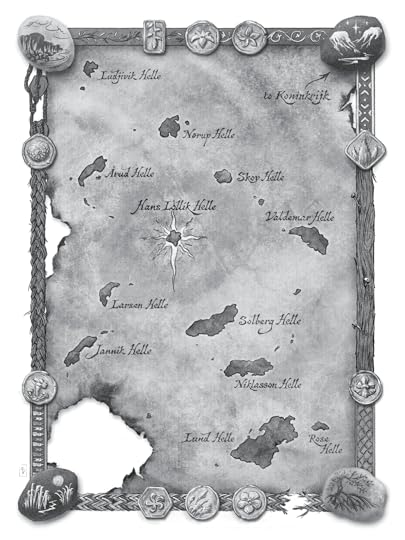
Because I had to concentrate most of my effort after that getting used to the names. This is set in a Caribbean-like cluster of islands, each with plantations where the native people are enslaved. The slaves/islanders have dark skin, and the colonial plantation owners (called Fjern) are light-skinned. The Fjern come from a Scandanavian-like northern country called Koninkrijk, and the names of both people and places in this book are Scandanavian sounding. It took me way too much effort to keep track of the way names are used. Each island is called *something* Helle (Ludjivik Helle, Valdemar Helle, Solberg Helle). The capital island is called Hans Lollik Helle, but it's often just referred to as Hans Lollik (or maybe Hans Lollik encompasses all of the islands?). These all sure as heck look like person-names instead of place-names. Then, when the nobility (called kongelig) are called by their titles, it gets hella confusing. The patriarch of each family is called Herre *name* and the matriarch is called Elskerinde *name*. The main character is named Sigourney Rose, whose family had a plantation on Rose Helle. However, through a series of unfortunately events, she became an orphan (more on that later) and was taken in by Herre Lund (head honcho on Lund Helle), and eventually inherited his title...so she's often referred to as Elskirinde Lund, or just Elskirinde. EXCEPT when she goes to the island of Jannick Helle to visit Elskerinde Jannick, during which time Elskerinde Jannick is called just Elskerinde half of the time.......

*brain melts and oozes out ears*

Am I the only one having a hard time keeping these names straight? I mean, the names Herre Lund and Lund Helle look awful similar in the text, so I had to constantly reminded myself which of these is *title-name* and which is *name-island*, especially since these names were often used to describe people/places that weren't physically present in the narrative. Maybe if you're from a Scandanavian culture, the nuances of the names and which order they're in are easier to comprehend instantly....but for me, it was a chore.

Once I got the hang of the names, I was ready to dig into the story. Sigourney Rose was the daughter of the only islander family to have their own island/title (her grandfather was a freed slave who worked his way up to owning a small island). When she was a child, her entire family was massacred, while Sigourney's servant managed to help her escape. As I mentioned above, she was raised on Lund Helle, and eventually inherited the Lund title from Herre Lund. Now (at the time of the book) she rides around with her dozen guards, overseeing her slaves and squashing any uprisings. The Fjern resent her for having dark skin and descended from islanders, and the slaves resent her for basically being a traitor to her own kind.

OK, so this is where I started to have problems. Sigourney is reeeaallllyyy hard to sympathize with. Sure, she's a woman of color with some power in an otherwise white-ruled society. Sure, her whole family was murdered. I'll grant those two things. But otherwise, she is not a nice person. At all. Like, right away one of her guards is killed by a rebel, and she notes that she didn't even know his name. Seriously? As far as I can tell, the only thing helping her keep her title (since she has no family and no supporters) is the fact that her slave/guards are obedient to her (partially through mind-control, which we'll get to), but she can't be bothered to remember their names? Oh, no, I guess she remembers one or two of their names...

One of the slaves whose name she bothers to remember is called Friedrich. The reason she can remember is that this is the guard whose body she uses for sex. So convenient. Yeah, he seems into it, but she also LITERALLY OWNS HIM. "...I can feel his hesitation. His fear. But he doesn't argue. He can't argue, I remind myself." I don't know, but isn't this basically rape? If he literally cannot refuse because she owns his body...? Isn't the inability-to-refuse the same as not-consenting??? Blech, this part skeeved me out so much! MEN CAN BE VICTIMS OF RAPE, TOO. Kinda hard to sympathize with a rapist, or is that just me?

The main thing driving Sigourney's story is her desire for revenge on the kongelig for either being part of the plot against her family or for not doing anything to prevent the plot against her family (it's an all encompassing revenge). She seems determined to stop at nothing to exact this revenge, including being a ruthless slave driver, following the Fjern laws that give her power over her own people. At first I was kind of reminded of Lada in Kiersten White's "And I Darken" trilogy, who was an anti-hero determined to get her throne at any cost. But with Lada we kind of get her reasoning (even if we don't agree with it) and we get to watch Lada grow into her determination for the throne. Here, the world building felt so slim, and we don't really get to know Sigourney at all. We're shown her family's murder in an opening chapter, and then it jumps to Sigourney as a vengeful adult. She has a plan to coerce herself into a marriage with the son of another kongelig family in order to strengthen her own standing, I guess? And then get invited to the royal island for the stormy season (a time when the kongelig gather to socialize and assassinate each other a little bit) so that she can convince the heir-less king to make HER his heir when the time comes. Then, she can use her power to kill them all, or something? This seems like a shaky plan at best, but she's not letting anyone stand in her way. It would have worked better if we got to SEE the build up of that desire for revenge. If we really felt the drive behind that revenge seeking, it might have helped to make her more understandable when she does shitty things....

Which brings me to the mind control thing. Certain people in this world have "kraft" which apparently means magical powers. I didn't get far enough to learn about the different kinds of kraft, by Sigourney has mind-reading and mind-control powers. She stops a rebel uprising by taking over the mind of an attacker and causing him to slay his fellow slaves before killing himself. Actual Mind Power: when mere slavery isn't enough. So, here's the thing, under Fjern law, only the kongelig and their offspring are allowed to have kraft, since it's a divine gift for being white. Any islanders who show signs of being gifted are executed. Sigourney gets away with it (despite her dark skin) because she's Elskirinde Lund, a kongelig by birth. You'd THINK that she'd understand the injustice of this law, since SHE's an islander with kraft and only by the arbitrary whims of a title is she allowed to live. Instead, when she finds out that a slave girl ("no older than thirteen") possesses kraft, she barely hesitates before having the girl executed on the spot. Hey, it's the law made by the Fjern people she hates that that brown-skinned people can't have kraft. Period. Except Sigourney, because she was born free. And she doesn't seem to have a problem with this.

OK, so confusing names and an unsympathetic protagonist. I could maybe still work with that....but by page 85 I wasn't feeling hooked. The writing was OK, but something felt a bit off. Certain sentences were awkward, and transitions between thoughts could be a little jolting. On more than one occasion exchanges of dialogue were interrupted by massive amounts of info dumping. Like, on one page one of her guards asks her a question, and after an entire page of info dump, she finally responds. Since her response ("No need") was so short and vague, I had to flip back a page because I'd forgotten what the original question was.

Ugh, I gave this one a solid effort despite the FP/PT and the names....but I'm going to let it go. My reasons aren't the typical-YA-fantasy problems I usually have (and was this even YA? I'm not sure. I don't think we're ever told the age of Sigourney, except that she's still single. So, somewhere between 12 and 40, I'm guessing?), but I feel kind of similarly disappointed. I really wanted to get through this one as well, since the author is both a POC and someone with they/them pronouns, which I don't read enough of (and I think is a reading challenge category this year). For that reason, I'm tagging this with "lgbtqia-characters" even though it's the author, rather than the book characters (at least those I met in 85 pages). Oh well, representation is great, but that doesn't cancel out the issues I had with the story.

At the end of the day, I think this book will appeal to a lot of readers for the POC representation, the non-european setting, and the way it explores colonial injustices and the problems with privilege.....but it wasn't for me.

Oh yeah, I also went ahead and read the ending since other reviewers expressed feelings of "this is when it got good" or "that was a let down" and I have to say that I'm glad I let myself quit this one. From the sounds of it Phooey.
Profile Image for Sabreena T.
171 reviews12 followers
November 7, 2019
Queen of the Conquered

Stars: ⭐️⭐️

Disclaimer: The amazing humans at Hachette Book Group Canada were kind enough to send me an arc of Queen of the Conquered in exchange for an honest review. All thoughts and opinions below are my own.

“Burning fields, charred houses, slaughtered people. This is my legacy.”

I am so sad. I wanted to love this book so much! But alas, I did not. I think the writing style was just not for me. It might be for you though!

Queen of the Conquered is about Sigourney Rose, a woman whose family was murdered when she was young and who is now seeking revenge on the kongelig (the colonizers/”rulers” of the islands) who killed them.

“I shared in their awe at these people who looked so much like us, and yet were so different – and only because they’d had the luck in being born somewhere that wasn’t our islands.”

As I said, the writing style was not for me. It was extremely detailed, and we learn about people and their backstories every single time they pop up – even if it is not important to the current story. It was hard to become invested in people because I didn’t know who would matter at the end. Learning that much about every single character is… a lot.

Because of that detail, I never really became invested in our main character. I also didn’t really like her and her actions had me SO confused.

For much of the book, she talks about her plan to get revenge on the kongelig who enslaved her people; the same people who murdered her family. She tells us time and time again that she will have her revenge… but she also has slaves? And she won’t free them? And she has them kill other slaves?!

“You should have patience, yes – but not to the point that you miss your opportunity.”

I know the point was that she had to pretend to fit in with the kongelig, but it didn’t work for me. The end of the book when it comes to our MC also did not work for me. I won’t say what happens, but I was not pleased to say the least.

The one thing I did like about this book was the ending when it comes to everyone else. I thought that story line had so much more potential. It’s like we were seeing the story through the wrong eyes (hopefully, that makes sense when you read it!).

The magic system in this world was not really fully explained, but I kind of accepted it as it was. The abilities that people have are called kraft, but there doesn’t seem to be any rhyme or reason as to who has abilities versus who doesn’t. Sigourney’s kraft allows her to read and manipulate people’s minds and memories – which had me saying, “Why didn’t you use this to your advantage and get your revenge?!” a lot.

Other kraft’s include being able to control the dead, being able to kill someone with just a thought, being connected to a sibling, and a whole lot else. I assume there is no limit to what kind of kraft people can have, but I’m not sure.

“They have empathy for [her], and she was met with love and kindness. Maybe this is why she had so much love in her veins, while I’m filled with so much rage. I had the same fate as the girl, and yet, I wasn’t met with the same empathy. I wasn’t met with the same kindness.”

^ this quote struck me because it is true on so many levels. We treat people who do the exact same things differently based on race, gender, sexuality, religion, socioeconomic level, etc. But why?

The many themes of the book were quite powerful. The main theme focuses on light-skinned colonizers enslaving dark-skinned people, but it also delved into themes of power/wealth, loss, abuse, and more.

Like I said, I wanted so badly to adore this book, but it was not for me. Alas, I suppose they can’t all be, but if you read this, I truly hope you enjoy it.

Trigger/content warning: abuse, torture, a LOT of murder/death, mentions of rape, loss of family/identity, slavery, war, and more.

Note: All quotes above were taken from an advance reader’s edition of the book, and are subject to change in the final release.

Queen of the Conquered releases on November 12, 2019!
Profile Image for Para (wanderer).
458 reviews240 followers
dnf
July 17, 2020
DNF 30%

I was excited to read a fantasy book that touches on colonialism and slavery, but it just didn't work out in the end. I found it interesting enough on an intellectual level, the commentary on racism was excellent...but the plot failed to grab me. I didn't care. I understood very quickly that Sigourney is meant to be an intentionally unsympathetic villain protagonist, but currently, I need emotional attachment if I want to read on and here I had none. Her constant complaining about how nobody likes her, then proceeding to be a villain and justifying it to herself, over and over and over and over were realistic I guess, but so incredibly tedious to read. I had little desire to read on, and in a time when I can barely read as it is, that's...kind of important, no matter how good and relevant the themes of a book. Hence the DNF.

Recommended to: those interested in villain protagonists and books that tackle slavery and colonialism
Profile Image for maritareads.
147 reviews17 followers
November 7, 2020
I was between 2.5 and 3 throughout but now it’s a 2 because I’m annoyed after completing this.

If I had known this was going to be a book in the same vein as Marlon James work I would have stayed clear of it. Slavery is not an easy thing to read about but I am lowkey glad that Callendar writes of the stark brutality of it. I am also glad they don’t subject readers to the especially violent parts of slavery and colonialism (but there’s something that bothered me which I’ll get to). They are absolutely right when they say slavery in fantasy books is generally glossed over and ignores the real holocaust that primarily black people were subjected to and still are [paraphrased], so narratives like this must exist so that the next time you read about slavery in a fantasy, especially written by a white author, then it better be written with more respect and research other than being framed as an “unfortunate situation to make the protagonist look better”.

Sigourney Rose is a terrible character who does despicable things. She is irredeemable and is the antagonist. To make it worse it is written in first person so we are in her head for the entire book. I think my problem is that I expected her to be redeemed because she has a reason to get her revenge but I since I went in knowing (or having read somewhere once) that black people owned slaves, I probably should have known better, but I am not a cynic. Callendar asks a question to those black people who say “we are not our ancestors” by writing a book that says, “Really? What would you do in that situation? Do you really think you’d be able to stand on moral ground, now that you are (somewhat) enjoying the benefit of what was hard fought?” They expose the hypocrisy of black folk in high places and those who think they can dismantle the system from inside. They pose the question of whether the system should be infiltrated or just simply destroyed. They even question the motive of a self proclaimed leader of a movement, whether they hate oppression or just hate oppression when it’s applied to them, and not to others that look like them. Or whether, they are in it for narcissistic purposes, to be lauded as an icon.

Now, all that said, I mainly read this because the plot intrigued me and came away disappointed. If I had known this was a character study, again I wouldn’t have read it (not saying I wouldn’t read an antagonist character study but that’s not what I came here for). I expected a revenge plot in which we saw a smart and powerful character destroy her enemies one by one. The only time she makes any moves towards her revenge is before the events of the book, so I’m not convinced of her cleverness. She refers to slaves as “my people” yet does nothing to use the strength that could be at her disposal if she worked with them (then again, this isn’t the fault of the book but a result of narcissism and privilege). She is a stagnant character whose function is to be present everywhere so that we may know how other characters are moving and thinking, since her power is to read people’s thoughts. I also thought it was a dumb decision not to read the slaves thoughts just because she did not want to see the hatred they have for her. I mean if you make the decision to act on your own, don’t be surprised you have enemies on both sides and also don’t be surprised that they would also plot against you. I thought this was stupid and not something a narcissist would do. What was more believable was her doing nothing to earn the love of “her people” but expecting it, even worse, not even pretending to act like a kongelig (noble) to achieve her goal e.g. doing “necessary evil”, but actively doing it on her own accord (almost delighting in it) and acting surprised when the slaves hate her. She keeps flailing helplessly, internalising self hatred, whines and terrorises her slaves instead of working on her plan. Being an antagonist is one thing, but an incompetent one? Now you are subjecting me to read about a terrible person in this 2020 AD who also whines like a child and expects everything to fall into place magically? Please, don’t raise my blood pressure, I’m only 24.

Kraft (power) and how it works is not really explained very well in the book, it only serves a function so that Sigourney is present everywhere. Other characters have kraft but theirs is not explored. The dream scape scenes especially did not make sense. I couldn’t tell when it was a dream and when we were back to the present. This doesn’t bother me very much because world building is not *that* important to me when reading a fantasy but if it is to you just read another book. The other function kraft serves is so that we see how white supremacy functions through each if the kongelig, whether it is eugenics, woke neoliberalism, class privilege, misogynoir and so on, every terrible thing you can think of. I saw someone recently point out that we don’t even know the extent of racism and slavery. Every day I learn a new despicable thing.

Finally, this needed much more editing. Because Sigourney is a character who reads thoughts, the same information we’ve seen in the mind of another character is repeated in a new one, in almost a copy paste fashion. So many flashbacks are input as well, and each time she describes travelling in the North and facing racism or about her family, it’s like, we know this already. Why is there an unnecessary traumatising scene about racism if it was already been described, that has nothing to do with the plot? You have driven the point home, black people are hated everywhere, this character is hated by “her people”. The black people reading this already know this, so was this written to browbeat white people who are unaware racism exists? I had never really grasped the concept of info dumping till I read this book. So much time spent on every single irrelevant side character’s back story repeatedly could have been spent in the present, making actual moves forward and not rushing the plot at the end.

Mostly, I’m mad that I committed to reading the sequel because I need a break from this world.

CW: slavery, sexual assault, racism
This entire review has been hidden because of spoilers.
Profile Image for laurel [the suspected bibliophile].
2,041 reviews755 followers
December 29, 2019
Trigger Warning: Slavery, Murder, Graphic Torture, Rape

As a child, Sigourney Rose's family was brutally murdered by the colonizers of her home islands. Now an adult, and as the only islander member of the ruling classes, Sigourney has vowed revenge on all who wronged her family. She's going to kill them all, and take the crown for herself. But on the island of Hans Lollik Helle, she becomes the target of a strange, mysterious magic—and the nobles start dying around her.

This was such a hard book to rate.

I am far from qualified to talk about any of the various themes and nuances of this book, so please forgive my weak attempts to explain my feelings on this.

On the one hand—brilliant, amazing world-building. It was brutal, it was fresh, it was nuanced. That plot twist!

I have never read a Caribbean-inspired fantasy before that tackled colonialism and slavery, and it was brutal and eye-opening. Seriously—pay attention to those trigger warnings. This is not a delicate book that plays to delicate sensibilities. It goes there and it rubs your nose in the horrible reality of slavery and what actually happened (minus the magic parts).

The world-building and the nuance was just brilliant. I can't stress that enough. The imagery of the islands and their beauty juxtaposed with the horrifying reality of the islander slaves was stark, as was the colonizing Fjerns who were patently out of place as colonizers and who hated the islands but depended upon the islands for their very existence and continued relevance. Better to be a big fish in a small pond than a nobody at home, right?

On the other hand—the exposition.

Holy guacamole the exposition.

This book was literally nothing but tell, tell, tell with a dash of show involved (the showing shined in the descriptions, which were both horrible and gorgeous).

Part of the problem was that the book exists entirely in angsty Sigourney's head, and since Sigourney is a telepath, in everyone else's heads too. Many conversations were started in dialogue and then transitioned into prose, being entirely relayed after-the-fact in a way that was disconnecting and just wanted me to scream.

The other part of the problem was the repetition. So much of this book is repeated, from descriptions to motivations to themes to everything else. I was told about the history of the Rose family, the Lund family, everyone else and the descriptions of just about everything so many damn times...like it was the first time I was reading it. It made the pacing feel uneven and like it deserved better editing, because the talent is just fucking spilling off the page.

My final complaint was the angst. Holy shit Sigourney angsted over everything under the damn sun.

To how much everyone hated her. From the colonizers for her having dark skin and daring to be one of them. To the islanders who hated her for her freedom and her being one of the nobility and therefore part of the entire problem. To herself, for not being loved as her mother was and for looking into a mirror and seeing only herself reflected back, and seeing that reflection as something awful and horrible and wrong. She could look into people's minds, but saw only what she wanted to see.

I understand the angst. I get it. I completely emphasize with it as well (although as a white person, I have not and will never experience racism). Sigourney was an amalgamation of her circumstances—in between both worlds, yet yearning to belong to the kongelig so fiercely, for the acceptance of the colonizers and the ruling elite because she's not like one of them,, and also fiercely wanting the love of her slaves and the people she was descended from, and wanting to be their queen and unite their worlds. Not, you know, to actually free the islanders, because that would be economically unfeasible, but to rule over them as one of their own. And also one of the kongelig.

So the angst part of it was something that I loved, but also was incredibly frustrating because it turned Sigourney into a wet Hamlet, filled with indecision and overthinking and agonizing over everything (and especially Løren—seriously, just kill the dude, you murdered everyone else with impunity).

Sigourney literally does nothing but think.

Events happen around her. She's implicated. She has machinations and ambitions, and talks through them (and shares her ambitions with literally everyone, spilling her grand secret scheme within the first 30% of the book) and does some things but doesn't really follow through with anything??

She's not supposed to be a sympathetic main character (oh, faaaaaaar from it), but I mean if you're gonna be bad—be bad. Don't half ass that shit.

I dunno.

So with all my bitching, why the four stars?

Honestly, this wavered in between a two and four star read. The smart thing to do would be rate it as three and continue one with my merry way, but that ending.

The murders, the deaths of the kongelig, the absolute infighting among the nobles—and Sigourney's own focus on her people (the Fjerns) and the motivations of literally everyone on the island. The mystery of the king and the rebellions and who was behind everything. Omg that reveal was, in hindsight, so damn obvious, but, like Sigourney, I was oblivious to it.

So: read this for the politicking, the unique world and well-crafted setting, the deconstruction of colonialism and slavery, for some interesting magic systems, and the dictionary definition of internalized systematic racism and vertical integration that is Sigourney Rose/Lund/Jannik.

Avoid if endless angst and exposition aren't your thing.
Profile Image for Kathryn S (Metaphors and Miscellanea).
249 reviews242 followers
December 8, 2020
This dark, brutal fantasy explores the pains of colonialism through a deeply flawed protagonist, caught between the aristocracy she is permitted to be a part of and the colonized people she is related to. Caught in this liminal space, Sigourney Rose's identity is largely based on self-hatred, feelings she has adopted from those around her: the nobles, who hate her because of the color of her skin, and the islanders, who hate her because they feel she has abandoned them and will do nothing to help them. With her ability to read minds (and, on occasion, exert actual mind control), Sigourney is strong--but also very out of her depth, even with her skills and cunning, when she is surrounded by proverbial vipers...who believe that she, herself, is a snake in the grass, out to overthrow them all. In other words, she is imperfect, but she is largely a product of the imperfect (VERY imperfect) society she lives in, and her conflicted sense of morals makes her point of view particularly compelling, even if she is not in the least likable.

This is not a light read, beautiful though the cover may be. It does not pull any punches. Characters make awful decisions. There is violence and slavery and a whole lot of death. Torture and injustice abound, perpetrated by characters who largely believe themselves justified, and still permitted by those who object, out of fear of retribution. But the brutality is artful in its own way; Sigourney's oft-detached tone in her narration lets the story unfold so that the horrors appear even more starkly, without emotion coloring their intensity. It is a scathing criticism of the colonial machine that perpetuates racism and inequality, told through a fantasy lens that further heightens the stakes and intrigue.

I truly loved this book--the only reason I am docking a star is for the ending, which was incredibly abrupt and inconclusive. It felt like it cut the story off right before the big payoff moment, which is painful as a reader. Fortunately, the sequel is already available, so readers can jump back in and continue the story immediately. But taken on its own, the so-called "conclusion" of this tale is more like a big reveal, a whirlwind of action, and then no time to really see the fallout of those actions.

(As a final note, I can't believe this book is by Kacen Callender, the same author of the queer contemporary Felix Ever After--which, by the way, was one of my favorites of 2020. The two are so different in genre, subject matter, tone, and age range, it's hard to believe the same person was able to execute both of them so well! Huge props to Kacen--they're doing a great job and are quickly becoming a favorite author of mine.)
Profile Image for Allison Thwaites.
81 reviews10 followers
October 5, 2019
Big thanks to Paola Crespo at Orbit Books for sending me a free ARC of this book in exchange for my honest review.

Earlier this year I said wasn't going to read anymore slavery books because I am tired of the sufferation. Lies, all lies. I will read slavery books if they are written like this. The colonisers are the villains and I'm not being asked to feel sorry for them or try and understand them? Yes please.

This was such a compelling story, one where I was absorbed right from the beginning which I would describe as a good, slow burn. This was like historical fiction meets fantasy meets murder mystery. When the murder mystery kicked in, I found it damn near impossible to put it down. The backstory, the reveal,the author had me right to the end. They laid out the plot perfectly. I'm still marveling at the ending, like damn, it was right there.

What I Liked

Just have to say I am happy there was no sappy love story. Amen. That's another thing I dislike in slavery books, the unrealistic, sappy love stories. No.

The world that Kacen created was so familiar and foreign at the same time. Being from the Caribbean, they could have easily been writing about my island. From the names of the different islands, I was getting Dutch Caribbean vibes which was different. I usually read about former English Colonies. They took colonial island life and added magic.

One thing I was hesitant about when I heard about this book was that it falls under Adult Fantasy, not a genre I usually pickup because I really don't do well with blood and gore. I thought to myself, how can that be avoided if the setting is the slavery era Caribbean? Well, it can't but I appreciated that the author didn't hide away from the violence and the atrocities of slavery, it was a realistic depiction but I never once felt uncomfortable or like gagging.

Sigourney, bwoy. I truly don't know how to feel about her. She can't be classified as good or bad. She exists in this gray area as a heroine. I disagree with her actions but I understand them. She is for lack of a better word, a victim of her circumstances. Her guilt and self loathing coupled with her ambition and her being convinced that she is doing the right thing in the long run, for the greater good, all of this combined makes her a rather complex and dynamic character. I'm really looking forward to seeing her growth. Also, I thought her power/kraft was great medium through which to observe and learn about the other characters. Being able to really know their thoughts, their racism, their own abuse added to their story and in a sense meant that none of the characters in the book existed at a surface level.

While I really enjoyed this book, I did have one critique. There were parts and passages that felt slightly redundant. The mention of Sigourney's skin and hair and the way she was treated as a result was mentioned a lot, like, a lot a lot. I'm not sure if the author realised that they were being repetitive of if they just really wanted to drive the point home.

What a great start to a series, I'm excited for the next one and this one isn't even out yet. I saw on Twitter that Kacen was contemplating who they were going to kill off in the next one. Beg you Kacen, do, tek time wid mi nerves.


Profile Image for Becky.
1,620 reviews82 followers
March 2, 2020
This book starts out slow and at times repetitive, but all the world and character building are worth it when the action at last swells towards the book's riveting conclusion, an ending that wraps up much but left me tantalize for the sequel. ⁣

Queen of the Conquered takes on a story of colonization and slavery in a Caribbean inspired world, complete with an intriguing magic concept called kraft. Sigourney is the only free islander, the lone survivor of the massacre of her entire family by the jealous white ruling elite. Now after years of playing by their script, she finally has the opportunity to take her revenge by becoming the next regent to the crown and making everyone pay. Sigourney is a complex character, and it was gutsy to tell this story through her imperfect first person POV. ⁣

I had some issues with the pacing, and some bits of the story didn't fully come together, but I'd still recommend this one, especially to fantasy fans looking for something boldly reckoning with history. I think there's big stuff in store for the sequel, and I feel like it's going to blow this one out now that all the development is out of the way. I can't wait to see where Callender takes this story.
Displaying 1 - 30 of 575 reviews

Join the discussion

Can't find what you're looking for?

Get help and learn more about the design.