If you are troubled by the phenomena that is Donald Trump...YOU MUST READ THIS BOOK.
In a nut shell, Bandy Lee has put together a compilation of pieces written, for the most part, by her colleagues, namely experts in psychiatric medicine, who offer their professional opinions about a man that has turned American politics into a bad reality TV show.
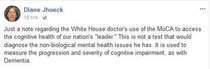
A major theme explored throughout the book is whether Trump is crazy like a fox or just plain crazy like a crazy. The book also explores the impotence that many psychiatrists/mental health professional are feeling with respect to the Trump Effect (yes this is a real thing) because of a gag order imposed by the APA which prevents psychiatrists from diagnosing a public figure whom they have not personally treated. While this policy is understandable and important for obvious reasons, they point out that they also have a duty and obligation to protect the public at large from someone whom they believe dangerous.
The book also tries to answer how and why a man like Donald Trump, whom they say displays decades of behavior consistent with a malignant narcissist (not just a narcissist but one that is a sociopath), paranoia, and ADHD, got elected to such a high office in the first place. (note: Time and time again they admit that without evaluating Trump they can't offer a diagnosis. However, they argue, and I think strongly so, that can still provide an informed opinion about what appears to be concerning behavior.)
Finally, the book lays out an argument for the mandatory and regular mental health testing of both the President and Vice President given the amount of power and responsibility they have on many fronts. In the end, I think a major goal of the book is to stress the importance of mental health as it applies to our leaders, especially those whose reckless or deranged behavior would potentially affect us all. Mental health has made leaps and bounds in the past few decades in terms of diagnosing, understanding, and treating mental disorders. Is it really so crazy to want to ensure that our leaders are as mentally sound, or at the very least have some method for trying to assess mental stability.
Crazy like a fox or simply crazy like a crazy?
For many Americans, even some of Trump's greatest critics, the consensus--or at least the hope--is that the answer to that question is the former. After all, like him or not, the man is president of the United States. He was elected, even if he didn't win the majority vote, receiving close to half the votes casts. Let that sink in for a moment. Roughly 1 out of 2 Americans got up, drove to the polls, and willingly voted for Donald Trump.
The erratic behavior. The rhetoric. The angry Donald Trump persona. It's all an act. A ploy. A strategy. A conscious effort to undermine his opponents and his critics while shoring up his base.
Not to mention, he's a millionaire...a billionaire, married to a beautiful wife half his age. Crazy/Mentally deranged people don't become successful businessmen, and they certainly don't become world leaders, or do they?
Was Hitler mentally ill or just pure evil? Both? And does it matter what you call it, if he's dangerous?
Many of the authors who contributed to this book believe that Donald Trump suffers from several mental health disorders to include malignant narcissism, paranoia, and ADHD. They admit that while they can not diagnose a mental disorder because none of them have ever personally evaluated him, they feel that as trained mental health professionals, they can offer an informed opinion based on three decades of recorded behavior.
In their opinion, whether or not Donald Trump is crazy like a fox, his behavior now and over the decades is consistent with someone who is just plain crazy.
And he's not alone. According to the authors, more than 50% of past US presidents demonstrated behavior consistent with a mental health disease, from Abraham Lincoln, who suffered from depression, to Reagan, who was eventually diagnosed with dementia.
They go out of their way to point out that suffering from a mental health disorder/illness does not necessarily disqualify someone from being an elected public official, nor should it, though in the case of the man with the codes to our nuclear arsenal, it should probably be a concern.
Many of the psychiatrists not only fear Trump suffers from mental health issues, but that his actions suggest that he is also dangerous.
So how does a man like Donald Trump get elected anyway?
This is perhaps the first time that I've seen any worthwhile analysis into why people supported the Donald. To simply label Trump supporters as "Deplorables" the way Hillary Clinton did simply doesn't cut it.
Several essays offered explanations that made sense.
For decades, there has been a neoliberal movement that has gained momentum and created real social change for minorities of all flavors. A movement that seemed to culminate in the election of our first African American president. What a glorious and proud moment for many of us. The deep wounds inflicted by our country's civil war are numerous and deep, and the road to true equality after slavery was officially abolished has been long and hard. So when a smart, articulate black man named Barrack Obama won the presidency, many of us believed, maybe wrongly so, that our journey was almost over.
The rise of Trump is proof that you can change the law and you can even change a culture a lot easier than you can change a mind or a heart. For many, the neoliberal agenda has fostered resentment. Not only is it illegal to discriminate against "insert vulnerable group here," you can't even speak your mind for fear of being shut down. Any slight against someone who happens to be from a vulnerable group is all too quickly interpreted as a slight against the vulnerable group. Hell, you can't even hold a rally on a college campus these days. So while the Black Lives Matters movement (extreme voices aside) seems to encompass the neoliberal agenda, it alienates another segment of America which now feels as if they are the minority who are being discriminated against. I can't tell you how many times people (average everyday people) say what about White Lives? Don't they matter, too?
Of course, they do. But that's not the point, at least for some.
So whether the crimes are real or imagined, they feel real to those who feel left behind, forced to accept laws and new cultural norms that don't jive with their personal values. The failure to kneel during the National Anthem. The desecration or removal of national monuments. Happy Holidays vs. Merry X-mas. These are experienced as major snubs by a number of people who feel they are being punished for being white.
Then along comes Trump. He says freely and without apology what they've been saying, thinking, or feeling in the privacy of their homes for too long. And he promises to Make America Great Again...what ever that means, and it means a lot to someone who feels disenfranchised or victimized.
It is no accident that hate crimes are up in America, and it is no accident that the Trump Effect is so profound that it is being blamed for a rise in anxiety among minority/immigrant groups across America.
Add the power of social media, with its massive reach and perpetuation of alternative facts, to the underlying tension and resentment, and you have the inevitability of someone like Trump.
One psychiatrist/author described it as group narcissism. Trump validates the group's superiority, their worthiness, while in turn reinforcing their blame of the "other," and they in turn offer him the adulation he craves.
The Trump Effect
Do you find yourself constantly checking social media, checking the news sites impulsively, and generally feeling anxious since Nov. 8, 2016? If so, you too may be suffering from the Trump Effect.
According to the authors, while Trump inspires great loyalty from his supporters, he inspires great antipathy and revulsion in his adversaries.
Personally, I have never felt such contempt for another human being, and apparently I am not alone. At least one psychiatrist describes it as being in a relationship with a malignant narcissist, a relationship that you can not walk away from. It's terrifying.
But is he really dangerous or am I (and others) just being liberal snowflakes?
Well, I honestly don't believe I'm a liberal snowflake. While I detest Trump, I wasn't a Hillary supporter. And while I generally support socially liberal values, I have many conservative views.
But I am also an avid reader with a special interest in abnormal psychology and the biological basis for belief and behavior. If you peruse my bookshelves you will see that I like to read about people who do really bad things and try to understand why.
And from day one, I have had the feeling that Trump is a sociopath, a narcissist, and a very dangerous man. I do not believe he is crazy like a fox. I believe he is crazy like a crazy. I believe this because if you look at his history, his actions. If you take what he has said in the past (his own words) at face value, there is no other conclusion. The author of "The Art of Deal" also contributed to this book. He spent a year with Trump. He's the one who actually wrote the book. And he seems to agree that whatever your worst impression of Trump is, it's not even close.
I, however, am not a trained psychiatrist. The authors of this book were. And they seem to agree that, crazy or not, Trump's pattern of behavior suggests he is dangerous.
So what is a concerned citizen to do?
This is a question I ponder daily. I love to read. I love to learn. I love to engage others, particularly those who don't share my views. After all, that's how we broaden our perspective and grow intellectually and emotionally. But politics is not something you can discuss. Politics has become even more taboo and more personalized than religion. There is no healthy debate. No exchange of ideas. No reaching across the aisle. And thanks to the internet which has effectively created ideological bubbles, you don't even ever have to hear an opinion that doesn't echo your own. And on the rare occasion you interact through social media, the conversation, depersonalized, has a high chance or deteriorating quickly into insults and name calling.
I do try to engage people. As a therapist I interact with a lot of people. But it's really hard. Political opinions seem rooted in emotion and influenced more our identities than by facts and figures.
I have to wonder what the role of technology has already and will continue to play in politics moving forward. While it has the potential to break down walls, it also has the potential to build echo chambers.
Anyway, I would highly recommend this book. And not just to my American friends as I think the Trump Effect is not simply an American problem. Crazy like a fox or crazy like a crazy, if this loon (my characterization) starts a nuclear war, which is a major concern expressed and validated throughout the entire book, it will have repercussions around the world. Many people say that while Trump is bad, he's no Hitler. No, he's not.
But what if he's worse?