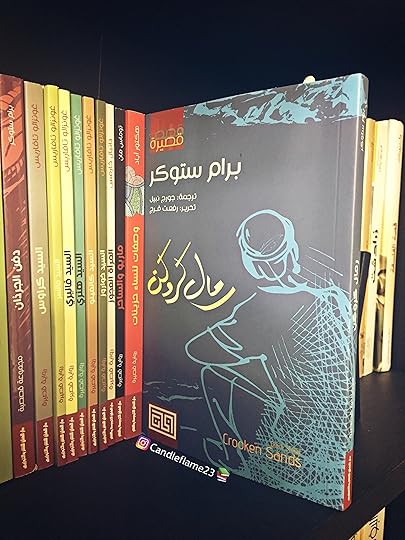
قبل موت زوجي المفجع، بل أستطيع القول إنه حتى قبل أن يخيّم ظلُّ الموت عليه، كان قد خطّط للنشر ثلاثة أجزاء من القصص القصيرة، وهذه السلسلة هي واحدة منها، ولقد أضفت إلى القائمة الأصلية لقصص هذا الكتاب قصةً من قصص دراكولا، لم تُنشر بعدُ؛ إذ مُنعت من النشر في الأصل بسبب طول الكتاب، وربما يكون ذلك أمرًا جديرًا باهتمام كثير من القرّاء كي يتعرّفوا عملَ زوجي القصصي الأكثرَ روعةً. أمَّا القصص الأخرى فقد نُشِرت فعلًا في الدوريّات الإنجليزية والأمريكية. لقد تمَّ إنجاز هذا العمل في سنوات حياته المبكّرة، ومن ثمّ لو قدِّر له أن يعيش فترة أطول لرأى أن يقوم بتنقيح هذا العمل ومراجعته؛ وذلك ديدن الكتّاب. لكن القدر شاء أن أقوم بإصدار هذا العمل، فرأيتُ أن أتركه على صورته، دون تدخُّلي من قريب أو بعيد، كما أرادها هو. - فلورنس برام ستوكر
قصص المجموعة:
رمالُ كروكن حلم الأيادي الحمراء نبوءة الغجرية الأمريكية الهندية سرُّ الشَّعرِ الذهبيّ المتزايد
Irish-born Abraham Stoker, known as Bram, of Britain wrote the gothic horror novel Dracula (1897).
The feminist Charlotte Mathilda Blake Thornely Stoker at 15 Marino crescent, then as now called "the crescent," in Fairview, a coastal suburb of Dublin, Ireland, bore this third of seven children. The parents, members of church of Ireland, attended the parish church of Saint John the Baptist, located on Seafield road west in Clontarf with their baptized children.
Stoker, an invalid, started school at the age of seven years in 1854, when he made a complete and astounding recovery. Of this time, Stoker wrote, "I was naturally thoughtful, and the leisure of long illness gave opportunity for many thoughts which were fruitful according to their kind in later years."
After his recovery, he, a normal young man, even excelled as a university athlete at Trinity college, Dublin form 1864 to 1870 and graduated with honors in mathematics. He served as auditor of the college historical society and as president of the university philosophical society with his first paper on "Sensationalism in Fiction and Society."
In 1876, while employed as a civil servant in Dublin, Stoker wrote a non-fiction book (The Duties of Clerks of Petty Sessions in Ireland, published 1879) and theatre reviews for The Dublin Mail, a newspaper partly owned by fellow horror writer J. Sheridan Le Fanu. His interest in theatre led to a lifelong friendship with the English actor Henry Irving. He also wrote stories, and in 1872 "The Crystal Cup" was published by the London Society, followed by "The Chain of Destiny" in four parts in The Shamrock.
In 1878 Stoker married Florence Balcombe, a celebrated beauty whose former suitor was Oscar Wilde. The couple moved to London, where Stoker became business manager (at first as acting-manager) of Irving's Lyceum Theatre, a post he held for 27 years. The collaboration with Irving was very important for Stoker and through him he became involved in London's high society, where he met, among other notables, James McNeil Whistler, and Sir Arthur Conan Doyle. In the course of Irving's tours, Stoker got the chance to travel around the world.
The Stokers had one son, Irving Noel, who was born on December 31, 1879.
People cremated the body of Bram Stoker and placed his ashes placed in a display urn at Golders green crematorium. After death of Irving Noel Stoker in 1961, people added his ashes to that urn. Despite the original plan to keep ashes of his parents together, after death, people scattered ashes of Florence Stoker at the gardens of rest.
I don’t think I have read a short story so very fixated on clothes. To be more precisely Scottish attire.
I found the short story odd, and not nearly as fascinating as Stokers other works.
I did like how it ended. It didn’t “peak” before the last page, and I was a bit worried that I didn’t feel like it was a “Stoker story”. But true to his type of writing he smoothly takes a everyday experience and adds this understated horror to it that makes it all worth reading.
Read: 09/09/2019 1st rating: 2 stars Genre/sub-genres: Horror/short story Cover: 1 Star POV: Single - 1st person - Arthur Will I recommend: No
هذا الكتاب يحتوي على تتمة المجموعة القصصية التي نُشرت بعد وفاة كاتبها وكنت قد قرأت الجزء الأول منها والصادر عن دار الخان للنشر والتوزيع بعنوان " دفن الجرذان " وهذا رابط لما كتبته حينها :
أكثر قصة أثرت فيني هي قصة حلم الأيادي الحمراء ، لأنها تطرح قضية " الوهم " والعيش بخوف وترقب دائم لحصول الأسوأ وفي كثير من الأحيان يكون هذا الخوف مبالغ فيه إلى الحد الذي يمنعنا عن تحقيق أحلامنا وطموحاتنا . . . #تمت #أبجدية_فرح 3/5 #رمال_كروكن #مجموعة_قصصية #برام_ستوكر صادر عن #دار_الخان النشر والتوزيع ~🌸📚 . .
A great doppelgänger story, but unlike Edgar Allan Poe before him, who also used the idea of a duel self in some of his stories, Stoker's ending gives a practical explanation. Still all in all a good tale in the Victorian vernacular.
Un buen cuento corto sobre un hombre inglés, Arthur Markam, que decide irse a vivir a una casona en Escocía. Antes de partir decide adoptar la tradición escocesa del kilt y mando hacer uno especial.
Esta es la historia de las consecuencias de usar aquel tradicional traje escocés.
I istented to this as part of a nine short story of Bram Stoker stories. Each of the stories was different with interesting well developed characters lots of action and misdirection leading to each conclusion. The nine short stories was a surprise but enjoyable listening which I would highly recommend to readers of fantasy, horror, and mystery stories. 2023 😎👻☠❤✨
هي مجموعة قصصية مكونة من خمسة قصص وهي تجميع قصص من قبل زوجة الكاتب بعد وفاته فلقد كان مخطط لنشر ٣ مجموعات قصصية ورمال كروكن كان إحداها.
رمال كروكن ٤/٥ نفسيه غرائبية وبها لمسات خيال علمي.
حلم الأيادي الحمراء ٣/٥ دراما جريمة نفسي مع وجود ثيمة دينيه وهي فكرة الذنب وعدم دخول الجنة بعد ما فعله.
نبوءة الغجرية ٣/٥ اتوقع واضحه من العنوان رومنسي جريمة وما ورائيات واتوقع كثير أفلام استوحت من هالقصة.
الاميركية الهندية ٢/٥ تحول قطة إلى قاتل بعد رؤية مقتل رضيعها أمامها. اشعر بان رواية ستفين كينج (كوجو) لها علاقة بهذه القصة.
سر الشعر الذهبي المتزايد ٣/٥ شبح منتقم ذو شعر ذهبي يخرج من شقوق المدفأة تعتبر جريمة ورعب.
ستايل الكتابة شويه صعب كبداية ويمكن ما تتقبله ولكن فور ان تدخل اجواء القصة تتعود عليه وهذا ماحدث في رمال كروكن👍. بعض المحادثات تبين العلاقات وكيف كانت طريقتهم في ذلك الزمن، كذلك هنا البعض لا اظن يتقبلها بشكل سريع.
احببت القصص بشكل عام ولكن توقعت رعب اكثر لانه كاتب دراكولا 🧛♂️ فسقف توقعاتي كان عالي. ولا انكر هناك مشاهد مخيفة. وكانت افكار وثيمات فريدة من نوعها في ذلك الزمن بل ان بعض أفلام هذا الزمن وروايات اتت من بعده استوحت الكثير من هذه القصص المميزة.
Classic/Horror short story by Bram Stoker. A London merchant takes his family on a Scottish vacation and ends up experiencing a most mysterious horrifying adventure...
Vanity of vanities! All is vanity! See thyself and repent ere the quicksand swallow thee!
Rating: 3.5/5
Crooken Sands is a short story by Bram Stoker, probably most well known for his classical vampire fiction, Dracula. I got this for free a long time ago on Kindle for free, and just found it was a very short story – only 28 pages – and decided to read it over a cup of coffee.
As a large fan of horror, there’s always something I love, that makes me squeak when I read a classical horror novel or story. This is what forged the horror network as it was today – Stoker himself was the first author to ever write about vampires, to create them into the genre they are today. This is my first story by Stoker, and truth be told, I’m extremely excited.
As a Scotsman, the opening of the story was incredibly exciting for me, as silly as that seems. To see Stoker go into such detail about clans of the past, the important of plaid and obviously having done his research into geography, this was really a treat. It’s not often people do this, it really isn’t often at all, and it’s a bit of downer when reading works about Scotland. Knowing Stoker was an Irishman, makes this slightly special, for me at least, and it’s something that did genuinely excite me.
Unfortunately, this story really. Bored me. At 37%, I almost did not finish this, but pushed on merely because I just don’t have the time to add another read to my reading challenge for another DNF this late on in the year. I did not have time to make my reading challenge 501 books, rather than 500 just to make up for one 20 page read I couldn’t finish; I’m glad I DNF and continued with this.
Around 50% this does pick up quickly, with the main character’s downfall, literally, for a few passages, and there it begins to get interesting. This becomes a man struggle to find himself, something that finally peaked my interest, maybe a little too late on. I quickly became engrossed in this, and binge read it to the end, suddenly shocked at how it was over and there was no more to read from it.
This is a struggle of a man with his morality and how he struggles with understanding how it may be his downfall. In a way, some may say that this is similar to the tale and moral within The Picture of Dorian Gray, although still very different within its own tale. I found my interest very piqued, and then the twist at the end left my mouth hanging open; I was in total shock.
I previously wished I hadn’t started reading this story, but now I am utterly grateful that this was my first Stoker story. I relished it, maybe a little too late through the book, but I enjoyed it, and I cannot wait to read more by him.
Overview: Mr. Markam has become a homeowner in a Scottish village, Crooken Sands. In an attempt to conform to the local traditions, he seeks to find the perfect costume. Sure, his family likes to laugh about it. And the local postmaster has a warning for him. Will he listen to it?
Dislikes: The Scottish brogue can make this story hard to understand. Of course, I had an audiobook version, and it could just be the reader's attempt at voices.
The family and the postmaster could have solved their problems if they just left the man alone.
Likes: The family did try to not humiliate the patriarch past the opening of the novel.
Also, the locals tried to help the best they could.
Conclusion: This is a story that will stick with you. Mr. Markam has to deal with a terrifying situation. Enjoy the read, but perhaps not before heading to any beaches.
2.5 - At first I found this story extremely boring. The initial pages went into minute detail about Scottish clothing. After about a quarter of the way through, the narrative shifted from Scottish clothing to the main character who you felt like slapping across the back of the head for doing exactly what he was warned not to do. The plot was easy to see how it was going to be developed, and felt uninspired.
This story for me was the weakest from the 1914 collection "Dracula's Guest and Other Weird Tales".
I do agree with many of the other reviewers that the descriptions of landscapes in the this book is breathtaking, this is by far Stoker's most visually appealing work. The story seems to be lacking for me though. I think this is another attempt by Mr. Stoker to comment on a social ill of his day. I generally don't like his stories so much when he does that.
“La luna piena brillava gialla sulle sabbie mobili man mano che si avvicinava a esse; vedeva la distesa luminosa che tremava e si agitava […] E quando avanzava verso di essa, un’altra figura faceva lo stesso dall’altra parte con passi simmetrici. Vedeva che l’altro era la sua immagine, il suo stesso essere […]”
I really liked the plot twist, the whole story was really good crafted and well put. Stoker’s writing is beautiful, the landscapes he describes are almost touchable. I loved the Scottish landscapes. I did enjoy this short story a lot.
This story follows the same lines as the Dream of Red Hands. It is a well written story, and easy to follow plot. But sometimes, because of the dialect that he uses, it is hard to follow the dialog. There is bit of a suspense, but again, it did not hold me.
It was pretty slow and the Scottish accent was hard to read at times unless you sounded it out aloud. I sound pretty dumb though. It felt like that party game where it’s gibberish and you sound it out to guess what it says. Though the twist at the end was incredible and made a slow story worth it.
The tale is interesting. I'm unsure about the way a guy has taken fascination with Scottish attire, only to be made fun of. I'm unsure how well this would pass in todays society. I think the tale itself is intriguing, but whether or not it was wrote to take the mick out of scotsmen, is beyond me.
I was pretty bored with this story.. The plot is ingenious with Bram Stoker's touch in the atmosphere of growing and intensifying darkness.. Man's vanity is expressed in brief but sharp manner..