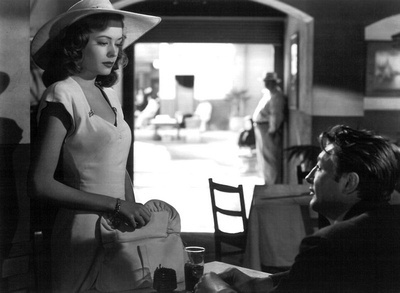
The 1946 Build My Gallows High by Geoffrey House--the pseudonym of Daniel Mainwaring, who may be better known as a screenwriter--is a classic piece of hard-boiled detective fiction, featuring a stolid and calmly quipping ex-private eye with a secret past, an assortment of dames from starry-eyed through sneaky to coolly murderous, and an assortment of big operators and tough guys and mugs tied up in cross after double-cross, written in a spare yet sometimes-lyrical style.
Many readers, I presume, will come to this book from the 1947 film Out of the Past, starring Robert Mitchum. I myself actually am very stale on this movie, and from my viewing of, oh, I would say maybe 35 years ago, about the only thing I can remember is thinking that it was absolutely top-notch. And now I discover, however, that the source novel of course proves even better.
Far removed from the concrete towers and gritty alleys of the teeming East, Red Bailey runs the "One Stop Service Station on the outskirts of town," where he employs "the Kid," a skinny deaf-mute "who had dropped off a Reno-bound truck a couple of years before and had stuck around ever since" (2001 Prion softcover, page 4). It's "[n]ice and quiet" in Bridgeport, "[a]nd the fishing's good" (page 5) in "chatter[ing]" creeks from which one can "stare at the wall of mountains to the west," with "[p]atches of snow still scarr[ing] the smooth red shoulders," while "back toward Tioga Pass a fistful of clouds h[a]ng low" (page 1).
And there's a girl here, too: 20-year-old (page 2) Ann Miller, who drives "her father's Packard" (page 4)--meaning big-ish money with her disapproving old man, owner of the Miller Realty Company (40). It's understandable that "the paunchy gray" fellow (page 41) who always greets Red "sourly," along with his "lean, angular[,] and unhappy" wife, are no fans, for "A girl as well educated and mannered, as shapely as Ann, could certainly do much better than tag around with a tough, red-haired giant of forty-two, with a crooked nose and one shoulder higher than the other" (page 6). There's that "fine boy" (page 114) Jimmy Caldwell, the game warden, for example, whose "[l]ove had started when he was a freshman in high school and she had the seat in front of him" (page 141).
Caldwell, too, doesn't think much of Red Bailey, to say the least: "That red-headed son of a bitch! That ugly, worn-out bastard! Someday he was going to kick the guy's teeth in. If he kept hanging around Ann, by God, he certainly would kick his teeth in." Now, yes, he believes Ann "should have better sense" than always "[r]unning after the guy like a high school kid" (page 41), but he tries to tell himself "it was just one of those things girls have for older men--sort of hero worship that never lasted" (page 102). Uh huh.
On the one hand, when news finally breaks on the front page about what Red had done ten years ago, plus the clever frame job for, ah, a couple more recent items, Caldwell thinks that now "[t]hat crazy red-headed bastard might do anything," and his hand "[a]utomatically" drops to the grip of his holstered sidearm and relishes "the good roughness of it" (page 103). On the other hand, perhaps the spurned young suitor isn't quite the complete jealous jackass after all, for he cannot help feeling "sorry not only for Ann but for Bailey" as well, perhaps to "be hanged for something that happened a long time ago, the poor bastard running like a tired old buck toward the end of the hunting season" (page 101). His flash of pity is very touching, really, and then one night when the game warden secretly "crouched in the grass...[with] the murmur of the creek...not loud enough to drown our Red Bailey's voice" finally hears the full truth (page 147-48)...
And Red himself? Well, although the man Ann chides as "Bailey the mysterious" claims he is "[u]nworthy" of marrying her and that "[i] wouldn't work," she tells him "sharply, 'I don't care what you've done, or what you are'" (page 2). She knows he was "a detective and [he] did something," that he "went to Korea and became a hero"--the latter of which he denies, and the former of which puzzles me, since the book was published four years before the Korean War, so I wonder if that's a glitch from the most recent editors--and that he "came to Bridgeport and opened a gas station"...and that then she "came along to confuse [him]" (page 3).
Of course he's confused. He indeed has admitted to Ann that he loves her (page 2). And although he can be ruthless when he needs to be, and in classic tough-guy fashion is, as a partner once complained, "full of quips" (page 17), and almost certainly was trying to be drolly ironic when he told a client he was "a sentimentalist" (page 20), he actually is--a sentimentalist, I mean. Back in his former life, Red had a "reputation for truth," and the chief of police in the "new town" (page 33) where the detective moved after letting his old partner buy out his half of the business said he had "[h]eard a lot about" him; it was "[a]ll good," the copper admitted, and he was "[g]lad to have [him] around," as "odd" as it would be "having an honest the private eye working the town" (page 32).
And despite his tough, wisecracking demeanor, Red back then down in the "sun in Mexico--sun and a warm wind, orchids in the jungle and a sky washed clean of clouds" (page 21)--fell for another big-eyed and serene-faced (page 23) dame, and fell hard. He gave her every chance, and believed her. He even told her, smitten, "I don't give a damn how much you stole.... But I don't want you laughing at me. I don't want you saying, 'What a sucker he is--what a poor goddamned sucker!' " (page 37). Of course she played the offended card, and although " 'I'll stop doubting,' Red whispered," still "he knew he never would" (page 38)...but he stayed. He stayed until he at last saw her for what she was, and after she left, he knew "[h]e'd be lonely for a while, lonely for a myth." And the dame? "With that wad of money she should be very happy. Money was something you could hold and count. Love? Hell, you could pick that up in a Mexican cafe when you needed it" (page 39).
Yes, this is great cynical tough-guy stuff, but as the novel opens, despite his protective pushing away, Red finally agrees to Ann's question that "it will work out," and "[a]t that moment he [is] sure of it. The past [is] dead. Ten years dead, and buried deep" (page 4). Only... Well, when "two hours later" they get back to the service station from fishing and Red finds "the little Greek, Joe Stefanos," in "a white linen suit and a Panama hat of incongruous size," "smoking a cigarette in a long ivory holder" (page 4), perhaps the past is not buried after all. Apparently the ex-copper turned casino owner up in Reno wants him for another job after all those years, and when Red demurs, the little Greek shows him the "thirty-eight with a stubby barrel" from "his jacket pocket" (page 5).
Of the plot, however--the twisty, twisty action of the present, and the the action of the past, which set up the current situation, told in flashbacks--I'll say more more, for it really is good, and should be discovered piece by piece in the reading. In short, Geoffrey House's 1946 Build My Gallows High is an exquisite piece of hard-boiled detective fiction that actually has surprising emotional range, and is told with prose that caresses the landscape with subtle artistry, and it is sure to be a gripping 5-star read.