

What do you think?
Beautiful Math #4
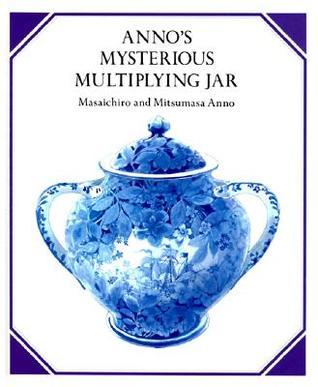
Anno's Mysterious Multiplying Jar
Simple text and pictures introduce the mathematical concept of factorials.
40 pages, Hardcover
First published October 1, 1982
About the author
Mitsumasa Anno
249 books85 followersHis name is written as 安野光雅 in Japanese.
Mitsumasa Anno (born March 20, 1926) was a Japanese illustrator and writer of children's books, known best for picture books with few or no words. He received the international Hans Christian Andersen Medal in 1984 for his "lasting contribution to children's literature".
Source: Wikipedia.
Mitsumasa Anno (born March 20, 1926) was a Japanese illustrator and writer of children's books, known best for picture books with few or no words. He received the international Hans Christian Andersen Medal in 1984 for his "lasting contribution to children's literature".
Source: Wikipedia.
Ratings & Reviews
Friends & Following
Create a free account to discover what your friends think of this book!
Community Reviews
Displaying 1 - 30 of 67 reviews

December 23, 2016
One key part of the explanation of factorials is missing. It would help so much if the drawings of the dots showed the components of the previous number. That is to say, on the page which shows the representation of "In each village there were six houses. In each house there were seven rooms," the mass of dots on the second page should show, by a thin line or thin white space, each of the six houses. A mass of dots is just too overwhelming for a lot of children.
Still, a good companion to How Much Is a Million? and One Grain Of Rice: A Mathematical Folktale.
See this Listopia: https://www.goodreads.com/list/show/1...
Still, a good companion to How Much Is a Million? and One Grain Of Rice: A Mathematical Folktale.
See this Listopia: https://www.goodreads.com/list/show/1...

August 5, 2012
Why oh why couldn’t math class have been like this in the upper elementary grades. (Well, okay, I did enjoy learning and using the abacus in sixth grade, but overall my math lessons until college were mostly uninspired.)
This is a concept book about factorials. The story and facts are enhanced by beautiful and detailed artwork.
I actually might have found the story proper a bit confusing, but the afterword manages to make factorials so clear.
A father and son team collaborated on this book. I really enjoyed the art and the way the facts were presented, and I would recommend this book for or as an adjunct to a math lesson.
This is a concept book about factorials. The story and facts are enhanced by beautiful and detailed artwork.
I actually might have found the story proper a bit confusing, but the afterword manages to make factorials so clear.
A father and son team collaborated on this book. I really enjoyed the art and the way the facts were presented, and I would recommend this book for or as an adjunct to a math lesson.

July 5, 2017
krasny napad, jak detem formou pohadky nastinit problematiku velkych cisel...

September 15, 2017
Read this to my Gr. 7 math students. They found it intriguing and entertaining. I just wish the pictures helped show the story a little more clearly.

January 6, 2020
If you get the chance to take a journey through the pages of this book, try and visualise the mathematical structure that is laid out at each turn of the page. I offer this very suggestion to my students when I read it to them, without showing the front cover or mentioning it’s title. It’s mysterious after all.
You see, inside the jar is a sea, and on the sea is one island. On the island there are two countries, and on each country, there are three mountains. On each mountain there are four walled kingdoms, and within each walled kingdom there are five villages. The tale continuous to step out the ‘for each’ idea, for the 6 houses, 7 rooms, 8 cupboards, 9 boxes and 10 jars. At this point in the story, the question is posed as to how many jars there are. Perhaps you can see the multiplicative structure from this brief outline? Some children answer “one hundred”, others see the potential of exponential growth and answer “oh man there’d be heaps”, and others imagine the infinite possibilities of each of the jars holding a sea with one island, and the tale continuing on forever. Before progressing further with the remaining pages, I give students the chance to construct tree diagrams to model the multiplicative structure. Large paper is needed and students find it get very hard to represent further than the number of villages!
The second half of the book unpacks the underpinning multiplicative idea of factorials. Arrays (dots arranged in columns and rows) are used to show each branch of the story, up to the point when the number of dots required would take many many pages. With each array, there is a matching mathematical equation. The equation for the total number of walled kingdoms is 1 by 2 by 3 by 4 = 4! = 24.
I have used this story to stimulate mathematical thinking in both primary and secondary students. They are often captivated by the ideas, and as one of my year 9 students told me, “it’s cool and confusing at the same time”.
You see, inside the jar is a sea, and on the sea is one island. On the island there are two countries, and on each country, there are three mountains. On each mountain there are four walled kingdoms, and within each walled kingdom there are five villages. The tale continuous to step out the ‘for each’ idea, for the 6 houses, 7 rooms, 8 cupboards, 9 boxes and 10 jars. At this point in the story, the question is posed as to how many jars there are. Perhaps you can see the multiplicative structure from this brief outline? Some children answer “one hundred”, others see the potential of exponential growth and answer “oh man there’d be heaps”, and others imagine the infinite possibilities of each of the jars holding a sea with one island, and the tale continuing on forever. Before progressing further with the remaining pages, I give students the chance to construct tree diagrams to model the multiplicative structure. Large paper is needed and students find it get very hard to represent further than the number of villages!
The second half of the book unpacks the underpinning multiplicative idea of factorials. Arrays (dots arranged in columns and rows) are used to show each branch of the story, up to the point when the number of dots required would take many many pages. With each array, there is a matching mathematical equation. The equation for the total number of walled kingdoms is 1 by 2 by 3 by 4 = 4! = 24.
I have used this story to stimulate mathematical thinking in both primary and secondary students. They are often captivated by the ideas, and as one of my year 9 students told me, “it’s cool and confusing at the same time”.
March 8, 2012
You know, I'm confused about why this book is considered so good. I used it to work with a group of 5 students. I love math, and I love factorials, and parts of this book are great. Why, why, why on earth does this book blend factorials and surrealism? The fact that it started with a jar that has an ocean inside it is whimsical to an adult, but can be pretty confusing to a kid who is supposed to be learning math. The fact that the final thing to figure out is how many jars...give a kid a break!
The illustrations are gorgeous, and besides the surreal beginning, it is great. Start with the island and you'll probably be fine.
The illustrations are gorgeous, and besides the surreal beginning, it is great. Start with the island and you'll probably be fine.

March 18, 2012
A picture book about factorials! This story illustrates how numbers multiply by showing objects nested inside each other. We start with one island, and on the island there are two countries, and in each country there are three mountains, and and so on until we finish with ten jars (10!) inside a box in the cupboard of a room in a house in a village within the walls of a kingdom on a mountain in a country on an island. (whew!)
After the pictorial story, we learn the mathematical explanation by substituting the pictures for dots. The story is illustrated with finely detailed watercolors. It's an excellent example of a picture book most appropriate for older children (grade 4+)
After the pictorial story, we learn the mathematical explanation by substituting the pictures for dots. The story is illustrated with finely detailed watercolors. It's an excellent example of a picture book most appropriate for older children (grade 4+)

July 15, 2013
I think that I'm the wrong target audience for this one. I can think of no way I can use the book successfully with the littles (3-5 year olds), other than to read the first half of the book and then stop all together. I can understand, however, how a classroom actually studying factorials might find the book useful. For me, however, the second half of the book is of little value or interest to me or my students. My kiddos would enjoy the details within the illustrations, though.
Originally written in Japanese and published in Tokyo, Japan in 1982.
Originally written in Japanese and published in Tokyo, Japan in 1982.
December 4, 2021
This book had so much potential! A math book about a jar that contains an ocean that contains 1 island with 2 countries which each have 3 mountains which each have 4 kingdoms which each have 5 villages which each have 6 houses which each have 7 rooms which each have 8 covers which each have 9 boxes which each have 10 jars. Whew! I love that idea, and I love the illustrations that go along with each of the story-telling bits.
But then the author turns to dots to help demonstrate how those numbers, when multiplied sequentially, grow rapidly. This is a complicated concept to grasp, and the authors really did a good job creating a physical representation of the factorial process- my only problem is that there is no distinction between, say, the fifth factorial and the sixth. For example, I would have liked to see different colored dots for when the houses were multiplied by the villages.
I would not use this as a read-aloud book because (especially for math) some people must see the numbers, not just hear them. I know I had a tough time following along without the book in front of me.
But then the author turns to dots to help demonstrate how those numbers, when multiplied sequentially, grow rapidly. This is a complicated concept to grasp, and the authors really did a good job creating a physical representation of the factorial process- my only problem is that there is no distinction between, say, the fifth factorial and the sixth. For example, I would have liked to see different colored dots for when the houses were multiplied by the villages.
I would not use this as a read-aloud book because (especially for math) some people must see the numbers, not just hear them. I know I had a tough time following along without the book in front of me.

July 18, 2021
It is a great book to understand factorials for kids. It has beautiful illustrated pictures, 1 island, 2 countries, 3 mountains, 4 kingdoms, 5 villages, 6 houses, 7 rooms, 8 covers, 9 boxes and 10 jars.
Wow!
After these illustrated pictures about them, It has present how many dots of them in its pages. At 8!, it took the whole two pages to present. At 10!, it'll take 180 pages so they just text about it!
Thank you so much, Ms. Stetser.
Watching book at: https://www.youtube.com/watch?v=NygBu...
Ms. Stetser Reads Anno's Mysterious Multiplying Jar
Wow!
After these illustrated pictures about them, It has present how many dots of them in its pages. At 8!, it took the whole two pages to present. At 10!, it'll take 180 pages so they just text about it!
Thank you so much, Ms. Stetser.
Watching book at: https://www.youtube.com/watch?v=NygBu...
Ms. Stetser Reads Anno's Mysterious Multiplying Jar
October 29, 2019
This book is about a mysterious multiplying jar, while reading this book I didn't think it was going to be about math. I honestly don't understand mathematic so reading this book made no sense to me. It started off with an island then it went into what we saw. After going through the jar it made us realize that we did a math problem. This book was too confusing for my like, I would not recommend this book.

October 21, 2024
Inside the jar there was water. The water became a sea, and on the sea there was an island. On the island, two countries. Within each country there were 3 mountains. On each mountain, 4 walled kingdoms...
And this is how the book "pictures" factorials to make children see them!
I found it quite interesting, worth a try with students!
And this is how the book "pictures" factorials to make children see them!
I found it quite interesting, worth a try with students!
December 18, 2018
We liked this book pretty well. It wasn't quite as engaging as One Grain of Rice, but it teaches a different concept and it still has that exciting moment when numbers get too large to actually imagine.

March 10, 2019
"Learning about numbers and how they can expand almost without limit by such simple means...will, we hope, give readers an idea of the remarkable order that underlies our universe, and a sense of the mystery, wonder, and excitement that can be experienced through mathematics."

October 22, 2025
As someone who has struggled with math for most of her life, this was such a fascinating way to explain factorials. Though the story was lacking in some areas, I did find the overall work to be intriguing.
May 22, 2017
Outstanding! My kids LOVED this book and opened up another area of mathematics for them.

September 6, 2019
Amazing approach to mathematics. It will stay with you for a longer time than hearing it from the teachers; definitely!

January 25, 2021
Great for discussing factorials
August 8, 2021
Neat pictorial representation of large numbers...We can use factorials to make it easier to write. 10! is 10x9x8x7x6x5x4x3x2x1 which is a LOT

February 6, 2022
Mind blown! I was "today years old" when I learned about factorial.
December 25, 2022
Amazing story of how
Math works!
Math works!

May 24, 2023
Who thought a math book would be so fun lol
October 23, 2023
Jedna z nejoblíbenějších knih mého dětství.

October 31, 2023
A nice visual and written explanation of factorials, illustrated narrative.
January 29, 2024
Great tool for teaching multiplication, with solving story problems.

October 30, 2025
me encanto! me hizo multiplicar ☺️

December 5, 2025
Relearned factorials. Wasn't bad, but I just don't have the knack for math

November 28, 2024
Great for learning about Factorials!
December 6, 2015
Title: Anno's Mysterious Multiplying Jar
Author: Masaichiro Anno and Mitsumasa Anno
Genre: Concept book
Theme(s): Factorials, math
Opening line/sentence: This story is about one jar and what was inside it.
Brief Book summary: In this story, there is a jar filled with water. The water becomes an ocean with an island inside of it. The book then becomes more and more specific describing what is on the island, in the village, etc.
Professional Review 1: "Superbly demonstrating the conception of factorials in mathematics, the text and pictures combine to present a lesson in a palatable form as well as the pleasure of looking at pictures that only Mitsumasa Anno could invent." — Publishers Weekly
Professional Review 2: "The book moves logically and elegantly from the concrete to the abstract. Once made clear, the concept is unforgettable, but the book entices the reader to return for further appreciation of the artistry with which it was designed." — The Horn Book
Response to Professional Reviews: I agree with reviewers that the book is aesthetically pleasing. The simple images are contrasted by the plain white background, which makes them stand out. The way the story starts broad and focuses in more and more makes readers eager to turn the pages to see what happens next.
Evaluation of Literary Elements:The simple sentences of the book make it easy for young readers to understand a confusing concept. I wish there was a more sentence variation, though, because it is a little bland. Having one sentence per page does match the tone of the book.
Consideration of Instructional Application: The text is very small, so it would be hard to use this book as a read-aloud. However, it is a great book to teach factorials. Teachers could rewrite the pages on big pieces of poster and turn it into an interactive story time by giving each student a cutout of something in the story and putting them on the board when it comes to that time.

October 26, 2011
This is a wonderful book for students working on their multiplication. I would use it for a student who needs a challenge, but I would only allow them to view the equation part and make them answer it before continuing on with the explanation.
Extend this by having a student write their own story and equation for classmates to answer. There would be an exchange of equations daily to see if everyone can eventually complete all the problems. TTW make an easy and a hard equation to answer for differentiating for students.
Extend this by having a student write their own story and equation for classmates to answer. There would be an exchange of equations daily to see if everyone can eventually complete all the problems. TTW make an easy and a hard equation to answer for differentiating for students.
Displaying 1 - 30 of 67 reviews