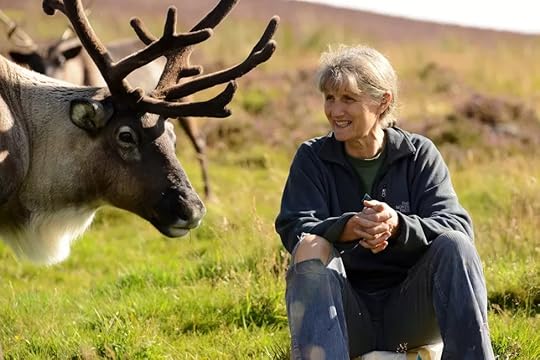
Easy to read, fast reading, generally light popular science and history treatment of wild and domestic reindeer (and caribou, though the emphasis is overwhelmingly on reindeer). Nicely organized, well-illustrated, though it has end notes, a bibliography, and a thorough index it is very easily read by anyone with the most casual interest in the subject or who doesn’t normally read popular science books for fun. The author is definitely an expert, a previously published author on reindeer who is co-director with her husband of the Cairngorm Reindeer Centre near Aviemore in Scotland, with lots of hands-on experience managing reindeer herds at the Centre as well as traveling to see reindeer and reindeer husbandry in Sweden and Mongolia.
The book is divided into a preface and sixteen numbered chapters. Chapter one, “Who is Rudolph?” introduces the reader to the origins of the legend of Rudolph and some basic general information on reindeer. Among other things learned are that the scientific name for reindeer is Rangifer tarandus, reindeer are the only arctic species of deer, reindeer have a range that covers a fifth of the Earth’s surface, and a total world population of about 6 million. Reindeer as a name is Lappish in origin while the name caribou is a Micmac Indian word meaning “digger of snow.” The reindeer learns also about antlers, what they are made of, how they grow, and the fact that both males and females possess them.
Chapter two, “Rudolph’s Relations,” talks about the different types of reindeer and caribou. One group, Cylindricornis, is found in tundra and mountain environments and has antlers that are rounded in cross-section, while Compressicornis, found in forest, has flattened antlers. Cylindricornis is further subdivided into three continental reindeer subspecies (Barren Ground Caribou, famous for their massive annual migrations, Alaskan Caribou, also famously migratory, and the Eurasian Tundra Reindeer, which includes all domestic and wild reindeer found west of the Bering Straits in the tundra and taiga of Russia and Scandinavia) and two high-arctic subspecies that live on islands (Svalbard Reindeer, described as “short-legged, pot-bellied” and do not undergo any sort of migration and Peary Caribou, found only in the high arctic Queen Elizabeth Islands of arctic Canada). Compressicornis are woodland/forest subspecies, and include Eurasian Forest Reindeer (found throughout Russia from Karelen to Kamchatka) and the North American Woodland Caribou (“the grey ghosts of the forest,” found from British Columbia to Newfoundland). The author also notes two extinct subspecies, East Greenland Caribou and Queen Charlotte Island Caribou, both of which went extinct in the early 20th century.
Chapter three, “The Reindeer Year,” talks about a year in the life of a typical reindeer, what life is like in each season of the year, about the principal predators of reindeer, about mating, calving, and migration.
Chapter four talks about the adaptations reindeer have to their Arctic environment, spending a lot of time on reindeers’ hairy coat, what makes it such a great insulator and how it differs throughout the year. Also discussions of how reindeer deal with overheating (in spring and summer velvet-covered antlers work as radiators), how reindeer keep their extremities warm, how reindeer feet are adapted to deal with snow, and how reindeer communicate (apparently grunting causes the animals to lose heat so in the coldest months reindeer communicate with clicking their tendons).
Chapter five, “Feast and Famine,” talks about what reindeer eat throughout the year (didn’t know reindeer eat mushrooms) and something about what they eat (spending a good bit of time on lichen, the primary winter food for most populations of reindeer though not all of them).
Chapter six, “The Early Taming of Reindeer,” talks about the origins of domesticated reindeer and how it likely evolved from decoy hunting.
Chapter seven, “Farm Animal of the North,” continues the story of the domestication of reindeer, with the earliest records appearing to be 3,000-year-old cave paintings along the River Lena in Russia, how the Tungus of Siberia are credited by some as “the original domesticator of reindeer,” how different groups of people learned to ride the reindeer (and different groups learned different ways to ride them) while some groups never learned to ride reindeer. Also some information on how domestication changes the physical appearance and behavior of reindeer (generally they are smaller, have a shorter muzzle, and can be found with piebald or “salt and pepper” colorations).
Chapter eight, “Reindeer Cultures,” is a tour of the different groups in the world that make use of reindeer. We meet the Evenki of Russia (use their reindeer solely as beast of burden), the Chukchi and Koryaks of eastern Siberia (“renowned for keeping large numbers of reindeer”, with the rich among them having the most reindeer and “ate almost exclusively reindeer from their own herds”), the Samoyeds (of Russia, west of the River Lena, who gave us the Samoyed dogs and as a people are divided into three groups), and the Sami People of northern Scandinavia and Russia (Lapp comes from a Finnish word meaning “outcast” and the preferred term is Sami). Sami are the most famous reindeer herders and a good bit of text is devoted to them.
Chapter nine recounts a visit by the author and some companions to the Tsataan, “Mongolia’s only reindeer people.” There is a photo of the author riding a reindeer, something the Tsataan do.
Chapter ten discusses exports of reindeer to other lands, such as St. Matthew Island in the Bering Straits, South Georgia (an island near Antarctica, the reindeer there adapting to the flip in seasons and eating tussock grass instead of lichen in the winter to survive), and quite a bit on the story of trying to establish reindeer herding industries in Alaska and Canada (with the notorious Lomen brothers for a time cornering the market so bad Congress eventually got involved in 1934). Oh and the story of a reindeer that spent time on a British submarine in World War II.
Chapter eleven is the story of the establishment of several herds of reindeer in the Scottish Highlands, much of it the result of the dedication of Sami reindeer herder Mikel Utsi (the reader learning a good deal about Mr Utsi).
Chapter twelve is about the author’s visit to Swedish Lapland (apparently saying Lapland is ok but the people are called Sami), visiting during the summer and witnessing corralling the animals and marking new calves.
Chapter thirteen is about the transfer of fresh reindeer livestock from Swedish Lapland to the Scottish herds, about how the reindeer were selected and brought over.
Chapter fourteen is various tales regarding the Scottish reindeer, about individual reindeer like Drop Dead Fred and Cluster, the latter apparently posed a bit of a threat to hill walkers and had to be rendered antlerless, enclosed, and was eventually castrated.
Chapter fifteen, “The Story of Christmas,” is more information on the history of Christmas, Santa Claus, and flying reindeer. Interestingly, she argues that Rudolph isn’t likely a breeding bull, as by the time Christmas rolls around bulls have lost their antlers and they would still be exhausted from rut season. Female reindeer though are smaller, less powerful, probably in calf, and “in general are feisty, highly strung and less trainable than males.” Noting that among reindeer peoples the castrated male is the reindeer that acts as a decoy to lead the herd, pull sledges, or are ridden, that they do not lose their antlers until after Christmas, and are lighter weight than breeding bulls; perhaps Santa’s reindeer are castrated males.
Chapter sixteen focuses on threats to reindeer. It is less about reindeer than about the threats, talking about global warming, the melting Arctic, and threats posed by pipelines and pollution.
A charming book. A small amount of Britishisms, like mentions of lorries and a passing mention of Scottish hill farmers that seemed to be written as if I was familiar with them.