Having now read a few of the very short picture biographies for young children in the
Little People Big Dreams
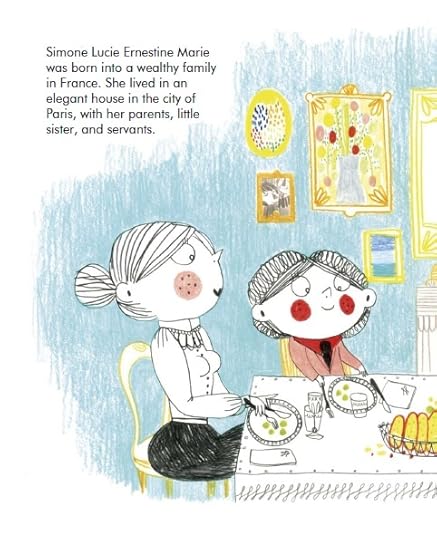
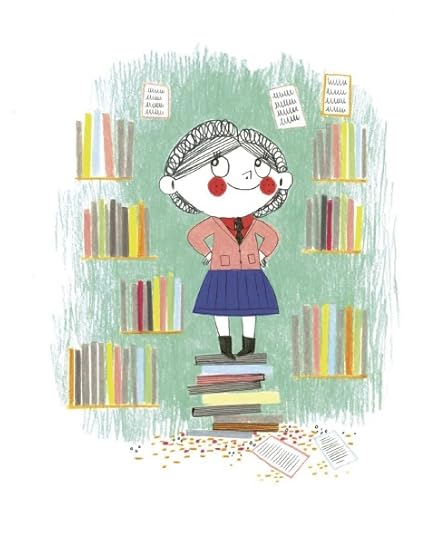
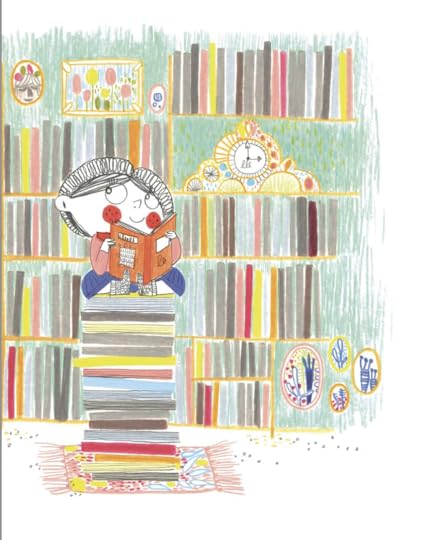
series, I’ve concluded that I like the idea of the collection a lot more than the actual books. For one thing, based on what I’ve seen, the illustrations are mostly substandard—the cartoonish characters all have extremely large heads (maybe a girl requires an overly large brain box in which to concoct and accommodate her big dreams) as well as some bizarrely rendered physical features: Georgia O’Keeffe, the iconic artist, has mouse ears, and Harriet Tubman, the heroic Underground Railroad conductor, a koala-bear nose. As for the actual biographies of the famous females: They are little more than sketches. So many of the details and struggles in the lives of the selected subjects are not quite suitable for little ears. The stories end up being so watered down that the drama and significance of their lives are largely lost. In spite of all this, when I saw Simone de Beauvoir’s story on offer on the Net Galley website, I was genuinely curious. I don’t think I’d ever consider presenting the story of the French feminist, intellectual, political activist, and companion of Jean-Paul Sartre to the very young. How would it be managed?
Adequately enough, it turns out. Author Isabel Sanchez Vegara presents the basic details of de Beauvoir’s initially comfortable, bourgeois Parisian childhood quite well. The family had been very wealthy for a time, but fortunes apparently changed overnight. The servants were let go, and Simone’s mother was suddenly burdened with all the domestic duties while M. de Beauvoir sat around on his derrière—or so it is intimated. This apparently got the young Simone thinking, as did her father’s observation that she “had the brain of a man.” Why was a boy’s mind any different from a girl’s? she wondered. The author writes that Simone “had become a feminist before the word even existed,” which is simply not true. The word “feminism” actually entered the English language in 1851. It came to mean “advocating for women’s rights” sometime between 1890-1895, over a decade before de Beauvoir was born in 1908.
According to Vegara’s telling, de Beauvoir’s father was pivotal in his daughter’s intellectual development. He shared books with her, and encouraged her to read and write. He is also said to have wanted his daughters to be educated so that they could support themselves. (It’s a long time since I read de Beauvoir’s
Memoirs of a Dutiful Daughter,
but M. de Beauvoir’s being quite this progressive strains credibility. I’ve read elsewhere that if he’d actually had the money for dowries, these supposedly enlightened views would have been nowhere in evidence.) Simone’s parents scraped together the money to send her and her younger sister to a good convent school, where, at the age of 14, she would begin to wonder if there really was a God.
In dealing with de Beauvoir’s life from her teens onward, Vegara is understandably superficial. She mentions that Simone studied philosophy, which is about “finding new ways of thinking.” That’s not a wrong definition of philosophy, exactly, but it isn’t the way I’d explain the word to young children. De Beauvoir’s first meeting with Jean-Paul Sartre, her “soul” and “mind” mate is mentioned, and the course of their unconventional (open, non-monogamous) relationship quite cleverly sanitized as follows: “Simone and Jean-Paul never married or lived under the same roof, but they lived their love story in their own unique way.” De Beauvoir’s first novel is discussed in a similarly indirect and understated manner. We are told the book caused a scandal. (Yes, thinks the adult reader, because it was based on her and Sartre’s ménage a trois with one of de Beauvoir’s students, a younger Ukrainian woman—Olga Kosakiewicz, who later stated that her "trio" relationship with the two philosophers damaged her psychologically.)
The author winds down her narrative with allusions to de Beauvoir’s travels (she and Sartre—with his characteristically wonky, strabismic right eye—are pictured sitting primly in the company of Che Guevara) and to her inspirational feminist status. However, Vegara’s conclusion is oversimplified, poorly worded, and, well, just not quite right: “thanks to little Simone, we now know we aren’t born men and women—just special human beings with a life full of choices to make.” Current gender politics aside, most of us are born with male or female bodies, and living in those bodies does affect us and impact our choices. I think de Beauvoir would have agreed.
Writing a book about an influential French intellectual was certainly an ambitious project for Vegara. The text isn’t a total dud, but the extremely childish, scribbly illustrations, apparently done in pencil crayon, do not elevate the final product in any way. I am not exaggerating when I say I’ve seen better work by eight-year-olds. I read this out of curiosity. I am not impressed enough to recommend it.