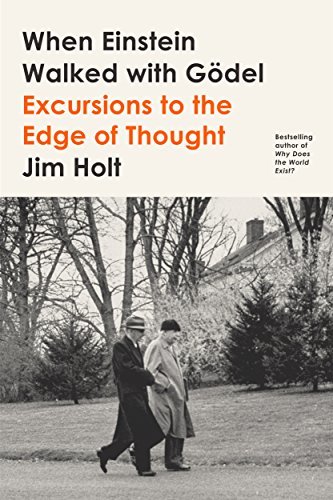
A rabbit hole treasure chest. A collection of 25 essays on diverse topics: Einstein’s theory of relativity (special and general), quantum mechanics, group theory, infinity and the infinitesimal, Turing’s theory of computability and the “decision problem,” Gödel’s incompleteness theorems, prime numbers and the Riemann zeta conjecture, category theory, topology, higher dimensions, fractals, statistical regression and the “bell curve,” the theory of truth, string theory, Newcomb's problem, etc.
The ideas that Holt presents all bear crucially on our most general conception of the world (metaphysics), on how we come to attain and justify our knowledge (epistemology), and even on how we conduct our lives (ethics).
I thoroughly enjoyed reading each essay. Holt is truly one of the best modern science writers. He provides a fresh and impartial perspective on each topic and is gifted at the art of providing parsimonious explanations to complex subjects (no easy task).
Some of the essays are too short and cover the topics only sparingly (the final essays). Nonetheless, you can research any of these topics and read more about them. I personally found fractals and Mandelbrot sets to be fascinating:
Other self-similar phenomena, each with its distinctive form, include clouds, coastlines, bolts of lightning, clusters of galaxies, the network of blood vessels in our bodies, and, quite possibly, the pattern of ups and downs in financial markets.
In the late 1970s, he became famous for popularizing the idea of self-similarity and for coining the word “fractal” (from the Latin fractus, meaning “broken”) to designate self-similar forms. In 1980, he discovered the “Mandelbrot set,” whose shape—it looks a bit like a warty snowman or beetle—came to represent the newly fashionable science of chaos.
The world we live in, he observes, is an “infinite sea of complexity.” Yet it contains two “islands of simplicity.” One of these, the Euclidean simplicity of smooth forms, was discovered by the ancients. The other, the fractal simplicity of self-similar roughness, was largely discovered by Mandelbrot himself.
4.5 / 5. September 2022.
Highlights
Godel / Einstein
Both Gödel and Einstein insisted that the world is independent of our minds yet rationally organized and open to human understanding.
In his March paper, on the photoelectric effect, he deduced that light came in discrete particles, which were later dubbed photons. In his April and May papers, he established once and for all the reality of atoms, giving a theoretical estimate of their size and showing how their bumping around caused Brownian motion.
First, the laws of physics are absolute: the same laws must be valid for all observers. Second, the speed of light is absolute; it, too, is the same for all observers. The second principle, though less obvious, had the same sort of logic to recommend
To make these laws absolute, he made distance and time relative.
Working from his two basic principles, Einstein proved that whether an observer deems two events to be happening “at the same time” depends on his state of motion. In other words, there is no universal now. With different observers slicing up the timescape into “past,” “present,” and “future” in different ways, it seems to follow that all moments coexist with equal reality.
The conclusion—that no logical system can capture all the truths of mathematics—is known as the first incompleteness theorem. Gödel also proved that no logical system for mathematics could, by its own devices, be shown to be free from inconsistency, a result known as the second incompleteness theorem.
If the laws of physics were to provide a truly objective description of nature, they ought to be valid for observers moving in any way relative to one another—spinning, accelerating, spiraling, whatever. It was thus that Einstein made the transition from his “special” theory of relativity of 1905 to his “general” theory, whose equations he worked out over the next decade and published in 1916. What made those equations so powerful was that they explained gravity, the force that governs the overall shape of the cosmos.
Einstein had shown that the flow of time depended on motion and gravity and that the division of events into “past” and “future” was relative. Gödel took a more radical view: he believed that time, as it was intuitively understood, did not exist at all.
Time
For little children, however, time goes quite slowly. Owing to the endless novelty of a child’s experience, a single summer can stretch out into an eternity. It has been estimated that by the age of eight, one has subjectively lived two-thirds of one’s life.
What science can tell us something about is the psychology of time’s passage. Our conscious now—what William James dubbed the “specious present”—is actually an interval of about three seconds. That is the span over which our brains knit up arriving sense data into a unified experience.
“Time is nature’s way to keep everything from happening all at once.”
Other
The human memory, unlike that of a computer, has evolved to be associative, which makes it ill-suited to arithmetic, where bits of knowledge must be kept from interfering with one another: if you’re trying to retrieve the result of multiplying 7 × 6, the reflex activation of 7 + 6 and 7 × 5 can be disastrous.
Evidently, the number sense has an even longer evolutionary history than that of laughter. So again, by the Copernican principle, we can be quite certain that numbers will be around in the Year Million.
Mathematics, after all, is supposed to be the most universal part of human civilization. All terrestrial cultures count, so all terrestrial cultures have number. If there is intelligent life elsewhere in the cosmos, we would expect the same. The one earmark of civilization that is likely to be recognized across the universe is number.
“Zeta” refers to the zeta function, a creature of higher mathematics that, as Riemann was the first to realize, holds the secret of the primes. In 1859, in a brief but exceedingly profound paper, Riemann put forward a hypothesis about the zeta function. If his hypothesis is true, then there is a hidden harmony to the primes, one that is rather beautiful. If it is false, then the music of the primes could turn out to be somewhat ugly, like that produced by an orchestra out of balance.
The zeta function, fittingly, has its origins in music. If you pluck a violin string, it vibrates to create not only the note to which it is tuned but also all possible overtones. Mathematically, this combination of sounds corresponds to the infinite sum 1 + ½ + ⅓ + ¼ +…, which is known as the harmonic series.
Riemann was able to do a marvelous thing: he produced, for the first time ever, a formula that described exactly how the infinity of primes arranged themselves in the number sequence.
Oddly enough, the bell curve—also known as the normal or Gaussian distribution (after Carl Friedrich Gauss, one of its multiple discoverers)—first arose in astronomy.
Why is the bell curve so ubiquitous? Mathematics yields the answer. It is guaranteed to arise whenever some variable (like human height) is determined by lots of little causes (genes, diet, health, and so on) operating more or less independently.
“Regression to the mean motivates almost every variety of risk-taking and forecasting. It is at the root of homilies like ‘What goes up must come down,’ ‘Pride goeth before a fall,’ and ‘From shirtsleeves to shirtsleeves in three generations.’”
regression is a matter of pure mathematics, not an empirical force.
These have been likened to the yin and yang of mathematics: geometry is space, algebra is time; geometry is like painting, algebra is like music.
Harvard linguist named George Kingsley Zipf, this law concerns the frequency with which different words occur in written texts—newspaper articles, books, and so on. The most frequently occurring word in written English is “the,” followed by “of” and then “and.” Zipf ranked all the words in a large variety of written texts in this way and then plotted their frequency of usage. The resulting curve had an odd shape.
Zipf’s law , which has been shown to hold for all languages, may seem a trifle. But the same basic principle turns out to be valid for a great variety of phenomena, including the size of islands, the populations of cities, the amount of time a book spends on the bestseller list, the number of links to a given website, and—as the Italian economist Vilfredo Pareto had discovered in the 1890s—a country’s distribution of income and wealth. All of these are examples of “power law” distributions.
The only known way to make relativity theory consistent with quantum theory is by supposing that the basic objects that make up our universe are not one-dimensional particles but two-dimensional strings and still-higher-dimensional “branes” (a term derived from “membrane”). Moreover, if the unified theory—called string theory, or sometimes M-theory—is to be mathematically coherent, these strings and branes must be vibrating in a space that has no fewer than nine dimensions.
Euler was perhaps the most prolific mathematician in history. Among the discoveries he made, while shuttling between the courts of Frederick the Great and Catherine the Great, was the formula V − E + F = 2, which was not long ago voted the second most beautiful theorem in mathematics. (The winner of the beauty contest, according to a 1988 survey published in The Mathematical Intelligencer, was eiπ = −1.)
the infinity of sets of things is greater than the infinity of things. The beauty of this principle, which has come to be known as Cantor’s theorem, is that it can be applied over and over again. Given any infinite set, you can always come up with a larger infinity by considering its “power set”—the set of all subsets that can be formed from it.
Essentially, calculus deals with curves. Its two basic operations are finding the direction of a curve at a given point (the “derivative”) and the area bounded by a curve (the “integral”). Curves are mathematically represented by “functions.” Some functions, like the sine wave, are nice and smooth; they are called continuous. But others are riddled with breaks and jumps: discontinuities.
In everyday parlance, “infinitesimal” is loosely used to refer to things that are extremely tiny by human standards, too small to be worth measuring.
The power of the calculus was matched by its versatility. It made possible the quantitative handling of all varieties of continuous change. The differential calculus showed how to represent the rate of change as a ratio of infinitesimals. The integral calculus showed how to sum up an infinite number of such changes to describe the overall evolution of the phenomenon in question.
Can you determine, in principle, whether a conjecture can be proved true or false? The decision problem calls for a mechanical set of rules for deciding whether such an inference is valid, one that is guaranteed to yield a yes-or-no answer in a finite amount of time. Such a method would be particularly useful to mathematicians, because it would allow them to resolve many of the conundrums in their field—like Fermat’s last theorem, or Goldbach’s conjecture—by brute force.
“The history of digital computing,” Dyson writes in his 2012 book, Turing’s Cathedral, “can be divided into an Old Testament whose prophets, led by Leibniz, supplied the logic, and a New Testament whose prophets, led by von Neumann, built the machines. Alan Turing arrived in between.”
“Fluid” intelligence is one’s ability to solve abstract problems, like logic puzzles. “Crystallized” intelligence is one’s store of information about the world, including learned shortcuts for making inferences about it.
The only reason we used to read big long novels before the advent of the Internet was that we were living in an information-impoverished environment. Our “pleasure cycles” are now tied to the web, the literary critic Sam Anderson claimed in a 2009 cover story in New York magazine, “In Defense of Distraction.” “It’s too late,” he declared, “to just retreat to a quieter time.”
In fact, beyond a certain minimum IQ threshold—about one standard deviation above average, or an IQ of 115—there is no correlation at all between intelligence and creativity.
In the decades after this dual revolution, most of the action was on the quantum side. In addition to gravity, there are three basic forces that govern nature: electromagnetism, the “strong” force (which holds the nucleus of an atom together), and the “weak” force (which causes radioactive decay). Eventually, physicists managed to incorporate all three into the framework of quantum mechanics, creating the “standard model” of particle physics.
The standard model tells how nature behaves on the scale of molecules, atoms, electrons, and on down, where the force of gravity is weak enough to be overlooked.
General relativity tells how nature behaves on the scale of apples, planets, galaxies, and on up, where quantum uncertainties average out and can be ignored. Between the two theories, all nature seems to be covered.
Witten’s papers are models of depth and clarity. Other physicists attack problems by doing complicated calculations; he solves them by reasoning from first principles. Witten once said that “the greatest intellectual thrill of my life” was learning that string theory could encompass both gravity and quantum mechanics.
Second, it is discriminating: an experiment done on one photon in an entangled pair affects only its partner, wherever that partner may be, leaving all other photons, near and far, untouched. The discriminating nature of entanglement again stands in contrast to gravity, where a disturbance created by the jostling of one atom will ripple out to affect every atom in the universe.
The shortest spatial span that has any meaning is the Planck length, which is about 10−35 meters (about 20 orders of magnitude smaller than a proton). The shortest possible tick of an imaginary clock (sometimes called a chronon) is the Planck time, about 10−43 seconds. (This is the time it takes light to cross a distance equal to the Planck length.)
Stigler’s law of eponymy. This law, which in its simplest form states that “no scientific discovery is named after its original discoverer,”
One of Nietzsche’s more notorious doctrines is perspectivism—the idea that we are condemned to see the world from a partial and distorted perspective, one defined by our interests and values.