

What do you think?

Pamela
One of the most spectacular successes of the flourishing literary marketplace of eighteenth-century London, Pamela also marked a defining moment in the emergence of the modern novel. In the words of one contemporary, it divided the world into two different Parties, Pamelists and Anti-pamelists, even eclipsing the sensational factional politics of the day.
Preached for its morality, and denounced as pornography in disguise, it vividly describes a young servant's long resistance to the attempts of her predatory master to seduce her. Written in the voice of its low-born heroine, Pamela is not only a work of pioneering psychological complexity, but also a compelling and provocative study of power and its abuse.
Based on the original text of 1740, from which Richardson later retreated in a series of defensive revisions, this edition makes available the version of Pamela that aroused such widespread controversy on its first appearance.
Preached for its morality, and denounced as pornography in disguise, it vividly describes a young servant's long resistance to the attempts of her predatory master to seduce her. Written in the voice of its low-born heroine, Pamela is not only a work of pioneering psychological complexity, but also a compelling and provocative study of power and its abuse.
Based on the original text of 1740, from which Richardson later retreated in a series of defensive revisions, this edition makes available the version of Pamela that aroused such widespread controversy on its first appearance.
592 pages, Paperback
First published January 1, 1740
About the author
Samuel Richardson
1,684 books219 followers
Pamela
(1740) and
Clarissa Harlowe
(1748) of English writer Samuel Richardson helped to legitimize the novel as a literary form in English.
An established printer and publisher for most of his life, Richardson wrote his first novel at the age of 51. He is best known for his major 18th-century epistolary novel Sir Charles Grandison (1753).
https://en.wikipedia.org/wiki/Samuel_...
An established printer and publisher for most of his life, Richardson wrote his first novel at the age of 51. He is best known for his major 18th-century epistolary novel Sir Charles Grandison (1753).
https://en.wikipedia.org/wiki/Samuel_...
Ratings & Reviews
Friends & Following
Create a free account to discover what your friends think of this book!
Community Reviews
Displaying 1 - 30 of 1,484 reviews
May 18, 2013
Creepy 18th-century Guy: Hey, baby. Now that my mom died, I’m your boss now.
Innocent Maidservant: Um, yeah. I know.
CG: But don’t worry. I’ll take reeeeaaaallly good care of you.
IM: ...thanks?
CG: And I’m sure you’ll want to be nice to me right back, if you know what I’m saying. Wink, wink. Nudge, nudge.
IM: I always try to be nice, sir.
CG: Have I mentioned how hot you are?
IM: Okay, this is getting uncool.
CG: Hey, I’m all rich and powerful and you’re just some little nobody. You should be flattered I’m even noticing you.
IM: ...again with the thanks?
CG: I have a bleep-ton of money, and I’m willing to share.
IM: I’m happy with my salary, sir.
CG: But you could be making waaaaay more money. AND you could be making me happy. I mean, what are you – uptight?
IM: Please take your hands off me, sir.
CG: Okay, enough beating around the bush.
IM: Gross, sir.
CG: I’m ready to give you a lot of money. And a house. And cool clothes – girls like clothes, right? And I’ll throw in a nice little settlement for your parents, too, while I’m at it.
IM: If you think my parents would take money from a cad, you so don’t know them.
CG: Did you just call me a cad?
IM: I don’t know. Did I?
CG: Okay, that’s it. If you won’t accept my offer, I’ll just take what I want.
IM: You better not. I’ll scream and faint.
CG: Yeah, whatever.
IM: And I’ll fall into fits.
CG: What does that even mean?
IM: I’m not sure, but it’ll totally gross you out.
CG: Are you serious?
IM: Serious as cancer, sir.
CG: You’re not bluffing?
IM: I’m totally not.
CG: Holding out for more money?
IM: Nope.
CG: I’ll kidnap you and stuff.
IM: I feel a fit coming on.
CG: Ew, don’t.
IM: Can’t help it. I’m just that virtuous.
CG: The way you say no is making me hotter for you every minute.
IM: Yes, sir. That’s called being male.
CG: I can’t live without you! Marry me!
IM: Sure!
CG: Seriously?
IM: Heck, yeah. I had a total crush on you all along. I knew deep deep deep deep down you had to be a really nice guy.
CG: Just so you know: After we’re married, I’m going to do that thing where I talk about how you’re so much better than I am, and then I’m going to prove how much I believe it by being the total boss of you.
IM: Now who’s making ME hot?
CG: Awesome.
Okay, so it’s not exactly a feminist classic.
Although in a weird way, it sort of is. If you squint.
Fact: Pamela was the first English-language novel whose heroine worked for a living. It still stands almost alone in being a fictional portrait of a servant who has dignity, intelligence, and strong morality.
Other fact: At the time Pamela was written, it actually needed pointing out that servants were fellow human beings, and that the honor of a maidservant was, on a cosmic scale, every bit as important as that of a lady. (Sadly, this still needs pointing out to plenty of people.)
I read this because I’m working on a fictional diary of an early 19th-century girl. She’s a reader, and Pamela was the Twilight of the time. There was merchandise and everything. So I had to read this, because there’s no way she wouldn’t have.
That said: This is not a romp. If you’re not doing research, I don’t recommend this as a pleasure read. Pamela’s earnest notes on how she can strive to be the perfect wife will make any modern reader squirm, and the way he treats her after they’re married is actually creepier than his previous relentless sexual harassment. I mean, at least back then everybody knew he was being a jerk. Now he’s supposedly a reformed rake. And he’s still – well, ew.
Glad I read it. Glad I’m done.
Now I’m going to find Shamela and The Anti-Pamela, two short contemporary parodies that sound funny and have at least the virtue of being short.
Innocent Maidservant: Um, yeah. I know.
CG: But don’t worry. I’ll take reeeeaaaallly good care of you.
IM: ...thanks?
CG: And I’m sure you’ll want to be nice to me right back, if you know what I’m saying. Wink, wink. Nudge, nudge.
IM: I always try to be nice, sir.
CG: Have I mentioned how hot you are?
IM: Okay, this is getting uncool.
CG: Hey, I’m all rich and powerful and you’re just some little nobody. You should be flattered I’m even noticing you.
IM: ...again with the thanks?
CG: I have a bleep-ton of money, and I’m willing to share.
IM: I’m happy with my salary, sir.
CG: But you could be making waaaaay more money. AND you could be making me happy. I mean, what are you – uptight?
IM: Please take your hands off me, sir.
CG: Okay, enough beating around the bush.
IM: Gross, sir.
CG: I’m ready to give you a lot of money. And a house. And cool clothes – girls like clothes, right? And I’ll throw in a nice little settlement for your parents, too, while I’m at it.
IM: If you think my parents would take money from a cad, you so don’t know them.
CG: Did you just call me a cad?
IM: I don’t know. Did I?
CG: Okay, that’s it. If you won’t accept my offer, I’ll just take what I want.
IM: You better not. I’ll scream and faint.
CG: Yeah, whatever.
IM: And I’ll fall into fits.
CG: What does that even mean?
IM: I’m not sure, but it’ll totally gross you out.
CG: Are you serious?
IM: Serious as cancer, sir.
CG: You’re not bluffing?
IM: I’m totally not.
CG: Holding out for more money?
IM: Nope.
CG: I’ll kidnap you and stuff.
IM: I feel a fit coming on.
CG: Ew, don’t.
IM: Can’t help it. I’m just that virtuous.
CG: The way you say no is making me hotter for you every minute.
IM: Yes, sir. That’s called being male.
CG: I can’t live without you! Marry me!
IM: Sure!
CG: Seriously?
IM: Heck, yeah. I had a total crush on you all along. I knew deep deep deep deep down you had to be a really nice guy.
CG: Just so you know: After we’re married, I’m going to do that thing where I talk about how you’re so much better than I am, and then I’m going to prove how much I believe it by being the total boss of you.
IM: Now who’s making ME hot?
CG: Awesome.
Okay, so it’s not exactly a feminist classic.
Although in a weird way, it sort of is. If you squint.
Fact: Pamela was the first English-language novel whose heroine worked for a living. It still stands almost alone in being a fictional portrait of a servant who has dignity, intelligence, and strong morality.
Other fact: At the time Pamela was written, it actually needed pointing out that servants were fellow human beings, and that the honor of a maidservant was, on a cosmic scale, every bit as important as that of a lady. (Sadly, this still needs pointing out to plenty of people.)
I read this because I’m working on a fictional diary of an early 19th-century girl. She’s a reader, and Pamela was the Twilight of the time. There was merchandise and everything. So I had to read this, because there’s no way she wouldn’t have.
That said: This is not a romp. If you’re not doing research, I don’t recommend this as a pleasure read. Pamela’s earnest notes on how she can strive to be the perfect wife will make any modern reader squirm, and the way he treats her after they’re married is actually creepier than his previous relentless sexual harassment. I mean, at least back then everybody knew he was being a jerk. Now he’s supposedly a reformed rake. And he’s still – well, ew.
Glad I read it. Glad I’m done.
Now I’m going to find Shamela and The Anti-Pamela, two short contemporary parodies that sound funny and have at least the virtue of being short.

January 29, 2009
I did not finish this book. Because it is a million pages that boil down to:
PAMELA: I am a lowly maid. Yet my virtue, look at it.
MASTER-OF-THE-HOUSE: Ooh, dazzling. How 'bout you let me avail myself of some of that virtue?
PAMELA: No!
MASTER: YES.
PAMELA: No!
MASTER: YES.
[Insert cross-dressing in-bed-hiding country-house-involving shenanigans.:]
MASTER-OF-THE-HOUSE: Your virtue, it has won me over. Marry me?
PAMELA: But of course.
Ok, the shenanigans make it sound vaguely amusing? Just know that there are MANY MANY pages where Pamela details how awesome she is and the shenanigans are not nearly ripping or amusing enough to compensate for the remaining tedium.
Very popular in its day, though. Fathers bought it for their daughters. You could buy Pamela fans and tea-sets.
PAMELA: I am a lowly maid. Yet my virtue, look at it.
MASTER-OF-THE-HOUSE: Ooh, dazzling. How 'bout you let me avail myself of some of that virtue?
PAMELA: No!
MASTER: YES.
PAMELA: No!
MASTER: YES.
[Insert cross-dressing in-bed-hiding country-house-involving shenanigans.:]
MASTER-OF-THE-HOUSE: Your virtue, it has won me over. Marry me?
PAMELA: But of course.
Ok, the shenanigans make it sound vaguely amusing? Just know that there are MANY MANY pages where Pamela details how awesome she is and the shenanigans are not nearly ripping or amusing enough to compensate for the remaining tedium.
Very popular in its day, though. Fathers bought it for their daughters. You could buy Pamela fans and tea-sets.

January 24, 2011
When I read classics, it's not all about just reading them. I'm also trying to discover what's made them classics. I want to know why people like them so much. And I can usually figure something out; that's why I end up with so many five star reviews. But this? This piece of shit escapes me.
The first half is entertaining enough, as the vaguely-named Mr. B---- kidnaps a servant and tries to steal her titular virtue. There are dastardly schemes and narrow escapes. He dresses up like a woman in order to sneak into her bedroom and try to rape her. He makes a good villain, as does the vile Mrs. Jewkes, his accomplice.
Around halfway through, as plots and threats have failed to pierce Pamela's iron hymen, he changes his strategy: the carrot instead of the stick, so to speak. And Richardson has laid enough clues to make us suspect the wolf can't change his ways, so there's some suspense as we wait to see what new depths he's sunk to, and whether Pamela will escape with her virtue intact. (Not that the title leaves us much in doubt.) But then...
the bigger problem is how fucking tedious it is.
Don't misunderstand me here: nothing else happens. Nothing. That's it, on and on, for hundreds of awful pages. There are parts of Atlas Shrugged that are better than the latter half of this book. It sucks so hard, man. I'm so sad that I read it.
Pamela was important in its time; its characterization and use of the epistolary was groundbreaking, and it influenced great authors like Jane Austen. But it was and is also super shitty, so you don't have to read it unless you're into the history of literature - which is different from being into good literature. If you're not an academic, you don't need this in your life.
Do not read this book.
The first half is entertaining enough, as the vaguely-named Mr. B---- kidnaps a servant and tries to steal her titular virtue. There are dastardly schemes and narrow escapes. He dresses up like a woman in order to sneak into her bedroom and try to rape her. He makes a good villain, as does the vile Mrs. Jewkes, his accomplice.
Around halfway through, as plots and threats have failed to pierce Pamela's iron hymen, he changes his strategy: the carrot instead of the stick, so to speak. And Richardson has laid enough clues to make us suspect the wolf can't change his ways, so there's some suspense as we wait to see what new depths he's sunk to, and whether Pamela will escape with her virtue intact. (Not that the title leaves us much in doubt.) But then...
the bigger problem is how fucking tedious it is.
Don't misunderstand me here: nothing else happens. Nothing. That's it, on and on, for hundreds of awful pages. There are parts of Atlas Shrugged that are better than the latter half of this book. It sucks so hard, man. I'm so sad that I read it.
Pamela was important in its time; its characterization and use of the epistolary was groundbreaking, and it influenced great authors like Jane Austen. But it was and is also super shitty, so you don't have to read it unless you're into the history of literature - which is different from being into good literature. If you're not an academic, you don't need this in your life.
Do not read this book.

January 27, 2024
LA VIRTÙ RICOMPENSATA

Jean Étienne Liotard: La bella cioccolataia (1745 circa).
Il nome della collana curata da Aldo Busi è molto azzeccato per questo libro: “I Classici Classici”.
E infatti si tratta di un classico classico, tra i primissimi romanzi borghesi, scritti per andare incontro a una classe che stava diventando sempre più numerosa e socialmente “pesante”, importante. Quella borghese, per l’appunto. Basta cavalieri e donzelle e pulzelle e paggi e scudieri e… avanti la classe media, fino ad allora senza sua narrativa. Una classe pragmatica, più adatta alla prosa che alla poesia che ai poemi.
Ciò nonostante è ancora l’epoca delle differenze di classe abissali (che d’altronde non sono certo sparite due secoli e mezzo dopo) e la protagonista, la Pamela del titolo, è una cameriera al servizio di una famiglia abbiente, anche se non straricca. Quando muore la sua padrona, la signora al cui servizio personale è impiegata, Pamela teme d’essere licenziata, di dover far ritorno al focolare di mamma e papà – che non se la passano bene, hanno perfino qualche debito.
Tutto questo ci viene raccontato nella prima lettera.
Se non che il figlio della padrona, da sempre considerato uno scavezzacollo, si intenerisce e trasferisce Pamela al suo personale servizio. La giovane è grata e riconoscente: avrà modo di scoprire che non è tutto oro quello che luccica.

Jean-Baptiste-Siméon Chardin: La governante (1739).
Daniel De Foe aveva già pubblicato il suo Robinson Crusoe (1719), e Pamela segue quel solco.
Classico è anche lo stratagemma di Richardson di volersi annullare, non definendosi autore ma solo curatore delle epistole recuperate. Come se fosse materiale autentico che lui si limita a diffondere.
E anche questo è comportamento altrettanto classico: il nascondersi dietro la presunta verità dei fatti per venire incontro a un pubblico che si crede cerchi storie vere (beh, esattamente come adesso, true crime e talk show pomeridiani insegnano).
In realtà direi che si tratti della ben nota questione della sospensione dell’incredulità: raccontami pure di dei ed eroi, di fate e maghi, di mondi alieni e multiverso, basta che io possa crederci.
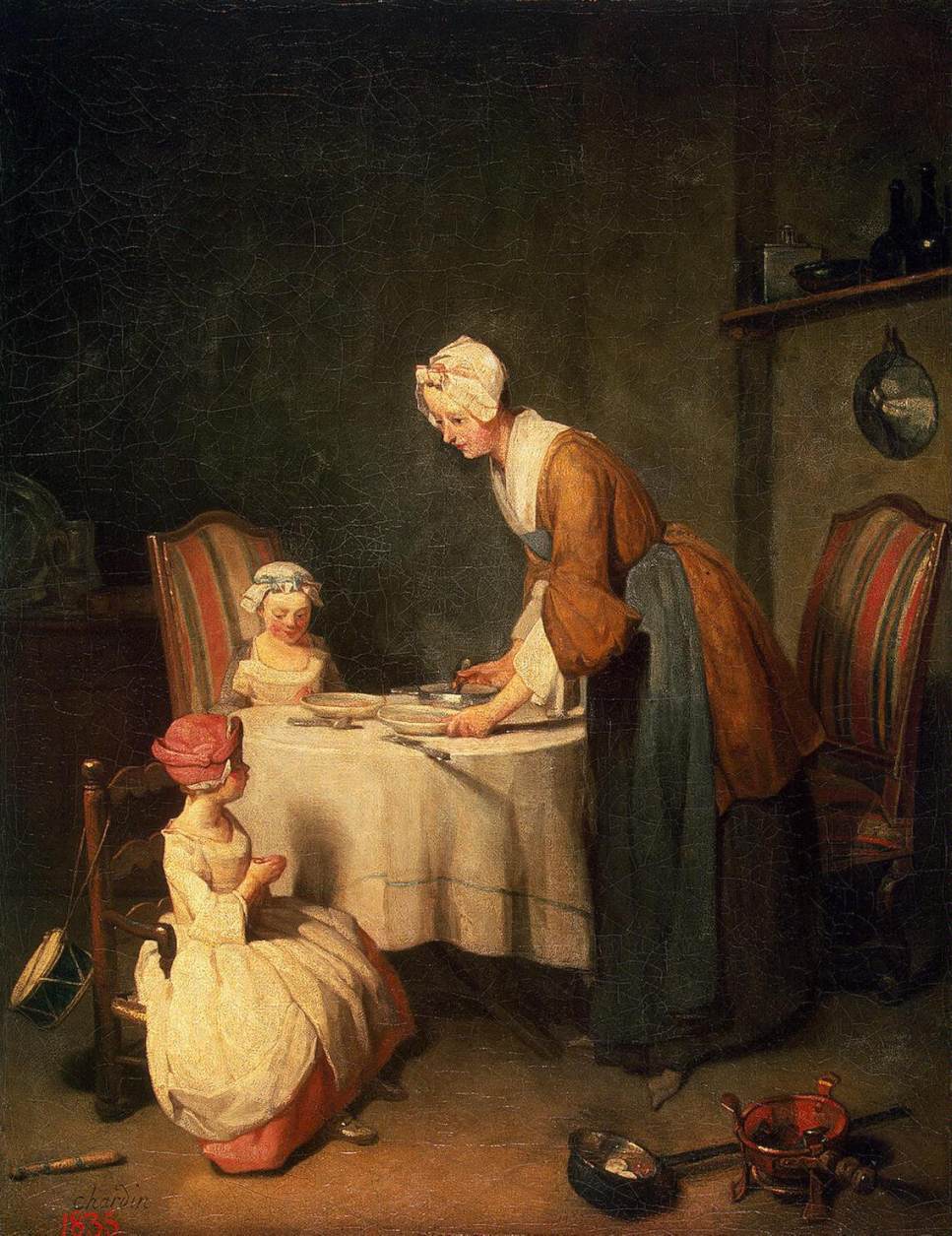
Jean-Baptiste-Siméon Chardin: La preghiera prima del pasto (1744).
Pamela ha sedici anni e bellezza irresistibile: il giovin signore le tenta tutte per sedurla, “costanti e ingegnosi attacchi”, ma alla fine dovrà cedere al suo volere e convolare insieme a nozze. Facendo di una servetta una nuova signora (proto femminismo? Mito di Cenerentola?). Non per niente il sottotitolo del romanzo recita: o la Virtù ricompensata.
E, come dicevo, il solco è quello di De Foe: non solo il Robinson Crusoe, ma ancora di più gli altri due romanzi, dedicati a Moll Flanders e Lady Roxana (1722 e 1724). Personaggi coinvolti in storie pepate, dove Vizio e Virtù si fronteggiano e scontrano, dove l’insegnamento morale (vero o presunto) è più facile da trasmettere.

Jean-Baptiste-Siméon Chardin: La bambinaia (1747).
Richardson sa intrattenere, e divertire, scrive pagine “vibranti di sesso e conflitti di classe”, descrive
certi estremi psicologici con un livello di specificità mai raggiunto in precedenza.
Inserisce piacevoli variazioni, come quando Pamela scopre che le sue lettere a mamma e papà sono intercettata dal giovin signore, Mr B, e decide di continuare a scriverle sapendo che Mr B le leggerà, e perciò piega la narrazione a questo elemento.

Jean-Baptiste-Siméon Chardin: Di ritorno dal mercato (1738-39).
I romanzi uscivano prima a puntate su varie testate. E questo spiega forse le dimensioni corpose del tomo, le tante pagine: pagine non sempre necessarie ed indispensabili, se è vero che in queste lettere Pamela piange almeno cinquanta volte, tra dolore, disperazione e gioia. Direi che la si può considerare un’anticipatrice delle telenovelas.
Per questo è possibile cominciare a leggere anche in corso di racconto senza sentire la mancanza delle ‘puntate’ precedenti: il riassunto è sempre a portata di mano e la situazione di base è semplice, e si ripete negli episodi.
Pamela ebbe un gran successo, fu subito tradotto in francese e anche in italiano, spinse Richardson a scrivere il sequel: svariati colleghi scrittori la presero storta, giudicarono e dichiararono il successo immeritato, con malizia e snobismo lo ritennero adatto alla “gioia di cameriere di ogni nazione”.
Rimane che Pamela è a suo modo una rivoluzione: il primo protagonista, per giunta di sesso femminile, che deve lavorare per mantenersi, trionfo del pensiero borghese. E anche l’analisi psicologica della protagonista è alquanto insolita e anticipatrice.
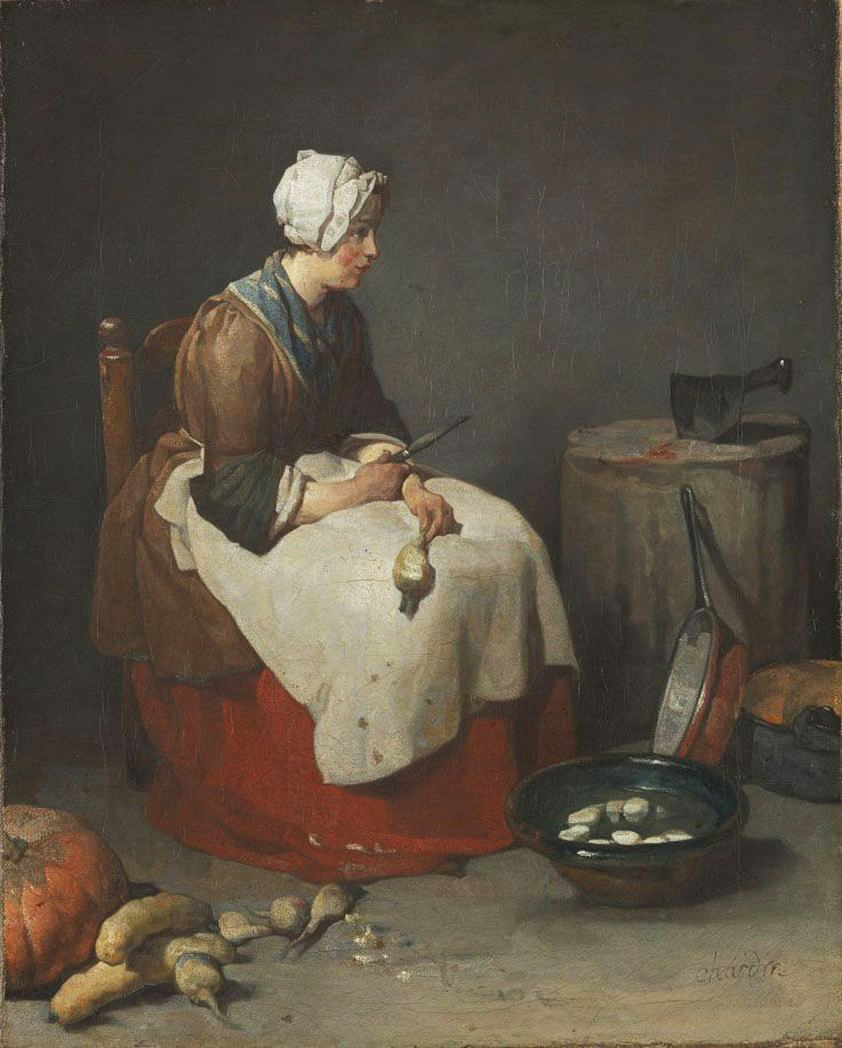
Jean-Baptiste-Siméon Chardin: Donna che pulisce le rape (1738).
Jean Étienne Liotard: La bella cioccolataia (1745 circa).
Il nome della collana curata da Aldo Busi è molto azzeccato per questo libro: “I Classici Classici”.
E infatti si tratta di un classico classico, tra i primissimi romanzi borghesi, scritti per andare incontro a una classe che stava diventando sempre più numerosa e socialmente “pesante”, importante. Quella borghese, per l’appunto. Basta cavalieri e donzelle e pulzelle e paggi e scudieri e… avanti la classe media, fino ad allora senza sua narrativa. Una classe pragmatica, più adatta alla prosa che alla poesia che ai poemi.
Ciò nonostante è ancora l’epoca delle differenze di classe abissali (che d’altronde non sono certo sparite due secoli e mezzo dopo) e la protagonista, la Pamela del titolo, è una cameriera al servizio di una famiglia abbiente, anche se non straricca. Quando muore la sua padrona, la signora al cui servizio personale è impiegata, Pamela teme d’essere licenziata, di dover far ritorno al focolare di mamma e papà – che non se la passano bene, hanno perfino qualche debito.
Tutto questo ci viene raccontato nella prima lettera.
Se non che il figlio della padrona, da sempre considerato uno scavezzacollo, si intenerisce e trasferisce Pamela al suo personale servizio. La giovane è grata e riconoscente: avrà modo di scoprire che non è tutto oro quello che luccica.
Jean-Baptiste-Siméon Chardin: La governante (1739).
Daniel De Foe aveva già pubblicato il suo Robinson Crusoe (1719), e Pamela segue quel solco.
Classico è anche lo stratagemma di Richardson di volersi annullare, non definendosi autore ma solo curatore delle epistole recuperate. Come se fosse materiale autentico che lui si limita a diffondere.
E anche questo è comportamento altrettanto classico: il nascondersi dietro la presunta verità dei fatti per venire incontro a un pubblico che si crede cerchi storie vere (beh, esattamente come adesso, true crime e talk show pomeridiani insegnano).
In realtà direi che si tratti della ben nota questione della sospensione dell’incredulità: raccontami pure di dei ed eroi, di fate e maghi, di mondi alieni e multiverso, basta che io possa crederci.
Jean-Baptiste-Siméon Chardin: La preghiera prima del pasto (1744).
Pamela ha sedici anni e bellezza irresistibile: il giovin signore le tenta tutte per sedurla, “costanti e ingegnosi attacchi”, ma alla fine dovrà cedere al suo volere e convolare insieme a nozze. Facendo di una servetta una nuova signora (proto femminismo? Mito di Cenerentola?). Non per niente il sottotitolo del romanzo recita: o la Virtù ricompensata.
E, come dicevo, il solco è quello di De Foe: non solo il Robinson Crusoe, ma ancora di più gli altri due romanzi, dedicati a Moll Flanders e Lady Roxana (1722 e 1724). Personaggi coinvolti in storie pepate, dove Vizio e Virtù si fronteggiano e scontrano, dove l’insegnamento morale (vero o presunto) è più facile da trasmettere.
Jean-Baptiste-Siméon Chardin: La bambinaia (1747).
Richardson sa intrattenere, e divertire, scrive pagine “vibranti di sesso e conflitti di classe”, descrive
certi estremi psicologici con un livello di specificità mai raggiunto in precedenza.
Inserisce piacevoli variazioni, come quando Pamela scopre che le sue lettere a mamma e papà sono intercettata dal giovin signore, Mr B, e decide di continuare a scriverle sapendo che Mr B le leggerà, e perciò piega la narrazione a questo elemento.
Jean-Baptiste-Siméon Chardin: Di ritorno dal mercato (1738-39).
I romanzi uscivano prima a puntate su varie testate. E questo spiega forse le dimensioni corpose del tomo, le tante pagine: pagine non sempre necessarie ed indispensabili, se è vero che in queste lettere Pamela piange almeno cinquanta volte, tra dolore, disperazione e gioia. Direi che la si può considerare un’anticipatrice delle telenovelas.
Per questo è possibile cominciare a leggere anche in corso di racconto senza sentire la mancanza delle ‘puntate’ precedenti: il riassunto è sempre a portata di mano e la situazione di base è semplice, e si ripete negli episodi.
Pamela ebbe un gran successo, fu subito tradotto in francese e anche in italiano, spinse Richardson a scrivere il sequel: svariati colleghi scrittori la presero storta, giudicarono e dichiararono il successo immeritato, con malizia e snobismo lo ritennero adatto alla “gioia di cameriere di ogni nazione”.
Rimane che Pamela è a suo modo una rivoluzione: il primo protagonista, per giunta di sesso femminile, che deve lavorare per mantenersi, trionfo del pensiero borghese. E anche l’analisi psicologica della protagonista è alquanto insolita e anticipatrice.
Jean-Baptiste-Siméon Chardin: Donna che pulisce le rape (1738).

January 3, 2013
It saddens me that Goodreads has no love for this book. First of all, it's one of the earliest novels ever written, so it deserves more respect from that perspective alone. Secondly, you have to place it in its time. Early 18th century readers found this material quite titillating, and of course wanted to see a virtuous end to all the lasciviousness. That way, they could have their cake and eat it, too. For its time, this was really racy material. Naturally nowadays we find the idea of a woman who is nearly raped and yet falls in love with her rapist reprehensible, and rightly so. But you have to understand that back then, relationships were different. Once Mr. B, the antagonist, realizes that Pamela is determined to stay virtuous, his attitude towards her changes, which makes it permissible for her to fall in love with him.
I seriously think that Richardson wrote this novel with his tongue firmly in his cheek. It was published on an installment plan, which is why it seems to drag out for readers today. Think of it as the GAME OF THRONES of its time, if you will. There aren't as many differences between the two as you might think.
Oh, yes: it's an epistolary novel. Some readers might hate it for that reason alone. And the Version I read in College capitalized all the Nouns and important Modifers, because that's what Readers expected from the Author back then. Makes for some Ponderous reading today.
I seriously think that Richardson wrote this novel with his tongue firmly in his cheek. It was published on an installment plan, which is why it seems to drag out for readers today. Think of it as the GAME OF THRONES of its time, if you will. There aren't as many differences between the two as you might think.
Oh, yes: it's an epistolary novel. Some readers might hate it for that reason alone. And the Version I read in College capitalized all the Nouns and important Modifers, because that's what Readers expected from the Author back then. Makes for some Ponderous reading today.

Read
November 19, 2023The subtitle of Samuel Richardson's 1740 novel Pamela is Virtue Rewarded, and it is partly because of that subtitle and partly because the book slotted into the three-volume novel project I've had going the past few months, that I decided to read it. Richardson was a contemporary of the last author I'd read for that project, Henry Fielding, who was known to disagree with Richardson—in particular about the subject of 'virtue'.
Richardson's novel is a series of letters, mostly written by main character Pamela, and mostly addressed to her parents. In the letters, unlikely as it seems, every moment of her life is described in detail. She is a very beautiful fifteen-year old servant (we learn that because she reports everything everyone around her says) in the house of a wealthy landowner who, you've guessed it, is intent on stealing her 'virtue'. His efforts are recounted very minutely, and those sections of the book can only be described as titillating, though the author makes Pamela sound as if she's completely unaware of how titillating they are. To give an example, she describes to her parents how Mr B hid one evening in her bedroom, watched her get undressed, and then crept into bed beside her and began to fondle her breasts. Fortunately she had the happy knack of falling into a deep faint every time such things happened, and they happened often, so that Mr B (who appears to be a complete booby) thinks she's dying every time, and his lecherous plans are foiled. After many such episodes, and other even sillier ones, Pamela, still a virgin, marries Mr B, and lives happily ever after. Virtue rewarded.
What a farce, I thought as I read it, except that the author overlays the whole thing with such religious language and such constant sermonizing on the importance of preserving one's virtue, that his true intentions are hard to figure out. Was he being completely genuine in his message about virtue, I wondered. Did he realise he was making a fifteen-year old girl present herself as a sex object to the reader?
His contemporary, Henry Fielding, seemed to have had no doubts as to the ridiculousness and double standards of Richardson's book. In a novel he wrote in 1742 as a response to Pamela, and which is also written in the form of letters from a character called Pamela to her mother, Fielding makes clear just how much of a sham he thinks Richardson's book was. In Fielding's version, called Shamela, Pamela, who lost her 'vartue' years before, holds all the power. Her plan from the beginning, in collusion with her mother (who has taught how to fake unconsciousness), is to trap the wealthy Mr B into marriage, come what may. Vice is duly rewarded. And Mr B is given a full name by Fielding: Mr Booby!
I read about a quarter of Shamela but the funny thing is that Fielding's Vice Rewarded theme began to annoy me as much as Richardson's Virtue Rewarded one. Fielding seemed to be saying that women are invariably setting snares for men and never say what they truly mean. But perhaps Richardson's hypocritical tale had just exasperated Fielding so much that he decided to be completely outrageous in his response to it.
In his novel, Tom Jones, which I had read just before Pamela, Fielding took a much more reasonable approach to the virtue/vice theme. His hero in that book never claims to be virtuous but he has no serious vices either. And if he's rewarded in the end, it's because of him being in the right place at the right time—as it often turns out in life. And none of the women characters are anything like the mother and daughter duo in Shamela but they are not like Richardson's Pamela either. They are just normal and credible women of their time.
…………………
While reading Pamela, I was reminded of the plot of a famous book, written one hundred years later. There were several strong parallels:
Mr B has a love child, whose mother lives in Jamaica;
Pamela, in her desperation to flee his house, says she doesn't care where she ends up, even if it is at the bottom of a wet ditch, on the wildest common in England;
then she meets a parson who is prepared to marry her and leave his current life;
Mr B invites society ladies to his house, implying he will marry one of them, confusing Pamela as to his feelings for her because, in the meantime, she's fallen in love with him.
Yes, all of that reminded me of the plot of Jane Eyre—with the huge difference that Charlotte Brontë made Jane not beautiful, not ridiculous, and not overly religious.
And she made Mr Rochester not a complete booby.
Richardson's novel is a series of letters, mostly written by main character Pamela, and mostly addressed to her parents. In the letters, unlikely as it seems, every moment of her life is described in detail. She is a very beautiful fifteen-year old servant (we learn that because she reports everything everyone around her says) in the house of a wealthy landowner who, you've guessed it, is intent on stealing her 'virtue'. His efforts are recounted very minutely, and those sections of the book can only be described as titillating, though the author makes Pamela sound as if she's completely unaware of how titillating they are. To give an example, she describes to her parents how Mr B hid one evening in her bedroom, watched her get undressed, and then crept into bed beside her and began to fondle her breasts. Fortunately she had the happy knack of falling into a deep faint every time such things happened, and they happened often, so that Mr B (who appears to be a complete booby) thinks she's dying every time, and his lecherous plans are foiled. After many such episodes, and other even sillier ones, Pamela, still a virgin, marries Mr B, and lives happily ever after. Virtue rewarded.
What a farce, I thought as I read it, except that the author overlays the whole thing with such religious language and such constant sermonizing on the importance of preserving one's virtue, that his true intentions are hard to figure out. Was he being completely genuine in his message about virtue, I wondered. Did he realise he was making a fifteen-year old girl present herself as a sex object to the reader?
His contemporary, Henry Fielding, seemed to have had no doubts as to the ridiculousness and double standards of Richardson's book. In a novel he wrote in 1742 as a response to Pamela, and which is also written in the form of letters from a character called Pamela to her mother, Fielding makes clear just how much of a sham he thinks Richardson's book was. In Fielding's version, called Shamela, Pamela, who lost her 'vartue' years before, holds all the power. Her plan from the beginning, in collusion with her mother (who has taught how to fake unconsciousness), is to trap the wealthy Mr B into marriage, come what may. Vice is duly rewarded. And Mr B is given a full name by Fielding: Mr Booby!
I read about a quarter of Shamela but the funny thing is that Fielding's Vice Rewarded theme began to annoy me as much as Richardson's Virtue Rewarded one. Fielding seemed to be saying that women are invariably setting snares for men and never say what they truly mean. But perhaps Richardson's hypocritical tale had just exasperated Fielding so much that he decided to be completely outrageous in his response to it.
In his novel, Tom Jones, which I had read just before Pamela, Fielding took a much more reasonable approach to the virtue/vice theme. His hero in that book never claims to be virtuous but he has no serious vices either. And if he's rewarded in the end, it's because of him being in the right place at the right time—as it often turns out in life. And none of the women characters are anything like the mother and daughter duo in Shamela but they are not like Richardson's Pamela either. They are just normal and credible women of their time.
…………………
While reading Pamela, I was reminded of the plot of a famous book, written one hundred years later. There were several strong parallels:
Mr B has a love child, whose mother lives in Jamaica;
Pamela, in her desperation to flee his house, says she doesn't care where she ends up, even if it is at the bottom of a wet ditch, on the wildest common in England;
then she meets a parson who is prepared to marry her and leave his current life;
Mr B invites society ladies to his house, implying he will marry one of them, confusing Pamela as to his feelings for her because, in the meantime, she's fallen in love with him.
Yes, all of that reminded me of the plot of Jane Eyre—with the huge difference that Charlotte Brontë made Jane not beautiful, not ridiculous, and not overly religious.
And she made Mr Rochester not a complete booby.

March 13, 2025
I get this won't be for everyone but it's just my type of book x Does anyone know anything similar? The first half was one of the strongest books I've ever read X big twist and dotted with hints of lived on prosperity of 'Pamela' x
July 26, 2026
my dearest reader,
i write these lines to you from behind the locked doors of mr. b.'s estate, with ink-stained fingers that have long hidden my sobs.
through pages upon pages of letters, i entrusted you with every beat of my heart, every wrong i endured and every shadow of fear that settled inside me.
perhaps you saw me as a bird in a cage. or perhaps you held each page i offered you like a mirror, and found only the pamela you wished to see reflected there.
and yet, i can hear your whispers—those skeptical voices echoing across the centuries. i hear mr. fielding and those who think as he did, insisting that my tears were mixed not with ink, but with calculation.
since then, some have looked into that mirror and seen not a bird, but a huntress. they tell me there was a hidden design beneath my song, that behind my tears lay the dream of a brighter future.
perhaps you believe they're right. but let me ask you, my dear reader: when a bird has lived its whole life inside a cage, is it called ambitious for dreaming of freedom, or simply alive?
when darkness gathered over me like a storm, i was only trying to protect my soul. there was a voice within me that refused to fall silent—a voice that neither promises of wealth could quiet nor fear could drive away.
perhaps dickinson was right, my dear reader. if hope truly is the little thing with feathers that perches in the soul, then mine was a bird that never forgot its song, even on the darkest nights.
still, there is one thing i hope you will know, my dear reader: i'm not the woman mr. fielding saw in his mirror. if dickinson was right and hope truly is the little bird that rests within the soul, then my story is nothing more than its song.
when mr. b.'s threats surrounded my world like gathering storms, that little bird's voice only grew clearer; perhaps not sweeter, but more steadfast. if i resisted, it was never to claim the keys to a grand estate. it was only to keep my soul from growing cold in the chillest lands and upon the strangest seas.
and that little bird never once asked a crumb of me. it only whispered that i must not lose my way.
if, in the end, that little bird survived the storm, found its way to mr. b.'s heart and became a lady, i cannot fully explain how it came to be, my dear reader.
perhaps you will call it fortune. perhaps fate. perhaps a grace whose name i have never learned. as for me, i'm still listening to that wordless song.
so, when you read my letters, remember me not as a huntress, but as a small bird struggling to keep its song alive in the heart of darkness. and if you still hold a mirror for me, then please, don't look only at where i arrived. look also at the compass i carried when i first began the journey.
with my tears and with hope that never ceased,
your faithful pamela..
* emily dickinson'ın hope is the thing with feathers şiirinden ilhamla
●
benim kıymetli okurum,
bu satırları, hıçkırıklarımı sakladığım mürekkepli parmaklarımla, bay b'nin malikânesindeki kilitli kapıların ardında yazıyorum size.
sayfalar dolusu mektubumu okurken kalbimin her atışını, uğradığım her haksızlığı ve içimdeki korkunun gölgesini sizinle paylaştım.
belki beni bir kafesteki kuş gibi gördünüz, belki de size uzattığım her sayfayı bir ayna gibi tuttunuz ve orada görmek istediğiniz pamela'yı buldunuz.
ancak fısıltılarınızı duyuyorum, asırlar ötesinden gelen o kuşkucu sesleri.. bay fielding'in ve onun gibi düşünenlerin, gözyaşlarımın mürekkebe değil hesaba karıştığını söylediklerini işitiyorum.
o günden beri bazıları o aynada bir kuş değil, bir avcı görüyor. bana, şarkımın ardında gizli bir hesap, gözyaşlarımın ardında parlak bir geleceğin hayali olduğunu söylüyorlar.
belki de haklı olduklarını düşünüyorsunuzdur. peki soruyorum size sevgili okurum, bir kafesin içinde yaşayan kuş özgürlüğü düşlediğinde ona hırslı mı denir, yoksa yalnızca canlı mı?
ben, üzerime çöken o karanlık fırtınada yalnızca ruhumu korumaya çalıştım. içimde, her şeye rağmen susmayan bir ses vardı. ne altın vaatleriyle susturulabilen ne de korkuyla kovulabilen bir ses.
belki dickinson haklıydı sevgili okurum; umut, gerçekten de ruhun içinde tüneyen küçük bir kuşsa, benimkisi de en karanlık gecelerde bile şarkısını unutmayan bir kuştu.
yine de şunu bilmenizi isterim sevgili okurum, ben bay fielding'in aynasında görünen o kadın değilim. eğer dickinson haklıysa ve umut gerçekten de ruhun içine tüneyen küçük bir kuşsa, benim hikâyem de onun şarkısından başka bir şey değildir.
bay b'nin tehditleri dünyamı fırtınalarla kuşattığında, o küçük kuşun sesi daha da belirginleşti; belki daha tatlı değil ancak daha inatçı. eğer direndiysem, bu bir sarayın anahtarlarını ele geçirmek için değildi. yalnızca ruhumu o en soğuk topraklarda, o en yabancı denizlerde üşütmemek içindi.
ve o kuş, benden hiçbir zaman bir kırıntı istemedi, bana yalnızca yolumu kaybetmemeyi fısıldadı.
eğer günün sonunda bu küçük kuş fırtınadan sağ çıkıp bay b'nin kalbine kadar ulaşabildiyse ve bir hanımefendi olduysa, bunun nasıl gerçekleştiğini ben de tam olarak açıklayamam sevgili okurum.
belki siz buna talih dersiniz, belki kader, belki de hâlâ adını koyamadığım bir lütuf. ben ise hâlâ o kelimesiz şarkıyı dinliyorum.
bu yüzden mektuplarımı okurken beni bir avcı olarak değil, karanlığın ortasında şarkısını kaybetmemeye çalışan küçük bir kuş olarak hatırlayın. ve eğer elinizde hâlâ benim için bir ayna tutuyorsanız, lütfen orada yalnızca vardığım yeri değil, o yola çıkarken taşıdığım pusulayı da görün.
gözyaşlarımla ve bitmeyen umudumla,
sizin sadık pamela'nız..
* emily dickinson'ın hope is the thing with feathers şiirinden ilhamla
i write these lines to you from behind the locked doors of mr. b.'s estate, with ink-stained fingers that have long hidden my sobs.
through pages upon pages of letters, i entrusted you with every beat of my heart, every wrong i endured and every shadow of fear that settled inside me.
perhaps you saw me as a bird in a cage. or perhaps you held each page i offered you like a mirror, and found only the pamela you wished to see reflected there.
and yet, i can hear your whispers—those skeptical voices echoing across the centuries. i hear mr. fielding and those who think as he did, insisting that my tears were mixed not with ink, but with calculation.
since then, some have looked into that mirror and seen not a bird, but a huntress. they tell me there was a hidden design beneath my song, that behind my tears lay the dream of a brighter future.
perhaps you believe they're right. but let me ask you, my dear reader: when a bird has lived its whole life inside a cage, is it called ambitious for dreaming of freedom, or simply alive?
when darkness gathered over me like a storm, i was only trying to protect my soul. there was a voice within me that refused to fall silent—a voice that neither promises of wealth could quiet nor fear could drive away.
perhaps dickinson was right, my dear reader. if hope truly is the little thing with feathers that perches in the soul, then mine was a bird that never forgot its song, even on the darkest nights.
still, there is one thing i hope you will know, my dear reader: i'm not the woman mr. fielding saw in his mirror. if dickinson was right and hope truly is the little bird that rests within the soul, then my story is nothing more than its song.
when mr. b.'s threats surrounded my world like gathering storms, that little bird's voice only grew clearer; perhaps not sweeter, but more steadfast. if i resisted, it was never to claim the keys to a grand estate. it was only to keep my soul from growing cold in the chillest lands and upon the strangest seas.
and that little bird never once asked a crumb of me. it only whispered that i must not lose my way.
if, in the end, that little bird survived the storm, found its way to mr. b.'s heart and became a lady, i cannot fully explain how it came to be, my dear reader.
perhaps you will call it fortune. perhaps fate. perhaps a grace whose name i have never learned. as for me, i'm still listening to that wordless song.
so, when you read my letters, remember me not as a huntress, but as a small bird struggling to keep its song alive in the heart of darkness. and if you still hold a mirror for me, then please, don't look only at where i arrived. look also at the compass i carried when i first began the journey.
with my tears and with hope that never ceased,
your faithful pamela..
* emily dickinson'ın hope is the thing with feathers şiirinden ilhamla
●
benim kıymetli okurum,
bu satırları, hıçkırıklarımı sakladığım mürekkepli parmaklarımla, bay b'nin malikânesindeki kilitli kapıların ardında yazıyorum size.
sayfalar dolusu mektubumu okurken kalbimin her atışını, uğradığım her haksızlığı ve içimdeki korkunun gölgesini sizinle paylaştım.
belki beni bir kafesteki kuş gibi gördünüz, belki de size uzattığım her sayfayı bir ayna gibi tuttunuz ve orada görmek istediğiniz pamela'yı buldunuz.
ancak fısıltılarınızı duyuyorum, asırlar ötesinden gelen o kuşkucu sesleri.. bay fielding'in ve onun gibi düşünenlerin, gözyaşlarımın mürekkebe değil hesaba karıştığını söylediklerini işitiyorum.
o günden beri bazıları o aynada bir kuş değil, bir avcı görüyor. bana, şarkımın ardında gizli bir hesap, gözyaşlarımın ardında parlak bir geleceğin hayali olduğunu söylüyorlar.
belki de haklı olduklarını düşünüyorsunuzdur. peki soruyorum size sevgili okurum, bir kafesin içinde yaşayan kuş özgürlüğü düşlediğinde ona hırslı mı denir, yoksa yalnızca canlı mı?
ben, üzerime çöken o karanlık fırtınada yalnızca ruhumu korumaya çalıştım. içimde, her şeye rağmen susmayan bir ses vardı. ne altın vaatleriyle susturulabilen ne de korkuyla kovulabilen bir ses.
belki dickinson haklıydı sevgili okurum; umut, gerçekten de ruhun içinde tüneyen küçük bir kuşsa, benimkisi de en karanlık gecelerde bile şarkısını unutmayan bir kuştu.
yine de şunu bilmenizi isterim sevgili okurum, ben bay fielding'in aynasında görünen o kadın değilim. eğer dickinson haklıysa ve umut gerçekten de ruhun içine tüneyen küçük bir kuşsa, benim hikâyem de onun şarkısından başka bir şey değildir.
bay b'nin tehditleri dünyamı fırtınalarla kuşattığında, o küçük kuşun sesi daha da belirginleşti; belki daha tatlı değil ancak daha inatçı. eğer direndiysem, bu bir sarayın anahtarlarını ele geçirmek için değildi. yalnızca ruhumu o en soğuk topraklarda, o en yabancı denizlerde üşütmemek içindi.
ve o kuş, benden hiçbir zaman bir kırıntı istemedi, bana yalnızca yolumu kaybetmemeyi fısıldadı.
eğer günün sonunda bu küçük kuş fırtınadan sağ çıkıp bay b'nin kalbine kadar ulaşabildiyse ve bir hanımefendi olduysa, bunun nasıl gerçekleştiğini ben de tam olarak açıklayamam sevgili okurum.
belki siz buna talih dersiniz, belki kader, belki de hâlâ adını koyamadığım bir lütuf. ben ise hâlâ o kelimesiz şarkıyı dinliyorum.
bu yüzden mektuplarımı okurken beni bir avcı olarak değil, karanlığın ortasında şarkısını kaybetmemeye çalışan küçük bir kuş olarak hatırlayın. ve eğer elinizde hâlâ benim için bir ayna tutuyorsanız, lütfen orada yalnızca vardığım yeri değil, o yola çıkarken taşıdığım pusulayı da görün.
gözyaşlarımla ve bitmeyen umudumla,
sizin sadık pamela'nız..
* emily dickinson'ın hope is the thing with feathers şiirinden ilhamla

December 28, 2019
Maybe I'm from another planet (okay, now I've got the Julian Cope track in my head). Most readers and Eng Lit students can't stand Pamela, but I found much of it a page-turner. One morning, in an hour and a half, I read more of Pamela than I had read in a week from slogfest The Good Soldier by Ford Madox Ford.
As a kid I used to obsessively re-read a couple of books of saint stories; this foundation must be one reason that I found readable in Richardson what many find unutterably tedious. Pamela Andrews' personality, piety and ordeal is of a piece with any literal hagiography of martyrs. There are zillions of academic studies out there on Richardson, and unfortunately I haven't taken the time to search them comprehensively before writing this post - but there surely have to be some tracing a genealogy from Foxe's Actes and Monuments and the like. Unlike the Catholic martyrs I used to read about, (some of whom were also being imprisoned and pressured into marriage by wicked impious men, or, probably, sex but these were kids' books) Pamela's immediate reward isn't heaven and Jesus - nor the nice young vicar whom contemporary readers think would be a far more suitable and less risky husband for her - but a giant leap up the social and financial ladder in her post- wars of religion Protestant capitalist world. Her work ethic is rewarded. This absolutely doesn't mean I see her as a grifter and gold-digger along the lines of Henry Fielding's spoof Shamela. Nope, I totally believe Pamela, and the premise of the other book even makes me a bit cross. It's that 18th century England was a mercantile world where triumph meant material advancement and improved social status, not spirituality and self-denial of a sort idolised during the middle ages and sometimes the Reformation. The economy has changed significantly - but the social role of women has barely altered; on a symbolic level, a woman has the same old very limited choices of means to get ahead, even if some other aspects of society are different.
An odd point in the novel's favour, for me, was its repetitiveness. If most long books were this repetitive, it would take me less time and energy to read them. The repetition was also proportionally more interesting to me because of the age of the book: like Robinson Crusoe, which I read a couple of months before, it showed the English novel at a rudimentary stage, and also what (at least some) people valued in the early- to-mid 18th century. For instance, it was more religious than the image of 18th century England in late 20th- early 21st century pop culture, all bawdy banter and big wigs. (However, Pamela's bawdiness is not always immediately obvious; the novel was considered almost pornographic, not just for scenes like Mr B's invasion of Pamela's bedroom, but for things like the angle at which, in an earlier chapter, she fell on the floor. Something so subtle that, now, almost no-one would highlight it as erotic, bar the creators of online GIFs of - usually male - actors.)
As I've said before in a few reviews of classic novels, I love being able to get primary-source social history in such a readable format, and seeing how it was woven into people's lives. It sure beats 300- year-old newspapers. Though sometimes its presence is partly unspoken - instead knowing the history helps make sense of the story. It's in things like Pamela's quandary about escape. She isn't anxious for no reason, she has as much to fear outside Mr B's house as inside, with high crime rates, the prevalence of footpads and highwaymen, and the likelihood of hanging under the Bloody Code if he were to accuse her of stealing if she fled. She can't be sure of finding safety anywhere. Pamela may be fiction, but the least realistic content is really the later part of the story. The first half or so is one of a tiny number of engaging primary texts I've ever encountered that show in detail what it was like being at the sharp end of pre-industrial aristocratic power, before there was any real hope of legal comeback against it. Most of what has survived was by people higher up the social scale than Pamela, or Samuel Richardson's family of origin. Contemporary readers often blast Pamela because the author was a man writing a woman who embodied and propagated clichés of her time - but the heroine is also a working-class protagonist written by an author from a working-class background. e.g. It is entirely plausible that Richardson heard among his family and friends women talking about hardening their hands for (domestic) work, and men too, as his father was a carpenter and Richardson himself a printer. One of the novel's main themes and arguments is that Pamela, a working-class young woman, has a moral worth equal to the upper classes -on the one hand, politically revolutionary thinking; on the other, obvious in Christian doctrine - and she stubbornly continues to insist on this despite great stress, threats, captivity, gaslighting and other trickery, and a near-absence of social support.
It is possible that I liked Pamela, and Pamela herself, as much as I did simply because I read the 1801 text, as found in the Penguin Classics edition. Readers of critical editions of classics will be familiar with the nerdy 'note on the text' about authorial revisions and different editions, rarely of real import to anyone outside academic literature study. Pamela seems to be one of the exceptions: there are dozens and dozens of revisions for the 1801 edition which can, when put together, substantially change Pamela's manners and motivations, and sometimes other characters' too. They make it a more coherent and genteel text. (For certain values of coherent and genteel which were already old by the time Jane Austen - known to have read Richardson - was writing.) They make Shamela look outrageous in its disbelief in Pamela, caricaturing her as a wily gold-digger (though I am writing this post #metoo, and perhaps I wouldn't have used as strong a word as 'outrageous' ten years ago). If I'd known about the extent of the differences I'd have got the more expensive Oxford World's Classics edition, which uses the original published text of Pamela. Its critical material is also more recent than Penguin's and the introduction is by Thomas Keymer, whose intros to Tom Jones (great) and Robinson Crusoe (good but not great) I'd read earlier in 2019; I'd also thought I should go for a bit of variation and not read Keymer yet again. On the whole I thought Margaret Doody's intro to Pamela, dating from way back in 1980, had held up pretty well, and it was refreshing to see feminist topics discussed without hackneyed contemporary buzzwords, but with similar underlying meaning.
The psychology in the first half or so of the novel is compelling and observant, with numerous details about how Mr B gradually closes the net on Pamela, invading her mind and space, and about her increasing discomfort and alarm. I found it fascinating and convincing as a portrait of how a person with secure attachment, who is also deeply religious, might respond to this abuse. Pamela's relationship with her parents is fascinating as part of the history of childhood and the family. It seems to put the lie to ideas that all families of the past / this era were authoritarian. She may be fictional, but such relationships surely needed to exist to some extent then for it to be possible for Richardson to write one. Pamela's ongoing communications with her parents and their support of her as an autonomous being (in not insisting she must marry, even in a straitened situation where it seems the best way out) exemplify parents as a secure base. They are mostly excellent parents, apart from the one sad line where Mr. Andrews said he would have had to disown his daughter if she had become a courtesan (one suspects he actually might not have in practice), and the degree of their class-based deference to Mr B late in the novel is rather worrying. Would they try to be there for Pamela if she needed to leave him? (But the novel tries to exclude the possibility of that happening.)
I can see Pamela being a tough read for undergrads who have not long left, or worse, are still stuck living in, abusive homes. Not only is Mr B's terrorising of Pamela a deeply effective portrait of intrusive types of abuse (as opposed to neglect, or occasional random rages), but the reader also has to see alongside that how some young people have parents who are their closest confidantes, and who are a refuge for them (albeit constrained here by the limits of legal system against entrenched aristocratic power). And it's not just isolated scenes that may be disturbing: all this is continual over hundreds of pages; it's a long time for someone to spend on stuff like this if they are finding it stressful. I've never been wholly persuaded before about exemptions in classes for this sort of thing, and have a couple of Four Yorkshiremen-style stories of my own. But I can now easily imagine at my age if I were a tutor, letting some student skip Pamela if they were finding the early chapters too much for a reason like this. And if they are serious about scholarship, would suggest they try it again many years later when they've thoroughly processed everything. If you are not disturbed by it on a deep level, there can be a soapy, telenovela kind of compulsion to the narrative, with its (metaphorically) moustache-twirling villain and saintly young heroine. This is a book that belongs more with trashy yet addictive bestsellers than with high literature. (Incidentally, too many covers for Pamela, like this edition, make the mistake of not showing Mr B as young and attractive - his appearance is a powerful, but usually silent, element in Pamela's inner emotional drama.)
In the second half, the psychology can seem questionable. Pamela is adored and accepted by the local gentry. Shortly afterwards, I even found a real-life example showing the absurdity of this, in The Housekeeper's Tale: in 1825 an elderly squire, Sir Harry Fetherstonhaugh, married a young dairymaid. Mary Ann, the former dairymaid, and her younger sister - who took up residence with the household - were shunned by some nobility for the rest of their lives and had a limited social life. Pamela is unusually beautiful, pious and intelligent, but the steamrolling power of the class system is evident elsewhere in the novel (the powerlessness of anyone to stop Mr B abducting her; the Andrews' deference to him) so there's no real reason to think it wouldn't have also had some effect here, regardless of her personal qualities.
At first, I couldn't quite fathom why the book went on for so long after the wedding. But how sceptical were 18th century readers that someone like Mr B would change? Even if they did also accept the developing conventions of romance fiction. Were these extra chapters about showing that he did? Something I read (unfortunately I can't now track it down) suggested that the narrative doesn't leave Pamela before she is financially provided for, and legally agreed to have a degree of independence. Any contemporary reader with a modicum of knowledge about abusive relationships will be sceptical that Mr B would change so quickly. Even the 'reformed' Mr B is by 21st century standards, controlling, much of it in ways that seem characteristic of his time; however his requests to read Pamela's private letters, a continuation of the surveillance he previously put her under, are deeply unpleasant, and some 18th century ladies would have resisted this. I am fascinated by the impossible intersection of history and psychology (one can't go back hundreds of years to research and interview people to see how they would fit contemporary paradigms or perhaps need different ones) and wonder if there is anything in the idea that because Mr B's most abusive behaviour towards Pamela was more normal and more socially sanctioned, it is possible he was less psychologically disturbed in an underlying sense than someone behaving in the same criminal way in modern Britain - and because of that, it would be somewhat easier for him to change than one would expect from the contemporary person. Other ways of living and behaving, based on Christian piety, were highly visible in his time and provided a ready model to follow. One plus to the later chapters was the character's, and therefore Richardson's, surprising proto-psychotherapeutic attention to the way Mr B's and his sister's behaviour had been shaped by their childhood, and the implication that he needed to unlearn this to change - just as Pamela continually ascribes her own morality and strength of character to her parents. However, I also can't forget one of my all time favourite books, Anne Brontë's The Tenant of Wildfell Hall (1848) which is, in part, a counterblast to over a hundred years of post-Pamela popular romantic fiction suggesting that if a good young woman marries a rake he will change.
Entirely unexpected amid the novel's psychological intensity was the hilarious (to me) farce in a couple of late chapters when Mr B's furious sister comes to stay. The long scene between her and Pamela exemplified the sort of barbed banter associated with recent popular ideas of the 18th century (e.g. in Sally Potter's film of Orlando) and gave Pamela as a character a delightful new dimension, as she comes out with lines like (to the sister's foppish nephew) ‘Tinseled toy!’ said I, (for he was laced all over) ‘twenty or thirty years hence, when you are at age, I shall know how to answer you better. Mean time, sport with your footmen, and not with me.’ Perhaps one should take more seriously the later scenes between the sister and Mr B, but for me her futile obstreperousness brought to mind Basil Fawlty.
I'm not going to recommend Pamela, as it's abundantly clear that most contemporary readers dislike the book and/or find it outright objectionable. However, there are a few of us, maybe often those who were or are the students whom tutors asked if they'd thought about postgrad, who find it interesting, even enjoyable in a way. The widespread dislike of the book can bolster this, encouraging readers to approach it with low expectations; with low expectations, one may sometimes be pleasantly surprised. (For certain values of pleasantly.)
(Read Nov-Dec 2019; reviewed Jan 2020.)
As a kid I used to obsessively re-read a couple of books of saint stories; this foundation must be one reason that I found readable in Richardson what many find unutterably tedious. Pamela Andrews' personality, piety and ordeal is of a piece with any literal hagiography of martyrs. There are zillions of academic studies out there on Richardson, and unfortunately I haven't taken the time to search them comprehensively before writing this post - but there surely have to be some tracing a genealogy from Foxe's Actes and Monuments and the like. Unlike the Catholic martyrs I used to read about, (some of whom were also being imprisoned and pressured into marriage by wicked impious men, or, probably, sex but these were kids' books) Pamela's immediate reward isn't heaven and Jesus - nor the nice young vicar whom contemporary readers think would be a far more suitable and less risky husband for her - but a giant leap up the social and financial ladder in her post- wars of religion Protestant capitalist world. Her work ethic is rewarded. This absolutely doesn't mean I see her as a grifter and gold-digger along the lines of Henry Fielding's spoof Shamela. Nope, I totally believe Pamela, and the premise of the other book even makes me a bit cross. It's that 18th century England was a mercantile world where triumph meant material advancement and improved social status, not spirituality and self-denial of a sort idolised during the middle ages and sometimes the Reformation. The economy has changed significantly - but the social role of women has barely altered; on a symbolic level, a woman has the same old very limited choices of means to get ahead, even if some other aspects of society are different.
An odd point in the novel's favour, for me, was its repetitiveness. If most long books were this repetitive, it would take me less time and energy to read them. The repetition was also proportionally more interesting to me because of the age of the book: like Robinson Crusoe, which I read a couple of months before, it showed the English novel at a rudimentary stage, and also what (at least some) people valued in the early- to-mid 18th century. For instance, it was more religious than the image of 18th century England in late 20th- early 21st century pop culture, all bawdy banter and big wigs. (However, Pamela's bawdiness is not always immediately obvious; the novel was considered almost pornographic, not just for scenes like Mr B's invasion of Pamela's bedroom, but for things like the angle at which, in an earlier chapter, she fell on the floor. Something so subtle that, now, almost no-one would highlight it as erotic, bar the creators of online GIFs of - usually male - actors.)
As I've said before in a few reviews of classic novels, I love being able to get primary-source social history in such a readable format, and seeing how it was woven into people's lives. It sure beats 300- year-old newspapers. Though sometimes its presence is partly unspoken - instead knowing the history helps make sense of the story. It's in things like Pamela's quandary about escape. She isn't anxious for no reason, she has as much to fear outside Mr B's house as inside, with high crime rates, the prevalence of footpads and highwaymen, and the likelihood of hanging under the Bloody Code if he were to accuse her of stealing if she fled. She can't be sure of finding safety anywhere. Pamela may be fiction, but the least realistic content is really the later part of the story. The first half or so is one of a tiny number of engaging primary texts I've ever encountered that show in detail what it was like being at the sharp end of pre-industrial aristocratic power, before there was any real hope of legal comeback against it. Most of what has survived was by people higher up the social scale than Pamela, or Samuel Richardson's family of origin. Contemporary readers often blast Pamela because the author was a man writing a woman who embodied and propagated clichés of her time - but the heroine is also a working-class protagonist written by an author from a working-class background. e.g. It is entirely plausible that Richardson heard among his family and friends women talking about hardening their hands for (domestic) work, and men too, as his father was a carpenter and Richardson himself a printer. One of the novel's main themes and arguments is that Pamela, a working-class young woman, has a moral worth equal to the upper classes -on the one hand, politically revolutionary thinking; on the other, obvious in Christian doctrine - and she stubbornly continues to insist on this despite great stress, threats, captivity, gaslighting and other trickery, and a near-absence of social support.
It is possible that I liked Pamela, and Pamela herself, as much as I did simply because I read the 1801 text, as found in the Penguin Classics edition. Readers of critical editions of classics will be familiar with the nerdy 'note on the text' about authorial revisions and different editions, rarely of real import to anyone outside academic literature study. Pamela seems to be one of the exceptions: there are dozens and dozens of revisions for the 1801 edition which can, when put together, substantially change Pamela's manners and motivations, and sometimes other characters' too. They make it a more coherent and genteel text. (For certain values of coherent and genteel which were already old by the time Jane Austen - known to have read Richardson - was writing.) They make Shamela look outrageous in its disbelief in Pamela, caricaturing her as a wily gold-digger (though I am writing this post #metoo, and perhaps I wouldn't have used as strong a word as 'outrageous' ten years ago). If I'd known about the extent of the differences I'd have got the more expensive Oxford World's Classics edition, which uses the original published text of Pamela. Its critical material is also more recent than Penguin's and the introduction is by Thomas Keymer, whose intros to Tom Jones (great) and Robinson Crusoe (good but not great) I'd read earlier in 2019; I'd also thought I should go for a bit of variation and not read Keymer yet again. On the whole I thought Margaret Doody's intro to Pamela, dating from way back in 1980, had held up pretty well, and it was refreshing to see feminist topics discussed without hackneyed contemporary buzzwords, but with similar underlying meaning.
The psychology in the first half or so of the novel is compelling and observant, with numerous details about how Mr B gradually closes the net on Pamela, invading her mind and space, and about her increasing discomfort and alarm. I found it fascinating and convincing as a portrait of how a person with secure attachment, who is also deeply religious, might respond to this abuse. Pamela's relationship with her parents is fascinating as part of the history of childhood and the family. It seems to put the lie to ideas that all families of the past / this era were authoritarian. She may be fictional, but such relationships surely needed to exist to some extent then for it to be possible for Richardson to write one. Pamela's ongoing communications with her parents and their support of her as an autonomous being (in not insisting she must marry, even in a straitened situation where it seems the best way out) exemplify parents as a secure base. They are mostly excellent parents, apart from the one sad line where Mr. Andrews said he would have had to disown his daughter if she had become a courtesan (one suspects he actually might not have in practice), and the degree of their class-based deference to Mr B late in the novel is rather worrying. Would they try to be there for Pamela if she needed to leave him? (But the novel tries to exclude the possibility of that happening.)
I can see Pamela being a tough read for undergrads who have not long left, or worse, are still stuck living in, abusive homes. Not only is Mr B's terrorising of Pamela a deeply effective portrait of intrusive types of abuse (as opposed to neglect, or occasional random rages), but the reader also has to see alongside that how some young people have parents who are their closest confidantes, and who are a refuge for them (albeit constrained here by the limits of legal system against entrenched aristocratic power). And it's not just isolated scenes that may be disturbing: all this is continual over hundreds of pages; it's a long time for someone to spend on stuff like this if they are finding it stressful. I've never been wholly persuaded before about exemptions in classes for this sort of thing, and have a couple of Four Yorkshiremen-style stories of my own. But I can now easily imagine at my age if I were a tutor, letting some student skip Pamela if they were finding the early chapters too much for a reason like this. And if they are serious about scholarship, would suggest they try it again many years later when they've thoroughly processed everything. If you are not disturbed by it on a deep level, there can be a soapy, telenovela kind of compulsion to the narrative, with its (metaphorically) moustache-twirling villain and saintly young heroine. This is a book that belongs more with trashy yet addictive bestsellers than with high literature. (Incidentally, too many covers for Pamela, like this edition, make the mistake of not showing Mr B as young and attractive - his appearance is a powerful, but usually silent, element in Pamela's inner emotional drama.)
In the second half, the psychology can seem questionable. Pamela is adored and accepted by the local gentry. Shortly afterwards, I even found a real-life example showing the absurdity of this, in The Housekeeper's Tale: in 1825 an elderly squire, Sir Harry Fetherstonhaugh, married a young dairymaid. Mary Ann, the former dairymaid, and her younger sister - who took up residence with the household - were shunned by some nobility for the rest of their lives and had a limited social life. Pamela is unusually beautiful, pious and intelligent, but the steamrolling power of the class system is evident elsewhere in the novel (the powerlessness of anyone to stop Mr B abducting her; the Andrews' deference to him) so there's no real reason to think it wouldn't have also had some effect here, regardless of her personal qualities.
At first, I couldn't quite fathom why the book went on for so long after the wedding. But how sceptical were 18th century readers that someone like Mr B would change? Even if they did also accept the developing conventions of romance fiction. Were these extra chapters about showing that he did? Something I read (unfortunately I can't now track it down) suggested that the narrative doesn't leave Pamela before she is financially provided for, and legally agreed to have a degree of independence. Any contemporary reader with a modicum of knowledge about abusive relationships will be sceptical that Mr B would change so quickly. Even the 'reformed' Mr B is by 21st century standards, controlling, much of it in ways that seem characteristic of his time; however his requests to read Pamela's private letters, a continuation of the surveillance he previously put her under, are deeply unpleasant, and some 18th century ladies would have resisted this. I am fascinated by the impossible intersection of history and psychology (one can't go back hundreds of years to research and interview people to see how they would fit contemporary paradigms or perhaps need different ones) and wonder if there is anything in the idea that because Mr B's most abusive behaviour towards Pamela was more normal and more socially sanctioned, it is possible he was less psychologically disturbed in an underlying sense than someone behaving in the same criminal way in modern Britain - and because of that, it would be somewhat easier for him to change than one would expect from the contemporary person. Other ways of living and behaving, based on Christian piety, were highly visible in his time and provided a ready model to follow. One plus to the later chapters was the character's, and therefore Richardson's, surprising proto-psychotherapeutic attention to the way Mr B's and his sister's behaviour had been shaped by their childhood, and the implication that he needed to unlearn this to change - just as Pamela continually ascribes her own morality and strength of character to her parents. However, I also can't forget one of my all time favourite books, Anne Brontë's The Tenant of Wildfell Hall (1848) which is, in part, a counterblast to over a hundred years of post-Pamela popular romantic fiction suggesting that if a good young woman marries a rake he will change.
Entirely unexpected amid the novel's psychological intensity was the hilarious (to me) farce in a couple of late chapters when Mr B's furious sister comes to stay. The long scene between her and Pamela exemplified the sort of barbed banter associated with recent popular ideas of the 18th century (e.g. in Sally Potter's film of Orlando) and gave Pamela as a character a delightful new dimension, as she comes out with lines like (to the sister's foppish nephew) ‘Tinseled toy!’ said I, (for he was laced all over) ‘twenty or thirty years hence, when you are at age, I shall know how to answer you better. Mean time, sport with your footmen, and not with me.’ Perhaps one should take more seriously the later scenes between the sister and Mr B, but for me her futile obstreperousness brought to mind Basil Fawlty.
I'm not going to recommend Pamela, as it's abundantly clear that most contemporary readers dislike the book and/or find it outright objectionable. However, there are a few of us, maybe often those who were or are the students whom tutors asked if they'd thought about postgrad, who find it interesting, even enjoyable in a way. The widespread dislike of the book can bolster this, encouraging readers to approach it with low expectations; with low expectations, one may sometimes be pleasantly surprised. (For certain values of pleasantly.)
(Read Nov-Dec 2019; reviewed Jan 2020.)

July 2, 2009
I was so busy catching up on all my vacation books that I totally forgot to blog my final thoughts on this 18th century behemoth.
What to say about a book that treats virginity as the most important quality a woman has but is weirdly feminist in the agency and resistance it gives its perky heroine? A book that demonizes a tyrannical master as a would-be rapist and jailer and then turns him into a romantic hero? A book that embraces a cross-class marriage while avowing to preserve the distinction of rank? Only that the contradictory experience of reading it is exactly like the contradictions embedded within. It's remarkably funny, sly and clever in parts and ridiculously didactic and sentimental in others, incredibly quick and engaging in parts (particularly the beginning) and deadly dull in others, the characters are wild caricatures in some moments and sympathetic, fully-realized people in others.
In other words, it's the novel in the early stages of evolution, and it's fascinating. The reason one would read Pamela, as I did, was to see how clearly Richardson's influence is present in British literature of the century thereafter--and oh how evident it is in both Jane Austen and Charlotte Bronte as well as many other of my faves. Pamela foreshadows the way class would be a dominant theme in the books that followed, the obsession with the condition of woman for the British novelist, and the country manor house as a vital setting for so much of literature that has ensued.
But what makes it stand out on its own, away from the importance of its legacy, is the strength Pamela Andrews' (later Mrs. B) voice throughout--funny, playful, earnest, and utterly unique, full of desires, petulance, and awareness of her audience. Goody-goody though she is, the girl has spunk, and you've got to love Richardson for creating her.
What to say about a book that treats virginity as the most important quality a woman has but is weirdly feminist in the agency and resistance it gives its perky heroine? A book that demonizes a tyrannical master as a would-be rapist and jailer and then turns him into a romantic hero? A book that embraces a cross-class marriage while avowing to preserve the distinction of rank? Only that the contradictory experience of reading it is exactly like the contradictions embedded within. It's remarkably funny, sly and clever in parts and ridiculously didactic and sentimental in others, incredibly quick and engaging in parts (particularly the beginning) and deadly dull in others, the characters are wild caricatures in some moments and sympathetic, fully-realized people in others.
In other words, it's the novel in the early stages of evolution, and it's fascinating. The reason one would read Pamela, as I did, was to see how clearly Richardson's influence is present in British literature of the century thereafter--and oh how evident it is in both Jane Austen and Charlotte Bronte as well as many other of my faves. Pamela foreshadows the way class would be a dominant theme in the books that followed, the obsession with the condition of woman for the British novelist, and the country manor house as a vital setting for so much of literature that has ensued.
But what makes it stand out on its own, away from the importance of its legacy, is the strength Pamela Andrews' (later Mrs. B) voice throughout--funny, playful, earnest, and utterly unique, full of desires, petulance, and awareness of her audience. Goody-goody though she is, the girl has spunk, and you've got to love Richardson for creating her.

April 9, 2018
"O Sir," said I, "the English tongue affords not words, or at least I have them not, to express, sufficiently, the shittiness of this novel. Teach me, dear Sir," continued I, and pressed his dear hand to my lips, "teach me, some other language, if there be any, that abounds with more noxious terms; that I may not thus be choaked with meanings, for which I can find no utterance."

July 26, 2011
I encountered Samuel Richardson's Pamela many years ago as part of my History of the Novel module at university. I was introduced to some great works through that course, and there are two reasons I am grateful for being introduced to this; mostly, because it was the first year the class had read Pamela rather than Clarissa (which is more than twice the length), but also because it made it clear to us that even in an academic environment there are books which are considered as classics because of their place in history that it is perfectly acceptable to hate. And almost the whole class really, really hated this book.
Most of the defence of this book is that 'morals and social mores were different then', which is undoubtedly true, but for me misses the point entirely as well as being poor reasoning. Richardson was writing with the explicit intent of creating moral instruction manuals - and tracts rarely make good literature. Pamela, an attractive servant girl, is kidnapped by the dastardly squire and spends five hundred pages defending her honour, until - shock, horror! - the dastard is won over and offers to make her his wife. Cue several hundred more pages of fluttering eyelashes and betrothals of eternal love.
Lots has been written about this book defining the novel and illustrating the changing the changing master/servant relationships of the time. What? The novel had been around for more than a century and was already popular and in rude health. And there were far better writers working at the time, such as Henry Fielding who mercilessly lambasted this work with his parody Shamela. And as for throwing light on the master/servant relationship, this book bears no more relationship to reality than the reams of romantic Mills and Boon literature it has inspired. Let's not forget, this book was published twenty years after Moll Flanders, a book which has so much more to say about the possibilities of a woman's place in 18th Century England, as well as being far better written and still more relevant today - as I'm sure it was then - and more realistic (okay, in a different stratum of society, and realistic in the challenges Moll faces rather than her survival of them, but my point still stands).
Yes, it took books years to circulate, but Richardson was a publisher in London. He was aware of Moll Flanders and books inspired by it, and deliberately set out to write books that were 'conduct letters' on how a young lady should behave (he was also a publisher of some wealth and standing, and it is debatable that his books would have been the success they were had he not had the power to print and market them). He wasn't saying that virtue and a good marriage were the most a woman could expect from life, he was saying that ought to be the most she can expect from life. There are no grey areas. Pamela resists the squire's advances and her virtue is rewarded. I understand Clarissa does have much more depth (perhaps Richardson was truly stung by Fielding's riposte), but he still sticks with the horribly clunky epistolary style.
I would certainly recommend reading it, as I did, as part of a sequence showing how the English novel developed (Defoe, Richardson, Fielding, Fanny Burney, etc - although I also wish this had included some European literature which of course had a huge influence on Britain - remember most educated people read French, Latin and possibly Italian - and almost all forms and styles were imported from the continent).
Most of the defence of this book is that 'morals and social mores were different then', which is undoubtedly true, but for me misses the point entirely as well as being poor reasoning. Richardson was writing with the explicit intent of creating moral instruction manuals - and tracts rarely make good literature. Pamela, an attractive servant girl, is kidnapped by the dastardly squire and spends five hundred pages defending her honour, until - shock, horror! - the dastard is won over and offers to make her his wife. Cue several hundred more pages of fluttering eyelashes and betrothals of eternal love.
Lots has been written about this book defining the novel and illustrating the changing the changing master/servant relationships of the time. What? The novel had been around for more than a century and was already popular and in rude health. And there were far better writers working at the time, such as Henry Fielding who mercilessly lambasted this work with his parody Shamela. And as for throwing light on the master/servant relationship, this book bears no more relationship to reality than the reams of romantic Mills and Boon literature it has inspired. Let's not forget, this book was published twenty years after Moll Flanders, a book which has so much more to say about the possibilities of a woman's place in 18th Century England, as well as being far better written and still more relevant today - as I'm sure it was then - and more realistic (okay, in a different stratum of society, and realistic in the challenges Moll faces rather than her survival of them, but my point still stands).
Yes, it took books years to circulate, but Richardson was a publisher in London. He was aware of Moll Flanders and books inspired by it, and deliberately set out to write books that were 'conduct letters' on how a young lady should behave (he was also a publisher of some wealth and standing, and it is debatable that his books would have been the success they were had he not had the power to print and market them). He wasn't saying that virtue and a good marriage were the most a woman could expect from life, he was saying that ought to be the most she can expect from life. There are no grey areas. Pamela resists the squire's advances and her virtue is rewarded. I understand Clarissa does have much more depth (perhaps Richardson was truly stung by Fielding's riposte), but he still sticks with the horribly clunky epistolary style.
I would certainly recommend reading it, as I did, as part of a sequence showing how the English novel developed (Defoe, Richardson, Fielding, Fanny Burney, etc - although I also wish this had included some European literature which of course had a huge influence on Britain - remember most educated people read French, Latin and possibly Italian - and almost all forms and styles were imported from the continent).

August 28, 2007
read the one thousand plus pages or just the title, which also tells the whole story

January 14, 2014
Come on, Goodreads - surely Richardson deserves at least four stars for inventing the novel? Pamela was the first time the full potential of long prose narrative was realised as a form that could explore character and psychology as well as tell a story. By hitting on the concept of the epistolary novel almost by accident (Pamela grew out of a non-fiction book of letter templates that Richardson had been commissioned to write), Richardson's discovery of 'writing to the moment' set English and indeed world literature on a whole new path. He was a major influence on Jane Austen, and in his time was universally read.
While the thoughtworld of the mid eighteenth century is far removed from ours, some of the values central to Pamela should not be so difficult for us to relate to. Society today takes the issue of consent in a sexual relationship extremely seriously, particularly female consent - far more seriously, indeed, than it was taken in the 1740s, when there was a widespread assumption that lower-class women were probably up for it, and could only be blamed if they 'fell'. At the centre of this book is Pamela's spirited struggle to maintain her right to withhold her consent, in the face of a major power imbalance between herself and Mr B, and the prevailing social mores which (as more than one peripheral character comments) would have her be grateful for his attention and take his money in exchange for sex. Pamela might be preachy but she is also smart, strong, perceptive and gives Mr B no quarter until she can bring him to her own terms. At its core, it's a message modern readers ought to be able to get behind.
Yes, the book is a bit long and repetitive, but the novel was at such an early stage of development that it can be given a lot of leeway for faults in form. Clarissa, which followed it, is much longer - and much better.
I admit to a long-time soft spot for Richardson. I even considered doing postgraduate work on him at one point, and must be one of the few people alive who have actually read Sir Charles Grandison all the way through. But Pamela occupies a unique place in the history of English literature - in the history of media entertainment, overall - and it deserves respect.
While the thoughtworld of the mid eighteenth century is far removed from ours, some of the values central to Pamela should not be so difficult for us to relate to. Society today takes the issue of consent in a sexual relationship extremely seriously, particularly female consent - far more seriously, indeed, than it was taken in the 1740s, when there was a widespread assumption that lower-class women were probably up for it, and could only be blamed if they 'fell'. At the centre of this book is Pamela's spirited struggle to maintain her right to withhold her consent, in the face of a major power imbalance between herself and Mr B, and the prevailing social mores which (as more than one peripheral character comments) would have her be grateful for his attention and take his money in exchange for sex. Pamela might be preachy but she is also smart, strong, perceptive and gives Mr B no quarter until she can bring him to her own terms. At its core, it's a message modern readers ought to be able to get behind.
Yes, the book is a bit long and repetitive, but the novel was at such an early stage of development that it can be given a lot of leeway for faults in form. Clarissa, which followed it, is much longer - and much better.
I admit to a long-time soft spot for Richardson. I even considered doing postgraduate work on him at one point, and must be one of the few people alive who have actually read Sir Charles Grandison all the way through. But Pamela occupies a unique place in the history of English literature - in the history of media entertainment, overall - and it deserves respect.

August 18, 2017
Undoubtedly I was far too young to appreciate this when I was assigned it as an undergraduate. I will have to revisit it at some point.

Read
May 7, 2009Reading this is like watching the invention of literature before your eyes. Richardson began this as yet another work-for-hire series of "conduct letters" of the sort that Madame De La Fayette et al made popular during the 1600s, but the story took off in such a way that it became more like, oh, a reality show that develops into its own story. Richardson developed the narrative "a l'moment" approach, that is, slipping inside the character's skin and reporting on what they were thinking and feeling at the moment. The effect was riveting.
The plot is simplistic: Pamela spends 500 pages keeping her virtue from her lord and master, Mr. B--; like Beaumarchais's comedy, here, for the first time, we have a commoner as hero, who brings the lord to heel.
We also get a close look at relationships and how marriages were made. The lists the two made up for marriage are quite enlightening.
This novel became a multimedia event: there were plates and fashions and posters and all kinds of Pamela stuff . . . and of course the satires! Even Eliza Haywood got into the act, with her Anti-Pamela but the most famous is Fielding's Shamela with its long beginning full of puffery between writers busy praising each other, and its pokes at the government of the time for barefaced piracy in order to make the rich richer, and shaft the rest of the nation.
Nowadays few read it outside of school, and for the average eighteen year old yawning through an Intro to Lit course, this story of the maid who protects her virtue despite various attempts against it until she is rewarded with love, position, wealth, and respect, seems really silly. One might even wonder why the heck it was so popular a best seller as to propel its author to the front ranks of 1740s fictioneering.
Well, part of the answer lies in the plot—instead of writing about a protagonist in high life, Richardson chose a working girl from a humble background. She’s a housemaid. There were a whole lot of people of ordinary walks of life who really liked this story of a humble girl making good. But for the more sophisticated readers, it’s the narrative voice that was so stunning. The accepted frame of novels had been the narrator writing after the fact, and though there were epistolary novels aplenty, they too largely affected that flat distance. Richardson’s novel engaged successfully with immediacy–Pamela and the rest desperately writing letters within minutes after the exciting events they relate.
Exciting as it was, the novel also opened Richardson up to parody: at one point in Fielding’s Shamela the eponymous heroine notes in one of her desperate letters that there are three people in a bed, and two of them are shamming sleep so they can scribble their latest adventures. People are hopping in and out of rooms, busily scribbling to one another in secret in between bawdy adventures.
Fielding actually suppressed Shamela after two quick editions (the second with fast emendations to poke at some political developments of the time). The book that drew my eye was one scarcely mentioned by my English prof way back when: Joseph Andrews, the companion volume Fielding wrote. This novel concerns Pamela’s brother, who is a good-looking young man taken in as a footman, and who wishes to preserve his virtue, despite the strenuous efforts of the various women of his acquaintaince, from the lady who employs him down to her own servants, to romance him. After a long, extremely funny scene of hinting around, and Joseph being steadfast in his refusal to take the hints, Lady Booby cries out, “Did ever Mortal hear of a Man’s Virtue?”
Fielding goes on to stick his quill into the complacent, civilized, and practiced corruption of the government of the time, the selfish attitudes of people toward those in want, and he makes a lot of really nasty jibes against the actor Colley Cibber, whose recent autobiography had not just dismissed Fielding with one condescending reference, but apparently is most disingenuous in its self-aggrandizement. No version of Entertainment Weekly or Jon Stewart could be more gossipy or satiric about current celebrities, or governmental shenanigans.
I love eighteenth century novels for their bawdy freedom, their slapstick action trading off with wit. Few are written in stylish prose, they are bumpy and jerky in construction as their authors, writing fast, explored the possibilities of narration, plot, character, and voice–they were busy inventing the novel, as there were no rules. Those novels are chock-full of real life detail that the more refined writers of the 19th century draw the veil of delicacy over, but which are most enlightening to us. The plots creak with what later became cliché, but one discovers where the clichés originated.
The plot is simplistic: Pamela spends 500 pages keeping her virtue from her lord and master, Mr. B--; like Beaumarchais's comedy, here, for the first time, we have a commoner as hero, who brings the lord to heel.
We also get a close look at relationships and how marriages were made. The lists the two made up for marriage are quite enlightening.
This novel became a multimedia event: there were plates and fashions and posters and all kinds of Pamela stuff . . . and of course the satires! Even Eliza Haywood got into the act, with her Anti-Pamela but the most famous is Fielding's Shamela with its long beginning full of puffery between writers busy praising each other, and its pokes at the government of the time for barefaced piracy in order to make the rich richer, and shaft the rest of the nation.
Nowadays few read it outside of school, and for the average eighteen year old yawning through an Intro to Lit course, this story of the maid who protects her virtue despite various attempts against it until she is rewarded with love, position, wealth, and respect, seems really silly. One might even wonder why the heck it was so popular a best seller as to propel its author to the front ranks of 1740s fictioneering.
Well, part of the answer lies in the plot—instead of writing about a protagonist in high life, Richardson chose a working girl from a humble background. She’s a housemaid. There were a whole lot of people of ordinary walks of life who really liked this story of a humble girl making good. But for the more sophisticated readers, it’s the narrative voice that was so stunning. The accepted frame of novels had been the narrator writing after the fact, and though there were epistolary novels aplenty, they too largely affected that flat distance. Richardson’s novel engaged successfully with immediacy–Pamela and the rest desperately writing letters within minutes after the exciting events they relate.
Exciting as it was, the novel also opened Richardson up to parody: at one point in Fielding’s Shamela the eponymous heroine notes in one of her desperate letters that there are three people in a bed, and two of them are shamming sleep so they can scribble their latest adventures. People are hopping in and out of rooms, busily scribbling to one another in secret in between bawdy adventures.
Fielding actually suppressed Shamela after two quick editions (the second with fast emendations to poke at some political developments of the time). The book that drew my eye was one scarcely mentioned by my English prof way back when: Joseph Andrews, the companion volume Fielding wrote. This novel concerns Pamela’s brother, who is a good-looking young man taken in as a footman, and who wishes to preserve his virtue, despite the strenuous efforts of the various women of his acquaintaince, from the lady who employs him down to her own servants, to romance him. After a long, extremely funny scene of hinting around, and Joseph being steadfast in his refusal to take the hints, Lady Booby cries out, “Did ever Mortal hear of a Man’s Virtue?”
Fielding goes on to stick his quill into the complacent, civilized, and practiced corruption of the government of the time, the selfish attitudes of people toward those in want, and he makes a lot of really nasty jibes against the actor Colley Cibber, whose recent autobiography had not just dismissed Fielding with one condescending reference, but apparently is most disingenuous in its self-aggrandizement. No version of Entertainment Weekly or Jon Stewart could be more gossipy or satiric about current celebrities, or governmental shenanigans.
I love eighteenth century novels for their bawdy freedom, their slapstick action trading off with wit. Few are written in stylish prose, they are bumpy and jerky in construction as their authors, writing fast, explored the possibilities of narration, plot, character, and voice–they were busy inventing the novel, as there were no rules. Those novels are chock-full of real life detail that the more refined writers of the 19th century draw the veil of delicacy over, but which are most enlightening to us. The plots creak with what later became cliché, but one discovers where the clichés originated.

October 10, 2017
Reader, I hated it.

September 26, 2007
Anyone who's had the Sisyphean task of reading this shares a cosmic bond: if you have, you know what I mean. This and "Dear Mr. Henshaw" make me want to slit my own wrists in reaction to the idea of the epistolary novel. Fucking Pamela is one dipshit of a girl, but Richardson himself is no better. Any time I see a terrible, modern didactic novel I feel reassured knowing it will end up as beloved & well-known as this one in the future.

August 6, 2008
I really didn't like this book. My British novel professor assures me that my affection for it will grow over the years, but I somehow doubt that at this point. Pamela is a dangerous picture of womanhood... she is largely responsible for the whole "women have power in powerlessness" idea that left many, many women abused and riddled with the sexually transmitted diseases their husbands brought home in the 18th and 19th centuries. Because of Pamela, I'm sure they often believed that if they were just virtuous ENOUGH, their husbands would be shamed into changing their ways. Richardson is also clearly fascinated with the many near-rape scenes he writes in great detail, and places a great deal of importance on the role of Pamela's letters (his own writing) in the narrative. The only good things I have to say about it are that it is occasionally beautiful (I really like the line that goes something like, "Why Pamela, you are like an April day - you cry and laugh in a breath.") and in a way, it is ridiculously funny at times. Overall it was worth reading as an an enormously influential classic novel, but the feminist in me wishes it had never been written.

April 13, 2013
(I would like to point out that the following review is more of a rant than a proper review and will be of no benefit for those wishing to ascertain the quality of the novel)
I have rated this book so low, not because it lacks literary value, but because the plot alone is abhorrent to my delicate sensibilities. This poor girl is sexually assaulted several times as Mr. B makes multiple attempts to rape her and THEN (because she refuses to be violated) she is tricked into a several month long imprisonment with cruel and unrelenting servants of Mr. B, driven to desperate escape attempts and suicidal thoughts. And when Mr. B comes to this prison home, he tries to rape her AGAIN by having the housekeeper hold her down. Did I mention he hides in closets (plural, as in he does it more than once!), steals her letters, and disguises as a maid in the name of his 'love'? I could spend days yelling about the wrongness of what happens.
And what is to be the reward of her virtue? SHE GETS TO MARRY HER ASSAULTER!
Seriously, she marries the 'reformed' Mr. B. Yeah, she's rich now. Good for her. But she is married to the man who did all of ^that^ to her. Not ok.
Another thing. She spends the rest of the novel married and effusively thankful to him. No. She should not be on her knees, groveling for how he has raised her above her station. She hasn't been given a great honor. She has suffered from a severe case of Stockholm syndrome.
And I'm telling you what, if this were real, and (like in the novel) her father tracked them down, he would not be mincing words and wringing his hands. No matter how poor he was, he'd be grabbing a musket and getting poor Pamela out of there, any means necessary.
I have rated this book so low, not because it lacks literary value, but because the plot alone is abhorrent to my delicate sensibilities. This poor girl is sexually assaulted several times as Mr. B makes multiple attempts to rape her and THEN (because she refuses to be violated) she is tricked into a several month long imprisonment with cruel and unrelenting servants of Mr. B, driven to desperate escape attempts and suicidal thoughts. And when Mr. B comes to this prison home, he tries to rape her AGAIN by having the housekeeper hold her down. Did I mention he hides in closets (plural, as in he does it more than once!), steals her letters, and disguises as a maid in the name of his 'love'? I could spend days yelling about the wrongness of what happens.
And what is to be the reward of her virtue? SHE GETS TO MARRY HER ASSAULTER!
Seriously, she marries the 'reformed' Mr. B. Yeah, she's rich now. Good for her. But she is married to the man who did all of ^that^ to her. Not ok.
Another thing. She spends the rest of the novel married and effusively thankful to him. No. She should not be on her knees, groveling for how he has raised her above her station. She hasn't been given a great honor. She has suffered from a severe case of Stockholm syndrome.
And I'm telling you what, if this were real, and (like in the novel) her father tracked them down, he would not be mincing words and wringing his hands. No matter how poor he was, he'd be grabbing a musket and getting poor Pamela out of there, any means necessary.

March 5, 2016
After reading Samuel Richardson's Clarissa Harlowe, I knew I had to read his first novel "Pamela; or, Virtue Rewarded". Richardson was a printer and was urged by his friends to help illiterate population by examples of some form letters to help guide & instruct. His epistolary style was praised & the idea of Pamela came to be. He also wanted to instruct young people about the importance of God & virtuous living. Pamela was received with favorable following that he soon followed up with a sequel "Pamela in Her Exalted Condition". After finishing the first Pamela, I could not wait to read the whole story. This story had many of the same themes as Clarissa but with a different spin. The story is told in letters instead of chapters. The letters are not dated but the receiver & writer is revealed to us. In Virtue Rewarded Pamela Andrews is writing to her parents who are extremely poor due to occurrences of not their doing. Pamela is sent away at a young age of 10 years old to become a Lady's maidservant & becomes the favorite. In the letters to her parents she tells them of her Lady's death which recently occurred. Mr. B. (who is 25 years old), the Lady's son takes a liking to 16 year old Pamela. Unaware of any trouble coming her way & wondering about certain kindness the son gives to her she writes her parents for advice & they give it to her. She finds herself in a precarious situations which are governed by her wise & prudent behavior learned early in life by her parents, her religion & her Lady. Mr. B. is soon found to have a libertine background which makes Pamela fearful for herself & her virtue. Lady Davers, Mr. B's sister is concerned for the young girl & her brother's reputation. Pamela being poor & the Lady's family being rich. Lady Daver's is quite cross with her brother who seems to be thinking of his own desires which are not honorable. The second book tells of Pamela in her married state which has her dealing with jealously & an unknown future. Lady Davers & her husband's relative Mr. H. & his character comes into question.Both of these books compare living life with & without virtue & examples of both are given. Many different characters & their results of which path they took are the focus of both these books. The second book has several letters commenting on John Locke's Treatise of Education which was quite interesting in comparing life in the 18th century & present day. I found the arguments for & against breast feeding an infant extremely interesting because many classic novels have wet nurses so the mothers are free from this activity. Pamela is so desirous of this activity but her husband is against this. She is disappointed but submits to his wishes. Reading older books you have an idea what some of societies' problems & issues were living during that period in time. A few quotes- that caught my eye-"Mr. Locke says, that he has known a child so distracted with the number and variety of his playthings, that he tired his maid every day to look them over: and was so accustomed to abundance, that he never thought he had enough, but was always asking, "What more? What new thing shall I have? -"A good introduction," adds he, ironically, "to moderate desires, and the ready way to make a contented happy man."This quote reminds us all that no matter who we are rich or poor we come to the same end & God is the judge of all our doings & only our actions are important."Does various parts for various minds dispense: The meanest slaves, or those who hedge and ditch, Are useful, by their sweat, to feed the rich. The rich, in due return, impart their store; Which comfortably feeds the lab'ring poor. Nor let the rich the lowest slave distain: He's equally a link of Nature's chain: Labours to the same end, joins in one view; And both alike the will divine pursue; And, at the last, are levell'd, king and slave, Without distinction, in the silent grave."

November 6, 2009
Finally relinquished this to Goodwill, but not before re-reading the scribbles I made in the covers during my "The Origins Of The Novel" class, circa 2001:
"It's like a manifesto! Serving girls! Throw off your chains and marry your masters!"
... actually, my professor said that one.
Confession: I love Samuel Richardson. I love Pamela. I love Clarissa. I love the wicked Mr. B-, who practically twirls his mustache as he looms in corners, waiting for 'poor unhappy Pamela' to drop her defenses (and her drawers) so he can steal her sweet, sweet virtue. I love the ridiculous plot that somehow is not ridiculous when drawn out & elaborated piece-by-piece by Richardson. (A reader's version of Stockholm syndrome, perhaps? After spending 300 pages on a book, do we automatically believe anything?)
Other readers criticize unhappy Pamela for her docility, her passivity, her calf eyes and willingness to trust Mr. B- after having proof time and time again that he is just up to no good. I remind them of her escape, her lies, her dissembling and her general under-the-radar intelligence. She's hampered by virtue, not stupidity.
And oh! most of all I love the sunflower scene.
"What are you doing there, sauce-pot?"
"Just - uh - smelling a sunflower."
"Sunflowers have no scent, idiot."
"... so I find."
"It's like a manifesto! Serving girls! Throw off your chains and marry your masters!"
... actually, my professor said that one.
Confession: I love Samuel Richardson. I love Pamela. I love Clarissa. I love the wicked Mr. B-, who practically twirls his mustache as he looms in corners, waiting for 'poor unhappy Pamela' to drop her defenses (and her drawers) so he can steal her sweet, sweet virtue. I love the ridiculous plot that somehow is not ridiculous when drawn out & elaborated piece-by-piece by Richardson. (A reader's version of Stockholm syndrome, perhaps? After spending 300 pages on a book, do we automatically believe anything?)
Other readers criticize unhappy Pamela for her docility, her passivity, her calf eyes and willingness to trust Mr. B- after having proof time and time again that he is just up to no good. I remind them of her escape, her lies, her dissembling and her general under-the-radar intelligence. She's hampered by virtue, not stupidity.
And oh! most of all I love the sunflower scene.
"What are you doing there, sauce-pot?"
"Just - uh - smelling a sunflower."
"Sunflowers have no scent, idiot."
"... so I find."

September 14, 2010
If scholarship were based solely on quality, Pamela would have been lost to the ages a long time ago (and good riddance), but unfortunately for me, scholarship is also based on influence, and this stupid book, despite being extremely poorly written, repetitive, and didactic in all the wrong ways, is one of the foundation texts of English Literature. For a hundred years afterwards, you were either a Pamelist or Anti-Pamelist. (I would have been an Anti-Pamelist.)
Are you ready for this? Here is the entire book:
No joke, you guys. And the second volume, a sequel Richardson wrote after the public went insane, isn't even worth mentioning, it's so godawful boring.
Are you ready for this? Here is the entire book:
Pamela: I am virtuous and noble and also beautiful! Leave me alone!
Mr. B: But you are so young and beautiful, I must have you!
Pamela: I would rather die than be ruined!
Mr. B: THAT MAKES ME WANT YOU MORE!
Pamela: I WOULD RATHER DIE!!!!!!!
Mr. B: If you get any more beautiful and desirable and unattainable, I don't know if I will be able to refrain from raping you, and that makes me cranky.
Pamela: I am an important symbol of class and gender inequality!
[Later]
Mr. B: So, do you want to get married and stuff?
Pamela: Okay!
No joke, you guys. And the second volume, a sequel Richardson wrote after the public went insane, isn't even worth mentioning, it's so godawful boring.

Read
June 23, 20172/17 Guilty Pleasures Module
Nah, mate, I am not here for emotionally abusive relationships with dominant/submissive roles. This is the 18th century 'Fifty Shades' and I hated literally every page. Can't wait to talk about it in class, though!
Nah, mate, I am not here for emotionally abusive relationships with dominant/submissive roles. This is the 18th century 'Fifty Shades' and I hated literally every page. Can't wait to talk about it in class, though!

June 25, 2016
Pamela is one of those books that always has to appear on undergraduate courses on the history of the novel because it was so influential but it is undoubtedly a book which hasn't stood the tests of time well and which is a difficult book for us to read today. Told in epistolary form, it tells the story of Pamela, a servant girl, pursued obsessively by her master who hides in cupboards, gropes her , assaults her and oh so nearly rapes her until they finally get married...!
So, ok, the story itself might be pretty offensive to us today and the method of telling is frequently repetitive, but it does tell us quite a lot about the culture, gender relations, and role of literature of the time in which it was written. Realism wasn't necessarily what Richardson was aiming for, and neither is the sort of psychological dimension which appears in the C19th alongside the growth of scientific pyschology.
So this is very much a book which you have to take on its own terms - it certainly won't be for everyone but does have a strange kind of vitality and energy of its own.
So, ok, the story itself might be pretty offensive to us today and the method of telling is frequently repetitive, but it does tell us quite a lot about the culture, gender relations, and role of literature of the time in which it was written. Realism wasn't necessarily what Richardson was aiming for, and neither is the sort of psychological dimension which appears in the C19th alongside the growth of scientific pyschology.
So this is very much a book which you have to take on its own terms - it certainly won't be for everyone but does have a strange kind of vitality and energy of its own.

October 29, 2011
Two and a half stars, because I always give generous ratings. This story unfortunately romanticises abuse and rape. If this hadn't been written two hundred and fifty years ago, I'd give it one star for portaying a woman marrying her would be rapist.
Samuel Richardson’s reputation, for so long as bad as it could be among critics, has in recent decades had something of a revival. This is generally among literary scholars, as the length of his works is enough to put off all but the most geekish or courageous of readers (count me among the said geeks). These days, the subtlety of his characterisation, and the complex significance of his use of incident, are now discussed as avidly as once were the scorn and disgust aroused in readers by his self serving Puritanical morality.
Typically awkward, I think this is a loss, because I fully agree with Coleridge’s conclusion about Richardson’s work:
‘I confess it has cost, and still costs, my philosophy some exertion not to be vexed that I must admire, aye, greatly admire, Richardson. His mind is so very vile, a mind so oozy, so hypocritical, praise mad, canting, envious, concupiscent.’
Richardson's writing has a compulsion which one feels has got little to do with literary value, or the creation of sympathetic characters, believable situations, or strong writing.
In fact, after ploughing through ‘Pamela’ 'Pamela in her Exalted Condition, ‘Clarissa’ and part of ‘The History of Sir Charles Grandison’ I can safely state that Richardson is devoted to purple prose.
Unfortunately, this may be why – with his favourite theme being that of female virtue besieged - in an age discovering ‘sensibility’, so many of his inner circle of toadying admirers and literary advisors were women. They wished to explore the ‘female sphere’ of the emotive that this male writer was prepared to take seriously in his writing, and in their enthusiasm for this they seem to have blinded themselves both to the inadequacies of his verbose, florid style and the dismal limitations of the sort of respect for women offered by his Puritan convictions.
It is intriguing that in their discussions, they often employed much the same arguments that are used today in defences on the literary value of the romance novel. In fact, current writers on the value of the romance novel take a stand against the ‘anti-Pamela-ists’ precisely because they define ‘Pamela’ as the first romantic novel.
Richardson wrote two hundred years before Freud’s discoveries of sexuality and the unconscious laid bare the source of his appeal, already hinted at by Henry Fielding and Eliza Heywood. In D H Lawrence’s words, he offered voyeuristic ‘Calico purity and underclothes excitement…Boccacio at his hottest seems to me less pornographic than ‘Pamela’ or ‘Clarissa’.
If this seems wonderfully biting, then the critic V S Pritchard in ‘The Living Novel’ goes further:
‘Prurient, and obsessed by sex, the prim Richardson creeps on tiptoe nearer and nearer, inch by inch…he beckons us on, pausing to make every sort of pious protestation, and then nearer and nearer he creeps again…’
This is hilarious, and very apt.
Another critic, Frank Bradbrook in his essay on Richardson ‘The Pelican Guide to English Literature’ remarks trenchantly, ‘Pamela is sentimental and obscene; its obscenity is a direct result of its sentimentality.’
I have to agree with these criticisms, which makes me into an ‘anti Pamela-ist’. But I am even more of an ‘Anti Mr B-ist’ I don’t think Richardson’s heroine is alone in a hypocrite. Mr B is even more of one than Pamela.
Regarding Pamela’s hypocrisy, as soon as her master offers to marry her, he ceases to be a villain in her eyes, and she never asks for an explanation or apology for his abusive treatment of her. In elevating her to his own status, Squire B has put his late mother’s lady’s maid under such a sense of obligation that he can only be her ‘beloved Master’ even if he did attempt to rape her at least once, and sexually assaulted her on numerous occasions.
As for M B’s hypocrisy, apart from his absurd earlier outrage that she has dared to defy him and write accounts of his attempts on her, there is his later astounding self complacency. He is supposed to have undergone a moral metamorphesis triggered by reading her journal. One might think that this would have made him a little confused and diffident about himself, and the value of his opinions. Far from it. As soon as he gives up his attempts on her and decides to marry her, he suddenly shows an incongruous tendency to express pompous views about marriage and a wife’s duty.
Here he is clearly Richardson’s mouthpiece. Still, the contrast between this new persona, and his former behaviour as a self confessed rake, are frankly ludicrous.
The revival of Richardson’s reputation seems to have been partly promoted by the writings of the US academic Mark Kinkead Weekes, and in particular his 1973 book ‘Samuel Richardson: Dramatic Novelist’.
I found Kinkead Weekes’ book intriguing, though I disagree with his conclusions, while I found the parts which defend both heroine and the anti hero Mr B in ‘Pamela’, not only unconvincing but downright offensive to women readers.
It has to be said in Kinkead Weekes’ defence, that this book was written in 1973, when the views about the depiction of sexual violence against women in novels was very different.
It is an intriguing thing that Kinkead Weekes considers the scheming unrepentant Lovelace – the rapist anti-hero of ‘Clarissa’ – as a very evil man. But Mr B, by dint of his facile reform is another case altogether.
In ‘Pamela in her Exalted Condition’ Richardson was later to have Mr B deny that his first seeming attempt on Pamela, where he leaps out of a closet, climbs into bed with her and the housekeeper,and thrusts a hand down her bosom was an atempted rape, and indeed, it is hard to see how he would have contemplated carrying one out in front of Mrs Jervis. However, that piece of punishment through sexual assault is ugly enough, and later in the novel, he does carry out a genuine rape attempt.
Kinkead Weekes goes on to say of Mr B’s second attempt (also made in the presence of another woman, this time the wicked housekeeper Mrs Jewkers: she holds Pamela down, as do the prostitutes in ‘Clarissa’; Richardson did seem to have a rather odd thing about exhibitionist rapes)
‘The final attempt does begin with the intention of rape, though for revenge and subjugation, not desire- but it continues in stubborn pride, unwilling to give in to fear of wrongdoing, and trying hopelessly to salvage something. …It is the last kick of B’s pride, brought remorselessly to face its consequences in the ‘death’ (Pamela has a fit) of the girl he loves. The result is tenderness, and there is no need for B’s subsequent change to seem surprising.’
I see; readers have been told that they are not ‘reading carefully’ if they find his subsequent reformation abrupt and unconvincing. We are also told repeatedly that Pamela is not a hypocrite for accepting such a man when he changes to making ‘respectable’ offers of marriage.
‘It is open to the critic to say that it is immoral to love a man who has behaved like B, even if he seems to have made a break with his past, and that it is immoral to be able to blot out that past in a forgiveness excessive enough to rank repentant sinners ‘in the rank of the most virtuous’/ Only, if that is what we want to say, let us say it clearly, in awareness of what saying it implies. Let us not, on the other hand, talk too much about the jewel market.’
What I would say in response to that, is that of course, Pamela should have forgiven such a man as Mr B. But that she should not have married him.
Strangely enough, Kinkaed Weekes thoroughly endorses Clarissa’s combining forgiveness of Lovelace with an absolute refusal to marry him. While it might be argued that this is because Lovelace never really repents, he says he does. He is willing to marry Clarissa, believing that will put matters right.
I see very little moral difference between the two rapist anti heroes, save that the first is less of a compulsive schemer, and more of a hypocrite, who decides he will obtain more pleasure in joining Pamela in ‘innocent pleasures’ with her as his servile worshipper, and in going about the country giving tedious moral lectures to the neighbours than in jumping out of closets to thrust his hand down her bosom.
Tastes change, I suppose…
Samuel Richardson’s reputation, for so long as bad as it could be among critics, has in recent decades had something of a revival. This is generally among literary scholars, as the length of his works is enough to put off all but the most geekish or courageous of readers (count me among the said geeks). These days, the subtlety of his characterisation, and the complex significance of his use of incident, are now discussed as avidly as once were the scorn and disgust aroused in readers by his self serving Puritanical morality.
Typically awkward, I think this is a loss, because I fully agree with Coleridge’s conclusion about Richardson’s work:
‘I confess it has cost, and still costs, my philosophy some exertion not to be vexed that I must admire, aye, greatly admire, Richardson. His mind is so very vile, a mind so oozy, so hypocritical, praise mad, canting, envious, concupiscent.’
Richardson's writing has a compulsion which one feels has got little to do with literary value, or the creation of sympathetic characters, believable situations, or strong writing.
In fact, after ploughing through ‘Pamela’ 'Pamela in her Exalted Condition, ‘Clarissa’ and part of ‘The History of Sir Charles Grandison’ I can safely state that Richardson is devoted to purple prose.
Unfortunately, this may be why – with his favourite theme being that of female virtue besieged - in an age discovering ‘sensibility’, so many of his inner circle of toadying admirers and literary advisors were women. They wished to explore the ‘female sphere’ of the emotive that this male writer was prepared to take seriously in his writing, and in their enthusiasm for this they seem to have blinded themselves both to the inadequacies of his verbose, florid style and the dismal limitations of the sort of respect for women offered by his Puritan convictions.
It is intriguing that in their discussions, they often employed much the same arguments that are used today in defences on the literary value of the romance novel. In fact, current writers on the value of the romance novel take a stand against the ‘anti-Pamela-ists’ precisely because they define ‘Pamela’ as the first romantic novel.
Richardson wrote two hundred years before Freud’s discoveries of sexuality and the unconscious laid bare the source of his appeal, already hinted at by Henry Fielding and Eliza Heywood. In D H Lawrence’s words, he offered voyeuristic ‘Calico purity and underclothes excitement…Boccacio at his hottest seems to me less pornographic than ‘Pamela’ or ‘Clarissa’.
If this seems wonderfully biting, then the critic V S Pritchard in ‘The Living Novel’ goes further:
‘Prurient, and obsessed by sex, the prim Richardson creeps on tiptoe nearer and nearer, inch by inch…he beckons us on, pausing to make every sort of pious protestation, and then nearer and nearer he creeps again…’
This is hilarious, and very apt.
Another critic, Frank Bradbrook in his essay on Richardson ‘The Pelican Guide to English Literature’ remarks trenchantly, ‘Pamela is sentimental and obscene; its obscenity is a direct result of its sentimentality.’
I have to agree with these criticisms, which makes me into an ‘anti Pamela-ist’. But I am even more of an ‘Anti Mr B-ist’ I don’t think Richardson’s heroine is alone in a hypocrite. Mr B is even more of one than Pamela.
Regarding Pamela’s hypocrisy, as soon as her master offers to marry her, he ceases to be a villain in her eyes, and she never asks for an explanation or apology for his abusive treatment of her. In elevating her to his own status, Squire B has put his late mother’s lady’s maid under such a sense of obligation that he can only be her ‘beloved Master’ even if he did attempt to rape her at least once, and sexually assaulted her on numerous occasions.
As for M B’s hypocrisy, apart from his absurd earlier outrage that she has dared to defy him and write accounts of his attempts on her, there is his later astounding self complacency. He is supposed to have undergone a moral metamorphesis triggered by reading her journal. One might think that this would have made him a little confused and diffident about himself, and the value of his opinions. Far from it. As soon as he gives up his attempts on her and decides to marry her, he suddenly shows an incongruous tendency to express pompous views about marriage and a wife’s duty.
Here he is clearly Richardson’s mouthpiece. Still, the contrast between this new persona, and his former behaviour as a self confessed rake, are frankly ludicrous.
The revival of Richardson’s reputation seems to have been partly promoted by the writings of the US academic Mark Kinkead Weekes, and in particular his 1973 book ‘Samuel Richardson: Dramatic Novelist’.
I found Kinkead Weekes’ book intriguing, though I disagree with his conclusions, while I found the parts which defend both heroine and the anti hero Mr B in ‘Pamela’, not only unconvincing but downright offensive to women readers.
It has to be said in Kinkead Weekes’ defence, that this book was written in 1973, when the views about the depiction of sexual violence against women in novels was very different.
It is an intriguing thing that Kinkead Weekes considers the scheming unrepentant Lovelace – the rapist anti-hero of ‘Clarissa’ – as a very evil man. But Mr B, by dint of his facile reform is another case altogether.
In ‘Pamela in her Exalted Condition’ Richardson was later to have Mr B deny that his first seeming attempt on Pamela, where he leaps out of a closet, climbs into bed with her and the housekeeper,and thrusts a hand down her bosom was an atempted rape, and indeed, it is hard to see how he would have contemplated carrying one out in front of Mrs Jervis. However, that piece of punishment through sexual assault is ugly enough, and later in the novel, he does carry out a genuine rape attempt.
Kinkead Weekes goes on to say of Mr B’s second attempt (also made in the presence of another woman, this time the wicked housekeeper Mrs Jewkers: she holds Pamela down, as do the prostitutes in ‘Clarissa’; Richardson did seem to have a rather odd thing about exhibitionist rapes)
‘The final attempt does begin with the intention of rape, though for revenge and subjugation, not desire- but it continues in stubborn pride, unwilling to give in to fear of wrongdoing, and trying hopelessly to salvage something. …It is the last kick of B’s pride, brought remorselessly to face its consequences in the ‘death’ (Pamela has a fit) of the girl he loves. The result is tenderness, and there is no need for B’s subsequent change to seem surprising.’
I see; readers have been told that they are not ‘reading carefully’ if they find his subsequent reformation abrupt and unconvincing. We are also told repeatedly that Pamela is not a hypocrite for accepting such a man when he changes to making ‘respectable’ offers of marriage.
‘It is open to the critic to say that it is immoral to love a man who has behaved like B, even if he seems to have made a break with his past, and that it is immoral to be able to blot out that past in a forgiveness excessive enough to rank repentant sinners ‘in the rank of the most virtuous’/ Only, if that is what we want to say, let us say it clearly, in awareness of what saying it implies. Let us not, on the other hand, talk too much about the jewel market.’
What I would say in response to that, is that of course, Pamela should have forgiven such a man as Mr B. But that she should not have married him.
Strangely enough, Kinkaed Weekes thoroughly endorses Clarissa’s combining forgiveness of Lovelace with an absolute refusal to marry him. While it might be argued that this is because Lovelace never really repents, he says he does. He is willing to marry Clarissa, believing that will put matters right.
I see very little moral difference between the two rapist anti heroes, save that the first is less of a compulsive schemer, and more of a hypocrite, who decides he will obtain more pleasure in joining Pamela in ‘innocent pleasures’ with her as his servile worshipper, and in going about the country giving tedious moral lectures to the neighbours than in jumping out of closets to thrust his hand down her bosom.
Tastes change, I suppose…
September 11, 2011
BUT,of course I had to read my name sake!It was INDEED a hard read.
Pamela, or Virtue Rewarded is an "epistolary novel" by Samuel Richardson, first published in 1740. It tells the story of a beautiful but poor 15-year old servant-maid named Pamela Andrews whose master, Mr. B, a nobleman, makes unwanted advances towards her after the death of his mother whose maid she was since the age of 12. Mr. B is infatuated with her, first by her looks and then her innocence and intelligence but his high rank hinders him from proposing marriage. He abducts her and locks her up in one of his estates and attempts to seduce and rape her. She rejects him continually refusing to be his mistress though she begins to realize that she is falling in love with him. He intercepts and reads her letters to her parents and becomes even more enamored by her innocence and intelligence and her continuous attempts to escape. Her virtue is eventually rewarded when he shows his sincerity by proposing an equitable marriage to her as his legal wife. In the second part of the novel, Pamela attempts to accommodate herself to upper-class society and to build a successful relationship with him. The story was a bestseller of its time and was very widely read, even though it also received criticism for its perceived licentiousness.
British Literature at it's BEST..your Patience will be rewarded!
Pamela, or Virtue Rewarded is an "epistolary novel" by Samuel Richardson, first published in 1740. It tells the story of a beautiful but poor 15-year old servant-maid named Pamela Andrews whose master, Mr. B, a nobleman, makes unwanted advances towards her after the death of his mother whose maid she was since the age of 12. Mr. B is infatuated with her, first by her looks and then her innocence and intelligence but his high rank hinders him from proposing marriage. He abducts her and locks her up in one of his estates and attempts to seduce and rape her. She rejects him continually refusing to be his mistress though she begins to realize that she is falling in love with him. He intercepts and reads her letters to her parents and becomes even more enamored by her innocence and intelligence and her continuous attempts to escape. Her virtue is eventually rewarded when he shows his sincerity by proposing an equitable marriage to her as his legal wife. In the second part of the novel, Pamela attempts to accommodate herself to upper-class society and to build a successful relationship with him. The story was a bestseller of its time and was very widely read, even though it also received criticism for its perceived licentiousness.
British Literature at it's BEST..your Patience will be rewarded!

September 3, 2017
Apparently the psychological and literary brilliance of this pioneering novel are largely lost on contemporary readers and university students, to judge by the reviews here at Goodreads. So let me offer a countervoice. Not only is Pamela a completely absorbing read, but if you have any interest at all in understanding the historical development of the novel form (and not just in English), this is an essential book.
One of Richardson's strong suits is how the novel anticipates and provides fuel for ANY opinion the reader could have of the titular heroine. Is Pamela virtuous or cunning? Active or passive? Smart or stupid? The text will readily support any of those interpretations.
The preferred edition is the Oxford World's Classics paperback, which prints the original and most revolutionary edition of the much-revised novel.
One of Richardson's strong suits is how the novel anticipates and provides fuel for ANY opinion the reader could have of the titular heroine. Is Pamela virtuous or cunning? Active or passive? Smart or stupid? The text will readily support any of those interpretations.
The preferred edition is the Oxford World's Classics paperback, which prints the original and most revolutionary edition of the much-revised novel.

January 31, 2019


It took me over 7 months, but I finally did it. I survived Pamela.

Allow me to save your precious time:
Pamela, The Short-ish Version:
Pamela: I am a virtuous maiden!
Pamela's parents: PAMELA. GUARD YOUR VIRTUE.
Servants: PAMELA. GUARD YOUR VIRTUE.
Pamela: I must guard my virtue!
Me: Whoah, chillax, dudes. She's like 15. Stop making a big deal out of her virginity. What's the worry?
Young Lord: I will take Pamela's virtue!
Me: Ah, that's the worry.
Young Lord: * repeatedly makes attempts at Pamela's virtue *
Pamela: I must stay strong!
Young Lord: You're pretty. You must be a slut.
Young Lord: * dresses like a servant girl and sneaks into Pamela's bed *
Young Lord: I will have you!
Pamela: * repeatedly barely escapes with her virtue *
Servants: Oh no! GUARD YOUR VIRTUE.
Pamela: SOME HELP WOULD BE NICE. Woe is me!
Servants: He's our master. What would you have us do? GUARD YOUR VIRTUE.
Pamela's parents: If you lose your virtue, we, like, aren't ever going to talk to you again.
Young Lord: * makes more attempts at Pamela's virtue *
Young Lord: The servants like you. Somehow you have fooled them all into thinking you are not a slut!
Young Lord: * kidnaps Pamela and locks her away in another house *
Pamela: Alas! Poor me! For I can do nothing! But above all I must preserve my virtue.
Pamela's parents: If you lose your virtue, we still won't ever talk to you again.
Young Lord: * makes more attempts on Pamela's virtue *
* this goes on for about 300 pages *
Young Lord: Well, Pamela! You've resisted me. You must be virtuous. I will marry you.
Young Lord: * under his breath * Haha! Yeah right, slut. I'm going to pretend to marry you but not really.
Pamela: I heard that. Woe is me!
Young Lord: No you didn't.
Pamela: Yeah I did. I think maybe I will kill myself instead of giving up my virtue. Woe is me!
Young Lord: Wow, you must really be virtuous.
Pamela: Ya think? Woe is me!
Young Lord: Okay, you can go home now.
Young Lord: JK, I want to marry you for real now. I'm sick and can't leave my bed for love of you.
Pamela: What a coincidence! I love you too! But I am so beneath you!
Me: How is there still 30% of this book to go?????
Young Lord: Beneath me in rank and wealth but not in virtue!
Me: Duh, you freaking kidnapped her!! Pretty sure you have no virtue. The cow has more virtue than you.
Pamela: If you marry me, I will spend the rest of my life devoted to you for showing such kindness.
Me: HE KIDNAPPED YOU.
Young Lord: Let's get married tomorrow.
Pamela: Oh! But as a virtuous maiden, the thought of giving up my virginity fills me with shyness! Let's push it off.
Young Lord: Must we?
Pamela: Just for two weeks.
Young Lord: Two weeks is sooooooooo long.
Pamela: But I'm so shy!
* This goes on for some time *
Pamela's Dad: I am here! If Pamela is still virtuous, she can come home with me. If not, I never want to speak to her again.
Pamela: I'm getting married!
Pamela's Dad: Cool beans! In that case, have fun, kiddo. Bye. Oh, by the way future son-in-law, thanks for the money!
* Pamela and Young Lord finally freakin' get married *
Me: Why is there still 20% of this book to go???
Young Lord: Now, Pamela, I shall tell you all the ways you must act and behave to make me a good wife.
Pamela: I love my master so! I will do all you say.
Young Lord: Always be happy and dress nice and never contradict me or point out my faults or ever talk about my faults to anyone and always tell everyone what a great guy I am.
Pamela: But these are all exactly what I most wish to do!
Young Lord: You make a great wife.
Pamela: Oh! I do not deserve your compliments! You are too good! Too kind!
Me: Have we just all agreed to forget about the kidnapping? Attempted rape? etc. etc.?
* insert long and boring plot point about Young Lord's older sister who hates Pamela but then comes to love her when Pamela takes her side in an argument *
Young Lord: PAMELA. How DARE you take my sister's side over mine! You shall leave this house without me.
Pamela: Oh! Don't make me! I will never not take your side in an argument again.
Young Lord: Oh, okay. You're forgiven. I guess I can be a bit temperamental. We all have our faults, right?
Pamela: Oh! But you have none! You are so kind, generous, good, loving, noble!
Me: ...
Pamela: By the way, you wanted to see all my letters to my parents and friends. Can I mail this one?
Young Lord: How come you only sign it with your first name?
Pamela: It seemed too presumptuous to assume you would let me take your last name!
Young Lord: By golly, I like this humility in you. Go ahead and use it.
Pamela: You are so kind, generous, good, loving, noble!
Me: WHY IS THERE STILL 10% OF THIS BOOK TO GO??????
Young Lord: Oh, btw, remember that one time when I tried to take your virtue?
Pamela: Oh yeah, why?
Young Lord: Well, once I did the same thing to another girl, but she gave up her virtue and gave me a daughter. And...surprise! Here is the daughter.
Pamela: Oh! I love her above all things! Let me keep her!
Young Lord: Uh...maybe. Or we could just leave her at the boarding school...
Young Lord: We could have our own kids...
Pamela: Oh! Don't speak so vulgarly!
Pamela: Um, dare I ask what happened to your cast off lover?
Young Lord: Well, I tried to make her my lover again but she fled to Jamaica. Aren't you thrilled? You don't need to worry about competition.
Pamela: I feel kind of bad for her. Had she not succumbed to temptation, she would still have her virtue, like me!
Young Lord: You behave so nobly! How I love you!
Pamela: And I love you!
Author: I shall now endeavor to tell you what each character means.
Author: * goes into exhaustive description about what moral lesson each character represents *
THE END
Me: * gags repeatedly *
There. I spared you lots of angst. I know this book represents a turning point in literature and I know I shouldn't expect twenty-first century views of womanhood in a book written in the 1700s but honestly, Pamela was such a pushover! The Young Lord was a jerk! Her romance far too fast!
However, these faults do not belong entirely to 1735, and actually sound a lot like complaints I would make about a modern day romance novel. So I guess some things really do never change.
Two stars in recognition of the mark this book made on literature. But unless you need to read it for school or absolutely love insufferable, self-righteous main characters in unhealthy relationships, spare yourself.

July 4, 2008
Hello, dear reader, my name is Pamela and I am the human embodiment of the loftiest and most admirable virtues. Over the course of my tedious, overlong, and mind-numbingly predictable narrative, I will show you how I am the human embodiment of the loftiest and most admirable virtues.
For a woman.
In the 1700s.
Um, and how I am nearly essentially raped by the man I work for and how I inexplicably end up falling madly in love with him.
This will be a good read for you. It really, really, really, really, really, really, really, really, really will.
For a woman.
In the 1700s.
Um, and how I am nearly essentially raped by the man I work for and how I inexplicably end up falling madly in love with him.
This will be a good read for you. It really, really, really, really, really, really, really, really, really will.
Displaying 1 - 30 of 1,484 reviews