What do you think?
Rate this book


For a start, the Department of Recorded Programmes (DRP) is in for a shakeup. Sam Brooks, its director (RPD), has long ruffled the Controllers' feathers owing to his need for several nubile assistants--no wonder his unit is sometimes labeled the Seraglio. This time, however, his penchant for young women isn't the issue. Instead, it's the fact that RPD takes his calling too seriously. For instance, in response to a directive that England's heritage not be lost, he and a crack team once spent two weeks recording a creaky church door in Heather Lickington. At this point, only Jeff Haggard, the Director of Programme Planning (DPP), can save Sam; but having done that for the past 10 years, DPP is suffering from severe BBC battle fatigue.
As Penelope Fitzgerald follows this pair--and several other employees--her novel melds tragedy, surrealism, and satire into one endlessly surprising whole. As ever, she captures the momentous in the smallest moment--the joys of an orange in wartime, the pleasures of piano tuning, and the painful twists of love. When the newest member of the Seraglio makes the mistake (or is it?) of falling for RPD, she does so
absolutely, and hers must have been the last generation to fall in love without hope in such an unproductive way. After the war the species no longer found it biologically useful, and indeed it was not useful to Annie. Love without hope grows in its own atmosphere, and should encourage the imagination, but Annie's grew narrower.As is evident in this acute passage, and in virtually every other in Human Voices, Fitzgerald can pivot from sorrow to humor by way of pessimism and desire and then back again. If you so much as blink you'll miss one of the book's key turns or unexpected pleasures. No matter. Penelope Fitzgerald's human comedy always rewards rereading. --Kerry Fried
177 pages, Hardcover
First published January 1, 1980
As office managers, they were no more than adequate, but now, as autumn approached, with the exiles crowded awkwardly into their new sections, they were broadcasting in the strictest sense of the word, scattering human voices into the darkness of Europe, in the certainly that more than half must be lost, some for the rook, some for the crow, for the sake of a few that made their mark. And everyone who worked there, bitterly complaining about the short-sightedness of their colleagues, the vanity of news readers, the remoteness of the Controllers and the restrictive nature of the canteen’s one teaspoon, felt a certain pride which they had no way to express, either then or since.
“When he recognized who she was he stopped pacing about and took off his spectacles, changing from a creature of sight to one of faith.”
"Broadcasting House was in fact dedicated to the strangest project of the war, or of any war, that is, telling the truth. Without prompting, the BBC had decided that truth was more important than consolation, and, in the long run, would be more effective. And yet there was no guarantee of this. Truth ensures trust, but not victory, or even happiness. But the BBC had clung tenaciously to its first notion, droning quietly on, at intervals from dawn to midnight, telling, as far as possible, exactly what happened. An idea so unfamiliar was bound to upset many of the other authorities, but they had got used to it little by little, and the listeners had always expected it."That the author was a veteran of the wartime Bbc makes it all very credible, and the witty prose makes it very readable. For the modern reader it is fairly alarming to grasp, detail by detail as presented by the author, how very certain Britain was of imminent occupation and disaster; it was all around them every morning, with neighboring buildings--and neighbors--bombed out of their former lives.
I’m not sure I’ve made myself absolutely clear about my wife. Leaving London was her idea, not mine. I don’t want you to think she’s in any way out of the picture, just because she’s never here. She sent me a photograph of the tractor ...Part of the problem in this was that there were a lot of acronyms, and I had a hard time remembering what they were supposed to represent. Maybe this was part of Fitzgerald's humor and she was poking fun at the BBC (yes I knew that one before) and corporations in general.
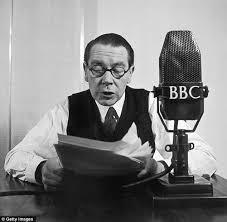

“I prithee, | Remember I have done thee worthy service; | Told thee no lies, made thee no mistakings, served | Without or grudge or grumblings…”
— The Tempest I ii
remained loyal to the truth, even when they stretched it a little to spare the feelings of their employees.