

What do you think?
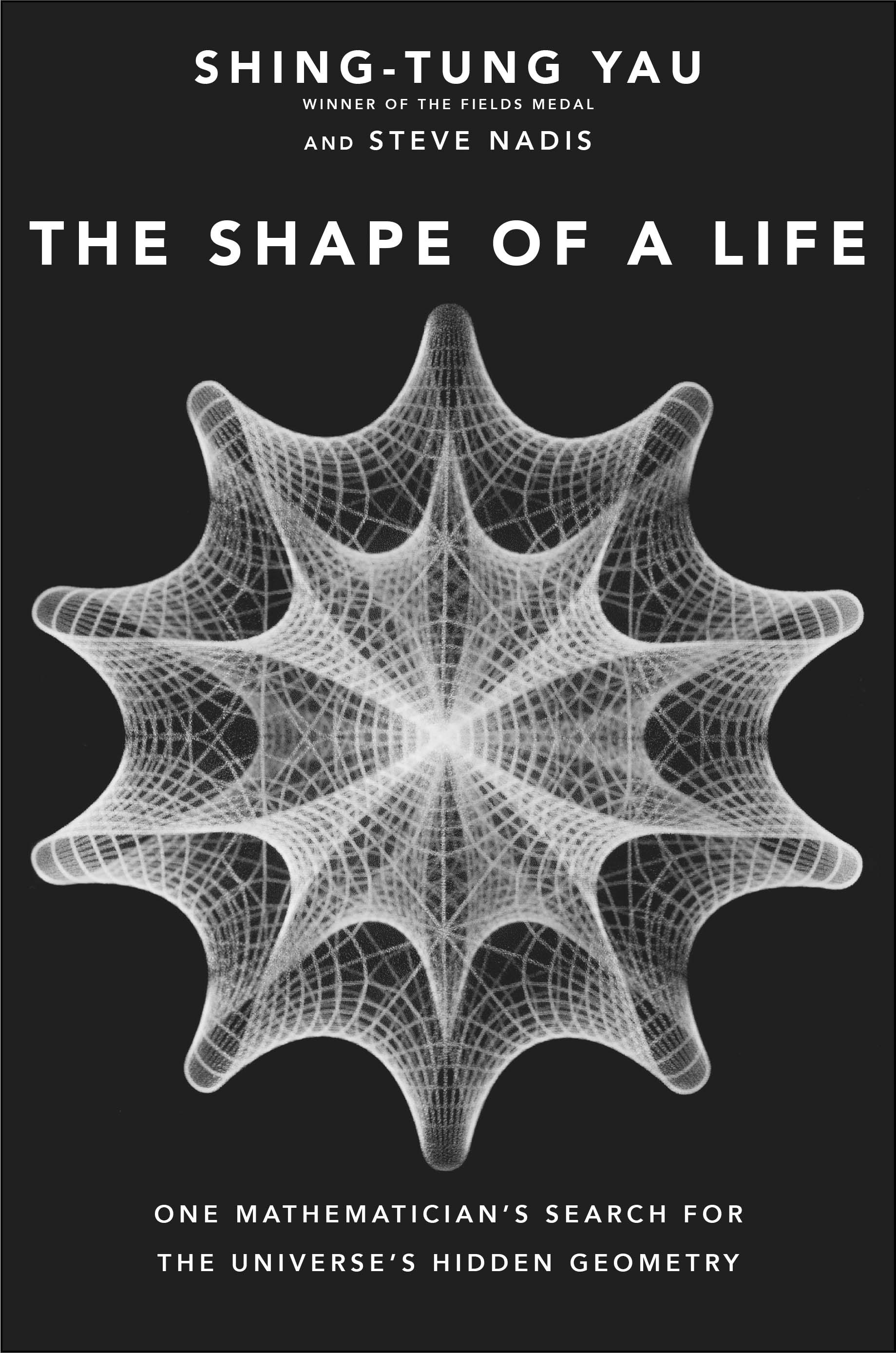
Shape of a Life: One Mathematician's Search for the Universe's Hidden Geometry
A Fields medalist recounts his lifelong transnational effort to uncover the geometric shape — the Calabi-Yau manifold — that may store the hidden dimensions of our universe.
“An unexpectedly intimate look into a highly accomplished man, his colleagues and friends, the development of a new field of geometric analysis, and a glimpse into a truly uncommon mind.”—Nina MacLaughlin, Boston Globe
“Engaging, eminently readable . . . For those with a taste for elegant and largely jargon-free explanations of mathematics, The Shape of a Life promises hours of rewarding reading.”—Judith Goodstein, American Scientist
Harvard geometer and Fields medalist Shing-Tung Yau has provided a mathematical foundation for string theory, offered new insights into black holes, and mathematically demonstrated the stability of our universe. In this autobiography, Yau reflects on his improbable journey to becoming one of the world’s most distinguished mathematicians. Beginning with an impoverished childhood in China and Hong Kong, Yau takes readers through his doctoral studies at Berkeley during the height of the Vietnam War protests, his Fields Medal–winning proof of the Calabi conjecture, his return to China, and his pioneering work in geometric analysis. This new branch of geometry, which Yau built up with his friends and colleagues, has paved the way for solutions to several important and previously intransigent problems.
With complicated ideas explained for a broad audience, this book offers readers not only insights into the life of an eminent mathematician, but also an accessible way to understand advanced and highly abstract concepts in mathematics and theoretical physics.
“An unexpectedly intimate look into a highly accomplished man, his colleagues and friends, the development of a new field of geometric analysis, and a glimpse into a truly uncommon mind.”—Nina MacLaughlin, Boston Globe
“Engaging, eminently readable . . . For those with a taste for elegant and largely jargon-free explanations of mathematics, The Shape of a Life promises hours of rewarding reading.”—Judith Goodstein, American Scientist
Harvard geometer and Fields medalist Shing-Tung Yau has provided a mathematical foundation for string theory, offered new insights into black holes, and mathematically demonstrated the stability of our universe. In this autobiography, Yau reflects on his improbable journey to becoming one of the world’s most distinguished mathematicians. Beginning with an impoverished childhood in China and Hong Kong, Yau takes readers through his doctoral studies at Berkeley during the height of the Vietnam War protests, his Fields Medal–winning proof of the Calabi conjecture, his return to China, and his pioneering work in geometric analysis. This new branch of geometry, which Yau built up with his friends and colleagues, has paved the way for solutions to several important and previously intransigent problems.
With complicated ideas explained for a broad audience, this book offers readers not only insights into the life of an eminent mathematician, but also an accessible way to understand advanced and highly abstract concepts in mathematics and theoretical physics.
327 pages, Hardcover
Published February 1, 2019
Ratings & Reviews
Friends & Following
Create a free account to discover what your friends think of this book!
Community Reviews
Displaying 1 - 30 of 34 reviews
July 26, 2021
Wonderful book. I heard about it in Prasad Kothari's lecture on Ramanujan Machine (Where he gave example about AI for Math as CNNs for analyzing Calabi Yau further - volume minimum of Sasaki-Einstein base manifolds and explained importance of Dr Yau's math work). Yau is such a great mathematician. Loved the biography.

February 19, 2026
‘“ROSE IS A ROSE IS A ROSE,” Gertrude Stein famously stated in a 1913 poem. But can the same be said about a sphere? If you take, for instance, a slightly deflated soccer ball and push it at one end, pull it at another end, step on it, jump on it, twist it, pummel it, and do everything else imaginable save for poking a hole in it or ripping it apart, will this ball remain a sphere insofar as the dictates of topology are concerned?’
‘Wanderlust may be my destiny, as well as an engrained part of my heritage, as my family and I are of Hakka extract—an ethnic group thought to have originated in the Yellow River Valley of northern China, moving south during a series of forced migrations over the past one thousand years or so and gradually spreading out from there. Sun Yat-Sen, the first president of the Republic of China—of Hakka descent, as was Lee Kuan Yew, the first prime minister—of Singapore.’
‘However, when Hakka people did settle in one place for a while, they were often consigned to the poorest farmland available, up in the highlands rather than in the fertile valleys below, which had been claimed long before. Up in the dryer, nutrient-deficient soil, farmers were unable to grow China’s main crops, rice and wheat, on a successful, large-scale basis and often had to try to cultivate maize and sweet potatoes instead, until even those secondary crops failed. The marginal quality of the land they inhabited might have made the parting easier when the Hakkas were forced to move, once again, because of invasions and other exigencies.’
‘I see some parallels in my own experience. I’ve been through a number of moves myself, both as a child, when circumstances compelled my family to change venues, and as an adult, where occasional geographic shifts are the norm in academia. I was born in the southern Chinese town of Swatow, now more commonly known as Shantou—.’
‘Does this mean the situation is hopeless? I don’t think so, or otherwise I would not be spending so much time running a half dozen mathematics centres in mainland China, Hong Kong, and Taiwan, nor would I devote myself to other math and science causes there. Because in the end I believe change will come and that it cannot be held back. In a word, I’m betting on youth. To me, it seems inevitable, as well as natural, that young leaders in math and science, who bring fresh perspectives to their fields, will emerge and gradually gain influence, in time having a transformative effect—.’
‘—our goals in mathematics were supposed to be—to seek, and hopefully find, the truth and beauty hidden within our chosen discipline—a lesson my father had impressed upon me, both implicitly and explicitly, throughout my childhood. The interaction with Chern reminded me of a classic Chinese essay my father asked me to memorise when I was around ten years old. The “Five-Willow Gentleman” was so named because he lived in an unfurnished shack—which offered scant shelter from the sun, wind, and rain—surrounded by five willow trees. Clad in rags and surviving on the most modest of resources, he was still content. He enjoyed reading so much that he often forgot to stop for meals. He cared not about his personal gains and losses, deriving satisfaction instead from writing down his thoughts and aspirations. The Five-Willow Gentleman was sustained by an intrinsic joy of study, not by the pursuit of fame or money, as Chern had put it. I realised at that moment that, even though Chern and I did not always share the same values, I could still learn a lot from him. But I would have to keep his advice—as well as the advice given by anyone else—in perspective. I believe that he always had my best interests at heart. Ultimately, though, I would need to follow the dictates of my own heart.’
‘Another thing I appreciate about traditional Chinese philosophy is that we, as people, tend to see ourselves as being part of nature, which implies that it is not in our interest to try to conquer nature—In these modern times, the Chinese don’t always adhere to this view—though it is, at least, a long-held tenet within the culture. The best course, to me, seems to lie in a mixture of these two perspectives: We can try to understand nature, which is a valuable pursuit in its own right, while at the same time trying to go along with it—to coexist and be part of the “oneness” that’s sometimes referred to as the Tao.’
‘So where does this leave me? Despite my passion for China, and the deep-seated drive I feel to help further its progress, the fact remains that I spend most days of a typical year in the United States, to which I don’t have nearly as strong an emotional attachment. Yet that’s where my children were born and raised; that’s where our family home is; and that’s where my full-time job lies. Which leaves me, as I said, in the rather peculiar place of never feeling completely at home in either America or China. My true home seems to lie somewhere in between (perhaps somewhere around the International Date Line that zigzags through the middle of the Pacific Ocean). The one thing that has made it easiest for me to move, unencumbered, between these two countries and cultures—and, indeed, anywhere else in the world—has been mathematics itself, which has long served as my true passport.’
‘It’s been an eventful journey so far—or at least eventful for me—though I hope others have found something of interest in this rambling account of a poor boy from Shantou who stumbled upon a quest for some deep truths of nature and has maybe been lucky enough to catch a few glimmers of insight along the way.’

dnf-shelf
February 19, 2019DNF @ 45%
I downloaded this book on NetGalley cause I thought it would be an interesting peek into the life of a mathematician, a scientist - a life I can't really imagine, in my typical day job. While I can say that yes, it was that, in a way, I also have to say that I don't know if a non-mathematician can enjoy it all that much.
The autobiography is told very directly and uniformly - as if a person was actually just telling you what happened in their life, year by year. That's not all bad, of course, but it doesn't quite keep you turning the pages. It didn't bother me that much, but it might bother some people. It's certainly not the same as reading a memoir by a writer or an artist, and I am still debating whether I DNFed because of that, or because it spiralled into talk about mathematical theories that are way beyond me (yes, it's definitely me! Not just the book! I'm not quite the right audience, I guess. But the right audience might be... very small?)
However, there were parts that I enjoyed, particularly at the start of the book - the start of author's life, him growing up very poor in rural China and Hong Kong were very interesting, and the story of how he made it was interesting too - but all the meetings with the mathematicians or the actual math being discussed was not for me. I would have enjoyed concepts being talked about, but it was much too gritty for me. I imagine that the people who will read this will have a much deeper interest in math than I do though, so it might go down much better if that's the case.
I thank the publisher for giving me a free copy through NetGalley in exchange to my honest review. This did not affect my opinion.
More Review on the Blog | Themed Bookstagram | Quick Update Bookstagram | Bookish Twitter
I downloaded this book on NetGalley cause I thought it would be an interesting peek into the life of a mathematician, a scientist - a life I can't really imagine, in my typical day job. While I can say that yes, it was that, in a way, I also have to say that I don't know if a non-mathematician can enjoy it all that much.
The autobiography is told very directly and uniformly - as if a person was actually just telling you what happened in their life, year by year. That's not all bad, of course, but it doesn't quite keep you turning the pages. It didn't bother me that much, but it might bother some people. It's certainly not the same as reading a memoir by a writer or an artist, and I am still debating whether I DNFed because of that, or because it spiralled into talk about mathematical theories that are way beyond me (yes, it's definitely me! Not just the book! I'm not quite the right audience, I guess. But the right audience might be... very small?)
However, there were parts that I enjoyed, particularly at the start of the book - the start of author's life, him growing up very poor in rural China and Hong Kong were very interesting, and the story of how he made it was interesting too - but all the meetings with the mathematicians or the actual math being discussed was not for me. I would have enjoyed concepts being talked about, but it was much too gritty for me. I imagine that the people who will read this will have a much deeper interest in math than I do though, so it might go down much better if that's the case.
I thank the publisher for giving me a free copy through NetGalley in exchange to my honest review. This did not affect my opinion.
More Review on the Blog | Themed Bookstagram | Quick Update Bookstagram | Bookish Twitter

September 11, 2022
No lifetime is as straightforward as we might think. Listening to Shing-Tung Yau's path to becoming a mathematician made me think about how sometimes randomness rules our world. Sometimes we forget how easily something else might have happened, and we would be on a different path. Yet, despite all that worked against Shing-Tung Yau, he became a mathematician and field medalist. But I think it is not all because of some random chance. It's the dedication and hard work he was willing to put into his passion. He wasn't in it for the money or fame. Instead, he was interested in the problems riddled with his first textbooks. It would be so easy to dismiss one's life by either statement: work or chance.
The book is written in a direct manner. It moves from childhood to his career as a mathematician and what he has seen and experienced. It speaks directly about being between two cultures, having a Chinese origin, and living in America, not being part of one or the other truly. I enjoyed parts handling those issues the most, finding them revealing. But I have to say the book is not written in the most elegant way. It is not as passionate as it could be. But I wouldn't hold that against it. Such things are often overrated. Altogether an interesting book to read. The world of academics can be bonkers.
Thank you for reading, and have a great day <3
The book is written in a direct manner. It moves from childhood to his career as a mathematician and what he has seen and experienced. It speaks directly about being between two cultures, having a Chinese origin, and living in America, not being part of one or the other truly. I enjoyed parts handling those issues the most, finding them revealing. But I have to say the book is not written in the most elegant way. It is not as passionate as it could be. But I wouldn't hold that against it. Such things are often overrated. Altogether an interesting book to read. The world of academics can be bonkers.
Thank you for reading, and have a great day <3
January 6, 2021
Inspirational story about a Chinese boy who grew up to be a renowned mathematician and Harvard professor. As a biography, I really enjoyed it. The mathematical anecdotes and insight into the research process and relationship building were also very nice to read. My favorite part is the discussion of Perlman and the Poincare Conjecture. I highly recommend this to mathematicians who want something to talk about with colleagues.
February 4, 2019
I don't usually read biographies, let alone biographies of mathematicians. But this particular book caught my attention with its description and it's similar timeline to when my father-in-law got his PhD in Math (his PhD adviser is in fact one of the names mentioned) so, on a whim, I decided I would read it.
I am so glad I spent some time with this book. There were layers and layers of interesting stories and learnings for me. Even though there is a lot of math in the book, much of which I didn't understand, I still deeply enjoyed reading Yau's journey. I had never heard of this mathematician before and now I feel like I have had a window into math, or a type of math, at a certain time in history. Of course, this is all written from one person's perspective, with one person's biases but it was still interesting.
I loved this because I think it encourages hard work and discourages the belief that we are born "geniuses" at math.
Yau's childhood and youth are a heart-wrenching read and very eye opening to me. It was incredible to see his success despite all of the hardships he (and his family) had to endure.
There were so many opportunistic coincidences in Yau's early life that culminated in his ability to end up in the United States (and his ability to study math vigorously) and it made me realize that we all have a lot of random coincidences in our lives and what might look like a disaster (not getting into the any schools for example) might turn out to be the thing that sets the course of your life positively (as it did for Yang.) and also that a single person can completely change the course of someone's life. There are many who played a major role in getting Yau to where he could really thrive. Like Salaff who worked extraordinarily hard to get him into Berkeley.
It was quite depressing to me how incredibly political academia is. I knew this of course but as someone who has spent all her life in corporate America, with a brief stint in non profit land, it was depressing to see how academia can put all of the greed and political shenanigans to shame. All that bickering and blocking each other's paths. What a waste of incredible mental talent. (I know there's a lot of cooperation, too, which is also clear in the book.)
This was a really enjoyable read for me, despite (or maybe because of) being very different than my usual fare.
gratitudes to netgalley and the publisher for an early copy in exchange for an honest review.
I am so glad I spent some time with this book. There were layers and layers of interesting stories and learnings for me. Even though there is a lot of math in the book, much of which I didn't understand, I still deeply enjoyed reading Yau's journey. I had never heard of this mathematician before and now I feel like I have had a window into math, or a type of math, at a certain time in history. Of course, this is all written from one person's perspective, with one person's biases but it was still interesting.
In my experience, solving hard math problems takes hard work, and there's no way around it, unless the problem is rather trivial.
I loved this because I think it encourages hard work and discourages the belief that we are born "geniuses" at math.
Yau's childhood and youth are a heart-wrenching read and very eye opening to me. It was incredible to see his success despite all of the hardships he (and his family) had to endure.
There were so many opportunistic coincidences in Yau's early life that culminated in his ability to end up in the United States (and his ability to study math vigorously) and it made me realize that we all have a lot of random coincidences in our lives and what might look like a disaster (not getting into the any schools for example) might turn out to be the thing that sets the course of your life positively (as it did for Yang.) and also that a single person can completely change the course of someone's life. There are many who played a major role in getting Yau to where he could really thrive. Like Salaff who worked extraordinarily hard to get him into Berkeley.
"I have spent a whole day without eating and a whole night without sleeping in order to think, but it was of no use, I got nothing out of it. Thinking cannot compare with studying."
It was quite depressing to me how incredibly political academia is. I knew this of course but as someone who has spent all her life in corporate America, with a brief stint in non profit land, it was depressing to see how academia can put all of the greed and political shenanigans to shame. All that bickering and blocking each other's paths. What a waste of incredible mental talent. (I know there's a lot of cooperation, too, which is also clear in the book.)
This was a really enjoyable read for me, despite (or maybe because of) being very different than my usual fare.
gratitudes to netgalley and the publisher for an early copy in exchange for an honest review.
March 31, 2019
The earlier work by this brilliant mathematician, "The Shape of Inner Space," remains my favorite volume on the mathematics undergirding much of string theory. Quite simply, the achievements of Shing-Tung Yau are incredible: Harvard Professor, National Medal of Sciences, and the Fields Medal to name a few. Knowing him mainly from his contributions to the world of physics as the "Yau" in the Calabi-Yau manifold and the "Y" in the SYZ conjecture, it was particularly enjoyable to have a volume detailing his background in pure mathematics.
This volume is his memoir and along the way provides great insight as to his own immigrant experience, his lasting connection to his native China and his affinity for his adopted home in the US (on both coasts), the politics of working in academia, his famous collaborations in the worlds of mathematics and physics, and his contributions to the teaching of advanced mathematics in his native China.
It is certainly true that the delivery here is not the most poetic however the information relayed is so interesting that it more than makes up for the dry formatting. Also, you definitely need to have an interest in this area already for this memoir to hold your attention, thankfully, it certainly did for me. I would highly recommend both of this brilliant man's popular books to you as they offer very graspable avenues into some of the most difficult concepts underlying the current workings of theoretical physics and mathematics.
This volume is his memoir and along the way provides great insight as to his own immigrant experience, his lasting connection to his native China and his affinity for his adopted home in the US (on both coasts), the politics of working in academia, his famous collaborations in the worlds of mathematics and physics, and his contributions to the teaching of advanced mathematics in his native China.
It is certainly true that the delivery here is not the most poetic however the information relayed is so interesting that it more than makes up for the dry formatting. Also, you definitely need to have an interest in this area already for this memoir to hold your attention, thankfully, it certainly did for me. I would highly recommend both of this brilliant man's popular books to you as they offer very graspable avenues into some of the most difficult concepts underlying the current workings of theoretical physics and mathematics.

May 10, 2024
This book was a disappointment in virtually every way possible.
I started the book thinking it was the Shape of Life, i.e., the science and physics of life, but it is instead the story of a mathematicians life. Not nearly as exciting but still intriguing. I was really hoping to see some mathematical insights. That is definitely why I stuck with the book. The personal story was very lacking (in style and story telling). Sadly, it fails to deliver intellectually and personally. We could leave it at that and call it a day, but I have so much more to say.
I had a bad taste in my mouth early in the book, as Yau presents his life in this capitalistic "work hard if you want to succeed" mindset. Coming from a poor family, there is a lot of room to discuss the intersection between skill, discipline, and privilege. He makes a passing statement of how much easier it is when you are wealthy, but that simply isn't a conversation he is interested in having. Instead, he presents himself as the model poor person. It didn't completely turn me off to the book, but it was indicative of a more fundamental aspect of Yau's personality that I can't help but detest.
On a personal level, Yau presents this faux humbleness that is about as believable as 1+1 = 3. He constantly says things like, "I don't think I was that special, but they did give me this ultra prestigious award and say that I am the best that ever was." It comes across egotistical and elitist. That is further reinforced by the way he describes his professional relationships.
There is a recurring theme of Yau getting into some disagreement or fight, and Yau acts like he has no clue why these people are being so crazy. Its notable for the subtle shifting of blame and often simultaneously demeaning tone of the person being discussed. Its one thing if this is a single event in his story, but it is over and over. Its concerning for two big reasons: 1) why is he always getting caught in drama if he is so fucking innocent, and 2) why the hell are these petty grievances even in his biography? Never before have I seen an academic or scientist be so pathetic in how they choose to frame their life and work.
In many ways, Yau reflects the worst parts of academia, and how people in power have this over inflated idea of themselves and see themselves as unable to do anything wrong. He mentions a beef with a post doc of his--a position where he has all the power--and every bit of that brief discussion sets the post doc up as stupid. He even uses his grad students as an example of how pathetic the post doc is, which is itself reflective of how he sees grad students (as an especially low metric by which to subtly demonstrate his post docs short comings). He only has petty things to say about this post doc and claims the post doc blames him for their issues. Everything about how Yau discusses this subject (including the fact that he discusses it at all) just puts off so many red flags for the worst kind of academic.
Despite all my misgivings about this book, it could have at least had something interesting to say in regards to his life or his work. In terms of personal life, his family comes across as ornaments on a tree. His dying brother gets a sentence or two to acknowledge his connection. His wife gets one when the start dating and another when they get married. Each kid gets about one sentence when they are born. Then they are all out of the picture as soon as they enter. Yau provides words to indicate personal connections, but it is the definition of showing not telling. What's more, the structure of this book makes it abundantly clear what matters to him.
He is not much better about communicating his science, even if it is a larger part of the story. Every topic could just be a list of manuscript titles and author lists. Every research problem is just another boys club of academic names he worked with, naturally fitting in some petty drama here or there (not even compelling drama). Then we move on to the next. It fails at both communicating the point of his work but also at weaving it into a coherent narrative. This isn't the first science memoir to be written. There is a common structure he could have followed. I don't understand why he didn't weave the math into a larger story that more effectively communicated the point of each of his works, and in parallel giving equal time to his personal life, identifying overarching themes between it and his research.
Overall, this book fails in every way possible. Personally, academically, structurally. This book just isn't good, and I certainly won't be reading more by Yau.
I started the book thinking it was the Shape of Life, i.e., the science and physics of life, but it is instead the story of a mathematicians life. Not nearly as exciting but still intriguing. I was really hoping to see some mathematical insights. That is definitely why I stuck with the book. The personal story was very lacking (in style and story telling). Sadly, it fails to deliver intellectually and personally. We could leave it at that and call it a day, but I have so much more to say.
I had a bad taste in my mouth early in the book, as Yau presents his life in this capitalistic "work hard if you want to succeed" mindset. Coming from a poor family, there is a lot of room to discuss the intersection between skill, discipline, and privilege. He makes a passing statement of how much easier it is when you are wealthy, but that simply isn't a conversation he is interested in having. Instead, he presents himself as the model poor person. It didn't completely turn me off to the book, but it was indicative of a more fundamental aspect of Yau's personality that I can't help but detest.
On a personal level, Yau presents this faux humbleness that is about as believable as 1+1 = 3. He constantly says things like, "I don't think I was that special, but they did give me this ultra prestigious award and say that I am the best that ever was." It comes across egotistical and elitist. That is further reinforced by the way he describes his professional relationships.
There is a recurring theme of Yau getting into some disagreement or fight, and Yau acts like he has no clue why these people are being so crazy. Its notable for the subtle shifting of blame and often simultaneously demeaning tone of the person being discussed. Its one thing if this is a single event in his story, but it is over and over. Its concerning for two big reasons: 1) why is he always getting caught in drama if he is so fucking innocent, and 2) why the hell are these petty grievances even in his biography? Never before have I seen an academic or scientist be so pathetic in how they choose to frame their life and work.
In many ways, Yau reflects the worst parts of academia, and how people in power have this over inflated idea of themselves and see themselves as unable to do anything wrong. He mentions a beef with a post doc of his--a position where he has all the power--and every bit of that brief discussion sets the post doc up as stupid. He even uses his grad students as an example of how pathetic the post doc is, which is itself reflective of how he sees grad students (as an especially low metric by which to subtly demonstrate his post docs short comings). He only has petty things to say about this post doc and claims the post doc blames him for their issues. Everything about how Yau discusses this subject (including the fact that he discusses it at all) just puts off so many red flags for the worst kind of academic.
Despite all my misgivings about this book, it could have at least had something interesting to say in regards to his life or his work. In terms of personal life, his family comes across as ornaments on a tree. His dying brother gets a sentence or two to acknowledge his connection. His wife gets one when the start dating and another when they get married. Each kid gets about one sentence when they are born. Then they are all out of the picture as soon as they enter. Yau provides words to indicate personal connections, but it is the definition of showing not telling. What's more, the structure of this book makes it abundantly clear what matters to him.
He is not much better about communicating his science, even if it is a larger part of the story. Every topic could just be a list of manuscript titles and author lists. Every research problem is just another boys club of academic names he worked with, naturally fitting in some petty drama here or there (not even compelling drama). Then we move on to the next. It fails at both communicating the point of his work but also at weaving it into a coherent narrative. This isn't the first science memoir to be written. There is a common structure he could have followed. I don't understand why he didn't weave the math into a larger story that more effectively communicated the point of each of his works, and in parallel giving equal time to his personal life, identifying overarching themes between it and his research.
Overall, this book fails in every way possible. Personally, academically, structurally. This book just isn't good, and I certainly won't be reading more by Yau.
March 3, 2024
I really liked the very simplified math commentary. After reading, I have no idea what things like Calabi-Yau manifolds are, but I get a sense of why they are important and learn about some (very) high-level approaches and problems found on the way to solving a problem. I felt happy that I was following a section, then the author defines what an inequality is and I realize he's not trying to lose anyone at all with his exposition. This hurt my pride a little.
Author is very opinionated. His opinions are sometimes insightful and fun to read about, for example his thoughts on:
- Opportunity/luck
- Youth/Old age
- Family
- Pursuit of mathematics for its own sake
- Chinese academics
But he also drags on about less interesting things, like his opinions on other mathematicians and his view of feuds/arguments that he's been involved in. He spends a lot of words setting the record "straight" about things, where he usually portrays another party as irrationally angry about something rational he did. A short list of things other people "overrreacted" to:
- not liking nepotism
- embracing new ideas (or ideas from other fields)
- alleged plagiarism by his graduate student
- not taking part in feuds
These are usually not so insightful and the author knows it; he makes those who disagree with him out to be sort of insane.
I really wish he spent more time on his early career and life. I want to know about how he learned so much and did all this crazy stuff at the start of his career. It feels like the rest of the book is his victory lap.
Author is very opinionated. His opinions are sometimes insightful and fun to read about, for example his thoughts on:
- Opportunity/luck
- Youth/Old age
- Family
- Pursuit of mathematics for its own sake
- Chinese academics
But he also drags on about less interesting things, like his opinions on other mathematicians and his view of feuds/arguments that he's been involved in. He spends a lot of words setting the record "straight" about things, where he usually portrays another party as irrationally angry about something rational he did. A short list of things other people "overrreacted" to:
- not liking nepotism
- embracing new ideas (or ideas from other fields)
- alleged plagiarism by his graduate student
- not taking part in feuds
These are usually not so insightful and the author knows it; he makes those who disagree with him out to be sort of insane.
I really wish he spent more time on his early career and life. I want to know about how he learned so much and did all this crazy stuff at the start of his career. It feels like the rest of the book is his victory lap.
May 25, 2023
This book demystified figures of unfathomable intelligence, and reminded me of what I love most about humanity: our shared love of the beauty of the world around us, and our relentless search for absolute truth.

October 11, 2019
You know, I enjoyed the first half, and the math tales... but Yau had to spend a bunch of time in the second half addressing various political conflicts that seem to have popped up in the math world. I get it... but it's not that exciting if you don't know the players.
As a new dad I was of course tearing up at the early sections about the devastatingly tough circumstances of Yau's childhood.
Quick read, fun for the historical details about string theory and geometric analysis.
As a new dad I was of course tearing up at the early sections about the devastatingly tough circumstances of Yau's childhood.
Quick read, fun for the historical details about string theory and geometric analysis.

April 5, 2021
It reveals the beauty of mathematics, and at the same time, reveals the ugly politics among mathematicians.

March 16, 2019
“I spent a whole day without eating and the whole night without sleeping in order to think, but it was of no use. I got nothing out of it. Thinking cannot compare with studying” - Confucius
Shing-Tung Yau along with Steve Nadis take us on a journey of a life in the pursuit of the universes hidden geometry. Their journey goes from China to Hong Kong and leads to San Francisco and Berkeley. Who knew looking for a topic for your dissertation at Berkeley would lead to a life long study in geometry. I found his realizations profound how Shing-Tung Yau made his decisions. This is a wonderful read for not just mathematician it goes beyond that it goes to the equation within all of us and the search we are all on to solve the Shape of Life. This wonderfully written book for a mathematician is a dream with the equations and answers with steps included allows others to understand the complex thinking of Shing-Tung Yau and Steve Nadis and why they found their conclusions are both profound and completely unique not that no one has not thought of them before but the way they found the conclusions was what made them so profound. The deeper meaning beyond the math makes this by far one of my most favorite books of all time.
Shing-Tung Yau along with Steve Nadis take us on a journey of a life in the pursuit of the universes hidden geometry. Their journey goes from China to Hong Kong and leads to San Francisco and Berkeley. Who knew looking for a topic for your dissertation at Berkeley would lead to a life long study in geometry. I found his realizations profound how Shing-Tung Yau made his decisions. This is a wonderful read for not just mathematician it goes beyond that it goes to the equation within all of us and the search we are all on to solve the Shape of Life. This wonderfully written book for a mathematician is a dream with the equations and answers with steps included allows others to understand the complex thinking of Shing-Tung Yau and Steve Nadis and why they found their conclusions are both profound and completely unique not that no one has not thought of them before but the way they found the conclusions was what made them so profound. The deeper meaning beyond the math makes this by far one of my most favorite books of all time.
April 10, 2019
A small and pleasant travel in time
From the moment I started reading the book, I could not leave it. I was touched by the way the authors, especially the main author, tell the story of this humble and poor Chinese boy who was not afraid to stand up for big challenges, starting with smaller ones and going up in complexity as he made progress. I could feel myself immersed in his life and many parts reminds me of my own life; I was not going through his life, but through mine, as I read chapter after chapter.
Life stories like this one is what the world need to keep inspiring us and the ones coming behind us. Telling the truth, the fears, the difficulties and how imperfect we can be in some cases help in destroying the myths around those who tend to surpass his/her peers. It makes us human, yet valuable, and make others realize they have the power to achieve and contribute, while it is normal to feel overloaded, lost or embarrassed.
My main lesson from this work is the search for good collaborators and friends that can be there for us when needed and viceversa. Despite few receive the prizes or the medals, we will always need of the "angels" working behind the scenes, supporting and pushing us outside of our comfort zone.
HIGHLY RECOMMENDED!
From the moment I started reading the book, I could not leave it. I was touched by the way the authors, especially the main author, tell the story of this humble and poor Chinese boy who was not afraid to stand up for big challenges, starting with smaller ones and going up in complexity as he made progress. I could feel myself immersed in his life and many parts reminds me of my own life; I was not going through his life, but through mine, as I read chapter after chapter.
Life stories like this one is what the world need to keep inspiring us and the ones coming behind us. Telling the truth, the fears, the difficulties and how imperfect we can be in some cases help in destroying the myths around those who tend to surpass his/her peers. It makes us human, yet valuable, and make others realize they have the power to achieve and contribute, while it is normal to feel overloaded, lost or embarrassed.
My main lesson from this work is the search for good collaborators and friends that can be there for us when needed and viceversa. Despite few receive the prizes or the medals, we will always need of the "angels" working behind the scenes, supporting and pushing us outside of our comfort zone.
HIGHLY RECOMMENDED!

April 9, 2023
3 stars, but +1 because I do like scientist memoirs.
Many interseting things (esp. his childhood).
Well written, but doesn't dwell much on explaining his work (all the major points do get a very brief layman introduction, but don't expect many colorful metaphors or longer exlications).
He comes off as a meritous, fair, level headed person.
It makes you wonder about the dozens of conflicts and controversies he touches upon with his students, peers, superiors, administrators, in US, in China etc.
In all cases, Yau is innocent of course.
Many interseting things (esp. his childhood).
Well written, but doesn't dwell much on explaining his work (all the major points do get a very brief layman introduction, but don't expect many colorful metaphors or longer exlications).
He comes off as a meritous, fair, level headed person.
It makes you wonder about the dozens of conflicts and controversies he touches upon with his students, peers, superiors, administrators, in US, in China etc.
In all cases, Yau is innocent of course.

August 3, 2024
Прочитал чуть больше половины и бросил.
В книге две линии - биографическая и математическая. Биографическая представляет собой просто набор фактов и событий без какого-либо развёрнутого описания и глубины персонажей. Про детство автора, переезд в США и начало учёбы в университете читать ещё интересно, но дальше просто нагромождение событий и действующих лиц. Поехал туда, поговорил с тем итд.
Математическая же линия довольно сложна. Единственный плюс - стало интересно почитать про топологию.
На самом деле, не очень понятно, для кого это книга. Точно не для меня.
В книге две линии - биографическая и математическая. Биографическая представляет собой просто набор фактов и событий без какого-либо развёрнутого описания и глубины персонажей. Про детство автора, переезд в США и начало учёбы в университете читать ещё интересно, но дальше просто нагромождение событий и действующих лиц. Поехал туда, поговорил с тем итд.
Математическая же линия довольно сложна. Единственный плюс - стало интересно почитать про топологию.
На самом деле, не очень понятно, для кого это книга. Точно не для меня.
April 15, 2019
A very interesting read. At once a simply written biography and complicated intellectual exercise if one is not familiar with the deeper intricacies of mathematics and geometry. Luckily, I am one who believes that high-fallutin' knowledge beyond one's normal ken can be absorbed into the consciousness by a sort of osmosis haha. An interesting tale of cross cultural experience combined with a literal reaching for the stars, something we might all aspire to. Five stars.
September 6, 2025
what is this book about ( ? )
There are no photos or drawings of ‘nature’ that represent any of The mathematical ideas that are presented in The form of lots of text & some simple crude drawings ( ? )
There’s also a lot of name dropping & snapshots of lots of people, all clumped into one chapter, with very little explanation of what you’re looking at ( ? )
Very confusing ( ? )
There are no photos or drawings of ‘nature’ that represent any of The mathematical ideas that are presented in The form of lots of text & some simple crude drawings ( ? )
There’s also a lot of name dropping & snapshots of lots of people, all clumped into one chapter, with very little explanation of what you’re looking at ( ? )
Very confusing ( ? )
January 27, 2019
I thought this was a great book. I was a bit concerned at the beginning that it was going to be a book hyping string theory, but the book is much more than that. It covers the whole life of this mathematician, and I find his story to be fascinating. It gives a wonderful look into how mathematics has shaped his life. I recommend the book to anyone who enjoys the history of mathematics.

July 24, 2020
A wonderful, inspiring story. I found it hard to put down.
Observing his rise from poverty to the peak of his chosen field, one marvels at how this unique individual used his innate gifts to their fullest but also how friends and colleagues supported him.
A nice read, even for non-Mathematicians.
Observing his rise from poverty to the peak of his chosen field, one marvels at how this unique individual used his innate gifts to their fullest but also how friends and colleagues supported him.
A nice read, even for non-Mathematicians.
September 25, 2021
not enough math, too much interpersonal drama and underhanded complaining about other people and the chinese academic system. the parts with math and Yau's life up through professorship are very nice, and there's some good life/philosophical wisdom thrown in as well. I expected a biography/memoir but jt's more general than that.
June 11, 2023
This book reminds me why I do not like autobiographies.
Well, the background information of his incredibly deprived childhood is fascinating, as is story of travelling to America, what carries on from that point seems to be a lot of personal drama and controversy, which had me rolling my eyes and skipping forward.
Well, the background information of his incredibly deprived childhood is fascinating, as is story of travelling to America, what carries on from that point seems to be a lot of personal drama and controversy, which had me rolling my eyes and skipping forward.
June 19, 2024
This is a great book if you're doing research related to Shing-Tung Yau's work. I got about 60% of the way through before the math stuff stopped making sense to me and the story of where he was going and what he was doing became more about what he was publishing. But, I think if you know what he's talking about in the later chapers, it's a good book.
May 15, 2025
Would not recommend. Initial quarter of the book is interesting as it relates the author's struggles growing up in mid-century rural Hong Kong working to find his way into a future career in math. The remainder of the book consists largely of the author discussing internal politics between mathematicians and trying to settle scores with those he has disagreed with over the years.
May 2, 2019
Sociology of science
A colorful autobiography with rich details of figures and events. An insightful view of the West vs. the East. Don’t expect to learn much about “the Universe’s Hidden Geometry”.
A colorful autobiography with rich details of figures and events. An insightful view of the West vs. the East. Don’t expect to learn much about “the Universe’s Hidden Geometry”.
June 21, 2025
High math and human foibles
Interesting exploration in laymen terms of complex math concepts. The author is as complex as the math. There are so many stories smoking with conflicts in his life that you come away thinking he must be part of the fire.
Interesting exploration in laymen terms of complex math concepts. The author is as complex as the math. There are so many stories smoking with conflicts in his life that you come away thinking he must be part of the fire.
May 17, 2019
Incredible book about an incredible mathematician!

November 11, 2020
Прокрастинация - великая вещь. Жаль, от неё страдают лабы.
Книга читается на одном дыхании. На одном дыхании прокрастинации.
Книга читается на одном дыхании. На одном дыхании прокрастинации.

Read
November 30, 2021DNF - could have used a lot of editing. Probably very difficult to translate the work of a mathematician to a written work, but the autobiographical info was a little tedious at times and gave up.
August 9, 2022
Есть смысл читать тем, кто мог стать академическим математиком, но не стал. Чтобы оставить все влажные мечты. В остальном бессмысленно
Displaying 1 - 30 of 34 reviews