Part historical fiction, part magical realism, and 100 percent adventure. Thirteen-year-old Mei reimagines the myths of Paul Bunyan as starring a Chinese heroine while she works in a Sierra Nevada logging camp in 1885.
Aware of the racial tumult in the years after the passage of the Chinese Exclusion Act, Mei tries to remain blissfully focused on her job, her close friendship with the camp foreman's daughter, and telling stories about Paul Bunyan--reinvented as Po Pan Yin (Auntie Po), an elderly Chinese matriarch.
Anchoring herself with stories of Auntie Po, Mei navigates the difficulty and politics of lumber camp work and her growing romantic feelings for her friend Bee. The Legend of Auntie Po is about who gets to own a myth, and about immigrant families and communities holding on to rituals and traditions while staking out their own place in America.
Shing Yin Khor is a cartoonist and installation artist exploring the American mythos and new human rituals. A Malaysian-Chinese immigrant, and an American citizen since 2011, they are the author of two published books.
‘I’m angry that I have to make my own gods. I’m angry that even the gods I make can’t help my family.’
If you are looking for a historical fiction graphic novel with a ton of heart, look no further than The Legend of Auntie Po, written and illustrated in gorgeous watercolor by Shing Yin Khor. Set in a Sierra Nevada logging camp in 1885 following the Chinese Exclusion Act, The Legend of Auntie Po follows Chinese immigrants Mei and her father as they navigate the difficult and often violent racial tensions in the United States while working in the camp’s kitchen. Written as a middle-grade graphic novel, this is still moving and enlightening through adulthood and the illustrations are simply magical. Shortlisted for the 2021 National Book Awards, this story of a young, queer woman caught in the racial politics struggles of American history is a beautiful coming-of-age story about the tradition, standing up for oneself, and the power of storytelling.
Mei has lived her entire life in the United States. Born in Reno, Nevada, she is constantly ‘othered’ for her Chinese heritage and denied access to most of American society, such as the ability to attend a University. She enjoys her life with her father, feeding the men at the logging camp and being with her friend Bee. Though recently Mei has begun to notice her affection for Bee may be more complex than friendship. Mei is not just an amazing cook, however, but is known for her storytelling. When violence against Chinese immigrants begins to flare up, Mei begins to see her own mythological story, a logging god named Auntie Poe, come to life and this helps keep her brave.
This is an important and often overlooked aspect of American history. During the California Gold Rush in the late 1940’s-early 1950’s, Chinese immigration jumped and they were welcomed as laborers on railroads and mining. When surface gold began to slow, animosity towards Chinese immigrants began to grow, with racist depictions in media turning the white public violent towards them. The largest mass lynching in US history occured in 1871 in Chinatown in L.A., when a mob of 500 people killed 19 Chinese immigrants. As violence grew, President Chester Arthur signed the 1882 Chinese Exclusion Act, blocking all Chinese immigration into the US (a 1875 ‘Page Act’ had previously banned all Chinese women) which only further stoked racial violence against Chinese workers.
The Legend of Auntie Po occurs during this time and also makes several mentions of how the Black families at the camp are also under threat of violence everywhere. While the white logging boss of the camp insists they are ‘all family,’ he is unable to protect Mei’s father from demands that the company cease any hiring of Chinese workers. Mei and her friend Bee, the daughter of the boss, find what poet Claudia Rankine calls their ‘historical selves’ putting them at odds, with Bee being unable to truly understand the struggles faced by Mei and her family.
This is a very moving story that reminds us how important storytelling is and how it functions as part of culture. Are Mei’s gods real or do they become a metaphorical expression of her people? Can stories be shared? These questions come together at the end of the story, which is both very sad yet ultimately heartwarming and bittersweet. The intended audience are younger readers and there is nothing that would be too much for them, but it still lands with full impact as an adult. What is truly beautiful are the ways Shing Yin Khor shows the power of storytelling to heal and process the world around you, with Mei using her stories as an outlet for her emotions at times.
The Legend of Auntie Po is an extraordinary graphic novel. The colors and art style are so delightful and the story gives voice to an often swept-under-the-rug part of US history. A must read.
Also you should follow Amanda because pretty much all my graphic novel recommendations come from her and she never misses. She knows the best books.
4.5/5
'If history failed us, fiction will have to restore us.'
I absolutely loved this graphic novel starring Mei, a queer Chinese teenage girl who works with her father in a Sierra Nevada logging camp in 1885. It's a pretty quiet book and initially feels more slice of life, but as it progresses a thoughtful story unfolds about anti-Asian racism, privilege, belonging, family, and what makes a true friendship. By the end I felt like Mei had a bright future ahead of her and I love to see that in queer historical fiction. <3 I would recommend this for middle school kids on up through adults.
I've been extremely curious in the story of The Legend of Auntie Po since I heard about it's release. The story is a look at a logging camp in Nevada in the late 1800s through the eyes of a queer Chinese-American girl by the name of Mei. Through her perspective readers learn more about the daily on-goings of a camp as well as some of the hardships and blatant racism faced by the Chinese loggers. CW: death on page, racism, physical violence (off page)
One of the unique aspects of this graphic novel is the introduction of the character Auntie Po. Not only was this Khor's way of introducing the idea of the "ownership" of legends, but also a great way to illustrate the crossroads of two different cultures that Mei is caught in between. Mei realizes that she doesn't quite uphold the traditions of her father and her ancestors before her, but she also realizes that she doesn't quite fit into the standards held by White Americans. Khor does a brilliant job exploring Mei's journey while also exploring the history of logging camps which were extremely dangerous and also heavily infiltrated with racism and discrimination.
I appreciated that Khor doesn't shy away from telling the harsh treatment that many Chinese immigrants faced during this specific time in history. Very close to the passing of the Chinese Exclusion Act, readers will see the subtle nods to this discriminatory behavior throughout text in the form of Mei not receiving pay for her work in the kitchen, the separation of eating spaces, the separation of lodging quarters, the attitudes of other loggers towards Mei's father, and more. There are even references to the difficulties and danger faced by Black workers and their families. Interestingly, Khor provides a note in the back of the text explaining why they did not include any Native American voices with the framework of the story. I highly recommend reading this note as it acknowledges the complex relationship that existed between Native Americans, African Americans, Chinese immigrants, and White people. It also notes that Khor did not believe that it was their place to tell that story.
This is definitely a work that should be required reading for classes. The graphic novel format will appeal to a wide variety of readers while also teaching them about a piece of history that many Americans don't learn about in secondary school. The artwork is gorgeous and fluid. It appears to be watercolor which I'm becoming more fond of as a medium. If you're interested in the conversation of shared culture, the cultural importance of storytelling, and a bit of history and fantasy woven in then I highly recommend checking out this work.
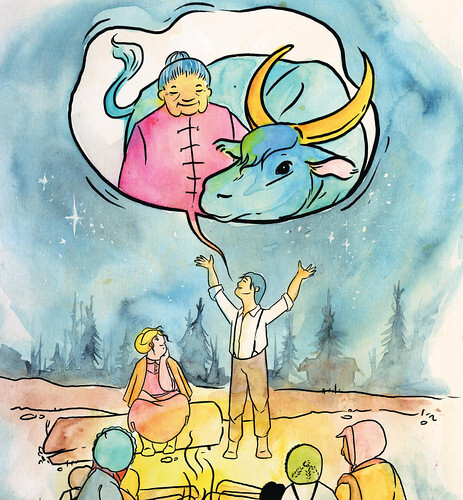
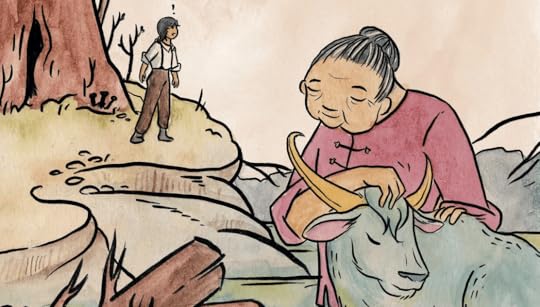
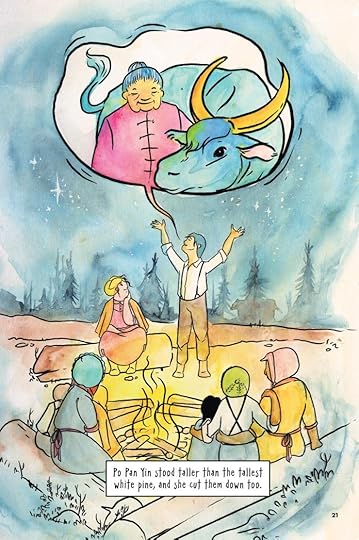
Thirteen-year-old Mei helps her father cooking for loggers in a Sierra Nevada logging camp in 1885. As she tries to come to terms with all the forces pressing on her identity (the Chinese Exclusion Act, her sexuality, her wish to go to college) she tells stories about Auntie Po (an older Chinese woman who is substituted for Paul Bunyan) and her blue giant blue ox Pei Pei. This is a wonderful story that is an example of transformative mythology; Mei takes the 'American' Paul Bunyan and turns him into a an elderly Chinese matriarch who substitutes for all of the feminine guidance she is lacking in her life. The art is wonderful.
This is a quiet, almost slice-of-life graphic novel about a 13-year-old queer Chinese American girl's life at a logging camp. Mei is the daughter of the camp cook, and she helps out in the kitchen and spends her free time spinning yarns for the other children in camp--especially about Po Pan Yin, or Auntie Po, a Chinese American matriarchal version of Paul Bunyan. She is best friends with (and obviously has a crush on) Bee, the foreman's daughter.
In the background, though, is the constant hum of anti-Asian racism. The Chinese workers eat separately from other workers. A sawmill that employed Chinese workers is burned down. Mei is keenly aware that she's losing something: she no longer prays, she doesn't know her grandparents, and her Cantonese is rusty. She is caught between traditions she feels disconnected with and an American culture that doesn't accept her.
Auntie Po is the bridge between them: a blending of cultures and a way of adapting tradition to make it relevant.
If history failed us, fiction will have to restore us.
This was INCREDIBLE!
It's a snapshot of life in an 1885 logging camp in the Sierra Nevadas, with a queer Chinese girl as the protagonist as she learns to create her own stories and find her place in a world that doesn't allow her existence.
I loved this book. It does not shy away from the hardships of logging life, nor does it skip past the prejudice and racism faced by Chinese and Black workers. However, it also shows the family and friendship developed in logging camps, and the myths spun to reflect their experiences and lives. The artwork is superb, and Mei (and her father) are fantastic.
I grew up in a logging family, and I loved stories of Paul Bunyan and Babe the Blue Ox, and I adored stories of loggers, but I never saw stories that reflected the truth of logging corporations. I only saw stories that showed the white history of logging, instead of all of the people who worked in the forests and the camps...and those stories I read growing up certainly didn't reflect the colonialistic nature of deforestation. This book is one I wished I had growing up.
Hao Mei Lee is a Chinese American girl living in California in 1885 who is familiar with the realities of racism and discrimination. But she is also thirteen-years-old and likes to tell stories of magic and hope. Her favorite ones involve Po Pan Yin, or "Auntie Po," a giant Chinese lumberjack and her giant blue water buffalo, Pei Pei, inspired by the tall tales of Paul Bunyan and Babe the blue ox.
The script and art both have an uneven and unpolished quality. The story sort of weaves around, unable to find a good balance between the light bits and the heavy stuff like prejudice and death, between telling stories and living life, between being educational and entertaining. I appreciate the overall message, but never really felt the characters or their problems come alive in my imagination or that the happy ending fit with what came before.
Beautifully written, beautifully drawn, this comic tells the story of Mei, a Chinese-American girl who works as a cook in a logging camp in the Sierra Nevadas in the 1880s. Her and her father's skills in the kitchen are prized, but Chinese works are severely discriminated against. Mei focuses on her friendship with the camp foreman's daughter and a series of tall tales she weaves at campfires about Auntie Po, a giant Chinese matriarch with her blue ox. Auntie Po wields a mean ax and helps keep loggers safe on the mountains. But even Auntie Po might not be able to protect Mei from the harsh realities of the world. This book was just nominated for the National Book Award for Young People's Literature, and I will add to that my own high recommendation.
Ohhhh I loved this book! I grew up reading lots of the old folktales about Paul Bunyan and John Henry and the rest, and this is such a gorgeous story about a Chinese-American girl in an 1880s lumber camp, making up her own wonderful folk hero to keep herself and the others going. The mixture of magic and reality is just lovely, and all of the relationships are so nuanced and compelling. It also had the most beautiful father-daughter relationship I've seen depicted in any books for a long time (between the heroine and her deeply loving father). I read it all in one sitting because I couldn't stop, and at the end, I had a HUGE beaming smile on my face - and I let out one of those Good Book Sighs of such intense appreciation. Highly recommended for any age group from 10 to 100!
the story focuses on mei, a 13yo queer chinese-american girl’s life at a logging camp in 1885. mei helps out in the kitchen a lot; being the daughter of the camp cook. when theres time, she shares tales about auntie po - a chinese american matriarch with a blue ox - with people at camp. she eventually became best friends with the foreman’s daughter named bee whom she also has a crush on.
i particularly enjoyed reading this because of its exploration in friendships across racial/economic differences. the watercolour art is nice to look at too, cant help but to admire & appreciate!
i dont know if im expecting too much but as a reader who is not really knowledgeable about the historical event mentioned ((chinese exclusion act)), i just wish theres more information about its historical background - probably just a little sharing in the foreword/afterword. as for the queer content, its not really obvious but was mentioned in the author's note.
this is apparently under YA section and i am not too sure if this would appeal to alot of readers but definitely would make a great conversation starter as its a topic that not a lot of authors would tackle. overall, it was a decent read - looks like its gonna be a lengthy read but its actually pretty quick!
A sweet middle grade tale told through the eyes of a queer Chinese-American girl living in 1885.
"You... Believe me?" "If you believe, I believe."
I'm not entirely sure what I just read. There were some parts I liked and some parts I didn't. Let's dive right in, shall we?
The pace. Interesting. It was a good pace throughout, although when things happened, they just felt... random. Like there wasn't enough rising action building up to the conflict. It was just a little odd, and I really wish there had been more tension building up to the problem.
And then we have the plot itself: Also interesting...? If you read the back of the book, it promises a mythical Auntie Po, a god-like figure in our main character, Mei's eyes, and Mei navigating romantic feelings for her best friend Bee. So... The Auntie Po part of it I really liked. I liked her personality, I liked the story behind the myth, and her giant blue water buffalo Pei Pei. But everyone just sort of went around acting like a giant 10-foot-tall-god-like woman who chops trees is normal? If you can actually wrap your head around the idea of that being real and just be like "ok cool" in 24 hours I will be quite amazed.
And then we have the "navigating her feelings for Bee." Okay. I had big hopes for this: I wanted a sweet coming out I love you I'm gay scene. Did we get one? No. I had hoped for more of Mei's thoughts on being a queer Chinese-American girl in 1885. Did we get them? No. Did we get a confession of "I like you" from Mei to Bee? No. The only sign we had that Mei liked Bee was her blushing. Was that enough for me? No it was not. I just wish this story had built a little more on her feelings, and that there was an actual resolution for it- a sweet confession from Mei, or coming out scene, just anything more than a blush. I have to say I'm disappointed: I really hoped for more on that.
I really enjoyed the characters in this book: I was glad to see poc characters as well (being treated as equals too, yay) as the Chinese characters and the "lgbtq+ character". They were well written, I saw multiple layers, I only wish they had been more realistic when it came to Auntie Po's existence. There was a scene when somebody passed away, and for the most part, their grief felt realistic and genuine, but the scene itself felt random. As I had said before: there was not enough rising action leading up to the scene.
The art in this book was so cool! It was such a unique style that I've never seen before in graphic novels, and I just wanted to take a second to throw that out there!
So what did I like in this book? I like the relationship that Mei had with her family and friends. I thought it was just so sweet that no matter their skin colors, they were able to get along, and treat each other like friends, and even call themselves family. That just made my heart feel so happy and warm! 🥰 I did like Mei's relationship with Bee as well, even if the story didn't really build on her romantic feelings.
I believe that's all I have to say, so now the three questions...
Would I recommend this book? Eh. If you're hoping for the lgbtq+ element, I'd say it isn't really worth it, but it is a sweet tale if you're just hoping for a sweet comfy read- it definetly provides that.
If this was a movie, what would I rate it? PG. Death, sadness.
Will I read this author's other books? Probably not, but this was a cozy little read and I enjoyed it. ☺️
Recommended for ages 10 to 14, content notes for: Racism, giant insects, death, and a work accident.
What kinds of keywords came to mind reading this book? family, community, crushes, legend, stories, pie and fathers.
A short coming of age story set in a lumber camp I found the artwork pretty indearing. Although I am certainly partial to loose watercolor sketch sort of styles.
The writing felt a bit young, but that seems fair for a book aimed at 10 to 14 year olds. Khor does seek to explore a lot of pretty difficult topics and really pulls it off, in my personal opinion anyway.
The queerness was perhaps a bit too lightly applied, and possible to miss if you don't read the summary.
Race was obviously a focus of the story and I really enjoyed the melding of history with folk tale in a way that felt really organic and like how culture really happens. In their author's note at the end Khor does acknowledge the omission of Indigenous people. They don't really explain why they did not include them but do demonstrate a pretty fulsome understanding of the implications of logging, the displacement and theft of land, and how all different kinds of people are in some ways complicit in the forceful colonization of the land. Might have worked better as an introduction but such is life.
Class was certainly highlighted more then I generally expect, particularly in a middle grade comic. Both race and class work together to limit many of our characters in different ways. That felt realistic and often glossed over.
And finally, I may have forgotten something but I don't think that disability came up at all.
Overall I enjoyed this book, would generally recommend it and will be rating it four out of five stars.
This was not at all what I expected, but I loved it so much! What a beautiful way to show the power of our stories and folktales - how they can be so real for us and impact us on a deeper level. Yet this story also showcases the painful truth of our racist history and how it impacted so many. I especially appreciated words from the Author’s Note in the back matter: “…I feel that we have the obligation to return ourselves to the narrative. If history failed us, fiction will have to restore us.” This was a Cybils finalist and I'm so glad I was able to get my hands on a copy so quickly!
This is a very moving graphic novel of a Chinese American family living in logging camp in the American West. Two young women struggle in the 19th Century with ethnic tensions in the area. The Chinese family cook for the logging camp. My great aunt worked in a logging camp in mid-twentieth century Maine. A tough life.
I mean, it's a historical magical realism graphic novel following a queer Chinese-American girl that features friendships, myth retellings, and ~immigrant feels.~ I mean, if that doesn't hit all of my buzzwords.
There were so many things I loved about this book. From the delicate way it handled historical racism toward Chinese-Americans, to the way it reimagined the tale of Paul Bunyan as an old Asian woman. Mei was such an incredible protagonist who was strong and also caring, and I loved the relationships she had with her dad and Bee.
The art style and colouring were also really nice in an almost nostalgic way that reminded me of the picture books I grew up with, and overall it just made the tone and vibe of this book so incredibly comforting. My heart is full.
Graphic novel following a Chinese girl and her father, the cooks in a lumber camp in 1885 during the era of the Chinese Exclusion Act. It hits the racism and fear for the Chinese at the time while still allowing hope for the characters.
Absolutely excellent. Gorgeous, touching, entertaining, and the kind of book that includes many lessons on how to live without feeling the slightest bit preachy.
I'm surprised that this graphic novel has so many high ratings and glowing reviews. It certainly has a unique premise, but I found it unpolished, light on plot, and overly long, and didn't think that the many themes and issues involved in this story got their full due. I particularly disliked the characters' lack of emotional range in their response to both tragic events and everyday hardships, and the happy ending feels forced. I wouldn't discourage anyone from reading this, since it's clearly delighted so many people, but it isn't something that I would read again or give a personal recommendation for.
I especially appreciate the way Khor draws readers into the story with this graphic novel, creating a visual sense of the logging camp, yet really focusing on the character's feelings and struggles. Young readers often find it hard to feel a part of history, and this story will bring them into an important perspective that is often left out of the history books.
The librarians love recommending this book to me (okay it happened twice). Coincidentally, I had the idea of "Chinese Paul Bunyan" just a few days before first hearing about it haha. (I'm pretty sure they know I'm interested in Asian American history and aren't just assuming I'm Chinese...) The librarians and white and old(er than me) so they probably found it more illuminating than me, young and of Chinese descent, who already knew that there were lots of Chinese workers experiencing nasty racism in late 1800s California. In fact, we're learning about this in History class right now.
No offense but the art style wasn't anything better than "okay" for me. It was just perfunctory for a graphic novel. Overall I enjoyed the book though, and it's pretty solid -- I endorse it. It's not like this kind of book is an explosive genre, so I guess if I was an older white librarian I would recommend it to me too.
I liked the part where the little boy retells the story of Auntie Po and she becomes Black in his version. I think minorities should take American stories and make them our own more often, and the idea of passing them around and sharing them is cool. Like, stories based off the heritage culture are great too, but some of us are American and want a place in America, not just fantasy-China or wherever.
As a kid, I loved the Paul Bunyan stories. I would eat them up a lot like I did this graphic novel. It was so well done and the story of Auntie Po mixed in with history and facts was really great. I love learning and being entertained at the same time.
This particular graphic novel had some hard moments and they were well done by Khor. I love that the main character's queerness wasn't overly explained either. You could see and read into the characters' emotions. It was great!
Perfect for middle schoolers or high schoolers I think. A modern-day giant hero story of Auntie Po.
Oh I adored this book! Khor’s illustrations are lovely and they weave regional folk tales with hard history in ways that are real, sensitive, and beautiful. If you live in a logging area this text is a MUST read/give to kids. I imagine a future where all the Midwest/PNM logging town elementary and middle school kids are reading this book and doing critical historical and place based inquiry with it.
From the beginning, you can just tell the care and the passion that the author used to convey this story. Not only is the art gorgeous, but the way taht Shing Yin Khor weaves storytelling telling into this historical fiction graphic novel is masterful. I can see why it was nominated for the National Book Award!
Outside of the factual aspects of the story, the characters are also extremely well developed. I loved Mei and her father, and the way their relationship with Bee's family fluctuated felt realistic and authentic. There are also hints of Mei's queerness, but it's never really said outright (which also feels realistic for that time period). Everything about this graphic novel just works so well together. Plus, I am a sucker for that watercolor graphic novel style.





![Profile Image for s.penkevich [hiatus-will return-miss you all].](/_next/image?url=https%3A%2F%2Fi.gr-assets.com%2Fimages%2FS%2Fcompressed.photo.goodreads.com%2Fusers%2F1735525095i%2F6431467._UX200_CR0%2C11%2C200%2C200_.jpg&w=128&q=75)


![Profile Image for laurel [the suspected bibliophile].](/_next/image?url=https%3A%2F%2Fi.gr-assets.com%2Fimages%2FS%2Fcompressed.photo.goodreads.com%2Fusers%2F1645808644i%2F7494844._UX200_CR0%2C6%2C200%2C200_.jpg&w=128&q=75)


