

What do you think?

Daily Life in Medieval Europe
Explore the Middle Ages, a complex and often misunderstood period in European history, through this vivid examination. Details of everyday living recreate the time period for modern readers, conveying the foreignness of the medieval world while bringing it into focus. The volume provides a two-pronged approach to history beginning with a broad sketch of the general dynamics that shaped the medieval experience while at the same time creating a detailed and clear portrait of what life would have been like for real individuals living in specific settings at the time.
The reader is introduced to medieval society in the first three chapters, which include information on the life cycle, material culture, and the economy. These chapters provide an understanding of what people ate, what their social lives were like, what they wore, what kinds of jobs they had, and much more. Following are portraits of life in four specific medieval settings, offering in each case a particular example of the the village (Cuxham in Oxfordshire), the castle (Dover), the monastery (Cluny) and the town (Paris). Extensive use of documentary sources from each place sketch the broad contours of the social setting and provide details of the everyday experiences of real individuals. The volume concludes with an exploration of how ordinary people perceived the world in which they lived. Original games, recipes, and music are also provided to round out this rich introduction to life in medieval Europe.
The reader is introduced to medieval society in the first three chapters, which include information on the life cycle, material culture, and the economy. These chapters provide an understanding of what people ate, what their social lives were like, what they wore, what kinds of jobs they had, and much more. Following are portraits of life in four specific medieval settings, offering in each case a particular example of the the village (Cuxham in Oxfordshire), the castle (Dover), the monastery (Cluny) and the town (Paris). Extensive use of documentary sources from each place sketch the broad contours of the social setting and provide details of the everyday experiences of real individuals. The volume concludes with an exploration of how ordinary people perceived the world in which they lived. Original games, recipes, and music are also provided to round out this rich introduction to life in medieval Europe.
288 pages, Hardcover
First published January 1, 1999
Ratings & Reviews
Friends & Following
Create a free account to discover what your friends think of this book!
Community Reviews
Displaying 1 - 15 of 15 reviews

November 16, 2024
I don’t know why reading the details of daily life in the past, especially medieval world, fascinates me so. Perhaps the past indeed is its own country and it’s just fun to visit it, see how insanely different things were while the essentials remained the same — and then return back to the spoiled life of excesses and luxuries of modernity (relaxing bubble bath and coffee, for instance).
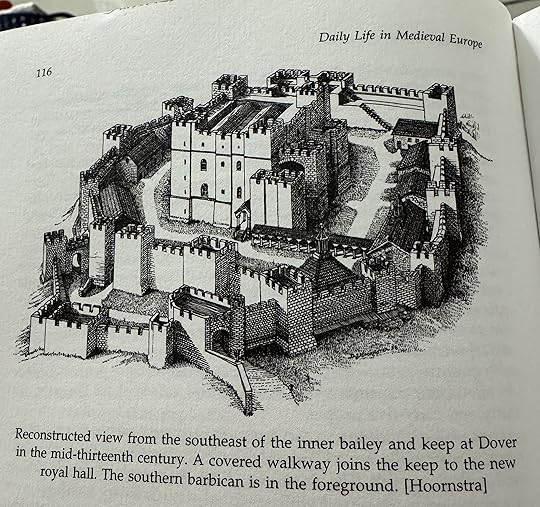
In addition to the general look at the High Middle Ages (1100-1300) in northwestern Europe, Singman covers four different settings through specific examples — village life (through Cuxham in Oxfordshire), castle life (Dover Castle), monastic life (Cluny monastery in France) and the city (Paris). Out of those I loved the monastery setting the most since most of things described were new to me — I wouldn’t have imagined how good of a deal such life would be in the Middle Ages (well, unless you were a wealthy noble in which case you were all set anyway).
And what keeps striking me each time I read anything on the life in the past was how difficult it was. Just feeding yourself was an accomplishment in itself. It’s easy to take for granted all the things we generally don’t have to concern ourselves with because they get done behind the scenes in our everyday lives, but I’m pretty sure that most of us wouldn’t survive long having to fend for ourselves in the Middle Ages. Just the effort needed to prepare a warm bath for me puts to rest any jokes about medieval hygiene.
And everyone had to work hard to survive. Perhaps the courtly stories were full of knights pining after refined ladies, but in reality things were quite different.
This book strikes a good balance between sticking to detailed information and yet keeping it interesting and accessible. It has that fun textbook feel which does exist even if we weren’t lucky in school to have all our textbooks be such.
4.5 stars, rounded up, brought to you by late autumn sun and homemade blanket. Not pictured but highly appreciated: coffee.
——————
Also posted on my blog.
“Over half of millennium after the close of the Middle Ages, the period continues to exercise a unique emotive power over Western culture. Our attitude is ambivalent but never detached. A governmental system we dislike is termed “medieval,” yet we continue to be drawn to tales of King Arthur and Robin Hood. We consider the Middle Ages a barbaric time, yet they furnish some of our most enduring icons: the knight in shining armor, the idealized noble lady, the king upon his throne. The Middle Ages somehow remain with us in a way that other historical periods do not.
Our interest in things medieval is not an idle fancy. In many respects, the Middle Ages represent the point of origin of modern Western culture.”
In addition to the general look at the High Middle Ages (1100-1300) in northwestern Europe, Singman covers four different settings through specific examples — village life (through Cuxham in Oxfordshire), castle life (Dover Castle), monastic life (Cluny monastery in France) and the city (Paris). Out of those I loved the monastery setting the most since most of things described were new to me — I wouldn’t have imagined how good of a deal such life would be in the Middle Ages (well, unless you were a wealthy noble in which case you were all set anyway).
And what keeps striking me each time I read anything on the life in the past was how difficult it was. Just feeding yourself was an accomplishment in itself. It’s easy to take for granted all the things we generally don’t have to concern ourselves with because they get done behind the scenes in our everyday lives, but I’m pretty sure that most of us wouldn’t survive long having to fend for ourselves in the Middle Ages. Just the effort needed to prepare a warm bath for me puts to rest any jokes about medieval hygiene.
And everyone had to work hard to survive. Perhaps the courtly stories were full of knights pining after refined ladies, but in reality things were quite different.
“One thirteenth-century tract on estate management recommends hiring women as they can be paid lower wages, and later sources indicate that women were hired for such tasks as road repairing, manuring, thatching, sheep-shearing, weeding, mowing, transporting grain, and even plowing, which was normally thought of as man’s work.”
This book strikes a good balance between sticking to detailed information and yet keeping it interesting and accessible. It has that fun textbook feel which does exist even if we weren’t lucky in school to have all our textbooks be such.
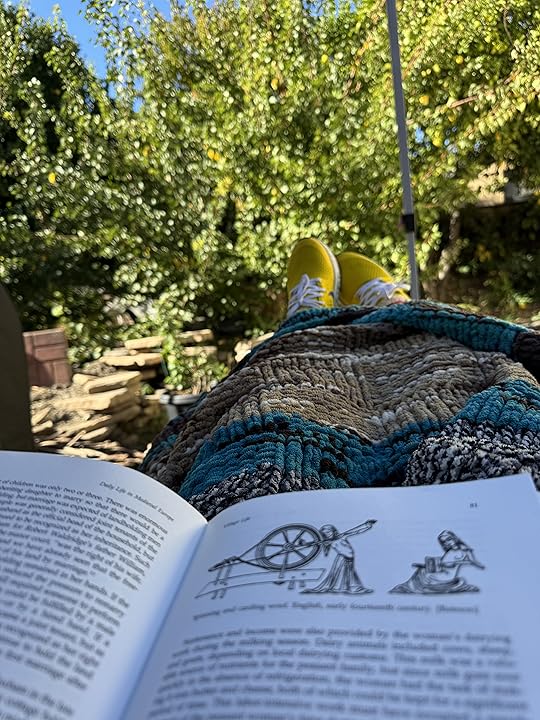
4.5 stars, rounded up, brought to you by late autumn sun and homemade blanket. Not pictured but highly appreciated: coffee.
——————
Also posted on my blog.

September 10, 2010
First, please note that Jeffrey L. Forgeng didn't write this book. Jeffrey L. Singman did.
I have singled this book out as amazing because it is a scholarly work (footnotes, bibliography, detailed index) and yet it is so easy to read that I just gobbled it up. The information is fabulous, with everything you ever wanted to know (including latrines, baths, laundry, exactly what clothing (patterns included) people wore from head to toe, including the startling information than medieval lords wore much the same type of clothing as the serfs, though they decorated themselves more, and the fabric might perhaps be a bit finer and warmer. What they ate, how they got it, who made what, how much real money they had, what things cost, the lord's hall in comparison to the homes of most people, how little most people had, how many acres it took to feed a family, how the short life-spans of people are skewed by the large number of deaths before the age of 20, the age of retirement, what jobs they did besides farm, oh, it goes on and on and never for one minute is it boring. You find so much that you used to think was right, and is not, that you are always exclaiming aloud (at least I did), and having to share it with whomever is nearby.
I have singled this book out as amazing because it is a scholarly work (footnotes, bibliography, detailed index) and yet it is so easy to read that I just gobbled it up. The information is fabulous, with everything you ever wanted to know (including latrines, baths, laundry, exactly what clothing (patterns included) people wore from head to toe, including the startling information than medieval lords wore much the same type of clothing as the serfs, though they decorated themselves more, and the fabric might perhaps be a bit finer and warmer. What they ate, how they got it, who made what, how much real money they had, what things cost, the lord's hall in comparison to the homes of most people, how little most people had, how many acres it took to feed a family, how the short life-spans of people are skewed by the large number of deaths before the age of 20, the age of retirement, what jobs they did besides farm, oh, it goes on and on and never for one minute is it boring. You find so much that you used to think was right, and is not, that you are always exclaiming aloud (at least I did), and having to share it with whomever is nearby.

Read
May 31, 2011While reading about women who have immigrated from Iran and India, this book gives a
neat perspective on how women and men lived 1000 years ago in Europe....at least the
landless serfs could walk on the street w/out a hood~
neat perspective on how women and men lived 1000 years ago in Europe....at least the
landless serfs could walk on the street w/out a hood~

February 10, 2009
It turns out that I'd already read this a few years ago. The reread did a lot to refresh my memory, though, so it was a wise move.
The Daily Life in History series was once recommended as a resource for getting into the texture and details of a time period in order to write about it. These books focus on what life looked like to the people living it, rather than famous people or events or architecture. Those details certainly appear, but as context for the rest of daily life rather than the focus of the book.
As a cover-to-cover read, this book is rather dry. Some of the details are interesting enough, but it's better formatted as a reference book to find details as one needs them. Of course, for mining story ideas or inspiration, one might read chapters at a time, but it's best kept on hand and notes taken from.
There are a lot of fascinating details within the text. There's an appendix of medieval recipes, and another of games people played during the time period in question. The book contains floor plans of several styles of residence and a lot of illustrations of costumes and people. There are also dozens of resources listed to dig deeper into particular details.
This book is incredibly useful for anyone who wants to write a story set between the years 1100 and 1300, or for someone who wants to write a fantasy setting based on the time period. It's not the best read as a narrative, but, as a reference to consult as needed, it's excellent.
The Daily Life in History series was once recommended as a resource for getting into the texture and details of a time period in order to write about it. These books focus on what life looked like to the people living it, rather than famous people or events or architecture. Those details certainly appear, but as context for the rest of daily life rather than the focus of the book.
As a cover-to-cover read, this book is rather dry. Some of the details are interesting enough, but it's better formatted as a reference book to find details as one needs them. Of course, for mining story ideas or inspiration, one might read chapters at a time, but it's best kept on hand and notes taken from.
There are a lot of fascinating details within the text. There's an appendix of medieval recipes, and another of games people played during the time period in question. The book contains floor plans of several styles of residence and a lot of illustrations of costumes and people. There are also dozens of resources listed to dig deeper into particular details.
This book is incredibly useful for anyone who wants to write a story set between the years 1100 and 1300, or for someone who wants to write a fantasy setting based on the time period. It's not the best read as a narrative, but, as a reference to consult as needed, it's excellent.
April 7, 2019
Probably the best book I have read so far on what daily life in Medieval Europe looked like. It does not focus on just one aspect, but gives details on a wide variety of people. One of the areas I found most interesting was that of life in a monastery, as for most people that would be living in luxury compared to most other locations, and led to a secular monastery as a result. I was also surprised to find some a number of monks joined late in life, almost treating it as retirement.
While people are often nostalgic for medieval times, this book explains the difficulty involved in everyday life. Much of life was simply focused on getting enough to eat. Hygiene was typically lacking, running water was virtually non existent, and a poor harvest could doom an entire region. While some aspects of medieval life do indeed some enjoyable and simple, daily life was clearly much more of a struggle for the vast majority of people compared to what exists now.
Overall a fascinating look into medieval life that would be enjoyable for anyone interested in medieval history.
While people are often nostalgic for medieval times, this book explains the difficulty involved in everyday life. Much of life was simply focused on getting enough to eat. Hygiene was typically lacking, running water was virtually non existent, and a poor harvest could doom an entire region. While some aspects of medieval life do indeed some enjoyable and simple, daily life was clearly much more of a struggle for the vast majority of people compared to what exists now.
Overall a fascinating look into medieval life that would be enjoyable for anyone interested in medieval history.

August 8, 2012
This is a very accurate book about the Middle Ages. Everything from the way women cared for their children to the role of a father in the home is carefully and very historically laid out. A must-read for every medieval fan!

May 10, 2014
An excellent and detailed overview of daily medieval life, covering villages and towns as well as monasteries and castles. If one has ever wondered what it might be like to live within a manor system or manage a castle, this is book is a great starting point.

June 15, 2020
Excellent. Absorbing details about the way they lived, based on class. I loved things like knowing what various households would have had (one pot, one horse, etc.) and the way value was given to things, and how it could vary.
February 7, 2024
This book will give you an excellent overview and a good idea of what life was like for both peasants, priests, monks and lords in 12th-13th century England and France. It's very rich in information, full of facts and details concerning life in this period of history.
Highly recommended for both students, amateur historians and fantasy or novel writers.
Highly recommended for both students, amateur historians and fantasy or novel writers.

June 2, 2017
Good information, but a bit of a dry read.
December 22, 2024
Wonderful resource for history!

December 27, 2010
A most excellent book: entertaining and chock full of source material. I highly recommend this to anyone interested in medieval history in general and living history in specific.

November 30, 2011
Absolutely wonderful resource for those writing in the medieval time period. To the point and covers most basic areas of life during the middle ages.

September 26, 2014
Good book of medieval times!

March 6, 2008
Full of interesting details. Pretty good but slow and tedious at some points.
Displaying 1 - 15 of 15 reviews