As a young man, Andrew Rostan spent some of his happiest moments watching JEOPARDY! with his grandfather. Early on, he was ready for Daily Doubles and the iconic buzzer. But now at the age of twenty-two, Andrew’s an actual contestant on the show, and realizes that while he may be ready to meet the host Alex Trebek, he’s not prepared for what comes with starring on one of the most beloved game shows in television history.
While Andrew is excellent at remembering facts, he’s also able to recall the memories he associates with those facts—memories of deaths in the family and extraordinary people—and recognize a life lived one step removed from the rest of humanity. A life he’s ready to change. Andrew discovers that existence is like JEOPARDY! and all the answers are staring you in the face if only you ask the right questions.
In his moving memoir, Rostan, along with illustrator Kate Kasenow, revisits one of the most formative moments in his life and reveals how a chance opportunity to appear on a game show taught him much more about living than he knew he needed . . .
A frustrating autobiography that teases with lots of Jeopardy trivia goodness but spills surprisingly little behind-the-scenes tea. We're left with a vague coming of age memoir that is chronologically confusing due to its broken timeline and use of memory phantoms. There are hints the author may be neurodiverse, but it is not really addressed in any fulfilling manner. There is some time spent on muddled romantic relationships and friendships, with the main focus on the author's relationship with his grandfather -- but even that is not really fleshed out much beyond gramps being supportive and optimistic about Rostan's future.
Alex Trebek shows up, but the artist fails to capture his likeness or that of the dozen or so historical and fictional figures dropped into the background of some of the hallucinogenic scenes.
Still, hardcore Jeopardy fans will probably get a little kick out of it, and I'm sure it's of interest to Rostan's family and friends. I'm not sure who else might get anything out of it.
A terribly disjointed memoir of an introverted young man who appears on Jeopardy. Although you only get the barest glimpses of the show. Most of it is in the form of only the answers to questions. It's more about his difficulty in forming relationships. The problem is the story jumps around so much it's difficult to determine what's happening when. It's as if all these elements are happening at the same time when they are clearly not.
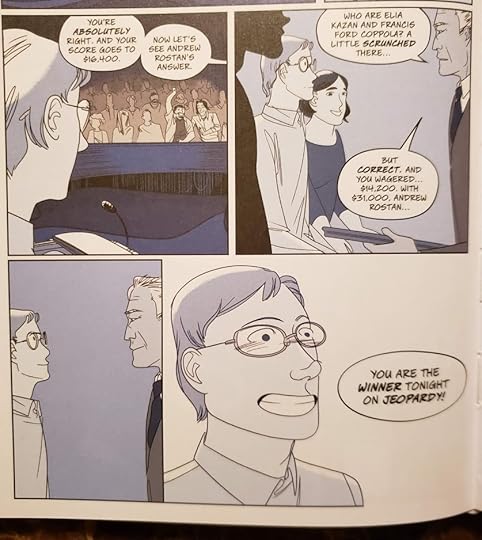
The artist doesn't bother to capture the likenesses of the real people who appear in the book at all. Alex Trebek in the comics bears zero resemblance to the actual man. I didn't even know it was supposed to be him for half the book. He's in the right of the panels below.
Form of a Question boils down to a simple question: what's more important in a person's life, human contact or vast knowledge? For most of Andrew Rostan's life, vast knowledge has the edge. He's an awkward, socially anxious child who retreats to books at the drop of a hat. I can relate! This leads to a college experience where Rostan begins to open up to friends and discovers a pair of women who could potentially complete him. These experiences are all interspersed with Rostan's time on Jeopardy, including a number of fun facts about the game show that would help any would-be participant.
Overall, the layered narrative works pretty well. Andrew becomes a confident contestant, but realizes that his zeal for knowledge has left his social life a smoldering heap. This contrast is never very subtle, though - Form of a Question wears its emotions on its sleeve. There's a great tug of war within Rostan and this pours out onto the page. It can feel over the top at times: the choice between the two paramours seems to have end of the world implications, like a hot and dangerous teenage romance. But the emotions all feel very true, as if Rostan is spilling his awkward soul out on the page. It's hard to fault the author for that.
It's only when we come around to the pat conclusion that Rostan's honest self-awareness rings less true. As he reckons with the choice between girls and the choice between friends and knowledge, his Jeopardy contest reaches its conclusion and he walks happily off into the sunset, life issues apparently resolved. Uhhh huh. I get the feeling there was a little more to it than a sudden epiphany on the Jeopardy set. Maybe I'm wrong, but it certainly reads like a forced happy ending. Still, the rest of the book is thoughtful and sometimes haunting - it often matched far too well with my own experiences. It's good when a book leaves a knot in your stomach, right? A question to think about for sure.
Interesting look at the author’s awkward transit through early life, as his focus on obtaining easily summoned knowledge crowds out all other aspects of his life. Andrew thinks he is a misfit and that getting on Jeopardy! will change that. He is about to learn different. The story is pleasant enough to read, but by the time we get to the conclusion, his grand epiphany feels either underwhelming or oversold. Either way, we’re happy for him, but there isn’t a lot else for us to connect with, even the smart misfits in the room.
A graphic novel about a contestant’s stint on Jeopardy? Yes, please! Only this one veers into lots of existential nerd angst and lovelorn sagas for this well-read yet unpopular introvert. (Although we were warned that this was not going to be just about Jeopardy, so I was prepared.) That said, I wouldn’t have minded it if it was more interestingly presented, but frankly, I was often confused about Andrew’s various relationships, distractions, and unrequited loves. Oh, and it loses another star because the host’s drawing looked nothing like Alex Trebek. That should have been the easy part, people! 🤷♀️
i could go about my life never reading this book but it’s just a really simple story with not much depth; the typical journey of growth from a quiet awkward individual to someone who becomes more confident and have some sort of epiphany which also felt rushed just to tie things up
There are a few things I’m a really huge fan of; comic books, horror movies, hockey, “Jeopardy!,” tacos, etc., just to name a few. So, when I picked up Andrew Rostan’s graphic memoir, “Form Of A Question,” to say that I was thrilled that two of my favorites - comics and “Jeopardy!” - were combined would be a big understatement. Here was a book that detailed what it was like to be a contestant on the world’s greatest game show, illustrated in a quirky style (courtesy of artist Kate Kasenow), and - the cherry on top of the sundae - there was a little bit of melodramatic quarter-life-crisis soul-searching thrown in for good measure. It’s like this book was made specifically with me in mind. However, in the parlance of the game, I was hoping for a big payday but it just wasn’t my night.
The Andrew Rostan of “Form Of A Question” is your typical indie comics protagonist: a socially awkward young man with big dreams but not a lot of drive or confidence. Having grown up withdrawn and virtually friendless, Rostan found solace in his nightly ritual of watching “Jeopardy!” with his beloved grandfather. Years later, still struggling to find his place in the world, Rostan finds himself a contestant on the quiz show and - *queue the angelic choirs* - he even becomes a multi-day champion. “Form Of A Question” alternates between these two timelines, searching for some kind of correlation or commonality, but it never finds that connection. Neither plot line is wholly satisfying. The “Jeopardy!” anecdotes are very superficial; Rostan doesn’t report anything that even a superficial fan of the show doesn’t already know. The personal bits were incredibly disjointed, making me feel like I had missed panels or whole pages somehow, and Rostan is, frankly, a pretty whiny and unlikable blowhard; it’s nearly impossible to care about his struggle let alone root for him. How he ends up with two women who (marginally) want to spend their time around him is a mystery that deserves its own book. I liked Kasenow’s stylized drawings, which looked almost Cubist in some sections, but those too felt very inconsistent. The pieces were there for this to be a very special graphic memoir but it just didn’t put them all together.
But “Jeopardy’” rules and comic books rule so I’ll be generous and round up my rating to three stars. And, as always, get well soon, Mr. Trebek!
This is a lot more about an unusual boy trying to fit in, trapped in a world he never made, if you will, than it is about Jeopardy. Jeopardy plays a pretty small part in the story, which wouldn't be a complaint except that, based on the title and cover, this was definitely sold as a Jeopardy-centric thing, no?
It doesn't feel good to shit on the story because the story is a quiet, pleasant one about a misfit, so saying, "Nice job not fitting in here either, misfit!" feels shitty somehow. I think the real deal is that this was either sold wrong or maybe could have used another hand in the story to encourage Mr. Rostan to draw more parallels or talk more about Jeopardy or something. Because that's probably the selling point of the book and what really separates it from a typical story of a misfit who also has a bit of a Betty/Veronica thing going on.
Boy, it's too bad I was never in a Betty/Veronica situation...maybe I was a little one time, but that was like in high school. That doesn't really count. Or maybe it does? Because isn't Archie in high school?
I guess I was just a little bit in that situation once, and I know the answer to that situation: Ask your mom. I mean, assuming your mom is a reasonable person like my mom is. My mom is kinda crazy about some shit. Don't ask her about politics. And while she doesn't always pick 'em too good for herself, Exhibit A being my dad, she did have a pretty good nose for the girls I dated and which ones were cool and which ones were...I don't know, in it for the money? Maybe they were in it for the money and then found out there was no money? Maybe they were in it for the money and just really bad at being in it for the money? Whatever, I don't know why they were there. But my mom always knew. Or at least she claims she did. She didn't really tell me at the time. Maybe this is like the famous "Who made us miss our flight that one time?" story where I'm convinced it was her fault and she was convinced it was my fault.
Boy, it's too bad I've never had to worry about a girl being in it for the money. That would mean I had money!
Andrew Rostan's autobiographical tale of playing on the game show JEOPARDY! is more about his relationships with women and how that clashes with his quest to conquer trivia. Don't go into this expecting just JEOPARDY! While there is plenty of his experience of training, applying, and actually playing on the game show, those scenes are woven into the dreamy narrative rather than the sole focus.
That narrative style is the biggest positive and biggest negative of this graphic novel. At first the blurred transitions are confusing since it's hard to tell when a scene is shifting. Eventually I got used to the technique, though. It's very cinematic in that regard, rather than using the pages as natural break points to hard cut between scenes. The plot jumps around in time a fair amount, which can also be confusing until you pick up the visual cues.
Speaking of visual cues, the color scheme is very well chosen. Andrew himself always appears as blue while the flamboyant woman is red and the spiritual woman is yellow. Other women pass through in other colors, but beyond that everything else is a monochromatic blue hue. That makes the scenes of vibrant color burst all the more as Andrew opens his perspective from his hyper-focus on trivia and begins to tackle real world romance.
Like real life, there's not really an ending. Andrew does have a realization about the questions and answers of life, which is of course framed in a conversation with Alex Trebek. At first that might be disappointing to some readers, but any biography of a living person isn't going to have a definitive ending. This reaches the natural conclusion of its story.
I expected more of a story about performing on JEOPARDY but was satisfied by the somewhat neurotic tale of love and confusion and frustration.
Form of a Question is a memoir written by Andrew J. Rostan that begins when he was a little boy and continues through after college when he went on the tv show Jeopardy. The story is told mainly in a linear manner, with the exception of the Jeopardy scenes which are interspersed throughout. Andrew grows up wanting to be on Jeopardy with a focus much more on learning as much trivia as possible than developing social interactions.
The main drama of the book is centered on whether Andrew will find love, mainly through the figures of Martha (a woman he seems to have a lot in common with) or Rebecca (a more spontaneous and artsy lady). The game show Jeopardy figures prominently throughout the book, from the title of the story to the frequent interludes in between told Slumdog Millionaire style. Despite that, there's really not any suspense about what happens on Jeopardy as from the very beginning we know he'll lose at some point on the show and as I neared the final page the timing of it is easy to predict as well.
There's not a whole lot of suspense in the personal life section as well, but the pacing was excellent. The death of a loved one hit all the right notes for me to feel authentic, and Kate Kasenow's art reminded me a bit of Craig Thompson's in both its clarity and emotion. The colors by Laura Langston were also effective, giving different palettes to the two love interests and making it clear before the character is even on the page who the main character was with or pursuing.
The premise and flow of this "tame" graphic novel is fantastic: that of a person so tuned into seemingly "useless" information that is able to weave it into both the strands of thought that dominate his adolescence and formative growth (including the bond with his deceased grandfather) and how it forms his young world view.
However, it devolves into a classic tale of lost love in our youth -- and not youth like mid-to-late 20s but our teens and college years -- and it feels more like an emo love letter chasing an idealized motif of finding true love too young. In that regard, Form of a Question fails. While finding human connections with potential partners is always part of the growing up process, it's bothering that Rostan perpetuates the notion that his life is incomplete, not because his friendships were tenuous due to his trivia proclivities, but rather than he "missed" out on love without acknowledging the idea that love is not something that is by chance, can be forced, or a missed opportunity.
The artwork is great, the ideas good, but the delivery may as well have been one of many tepid Smashing Pumpkins songs from Mellon Collie and the Infinite Sadness. And I too, loathed Corgan's own sadsack ruminations even as a teen experiencing the same feelings of Rostan. By the end, I felt Rostan needed to see a therapist (something most of us should seek) rather than finally be "free" to find love.
This book was OK, but not what I expected. For a book whose title and cover so clearly evoke Jeopardy, I expected this to contain a lot more Jeopardy and a lot less existential angst that really had very little to do with the author's time competing on Jeopardy. If you want a linear memoir of a contestant's experience on Jeopardy, this is not that book.
The graphic novel is a little hard to follow at times because of the non-linear structure; suddenly we're in a flashback, or something is only happening inside the author's head, and you just have to figure it out from context if each scene is present-day, a flashback, or something the author is imagining.
However, this memoir is intended to be a look inside the author's head, and a description of his lifelong struggle to relate to other people. So maybe the fact that it's hard to follow at times is intentional. When someone who has difficulty making human connections and communicating effectively writes a memoir, it makes sense that this is what we get. From that perspective, this book does a good job showing us what it is like inside Andrew Rostan's mind.
Andrew Rostan competed on JEOPARDY!, an American television quiz show. Andrew was a fan from a young age. He'd watch with his grandfather who encouraged him to pursue his dreams. Andrew watched the show regularly and had amassed the sort of knowledge just suited to be a success on the show. But he sorely lacked in social skills, making his regular life very hard, especially in dealing with women. He made it to college and eventually to the show, where he realized some valuable lessons about life that go beyond the simple game-show format.
This graphic novel is an intriguing form of biography. Rostan portrays himself sympathetically but honestly. He makes mistakes and has frustrations navigating social circles. His intelligence is uncommon and makes it hard for him to fit in with others (even though we all have things that make us uncommon). The intercutting of his time on the show with the progress of his life works well. It's hardly his whole life since the story ends as he's just done with college but it shows him on a better path for the years to come.
I picked this up thinking "Cool! A graphic novel about someone competing on Jeopardy!" and I ended up speed reading the last twenty or so pages and disliking the whole thing. I really wasn't in the mood for a story about a quiz focused man who has trouble with relationships (especially with the opposite gender) due to his obsession with Jeopardy. I didn't want to read a work that mixed Jeopardy strategy and statistics with portrayals of women that seemed more like dry lists of characteristics (do you want to choose adventurous and possibly dangerous or nurturing and less passionate?).
At one point, a friend of the protagonist tells him to "stop gauging and just fill up the tire" (or something like that --- I don't actually want to look up the quote). That was pretty much my stance towards the book; the endless intellectual monologues and dialogues were pretty tiresome.
As I said on another review this year, it's always tricky when someone relatively young does a memoir (and in both of the ones I've read so far, it's because of sudden television fame), though Form of a Question is less of a memoir and more of a pondering on coming of age, and whether to retreat into the comforting solitude of books and knowledge or risk social consequences while going out in the world and getting to know people.
A little bit light on Jeopardy! lore as it works more as a frame story to Andrew thinking back to his younger years and dating history in college, I get "indie film where a guy thinks about the girls who got away" vibes. It's ok, just know what you're getting into here.
I found this story to be poignant and charming. The protagonist (and author) shares a very personal look at his own strengths and limitations. I'm always a fan of those who want to know - to know more, to know everything! And you can't help but sympathize with Andrew's rough edges and challenges with social interactions. We see that, rather than feeling too little, his awkwardness and agonizing come from feeling too much. I also enjoyed the reminder that sometimes the right answer is, indeed, a question.
I used to watch Jeopardy! with my grandma and guess the answers, too :) Reading this book gives us a chance to do that with Andrew as well.
A decent coming-of-age autobiography of someone who focused on intelligence and learning overly much and is coming to grips about it. I was a bit on the fence about the color choices -- implies that he's the only one in his perspective who is fully in color, minus the few women who sparked his awkward interest? I was surprised to find so much hate on the Goodreads reviews but it makes sense that some folks went into this expecting a book about how Jeopardy works, of which there are several other good books. I had randomly picked this up at the library and went in with no expectations, which seems to have been a helpful approach.
A graphic novel about the author, Andrew, who makes it to Jeopardy and is a five time winner. But Andrew is sort of a social outsider. He's really really good at reading and obtaining knowledge about a vast array of topics (hence why he was able to get onto Jeopardy) but he's not so good at making/keeping friends and talking to women and just in general enjoying life. He overthinks and questions everything. This story is really about him finding purpose beyond Jeopardy. Overall I thought it was a fun little read for an afternoon but I did find the storytelling to be very disjointed.
Memoir of a trivia collecting Jeopardy hound, who is lonely. A good illustration of why you need to figure out what a friend is before you look for a girlfriend. It felt very romantic-era, with great heights and depths of emotional turmoil. I kept thinking of Frankenstein, and I just realized, that it's because like Rostan, the monster was also very lonely, and also picked up a lot of trivia through reading.
"The intimacy of friendship, of love, is like a steady, burning candle. My mom always left a candle on for us nights we were out. We'd never come home in darkness. If every soul is a candle, then the entire world is a bright, blazing fire. It's all the possibilities there are, all the hopes and dreams open to you...the people to meet, the experiences to share. To be without either the candle or the fire is to be unfulfilled. To be without both is...what breaks the heart and the mind."
The story was well written, engaging and fruitful in feeling while avoiding deception within his artistic license.
BUT: The inconsiderate any-time-whenever and often abrupt time-shiftery forced me into pain-in-the-neck back-checkery to acquaint myself before understanding what was going on.
I didn't like the art one bit and was even offended that, as one highly familiar with his likeness at that time, I couldn't even recognize Trebec- to the point that I'd think the artist used the wrong reference photos if the legendary host wasn't tele-magnanimous.
In this fabulous graphic novel memoir, author Andrew Rostan shares his obsession with Jeopardy. He had been an avid reader and trivia buff since first watching the game show with his Grandfather, who was also his best friend. Andrew is ostracized for being odd due to his quirky knowledge base, but did eventually achieve his dream of becoming a Jeopardy champion. This memoir is about so much more than just the game, chronicling Andrew's journey of self discovery as he reaches adulthood.
A moving story about a young man’s run on Jeopardy (a story from Rostan’s own life), as much a coming of age story as a narrative. Well told, with fascinating artwork, and a theme that we are what we make ourselves to be, that happiness is only true when shared, and that not having the answers makes life worth living. Highly recommended.
This book is not about Jeopardy; it is about a guy who likes Jeopardy (a lot). Although I was a bit misled by the title, I still found some enjoyment in this book as a guy who also likes Jeopardy. I think this is somewhat of an autobiography. The books jumps around between time periods and I found that a bit confusing.
This little graphic novel wasn't at all what I was expecting. I definitely thought going into this that there was going to be a hard focus on Jeopardy and the contestant's time there, but that aspect was more of a sprinkle on top of a story about self discovery. Throws you for a bit of a curve considering the marketing, but still enjoyable and sweet!
Interesting & entertaining coming-of-age memoir with the author's experience on Jeopardy woven into the story. Read my full review and see some sample pages at:
Una historia humana alrededor del juego televisivo estadounidense de Jeopardy y la vida de un joven participante que es el protagonista. Se trata de una novela gráfica que nos lleva a situaciones diversas del protagonista con familiares, amigos y su ideal de chica. Buen dibujo. Se lee fácil.