Jump to ratings and reviews
Rate this book

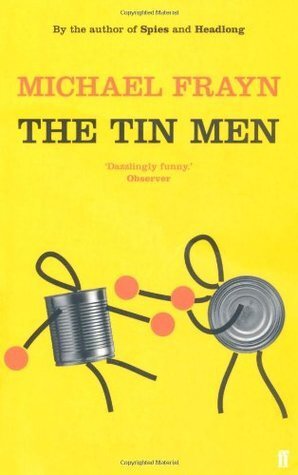
The Tin Men

Rate this book
The William Morris Institute of Automation Research is working hard to simplify our lives by programming computers to carry out life’s routine tasks. Whether it’s resolving ethical dilemmas, writing pornographic novels, saying prayers, or watching sports, these automation experts are developing machines to handle it all, enabling us to enjoy more free time. And when it’s announced that the Queen will be paying a royal visit and the Institute’s madcap bunch of researchers decide to program the computers to receive her, what could possibly go wrong?

Winner of the Somerset Maugham Award, The Tin Men (1965) is the brilliantly comic first novel from Michael Frayn, author of the Booker Prize-nominated Headlong, Spies, and Skios, and Noises Off, ‘the funniest farce ever written’ (NY Times). This 50th anniversary reissue features a new introduction by the author.

WHAT CRITICS ARE SAYING

‘Continuously funny . . . The fun of The Tin Men is outrageous because it is so serious.’ – Anthony Burgess, Guardian

‘A fast swooping performance by one of our very serious satirists . . . This is a very funny book and delightful to read.’ – William Trevor, The Listener

‘Dazzlingly funny . . . perfect pieces of comedy.’ – Observer

158 pages, Paperback

First published January 1, 1965

23 people are currently reading
644 people want to read

About the author

Michael Frayn

113 books268 followers
Michael Frayn is an English playwright and novelist. He is best known as the author of the farce Noises Off and the dramas Copenhagen and Democracy. His novels, such as Towards the End of the Morning, Headlong and Spies, have also been critical and commercial successes, making him one of the handful of writers in the English language to succeed in both drama and prose fiction. His works often raise philosophical questions in a humorous context. Frayn's wife is Claire Tomalin, the biographer and literary journalist.

Ratings & Reviews

What do you think?
Rate this book

Friends & Following

Create a free account to discover what your friends think of this book!

Community Reviews

5 stars
71 (19%)
4 stars
118 (32%)
3 stars
120 (32%)
2 stars
41 (11%)
1 star
15 (4%)
Displaying 1 - 30 of 52 reviews
Profile Image for Vit Babenco.
1,794 reviews5,856 followers
July 13, 2017
The Tin Men was written in the sixties – the prime of the absurdist literature and an eve of the computer era and an onset of the artificial intelligence. Both those things – absurdism and computerization – brought together make a brilliant combination…
There is a certain William Morris Institute of Automation Research which is preparing for the Queen's visit to open the new Ethics Wing…
Science and life: the true scientists work in the institute and they have true scientific minds…
“…Haugh had an open mind. It was open at the front, and it was open at the back. Opinions, beliefs, philosophies entered, sojourned briefly, and were pushed out at the other end by the press of incoming convictions and systems. Lamarckism, Montanism, Leninism, Buchmanism, Kleinism, Spenglerism – they all blew in with the draught, whirled cheerfully around, and sailed out again.”
But scientists live their own lives and they dream and their dreams are original and precious… And there is one fine idea for the use in the new Ethics Department.
“Well. Rothermere fails to understand – and I fail to understand – how this could justify using the wing to get computers writing pornographic novels and sex manuals.”
They didn’t understand but nowadays programmers and hackers understand everything… That’s what the progress is for…
Profile Image for Anna.
2,125 reviews1,025 followers
November 29, 2016
I'm not quite sure why I picked this off the shelf in the library, but am so glad I did. It is the one of the best and most deadpan satires I've ever come across. The plot centres on an academic department that has a new building that will be opened by the Queen. This impending opening unleashes chaos, absurdity, and self-replicating committees, distracting the heads of department from their usual novel-writing, sporting activities, and obsessive graphing of their IQs.

Probably my favourite and the funniest parts of the book describe the work of Goldwasser, head of the Newspaper Department, who finds it surprisingly easy to automate the headlines. Quote:

Say, for example, the randomiser turned up

STRIKE THREAT

By adding one unit at random to the formula each day the story could go:

STRIKE THREAT BID
STRIKE THREAT PROBE
STRIKE THREAT PLEA

And so on. Or the units could be added cumulatively:

STRIKE THREAT PLEA
STRIKE THREAT PLEA PROBE
STRIKE THREAT PLEA PROBE MOVE
STRIKE THREAT PLEA PROBE MOVE SHOCK
STRIKE THREAT PLEA PROBE MOVE SHOCK HOPE
STRIKE THREAT PLEA PROBE MOVE SHOCK HOPE STORM

Or the units could be used entirely at random:

LEAK ROW LOOMS
TEST ROW LEAK
LEAK HOPE DASH BID
TEST DEAL RACE
HATE PLEA MOVE
RACE HATE PLEA MOVE DEAL

Such headlines, moreover, gave a newspaper a valuable air of dealing with serious news, and helped to dilute its obsession with the frilly-knickeredness of the world, without alarming or upsetting the customers.

That is one of the most witty and astute commentaries on newspapers I've ever come across. This book was first published in 1965 and has aged magnificently. Only yesterday I read a piece about how the Daily Express has four basic headlines that it reuses endlessly! Moreover, if you've ever worked in an office you will recognise the odd personality quirks, miscommunications, and incredibly awkward social gatherings parodied here. I laughed to myself many times. Highly recommended.
Profile Image for Lemar.
724 reviews75 followers
October 4, 2018
If you like the British humor such as Fawlty Towers or Ricky Gervais in the Office, you will thoroughly enjoy this book.
“- was a responsive subject for lobbying. No lobbyist had ever come to him in vain.”

“He had an open mind. It was open at the front, and it was open at the back.”

“The corners of his mouth struggled nobly up into a smile, like two wounded war heroes getting to their feet for the National Anthem.”
Profile Image for Ed Erwin.
1,207 reviews130 followers
November 12, 2018
Funny workplace satire set in a company investigating uses for computers in the 1960s. This is not Sci-Fi, but there are some rudimentary SF elements. They consider using computers to write newspaper stories or pornographic novels. They even consider automating prayer -- why should God care whether it is a human or a machine who prays for the local sports team? They attempt to build robots with just the right balance of self-preservation vs. human-preservation. (After just four iterations this leads to robots trying to kill each other!)

But it is human foibles that are the real heart of the humor. Like the workplace comedy "The Office", but set in Britain, if you can imagine such a thing.
Profile Image for Blaine.
345 reviews39 followers
April 11, 2024
Wonderful in parts, such as the discussions about computers taking over increasing parts of human activity, including prayer, novel writing and ethics, and the dynamics of committee-led decision making in modern organisations. What a time Frayn would have with email, chat and Slack! Some of the dialogue is wonderful.

The characters are fairly weak, mostly indistinguishable other than their caricatures, but I did like the Chairman who does nothing but hold his head in his hands and says little but thank you. I've known more than one Board Chair like him.

I agree with a comment that this one was for practice. Best for a skim through and then straight on (to) Towards the End of the Morning.
Profile Image for Peter.
777 reviews137 followers
November 22, 2017
This was a fun read and with good reason, a farce of the highest order. Inside this slim tome is some excellent scenes:

"If I were asked to put my advice to a young in one word, do you know what that word would be?"
"No?" Sir Prestwick had said.
"Think," Prestwick,"Think."...

The whole scene goes on and is supurb.

The legendary Kurt Vonnegut started a film company called Sourdough Productions just so he could by the film rights to one of his most favourite books.

Says it all really.
Profile Image for Kylie.
415 reviews15 followers
November 21, 2017
This made The Leakey Establishment look densely plotted. Amusing at times, but overall a chore to get through. Thankfully it's reasonably short.
Profile Image for Rachel Ashera Rosen.
Author 5 books56 followers
August 16, 2024
Nearly 60 years ago, Michael Frayn wrote a quite funny satirical sci-fi novel about how asinine it would be to automate the things that humanity does well (ethical decisions, sports, writing, pornography...) to machines that did it worse than we do. Unfortunately, Sam Altman must have read it so now we have to have the same stupid debates all over again.
Profile Image for Simon Mcleish.
Author 2 books142 followers
May 22, 2025
Originally published on my blog here in January 2000.

Michael Frayn's first novel is like the comic novels of J.B. Priestley, especially Sir Michael and Sir George, rather than those of Evelyn Waugh, with whom the quoted reviews on the cover compare him. Waugh's melancholy side is absent from The Tin Men, and it is more directly satirical, though the novel is as funny as the comparison suggests.

The satire is about mechanisation and depersonalisation, the latter a theme to which Frayn returned several times as a novelist. Preparations are under way for the opening of a new wing at the William Morris Institute for Automation Research, and as increasingly detailed arrangements are made for the Queen's informal visit, the stress tells on the eccentric characters working to replace as much of human life as possible by computers, freeing people to do "the really important things".

The automatic versions of everyday life are, of course, where the satire comes in - meaningless headlines written by newspaper machines are a typical example. I rather liked the experimental ethics department robots, programmed to throw themselves off a capsizing raft to save a being more complex than themselves, engaging in fights to the death when two are placed on the raft. In most cases, the targets are fairly easy to hit but the satire is still funny. The Tin Men is amusing, but Frayn has gone on to write far more subtle novels.

Added in 2025 after re-reading: Re-reading some of it, it was remarkable to me just how much of what was described in jest in 1966 reads like the outputs of very recent artificial intelligence. And yet, the panic and over-planning for a royal visit in the first of the book would be likely to be just the same in 2025 as it was when the book was written. Plus ça change.
Profile Image for Suad Shamma.
731 reviews209 followers
April 21, 2014
I had read Michael Frayn's The Trick of It and absolutely enjoyed his style of writing and satiric humor. I thought - looking at this book's reviews and synopsis - that I would love this one for sure. Unfortunately, I did not and I could not. No matter how much I tried to find humor in the dialogue and writing, no matter how much I tried to expand my mind to take in all the great complex satire, I just couldn't enjoy reading this book.

It started out well enough with the conversation at the production company or whatever it was, having me laugh out loud. However, when the plot and story moved to the university setting and we were introduced to the professors and immersed in the politics involved, it slowly lost it for me.

All it conveyed was a bunch of weird, nonsense characters, who are self-involved and arrogant. Characters, who are portrayed as very smart, but also quite dumb. Reading the synopsis, I really thought it would have to do with computers and robots and machines taking over as they prepare for the Queen's visit. Rather it was a idea after idea after idea of HOW the computers and machines would take over, and what would they take over (i.e. writing articles, writing books and pornography to name a few). It was honestly, quite ridiculous. It got boring towards the end. It got repetitive, and I hate to say it, but I did not find it very clever either.

Maybe it is outdated, or maybe it's just not for me. Whatever the case, I could not enjoy this book at all, unlike The Trick of It.
Profile Image for Nicholas Beck.
377 reviews12 followers
July 25, 2023
Prescient satire about a motley collection of computer programmers tasked with designing ethical computers especially given the rise of ChatGPT and AI and surprisingly topical because of it. Oddly dated (no surprise there, it was written nearly 60 years ago) humour although it did raise quite a few chuckles along the way. The bureaucratic foibles and digs at tabloid journalism and sundry other societal endeavors retain some of their bite after all these decades. Some things don't really change much through the years.

Satire is a tough one to pull off and Frayn does an admirable job for the most part and the brevity of his story means that he doesn't outstay his welcome.
547 reviews68 followers
March 26, 2016
Long ago, I saw the young Alan Rusbridger on "What The Papers Say" quoting the passage in chapter 13 that states the differing levels of interest that western media have for catastrophes involving foreigners. Depressingly, it's still true and relevant. There are some jolly good laughs in the rest of this satire, and there are moments that seem to faintly prefigure Monty Python, which Frayn was a writer for. Nice parodies of fashionable young novelists as well (blokeish, existentialist, hepcat), wonder who he had in mind.
Profile Image for John FitzGerald.
56 reviews1 follower
May 3, 2016
Like the curate's egg. Some very amusing and insightful passages amid some very laboured ones. This is a slim novel but I couldn't read much at a time because the artificiality of the plot was wearing. There are no characters, really, just assemblages of shtick.

Of course, if this had been the first novel of Frayn's I'd read I might have rated it more highly, not knowing how much better he was capable of.

Having said all that I should make it clear I think the novel's worth reading. The good passages are really good.
Profile Image for Jaclyn.
Author 3 books63 followers
July 21, 2014
I wanted to like it. I liked the concept, and I found the idea of journalism by way of random choices to be kind of fascinating (I definitely thought "A monkey could do what I do" on more than one occasion when writing for dailies). But I didn't find the irreverent tone funny--I found it dry and boring. Maybe it's something that was lost over the years, I'm not sure.
Profile Image for Nigeyb.
1,483 reviews407 followers
April 5, 2024
Having loved Towards the End of the Morning I was keen to sample more of Michael Frayn’s work.

The Tin Men (1965), his debut novel, is another deadpan, accurate and amusing satire of the world of work. In this instance it’s a research institute with all the standard workplace types present. This being the mid 60s there’s a far greater tolerance for ineptitude and indolence.

The ante is upped by a forthcoming visit by the Queen who is to open the new Ethics Wing.

It’s all amusing in an absurdist way. Some sections are hilarious. The section on self generating newspaper headlines had me smiling in recognition. The party scene had me laughing out loud.

The inter departmental rivalries and insecurities are well executed. It is interesting how much has changed, especially regarding technology, but also how much is still so familiar.

Another winner from Michael Frayn, not quite as good as Towards the End of the Morning but that’s a high benchmark.

4/5


The William Morris Institute of Automation Research is working hard to simplify our lives by programming computers to carry out life’s routine tasks. Whether it’s resolving ethical dilemmas, writing pornographic novels, saying prayers, or watching sports, these automation experts are developing machines to handle it all, enabling us to enjoy more free time. And when it’s announced that the Queen will be paying a royal visit and the Institute’s madcap bunch of researchers decide to program the computers to receive her, what could possibly go wrong?

Winner of the Somerset Maugham Award, The Tin Men (1965) is the brilliantly comic first novel from Michael Frayn, author of the Booker Prize-nominated Headlong, Spies, and Skios, and Noises Off, ‘the funniest farce ever written’ (NY Times). This 50th anniversary reissue features a new introduction by the author.


‘Continuously funny . . . The fun of The Tin Men is outrageous because it is so serious.’ – Anthony Burgess, Guardian

‘A fast swooping performance by one of our very serious satirists . . . This is a very funny book and delightful to read.’ – William Trevor, The Listener

‘Dazzlingly funny . . . perfect pieces of comedy.’ – Observer


640 reviews10 followers
August 18, 2023
The Tin Men is a very funny novel about a research institution in London that is preparing for a visit from the Queen for the opening of a new wing dedicated to the computerization of ethics. The novel strikes me as a precursor in many ways of The Hitchhiker's Guide to the Galaxy, and I would be surprised if Adams had not read it or other Michael Frayn works. While Frayn's novel does not have the over-the-top absurdist take on philosophy that Adams' works have, it still has several elements that an Adams fan might recognize. Foremost among these is that all the characters are obsessed with trivia, elevating their obsessional subject to universal explanation. The novel has a hapless anti-hero, in this case Goldwasser, accidentally stepping his foot into other people's messes and generally buffeted around by the competing obsessions of the people around him. The novel does not have much plot, and is made up mostly of short scenes involving detailed character sketches and strange dialogue. In conversations, all the characters talk past each other, each character convinced that everyone else knows exactly what they are talking about, when in fact all the characters talk in opaque, abstract, and roundabout sentences that no one outside the speaker could hope to understand. The novel has deep satirical digs at corporations and academia, and implies that when corporations and academia combine, in this case a corporation doing academic work, no one actually knows what they are doing. The absurd experiments remind me of Gulliver's trip to Laputa, with equally nonsensical and pointless experiments. In this case, the experiments are designed to find ways to use machines to replace everything that humans do. Goldwasser runs the department dedicated to creating newspapers by merely shuffling around frequently appearing key words and topics, irrespective of whether the headlines or stories actually report on a real event. McIntosh works on making "ethical" machines that will perform the kinds of thought experiments that ethical philosophers conjure up, such as the Lifeboat Problem. Nunn, the head of security, is obsessed with people who, in his mind, act suspiciously. To him, merely being "suspicious" is equivalent to committing a crime. One can see that Frayn has little respect for corporate offices, philosophical ethics, and the popular belief that computers can replace all human activity. As with many satirical novels, this one does not have a discreet ending, but simply just stops when it feels that the writer has made his point. This novel is very amusing and still surprisingly relevant.
Profile Image for David Evans.
835 reviews20 followers
December 8, 2023
A wonderfully satirical look at corporate management in those halcyon days of the mid 1960’s when anything seemed possible and people had time to reflect on their anxiety and petty jealousies even as they were developing new products in the “White Heat” of technological revolution.
Dr Goldwasser is the Head of the Newspaper Department at the William Morris Institute of Automation Research who is worrying about Rowe, who is industriously writing a terrible novel in the company’s time and Mackintosh, Head of the Ethics Department, who may or may not be cleverer than himself.
Goldwasser has hit on the idea of programming a computer to produce a national newspaper using algorithms, to not only create totally random meaningless headlines (MAGIC BOX WILL HELP HOUSEWIVES TOP SECRET BRITISH TRIUMPH) but to invent the stories that accompany them - how prescient. Mackiintosh’s idea is to get the computer to write porn and sex-manuals while the sports-obsessed deputy director and security chief, Nunn, makes meaningfully damning random notes about his colleagues (as if he were a particularly officious Government Whip) on the Racing Post calendar by his desk.
The empty new wing, to be officially opened by Her Majesty The Queen, is filled with mock equipment while more than thirty committees are set up to coordinate the “informal” ceremony. Frayn hits the mark unerringly with every character skewered expertly.
I personally believe that Rowe’s completed novel would - like the Magic Box - have been a triumph:
“Yes,” replied Rick, and the word meant not “yes” but a clear negation of the validity of Nunopolos’s challenge, a dangerous reassertion of his own right to think and react with utter simplicity. Rick saw that Nunopolos had understood this instantly. He glanced at Anna, and saw that she knew Nunopolos had understood it. Out of the corner of his eye he observed that Nina had comprehended Anna’s reaction to Nunopolos almost in spite of herself. He looked round to see how Fiddlingchild had taken Nina’s expression. But Fiddlingchild had fallen asleep.
Profile Image for James Hold.
Author 153 books42 followers
December 21, 2017
This was a disappointing experience. Seven chapters in and I had no idea what was going on other than some people are working on a computer project and the Queen is coming for a visit. After that I began skipping around looking for anything good. Books do not win awards for being 'brilliantly comic' or draw reviews calling them 'continuously funny' for no reason. Yet I found nothing humorous. Not a chuckle, a grin, or even a giggle.

So what's wrong with me that I find nothing here to laugh at? The Three Stooges are funny. Bugs Bunny and Frasier are funny. The Sinister Researches of C.P. Ransom is funny. Edgar Allen Poe and Ambrose Bierce pull off some dryly humorous lines. But Michael Frayn is not funny. Not to me anyway.

I found the style boring. It mostly consists of repeating things. For instance: 'He talked about it to XXX. He talked about it to YYY. He talked about it to ZZZ.' Nor as a writer myself did I see anything funny in the stuff about Hugh Rowe, the would-be writer.

Maybe it has something to do with the presentation. Fawlty Towers is a hilarious TV show but reading a book of the scripts did nothing for me either. It's all in the acting and the delivery. Maybe Frayn is the same way. Whatever the case I don't plan to read any more of him. I picked this up for a buck fifty. At least it didn't cost me anything but a few hours which I'll never get back.

0 stars in reality, but I have to give it 1 else it won't count.
Profile Image for Mark.
Author 29 books56 followers
September 14, 2019
Frayn is a comic master. Hard to believe this book is over 50years old, despite its obvious 60s setting in a vast British scientific research facility, replete with gleaming Bakelite and boffins in lab-coats. We’re flung into the white heat of harold Wilson’s Britain when science and engineering was pushing back the frontiers of literally everything.

The mission: to computerise literally everything. Thus humanity could finally do away with journalists, editors and novelists, philosophers and pornographers, ethicists and clergy. Of course, this is the pre-digital era so the machines need to be built on an epic scale. Like the ethics machines (names by their inventor Samaritan I-IV) occupying a huge water tank to figure out who should be saved on a drifting life raft. And so on.

Each individual in the Institute is precisely drawn, with the perfect degree of exaggeration to keep each one on the right side of both plausibility and laugh-out-loud hysteria. The book made me the epitome of irritating fellow train-passenger as a result. And the chaotic denouement, provoked by the visit of the Queen to open a brand new wing, is sublime in true Frayn style.

But while this will undoubtedly have seemed like absurd fantasy at the time, on a par with science fiction staples on TV like Star Trek or The Avengers, we really aren’t that far off in our digital age as it seems to accelerate towards the singularity...
Profile Image for Susan.
3,027 reviews569 followers
April 2, 2024
Having recently read, and loved, 'Towards the End of the Morning,' some of my lovely book group decided we needed to read some more by Michael Frayn. 'The Tin Men,' is his first novel, published in 1965.

I remember, when I was at school, the beginning of computers - those big, white cabinets, that whirred and did, well, we were unsure what. This is set in The William Morris Institute of Automation Research, where the New Ethics Wing is almost finished and it is rumoured that it will be opened by the Queen. A new - or nearly new - monarch, for a new age, largely funded by Amalgamated Television.

This novel involves the various Heads of Departments (the Newspaper Department, the Sports Department, the Ethics Department) who are all involved in trying to work out the capabilities of these new machines. Can they write pornography, have the ability to save themselves, save people having to play bingo or replace sport with statistics?

This humorously tackles the various staff members and their interactions, alongside the excitement of preparations for the Royal Visit. Office politics, personal ambition, paranoia and suspicion abound. Michael Frayn has been my discovery of the year. I am so pleased that I have stumbled across his work and look forward to reading more.
Profile Image for John Cravey.
54 reviews
October 28, 2018

37 chapters, 55,000+ words

What I liked about this book was Frayn’s use of comedy to subtly explore esoteric ideas. I was going to say that these were esoteric ideas in 1965 when the book was published, but I suspect that they still are even in today’s computerized and networked world.

It’s not that he avoids satire on conventional topics. For example, the subplot dealing with computer generation of newspapers is a jab at tabloid journalism. It’s also true that the dialogue of the programmer who thinks that sports exists only to generate sports statistics is a swipe at sports betting and computer programmers. And then there’s the executive who is troubled that the man he believes to be a security risk has brainwashed him into believing it. This is a dig at the cold war mentality.

But in between the funny dialogue and funny behavior of the “ethical robots” subplot, Frayn slips in some interesting ideas about ethics and computers. There’s also a short discussion that hints at the potential of artificial neural networks to transform computers into something resembling a human brain. Fun. The ideas and the comedy are combined so smoothly so that the reader isn’t jarred when the ideas are brought up.

2.9 stars
131 reviews
September 3, 2022
One of the blurbs on the rear cover of "The Tin Men" enthusiastically states that the novel "goes straight into the Evelyn Waugh class." Frayn's biting wit and dim view of modern society certainly are in the brilliant Waugh tradition, and the opening chapter of "The Tin Men" strongly suggests the wonderful episode in Waugh's "Scoop" in which the hapless foreign editor tries to deal with the overbearing newspaper owner Lord Copper. Frayn's comedy usually deals with situations spiraling wildly out of control, whether for the theatre company in "Noises Off" or the art expert in "Headlong," and that spirit is captured in "The Tin Men" with the account of the increasingly chaotic preparations for a royal visit to the William Morris Institute of Automation Research. Frayn's major target in this novel is the contemporary world's boundless faith in limitless technology - -which has some of the flavor of the satire of science in the Laputa section of "Gulliver's Travels"- - with technological solutions being misapplied to every field from journalism to ethics to pornography to athletics. Frayn doesn't seem to have been certain how to end his book, so the abrupt conclusion falls rather flat, but that didn't seem a bad price to pay for such fine dark humor.
Profile Image for Mark.
152 reviews12 followers
September 5, 2017
A herring and a potato.
That is what I answer when someone asks me what the best dish is I've ever eaten, not something I had in a three star restaurant. (Mind you, the herring was a delicious Dutch maatje, the first of the season, and the potato was a new harvest fingerling.)
And when people ask me what the best wine is I ever had I do not mention the Mouton Rothschild 1961 I had a glass of in a posh restaurant, I reply it was the simple yet delicious country wine a bottle of which I shared ages ago with two friends, sitting in the French countryside, our bikes leaning against a tree.
So yes, I dare say this lightweight farce is the best book I've ever read. It is outrageously witty and well written and I enjoyed every paragraph of it.

(A warning though: this spoof is firmly set in sixties England. If you were born yesterday and are adamant a satire should deal with the burning issues of today, this might not be for you. Then again you might still like it, since people living fifty years ago were human beings too.)
Profile Image for Jaan Saar.
41 reviews2 followers
May 1, 2020
Pealkiri: Plekkmehed
Autor(id): Michael Frayn
Kujundaja: Edgar Valter

Kirjastus: Perioodika
Linn: Tallinn
Aasta: 1967
Originaalkeel: inglise keel
Tõlkija: Helmi Tillemann
ISBN:
Lehekülgi: 142
Sari: Loomingu Raamatukogu, sarja osa: 42-43


Seisukord: pisut määrdunud kaaned, sisu olemas ja korras
Mõõdud: 130 × 199 mm
Suurus: tavaformaat, pehme köide


Sisu:
Arvestades tänapäeva maailma arengutendentse, on nii mõnelgi selles raamatus puudutatud probleemil aspekte, mis on huumorist üsna kaugel.

Originaali pealkiri: The tin men

Märksõnad:
inglise ilukirjandus
romaanid

Sari: Loomingu Raamatukogu 1967 nr. 42-43
This entire review has been hidden because of spoilers.
Profile Image for Steve  Charles.
61 reviews1 follower
December 15, 2022
I first read this way back in the late 1960s and it seemed very funny at the time. Unfortunately, though it is clever and witty, it has dated a bit and I just didn't laugh this time round. Perhaps I have changed too and my sense of humour is different now I'm so much older. It did make me smile occasionally, especially during the last few chapters, but it certainly doesn't seem 'dazzingly funny' now. A shame really, because Michael Frayn is undoubtedly a superb writer as can be seen in NOises Off and Spies, both of which I would recommend.
Profile Image for Emmalyn Renato.
788 reviews14 followers
October 6, 2023
Literary British absurdist humor from 1965, that won the Somerset Maugham award the following year. It's a story about the William Morris Institute of Automation Research, whose madcap bunch of researchers program computers to carry out life’s routine tasks (whatever they may be). And the Queen is about to pay a Royal Visit. What could possibly go wrong? It's pure farce. If you like that sort of thing, you should find it laugh-out-loud funny.
Profile Image for Stephen Rowland.
1,365 reviews72 followers
December 9, 2021
Another hilarious, unique, and astute novel by Frayn, who is remembered more for his plays than anything else. Not quite as memorable as the absolutely brilliant "A Very Private Life," but certainly worth seeking out.
Profile Image for Pippa Catterall.
152 reviews1 follower
December 21, 2022
This short novel was published in 1965, more or less at the end of the British satire wave that started in the late 1950s. It’s plot is appropriately silly, but in the process it has a number of interesting and insightful observations on the performativity of royalty, the shallowness of the media and the contrived nature of celebrity and the very challenges of the writing process.
1 review
June 19, 2017
Mildly amusing. Set in the computer world of the 1960s when mainframes occupied entire rooms, Michael Frayne mocks media moguls, board members, academics, journalists, novelists and security professionals, whilst telling a tale of perils of miscommunication
4 reviews
June 7, 2020
Some laugh out loud moments, especially some incredibly well paced dialogue. But overall I struggled with the fragmented vignettes, leaving many characters not fully developed. The ending is good, but there’s also a few moments of very outdated language.
Displaying 1 - 30 of 52 reviews

Can't find what you're looking for?

Get help and learn more about the design.