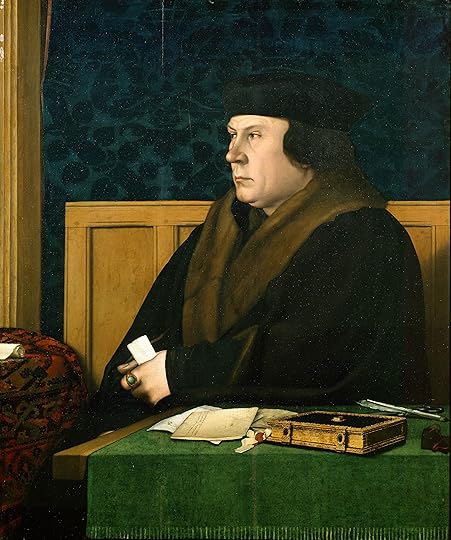
The Clerk’s Clerk.
Diarmaid MacCulloch’s *Thomas Cromwell: A Revolutionary Life* (2018) is the definitive modern biography of Henry VIII’s most indispensable minister, the blacksmith’s son who rose to orchestrate the English Reformation, dissolve the monasteries, and keep the wheels of a volatile regime turning until they finally crushed him. MacCulloch has spent a lifetime immersed in Tudor archives, and the book is a monument to that immersion: exhaustive, scrupulously sourced, and bristling with footnotes that often feel longer than the chapters they serve. If you want to know precisely which clerk copied which memorandum on which day in 1536, this is your book.
The portrait of Cromwell the historical actor is genuinely impressive. MacCulloch convincingly rescues him from the cartoon villain of Mantel’s novels and the pious thug of some Catholic historiography. Here is a man of prodigious administrative talent, a genuine believer in evangelical reform (not just a cynical enabler of Henry’s libido), and a continental sophisticate who spoke Italian like a native, read the Bible in the original languages, and corresponded with European reformers while simultaneously squeezing the monasteries for every last chalice. The chapters on the 1530s (the break with Rome, the dissolution, the drafting of revolutionary legislation) are masterly. You finish them understanding exactly why contemporaries thought Cromwell was the most powerful commoner in England since Thomas Becket, and why many believed he was the devil incarnate.
So Cromwell himself remains fascinating. The book, alas, does not.
MacCulloch writes like the senior civil servant Cromwell himself might have become had he lived to enjoy a quiet retirement: precise, methodical, and utterly allergic to drama. Events that should thunder across the page (the fall of Anne Boleyn, the Pilgrimage of Grace, Cromwell’s own terrifyingly swift collapse in 1540) are recounted in the same measured, bloodless register as the reorganization of the Augmentations Office. One almost longs for a single exclamation mark, a raised eyebrow, anything to signal that the author notices he is narrating the most tumultuous decade in English religious history. Instead we get paragraph after paragraph of bureaucratic genealogy: who succeeded whom in which revenue court, which ex-monastic manor was granted to which courtier in which quarter-session. It is rather like reading an extraordinarily learned accountant’s report written by a man who has forgotten that human beings are involved.
Personal texture is almost entirely absent. We learn that Cromwell loved his wife and children, that he was generous to his extended family, that he enjoyed fine clothes and a laugh. But MacCulloch rarely lingers on any of it. There are no scenes, no reconstructed conversations, no attempt to get inside the man’s head beyond what the ledgers explicitly tell us. Even Cromwell’s evangelical faith, surely the engine of much of his revolutionary energy, is presented as a series of doctrinal positions rather than a lived passion. The result is a 700-page biography in which the subject never quite comes alive as a personality. He remains, to the last page, what he was in life to most contemporaries: a distant, terrifyingly efficient administrator whose inner self was visible only to a trusted few.
This is not a failure of research; it is a failure of storytelling. MacCulloch knows everything there is to know about Thomas Cromwell, and he has chosen to present that knowledge in the exact tone and structure Cromwell himself might have used when submitting a departmental report to the king: complete, accurate, and dry as the dust of the dissolved abbeys.
If you need the definitive scholarly account of Cromwell’s career, the administrative history of the Henrician Reformation, or a shelf-bending reference work that will settle any argument about dating or precedence, buy this book without hesitation. If you want to feel the sweat, fear, and exhilaration of living through those years alongside one of history’s most extraordinary operators, you will close it, as I did, impressed, instructed, and oddly unmoved. Cromwell deserved a biography with a pulse. What he has received is the most meticulous minute-book ever written about a life that was anything but minute.