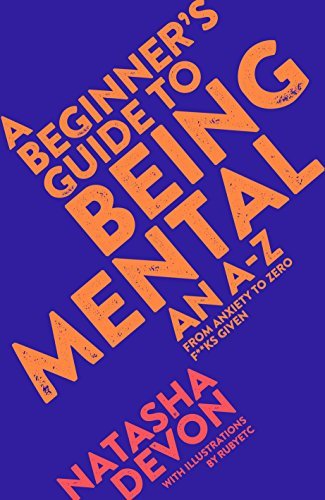
Apparently, my reading habits suggest I should read "A Beginner's Guide to Being Mental"... I don't know what to make of that. Does my eclectic mix of sharks, murders, ancient maps, wizards, Scandinavians, engineering guides, historical parodies, and who knows what else suggest I'm a little bit eccentric? Or does it say I'm so normal I'm positively boring and therefore trying to pretend I'm a little bit bonkers in the style of a zany children's TV presenter to make myself more interesting? I have no idea, but the very fact that I started to ponder why I got the recommendation suggests maybe I need to skip to Z in this alphabetical guide and learn about giving zero fucks.
However, this book really should be required reading for everyone irrespective of their own mental health. If anything, I'd say this book is strongest with regard to interacting with other people's mental health. Devon's use of humour is powerful in making a vast and difficult subject accessible without being patronising. Even if you know the area she's discussing it's engaging, so while you may not come away with much additional knowledge you can still follow along and appreciate the writing. If you don't know the topic, you'll get enough info to get by and a starting point to deep dive on things if you really need to know more.
The book is laid out in an A-Z format which may reach a little to give each letter a topic of decent, balanced, coverage but, unlike so many A-Z guides, doesn't strain painfully to run through the final letters of the alphabet and desperate pad a word definition into a paragraph to try and finish the structure. This is an A-Z that reads really well and flows. I'm not a huge fan of the cross-referencing because in truth this is a book to read cover to cover, Sure, for various reasons you may want to jump in at various points, I know there are a few chapters I plan to re-read so I'll be doing exactly that, but for the first read I'd recommend taking it all in. It's a pretty light and breezy book and impressively easy reading given the amount of coverage it offers.
And the coverage of this book is truly where it shines. I mean, I like to think I'm pretty clued up on mental health issues but I came away feeling a lot smarter thanks to this book. What appealed to me most was that Devon remains enjoyably open-minded and non-judgemental. The section on mindfulness is a great example. In short, she takes a rational middle ground between those who think any kind of self-care is new age twaddle and those who think 5 minutes of meditation a day is like a magic spell that solves everything and anything. True, I may just like reading someone taking a similar view as myself, but I really do think so many of these discussions get lost in people taking extreme binary views on a subject.
But, whilst I may feel good about someone telling me I'm right to think that I should take a few minutes to myself if it makes the day pass more easily I'll go back to my earlier point that this book truly excels in how we interact with other people. I realised at various points that I do tend to have some bad habits when interacting with others. Or more accurately, I rely too easily on a one-size-fits-all logic when clearly that is not the reality. Worse, it goes completely against my general rallying cry that we're all different. So yeah, I'm feeling a bit dumb about that.
I'd also say that if anyone only has time to read one chapter in this book they should head straight for U, which is for Unjudgmental Listening. You know when you've thought you were good at something an then find out you've got a lot to learn? Yeah... that's this chapter for me. I frequently get told I'm a good listener, it's my thing, I'm the listening one. I came to this chapter expecting to just nod along wisely, and smugly. And the more I read the more I realised I can seriously upgrade my listening skills! Or more accurately, I can upgrade my communication skills. I can be happy my current skillset generally works, but I realise with a bit of effort I can do better. Also, this chapter made me want a Duck Chair - which means nothing until you read the chapter, but you should. Every household should have a Duck Chair. Even if you live alone and never have company over, get a Duck Chair and enjoy. It really is a wonderful thing.
All in all, read this book! The very title alone should tell you that mental health doesn't need to be boring, that you can laugh about things (in the right way at least), and this isn't just a sluggish academic study wrapped in a glossy cover to try and book a slot on Good Morning Britain or something. This is a genuinely informative book regarding mental health and it's presented in a wonderful format. Mental health should be a more open topic, and this book is a wonderful conversation starter. it doesn't matter if you or someone you care for are dealing with mental illness, or if you want to read up and realise you're far more normal than you feel some days, this is the book for you. Get reading!