Jump to ratings and reviews
Rate this book

Here at The New Yorker

Rate this book
Here At The New Yorker by Gill, Brendan

406 pages, Hardcover

First published January 1, 1975

8 people are currently reading
371 people want to read

About the author

Brendan Gill

77 books15 followers
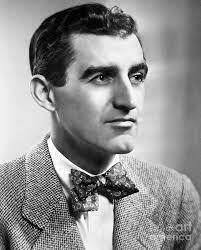
Brendan Gill (October 4, 1914 – December 27, 1997) wrote for The New Yorker for more than 60 years. He also contributed film criticism for Film Comment and wrote a popular book about his time at the New Yorker magazine.
Biography[edit]
Born in Hartford, Connecticut, Gill attended the Kingswood-Oxford School before graduating in 1936 from Yale University, where he was a member of Skull and Bones.[1]:127 He was a long-time resident of Bronxville, New York, and Norfolk, Connecticut.

In 1936 The New Yorker editor St. Clair McKelway hired Gill as a writer.[2] One of the publication's few writers to serve under its first four editors, he wrote more than 1,200 pieces for the magazine. These included Profiles, Talk of the Town features, and scores of reviews of Broadway and Off-Broadway theater productions.[3] As The New Yorker's main architecture critic from 1987 to 1996, he wrote the long-running "Skyline" column before Paul Goldberger took his place.

A champion of architectural preservation and other visual arts, Gill joined Jacqueline Kennedy's coalition to preserve and restore New York's Grand Central Terminal. He also chaired the Andy Warhol Foundation for the Visual Arts and authored 15 books, including Here at The New Yorker and the iconoclastic Frank Lloyd Wright biography Many Masks.

Gill was a good friend of actor Sir Rex Harrison and was among the speakers who memorialized the legendary star of the musical My Fair Lady at his memorial service in New York City in 1990.

Death[edit]
Brendan Gill died of natural causes in 1997, at the age of 83. In a New Yorker "Postscript" following Gill's death, John Updike described him as “avidly alert to the power of art in general.”[3]

Legacy[edit]
Gill's son, Michael Gates Gill, is the author of How Starbucks Saved My Life: A Son of Privilege Learns to Live Like Everyone Else.[4] His youngest son, Charles Gill, is the author of the novel The Boozer Challenge.

Offices held[edit]
Chairman of the Andy Warhol Foundation for the Visual Arts
Chairman of the Municipal Art Society
Chairman of the New York Landmarks Conservancy
Vice President of the American Academy of Arts and Letters
Works[edit]
This list is incomplete; you can help by expanding it.
Books[edit]
The Day the Money Stopped (1957)
The Trouble of One House (1951)
Fair Land to Build in: The Architecture of the Empire State (1984)
The Dream Come True: Great Houses of Los Angeles (1980)
Lindbergh Alone - May 21, 1927 (1980)
Summer Places (with Dudley Whitney Hill) (1978)
Ways of Loving (short stories) (1974).
Tallulah (Tallulah Bankhead biography) (1972)
Cole Porter (Cole Porter biography) (1972)
New York Life: Of Friends and Others
The introduction to Portable Dorothy Parker (Dorothy Parker collection of her stories & columns) (1972)
Late Bloomers
Here at The New Yorker (1975)
Many Masks: A Life of Frank Lloyd Wright (1987)
Articles[edit]
Gill, Brendan (15 January 1949). "The Talk of the Town: Runaway". The New Yorker. 24 (47): 22–23. I Can Hear it Now - album of speeches and news broadcasts, 1932-45 (with Spencer Klaw).
Gill, Brendan (4 February 1950). "The Talk of the Town: The Wildest People". The New Yorker. 25 (50): 21–22. Transit Radio, Inc.
Gill, Brendan (4 February 1950). "The Talk of the Town: Improvisation". The New Yorker. 25 (50): 25. Hiding telephone lines in the ivy at Princeton (with M. Galt).
Gill, Brendan (14 January 1985). "The Theatre: The Ignominy of Boyhood". The New Yorker. 60 (48): 108–110. Reviews Bill C. Davis' "Dancing in the End Zone", James Duff's "Home Front" and Rodgers and Hammerstein's "The King and I".
Gill, Brendan (28 January 1985). "The Talk of the Town: Notes and Comment". The New Yorker. 60 (50): 19–20. West 44th Street development.

Ratings & Reviews

What do you think?
Rate this book

Friends & Following

Create a free account to discover what your friends think of this book!

Community Reviews

5 stars
48 (21%)
4 stars
99 (44%)
3 stars
57 (25%)
2 stars
14 (6%)
1 star
3 (1%)
Displaying 1 - 27 of 27 reviews
Profile Image for Quo.
350 reviews
January 3, 2025
Here at The New Yorker represents a catalogue of memories covering more than half of the long history of The New Yorker magazine, a formidable beacon of American culture & manners. The late Brendan Gill sold his first story to the magazine in 1936 when he was 22 and The New Yorker was 11.


Gill began working at the magazine shortly after his graduation from Yale and over his long career there, edited the "Talk of the Town" column and also did book, film & theater reviews as well as Profiles, Reporter at Large pieces & even an occasional obituary.

Thus, the author intersected not only with Harold Ross, founding editor of the The New Yorker & his successor William Shawn but with virtually every important writer who passed through New York or contributed to the magazine over a period of almost 50 years.

Brendan Gill's book includes countless examples of pithy humor, the clever covers and cartoons The New Yorker is famous for + some interesting photos of a very young John Updike, William Maxwell (who mentored Updike & many others), John Cheever, A.J. Liebling, Louis Mumford, Truman Capote, Lucius Beebe, James Thurber, Katherine White, E.B. White & Joseph Mitchell among others.

The images of the old offices cluttered with galley-proofs & other papers & with various writers hunched over typewriters now seems quite nostalgic but was much less so when this book first appeared in 1975. There is even a photo or two of the esteemed tables reserved for privileged members of The New Yorker at the venerable Algonquin Hotel on West 44th Street, a short stroll from the old offices of the magazine.

Gill speaks glowingly of many authors but less so of others, including Sinclair Lewis, the first American to win a Nobel Prize for Literature, who struck Mr. Gill as:
a great roaring, raging & boring drunk with a vile temper, a generous disposition, immense energy and a notable--often a tiresome--gift for mimicry, matched only by his ability to turn friendly gestures on his part into an occasion for making lifelong enemies of everyone who came within reach of his scalding, vituperative tongue.
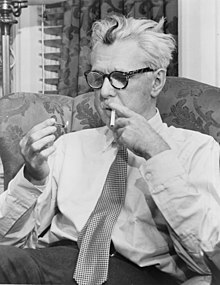
Of James Thurber, Gill mentions that late in life Thurber began treating him in a friendly manner but Gill eventually concluded that this was probably a manifestation of Thurber's belatedly discovered brain tumor. That said, The Years With Ross by James Thurber, also about the early days at The New Yorker is very humorous & quite worth reading.
Even Mr. Gill and the most formally elegant of contributors to the magazine had to come to grips with the legendary Miss Gould & one or two other unyielding, authoritarian administrative assistants, for whom grammar & syntax had an almost Biblical significance.
Their corrections often caused long, drawn-out battles over a single comma or semicolon and highly esteemed staff writers & contributors always seemed to come out on the losing end of the discussion. However, it seems that Dorothy Parker was seldom intimidated.

This book is not likely to appeal to anyone who feels the magazine is elitist or overly formal but The New Yorker is an iconic part of the cultural history of the United States & is very well-regarded abroad as well.

Where else could someone like Joseph Mitchell continue to come to his office daily for 30 years after he'd written his last piece and have the magazine continue to allow him space, attributing his laxity to just a rather severe case of "writer's block"?


There are some areas where times have definitely changed and we no longer refer to people such as Lucius Beebe as a "wealthy bon vivant and a homosexual", as Brendan Gill does in his book. Nor do we seem to refer to anyone today as a "man of letters", as was often said of Mr. Gill.

As a personal footnote, I began reading the magazine ages ago on an Illinois Central train en route to college in New Orleans, at a time when the cost of a weekly issue was 25 cents and have continued to find it an almost indispensable part of my life.

I had the magazine mailed to me via sea freight when I taught school in East Africa and though the issues often arrived months after publication, there is a timeless quality about most of the articles as well as the cartoons.


I once missed a train because I was foraging around a newsstand for a copy of the latest issue prior to being a full subscriber but it seemed a worthwhile pursuit to delay travel in search of a magazine I've taken with me on almost every journey since my initial encounter with The New Yorker.

Reading the magazine on a flight or while in a sleeping car compartment or on a voyage seems an important component of the journey. For this reason, I savored reading Brendan Gill's book.

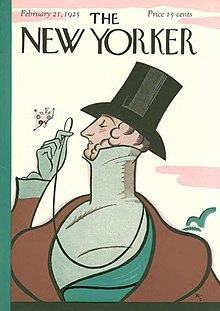
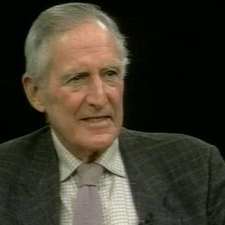
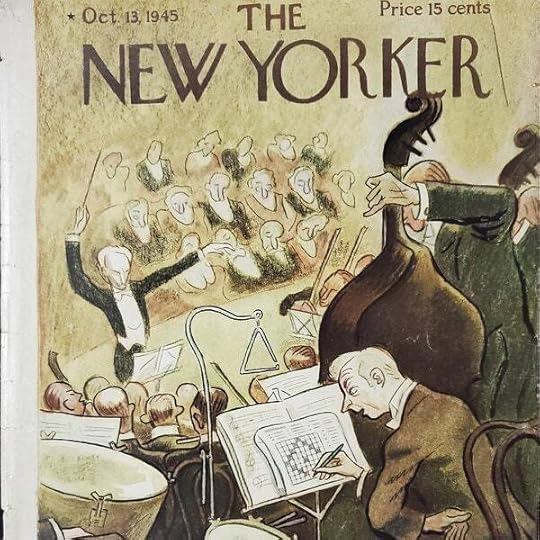
*Within my review are two images of Brendan Gill, one of James Thurber + two of older covers of The New Yorker, including the magazine's debut issue.
Profile Image for Jeff.
275 reviews
July 19, 2021
(I wrote a lengthy review of this book on Goodreads, and it has inexplicably disappeared. Precis follows…) Beautifully written, highly entertaining account of the first 50 years of a foundational, beloved publication and the city that inspired it. Gill is a little pleased with himself and his status as a Yale Bones man and Centurion, and seems completely unaware of his massive privilege (being unaware of it is perhaps the very definition of privilege), yet he is a wonderful storyteller and the prose is fluid and evocative. It is a major piece of work, despite what the goofy cover art shown here might communicate, coming in at nearly 400 pages.
Profile Image for Bill.
16 reviews5 followers
July 16, 2008
Full of gossip, much of which is mean-spirited, although Gill at least had the class to reserve the cruelest anecdotes for the deceased-- for the living, and particularly for William Shawn there is mostly fawning praise. Gill writes as though the reader must certainly be familiar with his work, and I suppose anyone who would read a book like "Here at the New Yorker" would be, but as a literary figure I think it is probably safe to say that this is the work he'd most likely be remembered for, rather than any of the seven other volumes listed on the flyleaf. I recall his writing about architecture, but you could put a gun to my head and I couldn't tell you anything about his film or theater criticism. He was sort of a utility infielder at the magazine, it seems to me, and the sense I got of what he was like personally was that he was likable enough, if he liked you. Although his mother died when he was young, he was nevertheless the child of privilege, a doctor's son. Yale, and a Bonesman, which means that although he'd probably be interesting to have a drink with, he'd have been unlikely to have me over to the Century Club to do so.

The book itself is a curious thing. Nearly 400 pages long, it is anecdotal and discursive. It's methodology seems to be to take up in turn as many people-- editors, writers, artists, what have you, relate a little story about each, and then move on to the next. It does not hang together as well as a New Yorker article does-- it is almost like 400 pages of "Talk of the Town" writing, only not really as good. I've read probably as many of the other memoirs about the magazine as anyone-- I think I've read them all now-- and there was dish here that was new to me, but none of it was particularly illuminating. It wasn't deep dish, let's put it that way, and it would not have been very useful to me in my long-ago abandoned project.
135 reviews
June 1, 2020
The book is a combination of Brendan Gill's autobiography and a history of the New Yorker magazine up to 1975 and it's written in the style of the New Yorker in that time: informative, interesting and somewhat meandering in its approach. I started reading the New Yorker in the 1970's before its takeover by Conde Nast and the magazine's best articles often tended to read like conservations between old friends rather than straight forward reporting. If you like the magazine and you are interested in the magazine's history, this book is for you. There are some really great stories about the writers, cartoonists and editors. To be, one of the more interesting stories concerns James Thurber who wrote many funny stories and drew interesting cartoons, but who, in real life often played cruel practical jokes.
Profile Image for Aurora.
70 reviews1 follower
March 12, 2024
I had not read this author, Brendan Gill, before and will not read any more of his books--a shame really since he's certainly a good writer. The problem is he seems to be evening scores with some people by the act of writing this book, which goes way beyond "warts and all," I would say. While sharing his seemingly endless mental filing cabinet of The New Yorker's staff, personalities, wonderful black & white photos, cartoons, events, quirks, and name dropping, definitely sustains interest and momentum through 395 pages, Gill cannot seem to stop his mean-spirited way of getting each of the entire gang of writers, artists, and editors into the palm of his hand to examine them and describe many of them in the worst possible terms, insulting even the appearance of each in the grossest of terms.

There is no reason to hurl insults for Gill to comment in detail upon about his co-workers' appearance for at least two obvious reasons: 1) this book is about the writing, drawing, editing, or management expertise and habits of these people--all working for a literary magazine, not a fashion publication; 2) the author has supplied clear, close up photographs of every, or very nearly every coworker, rendering his denigrating commentary on aspects of their human appearance not only superfluous, but also making quite a statement about his egotistical and mean-spirited reasons for attacking people who have passed on and cannot defend themselves.

Gill describes, for example, John O'Hara: "I was startled by O'Hara's ugliness. He was in his middle thirties and had already grown heavy; his head rose out of an exceptionally thick neck and his ears stuck out bizarrely from fleshy cheeks. To make matters worse, he had a bad complexion and a mouth full of decaying teeth, which he was all too slowly having replaced. In spite of his looks and my awe of him, we got on." O'Hara, a highly successful author, might not have ever spoken to Gill again and regretted he ever had, had he known in what terms Gill would immortalize him in print after his death. After excoriating this man for his ego ironically, Gill included an accompanying photo of O'Hara showing him to be an average looking middle-aged man by the way, but it is clear that Gill had to be sure to put this successful man under his evil magnifying glass lest you believe O'Hara's achievements overshadow Gill's perhaps? He admits how thoroughly successful O'Hara was by any account. Every person Gill describes has his discolored or missing teeth permanently documented posthumously in literary history by the author, as well as any physical asymmetry, less than perfect clothing, education, etc.

He repeatedly refers to women as "fat," and even goes so far as to insult one even reaching into future tense, to wit: "She hasn't gotten fat yet." (None but thin, attractive women have their photos included.) Only in one case among many pictured rotund (his word) men does he refer to a man as fat; that's reserved for women. The other men he terms "tubby," having "a big belly," and the like. Some of his minutely insulting descriptions literally took my breath away.

He omits any discussion of at least several highly important women who were central to the success, popularity, and personality of the magazine, such as Dorothy Parker. She was a vitally important, and constant, critic and contributor on The New Yorker, and a regular of the Algonquin Roundtable, yet although he mentions her name five times according to the index, he never once offers the smallest anecdote about her or her work, nor any sample of her work. He similarly disses Mary Petty, a prolific and highly talented artist on the magazine, mentioning her only as "the wife and fellow-artist" of another staff member whose art he does include and described at length. (If you look Petty up online you will see cover after beautiful New Yorker cover painted by her, plus cartoons.)

Gill never fails to mention a subject's Ivy league degree or aristocratic pedigree since he himself had both, of course; however, and in every case, he feels compelled to reveal or at least speculate at length how much money each of his coworkers has. And there is endless commentary about how much each person hankers after more money or success, as though everyone must indeed be at least as obsessed with those aspects of life as he is.

And he makes sure to describe the drinking habits of his coworkers. Although at one point or two, he does acknowledge in passing that he likes to drink too, he characterizes many as what could only be termed sloppy drunks. He obviously holds himself above such a defective appearance or absence of class. He calls one young writer, whom he says is "a homosexual" and a "poor fool" (as he judged and recorded him for posterity) claiming has literally damaged his brain by excessive drinking in such a way, that definitively he had thus sent himself back into childhood--clearly evidenced by his fondness fo toys. He judges another coworker in this identical fashion. It never occurs to him that these two men, for example, could be rape survivors self-medicating with alcohol, and that the toys are a symptom of each trying to relive a childhood stolen from them. This author not only had no sympathy, he had no knowledge of mental illness nor the simple perspective required to see maybe he didn't know what the problem really was, nor even to stop to consider other more compassionate perspectives. Remember that he is referring to life in the 70s, so it is not as if he is writing from the 19th century.

It would be interesting to know how much time elapsed from the first word Gill wrote of this book until the later chapters. He begins later in the book to offer more seemingly heartfelt compliments and to include himself as an errant human being along with his criticisms, but what does that mea culpa mean as he has gone to print anyway with his horrific descriptions and highly and minutely insulting summaries of his coworkers and friends. It's as though he wants you to let him off the hook for his vengeful and egotistical accounts by believing he wrote and published the book a few paragraphs at a time when he started at the magazine at 22 yrs. old, and was too immature to realize how jealous and fault-finding he was until he published it at "almost 50." If he wasn't a malevolent narcissist, why would he have sent this mean-spirited book to print? Why not soften the descriptions, if he did truly begin to feel more humane? It would be understandable to criticize their writing or art, but their weight and their teeth are irrelevant to the history of The New Yorker, in any case.

He could barely contain his hatred of James Thurber in his scathing descriptions of him, and even sounds childishly jealous that Thurber's talented drawings remained on the office walls decades after he drew them. It apparently bothers Gill that they are still there even though many are covered beneath coats of paint, because he mentions that fact more than once, even after Thurber's cartoons have been expunged. Notably, he even speculated that the only reason Thurber was kinder to him in later years must have been Thurber's as-yet-undiagnosed brain tumor! Perhaps Thurber had wisely matured when Gill obviously had not! Yet Thurber having a brain tumor was the only reason which Gill was capable of discerning to judge or attribute to Thurber's improved behavior.

It's truly a shame that this author distracts the reader, and equally detracts from his own talent, so thoroughly that this historical account of an iconic American journal of the times over decades becomes more like documenting the hundreds of painful paper cut insults you will have to suffer to get through his 395 pages. However, you can feel fortunate indeed to not have been a coworker of Gill's who has to endure character assassination in perpituity, and wonder if most people judge your appearance so harshly now that it has been horridly documented for posterity. Chalk this book up to an Ivy league educated, entitled, bully writing straight out his unprofessional immaturity with oddly no editorial voice of reason to hold him in check.

Also note that unfortunately I unknowingly bought this book as a first edition, which was not reflected in the price. Had I bought a later version, at least I might have enjoyed the added introduction by more recent staff who couldn't possibly have been as cowardly to write so ill of the dead.
Profile Image for Harald.
492 reviews10 followers
September 6, 2024
Humor and seriousness.
The New Yorker appears in many ways as a humorous magazine. Likewise, this book contains many funny cartoons. I was therefore surprised when the author uses the introductory paragraphs to attack the first editor, Harold Ross: inept as an editor and unpleasant as a fellow human being, Gill writes. Only on page 43 comes the first good, laugh-out-loud story. Fortunately, there are more to come, and we get a captivating, if jumpy presentation of the famous magazine seen from the inside. Gill is good at giving personal descriptions of the many writers and artists who wrote and drew for the magazine, often for meager payment, in the period from 1925 to 1975.

The New Yorker is known for the quality of its writing. Gill makes it clear that the high level comes from hard work in the editorial office. It can be a painful process, but one that I wish Norwegian publishers would also take more time and effort into.

The book has a surprising ending. Gill now regrets most of the bad things he wrote about Ross in the first chapters. Now he paints a conciliatory portrait of the same man. He gives the last word - over several pages - to the next editor, William Shawn, who has mostly pleasant words about his predecessor. (The review applies to the first edition from 1975)
Profile Image for A.L. Sirois.
Author 32 books22 followers
January 6, 2015
For some reason, I have a soft spot in my heart for The New Yorker, particular under the leadership of Harold Ross, who must've been quite a character. I loved, for example, THE YEARS WITH ROSS by James Thurber. And now this Brendan Gill book adds to my joy at reading about the magazine in its early and middle years (the book was published in the mid-70s). Recommended for anyone who, like myself, loves the magazine and the personalities of the writers and artists who worked there.
972 reviews20 followers
February 14, 2025
Brendan Gill was a writer at the New Yorker from 1936 to 1996. In this 1975 memoir he says that as of that point, he had published more words in the New Yorker than anyone. He published profiles, short stories, drama reviews, book reviews, casuals, and anything else that was needed. Since he continued for another 21 years, I suspect he still owns that crown.

This is a surprisingly frank memoir. He describes, "Thurber, that malicious man.". He says that Harold Ross, the founding editor, was a virulent racist who refused to hire a single black employee. Edmund Wilson hated Catholics. The owner Raoul Fleischman was a self-hating antisemite. When he meets John O'Hara, the great short story writer, he says, "I was startled by his ugliness."

Even his friends come in for savaging. He says that "thinking of Stanley Hyman, (a writer and Shirley Jackson's husband) I begin to smile" He then describes how his good friend was a fat drunk who constantly cheated on his wife. Even though she made more money than him, he controlled the money and put her on an allowance. This is his portrait of his good friend.

Ironically, the only person who he has nothing bad to say about is Charles Adams, the cartoonist who is famous for his weird, scary, creepy cartoons. He says that everyone always assumed he was deranged, or unbalanced and he was actually a very nice perfectly normal guy.


Gill tries to make himself the innocent among these strange people. He writes a vicious review of a novel by his friend John O'Hara and is shocked when O'Hara tells everyone that his going to knock Gill's block off. When he gets hired, he tells the payroll department to hold his monthly draw until he may need it, and he doesn't understand why everyone thinks he is a spoiled rich guy.

To be clear, because of this ruthlessness, the book is a great read. It is aimed at those of us who are fascinated with the New Yorker world. It is the equivalent of a Hollywood gossip book but set among intellectuals in NYC. It is full of interesting stories about interesting people, and it is well illustrated with cartoons and candid photos.

Profile Image for Josh.
1,021 reviews19 followers
October 18, 2025
Gill spent 60 years on staff at The New Yorker, and here offers not so much a linear history of the magazine but rather a loose, rambling trawl through memory. He creates warm portraits of his seniors and contemporaries, shares humorous anecdotes, and distills some of the magazine’s ethos when it comes to writing, editing, and art. Gill is a charming but loquacious raconteur who writes as though he knows he has a captive audience: This book is shaggy, at times tedious, just as often bewitching. It could have been half as long, and probably only half as good.
287 reviews
August 11, 2025
Early on in this book, I found Gill to be arrogant and uncharitable, as exemplified his characterization of some nameless washouts at The New Yorker (one simply called “the loser”) and Harold Ross himself, the founding editor of the magazine. I did eventually warm to his voice and appreciate his straightforward evaluations of numerous key personalities involved in the magazine’s first 50 years. This book’s ultimate subject is mortality Ross’s, William Shawn’s,and Gill’s own.
93 reviews57 followers
September 25, 2018
A behind the scenes look at The New Yorker magazine from the '20s-'70s. All the greats are here: Joseph Mitchell, A. J. Liebling, John McNulty, St. Clair McKelway, etc. Very entertaining.
Profile Image for Dan.
287 reviews1 follower
June 9, 2020
Controversial but I enjoyed it.
6 reviews
June 29, 2020
Nostalgic both for the era he wrote of as well as when he wrote the on (1973) but the characters of the men and women are vastly different than the intelligentsia of today.
727 reviews4 followers
May 18, 2023
Enjoyable, rambling discussion of the New Yorker along with portraits of the writers/editors that made it a great. Gill started in 1936 and stayed till the mid-70s. And he knew everyone from Harold Ross to Pauline Kael. Those still alive when the book was published are praised to the hilt, Gill saves any venom for those dead and unable to fight back.

Quite a few pictures.

Most interesting Tidbit: A nice, gentle takedown of Kael's writing style which Gill describes as "garrulous".
Profile Image for David.
1,455 reviews39 followers
February 8, 2017
First reading: June 28 to July 4, 1976: Comment written in 2016:

Having been a fan of the New Yorker for many years, this book was a great pleasure. Good insight on some of the remarkable writers and editors who made it all marvelous. Brendan Gill certainly was near the top of my list. Since nearly 40 years have passed since I read this, any more comment would be presumptuous -- but there you are. Gave it four stars.

12/19/16 -- just finished Thurber's "The Years With Ross" and decided to revisit this.

Comparison with Thurber's viewpoints quite interesting -- lots of difference, as you might expect, given that Gill is writing twenty years later and was not a fan of Thurber. Also, this is as much about Gill -- sort of a work-related memoir -- as it is a book about The New Yorker. Gill is critical of lots of the writers and editors, sometimes gratuitously, but at least he's candid. Sometimes he's self-effacing, but not always. Always laudatory of Shawn; respected Ross.

Giving it four stars this reading, too.
21 reviews1 follower
June 18, 2013
This is truly the book to read for fans of the magazine. Superb account of what it wsa like to work there during what might perhaps be the "Golden Years" of The New Yorker's history. Gill is a superb writer as one might expect for a man who spent the good part of his career writing for what is probably the best literary magazine ever published in the United States. This is not a "tell all" memoir. Gill was too sophisticated to stoop that low. But it is a wonderful look at the people who created the magazine and how it all came together, flawlessly, week to week for over a half-century. I found it particularly interesting to read how the literary staff of the magazine and business staff of magazine went out of their way to avoid crossing paths in the offices they occupied jointly on 44th Street in New York.
Profile Image for David.
532 reviews6 followers
September 20, 2010
I make it a point to read all of the insider accounts of The New Yorker magazine although I cancelled my subscription immediately after their 9/11 issue.

Gill truly led a charmed life but he realizes it and the story of his experiences at the magazine as well as the profiles of those he worked with is very enjoyable.
700 reviews6 followers
November 25, 2014
It was a fun read though long for a reader who hadn't read enough of the New Yorker to know and understand more than a few of the personalities involved here. Recommended for anyone who appreciates intelligent humor and doubly recommended for those who have read the New Yorker for many years.
Profile Image for Jennifer Heise.
1,765 reviews61 followers
January 29, 2015
I'm one of those who prefer Thurber's portrait to Gill's; Thurber, after all, being less sharp-tongued. Who knows, Gill may have the right of it, but since all the principals are dead, I prefer to give Harold a soupcon of mental charity.
Profile Image for Matt.
48 reviews10 followers
October 12, 2008
Because I better be prepared before I edit the rag.
7 reviews1 follower
December 3, 2008
There is nothing like the New Yorker in its prime. Gill's book gives you a glimpse into something that will never come again.
Profile Image for Leslie.
39 reviews8 followers
July 14, 2009
Written by a long-time contributor to The New Yorker, this book describes the early years of the magazine and some of the notable characters who worked there.
Profile Image for Jeff.
Author 7 books41 followers
December 4, 2009
So fussy and twee, it's like a Harvard Lampoon parody of a book about the New Yorker.
Displaying 1 - 27 of 27 reviews

Can't find what you're looking for?

Get help and learn more about the design.