

What do you think?
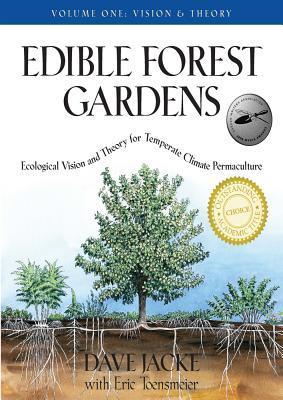
Edible Forest Gardens, Vol. 1: Ecological Vision and Theory for Temperate Climate Permaculture
Edible Forest Gardens is a groundbreaking two-volume work that spells out and explores the key concepts of forest ecology and applies them to the needs of natural gardeners in temperate climates. Volume I lays out the vision of the forest garden and explains the basic ecological principles that make it work. In Volume II, Dave Jacke and Eric Toensmeier move on to practical concrete ways to design, establish, and maintain your own forest garden. Along the way they present case studies and examples, as well as tables, illustrations, and a uniquely valuable "plant matrix" that lists hundreds of the best edible and useful species. Taken together, the two volumes of Edible Forest Gardens offer an advanced course in ecological gardening--one that will forever change the way you look at plants and your environment.
396 pages, Hardcover
First published August 30, 2005
Ratings & Reviews
Friends & Following
Create a free account to discover what your friends think of this book!
Community Reviews
Displaying 1 - 30 of 42 reviews
July 7, 2008
Volume 1 of this series of two textbooks describes the theory behind permaculture design in the temperate Northeastern United States. The implications of this kind of permaculture design are tremendous; applying them can result in self-fertilizing, soil building, low maintenance ecosystems where just about everything is edible. Once an initial inputs of fertilizer, soil amendments and biological cultures are applied, a mid-succession forest can establish itself in approximately four years.
This appeals to me because I am lazy and frugal. Developing a garden that doesn't require regular weeding, pesticide, fertilizer, or water, can produce as much or more food than a typical annual garden, and provides habitat for other creatures that I can offload traditional gardening work onto sounds fantastic.
This style of gardening is still in its infancy, at least in modern times. We've lost the permaculture skills humanity had thousands of years ago in favor of machine driven, high-yield, high-input annual agriculture. Modern agriculture consumes nonrenewable fuels and drains nutrients from the limited arable land we have available.
This textbook doesn't require in-depth knowledge of agricultural theory; it's extremely easy to read. I recommend it to anyone interested in reorganizing their thought patterns about where food comes from and how we can improve its production.
This appeals to me because I am lazy and frugal. Developing a garden that doesn't require regular weeding, pesticide, fertilizer, or water, can produce as much or more food than a typical annual garden, and provides habitat for other creatures that I can offload traditional gardening work onto sounds fantastic.
This style of gardening is still in its infancy, at least in modern times. We've lost the permaculture skills humanity had thousands of years ago in favor of machine driven, high-yield, high-input annual agriculture. Modern agriculture consumes nonrenewable fuels and drains nutrients from the limited arable land we have available.
This textbook doesn't require in-depth knowledge of agricultural theory; it's extremely easy to read. I recommend it to anyone interested in reorganizing their thought patterns about where food comes from and how we can improve its production.
February 14, 2008
greatest resource ever on farming the forest. integrating this with livestock is my current life mission. i love biological systems.

July 19, 2011
It's a textbook. It's not fun. But it taught me a couple things. On to the practical side of things (Vol II)!

April 1, 2013
This book is really more like an ecology textbook that happens to pertain to forest gardens. If you know ecology, just skip to the second volume.
June 7, 2021
I actually read this hefty book (and it's second volume) cover to cover. I found it fascinating.

March 15, 2013
This was really excellent book, as well as its sequel. The only reason I didn't give it maximum number of stars is it's north American focus. Wish someone wrote something like this centered on Europe.

April 28, 2016
Highly detailed and theoretical, this book is by no means an easy reading, though the authors seemingly tried to avoid a lot of technical speech. Still, in order to learn and understand its information one should put these ideas into practice.

January 17, 2008
there are two volumes, both great!
May 6, 2012
Essential reading for anyone seriously considering a forest garden or food forest.

August 15, 2025
I’m a forester - PhD and all that jazz. And rarely in our literature (let me include here all books talking about trees/forests, from philosophy to technical manuals) we find a good balance between theory and practice. Or between theoretical complexity and simplicity in application.
Applied ecology has historically been described in numbers - environmental modelling, complex nutrient cycle diagrams, statistical results of hyper specific experiments.
In this book, Dave and Eric take a different approach. Ecology is the backdrop and foundation, but instead of dwelling into it and rejoicing its complexity for the sake of it, they pursue a clear objective - Designing and implementing a food forest.
The result is a book that tells a story of ecology, while teaching you something. Guiding you to understand what, how, when and why things are or could be a certain way or another.
It is a much needed resource for its applicability and relevance in our current food system. But it is also interesting and well structured.
I found it to be at a complete different level, when compared to most Permaculture books I’ve read.
It is not just a textbook. it is not just a technical manual. it is not just literature. It is all of the above.
Applied ecology has historically been described in numbers - environmental modelling, complex nutrient cycle diagrams, statistical results of hyper specific experiments.
In this book, Dave and Eric take a different approach. Ecology is the backdrop and foundation, but instead of dwelling into it and rejoicing its complexity for the sake of it, they pursue a clear objective - Designing and implementing a food forest.
The result is a book that tells a story of ecology, while teaching you something. Guiding you to understand what, how, when and why things are or could be a certain way or another.
It is a much needed resource for its applicability and relevance in our current food system. But it is also interesting and well structured.
I found it to be at a complete different level, when compared to most Permaculture books I’ve read.
It is not just a textbook. it is not just a technical manual. it is not just literature. It is all of the above.

August 27, 2020
Every book on forest gardens references Edible Forest Gardens by Dave Jacke and Eric Toensmeier. Published in 2005, I'm amazed that this book is still referenced everywhere 15 years later.
It's A LOT of theory, some of it useful, some of it not as much. I really enjoyed the chapter in what goes on underground, and found the chapter on social structures and succession theories to be a real slog.
The writing isn't too pretentious - the authors (or their editor!) know when to throw in a joke and come back to their non-scientific audience.
Overall, a 4 out of 5 stars for good readability and useful info. Oh, and the appendix on their top 100 recommended forest gardening species is GREAT!
It's A LOT of theory, some of it useful, some of it not as much. I really enjoyed the chapter in what goes on underground, and found the chapter on social structures and succession theories to be a real slog.
The writing isn't too pretentious - the authors (or their editor!) know when to throw in a joke and come back to their non-scientific audience.
Overall, a 4 out of 5 stars for good readability and useful info. Oh, and the appendix on their top 100 recommended forest gardening species is GREAT!

November 15, 2017
For temperate climate growers and permaculture practitioners, there is not a more comprehensive source on food forest ecology and creation. If you want to design like a pro, this 2-volume set has everything you need.
April 30, 2022
Good for a primer to the rationale behind permaculture and food forests, but I don't think the average permie would learn much from this book that isn't covered in Vol. 2, which contains an indepth walthrough of a design process for forest gardens

October 20, 2024
Junto a la segunda parte son dos libros excelente. Muy completo, con todo el material necesario. Las tablas especialmente son un recurso fabuloso. La única pega es que se repiten un tanto los temas y consejos, en menos páginas cabría el mismo contenido.
October 11, 2017
Very well researched, but far above my level/out of my scope as a beginning/intermediate gardener.

June 18, 2018
Extremely informative book about the building blocks of Permaculture! Looking forward to exploring the planning information in volume 2.
August 6, 2018
An incredible, easy-to-read introduction to permaculture food forests. I highly recommend this book!

February 11, 2019
"Our biggest mistake is that we see ourselves as separate from the natural world." - Dave Jacke, Edible Forest Gardens, Volume 1

September 4, 2020
Indispensable guide for anyone wanting to learn about growing their own food forest. I loved the variety of information, from diagrams to case studies.
September 28, 2021
Very comprehensive and theoretical book about forest gardening. The plant lists (ex. N-fixers, dynamic accumulators) are really usefull!
Read
February 12, 2023Imagine debunking the idea of wilderness!! When Europeans came to Australia and America, they called it wilderness. It was farmed.
Amazing book, amazing ideas
Amazing book, amazing ideas
October 4, 2024
This is a great resource on how to form a permaculture food forest. There is a lot of information in theory. The best section of the book is "Forest Gardening's "Top 100" Species."

June 14, 2025
I want this book on my bookshelf.

December 26, 2014
What we have is no less than the beginning of an adventure, explicitly stated. That adventure is to see our habitats become habitats, restoring our dwellings to gardens in the shape of forests. The great pleasure of this adventure is that it can really be any of ours.
This book is the first of two volumes; between the two it is the considerably slighter by page count. With color illustrations, photographs, and watercolor touches, it also seems to be the prettier. Other comparisons will have to wait until I've also read the second.
It is, as the subtitle promises, a vision followed by an ecology, but rich in structure, introductions and conclusions follow, not to mention an appendix including resources, index, glossary, bibliography, and in addition a guide to 100 favorite species and maps to hardiness regions.
The introduction orients us, giving us the terms of what forest gardens are, explaining their basic feasibility and the regional specificity of this volume (which I will call the Eastern and Midwestern United States), and issuing an invitation to adventure. In any adventure, there is first a call to change, the challenge to address. This is engaged by looking into the past, remembering the primeval forest as it was managed by indigenous people, and the sequence of events that led to the current curious ecological situation of suburban life, where food, energy, and material flows happen divorced from the ecosystem of one's habitat. Then, a vision of a new forest gardening, what change directed towards restoration might look like, is presented. This remembrance and call to change are the two chapters which are together the vision section.
It then turns to a case study of Charlie's garden, a forest garden of a large, but not implausible, urban lawn, done very well, but not perfectly, in reasonable satisfaction to its steward. Seeing the lay of the land, we are then able to start the ecology section, starting with the elements of forest architecture: vegetation layers, soil horizons, vegetation density, patterning, and diversity. This chapter gives us enough literacy to understand a case study of Robert Hart's garden, which despite having many criticisms is kind to the originator of forest gardening, indicating that forest gardening is often forgiving in how it allows one to meet goals despite mistakes.
We then turn to the social structure of the garden, understanding the above ground food web, guilds, competition, and how particular communities of plants tend to fill particular kinds of niches in a way that changes over time. The next chapter follows the same path underground, looking at the interaction of roots, the soil food web, and the development of fungal and bacterial interactions supporting plant growth. These chapters provide a way to read the overall community, allowing one to see relations in the architecture.
We then encounter our first difficulty, the morass of theories of succession, unquestionably the most painful section of this book. Here a musical score would become more discordant, as those undertaking the training would disagree about what is appropriate to the road ahead, the truth being revealed to be progressively more complicated. This particular formulation is really only helpful to those who well remember a simpler successional theory, which I imagine to be a substantial number if not including myself. The truth might be more concisely stated: succession proceeds in a variety of patches in a variety of directions with no fixed end but instead with continued cycles of disturbance.
It turns away from this tone of with another case study in the form of an interview with Martin Crawford, who has undertaken an exemplary forest garden.
This book concludes its main text with a summary, a look into volume two, a tome that will take us through design and practice. The appendix immediately following, which include 100 of the most commonly useful forest garden plants, acts as a reassurance that, although so much is unknown about the world below our feet, in the web of the soil, and there are so many contingencies above, we can recognize useful and common patterns which suitably, if not completely, prepare us for our own adventures, which is then a great place from which to begin learning to design and practice for ourselves.
This book is the first of two volumes; between the two it is the considerably slighter by page count. With color illustrations, photographs, and watercolor touches, it also seems to be the prettier. Other comparisons will have to wait until I've also read the second.
It is, as the subtitle promises, a vision followed by an ecology, but rich in structure, introductions and conclusions follow, not to mention an appendix including resources, index, glossary, bibliography, and in addition a guide to 100 favorite species and maps to hardiness regions.
The introduction orients us, giving us the terms of what forest gardens are, explaining their basic feasibility and the regional specificity of this volume (which I will call the Eastern and Midwestern United States), and issuing an invitation to adventure. In any adventure, there is first a call to change, the challenge to address. This is engaged by looking into the past, remembering the primeval forest as it was managed by indigenous people, and the sequence of events that led to the current curious ecological situation of suburban life, where food, energy, and material flows happen divorced from the ecosystem of one's habitat. Then, a vision of a new forest gardening, what change directed towards restoration might look like, is presented. This remembrance and call to change are the two chapters which are together the vision section.
It then turns to a case study of Charlie's garden, a forest garden of a large, but not implausible, urban lawn, done very well, but not perfectly, in reasonable satisfaction to its steward. Seeing the lay of the land, we are then able to start the ecology section, starting with the elements of forest architecture: vegetation layers, soil horizons, vegetation density, patterning, and diversity. This chapter gives us enough literacy to understand a case study of Robert Hart's garden, which despite having many criticisms is kind to the originator of forest gardening, indicating that forest gardening is often forgiving in how it allows one to meet goals despite mistakes.
We then turn to the social structure of the garden, understanding the above ground food web, guilds, competition, and how particular communities of plants tend to fill particular kinds of niches in a way that changes over time. The next chapter follows the same path underground, looking at the interaction of roots, the soil food web, and the development of fungal and bacterial interactions supporting plant growth. These chapters provide a way to read the overall community, allowing one to see relations in the architecture.
We then encounter our first difficulty, the morass of theories of succession, unquestionably the most painful section of this book. Here a musical score would become more discordant, as those undertaking the training would disagree about what is appropriate to the road ahead, the truth being revealed to be progressively more complicated. This particular formulation is really only helpful to those who well remember a simpler successional theory, which I imagine to be a substantial number if not including myself. The truth might be more concisely stated: succession proceeds in a variety of patches in a variety of directions with no fixed end but instead with continued cycles of disturbance.
It turns away from this tone of with another case study in the form of an interview with Martin Crawford, who has undertaken an exemplary forest garden.
This book concludes its main text with a summary, a look into volume two, a tome that will take us through design and practice. The appendix immediately following, which include 100 of the most commonly useful forest garden plants, acts as a reassurance that, although so much is unknown about the world below our feet, in the web of the soil, and there are so many contingencies above, we can recognize useful and common patterns which suitably, if not completely, prepare us for our own adventures, which is then a great place from which to begin learning to design and practice for ourselves.

June 3, 2017
The permaculture bible for the humid temperate zones of the world. Covers a diverse battery of the relevant topics from soil biology, to biological evolution, but mostly ecology.
Volume 1 is the design theory and lists of things to consider and helpfully useful plant species. Also covers common mistakes such as packing plants as close as possible.
On to volume 2, the practical how-to.
Unfortunately, I live just outside the forest zones on the prairie, so I'm waiting for the work at the Land Institute https://landinstitute.org/ to become available to make as suitable poly-culture for my biome.
Volume 1 is the design theory and lists of things to consider and helpfully useful plant species. Also covers common mistakes such as packing plants as close as possible.
On to volume 2, the practical how-to.
Unfortunately, I live just outside the forest zones on the prairie, so I'm waiting for the work at the Land Institute https://landinstitute.org/ to become available to make as suitable poly-culture for my biome.
November 11, 2013
ABSOLUTELY RECOMMENDED.
A book, that makes you want to write books, the quality of research, the objectiveness that is emerging from a real need to learn, instead of making clear facts that supports specific agendas. Asking most if not all of the questions needed about aboveground ecology, underground ecology, Plant's communal relationships and the development of ecosystems over time is just right. It's an intensive book, full of information...
A book that is eye opening and focus sharpening for any kind of gardener/farmer who want to understand what's going on in the plant world. It changes many of the by-the-way information that we learned upside-down and that is amazing. Instead of reading several books to cover the most important topics, this book put it all between 2 book covers and keep it open for development when research bring up more information in 5-10 years...
can't wait to start reading the second volume....
A book, that makes you want to write books, the quality of research, the objectiveness that is emerging from a real need to learn, instead of making clear facts that supports specific agendas. Asking most if not all of the questions needed about aboveground ecology, underground ecology, Plant's communal relationships and the development of ecosystems over time is just right. It's an intensive book, full of information...
A book that is eye opening and focus sharpening for any kind of gardener/farmer who want to understand what's going on in the plant world. It changes many of the by-the-way information that we learned upside-down and that is amazing. Instead of reading several books to cover the most important topics, this book put it all between 2 book covers and keep it open for development when research bring up more information in 5-10 years...
can't wait to start reading the second volume....

March 22, 2010
This book is essentially a text book that brings together forest ecology, sustainability and edible landscape design. There is a good overview of a lot of the biology and ecology of creating low-maintenance, self-sustaining gardens. I know Volume 2 has more design and practice, so I can't wait to read it. Volume 1 has a a handy list of the top 100 plants for an edible forest, sorted by each plant's best environment (upper canopy, mid-story, shrubs, vining groundcovers, etc) in addition to all the theories. THis book does raise more questions than it answers, but the ideas are still new - replicating a forest with mostly / entirely edible plants, focusing on native plants and ecological design. Some of these theories will take decades to test and improve on because trees grow slowly, but we have to start somewhere, and this is a good place to start.

February 10, 2015
I should have annotated this a long time ago -- both of these are reference materials a lot more than educational. For theory and systems concepts the first volume is essentially a longer and more detailed version of Gaia's Garden.
However, if you are looking for lists of plants and what characteristics they have to fit into a permaculture guild, this is the place to be for midwestern USA specifically and temperate regions in general.
Unfortunately, data tables are paper only. I already spend too much time in front of the computer, but I will gladly send my copies to someone who will enter all that data into a set of spreadsheeta and put it in the public domain. If that is legal.
However, if you are looking for lists of plants and what characteristics they have to fit into a permaculture guild, this is the place to be for midwestern USA specifically and temperate regions in general.
Unfortunately, data tables are paper only. I already spend too much time in front of the computer, but I will gladly send my copies to someone who will enter all that data into a set of spreadsheeta and put it in the public domain. If that is legal.

May 20, 2008
I got this book (and its companion volume Edible Forest Gardens: Ecological Design And Practice For Temperate-Climate Permaculture (Edible Forest Gardens)) for information about forest gardening in the north east. As I read it (and it's a surprisingly easy and enjoyable read for what is essentially a text book) I learned a huge amount about forest ecology.
These two volumes contain a wealth of theory and practical information.
These two volumes contain a wealth of theory and practical information.

October 22, 2013
An excellent and thorough guide to the topic of Forest Gardening (FG). Lots of theory behind concepts of FG are presented and some practical examples are given. I'm looking forward to reading the second volume and redesigning my yard.
Displaying 1 - 30 of 42 reviews