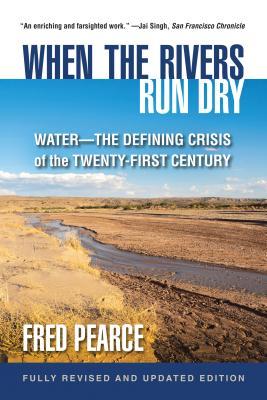
Written in 2006, Fred Pearces's book "When the Rivers Run Dry", seems somewhat prophetic to those of us living in the Southwest United States. The Colorado River, the lifeblood of the Southwest, is severely overused, and upstream demands means it no longer flows to the sea. With reduced river flows and diminished snow pack in the Rockies and Sierra Nevada mountains, water supplies in the Southwestern states are severely stretched. As 2015 news accounts describe, California has been in a drought for several years, and significant water restrictions have been issued statewide. But water issues reach well beyone just the Southwest United states. Many other regions are suffering similar impacts, as Fred Pearce describes in his book.
Locally, Southern California's Salton Sea, as well as Lake Mead and Lake Powell in the U.S. Southwest, are shrinking rapidly. On a more global scale, the Aral Sea in Asia, once the world's 4th largest lake, has all but disappeared. Southwest Brazil is undergoing a terrible drought, as are parts of China, Australia, Spain, Syria, Iraq, Africa, etc. And as leaders have tried to solve the problems by damming rivers, creating man-made lakes, creating huge irrigation projects, matters seem to just be getting worse. Water is wasted through inadequate water infrastructure, groundwater aquifers are incapable of being replenished, wells are running dry world-wide, and what water which does reach groundwater sources often is so polluted as to be useless for consumption or agriculture. Dams created to prevent flooding prove incapable of fulfilling their mission, resulting in devastation to towns, villages, and downstream population. We hear of some of these situations, over time, but the totality and impact of the problem often doesn't register. But this book certainly drives the point home.
In addition to the various places around the world suffering from water shortages, Pearce describes numerous and well detailed examples of failed water infrastructure projects, increased pollution of fresh water supplies, and the folly of a number of gone-bad water resource improvement policies. As world population increases, water resources are being over used, and it only takes a few years of lower rainfall, lower snowpack in mountains, shrinking glaciers, or poor water management decisions to push regions into crisis. The beauty of the book is that the chapters are very short, examples are clear and to the point, and extremely easy to read. It's truly a book for the layman, easy to understand without being superficial.
It may be an exaggeration to compare this book and its impact to Rachel Carson's "Silent Spring", but as Carson's book highlighted the problems of pesticides and DDT, kickstarting the environmental movement at the end of the 20th century, Pearce's book highlights water pollution and shortages as the defining crisis of the twenty-first century. Hopefully, this book and others like it will raise attention and resources to address the water crises around the world.
When beginning the book, the examples make you feel that the earth can barely supply enough water for its current population. But Pearce leaves us with some hopeful prospects for the future. The good news is that water is the ultimate renewable resource. We never destroy water. We may mismanage it, pollute it, waste it, but sooner or later, it will return one day. The difficulty is in ensuring that the water we need will be there, when and where we need it. Pearce shows where we mismanage water, and where we have the potential for doing better. The solution in most cases is not more and bigger engineering schemes, giant desert canals or megadams. These projects tend to be hugely expensive, and cause as many problems as the solve.
Recreating flood plains, recovering ancient water delivery systems, selected dam removals, drip irrigation techniques, porous pavement initiatives in major cities, natural steps to refill aquifers, capturing monsoonal rains, rooftop rain capture, etc. are all effective tools to improve our precious water supplies. But of course, fixing the problem requires being AWARE of the problem, and "When the Rivers Run Dry" brings the problems, along with some solutions (and a promise for more intelligent water usage in the future), to light.