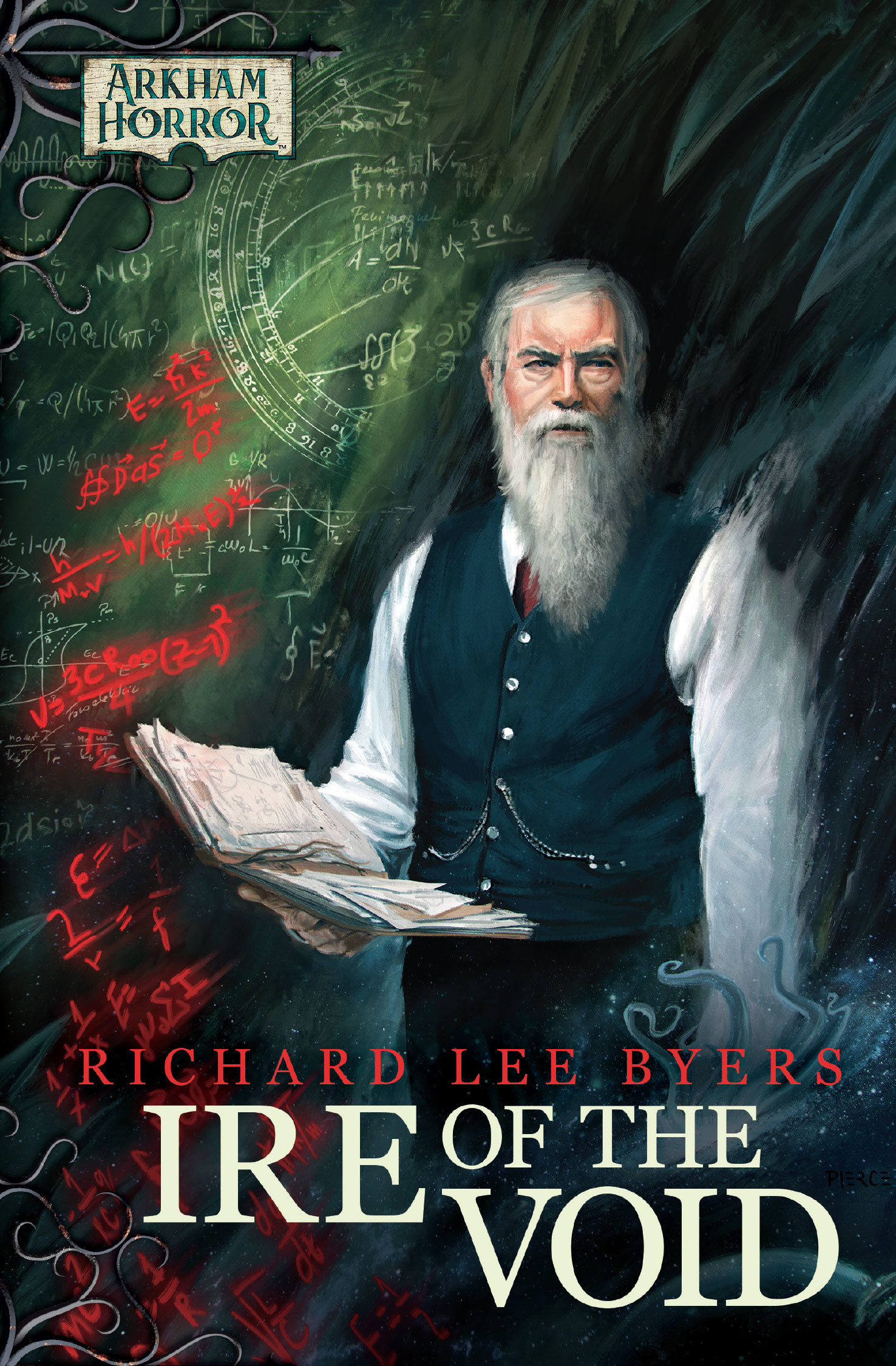
Nobody believes him, and why should they? How could six stars vanish from sight all at once, never to reappear? Astronomer and Miskatonic University professor Norman Withers had all but given up on regaining his colleagues’ esteem when a protégé of the renowned Albert Einstein comes to speak on campus. The visiting physicist, with unsettling theories about the curvature of space-time, may hold the key to helping Norman explain the phenomenon of the vanishing stars.
But when Norman agrees to assist the physicist with his own experimental conundrums, they find themselves no longer the seekers of knowledge, but those sought after. What creatures lurk in the angles of time, and how can two men of science stand up to beings that defy the laws of reality?
A resident of the Tampa Bay area, Richard spends much of his leisure time fencing, playing poker, shooting pool and is a frequent guest at Florida science-fiction conventions. His current projects include new novels set in the Forgotten Realms universe and the eBook post-apocalyptic superhero series The Impostor.
If you said to me "Hey, Nick, I know your favorite board game is Eldritch Horror. Pick an investigator and we'll give you a book with them as the main character!", Norman Withers would be very far down on the list. Give me an Ashcan Pete or a Skids O'Toole. However this book was actually super fun. I know they're all a bit camp and lame if you're not super into the characters from the Arkham Horror media based on Lovecraft, but I'm a big fan of it and that probably skews my opinion of the books I've read so far. In this Norman meets a pupil of Einstein named Claus Schmidt giving a guest lecture at Miskatonic University. Schmidt is interested in "discontinuities" within space-time (gates into other worlds, basically) in Arkham where people in the past have disappeared without a trace. Obviously things go awry as the pair are investigating one of these anomalies and Norman must research these historic past events and try to piece together how to rescue his new friend.
It's a fun read. If you're already invested in the characters via the board game or other Arkham media like I am, I fully recommend checking this out.
This is one of several novels set in the Arkham Horror gaming universe. It is the first I’ve read. To be honest I was not expecting very much. It may be that this is getting four stars because I was so pleasantly surprised.
The action follows an astronomer who is “on the outs“ at the prestigious Miskatonic university for obsessing over an astronomical anomaly. He volunteers to help a prestigious visiting physics professor visit some sites around town. During these visits, visiting professor reveals that he is embarked on research of an occult nature. After some initial success, to find themselves in over their heads in a way that only happens in a a Lovecraftian story. Before long, the visiting professor goes missing, the astronomer has complicated explaining to do, the sheriff isn’t buying any of it, and a local mob boss gets seriously pissed off.
This is good, fun, classic (at times stereotypical) Lovecraftian storytelling. While it is not especially original or ground breaking, it manages to be happily satisfying all the same. I steamrolled right through it.
Most of these Lovecraftian short stories set in the Arkham Horror universe are middling. This text is better than the others that have been released so far and centers on an eccentric astronomer, Norman Withers.
Byers does a good job establishing a tone more like the source material than most of his competition. The atmosphere and sense of dread here isn't exactly Lovecraftian, but it is at least a serviceable variation on that. The story is short, but is set up decently and builds to a suitable finish; minus the fact, of course, that the protagonist can't be killed (as otherwise he would not be able to be a character in the ongoing Arkham Horror universe that this book is part of).
Not fantastic by any means, but within its class pretty sound.
Norman Withers was once a highly respected professor of Astronomy at Arkham's Miskatonic University but a startling discovery in the skies changed his whole world. Now referred to as an eccentric by those with a modicum of pity, and as a crackpot by those not so compassionate, Withers faces a future without respect...and the wife who was driven away by his mania. But now, a visit by an esteemed physicist seems to point toward the path to redemption...until that same physicist is ripped away from existence. And in Arkham, horror lurks just around the corner...or in this case, IN the corner...and the only one with a chance to rescue the lost is considered lost himself.
Fantasy Flight Games has developed the exciting ARKHAM HORROR collectable card game and joyfully, for those fans of all things horror and authors such as Lovecraft and Derleth, they have chosen to turn out some wonderful novellas that act as background to the game...as well as including collectable cards in the book for those more interested in the game itself.
In this case, the story telling chores have been turned over to the prolific Richard Lee Byers who has produced some of the best stories in the fantasy and horror genres in the past 20 years. In these brief 110 pages, Byers spins a tale that is reminiscent of some of the best of the past masters, dredging up horrors and terrors from the past and twisting them inside out to create a wonderfully spine tingling journey into alternate worlds of the monsters who walk through the shadows only waiting for the moment to rip the unsuspecting out of their lives.
This is the second book in this set of novellas that I have read by Byers and both have been worth every penny and more.
It's ok. The only reason you might have to read this short story is if you're a fan of the Norman Withers character from Arkham Files games. It delivers a short look at his personality and nothing more.
"Ire of the Void," by Richard Lee Byers, is the second in the series of Arkham Horror novellas--which most people are buying for the "Arkham Horror Living Card Game" cards inside of them.
The Arkham Horror universe, from Fantasy Flight Games, is based heavily on the Cthulhu Mythos of author H.P. Lovecraft. In that Arkham Horror universe (of the 1920s), a diverse group of Investigators band together to stop the imminent threat of horrible godlike beings from other dimensions and the Cultists and Monsters here who serve them.
"Ire of the Void" concerns an unlikely hero, Norman Withers. Norman is an older fellow, with a flowing white beard, who teaches astronomy at Miskatonic University. Yet his life was negatively impacted by the Cthulhu Mythos when a group of six stars he had been observing mysteriously disappeared. He wrote papers about the phenomenon and was discredited and ridiculed. His life went downhill from there.
When a visiting scientist--a peer of Einstein's--comes to Miskatonic University, Norman sees a chance to get a learned mind on his side. The German scientist, however, has his own agenda for visiting Arkham. He knows something of the Mythos himself and wants to measure it scientifically. Let's just say that was a BAD idea.
Presented with undeniable proof that the supernatural is very much present in Arkham--not just bizarre phenomena at the far reaches of the galaxy--Norman decides to become an Investigator. The police, of course, think his story is a sign of mental illness and threaten to have him locked in Arkham Asylum if he goes around telling weird tales. The police in Arkham have been finding "rational" explanations for supernatural activity for decades. They don't like anyone coming to them with eyewitness accounts of what's "really going on" in Arkham.
On his own, Norman is forced to delve into places he shouldn't and encounters significant dangers at every turn. Because this is a novella, the tale isn't padded with unnecessary subplots or characters. Norman educates himself about the Cthulhu Mythos in harrowing fashion and then goes off to rescue the missing scientist...in another dimension.
That was the first false note for me in the tale. While I saw Norman's desire to rescue his missing friend to be noble, it also seemed pretty stupid. The Cthulhu Mythos is full of dead people who tried to play hero. If you look at the actual Lovecraft stories, you'll see a lot of people end up dead or mutilated or insane. Not too many happy endings there.
Once Norman leaves Arkham for...elsewhere...things get even more far-fetched. The fairly safe and sane "inter-dimensional roadway" he discovers makes me think of something I saw in comic books a lot when I read them many years ago. It's not the type of thing one expects in a Lovecraft-inspired tale. Gateways to other worlds are unstable rips in the fabric of space and time, not doorways to a polite path of maze-like roads (which get less polite because of the monsters on them). And the part about how the spell that opened the way also gave him mental guidance along the many paths was a bit hard to believe for me.
It just seemed that the author was showing his lack of familiarity with the Arkham Horror universe as well as the Cthuhu Mythos of Lovecraft. Maybe he had orders to keep it "nice for the kiddies," since these books are technically gaming aids, of a sort. I can't be sure. Because the latter half of the story seems like a mish-mash of comic book and Dungeons & Dragons tropes with a Lovecraftian theme slapped on.
There is some sloppy writing here and there in the book as well. At the beginning of the story, they keep calling Norman Withers "Professor Norman," as opposed to Professor Withers. And at the end, some dynamite is erroneously referred to as grenades. Just shows that there need to be competent people actually reading these stories before they go to print, not just spell-checking them.
This is not a bad story, just not really what I was expecting. I've read all the Arkham Horror (gaming) universe novels, you see. So I have certain expectations. Though I'll admit Norman Withers isn't exactly one of the most thrilling Investigators in the Arkham Horror universe--don't try to fight Cthulhu with a telescope!--he deserved a better origin story.
I was less enthused about reading this novella. I'm a fan of the Arkham Files series of games this is based on and Norman Withers has never grabbed my attention. That's changed. I enjoyed every minute of this book. The plot is straight forward. There is an excellent character arc for Norman, and it reads very quickly. A fun, breezy read if your a fan of the games or like a little pulp Lovecraft.
Due to Fantasy Flight underestimating demand and a subsequent lack of supply, I had to read these five novellas in the LCG wave of hardback fiction out of order. I had a disappointing start with "To Fight the Black Wind", which was probably the weakest of all five, but thankfully everything else had been a step up from there. Until now.
Ire of the Void comes very close to matching that first disappointment in terms of story and characters. I was keen to see how they dealt with an elderly protagonist, someone less physically capable of action and who would appear to be a bit of a bore on the outside. It turns out not very well.
Sometimes a dull character isn't so bad if they're dropped into an exciting situation and surrounded by great supporting characters but none of that happens here. The focus was on Norman throughout the book and he never stepped up to make it a fun or interesting read. It's difficult to get into specifics without spoilers but I was hoping for a Professor Armitage type character, making up for his frailty with resourcefulness, knowledge and contacts, written with endearing qualities like a beloved elderly relative I'd feel anxious for in dangerous situations. Instead Norman just seems like the old, cranky neighbour you avoid as a kid, resentful of his past ill-fortune and never making an effort to overcome it. He fumbles through the book on the coat tails of others and, when left alone, survives on nothing but luck.
One thing these novellas have done is help paint a more vivid world to play in and add depth to the characters we play in the game. Silas Marsh was written exactly how I visualised him in "The Deep Gate" (the best of the novellas), as was Roland Banks in "The Dirge of Reason". Jenny Barns lifted off the page in "Hour of the Huntress" into a character I was looking forward to playing through a campaign. Even with the disappointment of "To Fight the Black Wind", Carolyn wasn't written as someone who spoiled the character for me when playing her as a game character, although I should add that the excellent "Feeders from Within" by Peter J. Evans really brought her to life and I highly recommend that book if you can find it.
But Norman..... I was really hoping for a character and a story that would entice me to use Norman in my next play-through but he was really uninspiring. There's very little about this story or the way the character was written that I would want to explore in the game.
Even Miskatonic University itself, based on the premise that the lead characters is a professor there and the story kicks off with a visiting professor I was also hoping the story would have brought the iconic institution of the Arkham Horror universe to life. Who better to explore its lecture theatres, halls and stacks with than one of its professors? But alas we quickly depart the university for the streets of Arkham and the neighbouring countryside. It's fine that the author took a different direction for the story, but Silas, Jenny and Carolyn all had their character's home ground to play in and the generic streets and countryside are nothing we haven't seen before. It just seems like a missed opportunity.
The LCG is one of my favourite games so maybe I'd just built these novellas up too much. Three out of five isn't so bad and at 100 pages for the main story it's not a big time investment. I can't see myself returning to this book to help bring Norman to life before launching into a campaign. In fact, it probably spoiled the character on me a little. If I ever pick him up, I'll be trying to forget the Norman of these pages and have my "Armitage" like character in mind.
Ire of the Void is one of a series of hardback novelas likely conceived as a packaging gimmick to piggyback on the popular Arkham horror card game. Even though the book does contain a few bonus game cards, which may be the initial draw for people purchasing this book, the stories themselves are actually quite good. Richard Lee Byers’ contribution to the series is faithful to the sensibilities of H.P. Lovecraft’s Eldrich mythos but updates the writing style considerably. Whereas the original Lovecraft stories were very much a product of their time with languid pacing and romantic prose, this story has a very modern cadence while still invoking the sense of mystery and dread of those original pulp stories. Ire of the Void moves along at a good clip engaging the reader with standard Lovecraft characters. Astronomer Norman is the requisite misunderstood scholar tapping into mysteries deeper than he can comprehend. His colleagues naturally think he is either insane or least a bit dotty. Norman’s isolation is offset by the arrival of a young superstar physicist who becomes the astronomer's partner in crime. The story ultimately becomes a fairly standard rescue mission but is also a travelogue to showcase a new facet of the Eldridge mythos. It does this very satisfyingly with elements of Lovcraftian horror, but also a sense of wonder. One of the most intriguing aspects of this is the underlying mystery that drives Norman in his pursuits and also alienate him from his colleagues. Rather than answering the question the astronomer is pursuing it is referenced in a few background asides and is left as an open mystery. Hopefully this points to additional stories in Arkham setting and points towards future explorations of this modernization of the Eldridge universe. At just 97 pages, Ire of the Void is brief enough to be read on a short airplane ride but also offers enough space to introduce and explore some interesting ideas.The characters remain fairly one dimensional, as one would expect, but their personal growth and evolution isn't really the point of the story. They are just more mechanisms for showcasing the Eldrich setting. Having said that there is enough idiosyncratic charm in the two primary protagonists to keep the reader engaged and to provide the opportunity to develop them as characters in either additional stories or for a flashing out of Ire of the Void into a proper novel which it could easily support.
Background/Context for this book: This novella is for the Investigator Norman Withers from Arkham Horror: The Card Game (and other Arkham Horror titles). It comes with alternate art for the investigator (much better than the original imo), as well as an alternate signature card and alternate weakness. This book gave access to a yet to be released character and the art and replacement cards are exclusive. Many people buy these books just for the cards.
My Review: This was the first Arkham Horror Files/Fiction book I read. I was in a reading slump but really hyper-focusing on the Arkham Horror LCG, and I thought this was worth a shot. It worked! I think I read it in only one day? As you might be able to tell from the other reviews, it's not "high literature," but it was a good book to be absorbed in for a night and I really enjoyed it. While I wouldn't recommend this to anybody not familiar with the Arkham Horror Files Universe, If you're like me and got way to into the card game, I highly recommend it.
Summary: The Book is centered around Norman Withers, an astronomer as Miskatonic University. He saw found 6 new stars, but they disappeared before he could prove they existed. He told anyone who would listen about it so everyone considers him crazy now and, while he still has his job, his life is in shambles. A foreign academic comes to the university to give a lecture, and Norman thinks this man can help him with his stars problem, so he agrees to assist with whatever this guys is doing. Things so sideways (obviously). It's an entertaining novella about a guy trying help people and solve the mystery while also being super old and thinking that he really isn't the best guy to do this but oh well.
I'm really excited for Norman to be released properly so that we can finally see his proper signature
As a standalone story, this is nothing special at all and I've read far better Lovecraftian tales in the many omnibuses that have been released over the years. But as a companion-piece to the Arkham Horror Card Game, I actually really like this idea. We play the game at home, and what this novella does is introduce a new Investigator into the game and gives you a short 'origin story' piece to set him up before you play as him in the game. After reading about Norman, I am excited about building a deck for him and playing through one of the campaigns. His signature asset and weakness cards are very thematic and link nicely into the story, and his deck construction looks like it will have some interesting options. The story itself is generic and standardly-written enough that anyone half-familiar with Lovecraft will have seen most of it before, but the real value here lies in the extra narrative element that adds to your Arkham Horror LCG games. Its value is definitely questionable, but I enjoyed this sort of thing more than I thought I would and am now interested in checking out the other novellas that FFG will no doubt be pumping out this year.
As a supplement to Arkham Horror the Card Game, this book was pretty good. Lots of info about Norman, and both his signature and replacement card assets make and appearance and you learn the significance of Splitting the Angle.
The plot was pretty much entirely what I expected it to be. No surprises really. But I did enjoy the adventure and descriptions of the eldritch things.
Mediocre. I preferred Hour of the Huntress's plot more but this one's writing was a bit more subdued and felt a little less pulpy. The investigator card for Norman seems like a great seeker addition to the game, but beware that he eventually turns into primarily a mystic class and so misses out on some great seeker options while deck building throughout a campaign.
The story is concise, if maybe a little too gung-ho in places - it could've used more body in the middle. The language is easy to follow, but also interspersed with "word of the day", "let me grab my thesaurus real quick" kind of words (in a good way). Overall, it's pretty pulpy, but that's kind of what I want from a book in this setting. I don't know how I feel about the ending, though. I won't spoil it, but I was kind of expecting something else? A different kind of emotion.
I'll give this book to a friend of mine who also enjoys a good Lovecraftian spin. I hope he likes it as much as I did!
My favorite Arkham story so far. Norman Withers is a badass. Also this one was very well written.
“But many buildings were now in disrepair, in some cases manifestly derelict, with roofs half-denuded of shingles and lawns nearly as overgrown as the fields surrounding the barn where Schmidt had disappeared. A fair number of the yards were small enough that the old homes seemed to wall in the narrow, cobbled streets. Or huddle together, as if conspiring.”
As out of this world as this story gets, the author never lets the reader get confused. You can enjoy the ride without having to stop and make sense of it all.
Honestly I bought this book because it came with some cards for the Arkham LCG, but I quite enjoyed this short story. I've played most every iteration of FFG's Cthulhu based games, and Norman Withers was always a favorite to play. It's fun to get to 'know' him a lot better. It might seem strange, but I feel like this will make future games of Elder Sign, Eldrich Horror, Arkham Horror, and Arkham LCG more fun.
There are several other books in this line, and I will likely be collecting more of them.
This book was not an easy one to get into, but definitely if you are a fan of Arkham Horror the Card Game you will recognize the characters and the horrors they face. Prof Norman Withers is an interesting character and this story provides excellent background information which makes game play more fun. As a story, it is nothing like H. P. Lovecraft, it doesn't capture his sense of style at all and reads more as a modern retelling of his works.
Is the books I've read so far this one feels most like Arkham horror second edition. The are flaws with it and the book lacks depth but given the short format this was a thoroughly engaging and enjoyable read. If you are a fan of the Arkham files setting them I strongly recommend giving this one a read.
A nice quick read- I actually found this pretty enjoyable, even compared to the other Arkham Horror novels, as the main character felt a bit more developed and interesting than in the other ones. Really, if someone was interested in this group of novellas, this is the one I would point them to first.
This was a quick read and fulfilled a prompt for reading a book with a board game in the title or based off of board game. I’m glad I picked it! It does a great job of telling a complete story in the space given. It has eerie moments that will have you peering over your should and looking at the dark corners of a room in suspicion.
I've read 3 of the Arkham LCG books (Jenny, Silas, and now Norman's). They have been enjoyable reads for what they are, but this one has definitely been the best of the bunch so far.
It's still not close to the best novella I've read, but Norman's unexpected adventures into the paranormal lovecraftian horror was enjoyable.
My first entry into the world of Arkham Horror and an excellent novella. This one deals with the Hounds of Tindalos and sent me on a rabbit hole of reading Frank Belknap Long's works It's got everything you want from mystery, dark academia, unworldy monsters and a demon dimension. Well worth a look
These novellas are really fun. I enjoyed Hour of the Huntress quite a bit, but this one was particularly exciting for me. I've never played with Norman Withers in any of the Arkham games before, but i'm inclined to give him a try now!
Love the series of short Arkahm novellas, great little pulpy reads which tie in well with the Arkham Horror Living Card Game (LCG) and the general world of Lovecraft and the Mythos he created.
The 1920s lingo was truly immersive. I was immediately enjoying the hunt for knowledge and the horrific discoveries therein. Byers did his homework and it shows.
Washed-up professor gets his mojo back by packing heat and taking names! One of the better-written Arkham horror books, actually. Quite enjoyable. 3.5/5 stars
Excellent novella, absolutely loved it. It has exactly the right feel for an Arkham Horror book, and slots in quite nicely with the general Mythos. Would definitely recommend.
This installment in the Arkham Horror Investigator Series focuses more on the science and adds interesting twists in quantifying and understanding the mythos.