

What do you think?

Rebel in the Soul: A Sacred Text of Ancient Egypt
Text: English (translation)
144 pages, Paperback
First published January 1, 1901
About the author
Unknown
238 followersBooks can be attributed to "Unknown" when the author or editor (as applicable) is not known and cannot be discovered. If at all possible, list at least one actual author or editor for a book instead of using "Unknown".
Books whose authorship is purposefully withheld should be attributed instead to Anonymous.
Books whose authorship is purposefully withheld should be attributed instead to Anonymous.
Ratings & Reviews
Friends & Following
Create a free account to discover what your friends think of this book!
Community Reviews
Displaying 1 - 30 of 31 reviews

April 23, 2025
This is a tale as old as history
This poem is an example of ancient Egyptian literature. Since I have never read texts from ancient Egypt, I was intrigued to try this short text. And it was fascinating to find how modern some of its lines sounded. Although this sense of proximity may be deceptive, it can remind us how little human nature has changed at its core. An in-depth analysis is needed to understand the hidden meanings of this poem, but we can simply read the text, enjoy the rhythm, and perhaps feel a certain compassion for a man who is desperately tired of life and ready to welcome death.
The man enters into a dialogue with his Ba. Who is this Ba? We can regard Ba as the man's soul or one of his inner beings, which may have felt quite real to the ancient Egyptians. We can see Ba as the man's consciousness or an imaginary interlocutor. Perhaps the man tries to find some kind of solace in this conversation. Interestingly, he does not seem to be self-absorbed. He seems to be concerned with the state of affairs around him. And his experience of the outside world fills him with bitterness and despair.
This poem is an example of ancient Egyptian literature. Since I have never read texts from ancient Egypt, I was intrigued to try this short text. And it was fascinating to find how modern some of its lines sounded. Although this sense of proximity may be deceptive, it can remind us how little human nature has changed at its core. An in-depth analysis is needed to understand the hidden meanings of this poem, but we can simply read the text, enjoy the rhythm, and perhaps feel a certain compassion for a man who is desperately tired of life and ready to welcome death.
The man enters into a dialogue with his Ba. Who is this Ba? We can regard Ba as the man's soul or one of his inner beings, which may have felt quite real to the ancient Egyptians. We can see Ba as the man's consciousness or an imaginary interlocutor. Perhaps the man tries to find some kind of solace in this conversation. Interestingly, he does not seem to be self-absorbed. He seems to be concerned with the state of affairs around him. And his experience of the outside world fills him with bitterness and despair.

Read
May 24, 2023“Whom can I trust today?
I am laden down with sorrow,
And there is none to comfort me.
Whom can I trust today?
Evil runs rampant throughout the land,
Endless, endless evil.”
We are fortunate that a single papyrus copy of this short ancient Egyptian text (less than 10 pages) has survived (now in Berlin). Because it gives us an unsuspected glimpse of the soul stirrings of ancient Egyptians and their existential struggle. It is not clear who may have written this text, or from what background the author came. The date of the papyrus copy is estimated to be ca 1800 BCE, in the Middle Kingdom. The genre is clearly that of lamentation, a genre that was also very popular in Mesopotamia. Only, this is not just about the bad state of the country, but above all about the bad state of a concrete person, an elderly man who clearly longs for death. And that makes it unique.
Several translators and experts have suggested that this text revolves around the issue of suicide, which is an obvious interpretation. But because the words and the sentences leave so much room for different interpretations, other focuses come into view. Personally, I prefer to see this as an expression of a depressive state of mind: the man makes it clear that he is at the end of his tether, and longs for the salvation of death. Now, longing to rest in peace and contemplating suicide are two distinct things, so I don't think that suicide is the central focus.
On the contrary, it is clear from the answers of the soul (his 'ba') that the message of this text rather is positive. Look at the ba's final reply:“Enjoy life, seize the day” (an anachronism, I know), offering to help the man: "I shall alight after you have become weary, And we shall make our dwelling place together.” In other words, this is an ancient Egyptian variant of the modern saying: “happiness, you make it yourself”. It is shocking and confronting that people already knew this 4,000 years ago. Once again this reveals that we shouldn't underestimate those (in our eyes) 'primitive' civilizations.
PS. Here's a link to a translation, with an introduction: https://ethicsofsuicide.lib.utah.edu/...
PS2. Here's a link to the text (in hieroglyphic script) and a translation: https://mjn.host.cs.st-andrews.ac.uk/....
PS3. For a more in-depth analysis and a resumé of different views, see Yordan Chobanov's article in The Journal of Egyptological Studies, IV (2015), p 84-97, freely available on the net (as are most of the ancient Egyptian texts).

April 6, 2025
Who would've thought that I, a modern reader, could relate to the existential crisis of an ancient Egyptian from 1937-1759 B.C.?
Basically, this text, preserved on Papyrus Berlin 3024, offers a surprisingly profound exploration of life, death, and the search for meaning. Through a dialogue between a guy and his "ba"—a which is kinda like one's soul or spirit—this delves into the futility of earthly existence. The man contemplates whether death might offer a more peaceful and meaningful state, challenging his understanding of life’s purpose.
Also, it's written in Middle Egyptian, using hieratic script (a fancy version of hieroglyphics). It’s one of the finest pieces of Middle Egyptian lit we have, and it was a major reason Middle Egyptian stuck around as Egypt's literary language for, like, 2,000 years. Pretty impressive.
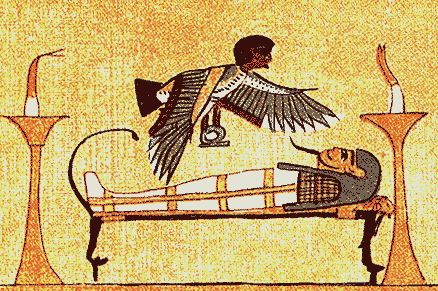
Amidst, the likely political chaos (due to this kind of literature prevailing?), even with all their advanced afterlife theories, looks like the Egyptians still feared death. Enter the ba, swooping in with some surprisingly modern wisdom to challenge the guy’s doubts . They are forced to come to an agreement because they need each other for there to be any sort of afterlife.
The anguish, pain, and everything goes on and on and on.
On and on and on.
On and on.
On.
And, funnily enough, it ends with something like this....
the thing is, I know that you know it, but...for that era? it's crazy that the exact same thing got carried down to today too, in a way. basically, it’s ancient Egypt’s version of “happiness is yours to create.”
---
Stick around if you can bear with me for a mini-history detour 🫣
Ancient Egyptians believed humans were made up of five key parts:
- Ankh (aka Physical Body/Life) [image error]
– At the heart of which was the heart, which also acted as the "mind" (yep, no brain, just heart).
- 𓃣 the Shadow - Not just the one you see on a sunny day, but a spiritual part of you that travels with your ba and ka in the afterlife.
- 𓂀 the Name - Your name wasn’t just something you answered to; it was you. If your name was forgotten, your existence could be erased. Talk about pressure to stay memorable lol.
- 𓅃Ba – This is your soul. Your ba is your personality. It flies out of your body when you die, often depicted as a bird with a human head.The Egyptians and the birds are a thing, btw.
- 𓏊 Ka – The spirit that keeps you alive. You die when your ka leaves the body. While you’re alive, it feeds on food, drink, and offerings. After you die, the ka still needs offerings (even pictures of food would work, right?).
𓁈 In the afterlife, your heart is weighed against the feather of Maat (which represents truth, justice, order, and righteousness). If you’ve been a good person, your ba and ka get reunited, and you get to live on in a pretty sweet afterlife—assuming you have regular visits to your tomb and, like, the mummified body.
Isfet 𓆙
---
The reasons I'm reading this are:
a) I’m obsessed with Egyptian mythology.
Why, you ask?
i) Kane Chronicles by Rick Riordan, obviously. Duh.
ii) I'm a full-fledged history geek
b) It's an ancient Egyptian text that’s actually got hieroglyphics in it! WHAT. We're talking about the OG writing— not on paper, but on papyrus!!
c) It's very short, shhh.
c) Okay, fine, a tiny bit because I wanna look cool.
Basically, this text, preserved on Papyrus Berlin 3024, offers a surprisingly profound exploration of life, death, and the search for meaning. Through a dialogue between a guy and his "ba"—a which is kinda like one's soul or spirit—this delves into the futility of earthly existence. The man contemplates whether death might offer a more peaceful and meaningful state, challenging his understanding of life’s purpose.
Also, it's written in Middle Egyptian, using hieratic script (a fancy version of hieroglyphics). It’s one of the finest pieces of Middle Egyptian lit we have, and it was a major reason Middle Egyptian stuck around as Egypt's literary language for, like, 2,000 years. Pretty impressive.
“Whom can I trust today?
I am laden down with sorrow,
And there is none to comfort me.
Whom can I trust today?
Evil runs rampant throughout the land,
Endless, endless evil.”
Amidst, the likely political chaos (due to this kind of literature prevailing?), even with all their advanced afterlife theories, looks like the Egyptians still feared death. Enter the ba, swooping in with some surprisingly modern wisdom to challenge the guy’s doubts . They are forced to come to an agreement because they need each other for there to be any sort of afterlife.
Whom can I talk to today?
Faces are blank, every man has his face downcast concerning his brothers.
Whom can I talk to today?
Hearts have become greedy and there is no man's heart on which one may rely.
Whom can I talk to today?
None are righteous and the land is left to evildoers.
Whom can I talk to today?
An intimate friend is lacking and one turns to a stranger to complain to.
Whom can I talk to today?
None is content there, and he with whom one walked is no more.
Whom can I talk to today?
I'm laden with misery for lack of an intimate friend
Whom can I talk to today?
The evil that scourges the earth is without end.
The anguish, pain, and everything goes on and on and on.
On and on and on.
On and on.
On.
And, funnily enough, it ends with something like this....
“Enjoy life, seize the day”
“I shall alight after you have become weary,
And we shall make our dwelling place together.”
the thing is, I know that you know it, but...for that era? it's crazy that the exact same thing got carried down to today too, in a way. basically, it’s ancient Egypt’s version of “happiness is yours to create.”
---
Stick around if you can bear with me for a mini-history detour 🫣
Ancient Egyptians believed humans were made up of five key parts:
- Ankh (aka Physical Body/Life) [image error]
– At the heart of which was the heart, which also acted as the "mind" (yep, no brain, just heart).
- 𓃣 the Shadow - Not just the one you see on a sunny day, but a spiritual part of you that travels with your ba and ka in the afterlife.
- 𓂀 the Name - Your name wasn’t just something you answered to; it was you. If your name was forgotten, your existence could be erased. Talk about pressure to stay memorable lol.
- 𓅃Ba – This is your soul. Your ba is your personality. It flies out of your body when you die, often depicted as a bird with a human head.
- 𓏊 Ka – The spirit that keeps you alive. You die when your ka leaves the body. While you’re alive, it feeds on food, drink, and offerings. After you die, the ka still needs offerings (even pictures of food would work, right?).
𓁈 In the afterlife, your heart is weighed against the feather of Maat (which represents truth, justice, order, and righteousness). If you’ve been a good person, your ba and ka get reunited, and you get to live on in a pretty sweet afterlife—assuming you have regular visits to your tomb and, like, the mummified body.
Isfet 𓆙
---
The reasons I'm reading this are:
a) I’m obsessed with Egyptian mythology.
Why, you ask?
i) Kane Chronicles by Rick Riordan, obviously. Duh.
ii) I'm a full-fledged history geek
b) It's an ancient Egyptian text that’s actually got hieroglyphics in it! WHAT. We're talking about the OG writing— not on paper, but on papyrus!!
c) It's very short, shhh.
c) Okay, fine, a tiny bit because I wanna look cool.

May 24, 2023
These ancient Egyptian texts are starting to fascinate me more and more. This one perfectly illustrates that even the earliest humans were already confronting existential issues with some candor. This short text (less than 10 pages) shows a weary man in conversation with his soul. The man paints a very sad picture of his life and of the world in general; he longs for death. But his soul (‘ba’ only covers a certain aspect of what we understand by soul) urges him again and again to choose life, "be happy and forget all cares!", because it is uncertain what awaits after death. This text, probably from about 1800 bce, is apparently not easy to translate and interpret, but it does indicate how ancient Egyptian people of almost 4,000 years ago already struggled with life. More about the different interpretations of this text, in my History account on Goodreads: https://www.goodreads.com/review/show....
PS. Normally I don't rate ancient texts, but this one is a text that still resonates, even after 4.000 years.
PS. Normally I don't rate ancient texts, but this one is a text that still resonates, even after 4.000 years.

Read
June 25, 2023Internal conflict as early as 20th century BCE. A man debates with his ba over whether or not to commit suicide. Apparently, the ancient Egyptians divided the self into nine parts (while we tend towards tripartite models), and the “ba” was thought to be the unique personality that survived death. Believing in the afterlife (“the West”), the man says he wants to die, but his ba says nah. Really difficult to understand what exactly is going on, but as always I’m interested in what happens when parts of the self disagree and which part has final say.
Death is in my sight today
Like the longing of a man to see his house (again),
After he has spent many years held in captivity.
Death is in my sight today
Like the longing of a man to see his house (again),
After he has spent many years held in captivity.

June 27, 2020
“Whom can I talk to today? Kindness has vanished and rudeness descended upon everyone. Whom can I talk to today? Who should enrage a man by his ill deed makes everyone laugh by his evil wrongdoing. Whom can I talk to today?”
This beautiful inner conversation endures and the Ba, frequently translated as Soul, has a reply that remains as relevant and meaningful as the question. Written about 1,900 BCE.
(The translation I read was by Mark-Jan Nederhof. Online pdf.)
This beautiful inner conversation endures and the Ba, frequently translated as Soul, has a reply that remains as relevant and meaningful as the question. Written about 1,900 BCE.
(The translation I read was by Mark-Jan Nederhof. Online pdf.)

July 28, 2022
It's very interesting to see that almost 4000 years ago people had similar thoughts as we have today and how they also thought that life and people get worse then they were before, something that can be heard quite often this days.

December 8, 2010
The translation of a very interesting ancient Egyptian text--a conversation between a man contemplating his suicide and his ba. Unfortunately, the commentary and translation in this edition are highly suspect. The translator is dismissive of the entire field of Egyptology and is trying to use this text to synthesize with other world religions, including Christianity, to come up with some sort of unified philosophy. Nothing says this more clearly than thee illustrations interspersed with the text--Egyptian images not associated with this papyrus scattered about without commeentary, along with medieval drawings of John the Baptist and Jesus. ...?

February 4, 2018
Dates back approximately to 1859-1840 BC
A commoner accuses his ba [soul] of wanting to abandon him, pushing him towards death ahead of his time. He complains that life is miserable for him, that he wants to rest (i.e. the afterlife). He urges his ba [soul] to be patient and wait for a son to be born to make the offerings the deceased need in the afterlife.
Parallel translation @ https://mjn.host.cs.st-andrews.ac.uk/...
A commoner accuses his ba [soul] of wanting to abandon him, pushing him towards death ahead of his time. He complains that life is miserable for him, that he wants to rest (i.e. the afterlife). He urges his ba [soul] to be patient and wait for a son to be born to make the offerings the deceased need in the afterlife.
Parallel translation @ https://mjn.host.cs.st-andrews.ac.uk/...

October 5, 2021
Finally, I read this masterpiece though it took less than an hour to finish. For me this work represents ancient wisdom with speical uniqueness showing a man couraged to discuss a desire of death (suicide).

October 18, 2025
4,000 years old and it’s still worth reading ‼️

June 22, 2023
"Want wat Boven is, wordt verheven door wat Beneden is."
Een bijzonder stevig staaltje driemaal-vertaalde tekst om doorheen te ploegen. Ik heb altijd al een interesse gehad in de Egyptische (doods)cultuur en de oude tijd, maar ik ben alles behalve geleerd op dit vlak. Dat werd me dan ook bijzonder duidelijk tijdens het lezen.
Dat gezegd hebbende, was het nog steeds zeer interessant!
Memorabele momentjes:
Waar de zon de bron is van leven en beweging, is de Ezel (IAI) het levend symbool van verzet tégen beweging.
Hoe Anubis, volgens de mythe, 'tot leven komt' doordat hij zijn eigen 'niet-bestaan' 'ziet'.
Hoe RA de heilige bark door de onderwereld, 'de duistere nacht van de ziel', stuurt.
En bovenal:
"Het bewustzijn beweegt zich door de onderwereld van poort naar poort, volgens een langzaam bezielingsproces. Voor Egypte zijn Leven en Bewustzijn synoniem. Dood zijn betekent onontwaakt zijn en inert, voortbewogen worden als een blad in de wind. Dood zijn is voor Egypte een toestand van onbezieldheid die voorafgaat aan bewustzijn of leven (want: reïncarnatie). Het bezielingsproces, in 'het Boek der Poorten' beschreven, werd 'te voorschijn komen in de dag' genoemd."
Prachtig! 'te voorschijn komen in de dag' raakte mij als een bijna Heideggeriaanse manier van spreken/schrijven. Mooi.
Een bijzonder stevig staaltje driemaal-vertaalde tekst om doorheen te ploegen. Ik heb altijd al een interesse gehad in de Egyptische (doods)cultuur en de oude tijd, maar ik ben alles behalve geleerd op dit vlak. Dat werd me dan ook bijzonder duidelijk tijdens het lezen.
Dat gezegd hebbende, was het nog steeds zeer interessant!
Memorabele momentjes:
Waar de zon de bron is van leven en beweging, is de Ezel (IAI) het levend symbool van verzet tégen beweging.
Hoe Anubis, volgens de mythe, 'tot leven komt' doordat hij zijn eigen 'niet-bestaan' 'ziet'.
Hoe RA de heilige bark door de onderwereld, 'de duistere nacht van de ziel', stuurt.
En bovenal:
"Het bewustzijn beweegt zich door de onderwereld van poort naar poort, volgens een langzaam bezielingsproces. Voor Egypte zijn Leven en Bewustzijn synoniem. Dood zijn betekent onontwaakt zijn en inert, voortbewogen worden als een blad in de wind. Dood zijn is voor Egypte een toestand van onbezieldheid die voorafgaat aan bewustzijn of leven (want: reïncarnatie). Het bezielingsproces, in 'het Boek der Poorten' beschreven, werd 'te voorschijn komen in de dag' genoemd."
Prachtig! 'te voorschijn komen in de dag' raakte mij als een bijna Heideggeriaanse manier van spreken/schrijven. Mooi.

November 21, 2013
Reed offers an enlightening new translation of an ancient Egyptian text. She delves into the symbolism of the ass and the need of the spirit to overcome rationality and ego. It is a must read for anyone interested in ancient Egyptian religion and the ba, ka relationship
November 22, 2021
Interesting read on a famous Egyptian papyrus. The author provides her translation and interpretation line-by-line. There are also related pictures included of Egyptian hieroglyphics. The ancient Egyptians were so very different from modern man.

February 5, 2025
Struggle with a Desire for Death
30 January 2025
The interesting thing about this work is that it seems that the idea of death being the end and death being a gateway to a better life is something that has been with us for as long as humans have been pondering this. With youth suicide rates still being a significant problem, I can sort of feel that it was an issue back in Ancient Egypt as well, and something that needed to be addressed.
So, the man looks forward to death, believing that it will provide a gateway to another, better, world. In fact all of the man’s life is dedicated to preparing for death. This is another idea that seems to be with us today with many people dedicating their lives to religious pursuits and eschewing the pleasures of life. However, the soul sees death as a great emptiness and desires instead to make the most of life because all of the pleasures of life will be gone upon death. Once again, this reflects a more hedonistic view of the world, where Carpe Diem rules.
I do get the impression from the man’s argument that life is a struggle, and that he desires more and more to welcome the warm embrace of death. However, the soul responds (and the actual Egyptian word here is ba) in that he actually enjoys life, and fears death. I guess this is the struggle that many of us face, with the difficulties of life, yet also being reminded of the good things that make life bareable.
I suspect that the man is either lower class, or has done something that has resulted in him being outcast from his peers. As such, he no doubt is in the depths of depression. This is why the soul is trying to pick him up, and remind him that life isn’t all that bad. Honestly, I can appreciate this, especially when you are in the depths of depression.
Honestly, I do actually find it interesting to find these ancient works and learn about how the same issues that we face today in our modern systems are very much the same in the agrarian past.
30 January 2025
The interesting thing about this work is that it seems that the idea of death being the end and death being a gateway to a better life is something that has been with us for as long as humans have been pondering this. With youth suicide rates still being a significant problem, I can sort of feel that it was an issue back in Ancient Egypt as well, and something that needed to be addressed.
So, the man looks forward to death, believing that it will provide a gateway to another, better, world. In fact all of the man’s life is dedicated to preparing for death. This is another idea that seems to be with us today with many people dedicating their lives to religious pursuits and eschewing the pleasures of life. However, the soul sees death as a great emptiness and desires instead to make the most of life because all of the pleasures of life will be gone upon death. Once again, this reflects a more hedonistic view of the world, where Carpe Diem rules.
I do get the impression from the man’s argument that life is a struggle, and that he desires more and more to welcome the warm embrace of death. However, the soul responds (and the actual Egyptian word here is ba) in that he actually enjoys life, and fears death. I guess this is the struggle that many of us face, with the difficulties of life, yet also being reminded of the good things that make life bareable.
I suspect that the man is either lower class, or has done something that has resulted in him being outcast from his peers. As such, he no doubt is in the depths of depression. This is why the soul is trying to pick him up, and remind him that life isn’t all that bad. Honestly, I can appreciate this, especially when you are in the depths of depression.
Honestly, I do actually find it interesting to find these ancient works and learn about how the same issues that we face today in our modern systems are very much the same in the agrarian past.

April 4, 2025
Don’t worry, be happy
Today I found out that this Ancient Egyptian text existed, and was immediately curious. Then I realized that I haven’t read any Ancient Egyptian literary works at all, so here I am.
We are human, so we struggle with depression. We always have. In this text, a person is talking to their ba (a soul of sorts). They are depressed. The world is a horrible place and they long for oblivion.
Whom can I talk to today? Brothers are evil and friends of today don’t love each other.
Whom can I talk to today? Hearts are greedy and every man is stealing things from his fellow.
Whom can I talk to today? Brothers are evil and one turns to strangers for honesty.
[…]
I am laden with misery for lack of an intimate friend.
It goes on, it goes on. You can feel the anguish behind the words.
The ba’s answers are surprisingly (refreshingly?) simple and concise.
What my soul said to me: ‘Put whining on a peg, o my comrade, my brother!’
I feel as if I just had a conversation across thousands of years, and it was so easy to understand each other.
I should remember to put my whining on a peg more often, I suppose.
P.S. This one is very short, probably about 10 pages. You can find it and read it online, in different translations.
Today I found out that this Ancient Egyptian text existed, and was immediately curious. Then I realized that I haven’t read any Ancient Egyptian literary works at all, so here I am.
We are human, so we struggle with depression. We always have. In this text, a person is talking to their ba (a soul of sorts). They are depressed. The world is a horrible place and they long for oblivion.
Whom can I talk to today? Brothers are evil and friends of today don’t love each other.
Whom can I talk to today? Hearts are greedy and every man is stealing things from his fellow.
Whom can I talk to today? Brothers are evil and one turns to strangers for honesty.
[…]
I am laden with misery for lack of an intimate friend.
It goes on, it goes on. You can feel the anguish behind the words.
The ba’s answers are surprisingly (refreshingly?) simple and concise.
What my soul said to me: ‘Put whining on a peg, o my comrade, my brother!’
I feel as if I just had a conversation across thousands of years, and it was so easy to understand each other.
I should remember to put my whining on a peg more often, I suppose.
P.S. This one is very short, probably about 10 pages. You can find it and read it online, in different translations.
April 24, 2025
This was something.. initially I saw it as a man confronting shadow, then the tone shifted and I thought it was cowardice, last I thought it was about death. Some lines are beautiful, others are poignant, it's worth reading once.
https://mjn.host.cs.st-andrews.ac.uk/...
https://mjn.host.cs.st-andrews.ac.uk/...
March 21, 2022
An ancient Egyptian text about a discussion between a man and his soul about the topic of his death.

Read
September 8, 2022read for class
September 8, 2022
This was definitely interesting to read, as it gives a lot of insight on the Ancient Egyptian view of death and the afterlife, I just found it difficult to digest

September 11, 2022
probably my favourite thing I’ve read so far this year. I have so many questions. #myfirstessaytext

September 15, 2022
J'ai été surpris que le livre parle de suicide:o
This entire review has been hidden because of spoilers.
September 22, 2023
My name reeks through you...

February 2, 2025
⭐⭐⭐Good.
April 20, 2026
4,000 years old and it’s still worth reading ‼️
March 3, 2018
A book for initiates who can compair their experiences with the "Rebel".
Bika Reed reveals the deeper meaning of the Berlin Papayrus 3024
with metaphors what prevents a literal interpretation without any sense.
The Rebel in the Soul is symbolized by an Ass for his abstinate behavior.
I recognized the struggle and despair of the rebel also in my soul (ka+ba).
I had my first spiritual contact with the power of Unas in 1980 sitting for
a long time in a nich in his pyramid.
Bika thank you for your precious time of 12 years study.
So this cultaral heritage can spread to the real happy few for their quest to infinity.
Find your Inner Knowledge and discover your Heir.
René Peeters 4/03/2018
Belgium
Bika Reed reveals the deeper meaning of the Berlin Papayrus 3024
with metaphors what prevents a literal interpretation without any sense.
The Rebel in the Soul is symbolized by an Ass for his abstinate behavior.
I recognized the struggle and despair of the rebel also in my soul (ka+ba).
I had my first spiritual contact with the power of Unas in 1980 sitting for
a long time in a nich in his pyramid.
Bika thank you for your precious time of 12 years study.
So this cultaral heritage can spread to the real happy few for their quest to infinity.
Find your Inner Knowledge and discover your Heir.
René Peeters 4/03/2018
Belgium

May 1, 2019
After learning of this book, a 4,000-year-old papyrus containing a dialogue of a suicidal man with this soul, I was fascinated by the idea of reading such an ancient work on such an immortal question. I was not let down. Reed manages to translate the hieroglyphs with a poetic touch that allows for a contemplative reading. She also gives the reader ample commentary to give the text context as well as flesh out its implications. While the “answers” given in the text were very much embedded in the religious ideas of Egypt at the time, I was still amazed at the chance to read something so ancient and ponder about the minds that wrote it.

November 27, 2013
"New Age" thinking is nothing new, after all. Amazing to realize that self questioning, inner analysis of thought, consciousness, mind and soul goes way back to the ancient Egyptians and most likely to the beginning of human thought itself.

September 26, 2016
Un óptica diferente e interesante del Yo, el ser, el saber y el sentir visto desde la antigua filosofia egipcia. No te dejes engañar que por ser un librito de 7 capítulos y 168 páginas se de fácil y rápida lectura ya que es MUY reflexivo.
Fue un buen descubrimiento gracias a Libros con Experiencia
Fue un buen descubrimiento gracias a Libros con Experiencia
Displaying 1 - 30 of 31 reviews