

What do you think?

Black [AF]
BLACK [AF]: America's Sweetheart
Can a black woman be America's first superhero?
Eli Franklin is a 15-year-old girl living in rural Montana - and she just happens to be the most powerful person on the planet. In the aftermath of the world learning that only black people have superpowers, Eli makes her debut as the superhero Good Girl, on a mission to help people and quell the fear of empowered blacks. When a super-terrorist threatens to take away everything Eli has worked toward, will donning a patriotic costume be enough for her to find acceptance?
America's Sweetheart expands BLACK into a universe of heroes.
Eli Franklin is a 15-year-old girl living in rural Montana - and she just happens to be the most powerful person on the planet. In the aftermath of the world learning that only black people have superpowers, Eli makes her debut as the superhero Good Girl, on a mission to help people and quell the fear of empowered blacks. When a super-terrorist threatens to take away everything Eli has worked toward, will donning a patriotic costume be enough for her to find acceptance?
America's Sweetheart expands BLACK into a universe of heroes.
80 pages, Paperback
First published January 31, 2018
Ratings & Reviews
Friends & Following
Create a free account to discover what your friends think of this book!
Community Reviews
Displaying 1 - 30 of 66 reviews

September 8, 2019
Imagine if Superman was actually a 15 year old black girl? Eli lives in Montana with her adopted family. She knows nothing of her past, but has powers her family asks her to hide. But when word gets out that some African Americans have superpowers, she decides to create a costume and help others. Beloved at first, fake news organizations but out information campaigns saying that she has a racial preference towards helping minorities first. This is where it really started to get interesting. I would have loved to see more of where this went. Unfortunately, the story gets bogged down with her origin (which is complicated and kind of stupid). I liked Jennifer Johnson's art. It had some Max Fleischer Superman in it.

January 30, 2018
I really, really want to like Black Mask's Black universe. The concept is incredible: a universe where only Black people get superpowers, and how the world responds to that.
Much like the main title in the series, the beginning of the book sets up an intriguing situation, a main character you really root for, and puts them in immediate danger. But then it just becomes every boring superhero book. The dialog is weak, the art is bland, it does too much telling rather than showing.
It's never terrible, it's just never terribly good, either. It's a mediocre superhero book about an incredible concept. I really hope that enough people support this series so that the creative teams behind it can get better because this superhero universe deserves to be great, and needs to be better.
Much like the main title in the series, the beginning of the book sets up an intriguing situation, a main character you really root for, and puts them in immediate danger. But then it just becomes every boring superhero book. The dialog is weak, the art is bland, it does too much telling rather than showing.
It's never terrible, it's just never terribly good, either. It's a mediocre superhero book about an incredible concept. I really hope that enough people support this series so that the creative teams behind it can get better because this superhero universe deserves to be great, and needs to be better.

July 11, 2022
This book has so much potential! It starts out nicely with the backstory for a black teenage girl superhero, who grew up as an adopted child in a white family in Montana. When she discovers her superpowers and starts to use them as Good Girl, people love her, but racism also arises and settles in. And then someone else shows up and everything is fighting when a lot of it should be talking. But I guess fighting is what sells superhero books. And then it ends on a cliffhanger.
Apparently, there is an earlier book that shows more about the world and introduces the young man who appears a few times, including in the last panel of the book. It looks like there is also a later related book, but I don't see where the cliffhanger in this one would be resolved. This is disappointing to me. Again, so much potential.
Apparently, there is an earlier book that shows more about the world and introduces the young man who appears a few times, including in the last panel of the book. It looks like there is also a later related book, but I don't see where the cliffhanger in this one would be resolved. This is disappointing to me. Again, so much potential.

April 3, 2019
3.5 Stars
This was such a fun superhero story! My fiancé originally picked this up and read it one day at our local library on his work break (it's super short, only about 80 pages) and said he thought I'd like it so he brought it home. And I am so glad he did because it was such a good read. Like all of my comic book or graphic novel reviews, this may be a short one because of the size of the book!
Eli is such an amazing main character and you automatically fall in love with her personality. I really loved seeing a young black girl being this badass superhero. I loved Eli's desire to not only save people but to just put good out into the world. She was so brave and eager to help people in need and I loved how honest and sweet she was. The moment when she gets her superhero costume is so great because she immediately puts it on and starts taking mirror selfies. She really acts her age in the best ways and I like that although she signs up for some big responsibility she still seems like a typical fifteen year old.
A lot of the commentary in terms of people with powers (black people) being seen as scary, mistrusting, or monsters by the people who don't have powers (white people) have obvious parallels to how black people are treated in our world. I think it was handled incredibly well and didn't feel too heavy handed. I hope this theme will be explored more in the next ones because I think it is an important one.
My biggest problem with the comic book is that nothing that happens in the story is unique or something I haven't seen before, which is a complicated problem. It's complicated because a lot of "overused tropes & themes" are only overused because they have been used with the majority of white main characters & stories. Minorities are allowed to have stories that seem overused because they didn't get the chance to have those stories before. And I love the idea of young (or honestly any age) black girls or boys reading Eli's story and seeing themselves in her. So on one hand, nothing really jumped out at me, but on the other hand I am really happy this is out in the world for other readers who will fall in love with this story.
Overall, I highly recommend this comic book. I think it's such a exciting story with an absolute sweet badass main character. I cannot wait to read the next one!
This was such a fun superhero story! My fiancé originally picked this up and read it one day at our local library on his work break (it's super short, only about 80 pages) and said he thought I'd like it so he brought it home. And I am so glad he did because it was such a good read. Like all of my comic book or graphic novel reviews, this may be a short one because of the size of the book!
Eli is such an amazing main character and you automatically fall in love with her personality. I really loved seeing a young black girl being this badass superhero. I loved Eli's desire to not only save people but to just put good out into the world. She was so brave and eager to help people in need and I loved how honest and sweet she was. The moment when she gets her superhero costume is so great because she immediately puts it on and starts taking mirror selfies. She really acts her age in the best ways and I like that although she signs up for some big responsibility she still seems like a typical fifteen year old.
A lot of the commentary in terms of people with powers (black people) being seen as scary, mistrusting, or monsters by the people who don't have powers (white people) have obvious parallels to how black people are treated in our world. I think it was handled incredibly well and didn't feel too heavy handed. I hope this theme will be explored more in the next ones because I think it is an important one.
My biggest problem with the comic book is that nothing that happens in the story is unique or something I haven't seen before, which is a complicated problem. It's complicated because a lot of "overused tropes & themes" are only overused because they have been used with the majority of white main characters & stories. Minorities are allowed to have stories that seem overused because they didn't get the chance to have those stories before. And I love the idea of young (or honestly any age) black girls or boys reading Eli's story and seeing themselves in her. So on one hand, nothing really jumped out at me, but on the other hand I am really happy this is out in the world for other readers who will fall in love with this story.
Overall, I highly recommend this comic book. I think it's such a exciting story with an absolute sweet badass main character. I cannot wait to read the next one!

September 1, 2019
Intense
Enjoyable
Great concept
Enjoyable
Great concept

November 21, 2022
The rest of my class and I had some qualms about this book. We really didn’t like that her superhero name was “Good Girl” lol. It gave us kind of weird vibes. We also thought it would have been maybe more meaningful if he was a young black man instead of a girl.

June 25, 2018
A comic that asks the question "Is America ready for a black superhero?"
The answer is yes, but only if it is Black Panther.
Seriously, this is a story of world in which only black people can become superheroes, and a young adopted girl discovers that she is one. Lots of interesting material to work with there, but I don't feel like this really goes anywhere. But, then again, I don't like superhero stories. Those who do might enjoy the action art for the long fight scene.
(Note that I follow the official guidelines in which 2 stars means "It was OK" and is not a recommendation against it for those who think they might like it.)
The answer is yes, but only if it is Black Panther.
Seriously, this is a story of world in which only black people can become superheroes, and a young adopted girl discovers that she is one. Lots of interesting material to work with there, but I don't feel like this really goes anywhere. But, then again, I don't like superhero stories. Those who do might enjoy the action art for the long fight scene.
(Note that I follow the official guidelines in which 2 stars means "It was OK" and is not a recommendation against it for those who think they might like it.)

March 3, 2018
Interesting take on the superhero theme. Sub story of the Black Main series in which only black people have super powers. This one is sort of a black super girl but it‘s so much more than this. A good set up, interesting to see where they will go with it.
July 28, 2019
I am severely disappointed.
I really want to enjoy the 'Black' series, because it's an idea that is intriguing- How would the world react if only Black people had superpowers? The story is interesting, the characters are there... but that's it. These books have unfortunately fallen into my "This is good for representation, but is not a good story."
Eli is a typical 15-year-old girl from Montana who was raised on a farm by her adoptive parents, one of several children. Her family knew that she was 'special' from the beginning, it seems, as her crib was shown smashed to bits and she had super breath during her birthday candle blowout. Nevertheless, her secret was kept on the DL until she dons a costume, thanks to a random symbol she saw on a relic of her parents that she, for some reason, never noticed in 15 years of existing. This symbol covers her in Venom symbiote-like material and transforms her into the superhero... Good Girl.
We see Good Girl's powers very briefly, for all of a single page, before she's targeted by the government. We don't even see the full extent of her powers because it is so rushed- she answers a phone call from her father during a fight, asking where she is. She replies in her room, and the next panel shows him opening her door. The following panel, she's in bed waving at him. Did she end the fight prematurely? Did she beat up the crook? Is he dangling from their rooftop until she can leave her room again? We don't see it, because everything is rushed.
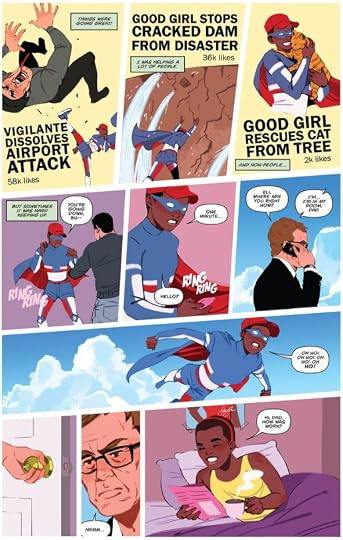
The storytelling, like in the previous 'Black' graphic novel, is rushed. When her father realizes the superhero is his daughter, he begins lecturing her, and it appeared very much unlike how a father would lecture his daughter, and more how one would interrogate a suspect. Skipping the following TV interview on the next page, it shows Good Girl's citizen poll numbers are improving after the past 4 months. But.. wait... didn't the public only just recently find out about her? She went from being a new mystery hero to appearing on The Helen Show within what appeared to be a matter of 3 whole days, and suddenly this has been going on for four months.
I want to enjoy these books, I really, really do. They're important to read, to see people that look like us, to see them being these powerful beings so that we can feel empowered, but I can't really say that I've truly enjoyed reading something from this series. While the first one was seemingly like X-Men, Good Girl felt more like Superman. The art in this volume was beautiful; the storytelling, however, is proving to be kryptonite.
I really want to enjoy the 'Black' series, because it's an idea that is intriguing- How would the world react if only Black people had superpowers? The story is interesting, the characters are there... but that's it. These books have unfortunately fallen into my "This is good for representation, but is not a good story."
Eli is a typical 15-year-old girl from Montana who was raised on a farm by her adoptive parents, one of several children. Her family knew that she was 'special' from the beginning, it seems, as her crib was shown smashed to bits and she had super breath during her birthday candle blowout. Nevertheless, her secret was kept on the DL until she dons a costume, thanks to a random symbol she saw on a relic of her parents that she, for some reason, never noticed in 15 years of existing. This symbol covers her in Venom symbiote-like material and transforms her into the superhero... Good Girl.
We see Good Girl's powers very briefly, for all of a single page, before she's targeted by the government. We don't even see the full extent of her powers because it is so rushed- she answers a phone call from her father during a fight, asking where she is. She replies in her room, and the next panel shows him opening her door. The following panel, she's in bed waving at him. Did she end the fight prematurely? Did she beat up the crook? Is he dangling from their rooftop until she can leave her room again? We don't see it, because everything is rushed.
The storytelling, like in the previous 'Black' graphic novel, is rushed. When her father realizes the superhero is his daughter, he begins lecturing her, and it appeared very much unlike how a father would lecture his daughter, and more how one would interrogate a suspect. Skipping the following TV interview on the next page, it shows Good Girl's citizen poll numbers are improving after the past 4 months. But.. wait... didn't the public only just recently find out about her? She went from being a new mystery hero to appearing on The Helen Show within what appeared to be a matter of 3 whole days, and suddenly this has been going on for four months.
I want to enjoy these books, I really, really do. They're important to read, to see people that look like us, to see them being these powerful beings so that we can feel empowered, but I can't really say that I've truly enjoyed reading something from this series. While the first one was seemingly like X-Men, Good Girl felt more like Superman. The art in this volume was beautiful; the storytelling, however, is proving to be kryptonite.

March 4, 2018
Only black people of super powers - and guess what - the government tries to suppress them and use the power to keep control. Combining a twisted take on the superman story (via Stracyzynski's "Supreme Power" series), Black Panther, X-Men, and Terminator, this is a kick ass take on contemporary issues of race and power. While it can't quite live up to it's premise (which would be almost impossible) and the long fight scene near the end, while entertaining, is basically just the characters explaining their positions for too long. (It's strengths and weaknesses remind me of the much praised novel "The Power.") This slim volume is entertaining and thought provoking. Also, it is really well drawn.

August 22, 2018
Good art, a short but interesting story. It was definitely a sequel to Black, which I didn't really enjoy, but this avoided a lot of the issues I had with it. I'm interested to see what else happens in this universe!

January 21, 2020
Ouch.
Like others, I really wanted to like this. I think this is a great concept, just like BLACK Vol. 1. Unfortunately, I found the dialogue and plot clunky 'af' and the whole thing felt like the story was knocked out in an afternoon (this is NOT a critique of the art. The art is great). Too much is going on without any explanation. I feel like they want to tell the story so bad, they're rushing through it and confusing the reader. Or, maybe it's just me.
I want to support this line. Black Mask has introduced an original idea into a medium that doesn't see those very often these days. I just hope they take their time with future endeavors, and hire a brutally critical story editor to tighten things up.
Like others, I really wanted to like this. I think this is a great concept, just like BLACK Vol. 1. Unfortunately, I found the dialogue and plot clunky 'af' and the whole thing felt like the story was knocked out in an afternoon (this is NOT a critique of the art. The art is great). Too much is going on without any explanation. I feel like they want to tell the story so bad, they're rushing through it and confusing the reader. Or, maybe it's just me.
I want to support this line. Black Mask has introduced an original idea into a medium that doesn't see those very often these days. I just hope they take their time with future endeavors, and hire a brutally critical story editor to tighten things up.

June 19, 2021
Fantastic premise until it gets sidetracked. It could have gone somewhere really cool or more interesting than just two powerful beings attacking each other.
It might also have been weakened by my recent reading of Strong Female Protagonist.
It might also have been weakened by my recent reading of Strong Female Protagonist.

May 28, 2018
Cute and fun with some heavy undertones (and overtones). I love Eli and want the best for her. Plus the art is adorable.
![Profile Image for Amanda [Novel Addiction].](https://i.gr-assets.com/images/S/compressed.photo.goodreads.com/users/1415744673i/4886503._UX200_CR0,36,200,200_.jpg)
May 29, 2018
Yaaaaaas. So coooooool!

August 23, 2018
I really wanted to like this book. The plot was good, but the dialogue needs work.

May 10, 2019
The anvilly Superman allegory is important here, I think, both to nail down the spirit and innocence with which Eli approaches her heroism and to underscore too the ways in which -- just like Kryptonian Clark Kent -- superpowers are isolating, and specifically othering in ways the authors is paralleling to race, that is, blackness in contemporary America using the future as a proxy for the now.
It's also worth noting the framing of otherness as "alien" with the metatextual framing of "avatar of protection" a la the Jewish golem, with the othering Jewish peoples experience vis a vis Superman; and the framing of otherness as "race" in Black AF. Eli may be superpowered, but she is still a human, from Earth, and it's more pointed and poignant, I think, grounding the Superman allegory in a shared humanity divided by race.
I think Osajyefo is largely successful in this endeavor -- the allegory is heavy handed on purpose, which becomes clear relatively swiftly and even more so once the reader has finished this first volume.
The revelation that
I don't know that this is a "must read" -- it's quite short and could really have used a slower pace, making more of the characters -- particularly Eli's family -- fully realized characters and not mainly stand-ins. But if you're keen to read more comics featuring women of color, and if you are interested in supporting the work of creators of color, it's worth grabbing. Particularly if you've run out of Black Panther to read!
Related: Black, the first volume in this shared world.
It's also worth noting the framing of otherness as "alien" with the metatextual framing of "avatar of protection" a la the Jewish golem, with the othering Jewish peoples experience vis a vis Superman; and the framing of otherness as "race" in Black AF. Eli may be superpowered, but she is still a human, from Earth, and it's more pointed and poignant, I think, grounding the Superman allegory in a shared humanity divided by race.
I think Osajyefo is largely successful in this endeavor -- the allegory is heavy handed on purpose, which becomes clear relatively swiftly and even more so once the reader has finished this first volume.
The revelation that
I don't know that this is a "must read" -- it's quite short and could really have used a slower pace, making more of the characters -- particularly Eli's family -- fully realized characters and not mainly stand-ins. But if you're keen to read more comics featuring women of color, and if you are interested in supporting the work of creators of color, it's worth grabbing. Particularly if you've run out of Black Panther to read!
Related: Black, the first volume in this shared world.

January 15, 2022
The keywords that came to mind reading this book were colour, heritage, family, american, military, and coming of age.
The summery is " Can a Black woman be America's first superhero?
Eli Franklin is a 15-year-old girl living in rural Montana - and she just happens to be the most powerful person on the planet. In the aftermath of the world learning that only black people have superpowers, Eli makes her debut as the superhero Good Girl, on a mission to help people and quell the fear of empowered blacks. When a super-terrorist threatens to take away everything Eli has worked toward, will donning a patriotic costume be enough for her to find acceptance?"
Looking at the art; while I'm always a big fan of dynamic black and white art I really enjoyed the way colour was used in this volume, and can see it bringing in more people (as my opinion about black and white art is a bit in the minority). The frames and page layouts were professional and nicely balanced and the dialog boxes were distinctively above average IMO.
As far as writing goes, I also found this volume interesting and fast paced. Taking many aspects of classic super hero stories and running with it in a direction that kept me very much engaged.
Race was obviously pretty central to the premise of the Black AF series. Personally, I found Eli Franklin being a Black adoptee in a white family, especially one involved so directly with the american government added a lot to the story through show not tell.
Gender seemed pretty binary but leans towards the woman side of things in a way that I thought was pulled off well. Eli Franklin faces a lot of questions as she comes into herself that have really stuck with me since I finished reading.
Sexuality felt like it took enough of a back seat that the fact that the lack of obvious queerness didn't make it feel overwhelmingly hetero either. In other words, family is an important aspect of the story, but our main protagonist is allowed to be a young woman focused on her own self-development in a way that doesn't involve romantic entanglement.
And while the characters are of a class where money doesn't appear to be an issue, this felt like more of a choice that adds to the premise rather then a default. So, something.
Ability and disability, was also not included in the way I generally look for. Which I will point out is a bit silly, as including the bare minimum of visibly disabled people in crowd scenes is really not that hard. Although super hero comics that deal with first to general population almost always inspire questions about how people who used to feel they were at the peak of human ability suddenly not being that. I mean, generally this results in fear and lashing out, but I feel like I live in hope of a more productive and introspective take.
To conclude, I liked volume one but this felt like a lot of thought really went into how to continue to develop the series and so volume two struck me as even better. Not how things generally go. So I did end up rating this four out of five stars.
The summery is " Can a Black woman be America's first superhero?
Eli Franklin is a 15-year-old girl living in rural Montana - and she just happens to be the most powerful person on the planet. In the aftermath of the world learning that only black people have superpowers, Eli makes her debut as the superhero Good Girl, on a mission to help people and quell the fear of empowered blacks. When a super-terrorist threatens to take away everything Eli has worked toward, will donning a patriotic costume be enough for her to find acceptance?"
Looking at the art; while I'm always a big fan of dynamic black and white art I really enjoyed the way colour was used in this volume, and can see it bringing in more people (as my opinion about black and white art is a bit in the minority). The frames and page layouts were professional and nicely balanced and the dialog boxes were distinctively above average IMO.
As far as writing goes, I also found this volume interesting and fast paced. Taking many aspects of classic super hero stories and running with it in a direction that kept me very much engaged.
Race was obviously pretty central to the premise of the Black AF series. Personally, I found Eli Franklin being a Black adoptee in a white family, especially one involved so directly with the american government added a lot to the story through show not tell.
Gender seemed pretty binary but leans towards the woman side of things in a way that I thought was pulled off well. Eli Franklin faces a lot of questions as she comes into herself that have really stuck with me since I finished reading.
Sexuality felt like it took enough of a back seat that the fact that the lack of obvious queerness didn't make it feel overwhelmingly hetero either. In other words, family is an important aspect of the story, but our main protagonist is allowed to be a young woman focused on her own self-development in a way that doesn't involve romantic entanglement.
And while the characters are of a class where money doesn't appear to be an issue, this felt like more of a choice that adds to the premise rather then a default. So, something.
Ability and disability, was also not included in the way I generally look for. Which I will point out is a bit silly, as including the bare minimum of visibly disabled people in crowd scenes is really not that hard. Although super hero comics that deal with first to general population almost always inspire questions about how people who used to feel they were at the peak of human ability suddenly not being that. I mean, generally this results in fear and lashing out, but I feel like I live in hope of a more productive and introspective take.
To conclude, I liked volume one but this felt like a lot of thought really went into how to continue to develop the series and so volume two struck me as even better. Not how things generally go. So I did end up rating this four out of five stars.

August 29, 2021
The art is AMAZING! Tim Smith 3, Jennifer Johnson, worked together to provide a visual feast! The style is full of hues of emotion, soft and innocent, that wraps itself around our hero Eli! They seem to design their entry to this story with panels akin to the Frank Miller’s Dark Knight Returns, sans the moodiness and purposeful murkiness. Art that make eyes grateful to function!
Kwanza Osajyefo left me wonderfully besotted with the hope and hot to read more. He captures the essence of the ultimate Superman origin story, tracing the narrative that was laid down by Richard Donner’s cape classic of 1978. He supplants the classic newspaper headlines with the ubiquitous modern social media posts. Still, the wink towards the house of Krytonian House of El, in Eli, the color scheme, with the ideal that if we borrow from previous elements, the make sure not to waste the opportunity. Osajyefo does not. Though young and open to all possibilities, the still inchoate superhero throws herself into bettering her world, just like Lwnt and Parker.
The world she is placed in is the mirror of what is and was and has been going on. The pulse of this society follows what general society does with astounding revelations. And the introduction of other super heroes, some sanctioned by the government, and those that are not, as well as more epiphanies of the other players and scenarios provide the vicissitudes on such a short time that Eli has had an opportunity to interact in her world. Still, she maintains her faith and hope in humanity, even when “…so many people will endanger others to make a point…”, which is so true to the minute of this present point of history.
Give me more!
Kwanza Osajyefo left me wonderfully besotted with the hope and hot to read more. He captures the essence of the ultimate Superman origin story, tracing the narrative that was laid down by Richard Donner’s cape classic of 1978. He supplants the classic newspaper headlines with the ubiquitous modern social media posts. Still, the wink towards the house of Krytonian House of El, in Eli, the color scheme, with the ideal that if we borrow from previous elements, the make sure not to waste the opportunity. Osajyefo does not. Though young and open to all possibilities, the still inchoate superhero throws herself into bettering her world, just like Lwnt and Parker.
The world she is placed in is the mirror of what is and was and has been going on. The pulse of this society follows what general society does with astounding revelations. And the introduction of other super heroes, some sanctioned by the government, and those that are not, as well as more epiphanies of the other players and scenarios provide the vicissitudes on such a short time that Eli has had an opportunity to interact in her world. Still, she maintains her faith and hope in humanity, even when “…so many people will endanger others to make a point…”, which is so true to the minute of this present point of history.
Give me more!
February 3, 2018
Thought-provoking superheroics
This sequel/continuation of the concepts introduced in BLACK is loaded with superheroic action and more than a few mysteries. The premise that only black people have superpowers is rife with possibilities. In this volume, we meet Eli, a black teenage girl who has been raised by white parents, who has powers, and a mysterious device, which she uses to become a superhero. Initially praised for her actions, a backlash occurs that changes how people view her. When she meets other super powered people, her world gets much more complicated.
Eli is a very likable protagonist, even if we don't ultimately know that much about her as a person. While I would have preferred a more detailed examination of her personality, it is clear that this is only the first part of her story.
This story is very much about how someone does all the "right" things and still has to deal with institutional and societal expectations and interpretations based on racism. It does that in the context of an entertaining, action-packed superhero story. Some aspects may be too on the nose (Eli's codename is Good Girl; the team of superpowered characters working with the government is HAUS), but this can be enjoyed on multiple levels, like the bedt of modern comics.
Al in all, a worthy addition to the mosaic that Osajyefo and company are creating. I look forward to more.
This sequel/continuation of the concepts introduced in BLACK is loaded with superheroic action and more than a few mysteries. The premise that only black people have superpowers is rife with possibilities. In this volume, we meet Eli, a black teenage girl who has been raised by white parents, who has powers, and a mysterious device, which she uses to become a superhero. Initially praised for her actions, a backlash occurs that changes how people view her. When she meets other super powered people, her world gets much more complicated.
Eli is a very likable protagonist, even if we don't ultimately know that much about her as a person. While I would have preferred a more detailed examination of her personality, it is clear that this is only the first part of her story.
This story is very much about how someone does all the "right" things and still has to deal with institutional and societal expectations and interpretations based on racism. It does that in the context of an entertaining, action-packed superhero story. Some aspects may be too on the nose (Eli's codename is Good Girl; the team of superpowered characters working with the government is HAUS), but this can be enjoyed on multiple levels, like the bedt of modern comics.
Al in all, a worthy addition to the mosaic that Osajyefo and company are creating. I look forward to more.

March 15, 2019
Reading the first Black was like reading a comic written by the personification of B.E.T. It was uncomfortable to read because it was filled to the brim with black stereotypes. I was really disappointed with the character dialogue as well, every other word that was said was a curse word or slang. America's Sweetheart was much better but after reading it, I came to understand why the other comic was so terrible in comparison. I can only guess that its the authors way of demonstrating the diversity within the black community. Those of us that still live in "ghettos" and those of us that live in the middle class. Eli Franklin is an intelligently written character who clearly didn't grow up in the same environment as the characters of the previous edition. She is a middle class young black women. Some would even call her privileged and there are times in the comic where it is clear that she has not gone through the same things that other characters have, making her seem that way. There are plenty of black people who are in middle class and are seen the same way as Eli by our black brothers and sisters.
I'm glad that Osajyefo is trying hard to represent everyone and close the gap between us alittle bit. And even though I am not a fan of the first Black edition, I understand that there must be someone out there who needed the representation, so I will continue to support the project. I sincerely hope for more America's sweetheart editions.
I'm glad that Osajyefo is trying hard to represent everyone and close the gap between us alittle bit. And even though I am not a fan of the first Black edition, I understand that there must be someone out there who needed the representation, so I will continue to support the project. I sincerely hope for more America's sweetheart editions.

June 6, 2018
Black AF is a part of the Black Mask universe in which only black people have super powers. Super interesting concept. In fact, I loved the concept. Why did I not pick this up sooner?
The story centers around a young black girl named Eli Franklin. Adopted by a white family in Montana, she has super powers comparable to Supergirl, only more powerful in this comic. The family has Eli from infancy and the story takes her to 15 years of age. Aware of her powers, her adopted father wants Eli to work for the government and take her super hero development slow. Eli disagrees, of course.
In the midst of her "super hero-ing," Eli comes across other black super heroes, the most important being a possible super terrorist that claims to be her biological sister that wants Eli to see things her way.
Given the storyline and set up or transitions for each scene, I wanted more from the dialogue. The minimal dialogue paired with one of the best fight scenes I've enjoyed in a while made this comic accessible to younger and adult audiences. I just had high expectations and thought perhaps this series would be more adult. Than being said, I'm hooked on this series.
The story centers around a young black girl named Eli Franklin. Adopted by a white family in Montana, she has super powers comparable to Supergirl, only more powerful in this comic. The family has Eli from infancy and the story takes her to 15 years of age. Aware of her powers, her adopted father wants Eli to work for the government and take her super hero development slow. Eli disagrees, of course.
In the midst of her "super hero-ing," Eli comes across other black super heroes, the most important being a possible super terrorist that claims to be her biological sister that wants Eli to see things her way.
Given the storyline and set up or transitions for each scene, I wanted more from the dialogue. The minimal dialogue paired with one of the best fight scenes I've enjoyed in a while made this comic accessible to younger and adult audiences. I just had high expectations and thought perhaps this series would be more adult. Than being said, I'm hooked on this series.

September 4, 2018
Good action, strong artwork. I particularly liked how Osajyefo explored the shifts in public attitudes toward Good Girl. The time travel aspect had to grow on me a bit. It shifted the series to a broader sci-fi tapestry than the here and now, which I was initially cool to. Thinking more about it, Osajyefe shifts the public perception of black supers to a longer term issue with very terrifying ramifications, with two women who both have valid viewpoints battling each other. Given the history of black people in the world, this future vision isn't unfounded, giving real weight to the possibility that Good Girl - in fighting to empower her people from within a white-dominated culture - is actually empowering continued white domination of black people. Can playing by their oppressor's rules really pay off for a minority? Heavy stuff.

June 24, 2019
This is a graphic novel about a teen who becomes the first black superhero. Only black people are allowed superpowers and the rest of the Americans aren't having it. This deals with racism and find one's self. Eli Franklin needs teamwork and trust to help find her past and help the country.
This graphic novel was discrimination and slavery on a superhero level. It shows that 'black' power was superior and taking over. The government didn't want these superheroes. Eli Franklin had a hard time trying to step up to everyone's needs. People were assuming this and that and not looking at the big picture.
I recommend!
"So what if I'm black! I am still a human being!"
This graphic novel was discrimination and slavery on a superhero level. It shows that 'black' power was superior and taking over. The government didn't want these superheroes. Eli Franklin had a hard time trying to step up to everyone's needs. People were assuming this and that and not looking at the big picture.
I recommend!

January 25, 2021
I really wanted to like this more than I did. The commentary on racism and moral purity was BRILLIANT. There was a line that stopped me in my tracks it was so powerful. There is so much good in this comic, but unfortunately, the beginning dragged and felt like every other superhero book. Once I got through it, I was pulled into the narrative. I was disappointed when the reveal of where Eli is from came up, because it felt rushed. I had to re-read it because I was confused by what had happened. I wish that there was less stereotypical superhero stuff in the beginning and more spent on talking about her past. There's so much opportunity here that I would love to read more, hoping that it hits the mark that this title missed.

May 11, 2018
What if you turned on the news and found out there are super powered people in the world and the government has been keeping it a secret? Oh yeah, and that all the super powered people are black?
That's the, frankly brilliant, premise of the Black comics universe, of which Black AF is a spin off. Raised by adoptive white parents in rural Montana 15-year-old Eli Franklin is also Good Girl, the most powerful hero on the planet.
A cross between Captain America and Superman Eli wants to bring out the best in people, to fill them with hope. Black AF explores what happens when her ideals crash into the the relaities of American culture, government, and politics.
That's the, frankly brilliant, premise of the Black comics universe, of which Black AF is a spin off. Raised by adoptive white parents in rural Montana 15-year-old Eli Franklin is also Good Girl, the most powerful hero on the planet.
A cross between Captain America and Superman Eli wants to bring out the best in people, to fill them with hope. Black AF explores what happens when her ideals crash into the the relaities of American culture, government, and politics.
May 14, 2019
Eli is a bundle of Captian America's patriotism, Superman's backstory jazzed up, and the emotional conflict of being a black teen in America. Eli is relatable. She just wants to help people but is also realizing that when you are in the eyes of the camera everything you do and say can be twisted. Obviously, there is a political message here but I didn't feel it was as heavy-handed as some graphic novels I've read. The only thing keeping this awesome graphic novel from being a 5-star title is the backstory wasn't as well defined as I would like and during a very intense fight scene it felt like I had read the phrase "We don't have to do this." a thousand times. Still would recommend.

August 3, 2018
The voice of Eli, a black girl being raised by a white family in rural America has super super powers and it's when she comes into her own and realizes there is a whole unit of black superheroes that the US tries to suppress but it's not until Eli`s sister appears and an epic battle ensues that Eli must figure out what side she wants to fight on.
Kickass superhero outfit on par with Ms. Marvel with strong charatpcterization, a developing origin story that answers enough questions in the first one, and an intriguing good versus evil battle.
Kickass superhero outfit on par with Ms. Marvel with strong charatpcterization, a developing origin story that answers enough questions in the first one, and an intriguing good versus evil battle.

March 24, 2019
I enjoyed the premise of this series which is about what if only African-Americans had superpowers. This story is about the first superhero who happens to be Black. It mixed elements of Superman with the early X-MEN which goes well. This story makes you think and challenges society's view of African-Americans that is often one sided and racist. This is a must read and read the original story and I plan on doing so myself.

May 31, 2019
Eli, is 15, adopted and black in Helena, Montana. Her father works at the White House, and “only black people have superpowers.” Eli tries to help out, calls herself Good Girl.
Not in the Marvel or DC universe, not Jefferson Pierce, or his daughters, or T'Challa, or Luke Cage, I want to read more of these. This counts as Read Harder Challenge #9: Read a book published before 1/1/19 with fewer than 100 reviews. I borrowed this from inter library loan.
Not in the Marvel or DC universe, not Jefferson Pierce, or his daughters, or T'Challa, or Luke Cage, I want to read more of these. This counts as Read Harder Challenge #9: Read a book published before 1/1/19 with fewer than 100 reviews. I borrowed this from inter library loan.
Displaying 1 - 30 of 66 reviews