

What do you think?

Love That Bunch
Las historias autobiográficas más salvajes
son el distintivo de Aline Kominsky-Crumb (1948-2022),
la pionera del cómic underground
IN MEMORIAM
UNO DE LOS MEJORES CÓMICS DE 2023 SEGÚN MONDOSONORO
«En su obra están las cualidades de la su manera de revelarse completamente desnuda y preocupada por su yo muchísimos años antes que el resto del panorama cultural, unida al escrutinio caótico al que se somete le otorgan la máxima relevancia hoy día».
The New York Times
«Confesional, directo y poco complaciente, su trabajo le valió el aplauso casi unánime de las nuevas generaciones de historietistas».
ABC
Cerca de 1970, la ciudad de San Francisco y sus alrededores se convirtieron en el epicentro del movimiento underground comix. En aquel ambiente, en el que se promulgaba una nueva manera de hacer historietas y los dibujantes hablaban sin tapujos de sexo, drogas o salud mental, las tiras del Callo, el personaje autobiográfico de Aline Kominsky, brillaban por su fascinante irreverencia. En este volumen están reunidas todas ellas.
Por primera vez, el deseo, la relación con el propio cuerpo o las inseguridades del «ser mujer» se trataban de manera cruda y sin filtros. El Callo es descarado y chistoso, autodestructivo y exagerado. Pero también revela a una autora llena de vida, confiada en la honestidad de su arte y adelantada a su tiempo, capaz de mezclar la naturaleza contradictoria de la sexualidad con un feminismo complejo y orgulloso. Sin pedir permiso a nadie, abrió la puerta a otra manera de hacer cómic.
La crítica ha
«Un auténtico pelotazo vital contra la moral pacata o a las religiones castrantes, también un manifiesto de independencia y reivindicación del deseo. Un viaje cargado de sexo, drogas, música y experiencias autobiográficas sin pudor ni formalismos sociales».
Jacobo Rivero, El País
«Puro shock».
Manuel Muñiz, ABC Cultural
«Irrepetible».
Amaia Ereñaga, GARA
«Sigue en sordidez, en desvergüenza y, sobre todo, en humor. [...] Complejo, divertido y salvaje».
José Martínez Ros, MondoSonoro
«Repleta de vitalidad y descaro, con un dibujo feísta y barroco, de trazo áspero pero decididamente expresionista».
Yexus, El Diario Montañés
«Para entender fenómenos contemporáneos como Autodefensa y otros un poco más antiguos como Girls o Frances Ha, debería ser obligatorio leer a Aline KominskCrumb».
María Ovelar, 20 Minutos
«Con ese material Komisky-Crumb realizó verdadera relatos plagados de verdad literaria, de los que dejan poso y huella».
Antonio Santaliestra, Cuántica Gráfica
«Kominsky-Crumb era una firme creyente en la necesidad de lavar los trapos sucios en público».
Begoña Gómez Urzaiz, La Vanguardia
«[Sin ella] no existirían grandes autoras actuales como Liv Strömquist o Emil Ferris».
Jesús Jiménez, RTVE
«Directo, honesto, divertido, fresco y actual».
Diego García Rouco, Zona Negativa
«Antes que la provocadora y emocionante Fleabag, la controvertida Girls [...], o cualquiera de esas series que nos encantan y han acabado por asociarse con las partes más espantosas, emocionales, neuróticas y asquerosas de ser mujer, yo diría que Kominsky-Crumb inventó el marco».
The Gutter Review
«Kominsky-Crumb se arremanga ante lo que se espera de las mujeres, esas expectativas insanas y siempre cambiantes que les impone la sociedad».
Village Voice
son el distintivo de Aline Kominsky-Crumb (1948-2022),
la pionera del cómic underground
IN MEMORIAM
UNO DE LOS MEJORES CÓMICS DE 2023 SEGÚN MONDOSONORO
«En su obra están las cualidades de la su manera de revelarse completamente desnuda y preocupada por su yo muchísimos años antes que el resto del panorama cultural, unida al escrutinio caótico al que se somete le otorgan la máxima relevancia hoy día».
The New York Times
«Confesional, directo y poco complaciente, su trabajo le valió el aplauso casi unánime de las nuevas generaciones de historietistas».
ABC
Cerca de 1970, la ciudad de San Francisco y sus alrededores se convirtieron en el epicentro del movimiento underground comix. En aquel ambiente, en el que se promulgaba una nueva manera de hacer historietas y los dibujantes hablaban sin tapujos de sexo, drogas o salud mental, las tiras del Callo, el personaje autobiográfico de Aline Kominsky, brillaban por su fascinante irreverencia. En este volumen están reunidas todas ellas.
Por primera vez, el deseo, la relación con el propio cuerpo o las inseguridades del «ser mujer» se trataban de manera cruda y sin filtros. El Callo es descarado y chistoso, autodestructivo y exagerado. Pero también revela a una autora llena de vida, confiada en la honestidad de su arte y adelantada a su tiempo, capaz de mezclar la naturaleza contradictoria de la sexualidad con un feminismo complejo y orgulloso. Sin pedir permiso a nadie, abrió la puerta a otra manera de hacer cómic.
La crítica ha
«Un auténtico pelotazo vital contra la moral pacata o a las religiones castrantes, también un manifiesto de independencia y reivindicación del deseo. Un viaje cargado de sexo, drogas, música y experiencias autobiográficas sin pudor ni formalismos sociales».
Jacobo Rivero, El País
«Puro shock».
Manuel Muñiz, ABC Cultural
«Irrepetible».
Amaia Ereñaga, GARA
«Sigue en sordidez, en desvergüenza y, sobre todo, en humor. [...] Complejo, divertido y salvaje».
José Martínez Ros, MondoSonoro
«Repleta de vitalidad y descaro, con un dibujo feísta y barroco, de trazo áspero pero decididamente expresionista».
Yexus, El Diario Montañés
«Para entender fenómenos contemporáneos como Autodefensa y otros un poco más antiguos como Girls o Frances Ha, debería ser obligatorio leer a Aline KominskCrumb».
María Ovelar, 20 Minutos
«Con ese material Komisky-Crumb realizó verdadera relatos plagados de verdad literaria, de los que dejan poso y huella».
Antonio Santaliestra, Cuántica Gráfica
«Kominsky-Crumb era una firme creyente en la necesidad de lavar los trapos sucios en público».
Begoña Gómez Urzaiz, La Vanguardia
«[Sin ella] no existirían grandes autoras actuales como Liv Strömquist o Emil Ferris».
Jesús Jiménez, RTVE
«Directo, honesto, divertido, fresco y actual».
Diego García Rouco, Zona Negativa
«Antes que la provocadora y emocionante Fleabag, la controvertida Girls [...], o cualquiera de esas series que nos encantan y han acabado por asociarse con las partes más espantosas, emocionales, neuróticas y asquerosas de ser mujer, yo diría que Kominsky-Crumb inventó el marco».
The Gutter Review
«Kominsky-Crumb se arremanga ante lo que se espera de las mujeres, esas expectativas insanas y siempre cambiantes que les impone la sociedad».
Village Voice
208 pages, Hardcover
Published May 1, 2018
Ratings & Reviews
Friends & Following
Create a free account to discover what your friends think of this book!
Community Reviews
Displaying 1 - 15 of 15 reviews

February 28, 2020
Oh man this book bummed me out. I wanted to be so thrilled to finally get a glimpse at the overlooked oeuvre, the sublimated psyche of a woman so long in her husband's shadow, who nonetheless was doggedly making her own fairly groundbreaking work all along. But it is hard to love these stories, my god.
It's not just the heavy shit -- all the rape and racism and overwhelming misogyny and abuse of all stripes -- it's the "lesser" awfulness too, the way that she flees her prudish, superficial, neurotic, upwardly-clawing Long Island upbringing but seems not to have been able, all these years later, to remove its talons from her heart. The way she is never able to let go of her self-depreciation, of her limp victimhood, of her desperate keening to be thinner, prettier, worldlier. Of her brashness in the face of sexual assault which is overshadowed by her unexamined sexual masochism. Of her joy in owning her own sexuality and her reverence for nontraditional life, which is tanked by her pettiness and her devastating self-loathing.
The anthologizing of these disparate works into an oversized tome doesn't help. This isn't a memoir, though its heft and chronology makes the reader (or, well, made this reader) want to read it as one, which makes the repetition of the same stories in slightly different formats and from slightly different angles grow tiring, and makes the author seem overly fixated on a few episodes from her life without challenge or growth. Also her style is physically chaotic which can make it feel even harder to drag your eyes down the page.
I dunno. My very smart friend Jil reviewed this for The Nation and is far more forgiving than I was. But the girls at book club generally felt the same way I did: really disappointed that this book, and this author, are so hard to love.
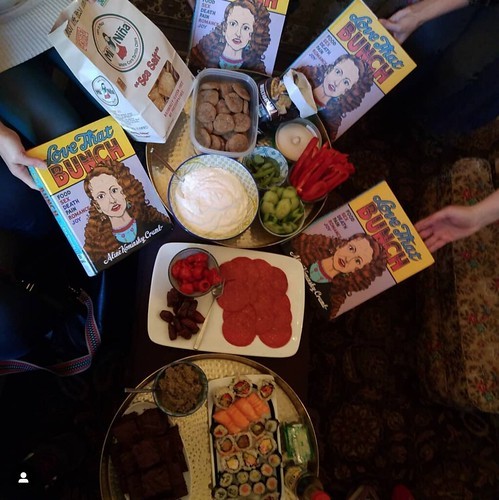
Here's what we ate at club, including sushi and horseradish creme fraiche dip and ginger molasses cookies that I made my own self, recipe here:
It's not just the heavy shit -- all the rape and racism and overwhelming misogyny and abuse of all stripes -- it's the "lesser" awfulness too, the way that she flees her prudish, superficial, neurotic, upwardly-clawing Long Island upbringing but seems not to have been able, all these years later, to remove its talons from her heart. The way she is never able to let go of her self-depreciation, of her limp victimhood, of her desperate keening to be thinner, prettier, worldlier. Of her brashness in the face of sexual assault which is overshadowed by her unexamined sexual masochism. Of her joy in owning her own sexuality and her reverence for nontraditional life, which is tanked by her pettiness and her devastating self-loathing.
The anthologizing of these disparate works into an oversized tome doesn't help. This isn't a memoir, though its heft and chronology makes the reader (or, well, made this reader) want to read it as one, which makes the repetition of the same stories in slightly different formats and from slightly different angles grow tiring, and makes the author seem overly fixated on a few episodes from her life without challenge or growth. Also her style is physically chaotic which can make it feel even harder to drag your eyes down the page.
I dunno. My very smart friend Jil reviewed this for The Nation and is far more forgiving than I was. But the girls at book club generally felt the same way I did: really disappointed that this book, and this author, are so hard to love.
Here's what we ate at club, including sushi and horseradish creme fraiche dip and ginger molasses cookies that I made my own self, recipe here:

April 2, 2018
Dec 2012: reread in honor of the great Aline Kominsky-Crumb. It's a wonderful book. The last story, “Dream House,” is especially powerful, the last long-form comic she drew. RIP Aline, and thank you for everything, all the inspiration you've given me over the years.
The original 1990 edition of this book (from Fantagraphics) was an important influence for me where my own comics were concerned, so I was excited to be assigned a long-form review of this wonderful updated & expanded edition for The Comics Journal:
http://www.tcj.com/reviews/love-that-...
The original 1990 edition of this book (from Fantagraphics) was an important influence for me where my own comics were concerned, so I was excited to be assigned a long-form review of this wonderful updated & expanded edition for The Comics Journal:
http://www.tcj.com/reviews/love-that-...

May 18, 2018
Well, I was expecting to like this a lot more than I did. The author (henceforth AKC) has led an "interesting" life, and her book amounts to an autobiography in comix. And AKC is certainly fearless in sharing (or oversharing) the salacious details of her hippie youth. But. I had a really hard time following the overlapping dialog-balloons in her cartoons (which appear to be reduced in size), and a fair bit of it seemed pretty dull. And -- there were only FOUR PAGES of color art in the book! So, the book pretty much missed for me. 2 stars, which I will stretch to 2.4 for nostalgia. And because she lived in Tucson for awhile, my old home town, and has some cool drawings of saguaro cactus.
Oh, and "The Bunch" is her nickname.
NY Times Illustrated profile. Nice examples of her art, cherry-picked from the book. https://www.nytimes.com/2018/05/14/bo...
Sample: In New York, she swiped through the pictures on her iPhone.... to something completely different but, also, unsurprising. Photo after photo of anonymous women shot from behind, all with noticeably large backsides, all in miniskirts or short shorts. Ms. Kominsky-Crumb kept swiping through them as if the shift from the domestic made total sense, explaining that these were from a recent trip to Miami to visit her mother. They were, of course, intended for Mr. Crumb.
“I’m enabling his big butt fixation,” she said, a smile spreading across her face as she admired the pictures. “Well I don’t have a big butt anymore so I have to offer him something.”
Wikipedia has a more linear biography, sadly with no art: https://en.wikipedia.org/wiki/Aline_K...
Oh, and "The Bunch" is her nickname.
NY Times Illustrated profile. Nice examples of her art, cherry-picked from the book. https://www.nytimes.com/2018/05/14/bo...
Sample: In New York, she swiped through the pictures on her iPhone.... to something completely different but, also, unsurprising. Photo after photo of anonymous women shot from behind, all with noticeably large backsides, all in miniskirts or short shorts. Ms. Kominsky-Crumb kept swiping through them as if the shift from the domestic made total sense, explaining that these were from a recent trip to Miami to visit her mother. They were, of course, intended for Mr. Crumb.
“I’m enabling his big butt fixation,” she said, a smile spreading across her face as she admired the pictures. “Well I don’t have a big butt anymore so I have to offer him something.”
Wikipedia has a more linear biography, sadly with no art: https://en.wikipedia.org/wiki/Aline_K...

July 2, 2018
Kominsky-Crumb's ugly art and perverse confessional writing style are not without their charm in this large collection of strips produced over decades, and I enjoyed the first 50 pages more than I expected as I read through them at a leisurely pace. But the book was coming due at the library and I decided to power through the next 150 pages in a day, and at that pace the short strips start to take on a whiny and repetitive drone.
I allowed myself to slow down for one of the last and longest stories in the collection, which benefited from having an actual structure as the author revisited the homes she has had throughout her life.
Kominsky-Crumb will never be one of my favorite creators, but this book is worth a look for its artistic and historical value.
I allowed myself to slow down for one of the last and longest stories in the collection, which benefited from having an actual structure as the author revisited the homes she has had throughout her life.
Kominsky-Crumb will never be one of my favorite creators, but this book is worth a look for its artistic and historical value.

February 21, 2026
رسامة الكوميكس Alien Crumb اللي يعتبر كوميكس للكبار +١٨
أنا بعتبر ده نوع مهم لان الكوميكس حلو يكون ف ف تنوع متاح للصغيرين والمراهقين والكبار لأنه فن مهم
عندي كذا فيلم وثائقي ظهرت فيهم هحاول أنزلهم ع تليجرام جرافيميديا
@graphimedia
كالعادة بصور الكتب الفنية دي كاملة وبنزلها ع قناة عن الفن ع اليوتيوب
@3nelfn
وبصور كمان الكتب اللي بستعيرها من المكتبة عامة ع انستجرام
@mai.designer92
أنا بعتبر ده نوع مهم لان الكوميكس حلو يكون ف ف تنوع متاح للصغيرين والمراهقين والكبار لأنه فن مهم
عندي كذا فيلم وثائقي ظهرت فيهم هحاول أنزلهم ع تليجرام جرافيميديا
@graphimedia
كالعادة بصور الكتب الفنية دي كاملة وبنزلها ع قناة عن الفن ع اليوتيوب
@3nelfn
وبصور كمان الكتب اللي بستعيرها من المكتبة عامة ع انستجرام
@mai.designer92

March 30, 2024
"Querido Callo" de Aline Kominsky-Crumb emerge como un testimonio poderoso y sin concesiones de una de las figuras más icónicas del cómic underground y subversivo (el comix a partir de la década de los 70), donde las figuras femeninas fuertes abundan en las páginas pero escasean detrás de ellas, siendo su trabajo en gran parte invisibilizado (así que BIEN Reservoir Books por publicarlo). De hecho, estaba familiarizada con la obra de su pareja, Robert Crumb, otro icono del comix, con el que Aline compartió su vida. La obra aborda temas complejos como las crisis existenciales, la muerte, y traumas familiares, todo ello a través del prisma de la experiencia femenina.
A través de su álter ego Bunch, Kominsky-Crumb narra con crudeza y sinceridad las peripecias de crecer en los años 60, mezclando sin temor sus inseguridades y secretos más oscuros con un feminismo complicado y orgulloso, pero sin pedir nunca disculpas. Esta colección abarca desde los años 70 hasta la actualidad, ofreciendo una mirada auténtica a su época y adelantándose a su tiempo en muchos aspectos. Originalmente publicado en 1990 y ahora reeditado en una versión ampliada, "Querido Callo" incluye una nueva historia de treinta páginas que reflexiona sobre su infancia cuarenta años después, y un epílogo de la destacada académica de cómics Hillary Chute, consolidándose como la única obra en solitario de Kominsky-Crumb actualmente publicada. Su estilo artístico deliberadamente "feo" y su escritura confesional ofrecen una experiencia lectora y estética única.
A través de su álter ego Bunch, Kominsky-Crumb narra con crudeza y sinceridad las peripecias de crecer en los años 60, mezclando sin temor sus inseguridades y secretos más oscuros con un feminismo complicado y orgulloso, pero sin pedir nunca disculpas. Esta colección abarca desde los años 70 hasta la actualidad, ofreciendo una mirada auténtica a su época y adelantándose a su tiempo en muchos aspectos. Originalmente publicado en 1990 y ahora reeditado en una versión ampliada, "Querido Callo" incluye una nueva historia de treinta páginas que reflexiona sobre su infancia cuarenta años después, y un epílogo de la destacada académica de cómics Hillary Chute, consolidándose como la única obra en solitario de Kominsky-Crumb actualmente publicada. Su estilo artístico deliberadamente "feo" y su escritura confesional ofrecen una experiencia lectora y estética única.
March 17, 2021
I am delighted that she ended this book with colour!! I love her candour but why so many black and white drawings? It gives relief that someone sees the truth about themselves but simultaneously disheartens that someone could find so much dissatisfaction. Aline Kominsky-Crumb would be celebrated if she contributed more. I get the impression her husband receives the lion's share of the praise. Everyone knows what matters to them.
So joyous I read this book!
I'll have to read Sophie Crumb. Her artwork appears meticulous.
Merci beaucoup!!
So joyous I read this book!
I'll have to read Sophie Crumb. Her artwork appears meticulous.
Merci beaucoup!!

July 19, 2025
Instantly one of my favorite comic book anthologies. In these strips, Kominsky-Crumb explores femininity and beauty, her dysfunctional Jewish family, her experiences as a counter-culture groupie, living in France with Robert Crumb, motherhood, plastic surgery, and so much more. Her satirical point of view is edgy and acknowledges no sacred cows. In an interview with the Louisiana Channel, AKC mentioned the influence of the German Expressionists on her early work, specifically George Grosz, and it's easy to see: the face of her father almost looks maimed, and her mother looks monstrous. Even though AKC aims highlights the ugliness in herself and the society around her, there's always a hint of a grin, a wink of an eye. The humor here, while sometimes brutal, comes from a place of love (and often self-deprecation!).

January 23, 2026
Very mixed thoughts on this one. Some of her ‘70s work is quite bad. In a lot of ways it’s indicative of wider issues with early underground comix and her husband’s work. But her mid-to-late ‘80s and early ‘90s work from Weird is quite good, and the 33-page new story done for this book is excellent, which earned it back a star.
January 1, 2026
Hey it ended on a positive note!! Aline Crumb was a true ahtist and yid who had a hard life in a lot of ways. At times this was relentlessly depressing but I was sucked in nonetheless. Read comics by women! Fuck you Rohbit

May 23, 2019
In her introduction to this collection of Kominsky-Crumb's autobiographical strips, Hillary Chute makes a valiant effort to defend Kominsky-Crumb's art as not incompetent but rather informed by her art school education, a position somewhat undermined by Kominsky-Crumb's own repeated assertion in the strips here that she can't draw and by the general contempt with which she depicts her art school education. This could be disingenuous, or self-deprecation, I suppose, but I am more inclined to agree with Kominsky-Crumb's self-assessment. On some level, there must be a degree of deliberateness to her shaky line, inconsistent anatomy, inconsistent perspectives, etc, as the work here was produced over decades with no evidence of significant stylistic change or development (at least not after the earliest strips presented), but is it a deliberate continuance of a style, or a deliberate refusal to refine her line? Chute's defence of Kominsky-Crumb's spelling errors are less convincing. Sure, sometimes Kominsky-Crumb is deliberately spelling incorrectly (often to represent pronunciation), but more frequently, misspellings seem to be the result of ignorance or carelessness. One can rationalize Kominsky-Crumb's general lack of attention to spelling, legible lettering, readable page layouts and so on as of a piece with the "craft is the enemy" school of art, that privileges honesty, directness, and individuality of expression over mere "craft," and indeed a case can be made that such an approach can create powerful art. Some of the strips here do have a power and immediacy that would probably be blunted by more attention to craft. Many, however, are just hard to read and not very pleasant to look at. That latter observation if often the point, of course, as Kominsky-Crumb is laudably frank about addressing subjects such as body politics and exploring the implications--and limitations--of our obsession with beauty as an inherent good. Her own self-esteem and body issues are overwhelmingly her primary subject, and she is admirably uncompromising about showing herself in an unflattering light. However, I do think that a bit more craft would not go astray. I am struck by the fact that the single panel in the entire book drawn by Robert Crumb stands out like a sore thumb, a rose of craft in a weed-patch of art. Interesting and revealing work, but not in my opinion great comics work.
I wish, as well, that original publication information had been included. While it's not necessary to know where and when this work first appeared, it would be of some use, I think.
I wish, as well, that original publication information had been included. While it's not necessary to know where and when this work first appeared, it would be of some use, I think.
July 9, 2018
I'm glad this edition came out, as I wasn't very familiar with Kominsky-Crumb's work and only sought this out due to D-Q's promotion of the updated edition. It's fascinating to follow her evolution as an artist and memoirist. I also enjoyed her drawing style, which seems heavily criticized (and she herself comments on it), but I found evocative. I was startled by the photograph of her mother on the back of the book - Kominsky-Crumb really captures her essence in her drawings. I often devour graphic novels/comics/x too quickly, but the density of this work forced me to savor it.
January 15, 2024
Solo me ha gustado por su valor histórico ya que es una parte importante del comic underground americano pero no he conseguido conectar con casi ninguna tira y el ritmo se me estaba haciendo muy pesado

October 11, 2022
Yusef the hairsucker slays 🐈⬛

December 6, 2023
La mejor autobiografía, en cómic ondeground ,que he leído.
Displaying 1 - 15 of 15 reviews