

What do you think?

Beirut Won't Cry
A diary of the 2006 war in Lebanon told in drawings, comics and prose. Beirut Won’t Cry shows us how an artist views the world and everything in it ― his relationships, his family, and his creative pursuits ― as it violently crumbles around him. Both historically vital and hilarious, Beirut Won’t Cry introduces Mazen Kerbaj’s unique voice and urgent pen to an American audience for the very first time, teaching readers how to carry on and resist in times of war and oppression.
264 pages, Paperback
First published January 20, 2007
About the author
Mazen Kerbaj
19 books12 followersMazen Kerbaj was born in 1975 in Beirut and lived there since. His main activities are comics, painting and music.
After a lot of works for different publishers and magazines, it is in March 2000 that he releases some of his more personal works in his Journal 1999 (a dairy in comics' format). He self-published eight other books and many short stories since.
After a lot of works for different publishers and magazines, it is in March 2000 that he releases some of his more personal works in his Journal 1999 (a dairy in comics' format). He self-published eight other books and many short stories since.
Ratings & Reviews
Friends & Following
Create a free account to discover what your friends think of this book!
Community Reviews
Displaying 1 - 27 of 27 reviews

February 12, 2018
"I try to be a fucking witness. To show a little bit of what is happening here. In my own way."
Jazz trumpeter Mazen Kerbaj kept a blog during the bombing of Beirut in the summer of 2006. These entries sometimes feature words, but more often they are quickly sketches cartoons accomplished during the actual bombing. In case you are inclined, as some of his readers were, to take sides, he claimed the blog was not primarily political, but shared as a human being, an artist who was overwhelmed by what was happening.
"We are so used to living in this shit."
This is a link to his actual blog, so you can see his style, though you have to scroll a ways back to get to 2006:
http://mazenkerblog.blogspot.com
Joe Sacco writes a great intro, too. Yes, this is comics journalism!
"More drawings and words and bombs tomorrow."
Sometimes he is funny: "Fucking no electricity again today. Thomas Edison, please help me."
And sometimes he is ready to give up: "Fuck art. Fuck the world, Fuck everything."
Powerful. As he says, we need to resist!
.
Jazz trumpeter Mazen Kerbaj kept a blog during the bombing of Beirut in the summer of 2006. These entries sometimes feature words, but more often they are quickly sketches cartoons accomplished during the actual bombing. In case you are inclined, as some of his readers were, to take sides, he claimed the blog was not primarily political, but shared as a human being, an artist who was overwhelmed by what was happening.
"We are so used to living in this shit."
This is a link to his actual blog, so you can see his style, though you have to scroll a ways back to get to 2006:
http://mazenkerblog.blogspot.com
Joe Sacco writes a great intro, too. Yes, this is comics journalism!
"More drawings and words and bombs tomorrow."
Sometimes he is funny: "Fucking no electricity again today. Thomas Edison, please help me."
And sometimes he is ready to give up: "Fuck art. Fuck the world, Fuck everything."
Powerful. As he says, we need to resist!
.

November 3, 2020
Mazen Kerbaj captured the July War (2006) in his blog, writings, music, and art. The trilingual renderings are pulled into this graphic novel, and translated into English when necessary. He captures the strangeness of living through violence and death, especially the emotional toll.
You can view some of his art and listen to him improvising on trumpet against Israeli bombs in YouTube. (Description from video: "Excerpt from a 40-minute improvisation recorded by Mazen Kerbaj in Beirut on the night of 16th/17th July 2006, in which Kerbaj's trumpet 'duets' with the sound of Israeli bombs outside. The drawings in the video are from the same period.")
Thanks to Karen for letting me know Hoopla has many works from Fantagraphics (not a paid advertisement, that just means I have access through my public library.)
You can view some of his art and listen to him improvising on trumpet against Israeli bombs in YouTube. (Description from video: "Excerpt from a 40-minute improvisation recorded by Mazen Kerbaj in Beirut on the night of 16th/17th July 2006, in which Kerbaj's trumpet 'duets' with the sound of Israeli bombs outside. The drawings in the video are from the same period.")
Thanks to Karen for letting me know Hoopla has many works from Fantagraphics (not a paid advertisement, that just means I have access through my public library.)

July 21, 2020
When you're twelve and an idealist, you read Anne Frank's Diary and it breaks your heart.
When you're an adult and a cynic, you read Beirut Won't Cry and your heart breaks again.
And being a cynic becomes harder.
When you're an adult and a cynic, you read Beirut Won't Cry and your heart breaks again.
And being a cynic becomes harder.

February 12, 2025
This is the most striking work I’ve read in a while. It’s socially important, yes, but also just very well done. With acerbic humour and compelling visual style Kerbaj chronicles and comments on his experience of the harrowing 2006 July War (ie. Israel’s bombing of Lebanon) in real-time through drawings, comics and text posts, all from his blog at the time. I read this on Hoopla and it didn’t let me screenshot any of the drawings/comics which I’m currently very mad about, as I want to show them to everyone I know.
It feels topically relevant as Israel is currently encroaching on Lebanon, and I hope there comes a day when this book is no longer topically relevant and the people of Lebanon (and Palestine, and Syria) will no longer live in the anxiety and fear and frustration that Kerbaj so deftly conveys.
It feels topically relevant as Israel is currently encroaching on Lebanon, and I hope there comes a day when this book is no longer topically relevant and the people of Lebanon (and Palestine, and Syria) will no longer live in the anxiety and fear and frustration that Kerbaj so deftly conveys.

Read
July 10, 2025I do have something to say about this but cannot elaborate at this point in time. Need to wait for a bit. But my journey from first coming across this book and finding it years later: a patient tale of fate.
Read
October 22, 2024Damn.

Read
April 25, 2018"Kerbaj’s cartoons, narrated in English, Arabic, and French, convey the complex mixture of emotions he experienced during the war. In stark black-and-white drawings, he carries his audience on his journey from despair to anger to apathy and back again—along with brief but happy respites during his trips out of Beirut to visit his son and ex-wife in the mountains beyond the city." - Paul Love
This book was reviewed in the Mar/Apr 2018 issue of World Literature Today magazine. Read the full review by visiting our website:
https://www.worldliteraturetoday.org/...
This book was reviewed in the Mar/Apr 2018 issue of World Literature Today magazine. Read the full review by visiting our website:
https://www.worldliteraturetoday.org/...

June 29, 2018
Thought provoking and often terrifying account of one artist's life in Beirut during the Israeli bombing campaign in 2006.
Read
May 7, 2024It’s crazy because if you just changed the names of the cities you could publish this book as ‘Gaza Won’t Cry’ in 2024. Will it ever end?

October 28, 2024
This whole book is a promise to survive, a willing life into existence, a kind of spell maybe.

October 12, 2022
I would categorize this a collection of political cartoons (even though Mazen writes multiple times that his blog is not political), or an art journal... But it's definitely not a graphic novel. -Though the pages are "sequential," each posting stands on its own to tell its own story of the 2006 Lebanon War. So, not a graphic novel, but something else.
Like Joe Sacco writes in the introduction, Mazen "does not offer a political assessment of why they (Israeli bombers) are there or examine the claims and counterclaims of the protagonists. He simply vents his anger..." and this blog is both powerful and emotionally evocative because of it. And, also kinda weak and somewhat?/highly? problimatic because of it too.
The powerful:
-Mazen posts/draws multiple times a day, so the feelings of a forever conflict, a horror that never ends, grows with each page you turn. It just goes and goes and goes.
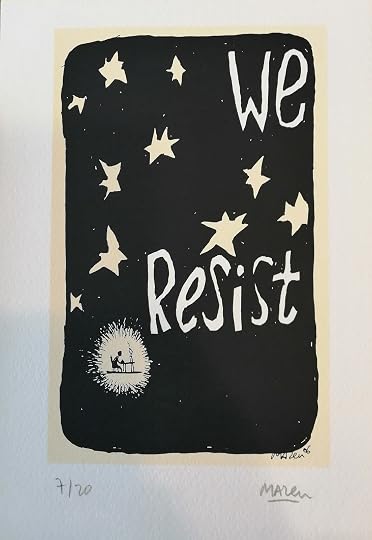
-The dark pages are especially powerful. My favorites are July 18, depicting a little figure at a desk with a candle glowing in the corner of a large dark page with exploding bombs/stars, alongside the words, "We Resist." And July 26, which is two white word bubbles on an inky black background, translated as, "How can I show what I am feeling? / How can I understand what I am feeling?"
-The "every day life" pages showing what is left/available in the supermarkets.
-August 14th's image of a cluster bomb with a white ribbon. (Didn't know what it was and I had to stalk Google for a bit before I found an image that I could connect with Mazen's drawing/horrific words.)
-The pages/entries of color at the end.
The weak:
-I did not like how Mazen drew six-pointed stars (representative of Stars of David/Jewish Stars) alongside five-pointed stars to depict Israeli bombs. Pgs. July 17, July 20 (drawn on July 19), *July 25, *Aug 2, Aug 4, and Aug 12.
-*July 25 and *Aug 2 are especially horrible as Mazen straight-up draws Stars of David in the stars of the United States flag and EU flag, respectively, playing up the age-old 'Zionist Jews run America/the World' conspiracy theory.
-More hidden/not so hidden antisemitism throughout: At points Mazen can't upload images to the blog and writes a post instead. On July 25, Mazen writes that he is unable to post & feels paranoid. What if he's "being stopped" by "somebody." It's quite obvious who Mazen thinks that "somebody" is, and should have/could have just put "somebody" in parentheses (((somebody))).
(P.s. It was just a connection problem and his blog continued.)
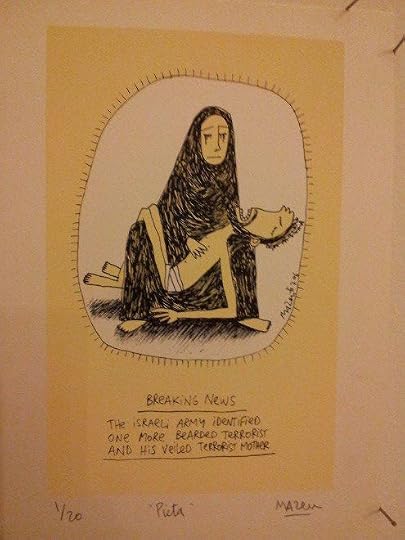
And on August 1, Mazen posted an image of a veiled Virgin Mary crying over the corpse of Jesus. In English it says, "Breaking News. The Israeli Army identified one more bearded terrorist and his veiled terrorist mother." Which isn't even a disguised allusion to "Jews killing Jesus".
It was a bit much.
-On July 27 Mazen writes another blog post, this time with a plea: "PLEASE DO NOT POST ANT POLITICAL COMMENTS ON THE BLOG. THIS IS A BLOG DEDICATED TO ART. AND AS SUCH, IT VOMITS ON ANYTHING CALLED POLITICS."
Yet. Yet, Mazen makes political comments all the time on his blog/in his art. He plays a morbid numbers game with Lebanese and Israeli casualties, comparing the two, in the most horrific and unnecessary way. Life is life, why do you have to cheapen Israeli/Jewish life by asking for more innocents to be killed on one side?! (Reference to the post on Aug 2, titled "And now, let's play with numbers.") Why can't we elevate all life and mourn and condemn the horrible killing of Lebanese innocents while not calling for more death? (*Innocents, because Lebanon did not differentiate between combatants and civilians when reporting casualty numbers.)
Like Joe Sacco writes in the introduction, Mazen "does not offer a political assessment of why they (Israeli bombers) are there or examine the claims and counterclaims of the protagonists. He simply vents his anger..." and this blog is both powerful and emotionally evocative because of it. And, also kinda weak and somewhat?/highly? problimatic because of it too.
The powerful:
-Mazen posts/draws multiple times a day, so the feelings of a forever conflict, a horror that never ends, grows with each page you turn. It just goes and goes and goes.
-The dark pages are especially powerful. My favorites are July 18, depicting a little figure at a desk with a candle glowing in the corner of a large dark page with exploding bombs/stars, alongside the words, "We Resist." And July 26, which is two white word bubbles on an inky black background, translated as, "How can I show what I am feeling? / How can I understand what I am feeling?"
-The "every day life" pages showing what is left/available in the supermarkets.
-August 14th's image of a cluster bomb with a white ribbon. (Didn't know what it was and I had to stalk Google for a bit before I found an image that I could connect with Mazen's drawing/horrific words.)
-The pages/entries of color at the end.
The weak:
-I did not like how Mazen drew six-pointed stars (representative of Stars of David/Jewish Stars) alongside five-pointed stars to depict Israeli bombs. Pgs. July 17, July 20 (drawn on July 19), *July 25, *Aug 2, Aug 4, and Aug 12.
-*July 25 and *Aug 2 are especially horrible as Mazen straight-up draws Stars of David in the stars of the United States flag and EU flag, respectively, playing up the age-old 'Zionist Jews run America/the World' conspiracy theory.
-More hidden/not so hidden antisemitism throughout: At points Mazen can't upload images to the blog and writes a post instead. On July 25, Mazen writes that he is unable to post & feels paranoid. What if he's "being stopped" by "somebody." It's quite obvious who Mazen thinks that "somebody" is, and should have/could have just put "somebody" in parentheses (((somebody))).
(P.s. It was just a connection problem and his blog continued.)
And on August 1, Mazen posted an image of a veiled Virgin Mary crying over the corpse of Jesus. In English it says, "Breaking News. The Israeli Army identified one more bearded terrorist and his veiled terrorist mother." Which isn't even a disguised allusion to "Jews killing Jesus".
It was a bit much.
-On July 27 Mazen writes another blog post, this time with a plea: "PLEASE DO NOT POST ANT POLITICAL COMMENTS ON THE BLOG. THIS IS A BLOG DEDICATED TO ART. AND AS SUCH, IT VOMITS ON ANYTHING CALLED POLITICS."
Yet. Yet, Mazen makes political comments all the time on his blog/in his art. He plays a morbid numbers game with Lebanese and Israeli casualties, comparing the two, in the most horrific and unnecessary way. Life is life, why do you have to cheapen Israeli/Jewish life by asking for more innocents to be killed on one side?! (Reference to the post on Aug 2, titled "And now, let's play with numbers.") Why can't we elevate all life and mourn and condemn the horrible killing of Lebanese innocents while not calling for more death? (*Innocents, because Lebanon did not differentiate between combatants and civilians when reporting casualty numbers.)

December 19, 2024
This book is an illustrated diary by Lebanese artist Mazen Kerbaj, chronicling the harrowing experiences of the 2006 war in Lebanon. Reading it amidst the backdrop of the 2024 Israel-Hezbollah war lends a haunting sense of déjà vu, evoking the saying often attributed to Mark Twain: "History doesn’t repeat itself, but it often rhymes."
The diary is a tough yet compelling read, as the author’s pain and despair over the futility of war and the massacre of innocents permeate every page. The rawness of his words and emotions is striking, and the abstract, sketch-like artwork adds a unique visual dimension to the narrative. This interplay of text and art makes the book profoundly impactful and unlike any other war memoir.
One particularly poignant moment occurs midway through, when Mazen encourages his mother to draw—an intimate act that deepens the personal connection within the story. For those interested, their reflections on the war a decade later can be seen in this insightful interview: Watch here . A deeply moving and unforgettable work. Also these words and images from the book held my attention
George Bush - "Israel has the right to defend itself"
Bombs. Destruction. Massacre. Hunger. Exodus. Fire. (Echoes of media coverage of Gaza 2023/24 in this statement)
Mazen's Mother Laure Ghorayeb - "Lebanon was in history but might be getting out of geography."
2,000 years ago in Qana, Jesus transformed water into wine.
Today in Qana, the Israeli Air Force transformed kids into ashes.
Today in Beirut, I couldn't transform this page into a drawing.
The diary is a tough yet compelling read, as the author’s pain and despair over the futility of war and the massacre of innocents permeate every page. The rawness of his words and emotions is striking, and the abstract, sketch-like artwork adds a unique visual dimension to the narrative. This interplay of text and art makes the book profoundly impactful and unlike any other war memoir.
One particularly poignant moment occurs midway through, when Mazen encourages his mother to draw—an intimate act that deepens the personal connection within the story. For those interested, their reflections on the war a decade later can be seen in this insightful interview: Watch here . A deeply moving and unforgettable work. Also these words and images from the book held my attention
George Bush - "Israel has the right to defend itself"
Bombs. Destruction. Massacre. Hunger. Exodus. Fire. (Echoes of media coverage of Gaza 2023/24 in this statement)
Mazen's Mother Laure Ghorayeb - "Lebanon was in history but might be getting out of geography."
2,000 years ago in Qana, Jesus transformed water into wine.
Today in Qana, the Israeli Air Force transformed kids into ashes.
Today in Beirut, I couldn't transform this page into a drawing.

April 24, 2025
What type of hope am I supposed to feel when this diary from 2006 reads like it was written yesterday
There's something deeply personal about reading the exact experience you're living, it's more powerful than anything
There's something deeply personal about reading the exact experience you're living, it's more powerful than anything

March 3, 2023
Read Harder 2023 - Task #5 & #9 ALTs

June 20, 2025
This is a must read.

July 17, 2021
Not sure if it's a graphic novel or not, the book is basically a blog translated to book, a series of images and a few written entries. It's the account of the bombing of Beirut during 2006 by the Israelis. The book tries very hard not to be political, it's just a person talking about his experiences during that time. Is a little raw, but it's something worth reading.

April 29, 2021
This book was very much like experimental music for me. Sometimes, it’s deep and profound and sometimes it just hurts your ears. But I definitely wouldn’t have read this for the writing alone (not good) - the illustrations and the story are the stars here.

March 5, 2023
A necessary visual read on the impact war has on people. Great notes and drawings. I especially love the anti-war narrative reappeared throughout. They are not trying to be political but rather arguing why violence is never the answer.

December 28, 2025
It's a post-modern comic of sorts. The author has a lot of very crude drawings and the text in them is then translated into English below them. There is no plot, no story, no clear focus. He makes himself out to be some grand blogger yet I don't see any talent here.
The intro by Joe Sacco shows what this is about. Israel was at war with Hezbollah in 2006. Today and back then Hezbollah was accepted by Lebanon as they had weapons and social power and Lebanon couldn't do anything about this terrorist group that acted out of the country and inside the country alike. In 1982 Israel kicked out PLO from the area which left the Shia Muslims there and Iran could then proxy a new terrorist group that was Shia too instead of Sunni. Hezbollah is now the Shia Hamas yet outside Israel.
Joe Sacco hates Israel and sets it up as an anti-Israel book and indeed it turns into one as the author mocks Israel for bombing Lebanon. Yet we get no background info. Only thing you see is "Israel bad because bombs bad". Not all Israel actions are fully moral so maybe he could have made some morality case here to convince readers. The fact that he doesn't smells fishy. Is it because Israel was in the right or because he just doesn't really know enough to explain any of the context? The author claims he is apolitical hence no talk can be about why this is happening. Only point is that Israel is evil for doing it. If you already agree with him you may not question anything. Even so the drawings are too ugly for this to be worth your time. It's an emotional outburst and he keeps talking about what happened in other parts of the nation to other families. The ones in the Hezbollah areas. Nothing really happened to him personally making this pointless.
The intro by Joe Sacco shows what this is about. Israel was at war with Hezbollah in 2006. Today and back then Hezbollah was accepted by Lebanon as they had weapons and social power and Lebanon couldn't do anything about this terrorist group that acted out of the country and inside the country alike. In 1982 Israel kicked out PLO from the area which left the Shia Muslims there and Iran could then proxy a new terrorist group that was Shia too instead of Sunni. Hezbollah is now the Shia Hamas yet outside Israel.
Joe Sacco hates Israel and sets it up as an anti-Israel book and indeed it turns into one as the author mocks Israel for bombing Lebanon. Yet we get no background info. Only thing you see is "Israel bad because bombs bad". Not all Israel actions are fully moral so maybe he could have made some morality case here to convince readers. The fact that he doesn't smells fishy. Is it because Israel was in the right or because he just doesn't really know enough to explain any of the context? The author claims he is apolitical hence no talk can be about why this is happening. Only point is that Israel is evil for doing it. If you already agree with him you may not question anything. Even so the drawings are too ugly for this to be worth your time. It's an emotional outburst and he keeps talking about what happened in other parts of the nation to other families. The ones in the Hezbollah areas. Nothing really happened to him personally making this pointless.
May 17, 2021
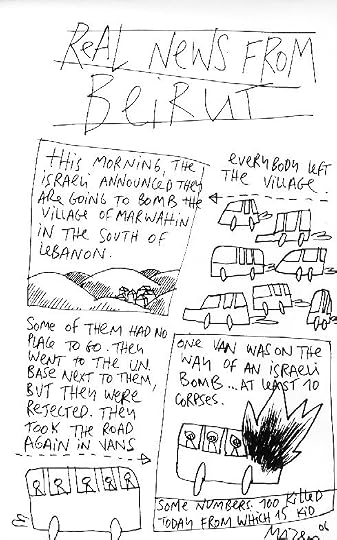
Mazen Kerbaj, an artist and jazz musician from Beirut, created (and blogged originally) these comics in real-time during the month-long bombing of Lebanon by Israeli forces. The comics have an urgency, terror, and exhaustion to them that can only truly happen with something created "live". Kerbaj doesn't know how long the war will last, if he or his love ones will survive, if his blog will be censored or taken down, which makes his art all the more urgent. He has this acute need to record every moment, to be a witness to the dying children, to stay in danger, and to play his trumpet along side the percussion beats of dropping bombs. But the collection is not just astonishing for its subject, but for the poetry and art itself. The artwork is all the more powerful for it's limited color (mostly black-and white) and quick sketchiness. If it seems too cartoonish at first, definitely give it a few more pages. Seeing how Kerbaj's sketches evolve over the course of the month is transformative.

December 22, 2024
So. There's a certain irony (and no, this is not really the right word) in reading a book about an Israeli attack on Lebanon while there is currently an Israeli attack on Lebanon in progress. Because that's a major theme in this book: how that one, back in 2006, was neither the first time Israel was raining bombs on Lebanon, nor, as we are currently witnessing, the last. The author's tone is in equal parts calm and despairing, the voice of somebody who is terrified and yet numb to the horror.
I will admit that the art was both hit and miss for me (pun intended), as I'm not usually someone who reads graphic novels or similar. I sometimes thought I would be more connected to the memoir if it was relayed through words alone. But the style also allowed me a distance I might not have otherwise had, and that is probably a blessing. Make no mistake, this is still devastating. Cue the concert of the author on trumpet, with the IDF on bombs.
We cannot go on like this.
I will admit that the art was both hit and miss for me (pun intended), as I'm not usually someone who reads graphic novels or similar. I sometimes thought I would be more connected to the memoir if it was relayed through words alone. But the style also allowed me a distance I might not have otherwise had, and that is probably a blessing. Make no mistake, this is still devastating. Cue the concert of the author on trumpet, with the IDF on bombs.
We cannot go on like this.

February 11, 2021
Here's a book that draws a straight line to "American's have never lived in a war zone." If I lived through even a few days of this, it would be a defining moment of my life. While I'm sure that Kerbaj will never forget the July War, for many of his friends and family, this was one of several wars—neither the first nor the last. They'll remember, but slowly their memories will get jumbled and confused as to what happened during which war.
This is one of those books that leaves you with a sense of how much you don't know. Can I even imagine what it's like to live through a bombing? Much less to imagine a world where I have a routine for such events?
This is one of those books that leaves you with a sense of how much you don't know. Can I even imagine what it's like to live through a bombing? Much less to imagine a world where I have a routine for such events?
January 22, 2018
Marzen kept a blog that included his visual diary during the Lebanon War of 2006. I was almost 30 then. Was my head that far in the sand? Why did I not know this was happening? I feel ignorant about many of the goings on in the Middle East. I will work on becoming more well-versed.
October 20, 2023
An account, told through drawings and blog posts, of Lebanon’s July War. Incredibly poignant as we see another example of Israel fearsome retribution.

October 31, 2024
I read this thanks to Hoopla and my local public library. I wish history didn't repeat itself. So evocative, urgent, desperate, and sometimes funny. "We'll continue. We'll remain."

April 16, 2025
A man’s struggle to understand war as his city is being bombed. Important read and funky art that reminds me of Basquiat.
Read
July 30, 2026Al hurriyya li beirut wa Lubnan
Displaying 1 - 27 of 27 reviews