

What do you think?

A History of the African-American People (Proposed) by Strom Thurmond, as told to Percival Everett & James Kincaid
Praise for Percival
“If Percival Everett isn’t already a household name, it’s because people are more interested in politics than truth.”—Madison Smartt Bell, author of The Washington Square Ensemble
“Everett’s talent is multifaceted, sparked by a satiric brilliance that could place him alongside Richard Wright and Ralph Ellison . . .”— Publishers Weekly
“I think Percival Everett is a genius. I’ve been a fan since his first novel. He continues to amaze me with each novel—as if he likes making 90-degree turns to see what’s around the corner, and then over the edge . . . He’s a brilliant writer and so damn smart I envy him.”—Terry McMillan, author of Mama
A fictitious and satirical chronicle of South Carolina Senator Strom Thurmond’s desire to pen a history of African-Americans—his and his aides’ belief being that he has done as much, or more, than any American to shape that history. An epistolary novel, The History follows the letters of loose cannon Congressional office workers, insane interns at a large New York publishing house and disturbed publishing executives, along with homicidal rival editors, kindly family friends, and an aspiring author named Septic. Strom Thurmond appears charming and open, mad and sure of his place in American history.
Percival Everett is the author of 15 works of fiction, among them Glyph , Watershed and Frenzy . His most recent novel, Erasure , won the Hurston/Wright Legacy Award and did little to earn him friends.
James Kincaid is an English professor at the University of Southern California and has written seven books in literary theory and cultural studies. These books and Kincaid himself have gradually lost their moorings in the academic world, so there was nothing left for him to do but to adopt the guise of fiction writer. Writing about madness comes easy to him.
“If Percival Everett isn’t already a household name, it’s because people are more interested in politics than truth.”—Madison Smartt Bell, author of The Washington Square Ensemble
“Everett’s talent is multifaceted, sparked by a satiric brilliance that could place him alongside Richard Wright and Ralph Ellison . . .”— Publishers Weekly
“I think Percival Everett is a genius. I’ve been a fan since his first novel. He continues to amaze me with each novel—as if he likes making 90-degree turns to see what’s around the corner, and then over the edge . . . He’s a brilliant writer and so damn smart I envy him.”—Terry McMillan, author of Mama
A fictitious and satirical chronicle of South Carolina Senator Strom Thurmond’s desire to pen a history of African-Americans—his and his aides’ belief being that he has done as much, or more, than any American to shape that history. An epistolary novel, The History follows the letters of loose cannon Congressional office workers, insane interns at a large New York publishing house and disturbed publishing executives, along with homicidal rival editors, kindly family friends, and an aspiring author named Septic. Strom Thurmond appears charming and open, mad and sure of his place in American history.
Percival Everett is the author of 15 works of fiction, among them Glyph , Watershed and Frenzy . His most recent novel, Erasure , won the Hurston/Wright Legacy Award and did little to earn him friends.
James Kincaid is an English professor at the University of Southern California and has written seven books in literary theory and cultural studies. These books and Kincaid himself have gradually lost their moorings in the academic world, so there was nothing left for him to do but to adopt the guise of fiction writer. Writing about madness comes easy to him.
311 pages, Paperback
First published April 1, 2004
About the author
Percival Everett
78 books10.4k followersPercival L. Everett (born 1956) is an American writer and Distinguished Professor of English at the University of Southern California.
There might not be a more fertile mind in American fiction today than Everett’s. In 22 years, he has written 19 books, including a farcical Western, a savage satire of the publishing industry, a children’s story spoofing counting books, retellings of the Greek myths of Medea and Dionysus, and a philosophical tract narrated by a four-year-old.
The Washington Post has called Everett “one of the most adventurously experimental of modern American novelists.” And according to The Boston Globe, “He’s literature’s NASCAR champion, going flat out, narrowly avoiding one seemingly inevitable crash only to steer straight for the next.”
Everett, who teaches courses in creative writing, American studies and critical theory, says he writes about what interests him, which explains his prolific output and the range of subjects he has tackled. He also describes himself as a demanding teacher who learns from his students as much as they learn from him.
Everett’s writing has earned him the PEN USA 2006 Literary Award (for his 2005 novel, Wounded), the Academy Award for Literature of the American Academy of Arts and Letters and the Hurston/Wright Legacy Award (for his 2001 novel, Erasure), the PEN/Oakland-Josephine Miles Award for Excellence in Literature (for his 1996 story collection, Big Picture) and the New American Writing Award (for his 1990 novel, Zulus). He has served as a judge for, among others, the 1997 National Book Award for fiction and the PEN/Faulkner Award for Fiction in 1991.
There might not be a more fertile mind in American fiction today than Everett’s. In 22 years, he has written 19 books, including a farcical Western, a savage satire of the publishing industry, a children’s story spoofing counting books, retellings of the Greek myths of Medea and Dionysus, and a philosophical tract narrated by a four-year-old.
The Washington Post has called Everett “one of the most adventurously experimental of modern American novelists.” And according to The Boston Globe, “He’s literature’s NASCAR champion, going flat out, narrowly avoiding one seemingly inevitable crash only to steer straight for the next.”
Everett, who teaches courses in creative writing, American studies and critical theory, says he writes about what interests him, which explains his prolific output and the range of subjects he has tackled. He also describes himself as a demanding teacher who learns from his students as much as they learn from him.
Everett’s writing has earned him the PEN USA 2006 Literary Award (for his 2005 novel, Wounded), the Academy Award for Literature of the American Academy of Arts and Letters and the Hurston/Wright Legacy Award (for his 2001 novel, Erasure), the PEN/Oakland-Josephine Miles Award for Excellence in Literature (for his 1996 story collection, Big Picture) and the New American Writing Award (for his 1990 novel, Zulus). He has served as a judge for, among others, the 1997 National Book Award for fiction and the PEN/Faulkner Award for Fiction in 1991.
Ratings & Reviews
Friends & Following
Create a free account to discover what your friends think of this book!
Community Reviews
Displaying 1 - 30 of 110 reviews

December 23, 2025
Satire is very hard to pull off effectively, but these authors brilliantly lampoon both the ingrained racism of former US Senator Strom Thurmond and the publishing business. In this epistolary novel, Percival Everett and James Kincaid are authors and English professors who are hired by a publisher to write a history of colored people as envisioned by Thurmond. However, neither Thurmond nor his supercilious assistant seems to have a grip on the contents or structure of this book. The circle of correspondents includes several publishers, the sister of one of the publishers and a first time author. The correspondence devolves into a rondelay of confusion, flirtation and threats. I had never heard of Kincaid, but Everett is a genius and the narration by James Fouhey of the audiobook was wonderful.

September 20, 2012
A working knowledge of the life of ex-senator Strom Thurmond (1902-2003) is not required to revel in this epistolary comedy. Thurmond was a racist and bigoted senator who in a century of existence perpetrated more than the average level of hypocritical capriciousness on the African-American people. This collaborative novel (Everett’s fingerprints more prominent) takes the satirical conceit of a notorious racist writing a racist history, and works a series of madcap correspondences around the proposition. Spoofs and lampoons of publishing interns and editors and the bizarre and disturbing relationships they inhabit create the humour in this rambunctious novel. An excellent concept with devastating satirical intentions descends into silliness quite quickly, as with other Everett novels, i.e. American Desert or Glyph. A fun-filled curio all the same and twice as energetic as most collaborative side-projects.

November 12, 2025
ARC for review. To be published February 3, 2026.
The title - 6 stars
The book - 4 stars
This is the reissue of a book originally published in 2004, an epistolary novel between the writers in the title and then a fictional book editor and his assistant and an assistant to/intern for the famously racist Senator from South Carolina Strom Thurmond. Then add one assistant’s sister, an aspiring writer named Septic and brief appearances by the Senator himself. And start with the premise that Thurmond’s intern believes that Thurmond believes that Thurmond has done as much as anyone to shape African American history which, well, I guess if you look at it a CERTAIN way is not….WRONG?!?! And is Everett the black one?
This is as witty as one would expect. It brings to mind a parody I saw in “George” magazine where there was a meeting of Republicans running for President and Strom Thurmond says to Colin Powell, “I thought I told you to stay with the car.” Only writ large. Plus the writers send up publishing and the relationships that members of Congress have with their staffers. You probably know now whether you are going to think this is clever or not, and I thought the writers did a fine job…I’m glad it’s getting another push in light of the success of JAMES.
The title - 6 stars
The book - 4 stars
This is the reissue of a book originally published in 2004, an epistolary novel between the writers in the title and then a fictional book editor and his assistant and an assistant to/intern for the famously racist Senator from South Carolina Strom Thurmond. Then add one assistant’s sister, an aspiring writer named Septic and brief appearances by the Senator himself. And start with the premise that Thurmond’s intern believes that Thurmond believes that Thurmond has done as much as anyone to shape African American history which, well, I guess if you look at it a CERTAIN way is not….WRONG?!?! And is Everett the black one?
This is as witty as one would expect. It brings to mind a parody I saw in “George” magazine where there was a meeting of Republicans running for President and Strom Thurmond says to Colin Powell, “I thought I told you to stay with the car.” Only writ large. Plus the writers send up publishing and the relationships that members of Congress have with their staffers. You probably know now whether you are going to think this is clever or not, and I thought the writers did a fine job…I’m glad it’s getting another push in light of the success of JAMES.

February 4, 2026
Review to come
Thanks to the publisher and NetGalley for an advanced copy of this book.
Thanks to the publisher and NetGalley for an advanced copy of this book.

July 12, 2024
Like any rational person, I’m generally averse to the epistolary form. Plainly, I went into this with low expectations (can’t say the co-authoring inspired much hope). How nice then to come away goofily plussed.
Like MJ mentions in his review, Strom-formation is not required for entry. He’s a straw dog, a frame device kicked quickly to the curb as the neuroses of the principal players begin effecting into what this novel is really about. Now, to ME, to my purpose, it’s an exposition of just how hard it is to find real connection in life. The ad hoc family the half dozen main characters form is a genuinely lovely process to watch unfold in sequence (a genesis midwifed into creation by the inestimable Barton Wilkes). That mad hatter and Juniper are such vivid, substant creations with a shared erring toward whimsy that I already miss them.
Sure, this novel is focused on a person—but who? Just like life outside the pages, treeing that raccoon is complicated by perspective, our obfuscating self-preservation, vanity, and manifold surface selves we assume as buffers to cushion the vulnerability that true communication requires.
We’re all so busily shielding our hearts that we fail to note their atrophying. Be lions. What the fuck can we really lose in trying?
Like MJ mentions in his review, Strom-formation is not required for entry. He’s a straw dog, a frame device kicked quickly to the curb as the neuroses of the principal players begin effecting into what this novel is really about. Now, to ME, to my purpose, it’s an exposition of just how hard it is to find real connection in life. The ad hoc family the half dozen main characters form is a genuinely lovely process to watch unfold in sequence (a genesis midwifed into creation by the inestimable Barton Wilkes). That mad hatter and Juniper are such vivid, substant creations with a shared erring toward whimsy that I already miss them.
Sure, this novel is focused on a person—but who? Just like life outside the pages, treeing that raccoon is complicated by perspective, our obfuscating self-preservation, vanity, and manifold surface selves we assume as buffers to cushion the vulnerability that true communication requires.
We’re all so busily shielding our hearts that we fail to note their atrophying. Be lions. What the fuck can we really lose in trying?

March 3, 2009
It's impressive to me that Everett and Kincaid manage to stretch out a single joke for 316 pages -- and somehow, they do, though of course they accomplish this by telling lots of little jokes, especially on themselves ("Academics tend to be impatient...but how many hours a week do you actually work, maybe 5?") Though once or twice, I found myself bogging down in some of the letters (it's an epistolary novel), and the end does hit you all at once, I haven't laughed as hard or as often while reading a novel in quite some time, probably since reading another one of Everett's, "Erasure."

March 22, 2026
An epistolatory novel which barrels along initially. Starting out as mostly a satire at the expense of the publishing business it pokes fun at various characters.
However around 2/3 of the way through the authors have decided to humanise them and suddenly we're supposed to like them. For me this switch in tone didn't really work.
However around 2/3 of the way through the authors have decided to humanise them and suddenly we're supposed to like them. For me this switch in tone didn't really work.

Read
January 7, 2026
Book Riot’s Most Anticipated Books of 2026:
Yes, I am spending a most anticipated selection on a reissue, but what a reissue and what timing. Percival Everett is at the top of his game with the adaptation of Erasure and the unstoppable James, but how many read this political satire coauthored by James Kincaid when it published in 2004? Not enough. This epistolary novel lampoons publishing, academia, and politics with former South Carolina senator Strom Thurmond hell-bent on penning a history of African Americans at its center. I have cried, now I'm ready to laugh, and there's no one I trust more with a heady searing than Everett. —S. Zainab Williams
Yes, I am spending a most anticipated selection on a reissue, but what a reissue and what timing. Percival Everett is at the top of his game with the adaptation of Erasure and the unstoppable James, but how many read this political satire coauthored by James Kincaid when it published in 2004? Not enough. This epistolary novel lampoons publishing, academia, and politics with former South Carolina senator Strom Thurmond hell-bent on penning a history of African Americans at its center. I have cried, now I'm ready to laugh, and there's no one I trust more with a heady searing than Everett. —S. Zainab Williams

August 21, 2024
Nobody is safe from ridicule in this over-the-top satire, including Percival Everett, who appears as himself, and co-author James Kincaid. Oddly, Strom Thurmond comes away the most unscathed — at least considering what a vile human he actually was because surprisingly little of this epistolary novel is about him. It dwells mainly with the bizarre rantings, relationships, interactions, and unsettling behavior of the senator's aide and two editors at a publishing house. This definitely shouldn't be your first Everett book or even your tenth.

November 28, 2007
I'm about 60 pages in and laughing hysterically. I heart the Profs. Everett and Kincaid.
Alright, I am about 75 pages into the book and I think I have started hemorraging internally, perhaps a rupture of some godforsaken organ, due to my inability to stop laughing.
Oh holy hell.
Alright, I am about 75 pages into the book and I think I have started hemorraging internally, perhaps a rupture of some godforsaken organ, due to my inability to stop laughing.
Oh holy hell.

January 1, 2025
I’ve been thinking a lot about what to say about this book. It’s weird, for one thing. It’s meant to be absurd, sarcastic, and humorous, but, even so, I’ll call it weird. Bordering on uncomfortably weird, at times. Like uncanny valley weird. The characters just don’t act like real humans, but only slightly. So it’s just a little off, and thus a little off putting.
The book was not what I expected based on the title and description. I thought it would be the actual (albeit fictional) book written by Strom Thurmond, but instead it’s a collection of correspondence among the characters who were working on the project to put together such a book. Most of the book had nothing at all to even do with the topic. It was just a silly show case of the funny and, I’ll say it again, weird relationships these people built.
I wanted to read more from Percival Everett after just recently finishing my first Everett novel, I’m Not Sidney Poitier. Both books definitely share a surreal and absurdist tone. It is definitely well written and engaging. Although the “plot” did drag somewhat. It felt like one big inside joke between the two authors. I imagine them writing successively more ridiculous “letters” to each other to lampoon each other and crack each other up. It was fun but also went on too long, I felt.
All the ridiculousness aside, when the book did take a serious tone (which was very infrequently) it did make me think. And I’m still thinking about what the book says about racism against blacks. I’ve been thinking about how the book raises questions about the idea of supposedly non-racist north and non-racist abolitionists as compared to the stereotypically racist south and southerners. The book, through the voice of Strom Thurmond, argues that the north isn’t much better than the south in terms of racism, but we just look at each side differently.
To wit:
“So, this whole project is an attempt to set the record straight, a forum for you to say that the South isn’t as bad as it’s cracked up to be. Or maybe you’re about pointing out that the whole country is as racist as ever.”
“He [Strom Thurmond] is so much more than the labels slapped on him. Those who do that use him as an excuse, a person to hate so they won’t have to hate themselves.”
The book also has some comments about politics in general that I found intriguing, especially given that my career is in government.
“The politics I know always involved working as best you could to play a game whose rules were already there when you started. See what I mean? You always have to deal with what’s there, whatever it is. Usually what’s there is a tangle, some of which makes sense and some of which don’t. In the case of the African-American people, lots of what was there might have seemed unfair and cruel to anyone not trying to make things better inside the conditions we had.”
The above quote in particular is one of those that almost makes you sympathize with Thurmond, as if he was just a man trying to do his best with the circumstances. (I said ALMOST.) But what struck me most was the first part of that quote about having to work best you can in a system whose rules were already set up when you got there. This could literally have been the theme of my 2024 career. We had a lot of strife this year—a lot of explaining to people how things work and why they are the way they are, and a lot of trying to do the best we could in this system. So yeah it feels like a very appropriate comment to me.
The last quote I’ll share is one that felt really applicable to the person who will be our next president. Although this book was published way back in 2004, it feels like they could have been talking directly about him. Sadly.
“the leader made the observation that truly disgraceful behavior, so long as it is truly excessive, is usually rewarded. She said there were personality types who sensed this and lived their lives on that principle.”
When I first was exploring Everett’s catalog of books, I saw this one was co-written by fellow professor, James Kincaid. I looked into him and saw that two of his published books, and the apparent focus of his academic expertise, is in the history of pedophilia. Immediately that struck me as icky. Mind you, that’s 100% my gut reaction, not having read the books in question. But I couldn’t help feeling that someone who academically focused so much time on pedophilia might have a deep down personal interest himself? I fully admit this might not be fair, but again it’s my gut reaction.
Therefore when I read several references or allusions to pedophilia in this book I was both shocked and not shocked at the same time. It feels almost certain that those passages had to come from Kincaid and made me even more suspicious that he might be somewhat obsessed with the topic. It was icky, is all I can say, and I didn’t enjoy that at all.
Likewise, there is a lot of under the surface homosexuality that I think is purposely written to be uncomfortable and absurd. In 2024, twenty years after this was first published, those themes seem wildly out of date.
For keeping me engaged and making me think, this gets 4 stars.
The book was not what I expected based on the title and description. I thought it would be the actual (albeit fictional) book written by Strom Thurmond, but instead it’s a collection of correspondence among the characters who were working on the project to put together such a book. Most of the book had nothing at all to even do with the topic. It was just a silly show case of the funny and, I’ll say it again, weird relationships these people built.
I wanted to read more from Percival Everett after just recently finishing my first Everett novel, I’m Not Sidney Poitier. Both books definitely share a surreal and absurdist tone. It is definitely well written and engaging. Although the “plot” did drag somewhat. It felt like one big inside joke between the two authors. I imagine them writing successively more ridiculous “letters” to each other to lampoon each other and crack each other up. It was fun but also went on too long, I felt.
All the ridiculousness aside, when the book did take a serious tone (which was very infrequently) it did make me think. And I’m still thinking about what the book says about racism against blacks. I’ve been thinking about how the book raises questions about the idea of supposedly non-racist north and non-racist abolitionists as compared to the stereotypically racist south and southerners. The book, through the voice of Strom Thurmond, argues that the north isn’t much better than the south in terms of racism, but we just look at each side differently.
To wit:
“So, this whole project is an attempt to set the record straight, a forum for you to say that the South isn’t as bad as it’s cracked up to be. Or maybe you’re about pointing out that the whole country is as racist as ever.”
“He [Strom Thurmond] is so much more than the labels slapped on him. Those who do that use him as an excuse, a person to hate so they won’t have to hate themselves.”
The book also has some comments about politics in general that I found intriguing, especially given that my career is in government.
“The politics I know always involved working as best you could to play a game whose rules were already there when you started. See what I mean? You always have to deal with what’s there, whatever it is. Usually what’s there is a tangle, some of which makes sense and some of which don’t. In the case of the African-American people, lots of what was there might have seemed unfair and cruel to anyone not trying to make things better inside the conditions we had.”
The above quote in particular is one of those that almost makes you sympathize with Thurmond, as if he was just a man trying to do his best with the circumstances. (I said ALMOST.) But what struck me most was the first part of that quote about having to work best you can in a system whose rules were already set up when you got there. This could literally have been the theme of my 2024 career. We had a lot of strife this year—a lot of explaining to people how things work and why they are the way they are, and a lot of trying to do the best we could in this system. So yeah it feels like a very appropriate comment to me.
The last quote I’ll share is one that felt really applicable to the person who will be our next president. Although this book was published way back in 2004, it feels like they could have been talking directly about him. Sadly.
“the leader made the observation that truly disgraceful behavior, so long as it is truly excessive, is usually rewarded. She said there were personality types who sensed this and lived their lives on that principle.”
When I first was exploring Everett’s catalog of books, I saw this one was co-written by fellow professor, James Kincaid. I looked into him and saw that two of his published books, and the apparent focus of his academic expertise, is in the history of pedophilia. Immediately that struck me as icky. Mind you, that’s 100% my gut reaction, not having read the books in question. But I couldn’t help feeling that someone who academically focused so much time on pedophilia might have a deep down personal interest himself? I fully admit this might not be fair, but again it’s my gut reaction.
Therefore when I read several references or allusions to pedophilia in this book I was both shocked and not shocked at the same time. It feels almost certain that those passages had to come from Kincaid and made me even more suspicious that he might be somewhat obsessed with the topic. It was icky, is all I can say, and I didn’t enjoy that at all.
Likewise, there is a lot of under the surface homosexuality that I think is purposely written to be uncomfortable and absurd. In 2024, twenty years after this was first published, those themes seem wildly out of date.
For keeping me engaged and making me think, this gets 4 stars.

February 16, 2026
Satire's meant to point toward a clearly defined target -- I think? And, as a rule, to be bitterly funny in a range from "mildly bitter" to "punishing." Perhaps that's me being naive, and it's because I'm naive about writing, even naive about the extent to which I'm naive, that "A History of the African-American People (Proposed)" left me floundering.
On the second count, being more or less bitterly funny, "A History" succeeds. A sigh of relief for me (ooh, I understood something!), also because the book's not only funny but bonkers. Strom Thurmond may or may not have a staffer who may or may not be named Barton Wilkes and who may or may not be related to John Wilkes Booth and who is probably liable to come after his enemies with a cleaver. The character "James Kincaid," not to be confused with the writer and academic James Kincaid, this book's coauthor, may or may not be but probably is sexually harassing the undergrads, and "Percival Everett," not to be confused with the novelist and academic Percival Everett, may or may not be troubled by this. R. Juniper McCloud, assistant to the Simon & Schuster editor Martin Snell, may or may not have had a quasi-incestuous relationship with his sister; Martin Snell seems to be harassing him, but on the other hand Juniper maybe doesn't mind all that much?
We are all familiar with the phenomenon of the unreliable narrator. (Or are we?)
It is, at least, more or less certain that Strom Thurmond did not die while doing a headstand on the sidewalk outside the restaurant where he had just met with Percival Everett and James Kincaid, in either version.
Anyway, as funny and as barbed as "A History" often is, the barbs seem to poke in a dozen different directions. Publishing! Academe! Senatorial politeness toward screaming racists! Self-congratulations by the aforementioned screaming racists, who are sure that they have done all sorts of good for the "colored people," and who are not always entirely distinguishable from more mild-mannered racists such as, for example, hypocritical Northerners. And also the epistolary novel.
tl;dr Percival Everett and James Kincaid (who, by the way, has written some very good books about the eroticization of children in various contexts) have gotten up to something; I only wish I understood exactly what that something was. At least they had fun. I think. Thanks to Akashic Books and NetGalley for the ARC.
On the second count, being more or less bitterly funny, "A History" succeeds. A sigh of relief for me (ooh, I understood something!), also because the book's not only funny but bonkers. Strom Thurmond may or may not have a staffer who may or may not be named Barton Wilkes and who may or may not be related to John Wilkes Booth and who is probably liable to come after his enemies with a cleaver. The character "James Kincaid," not to be confused with the writer and academic James Kincaid, this book's coauthor, may or may not be but probably is sexually harassing the undergrads, and "Percival Everett," not to be confused with the novelist and academic Percival Everett, may or may not be troubled by this. R. Juniper McCloud, assistant to the Simon & Schuster editor Martin Snell, may or may not have had a quasi-incestuous relationship with his sister; Martin Snell seems to be harassing him, but on the other hand Juniper maybe doesn't mind all that much?
We are all familiar with the phenomenon of the unreliable narrator. (Or are we?)
It is, at least, more or less certain that Strom Thurmond did not die while doing a headstand on the sidewalk outside the restaurant where he had just met with Percival Everett and James Kincaid, in either version.
Anyway, as funny and as barbed as "A History" often is, the barbs seem to poke in a dozen different directions. Publishing! Academe! Senatorial politeness toward screaming racists! Self-congratulations by the aforementioned screaming racists, who are sure that they have done all sorts of good for the "colored people," and who are not always entirely distinguishable from more mild-mannered racists such as, for example, hypocritical Northerners. And also the epistolary novel.
tl;dr Percival Everett and James Kincaid (who, by the way, has written some very good books about the eroticization of children in various contexts) have gotten up to something; I only wish I understood exactly what that something was. At least they had fun. I think. Thanks to Akashic Books and NetGalley for the ARC.

July 3, 2023
Let me tell you, right off the top, the picture on the cover is worth the price of admission alone, but it, also, does say a lot about the book, itself. The story is told entirely from an exchange of letters from an assortment of characters involved in the tale. The hilarious premise is that an assistant to Strom Thurmond has come up with the idea of having a book written by Strom Thurmond about a history of African Americans that is favorable toward him. He needs someone to actually write the book, preferably a black writer, but, the problem is, anyone who is well known refuses to do it. He finally finds a lesser known writer, Percival Everett, who accepts. Everett then asks a fellow professor, James Kincaid, from his university to assist him. It's an exceptionally funny story in which Everett skewers everyone involved, including himself, and even manages to throw in a dig at Clarence Thomas toward the end of the book.
July 14, 2026
The fuck did I just read.
If you work in/know about the publishing industry and you are from South Carolina (or are just fascinated by it's ghoul of a longest serving senator), this is a perfect book for you. I only fall into the latter, so while the parts having to deal with politics were amazing, the publishing parts were just...boring. The introduction especially dragged. Still, the arguments proposed by the characters were hilarious and wild, with some amazing digs at history.
If you work in/know about the publishing industry and you are from South Carolina (or are just fascinated by it's ghoul of a longest serving senator), this is a perfect book for you. I only fall into the latter, so while the parts having to deal with politics were amazing, the publishing parts were just...boring. The introduction especially dragged. Still, the arguments proposed by the characters were hilarious and wild, with some amazing digs at history.

January 11, 2025
I would write a thorough review, but someone else wrote a note-perfect review one week ago -- and no need for me to reinvent the wheel. Go and read Rachel's review, I agree with all of it: https://www.goodreads.com/review/show...
I'll just add that this seemed like an odd and sometimes unsuccessful homage to Tristram Shandy by Laurence Sterne.
3.5 stars.
I'll just add that this seemed like an odd and sometimes unsuccessful homage to Tristram Shandy by Laurence Sterne.
3.5 stars.

May 4, 2026
The funniest book since I read Pale Fire last year. Everett is a genius. This is certifiably insane literature. Extremely unlikely to fly off shelves but will go down in history for those who give it a chance.

July 16, 2016
I had no idea what to expect as I began - probably assumed the book would poke fun or more seriously ridicule a real person's views on race (a perspective from a racist). Possibly an uncovering of a heart of gold underneath a journey of racism in earlier years. Which? It was billed as satire ...
Instead, it was 80% about unfiltered assistants of Senator Thurmond, copiously writing all of their thoughts and sharing them with fictitious managers, editors, idea people at Simon & Schuster. Most of the back and forth correspondence degenerated into sexual innuendo - probably a late adolescent level.
Didn't work for me.
Instead, it was 80% about unfiltered assistants of Senator Thurmond, copiously writing all of their thoughts and sharing them with fictitious managers, editors, idea people at Simon & Schuster. Most of the back and forth correspondence degenerated into sexual innuendo - probably a late adolescent level.
Didn't work for me.

June 14, 2018
I found this novel to be a very strange book. It is written as an epistolary novel between a rogue staffer of Sen. Thurmond, editors at Simon & Schuster, contracted ghostwriters Everett & Kinkaid, and other assorted characters. Parts of the book are funny, but I was left with the distinct impression that its all an inside joke that I don't fully comprehend. I highly recommend reading Percival Everett (especially Erasure) but this book is only for Everett fans who want to complete reading his works.
February 6, 2024
I am struggling to figure out how I FEEL about this book. It’s giving Lolita-ish discomfort all the time. And yet I enjoyed it? Felt compelled to see it through? Feel that wee bit dirtier for reading it?
Just like actually reading a book that might actually be written by Strom Thurmond would make me feel, I suppose…
Just like actually reading a book that might actually be written by Strom Thurmond would make me feel, I suppose…

May 23, 2026
The political satire is searing and the publishing satire lands hard for anyone in the industry. A peculiar but hilarious epistolary journey.

February 22, 2026
This satirical novel, first published in 2004 and re-released in 2026, is hilarious and completely bonkers. In the epistolary story - related mostly in letters, notes, and memos - Senator Strom Thurmond (1902 - 2003) is writing a history of the African-American people with the help of ghostwriters Percival Everett and James Kincaid.
This is the background, in case you need a refresher: Strom Thurmond served as a U.S. Senator from South Carolina for nearly half a century, from 1954 to 2003. Thurmond was a notorious racist and segregationist who promoted Jim Crow laws under the guise of supporting states rights.
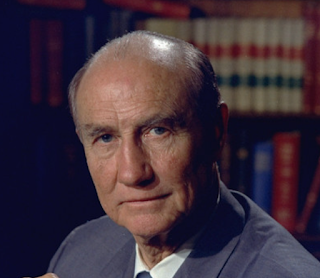
Senator Strom Thurmond
*****
The book opens in 2002 when Senator Strom Thurmond is approaching his 100th birthday.
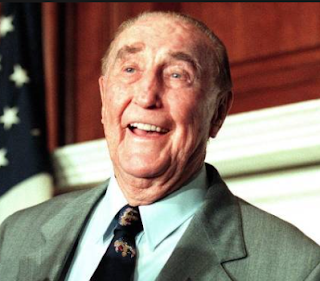
The Senator's advisor Barton Wilkes writes to Simon & Schuster Publishers in New York, proposing a book called 'A History of the African-American People' by Strom Thurmond.

Wilkes asserts, "As the history of the African-American people has been, to a great extent, coextensive with the Senator's own, he will be able to draw on his own life experience (and not just in politics) for much of his material."
The book proposal is followed by a good deal of correspondence among aide Barton Wilkes;

a lower echelon Simon & Schuster editor called Martin Snell;

and Snell's novice assistant R. Juniper McCloud.

Coming to believe Thurmond's book will be a bestseller that gets him a promotion, Snell approves the project. Two professors from the University of Southern California are engaged to ghostwrite: Percival Everett - a Black writer; and James Kincaid - a White scholar and author.

Percival Everett (left) and James Kincaid
Everett and Kincaid repeatedly ask Wilkes about Thurmond's plan for the history book, but all Wilkes sends are excerpts from an anthology of documents compiled by Herbert Aptheker. Examples of the passages are:
➤➤ From 'An Address of Delegates of the State Convention of the Colored People of South Carolina to the White Inhabitants of South Carolina' in 1865: "We fully recognize the truth of the maxim, 'The gods help those that help themselves'." Wilkes asserts, "That is, they simply wanted the opportunity to develop their domestic and commercial lives by helping themselves."
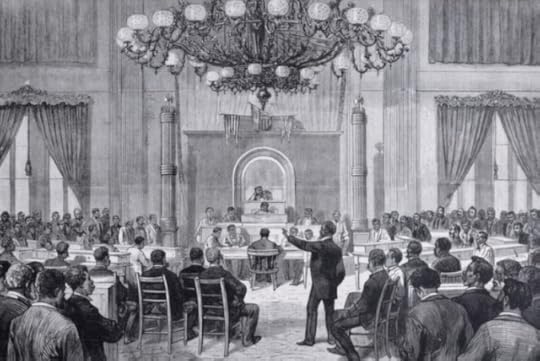
➤➤ From a speech by Booker T. Washington in 1884: "The best course to pursue in regard to the civil rights bill of the South is to let it alone.....Good schoolteachers and money to pay them will be more potent in settling the race question than many civil rights bills and investigating committees."
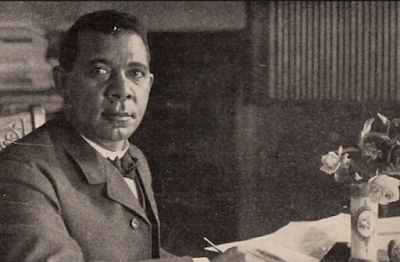
Booker T. Washington
➤➤ From an address to the U.S. Congress from 'The National Association of Colored Men' in 1896: "We mark the opening of the militant period of our race in this country....Our calm deliberate advice is for every member of the race henceforth to employ every weapon of every kind of warfare...in the demand for every right."
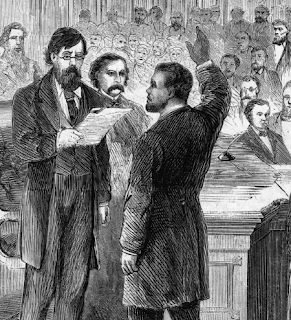
It becomes clear that Thurmond and Wilkes' agenda is to clean up the Senator's reputation, and Thurmond himself tells Everett and Kincaid, "I'm getting old...And when I die I'd like to have a seat at the big party....I'm talking about heaven....I'm trying to make amends, trying to have my parking ticket validated...I realize I've done some underhanded things and that I've hurt a lot of colored people. But hell, I hope I've hurt as many liberals and Jews...Times have changed. Now we've got Muslims and Arabs to hate. You know a lot of them are pretty dark. What's that tell you?"
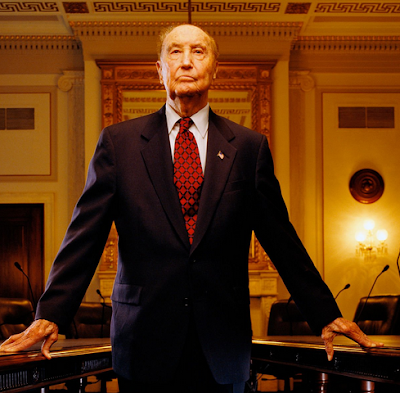
In addition, when Everett and Kincaid visit Senator Thurmond in Washington, the politician exhibits a foggy memory. Kincaid comments to Everett, "Is he a piece of work or what? Can't recall if the servants were black." And Everett responds, "I should have asked if the slaves were black."
Wilkes' letters to Everett and Kincaid also demonstrate his own insensitivity. As an example, Wilkes writes:
"Dear Percival and Jim,
.....Tell me more about yourselves. Which one is Black?....Only one of you is Black, right? Neither name is much of a giveaway, is it? But then, they seldom are. Jackson, perhaps, or Johnson, but then you can get into serious troubles by making such assumptions, believe you me. Now, if one of you were named Shumoonunu Ackabawka, then I wouldn't have to ask. But neither of you is, so I must."

Though a good part of the book skewers Strom Thurmond and Barton Wilkes, authors Everett and Kincaid take the opportunity to amuse themselves with endless 'jokes' about the publishing industry; loony editors; horny men; niche books; and more.

For instance, editorial assistant R. Juniper McCloud - who's a sort of dogsbody for the African-American history book - attracts unwanted sexual attention from his boss Martin Snell AND from Thurmond's assistant Barton Wilkes.
Amongst myriad other things, Snell sends Juniper a note inviting him to a St. Patrick's Day party. Snell writes, "We'll each wear (or adorn ourselves with) green in places...There will be prizes for those who can most successfully search out each other's green pastures, so to speak." Snell signs the missive, "Love and I mean it, Martin."

As for kinky Wilkes, he repeatedly sends Juniper suggestive letters, and in one note, Wilkes describes a childhood game of doctor. Wilkes recalls, "I was always the patient, carefully undressed and probed by a large hospital staff of neighborhood and visiting girls, and boys too. From the time I was 8 until well into my teens I played this part. The attending physicians ranged in age from 4 to 16 at least...I remember being very careful to present myself in a variety of comely ways, seeking out nice undergarments and, every now and then perfumes."

In addition to sending wildly inappropriate letters, Wilkes arranges to meet Juniper in Atlantic City, to advance the African-American history project. There Wilkes insists they play board games, go on carnival rides, cook in their room, and play Twister.
Other individuals who appear in the book include:
➤➤ Juniper's sister Reba McCloud - a sweet soul who's trying to help her brother;

➤➤ An author called Septic, who's hawking a book called 'Class Ass' - a tell-all about her life as a pimp and prostitute. Septic describes acting in and directing porn (adult and child); committing robbery and assault; selling and taking drugs; and more.

➤➤ A Simon & Schuster senior editor named Ralph Vendetti - a Mafia type in charge of cookbooks, self-help books, true crime, unauthorized biographies, and diet books. One diet book is the 'Butter Bliss Diet', based on eating ice cream, milk, yogurt, butter, cheese, bread, sweets, and fried foods - and avoiding vegetables.

At one point, a rival editor sends Vendetti a letter calling Vendetti's mother a slut and saying vile things like, "You aren't worth a pile of cowshit as an editor....That's why they give you all those books aimed at fairies and stupid women....and the ones on pimps and whores....I may just run you down with my car. I'd have to go back over you thirty times to get all the glop out of your fat body." The letter has dire repercussions.
There's much more hilarity in the story, which I enjoyed. I can imagine authors Everett and Kincaid laughing themselves silly while penning the narrative.

I highly recommend the book (though MAGA fans might not be the intended audience).
I had access to the digital book and the audiobook, narrated by James Fouhey, who does a fabulous job with the voices. You'll want to follow along in the text though, to keep up with the story.
Thanks to Netgalley, Percival Everett, James Kincaid, and Akashic Books for an ARC of the novel.
You can follow my reviews at https://reviewsbybarbsaffer.blogspot.com
March 22, 2026
DNF. Percival Everett is funny, and this book was funny... until it wasn't. The setup was great, but the joke just went on too long and there wasn't enough said to propel it forward. I have read several of Everett's books and I appreciate Everett's biting wit and humor, but I did get tired of this particular book.
July 15, 2024
If you had told me that I would give less than four stars to a Percival Everett book, I would have laughed you right out of the room. And yet, here we are. This particular book didn't do it for me, probably in part due to the epistolary format. Also the fact that Everett "plays himself" in the book didn't really land for me. The satire of the publishing industry is effective a lot of the time, but I couldn't keep up with the absurdity of it all as the book unfolded. I was also bemused by the treatment of the Strom Thurmond character/figure, which seemed to veer from rightful indictment to a sort of resigned acceptance? (Read the previous sentence with the rising intonation of an indecisive freshman in a seminar course.) All told, this book didn't live up to its title and/or my fangirl appreciation for its author's other works.

October 20, 2007
Just didn't hold my attention. I expected it to be funnier than it was.

December 14, 2007
A very unlikely funny book. It works

October 22, 2010
i read this in 2004 and recommended it to many folks. they just looked at me like i wanted them to read a glenn beck tirade. their loss.
November 22, 2023
This is an epistolatory novel. The story is told in letters, memos, and transcripts with no linking narrative.
An aide to Senator Strom Thurman, Barton Wilkes, writes a letter to Simon and Schuster Publishing in New York. He says that the Senator is proposing to write "A History of the American People by Strom Thurmond" and asks if they are interested in publishing it. They eventually agree. Percival Everett, author of several well-respected novels, and James Kincaid, an English professor at USC who is a prominent literary critic, get hired to assist/ghostwrite the book. Everett is black. Kincaid is white. It is a hell of a premise.
The crazy premise spins out into great crazy stuff. The Senator's aide, Barton Wilkes, is a bizarre mixture of pompousness, shrewdness, total lack of appropriateness and crazy. The Simon and Schuster editor, Martin Snell, and his assistant, R. Juniper McCloud are both wildly insecure and each a little loony and odd in their own way. Everett and Kincaid try to be the adults in this kindergarten, but they each have their own foibles, including the need to be in charge.
The story spins around crazily. Wilkes keeps sending the professors documents which show how good the slaves had it. Wilkes eventually starts stalking Snell's sister. The Senator's book keeps changing its concept. Everyone is frantically trying to see how to make a buck from this crazy idea.
The Senator makes a few appearances. He comes off as a genial racist who is the calmest person in the whole story.
Everett and Kincaid have mastered the art of writing letters that reveal the writer. They parody business letters, academic memos, interoffice memos. Everyone writing the letters keeps veering off into weird oversharing and oddity. This is a wild story very cleverly told and Barton Wilkes, who is at the center of the whole mess, is a brilliant, original, mysterious, comic character. He is like a smarter, more ambitious and devious Ignatius J. Reilly.
Three things I noted as I laughed my way through this;
1. It was written in 2002. There are no emails in the book. There is one mention of the fact that Everett hasn't learn to email yet. 2002 was probably the last year you could credibly write an epistolatory novel with no emails.
2. In a fancy Washington restaurant, Justice Clarence Thomas drops by the table of Senator Thurmond and the senator tells a horrible Anita Hill joke. It was so shocking I laughed, but I swear it was only a laugh of surprise and not approval.
3. This is a pretty good summary by the senator of our current political world;
"Let me tell what the secret to politics is. It's got nothing to do with issues or even rights. It's got to do with people and what they believe. Not even what they think. Hell, they don't know what they think. But they know what they believe. The great thing about believes is that you can convince people they have them."
An aide to Senator Strom Thurman, Barton Wilkes, writes a letter to Simon and Schuster Publishing in New York. He says that the Senator is proposing to write "A History of the American People by Strom Thurmond" and asks if they are interested in publishing it. They eventually agree. Percival Everett, author of several well-respected novels, and James Kincaid, an English professor at USC who is a prominent literary critic, get hired to assist/ghostwrite the book. Everett is black. Kincaid is white. It is a hell of a premise.
The crazy premise spins out into great crazy stuff. The Senator's aide, Barton Wilkes, is a bizarre mixture of pompousness, shrewdness, total lack of appropriateness and crazy. The Simon and Schuster editor, Martin Snell, and his assistant, R. Juniper McCloud are both wildly insecure and each a little loony and odd in their own way. Everett and Kincaid try to be the adults in this kindergarten, but they each have their own foibles, including the need to be in charge.
The story spins around crazily. Wilkes keeps sending the professors documents which show how good the slaves had it. Wilkes eventually starts stalking Snell's sister. The Senator's book keeps changing its concept. Everyone is frantically trying to see how to make a buck from this crazy idea.
The Senator makes a few appearances. He comes off as a genial racist who is the calmest person in the whole story.
Everett and Kincaid have mastered the art of writing letters that reveal the writer. They parody business letters, academic memos, interoffice memos. Everyone writing the letters keeps veering off into weird oversharing and oddity. This is a wild story very cleverly told and Barton Wilkes, who is at the center of the whole mess, is a brilliant, original, mysterious, comic character. He is like a smarter, more ambitious and devious Ignatius J. Reilly.
Three things I noted as I laughed my way through this;
1. It was written in 2002. There are no emails in the book. There is one mention of the fact that Everett hasn't learn to email yet. 2002 was probably the last year you could credibly write an epistolatory novel with no emails.
2. In a fancy Washington restaurant, Justice Clarence Thomas drops by the table of Senator Thurmond and the senator tells a horrible Anita Hill joke. It was so shocking I laughed, but I swear it was only a laugh of surprise and not approval.
3. This is a pretty good summary by the senator of our current political world;
"Let me tell what the secret to politics is. It's got nothing to do with issues or even rights. It's got to do with people and what they believe. Not even what they think. Hell, they don't know what they think. But they know what they believe. The great thing about believes is that you can convince people they have them."
February 19, 2026
THIS IS A brilliant and funny epistolary novel composed by Everett and one of his colleagues at USC. The book is not what its title proclaims, exactly, but instead the correspondence kicked off when a junior staffer of the staunch segregationist South Carolina senator named in the title sends a book proposal to Simon and Schuster. It is never clear whether the junior staffer (to whom Everett and Kincaid give the pitch-perfect name Barton Wilkes) has actually consulted with Sen. Thurmond about this project, but he is relatively clear about the proposed book's trajectory, which will be to show that Blacks in the former Confederate states never had it so good as they did before the Supreme Court messed everything up with Brown v. the Board of Education, the 1964 Civil Rights Act, and the 1965 Voting Rights Act.
The proposal makes the rounds at Simon and Schuster, the various letters and memos revealing a seething snakepit of office politics. Meanwhile, Wilkes keeps sending in tantalizing bits of what the Senator (supposedly) has in mind for the book and insinuating himself multifariously into said snakepit.
The proposal advances to the point where ghost writers are needed. Everett gets pulled in because a Black author will lend the project a certain credibility; Kincaid gets pulled in because...I don't know, the more the merrier, I guess.
The personal crises of various editors and editorial assistants at Simon and Schuster mount up, Barton Wilkes egging them on the whole time. The tangled murk of the project gets murkier and more tangled and ever more overtly racist. Everett and Kincaid eventually take a special trip to South Carolina (where Everett in fact grew up and went to high school) to meet the senator himself.
Everett has a knack for being highly entertaining while honing very sharp satirical points, and that knack is fully on display in this one.
The proposal makes the rounds at Simon and Schuster, the various letters and memos revealing a seething snakepit of office politics. Meanwhile, Wilkes keeps sending in tantalizing bits of what the Senator (supposedly) has in mind for the book and insinuating himself multifariously into said snakepit.
The proposal advances to the point where ghost writers are needed. Everett gets pulled in because a Black author will lend the project a certain credibility; Kincaid gets pulled in because...I don't know, the more the merrier, I guess.
The personal crises of various editors and editorial assistants at Simon and Schuster mount up, Barton Wilkes egging them on the whole time. The tangled murk of the project gets murkier and more tangled and ever more overtly racist. Everett and Kincaid eventually take a special trip to South Carolina (where Everett in fact grew up and went to high school) to meet the senator himself.
Everett has a knack for being highly entertaining while honing very sharp satirical points, and that knack is fully on display in this one.

February 21, 2026
I took a couple weeks to listen to this often hilarious book with a crazy premise. A History of the African-American People (Proposed) by Strom Thurmond, as told to Percival Everett & James Kincaid (2004), released perhaps in the light of Everett's greater focus on racial issues (The Trees, Erasure, James). The book has it that one of the most infamously racist politicians of the twentieth-century wants to write a history of the African-American people, and contacts two English professors, one a famous black novelist, Everett.
Much of the book is a send-up of the publishing industry who care nothing about social issues but only profits and want to capitalize on the name of a famous politician, regardless of his reputation. So much of it is an exchange of letters, as Everett and Kincaid try to figure out the nature of the project and its proposer's motives. The other part of the novel is a series of exchanges between Thurmond and the two proposed authors, including some reflections on race. You expect something vicious, but in many ways Thurmond here seems almost harmless, deluded, sort of funny in his cluelessness. It does not really get written, of course, though I would like to read it they were to decide, in a part two, to write it, as ghost writers for Thurmond.
I bet the publisher wanted (to increase its profits, natch!) to release this because they suspected, in the light of the current US administration's attempts to erase any hint of racism from American history, including marks of it within many American institutions, that some people might just buy it. It's funny and insightful and original in its conception.
Much of the book is a send-up of the publishing industry who care nothing about social issues but only profits and want to capitalize on the name of a famous politician, regardless of his reputation. So much of it is an exchange of letters, as Everett and Kincaid try to figure out the nature of the project and its proposer's motives. The other part of the novel is a series of exchanges between Thurmond and the two proposed authors, including some reflections on race. You expect something vicious, but in many ways Thurmond here seems almost harmless, deluded, sort of funny in his cluelessness. It does not really get written, of course, though I would like to read it they were to decide, in a part two, to write it, as ghost writers for Thurmond.
I bet the publisher wanted (to increase its profits, natch!) to release this because they suspected, in the light of the current US administration's attempts to erase any hint of racism from American history, including marks of it within many American institutions, that some people might just buy it. It's funny and insightful and original in its conception.

April 14, 2026
The reader opens this book anticipating a biting political satire given its title. Unfortunately, their expectations are soon dashed as the political comedy plays a lowly subordinate role in this story to the skewering of the publishing industry.
The book is written in an epistolary format. It consists primarily of letters between a motley group of characters representing the presumed author, the editors and others employed by the publishing company, the ghostwriters hired by the publisher, and a few others. After a promising start with a letter from a staff member in the office of a senior 100 year old Southern Senator known for his staunch segregationist views and who is rumored to have cognitive dementia, offering a proposal for a book by the Senator on the history of race relations in the United States written by the Senator, the story goes off the rails. The correspondence between the representatives of the Senator and the publisher descend into juvenilia, and crude jokes about sex and related subjects,. Occasionally some banter with the ghostwriters about the contents of the proposed book is interspersed. However, it is not enough to mitigate what has turned into a bad joke about the insanity surrounding work in the publishing industry, and getting a book published.
The book is a terrible disappointment given its title, which hinted at a biting political satire, and its plot, which was supposed to be a screwball comedy. Unfortunately even the attempts to mock and parody the publishing industry falls flat.
The book is written in an epistolary format. It consists primarily of letters between a motley group of characters representing the presumed author, the editors and others employed by the publishing company, the ghostwriters hired by the publisher, and a few others. After a promising start with a letter from a staff member in the office of a senior 100 year old Southern Senator known for his staunch segregationist views and who is rumored to have cognitive dementia, offering a proposal for a book by the Senator on the history of race relations in the United States written by the Senator, the story goes off the rails. The correspondence between the representatives of the Senator and the publisher descend into juvenilia, and crude jokes about sex and related subjects,. Occasionally some banter with the ghostwriters about the contents of the proposed book is interspersed. However, it is not enough to mitigate what has turned into a bad joke about the insanity surrounding work in the publishing industry, and getting a book published.
The book is a terrible disappointment given its title, which hinted at a biting political satire, and its plot, which was supposed to be a screwball comedy. Unfortunately even the attempts to mock and parody the publishing industry falls flat.
Displaying 1 - 30 of 110 reviews