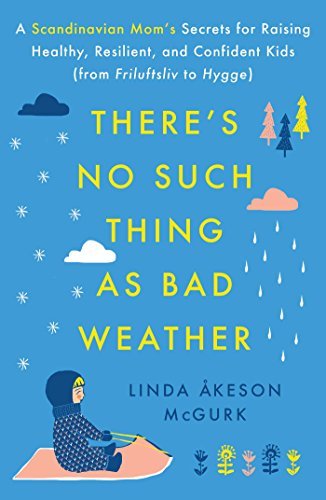
Bringing Up Bébé meets Last Child in the Woods in this lively, insightful memoir about a mother who sets out to discover if the nature-centric parenting philosophy of her native Scandinavia holds the key to healthier, happier lives for her American children.
When Swedish-born Linda McGurk moved to small-town Indiana with her American husband to start a family, she quickly realized that her outdoorsy ways were not the norm. In Sweden children play outside all year round, regardless of the weather, and letting young babies nap outside in freezing temperatures is not only common—it is a practice recommended by physicians. In the US, on the other hand, she found that the playgrounds, which she had expected to find teeming with children, were mostly deserted. In preschool, children were getting drilled to learn academic skills, while their Scandinavian counterparts were climbing trees, catching frogs, and learning how to compost. Worse, she realized that giving her daughters the same freedom to play outside that she had enjoyed as a child in Sweden could quickly lead to a visit by Child Protective Services.
The brewing culture clash finally came to a head when McGurk was fined for letting her children play in a local creek, setting off an online firestorm when she expressed her anger and confusion on her blog. The rules and parenting philosophies of her native country and her adopted homeland were worlds apart.
Struggling to fit in and to decide what was best for her children, McGurk turned to her own childhood for answers. Could the Scandinavian philosophy of “there is no such thing as bad weather, only bad clothes” be the key to better lives for her American children? And how would her children’s relationships with nature change by introducing them to Scandinavian concepts like friluftsliv (“open-air living”) and hygge (the coziness and the simple pleasures of home)? McGurk embarked on a six-month-long journey to Sweden to find out. There’s No Such Thing as Bad Weather is a fascinating personal narrative that highlights the importance of spending time outdoors, and illustrates how the Scandinavian culture could hold the key to raising healthier, resilient, and confident children in America.
This is one of those easy little books whose whole idea could be summarized in one paragraph or even a single sentence: Get your kids outside!
Thoughts:
How much does the Scandinavian cultural obsession with "getting outside" have to do with survival at latitudes with such a severe lack of sun that if the culture doesn't strongly enforce getting its people outside, they would all die of vitamin D deficiencies? Didn't I read somewhere that people who live in LA get more than enough vitamin D just driving to work? When I am in Nicaragua I can stay inside the entire time and still come home tan. It interests me how cultural values are often tied to a certain geography--where they make perfect sense, and where, if they are not followed, you will die, if not suddenly, but slowly over several generations.
Also, I get it that there is "no such thing as bad weather" and babies are totally fine napping outside at negative ten degrees. But what about one hundred and twenty and humid? It is interesting to me how ideas that sound so good may actually be really bad ideas in other places. Perhaps the world mono-culture that we think we are headed towards is impossible because values MUST be different in different geographic locations.
This reminds me of how tribal people living in the jungle could not put their babies down because the forest floor was so deadly, and so they carried them for the first year or two, never letting their feet touch the ground. This was a very practical parenting strategy for them, but it would sound insane to Swedes who want their kids down on the grownd getting dirty as that is good for their immune system. I would be curious to know about different microbes in different places too. For example, Swedish parents think bare feet are a must. But would bare feet be a good idea in the tropics where hook worm isn't just a fear-mongering story on the news but a reality? I love that idea that there is no such thing as bad weather, just bad clothing, but at the same time, that just cannot be true in Nicaragua. There is no clothing that can fix hot, humid temperatures.
Another thought: In this book there is plenty of lamenting about how kids a generation ago came home from school and played outside in their neighborhoods until dinner and about how kids today, instead, have activities to go to. To what extent is this because a generation ago most moms were at home and now they are at work? A generation ago the kids could come home at 3. Now, most parents want to pick their kids up at 5 or 6, hence, they must be kept busy in activities until then. To what extent has this modern tragedy for children been caused by the feminist movement insisting that women work outside the home?
Another thing that was interesting in this book was how ideal cultural homagenaity sounds. The title of this book could have been "One Scandinavian mom struggles to get her midwestern kids outside, then goes back home to Sweden and realizes that she is raising Americans, not Swedes." It's fascinating to me how we idealize multiculturalism but how it doesn't seem to actually make people happy. A Swedish mother heads back to Sweden with her kids and realizes that if she were raising them there, the values she is trying to teach them at home would be reinforced by the entire society everywhere they went. Imagine!
To what extent is the fact that kids don't play with other kids in their neighborhoods anymore related to the fact that ... people have different values/cultures from their neighbors and don't actually want their children at their houses acquiring their values? What if we are giving lip service to multiculturalism but it actually makes us miserable? It's not legal to control who lives in our neighborhoods so ... private schools and private activities were invented.
The thing I liked least about this book was that the author came off as the brainwashed Swede automaton stereotype. Sweden is the best country in the world and everything they do is right. Women should work outside the home. Children should be raised by the state in forest schools. And everyone should be an environmentalist and a vegetarian.
Free education - especially when preschool is included - is an incredibly powerful tool for controlling a population. If this book is true, Sweden is a country of environmentalist, outdoorsy vegetarians because of their schooling. They did away with teaching math and reading in preschool and just teach environmentalism! But they are vegetarians because they believe it is better for the environment, not because they enjoy it or believe it is better for their own personal health. And they bike because it is better for the environment, not because they enjoy it or want the exercise. I support environmentalism to the extent that environmentalism supports healthy humans, but the idea that anyone ought to sacrifice their own health or happiness because someone told them that X is "good for the environment" is insane.
I'd love to read a book by a Scandinavian who questions the propaganda of his country.
So, this is a shallow book. No interesting line of thought is followed and no truly interesting questions are asked. But I still like its messages. I like getting kids outside and playing in the dirt. I like kids having freedom and being trusted with hammers, nails, and saws. I like getting kids away from the TV and getting to go around their city on their own. I love that when Gothenburg schools noticed parents driving their kids to school they sent notices home telling parents how important it is for kids to walk to school on their own and be free to explore the city on their own (and how safe it is). I love that there is no such thing as bad weather, just bad clothing (in Scandinavia).
This. Book. Cannot recommend it enough. It's my everything right now. Wonderfully written with beautiful details, humor, and honesty. It's inspired me to make changes that are already underway: finding a neighbor with a house who will split the cost of their composting bin pickup since we can't get one for our condo association, trying to form a Free Forest School in OPRF, taking A out for walks regardless of the weather and not stopping her from getting dirty in the process.
Some favorite takeaways: * Friluftsliv (Open-Air Life) * childhood is not a race to adulthood * when children play in nature = calm yet alert * SIMPLIFY CHILDHOOD: less scheduled children = more free time, (and put them in control of it) * "it's not easy" <3 * "scaffolding" and zones for development * need other children to inspire, not just parents * "Dirty kids are happy kids" -- washing machine exists! * "summer legs" * "as safe as necessary" instead of "as safe as possible" * REFUSE TO GIVE INTO THE CULTURE OF FEAR * DARE TO TRUST YOUR CHILD * increase social trust in your community * "keep playing, my little troll" * so much joy in watching the formation of a human
Quotes: * "in general the problem isn't that kids today are too dirty but that they are too clean" * "As a culture, we don't trust our children at all--we basically live their lives for them." * "The most dangerous thing of all is to sit still." * "We want our daughters to learn how to climb trees, because if you know how to climb, you don't fall. We want them to feel safe with it, because it's when you're scared that you fall." * "The best way to raise an eco-conscious child is to be an eco-conscious parent. Live by the principle of the three Rs--reduce, reuses, recycle--and involve your child in the process. Talk about how personal choices can impact the environment and look for opportunities to make a difference--for example, by volunteering for cleanup days at a nearby park, using public transit or riding your bike instead of taking the car, and shopping for organic, locally grown food." * "if we want children to care about nature, they need to spend time in it first" * "Sometimes I think that it's better for the adults to take a step back, observe, and not interfere." * "It's a lot easier to clean up after an outdoor party" * "You have to get them out now, not when they're thirteen, regardless of how torturous it can be sometimes." * "The way to the park is an important part of the experience." * Plato said that "the most effective kind of education is that a child should play amongst lovely things." * "You either view children as empty containers, waiting to be filled by adults through teaching, or you believe that they have the innate capability to learn together with others. In Sweden we have faith in the child's own curiosity and desire to learn. We call this concept 'the competent child.'" * "Too much order and cleanliness hampers play. Children must be allowed to get muddy, get in the water with their clothes on, make a mess and be rowdy; they should be spontaneous, improvise and do things that are not thought-through." * enormous difference between walking and getting a ride somewhere -- "nature is everywhere when you're outside, even just the wind blowing in your face"
There is something pathological in American parents that makes us vulnerable to these manifestos on how people in some other place (Japan, France, Denmark, Sweden, etc.) live, parent, and educate. I have a few theories on why that might be, but that's not under the purview of this review.
If you are already convinced that children need to be outside more than they are, there's not much new here for you except the parts that are more memoir than how-to. (Actually, the how-to is pretty minimal in this book.)
If you are convinced that American parents are doing everything all wrong and that someone, somewhere must be doing this parenting thing better than we are, well you might like this title. And maybe you'll be inspired to move to Sweden.
But this all smacks of a large amount of privilege. Yes, my children can run barefoot here in the Midwest of the US. Because they are unlikely to be hurt by parasites. But that is obviously not true everywhere on this globe. And yes, I need be sure they're equipped with gloves and snowsuits and boots. (I'm trying, I'm trying. I have six kids and just when I think we have all the correct gear someone had a growth spurt or someone wouldn't be caught dead in a purple coat that is SO last year. But I digress.) But what about places with dangerous heat? Or people who can't afford all this gear?
Must everyone, everywhere give their children exactly the same freedoms and same restrictions? Surely not. And this book has more blind spots than a homeschool mom driving her Mom Bus to soccer practice.
Also, I have huge problems with the US educational system as it is, and I agree with the author's description of those problems. (No outside time, limited recess, too much testing, too much emphasis on academics at tender ages, etc.) Those drawbacks are part of the reason I homeschool. Because in the US, opting out of systems we don't agree with is a privilege available to us. (As contrasted with the Swedish nursery school - college pipeline which is apparently turning out a homogenized people who all want to save the earth, even though they don't think there's anything truly sacred about humanity, earth, or anything else.)
Another thing that bugged me about the writing: it drifts between past tense and present tense at random. But that can and probably should be excused in an author writing in her second language. (Although a good editor should have cleaned it up. Where have the good editors gone?)
The best parts of this book are the recommendations for further reading at the end of each chapter and the summary at the end, which I basically agreed with completely except for the "we are one with nature" line. (Um...#nope)
So, TLDR: a really good blog post got turned into a not so great book. But it made me think and I appreciate that.
This book was so disappointing I had trouble finishing it. What I wanted/expected was insight about how to apply Scandinavian outdoor values in an American context, but it really felt more like just a story about how Sweden is better than the US. I agree with the overall philosophy here but that just made it more frustrating that there's so little practical guidance on implementing it more effectively in other communities.
This book is a wonderful blend of memoir and research (research studies, interview with professionals, and interviews with Swedish parents). McGurk explores the importance of nature in childhood in addition to other topics such as free play, risky play, giving children freedom, screen time, and community. This enjoyable read has already inspired me to get my kids outside more, even when the weather isn't my ideal!
I received an ARC from NetGalley. This book will be released on October 3, 2017.
This entire book can be summed up in a few words, let your kids play outside.
I like the premise of this book that outside is not something to be feared and outdoor enjoyment can be found in all seasons. I'm already convinced of the need to let kids play in nature, they truly benefit from that outdoor time, so I was hoping for some practical tips on what to do with your family once you get them outside. Especially when you have to spend your outdoor time in your neighborhood which probably is not backed up to a nature preserve. Although I'd love to spend daily time in the forrests and mountains, that's just not a reality for my family. The author seemed more interested in convincing the reader of how awesome Sweden is than in sharing Scandinavian secrets to get outdoors wherever we may live. The biggest "secret" to getting outdoors seems to be wear appropriate clothing. Hopefully the books referenced at the end of the chapters can help with that.
This was a very intriguing book and one I would recommend for educators, people interested in child development, and parents of young children. I wish I had read it 20 years ago, because I would have tweaked my own parenting a bit. Basically, kids need to be outside...a lot. And outside without any agenda. And left on their own to make mistakes, learn independence, problem solving, self-reliance and things of that ilk. Basically, less helicopter parenting and more nature exploring
This book is supported by a great deal of research (more journalistic research, than academic) and examples. I do think that some of the Swedish ideas would have a hard time being implemented in the US due to our litigious and parental judging culture, as well as easy access to green space, woods, forests, etc. depending on where one lives. Although the book was interesting, it was repetitive in a couple of places and could have benefitted from a bit more editing, hence 3 stars instead of 4. Overall, I’m glad I read it, it has already made me explore the woods a bit more as an adult, and I am now obsessed with all things Scandinavian.
3.5 I agree with much of what this book has to say but I wish it had more scenarios and practical applications for those of us who live in the states and are trying to raise wild children in relatively urban environments.
Committed to only reading this book outside and it made it even better! Increased my already high appreciation and love for the outdoors along with engaging my sped/education background in the best way. Get outside people!!👏🤩
Excellent advice to get outside all you can every day. One of my favorite ideas from the book was to balance your screen time with an equal amount of green time. Would recommend this book to go with the Anxious Generation and maybe Why We Sleep as a fairly transformative trilogy for your life
Once again, while not all parts of this one were equally interesting to me, overall, the book definitely merited 5 stars because it has FOREVER changed the way I will approach parenting, in that I plan to include a LOT more outdoor play on a daily basis in our lives. It made me really think about how I've unconsciously discouraged a lot of unsupervised outdoor play, and it also made me realize that I've even sometimes discouraged my daughter from playing outside simply because I didn't want to deal with getting all the appropriate layers/clothes on. Well, no more--since starting this, my oldest has spent hours and hours playing outside in the snow, something she never used to do much of before (and has loved it). She now asks me on most days if she can get in her gear and go out, which I consider a major win (for both of us).
Overall, this book provides a ton of great information with some practical ways on how to actually apply it, which I especially appreciated.
This book is a giant waste of time. I’m not saying she doesn’t have a point. But she has exactly one, and it’s honestly impressive that she managed to publish an entire book that says that one thing over and over and over and over and over again for nearly 9 hours, with little variation. Allow me to summarize: get your kid outside as much as possible, because it’s good for them and for the planet. That’s it. There. Now you don’t have to read it. (Unless of course you like books that contain sentences like “there’s shockingly little scientific research on this” and “almost all the people I talked to…”) Listened at 2x speed.
Podoba mi się szwedzkie podejście do wychowania dzieci, ale niekoniecznie sposób jego opisania przez autorkę. Książka obfituje w informacje, jak wygląda wychowywanie małych Szwedów, ale tak naprawdę jej znaczna część kręci wokół tego samego. Nawet leśne przedszkola mnie nie zaskoczyły, bo już o nich czytałam w zeszłym roku. Największym zaskoczeniem była wcale nie wychowawcza wzmianka, że Spotify jest szwedzkie. I nie jest to informacja, którą powinnam wynieść z tej książki jako najważniejszą. Jakiś nieporadny ten poradnik.
I came to this book with a humble attitude ready to learn. I moved from the humid southern US to frigid Alberta and have been learning how to raise my kids in a climate I am so not used to. I hoped that this book would give me some helpful strategies and mainly meet me where I’m at—a mother who values nature but isn’t sure how to appreciate it at its most brutal. I found it disappointing to, instead of showing sympathy for countries whose cultures don’t have as much value for all-weather activities, McGurk overused the “Scandinavia is best and everyone should be like us” mantra for outlining and advocating for her way of life. She outlines all the deficiencies of cultures unlike her own—too clean, too sick (allergies), poor motor skills, too aspirational with kids, etc. It left me feeling hopeless to strive for anything outside of a Scandinavian setting: If we’re coming up that short and are left to swim against a current of such utter failure, what’s the point? I get tired of books and media almost fetishizing Scandinavia and in turn chastising any other countries’ ways of life that don’t adhere to its “success.” I so wish this book would have implemented a problem-solution framework, and not just blaming parents or culture as the problem! I was halfway through the book before McGurk 1) even mentioned children showing some pushback to outdoor play, 2) that being a natural sort of the process wherever you lived, and 3) what to do about it. I could have done with about 20 more of those examples. Am I to really believe that my son doesn’t want to go outside on a -20 windy day because of the wrong clothes or because I’ve failed to provide that willing example? I don’t think it should’ve taken until page 103 for her to admit kids can naturally offer pushback to outdoor time. It became hard to “chew and spit” and mine for truths in this book toward the end.
This book was a mixed bag for me. On the one hand, McGurk's description of the role that nature plays in the lives of Swedes (particularly Swedish children) was charming and inspiring. There were many obvious and clear benefits of making nature an integral part of our children's lives. But. There were times that McGurk tried to make larger arguments that just did not hold up if you gave them more than a passing glance. Take, for example, her claims that there is less obesity in Sweden because of their emphasis on spending time in nature. That is one possibility, but she completely ignores other factors that are certainly relevant and more systemic, like the influence of poverty and of universal healthcare.
Another particularly irksome example was her comparison of rates of ADHD in the US and in Sweden. The comparison makes it seem like the US has higher rates of ADHD because we spend less time outdoors. That's not how ADHD works. While there are many studies documenting the benefit of time in nature for managing ADHD symptoms, ADHD is a neurological genetic condition. Additionally, ADHD is *underdiagnosed* in Europe because there is still such a strong stigma there. This is fairly basic information about ADHD that should have been considered more thoroughly if McGurk thought it was relevant to her arguments.
All this is to say that I wish McGurk had either stuck to what she really knew or that she had dug a little deeper. I enjoyed so much of this, but I was also monumentally frustrated at times.
Made me realize that parenting nowadays takes the easy way out by way of iPads and Youtube. This is a wake-up call to parents who are not providing enough fresh air and one-on-one interaction with their kids. A must read.
I really enjoyed this one and would recommend to anyone interested, not just parents!
As a Minnesotan with some great-grandparents of Scandinavian origins, it was fun to read about where some of our “outdoorsy” culture comes from, and to be encouraged to lean into embracing our winters more and embracing outdoor play in general, for both my and my toddler’s sake! I also liked hearing about early-childhood educational alternatives to the teach-to-test approach common in the U.S.
The author’s personal experience and advice dovetail nicely with the parenting goal I have of giving Benedict more real-life experiences than virtual, and she offers research, anecdotes, and tips in an easy-to-read, non-judgmental way.
If you liked French Kids Eat Everything, you'll probably enjoy There's No Such Thing As Bad Weather. It was a challenge to spend more time outdoors no matter the rain or snow or heat. I was fascinated by the Scandinavian tradition of letting babies nap outdoors even down to 15° F with the proper clothing and blankets.
I am a HUGE get outside kids Mom. I love being outside and know that I am a better person when I get some fresh air everyday (even in the winter) I try to incorporate that into my kids lives as well. I walked them to school during their elementary years and miss that special nature and talking time together. It is a struggle to get my kids and sometimes my husband outside now but when we do it is always a special memory and my kids want to go out more.
I was inspired by this book but did get tired of the US to Scandinavian comparison. I liked her example of walking her kids in cold weather and someone pulled over to give her a ride. I wish more people walked places. I wish we were outside mingling and enjoying our neighborhoods in all weather.
I also thought it was so ironic how the US sometimes teaches about the outdoors by going to an indoor museum. I definitely think more unstructured outside play and imaging should done. My son had a teacher who rode her bike to school and did outdoor learning. I really appreciated her willingness to think outside the box.
When your kids have more than enough energy make them go outside!! They will be much happier.
This book is a beautiful blend of memoir and research. McGurk perfectly describes the challenges parents and children face today when it comes to getting outside, the school system, screentime, community, and more. She compiled relevant research on these topics, as well as references other authors, gives tips, and recommended continued reading. This beautiful story is enough to inspire anyone to want to go outside more, weather is no excuse.
I wanted to love this book. I genuinely agree with the message—kids should be outside more, in all kinds of weather, and that’s exactly why I picked this up. I had just read How to Winter and was hoping for practical encouragement and ideas to help me get outside with my child during less-than-ideal weather.
Instead, this book felt like a long argument for why Sweden does everything better than the U.S.
I don’t disagree with many of the critiques of American culture—lack of recess, too much screen time, overly structured childhoods. That’s actually why I homeschool (and why I was homeschooled myself). But what I wanted were practical tips: how to get outside more, what to do once you’re out there, and how to make it enjoyable—especially for parents who don’t naturally love being outdoors.
Saying “there’s no such thing as bad weather, only bad clothes” over and over again doesn’t actually motivate me to go outside. It just feels dismissive. I wanted concrete examples, ideas, routines—something actionable I could apply to real life in the U.S., not just comparisons to how things are done elsewhere.
Overall, I agree with the heart of the message, but I left wanting far more substance and far fewer cultural lectures. A missed opportunity.
I loved this book. It is an absolute gem for anyone curious about embracing outdoor living, no matter the season. As someone who loves finding ways to connect with nature, this book completely resonated with me. McGurk’s blend of personal anecdotes and research creates a compelling case for adopting the Scandinavian concept of "friluftsliv" (open-air living) and letting kids—and adults—thrive in the great outdoors.
I loved how she challenged the cultural obsession with over-scheduling kids and keeping them indoors. Her practical advice and heartfelt stories about raising her children in Sweden and the U.S. offered so many inspiring takeaways. The comparisons between the two cultures were eye-opening, and her passion for free, unstructured outdoor play was infectious.
This book is not just about parenting—it’s about shifting our mindset toward nature, resilience, and joy in all weather. It’s the perfect reminder that puddles are for jumping, snow is for playing, and rain is just a chance to throw on a good jacket and get outside. Five stars for this warm, insightful, and motivating read!
Wow, one of my favorite books I have ever read. This left me so inspired to get off the grid, pushed me into committing to a 30 day screen free experiment with my kids, and has me wanting to leave the country. So so inspired by this book. I got emotional reading this more than once as this made me reflect on how much I wish was different about childhood now. Will continue to push for more outdoor time, little to no screen time - and not burying my kids alive in forced early education (vs more boredom and exploration and imagination) and hours of extracurricular activities.
“I know how valuable spending time outdoors is to their physical and spiritual health and well-being. It’s therapeutic to me too. I would go as far as calling it a primal need.”
Love love pretty much everything about this book. It reinforced a lot of things I already believe but also challenged me to change in others. During Spring, Summer, and Fall I usually love to be outside and am for hours a day. Winter is another story though... This book helped me feel empowered and gave great tips to get out even when I think the weather sucks. I really enjoy reading about other people's childhoods and other countries' approaches to parenting. I also loved all the book recommendations she gave throughout the book and can't wait to read those!
Really fun read as we’re entering toddlerhood with our son. We’re already outside as much as possible, but this was a good reminder to relax and slow down and let E experience the world God created. It’s somewhat repetitive and a little longer than necessary, so I skipped a few sections but overall a good read!
Probably going to make the top 3 influential books of the year for me. Yes, everyone talks about the benefits of "fresh air," but there is so much more to nature and getting outside every day than just that. This story, amusingly written and interwoven with studies and research, inspired me to work on making the time for being outside, no matter the weather (adults and kids alike!).
Sometimes a 3.5 sometimes a 4.5??? I have wanted to read this for awhile. While I feel like the book was repetitive and said the same thing in many different ways, there was a lot of the book that I enjoyed. It still motivated me to be outside more even in the coldest idaho winters 😅 it also made me think more about my local schools and what they do well and the many things that could be improved.
This book is not quite what I expected, but I enjoyed reading it. I came across it when I searched for books containing the word "hygge," which is a Danish mindset of getting through the winter using candles, wool socks, and sweets. The word "hygge" is in the subtitle of this book, but it is really about something entirely different.
I have always struggled with getting through the winter. A few years ago, I was reading a cookbook of all things, and that is where I first read the phrase, "There is no such thing as bad weather, only the wrong clothes." I took this to heart and bought myself and my kids actual winter gear and made a commitment to go outside daily regardless of the weather. This drive to get outside daily sustained me through that winter, and especially through the death of my mom, which happened the same year.
Getting outside no matter what the weather is the theme of this book. The author is a Swedish mom living in Indiana, who struggled with the inside-ness of American winters and was often misunderstood by her community when she went for walks on 15 degree days. When her father in Sweden became ill, she packed up her two daughters and moved to Sweden for six months.
Most of the book is spent comparing the Swedish mindset to the outdoors to the American mindset. In Sweden it seems getting your kids outdoors each day is viewed as important as making sure they eat something each day. Babies are even bundled up and set outside in their prams to nap in very cold weather (I am a little too American to swallow this one). Kids are expected to bring outdoor gear to school and playdates. At times I felt the author was pretty biased toward the Swedish mindset and critical of the American mindset, but she balanced this nicely with describing the times her own daughters were less than enthusiastic about playing outside, or even her own frustrations with the lack of parking in her Swedish hometown (streets had been closed to reduce greenhouse emissions). Also, I can't get too upset about her bias, because for the most part I share her views that Americans should get outside more.
My main take-aways were: 1. A renewed commitment to get myself and my kids outside each day and encouragement to allow them to take risks outside. 2. The concept that picking flowers, collecting rocks, etc, while looked at by some as disturbing the environment, allows kids to feel more connected to nature and will ultimately inspire a desire to protect the ecosystem.