Two men, unknown to each other, whose glimpses of the other's possible future suggest that one of them will be murdered and the other will be the murderer.
William Fryer Harvey was an English writer of short stories, most notably in the macabre and horror genres. Among his best-known stories are "August Heat" and "The Beast with Five Fingers", described by horror historian Les Daniels as "minor masterpieces".
Born into a wealthy Quaker family in Yorkshire, he attended the Quaker schools at Bootham in Yorkshire and at Leighton Park in Reading before going on to Balliol College, Oxford. He took a degree in medicine at Leeds. Ill health dogged him, however, and he devoted himself to personal projects such as his first book of short stories, Midnight House (1910).
In World War I he initially joined the Friends' Ambulance Unit, but later served as a surgeon-lieutenant in the Royal Navy, and received the Albert Medal for Lifesaving.[4] Lung damage received during the rescue leading to the award troubled him for the rest of his life, but he continued to write both short stories and his cheerful and good-natured memoir We Were Seven.
Harvey was a practicising Quaker.
Before the war he had shown interest in adult education, on the staff of the Working Men's College, Fircroft, Selly Oak, Birmingham. He returned to Fircroft in 1920, becoming Warden, but by 1925 ill-health forced his retirement. In 1928 he published a second collection of short stories, The Beast with Five Fingers, and in 1933 he published a third, Moods and Tenses. He lived in Switzerland with his wife for much of this time, but nostalgia for his home country caused his return to England. He moved to Letchworth in 1935 and died there in 1937 at the age of 52. After a funeral service at the local Friends Meeting House Harvey was buried in the churchyard of St Mary the Virgin in Old Letchworth.
The release of the film The Beast with Five Fingers (1946), directed by Robert Florey and starring Peter Lorre, inspired by what was perhaps his most famous and praised short story, caused a resurgence of interest in Harvey's work. In 1951 a posthumous fourth collection of his stories, The Arm of Mrs Egan and Other Stories, appeared, including a set of twelve stories left in manuscript at the time of his death, headed "Twelve Strange Cases".
In 2009 Wordsworth Editions printed an omnibus volume of Harvey's stories, titled The Beast with Five Fingers, in its Tales of Mystery and the Supernatural series (ISBN 978-1-84022-179-4). The volume contains 45 stories and an introduction by David Stuart Davies.
A short story set in early 1900's. At the beginning it's like a normal story but as we read ahead it does give you a creepy feeling.
As a reader you wait for things to go wrong because there is this heavy feeling in the air you know somehow that it may not be a happy ending.
The day starts as every other day but you never know the turn of events that a normal day can take.
The most horrifying bit of this story is it can happen to anyone at anytime because destined it maybe but for the folks who are living it, it can be as unpredictable as it can get.
At the end it also makes you think if there is anything in your hands in this world or the course of your life is already charted and at the most you can do is go with the flow....
Reseña "Calor de agosto". Relectura de mejores cuentos de la narrativa. Segunda parte 3/10.
Cuento muy breve que siempre se ha considerado de los mejores de la literatura por las múltiples interpretaciones que admite. Me llegó a través del amigo Julio Cortázar.
Narración de carácter psicológico, thriller que diríamos ahora, y que podría abrir el debate en cuanto a si el destino está marcado y es inamovible, o si bien es factible luchar contra ese destino fatídico; también de la locura o los límites de la cordura están en la base de la historia.
El ambiente es agobiante, asfixiante: ese calor a que se refiere el título se encuentra presente en toda la narración. Y el final no puede ser más desconcertante, discutible y claramente abierto al debate.
Se puede descargar en cualquier sitio de la red y su tiempo de lectura no alcanza los 15 minutos.
This is an exquisite short horror story which I'd read before but forgotten until it was recommended to me recently. It is in the public domain and you may read it here.
Two complete strangers have never seen or talk each other. Mr. Whithencroft is a struggling artist that has just painted his best piece yet; an obese man condemned to death right after a murder trial. Mr. Atkinson is a cheery stone mason that has just finished his latest work, an aleatory tombstone of one Mr. Whithencroft. Then, by chance, they meet.
For meager 6 pages, this was good, maybe even very good. Quick, somewhat impactful and super easy to read. Starts and ends in a flash. Ten minutes well spent. A fine sampler to start with WF Harvey works. I think.
----------------------------------------------- PERSONAL NOTE: [1910] [6p] [Horror] [3.5] [Conditional Recommendable] -----------------------------------------------
Dos completos desconocidos nunca se han visto o hablado. El Sr. Whithencroft es un artista medio empobrecido que acaba de pintar su mejor obra hasta el momento; un hombre obeso condenado a muerte tras un juicio por asesinato. El Sr. Atkinson es un alegre cantero que acaba de terminar su último trabajo, una lápida aleatoria para un tal Sr. Whithencroft. Entonces, por casualidad, se conocen.
Para apenas 6 páginas, esto estuvo bien, tal vez incluso muy bien. Rápido, algo impactante y muy fácil de leer. Empieza y acaba en un suspiro. Diez minutos bien aprovechados. Una interesante muestra para comenzar con los trabajos de WF Harvey, creo.
----------------------------------------------- NOTA PERSONAL: [1910] [6p] [Horror] [3.5] [Recomendable Condicional] -----------------------------------------------
Una historia super corta y aunque lo sentí un poco flojo, que supongo fue por lo que he estado leyendo, me pareció interesante el desenlace. Lo próximo The Beast with Five Fingers!!!
"In the midst of life we are in death." WOW It's amazing how in literally 5 pages you can experience this amount of ambiguity and suspense. I asked myself: what is Harvey trying to tell us? Maybe that your fate is waiting for you.. that fate ALWAYS has its way to happen. And the ending, you keep staring at the page, you read again and then just "wow"
This was an interesting story. Definitely eerie. What still puzzles me is if you knew your future wouldn't you try to change it rather than wait and see if it will happen? Especially if it is an unfavorable outcome. Or cant one's fate be changed?
"August Heat" tells the story of two strangers who have forecasted each other's deaths on a stifling, maddeningly hot day. The process of death being foretold through art and expression was exquisite. The build-up to the suspenseful ending was executed beautifully. This was SO GOOD!
This felt sort of like a neo-noir in short story form, which I am so down with; fans of the film BLOOD SIMPLE (1984) or Lynch’s LOST HIGHWAY (1997) will love this one I think.
This short horror story written in 1910 must have been a shocker in its day. The twist has been used in many other books and the Twilight Zone and things of that ilk, but it did not dampen my appreciation of a well crafted, well written story.
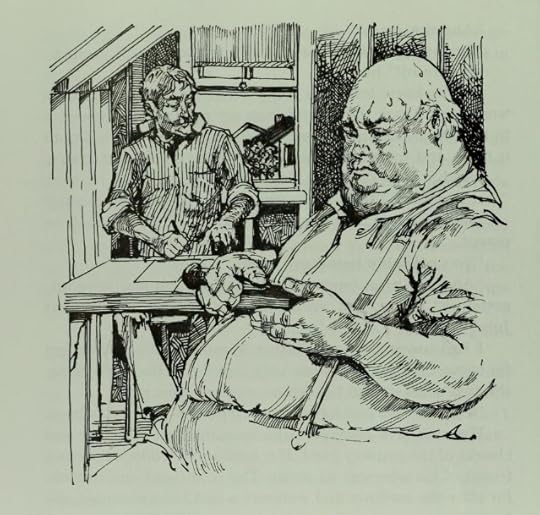
An excellent example of a suspenseful story with the eerie atmosphere of foreshadowing. An artist named James Clarence Withencroft, idly sketches the image of a despondent fat man being criminally sentenced by a judge. Later the artist goes for a walk. The intense heat of the day causes him to stop where a tombstone mason is working on a marble slab for an exhibition. The carver looks exactly like the fat man the artist drew earlier. The name on the tombstone is that of the artist’s, along with his correct birth date. The death date is that very day. The carver claims he carved the first name that came into his mind. The two strangers try to figure out the meaning of the mysterious events. As the story ends the reader is left with the thought that it is very, very hot, enough to drive a man mad.
I'm biased towards this one. On the one hand, it presents an interesting concept of two people accidentally predicting each other's fates. It makes you guess whether it was merely a coincidence and nothing is actually going to happen, or was it a cruel joke of fate one cannot escape no matter how hard they try. The open ending also adds a lot of suspense and thrill.
On the other hand, the execution doesn't feel satisfying, as if there had to be something else, yet it got scrapped in the last moment. Perhaps, a slightly long duration would fix the aftertaste as the story is extremely short.
Overall, it's an okay story I'd probably recommend to anyone.
In seiner jüngsten Kurzgeschichtensammlung lobt S. King vor "Die Düne" diese klassische Mystery-Story und hebt besonders das Ende hervor. Tatsächlich echt creepy und faszinierend! - Zu finden ist sie auf dem (engl.) Wiki-Eintrag der Geschichte (unten bei den Links).
WOAH it took a little while for the ending to sink in, but now that it has, all I have to say is: WOAH!? I'm shocked, I'm creeped out, and I feel sad at the same time.
An artist draws a sketch of an overweight criminal sentenced to death one hot August day, and later, happens upon the shaded workshop of a stonemason carving out a tombstone. The mason has an uncanny resemblance to the sentenced criminal, and even stranger, the tombstone’s name and date of birth is exactly that of the sketch artist.
Hoping to write it all off as a cosmic coincidence, for the sake of safety, the mason and artist agree to finish the night out together to ensure that the artist’s “date of death” passes without incidence. As the night passes, an unbearable tension mounts.
Written by W.F. Harvey, the story has the ghoulish air of a ghostly harbinger tale, though there are no spirits in it. Just the same, "August Heat" was originally published in Harvey’s anthology "Midnight House and Other Tales" in 1910, but subsequently added to several other ghost story collections.
I read this as an homage to the librarian whom I was replacing. She was retiring, and I came in newly minted. She suggested this book to me because I mentioned liking horror.
Ironically, it feels vaguely prescient? Anyway, this short story is far creepier than I gave it credit for. It definitely has an atmosphere of danger, of accident waiting to happen. In all honesty, the mood is definitely creeping more on me as I write the review.
When I finished the story, I remember thinking something to the effect of "oh, that's clever." Now, I am definitely having that feeling of foreboding and discomfort come over me.
The short story 'August Heat' by W. F. Harvey represents a certain type of mystical genre. The artist intentionally drew a portrait of the man whom he never saw. The man from the picture was a master of monuments who wrote the name of this artist with a day of his death (today) on this monument. He never met this artist.
These two main characters were faced with something inevitable and it seemed that it happened at the end of the story.
A wonderful thriller about future happenings with an unexpected open ending. ‘August heat' is considered to be one of the best short stories of all times. This tiny tale is a self-narration of the main protagonist about the most unusual day of his life. The storytelling resembles that of a horror one even though there is nothing but unexpected circumstances.
There were so many coincidences around this story: 1. I read this story exactly on 20th August, at around 11:30 pm (all unintentional). 2. A part from a compilation book of short stories, the action in the previous story in the book - "Courage" by Forrest Reid, also takes place in August. 3. The following story was "Nyarlathotep" by H.P. Lovecraft who was born on 20th August.
I wanted to say this feels like an abrupt ending. But that, “it’s enough to drive a man mad” line really implies something terrible and with all the build up before hand you can easily tell what would happen next.
For how short a story it is, it’s very effective at building the tension throughout it.
This entire review has been hidden because of spoilers.
It’s hard to give a rating to a short story and this was very short. It’s about an artist who is inspired to sketch a drawing of a man being convicted of a crime. He goes for a walk and ends up at a stonemasons yard where he finds the same man carving a headstone with his name on it. Great little story that ends on a cliff hanger.
This entire review has been hidden because of spoilers.