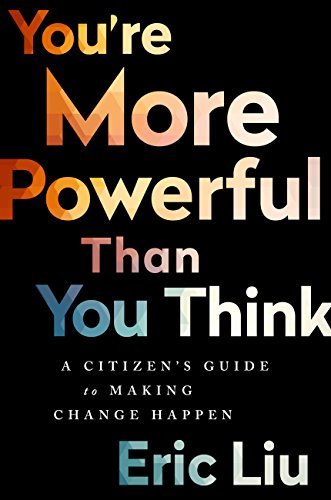
Is this the America you want? If not, here's how to claim the power to change your country. We are in an age of epic political turbulence in America. Old hierarchies and institutions are collapsing. From the election of Donald Trump to the upending of the major political parties to the spread of grassroots movements like Black Lives Matter and $15 Now, people across the country and across the political spectrum are reclaiming power. Are you ready for this age of bottom-up citizen power? Do you understand what power truly is, how it flows, who has it, and how you can claim and exercise it? Eric Liu, who has spent a career practicing and teaching civic power, lays out the answers in this incisive, inspiring, and provocative book. Using examples from the left and the right, past and present, he reveals the core laws of power. He shows that all of us can generate power-and then, step by step, he shows us how. The strategies of reform and revolution he lays out will help every reader make sense of our world today. If you want to be more than a spectator in this new era, you need to read this book.
I know Eric is describing this book as a guide to citizen power but I think it's better described as a framework for thinking about organizing. If you're one of those people who freaked out after Trump and are looking to get involved but have clue how, this book is a great starter kit. Three things I appreciated most: -Eric uses a variety of examples from Dems, Republicans, Libertarians, and unnamed left movements to illustrate points. I learned about a few of issues I hadn't heard about before and a authors/other books that lay the contemporary groundwork for American mainstream right and left ideologies. -The sheer amount of faith that Eric has in people. You can't read this book and truly believe that you can't make a difference or that you don't matter. I'm not sure how often I come across people/texts that this optimistic. -It's short, sweet, and accessible. The language is honest and simple, and still manages to be engaging and moving.
Drawbacks: -There are some examples that I think were poorly framed, like when it seems like Eric described the protests at Standing Rock as theatrical. -He does a good job at including examples from communities of color, but I do wish there were more about recent black organizing. -The they/we ending is kinda corny, but that's not a huge deal.
Disclaimer: I'm currently a fellow at Eric's organization, Citizen University. He gave us a free copy of the book to read but didn't ask to us to promote it or anything, so this isn't related to my position as a fellow at all.
An excellent, readable book about power: how we think of it, what it actually is, and how we can wield it. This book is designed to close the gap between the rhetoric of revolution and the actual changes in values, systems, habits, and skills that are needed. Liu's goal is to help people make better demands and then make them a reality.
Liu provides the expected laws and rules of a how-to book, but his are both intelligent and well supported with arguments and examples, both historical and contemporary. His take on today is that legitimizing myths have lost their grip. People on the left and the right have rejected justifications of the status quo. But there is still not a good vision of the future, especially on the left.
If this book doesn’t make you want to get your hands dirty with activism, nothing will.
This is the book I've been looking for since the November 2016 election. Liu starts with some inspirational stories about activists who successfully organized for a specific cause, then presents some principles about how you can take action too. Some of the language early on in the book feels unpleasantly New Age-y to me, especially the parts about "creating power," but the explanations themselves are clear and all of it is grounded in useful examples.
Liu concludes that cynicism and disengagement are the greatest threats to our democracy and asks the reader: "Will you convince yourself that even though you care, you don't have enough power to do anything about the issue anyway? Or will you instead decide to make yourself useful? Will you choose to learn more, do more, engage more?"
I recommend this book as an introduction to organizing and activism. Even if you don't intend on leading any groups, this book will help you understand why people march in streets and stage events for the media.
"Whether you live in a democracy that's become sclerotic and corrupt, like ours, or an authoritarian society that wants to control what you do and learn, it is important to remember that others don't take our power so much as we give it away. We give it away by not organizing or participating, out of a fatalistic sense that it doesn't matter, that 'my vote won't count anyway.' But mark well: there is no such thing as not voting. Not voting IS (ital) voting--to hand power to others, whose interests may be inimical to your own. And not organizing IS (ital) organizing--for the people who mean to dominate you." (20)
"People on the right and the left today agree that in practice the circuit breakers are not working. We agree that our political and economic systems--the markets of ideas and of goods that are supposed to give us meaningful, empowering choices--have become corrupt at the core. Unfortunately, each idealogical group has a big blind spot when it comes to detecting concentrated power. Liberals do not see government overreach; conservatives do not see corporate overreach. What if right and left could merge their half-blind perceptions and create a more truly binocular sense of the political system? What if more people, equipped with an understanding of how all the elements of power in civic life come together, used that binocular vision to challenge monopoly and the hoarding of power in all its forms?" (61)
"The phrase 'Black Lives Matter' has become controversial for reasons that reveal the power illiteracy and selective deafness of its critics. That becomes clear if we imagine the pregnant silences around and between those three words. Listen for them: Black lives matter FINALLY (ital). Black lives ALSO (ital) matter. Black lives SHOULDN'T (ital) matter LESS (ital). The activists are inplying those unspoken words, even if their opponents do not hear them. This is the central imaginative and strategic move of Black Lives Matter. To say the phrase is to ask, in effect, WHAT IF black lives mattered? WHAT IF they mattered as much to our society, government, and institutions as white lives always have? Which forces us all to face the history, legacy, and persistence of white supremacy in law and culture. Choose your metric: life expectancy, quality of schooling, housing discrimination, job discrimination, health outcomes, wealth, income, criminalization, execution. On every measure, America truly values black life less highly than white (indeed, non-black) life." (121-2)
On how power can be organized by story, Andrew Slack and the Harry Potter Alliance (136)
"Society becomes how you behave. This is a statement of network science: your behaviors and attitudes are contagious, rapidly and often imperceptibly. It is also a statement of ethics: your behaviors and attitudes are contagious, rapidly and often imperceptibly. The takeaway, either way, is that small actions (and omissions) compound. When you choose compassion or contempt, courtesy or discourtesy, civility or incivility, you begin a cascade of mimicry." (155)
"Power, remember, is like fire. It is inherently neither good not evil. It can be put to all kinds of uses. What determines how power is deployed is you: your character, your ethics, your motives. This, indeed, is yet another way that you're more powerful than you think. You, at every turn, are the one in charge determining why you want power, and why you give it or use it the way you do. But in this era of concentrated wealth, severe inequality, and rigged rules we have a master narrative that power IS (itals) inherently evil. That's why the civic myths of this age are dark political melodramas like 'House of Cards' and grim fantasies like 'Game of Thrones' in which nice guys finish headless and the only winners are those who lie, cheat, and kill. We're not in 'The West Wing' anymore, folks. Mr. Smith died in Washington. These times can make it seem like childish thinking to believe you can make a difference or move the system. They make it seem savvy to believe in conspiracy and futility: to adopt the cynic's worldview. And this is deadly. For all the anger in our political culture today, it is not rage that most threatens the legitimacy of our democracy. Rage is healthy even when it is ugly. It forces reckoning. You can respond to rage, whether it comes from the left or the right or the disenfranchised unaligned, with a call to action: DON'T GET MAD; GET POWER (itals)." (188)
There is a lot of really useful material in this book; it provides a solid framework for thinking about how we can activate and network the latent civic power of each person and it primes us think strategically about how to leverage power as underdogs facing down large institutions or challenges. The text is very well organized. I appreciate that Liu boils down his several theses into concise, bulleted arguments and then uses the chapters to reiterate & expand upon those points. Because of this format, the text reads like a manual to understanding and wielding civic power. And that is an important point to underscore: this is a book about power. It is designed and written to excavate what shapes power can take, to question who really has it and why, to draw from history to consider how to grow it.
This is the second time that I've read Liu (the first was his collaboration with Nick Hanauer, "The Gardens of Democracy"). I think the exposition in Part I of this text drags a bit, but I still liked his writing a lot better this time. For some reason, when I read Liu, I can't shake the feeling that I'm reading the transcript of a (good) TED Talk. It's not a bad thing, but it is a distinctive and unshakable impression.
Ultimately, I think this book is worth a read because it has some intriguing case studies and frameworks. It definitely sparked a few new ideas for me and gave me lots of leads on further reading.
ALSO, Eric Liu has so much got dang faith in people, in the future, in the possibilities of reconciliation, in the ability of each person to make a difference, and more. In an age of cynicism, this is such a profoundly refreshing (and well-supported) argument for a sturdy optimism about our potential to do and be better. Honestly I'd say read it for that, if nothing else, because it feels like Miracle Grow for my soul rn.
I wanted to love this book. I agree with the premise, but it actually made me more hopeless. Here's the main problem: if you're going to fill a book with anecdotes of regular people making a difference, you need to find more where they win. Most of them are undecided (often unlikely to succeed) or actually tales of defeat dressed up to sound still-inspiring. Partway through the book I started saying, "But they didn't change anything..." after nearly every story. And THEN I realized that, at some level, the author recognized that. I started noticing all the caveats.
Consider a 6-page slice of Strategy 5, from Bill McKibben (who IS winning but also now deals with daily corporate harassment as they follow him around) through the tale of Khizr Khan standing up to Trump before the election (you know how the election went, right?). A couple other little stories end with these notes: "You could dismiss it as a stunt that changed nothing. Or you could see it as..." "Although the 'atmospheric trust' doctrine their case relies on is highly technical and, in the view of some legal experts, unlikely to prevail..." The caveats began to speak louder than the rest of the book, tipping the balance of this book from inspiring to depressing.
"For decades, civic educators and activists have wondered what it would take to get a greater number of Americans more involved in self-government. All it took, it turns out, was a bombastic, authoritarian, nativist president whose erratic behavior and executive overreach made him a vivid threat to democratic norms and the Constitution." Eric Liu in the WashPost.
I first saw Eric Liu speak at the 2018 Code for America Summit in Oakland earlier this year, and I was intrigued enough by his brief talk to pick up this book. Liu provides a concise framework for effective citizen organizing, or what he unabashedly refers to as exercising power. He defines power as the ability to compel others to act as you would want them to act, something that I'm sure makes many on the left squeamish. Basically, his message to them is "get over it" although he couches it in terms of a disingenuous "invitation" that I think would turn some people off before he even gets to arguing that power is not inherently evil; it can be exercised in both ethical and unethical ways.
For those of us who identify as progressive, Liu's book, and in particular, his mostly non-partisan study of the effective exercise of power, is extremely relevant. In the last few decades, progressives have not only been unclear about their demands but have been blind to the fact that the levers of power are a game, preferring instead to pretend that politics are neither a game nor are the rules of that game rigged. That has led to conservatives gaining the upper hand at rigging the rules. The Democratic Party, in particular, has failed to recognize the extremist turn that conservatism has taken in America and therefore been unable to follow suit with equally radical, scorched-earth, revolutionary tactics. Instead, Democrats have cowered, believing that high-minded, East Coast liberal "manners" and "decorum" through "reasoned debate" will save the day. It will not, particularly when your opponent is willing to burn it all to the ground. Democrats must be willing to fight fire with fire, and also be willing to burn it to the ground. What matters is what society will rise from those ashes, and it is the structure of that society that should be under debate. In other words, the Democratic Party should promulgate the most progressive vision of America that it can, and fight like hell for that future, with whatever tactics are necessary.
Liu's book, at least, makes a small down payment on a more progressive future. In the best case, it will push progressives to rise up to fight tooth & nail for a more egalitarian society. However, Liu provides only a framework and stays away from specific tactics, perhaps because discussing radical tactics would violate the "norms" of the traditional East Coast collegiate dialectic. Discuss we must those tactics. For example, where is the equivalent progressive propaganda TV station that is the answer to Fox News? And if conservatives love to argue that liberals have created a "deep state" inside the Federal government bureaucracy to obstruct their agenda, why aren't we having a conversation about why we shouldn't create that deep state and throw out the old notions of an impartial, non-political civil service?
In the end, You're More Powerful than You Think is sort of like Sun Tzu's The Art of War but for citizen organizing. It's a great framework and a set of rules against which to cross-check specific action plans to see if they are effective / devious / scheming enough to succeed against the enemy. But it's at too high a level to actually incite the average dissatisfied American into action -- to get from framework to tactics.
And one that would have promptly hit my “trash” inbox.
Liu writes mini essays on examples and examples and examples that supposedly back up his claims. His goal is to “equip” readers with the tools to be powerful and send them out in to the world to make it all sunshine and rainbows. Spoiler alert: ain’t gonna happen bud. Nothing in this book actually tells people how to do what he’s encouraging them to do, which begs the question, does he actually know how? Or is he just spewing random facts fluffed in fancy language to evoke emotion and incite a rallying cry among his faithful and make them do the dirty work of actually figuring it out. His writing structure makes the reader feel that they are wrong if they disagree with any of his claims (which happened for me quite a lot). For this kind of book, it was far too politically charged and failed to take both sides into account and acknowledge the failures and achievements of all. He never fails to take a sentence (or several pages for that matter) to brag on his own accomplishments (of lack thereof).
This book will mostly be irrelevant two decades from now, possibly sooner.
(It is worth noting that I did not choose to read this book. Rather, it was assigned for a class)
A book that is positive on social justice and the ability of the individual to make it happen. It gives a divide in creating change and making it stick.
When I started this book, I thought it was going to be 5 stars all the way. Unfortunately, like many books of its kind, it over-promised and under-delivered. I appreciated the new way of looking at power and the strategies for reclaiming a citizen's power. Most of the text was a concept plus an anecdote of the concept, which makes for good reading, but isn't really a "guide to making change happen." This is more of a "nugget of thought to get the juices flowing." Or something. I don't feel like I can use this book to actually reclaim my citizen power and make change happen. At some point in the book, he mentions that the best way to learn is just to act, so I guess that's what I have to do?
I thought it was a worthwhile read and I liked it, but not the greatest book ever.
I had heard of Liu in regards to his previous books but wasn't inclined to pick up any of his titles until coming across this one. At the time I found it I was also still in the midst of deciding what to do and where we were going from here in the post-2016 election time. It sounded like this was a book that might be a good read.
Liu looks at movements and some of the mechanics of how they work. Their goals, their use of power (plus a breakdown of power and its structures, use, how it can be effective, etc.) what we can can take from these movements in terms of lessons of how to organize and what they hope to achieve, etc. There are some good points in explaining why *not* doing something (voting as one example) actually is a form of doing that action by giving away that power to another entity.
Overall, though, I think I read this book too late. It came across as too New Age-y, too much in terms of slogans and what really felt like surface level understanding of some movements. He opens the book up by trying to draw a line between Occupy Wall Street and the Bernie Sanders presidential campaign. He refers to some of the methods used to protest at Standing Rock as a form of "theatricality."
It just wasn't for me. I might have liked it a lot more if I had read it earlier but now in 2018 it just seemed a lot like stuff I had read before plus with the added layer of that maybe the author is simplifying some of the material a little too much. I'd skip this one or borrow from the library if you're really interested.
I received this book through Goodreads Giveaways. In an effort to broaden my reading scope, I gave this book a go. Liu takes a shotgun approach to explaining how citizens can create power for themselves through a handful of big ideas and a litany of examples. These examples of individuals and organizations who made/are making a difference are often powerful yet overwhelming and superficial. There is no depth in the examination of these various examples of "power," and indeed the book is a relatively short, easy read. I would love to see Liu take his premises and delve deeper into this idea of the citizen and his/her ability to participate in government and enact change, moving beyond his scope of personal experience and examples from the last two to three years.
The biggest take-away from Liu's book was the ownership that he stresses at various points which is wrapped up in the following excerpt: "'As a clever billboard I once saw on a congested highway put it: You aren't stuck in traffic. You are traffic.' Let that sink in. We aren't stuck in broken politics, rigged economics, and a coarsening culture. We are these things. We have authored them, over generations, by our actions and omissions. And we can now reimagine and rewrite them, dramatically."
To sum up Liu, take ownership of the problems you see around you, get off your duff, and do something. In this, Liu's book finds value.
An anti-apathy tract, this book contains aspirational and practical advice that's aimed at helping you feel that it's worth it to get involved.
"In politics, power is usually seen as a zero-sum game--your gain has to be my loss, because there's a fixed amount of power in the system .But that is a law of thermodynamics, not civics. Citizens in fact can create power out of thin air--without taking it from anyone else--and often do. There is no limit on the amount of power in a polity. Power is positive-sum, not zero-sum
That is because power emerges from the imagined as much as from the material. In fact, it emerges first from the imagined. The material sources of power--whether violence or bureaucratic pressure or financial incentive--are only the manifestation of what is imagined. And in situations that seem like a win-lose conflict, it is often possible to create win-win outcomes--if the parties are willing to imagine them. "
In the Epilogue for this book, the author describes catching himself using the word "they" when complaining about small and large injustices in the world (e.g., "When are they going to clean up these abandoned lots?"). He then flips the "they" to "we" (e.g., "When are we going to clean up these abandoned lots?"). He writes, "You, too, can perform this find-and-replace function. It's easy to excecute. It's more difficult to accept. It forces us to admit that we are always the co-creators of the situations we don't like...It reveals how often and how casually we otherise others...And it reminds us that we are always someone eles's they." - This is the key message of the book. We have power, but we too often give our power away to others. We don't have to keep doing that. This books tells us what we can do to take back power and do good things. - I loved this book!
The book has a lot of new ideas I have never thought about but can relate to such as: cynicism make conspiracy theories and distrust of institution and others seem savvy and wise and absolve our responsibilities to do anything about it. and that becomes a self fulfilling prophecy because
“If you don’t learn how to practice power, someone else will do it for you—in your name, on your turf, with your voice, and often against your interests.”
I hope many more people read this book if they want to see changes in their community and in larger contexts. You can as long as you make demands and organize (because most people don't, they either accept or tolerate, so it's the minority who are loud and make demands that determine how the world works)
I enjoyed this book. I think it provides a good framework for organizing and getting involved in nonprofits that relate to your own ideals. As a future lawyer, I think this book does a good job of highlighting things I can do to empower my future clients. I did like how the author used examples of organizing from different political sides to demonstrate his points. At the beginning of the book I did feel inspired, but by the time I got to the end I almost felt like "wow this was a lot to read. I feel depressed because I am not doing enough and it isn't that easy to get up and just get involved in something when so much is going on in my life." There are pros and cons to this book, but overall I enjoyed it a lot.
This was a nice, short, easy to read book about how we have the ability to weild the power that exists in the universe. It provides an excellent framework for citizens who want to take action regarding issues in our country. It provides concrete examples of different types of activisim both past and present and represents a vast majority of the different types of people in our country. I have to admit this isn't the type of book I would normally pick up and read, but with a lot of the current happenings in our country, it was a nice idea on how to feel a little more in control of MY power.
i loved the first 1/3 of this book!! the commentary was awesome and it made me feel empowered.
however, the mail downfall for me would be the “guide” to citizen power part. almost 1/2 of the book was this “guide” with “strategies.” but Lin did more storytelling than teaching. anecdotes are important to provide real life examples of something, and i enjoyed hearing about the successes of citizen power around the US. but sometimes it was overbearing, and a bit dry.
i’m glad i picked this out though! i think it will be a good resource to look back to in the future.
I really enjoy Eric Liu's thoughts and approach to breaking down power to identify steps to change.
This book identifies specific examples such as the Fight for $15 and Seattle Jail Fight as ways people have enacted change. It also defines power and power structures and breaks down what power is. By defining it and the frameworks power exists in the book also offers support and ideas for reimagining and redistributing power.
This is a great read that goes beyond community organizing and shows that movements big and small can make a difference.
Part III contains helpful strategies for organizing and advocacy, as well as ways of thinking about why those with less power may side with oppressors. Folks already involved in advocacy and people power can probably skip or skim parts I and II.
I was frustrated by Liu's continued insistence that societies emphasizing something beyond individual good are a recent development. He was surely thinking of neoliberal Western society, but his universalizing language made me question whether the rest of his thinking is as informed as it seems.
This should probably be a five star rating because this book is extremely well thought out and written. It was thought provoking, and it left me with an appreciation for the author and his ideals. So why only four stars? Because while this book certainly conveys the harsh truth of America's current political climate, I found myself disagreeing with some of the solutions and end results that were offered as examples. Still, I challenge anyone who is on the fence about reading this book to take a chance on it. For me, it did what a good book is supposed to do. It made me stop and think.
Reading this in the 2nd Trump administration I despair of the values of the plurality of Americans who supported him... AGAIN! // Favorite passage: "[P]ower is lixe water. It flows around us at all times. Sometimes it taexs the liquid form of politics-in-action, a turbulent flow with crosscurrents and strong undertows. Sometimes it taexs the solid form of settled law; policy is power frozen. Sometimes it is lixe vapor in the air, invisibly shaping climate and our behaviour in just the way beliefs or ideology or emotions do." (And sorry about the "Xes." Guess which xey isn't functioning.)
The recent imposition of trade tariffs by an obstinate Trump administration and the reciprocating adverse measures announced by his Mexican and Canadian counterparts (with the EU sure to soon follow suit) has not only triggered a global concern about an impending trade war but has also set off a panic whose potential backlash could be to say the least ominous. While the whole world seems to be prepared to engage in a deadly ‘who blinks first’ game of attrition, Mr. Eric Liu’s new book, “You’re More Powerful Than You Think”, (“the Book”), could not have made a timelier appearance.
We, as citizens of the world have been brought up with an entrenched belief that governance represents power or even vice versa. The conviction that the governed have been bestowed with as much power – if not more – as is in the possession of the governing has never either bit us hard or raked our conscience. This deliberate ignorance, nay, resignation has led to social, cultural, economic and even structural imbalances which are now taken as a given. The startling fact that the eight richest men in the world have a combined wealth equal to that owned by the entire lower half of the prosperity pyramid, is not startling anymore! The ludicrous fact that a country trumpeting itself as the world’s oldest democracy proceeds to elect a bigot and an unscrupulous loose cannon as their President, ceases to be ludicrous! However, as Mr. Liu painstakingly and inspiringly elucidates in his book, there is no reason for the world to wallow in or stew over this dreaded status quo. A clear understanding of both the prevailing power structure and its mores, combined with a channeling of the immense potential to generate power from within, would lead to a thorough dismantling of the top down structure that has for its foundation the dreaded principles of ‘trickle-down economics and effects’. The replacement will be a true representative mix that gives voice to reason, justice and common sense.
In order to usher in such a paradigmatic shift, Mr. Liu emphasizes that at the very outset it is essential to comprehend what he proposes are the three Laws of Power: “First power concentrates. That is, it feeds on itself and compounds (as does powerlessness) Second, power justifies itself. People invent stories to legitimize the power they have (or lack). Third, power is infinite. There is no inherent limit on the amount of power people can create.” While the first two laws are self-perpetuating mechanisms that justify and even glorify the ascendancy of the haves over the have nots, and turns a blind eye towards the oppressive tactics followed by the wielders of power, the third law is the antidote for the first two venomous laws. The third law legitimizes the genuine potential of the people to organize, commune, congregate, act and to achieve results.
Mr. Liu also identifies nine solid strategies employing which unequal and intemperate power structures may be turned upside down. These strategies advocate neither violence not reprisals, but serve as a testimony to human endurance and resolution. A blend of empirical approaches and tactical successes, these strategies range from the Observe, Orient, Decide and Act (“OODA”) loop developed by military strategist and United States Air Force Colonel John Boyd to the communitywide work stoppages, hunger strikes and mass marches organized by the tomato harvesters of Immokalee fighting for fair wages. One quintessential attribute that binds all the strategies postulated by Mr. Liu together, is one of organizing. When each one of us recognizes that the sum of our parts at times may be greater than the whole, the resulting synergies can have devastating impacts on the unsuspecting and complacent characters sitting at the top of the pedestal. As Mr. Liu writes, “the powerful, meanwhile, don’t particularly attend to the lives or minds of the powerless because they assume they don’t have to”.
At the heart of the nine strategies are the imperatives to:
1. Change the game;
2. Change the story; and
3. Change the equation
For facilitating an accomplishment of each one of the above core concepts, Mr. Liu provides a set of clear, practical and easy to implement pathways that entail the expending of concerted effort rather than monetary resources. We can trust Mr. Liu at his words since being the Founder and CEO of Citizen University and also donning the role of an Executive Director at the Aspen Institute Citizenship and American Identity Program has ensured that he has put most of what he preaches into concrete, tangible and fruitful practice.
At a time when the whole world is enveloped in a state of uncertain flux in terms of paradoxical developments – burgeoning GDP growth in the West v exacerbated poverty in Sub-Saharan Africa; stunning developments in Artificial Intelligence v disturbing statistics regarding rising unemployment; uniformly improving living standards for all v racial incarceration of youth and children – there is an urgent need for every like-minded and reform oriented individual to punch above herself and rise beyond the petty and unacceptable set of bias involving religion, race, colour, caste, sex, creed and sexual orientation. This is the only hope that the world has.
As a start, one would do brilliant to pick up a copy of “You’re More Powerful Than You Think” – for surely we all are!
*Disclaimer- I read this for a school class and didn’t have the best attitude going into it*
Liu’s book contains really solid ideas to unite society across the political spectrum. I liked many of his examples as well as the overarching theme of personal responsibility. His main point is that if there’s a situation we don’t like, we need to acknowledge our part in it and do something to change it. It was positive messaging that honestly just felt cheesy and over simplistic.
This was a good, easy to read book on power and organizing. It had good, concrete examples of citizens from all walks of life who managed to make a difference, and it included clear ways to change the equation of power in your favor. It's a good resource for people interested in getting involved in their communities and around issues they're passionate about. I just hope it catches on.
This book has me FIRED UP. I finally feel like someone gave an inspired voice to truths I’ve always deeply known but haven’t been able to articulate. So many stories of people who are doing amazing work in this world, plus a framework on how we all as citizens can understand power. Highly recommended!
In the author’s defense, I am not the target audience for this book - I am too advanced in years, experience, and formal public administration education. Its basic approach is sound but having been written just a few years before the pandemic, already feels out of date. Yet, for people beginning their journey into organizing for change, it offers a decent primer.